 Скачать презентацию Balun Unun Construction Mike N 1 IW Outline
782ab019728e883891fc90d76092a1ba.ppt
- Количество слайдов: 30



Balun/Unun Construction Mike, N 1 IW
Outline l l l 1: 1 & 4: 1 Balun description Design Considerations Construction Materials Construction Steps Parts Sources Questions?

Balun Description
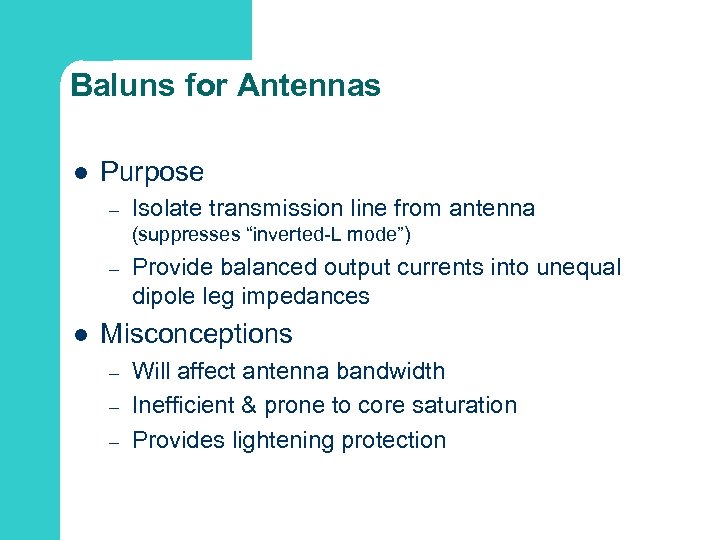
Baluns for Antennas l Purpose – Isolate transmission line from antenna (suppresses “inverted-L mode”) – l Provide balanced output currents into unequal dipole leg impedances Misconceptions – – – Will affect antenna bandwidth Inefficient & prone to core saturation Provides lightening protection
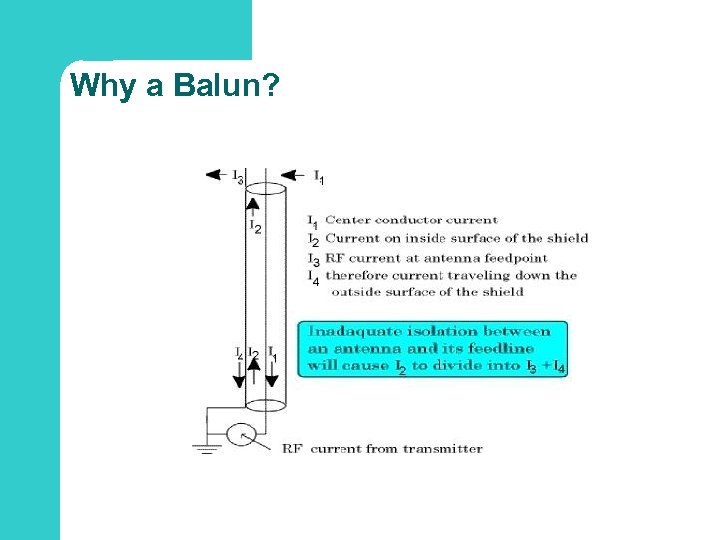
Why a Balun?
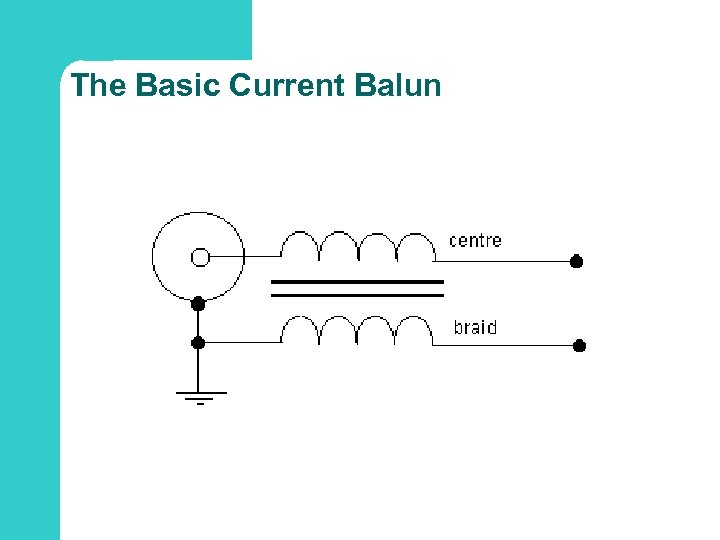
The Basic Current Balun
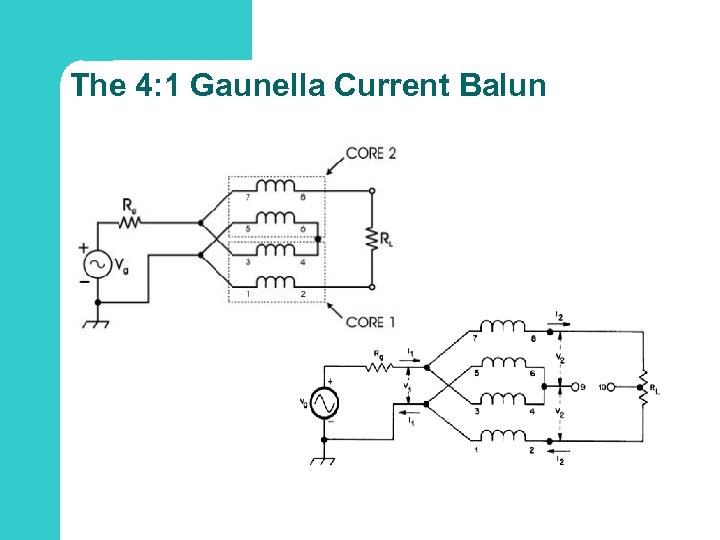
The 4: 1 Gaunella Current Balun
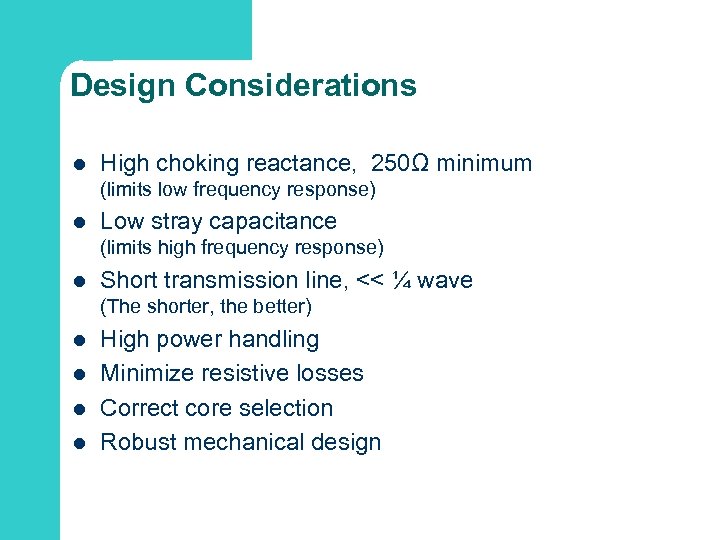
Design Considerations l High choking reactance, 250Ω minimum (limits low frequency response) l Low stray capacitance (limits high frequency response) l Short transmission line, << ¼ wave (The shorter, the better) l l High power handling Minimize resistive losses Correct core selection Robust mechanical design
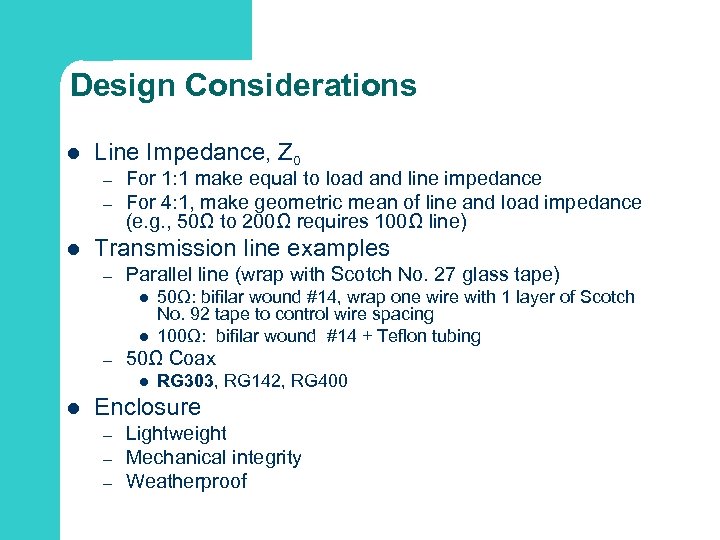
Design Considerations l Line Impedance, Z 0 – – l For 1: 1 make equal to load and line impedance For 4: 1, make geometric mean of line and load impedance (e. g. , 50Ω to 200Ω requires 100Ω line) Transmission line examples – Parallel line (wrap with Scotch No. 27 glass tape) l l – 50Ω Coax l l 50Ω: bifilar wound #14, wrap one wire with 1 layer of Scotch No. 92 tape to control wire spacing 100Ω: bifilar wound #14 + Teflon tubing RG 303, RG 142, RG 400 Enclosure – – – Lightweight Mechanical integrity Weatherproof
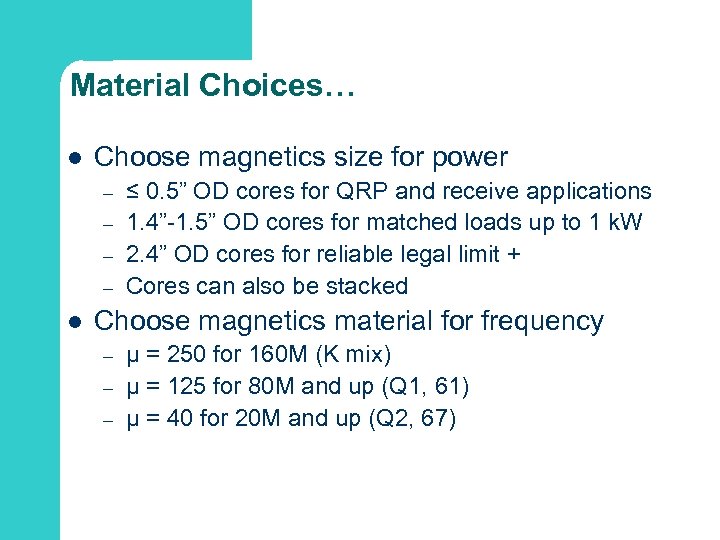
Material Choices… l Choose magnetics size for power – – l ≤ 0. 5” OD cores for QRP and receive applications 1. 4”-1. 5” OD cores for matched loads up to 1 k. W 2. 4” OD cores for reliable legal limit + Cores can also be stacked Choose magnetics material for frequency – – – µ = 250 for 160 M (K mix) µ = 125 for 80 M and up (Q 1, 61) µ = 40 for 20 M and up (Q 2, 67)
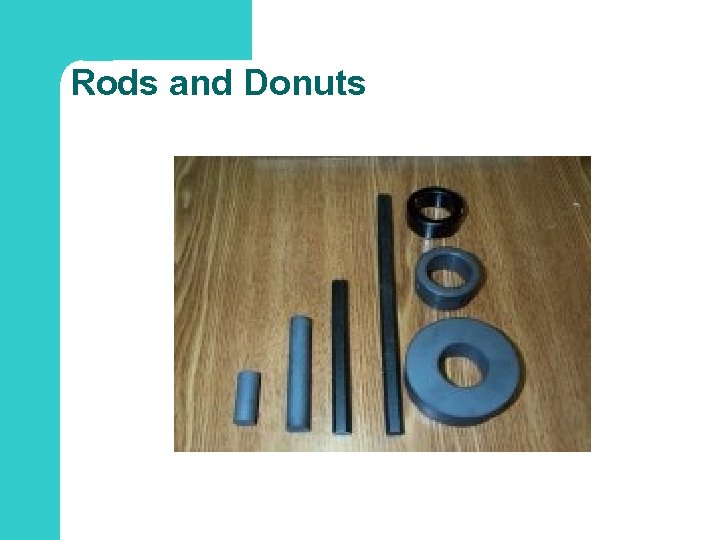
Rods and Donuts
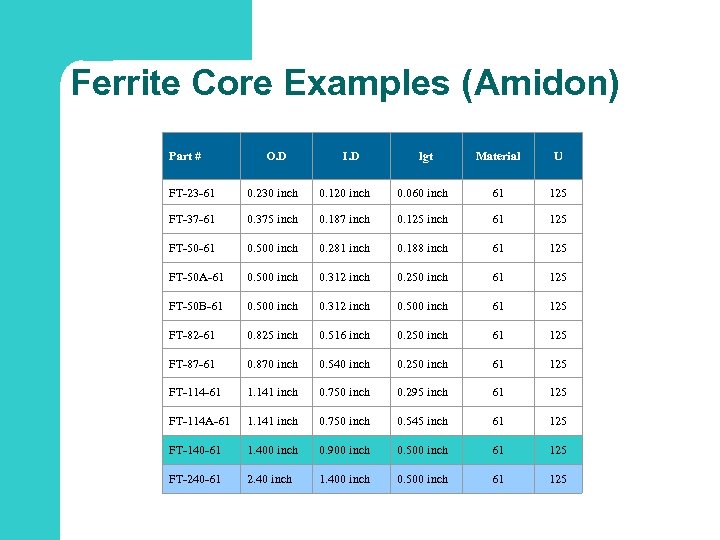
Ferrite Core Examples (Amidon) Part # O. D I. D lgt Material U FT-23 -61 0. 230 inch 0. 120 inch 0. 060 inch 61 125 FT-37 -61 0. 375 inch 0. 187 inch 0. 125 inch 61 125 FT-50 -61 0. 500 inch 0. 281 inch 0. 188 inch 61 125 FT-50 A-61 0. 500 inch 0. 312 inch 0. 250 inch 61 125 FT-50 B-61 0. 500 inch 0. 312 inch 0. 500 inch 61 125 FT-82 -61 0. 825 inch 0. 516 inch 0. 250 inch 61 125 FT-87 -61 0. 870 inch 0. 540 inch 0. 250 inch 61 125 FT-114 -61 1. 141 inch 0. 750 inch 0. 295 inch 61 125 FT-114 A-61 1. 141 inch 0. 750 inch 0. 545 inch 61 125 FT-140 -61 1. 400 inch 0. 900 inch 0. 500 inch 61 125 FT-240 -61 2. 40 inch 1. 400 inch 0. 500 inch 61 125
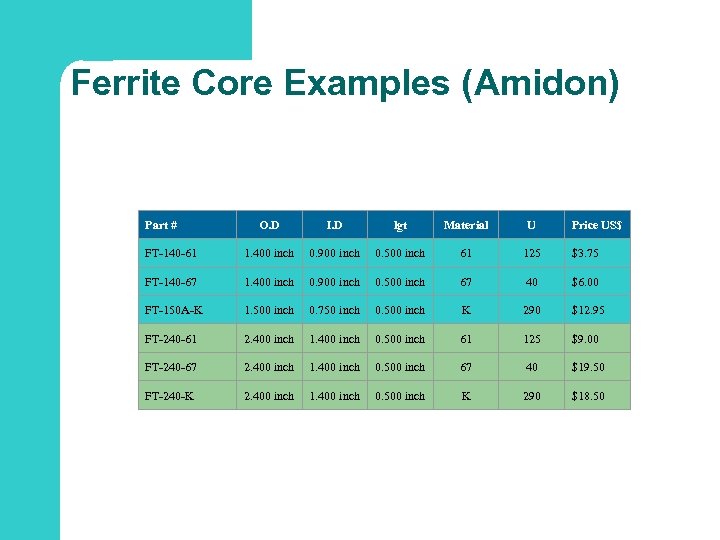
Ferrite Core Examples (Amidon) Part # O. D I. D lgt Material U Price US$ FT-140 -61 1. 400 inch 0. 900 inch 0. 500 inch 61 125 $3. 75 FT-140 -67 1. 400 inch 0. 900 inch 0. 500 inch 67 40 $6. 00 FT-150 A-K 1. 500 inch 0. 750 inch 0. 500 inch K 290 $12. 95 FT-240 -61 2. 400 inch 1. 400 inch 0. 500 inch 61 125 $9. 00 FT-240 -67 2. 400 inch 1. 400 inch 0. 500 inch 67 40 $19. 50 FT-240 -K 2. 400 inch 1. 400 inch 0. 500 inch K 290 $18. 50
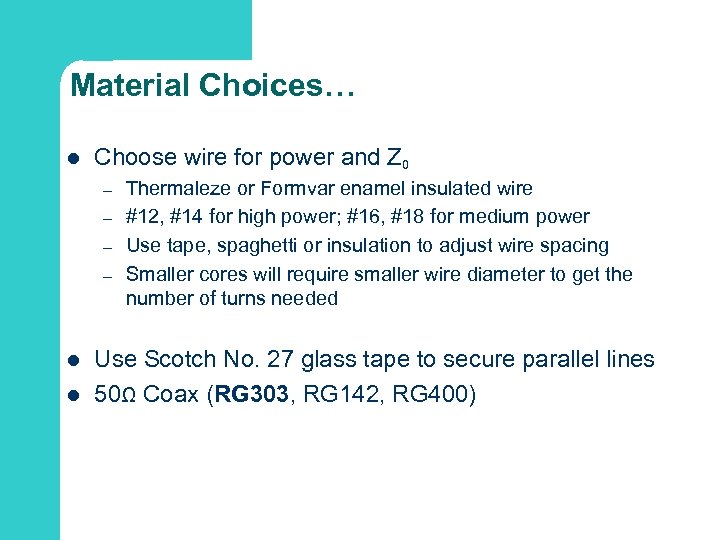
Material Choices… l Choose wire for power and Z 0 – – l l Thermaleze or Formvar enamel insulated wire #12, #14 for high power; #16, #18 for medium power Use tape, spaghetti or insulation to adjust wire spacing Smaller cores will require smaller wire diameter to get the number of turns needed Use Scotch No. 27 glass tape to secure parallel lines 50Ω Coax (RG 303, RG 142, RG 400)
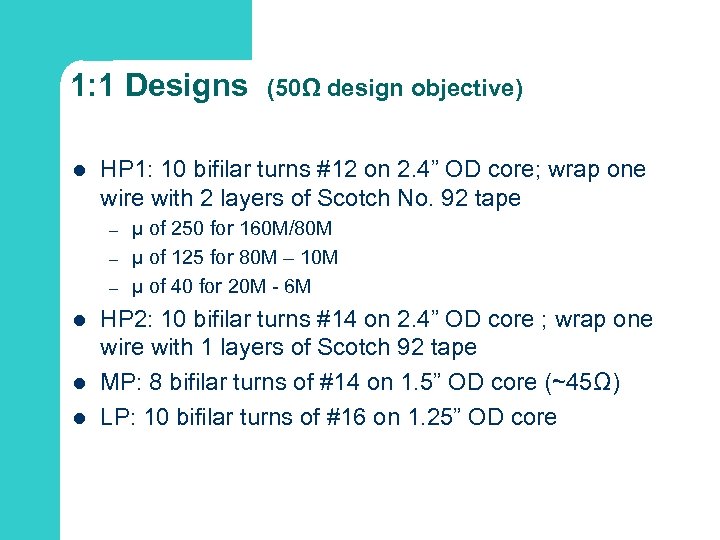
1: 1 Designs l HP 1: 10 bifilar turns #12 on 2. 4” OD core; wrap one wire with 2 layers of Scotch No. 92 tape – – – l l l (50Ω design objective) µ of 250 for 160 M/80 M µ of 125 for 80 M – 10 M µ of 40 for 20 M - 6 M HP 2: 10 bifilar turns #14 on 2. 4” OD core ; wrap one wire with 1 layers of Scotch 92 tape MP: 8 bifilar turns of #14 on 1. 5” OD core (~45Ω) LP: 10 bifilar turns of #16 on 1. 25” OD core
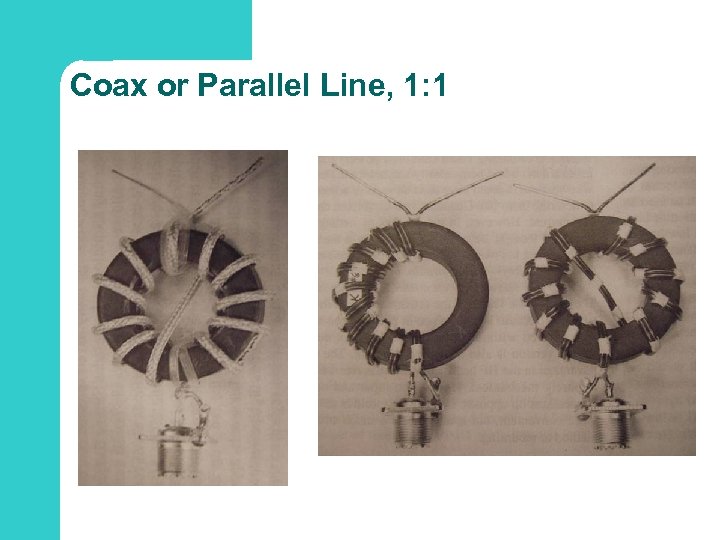
Coax or Parallel Line, 1: 1
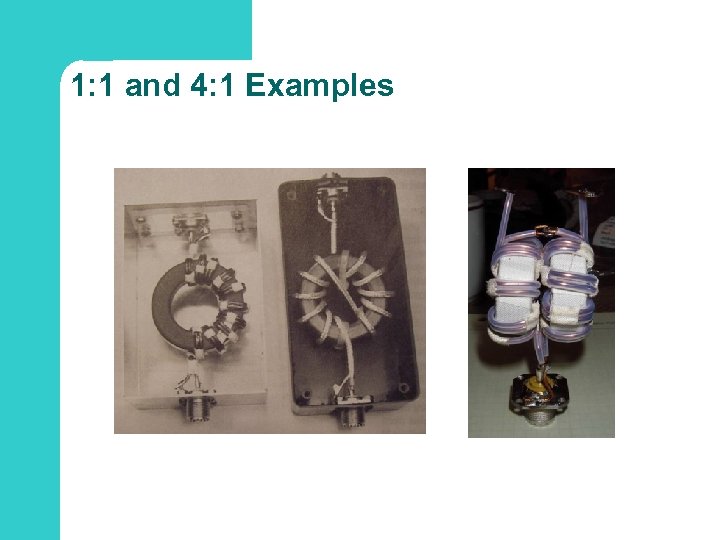
1: 1 and 4: 1 Examples
200Ω: 50Ω Designs l l (100Ω design objective) Inputs (50Ω side) in parallel; outputs (200Ω side) in series 2 X 8 bifilar turns #14 on single 2. 4” OD core (cover each wire with teflon tubing) l 14 -16 bifilar turns #14 on 2. 4” OD core x 2 cores (cover each wire with teflon tubing) l l Can substitute #14 solid house wire but take hit in breakdown voltage LP: 14 bifilar turns #20 insulated hook-up wire on each 1. 25” OD core; 2 X 7 bifilar turns on single core
Efficiency (Sevick) l 250 for 160 M / 80 M – l 125 for 80 M thru 10 M – l 99% at 1. 8 MHz, 97% at 30 MHz 99% at 3. 5 MHz, 98% at 30 MHz 40 for 20 M thru 10 M – 99% at 14 MHz and 30 MHz
Construction Steps
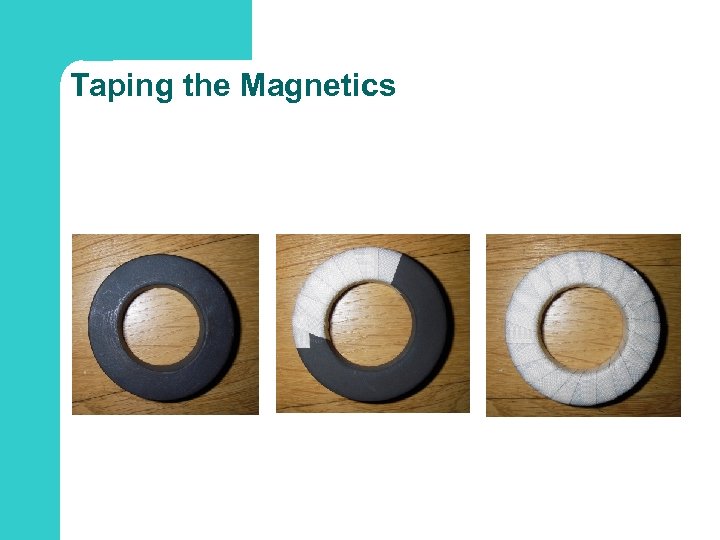
Taping the Magnetics
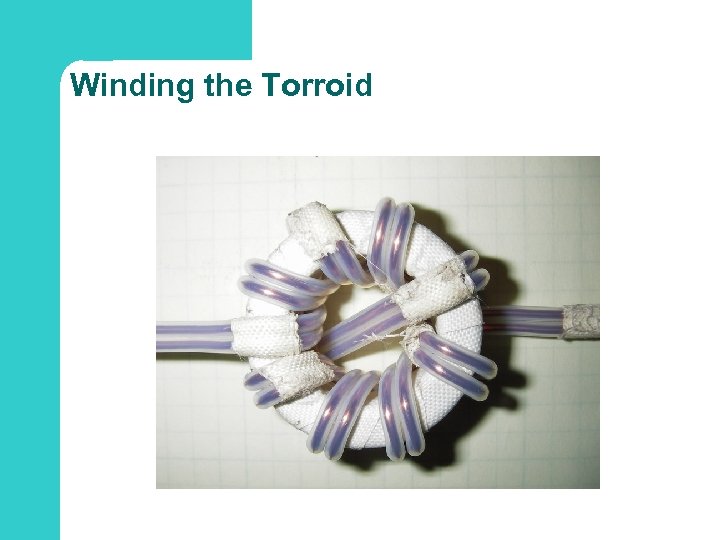
Winding the Torroid
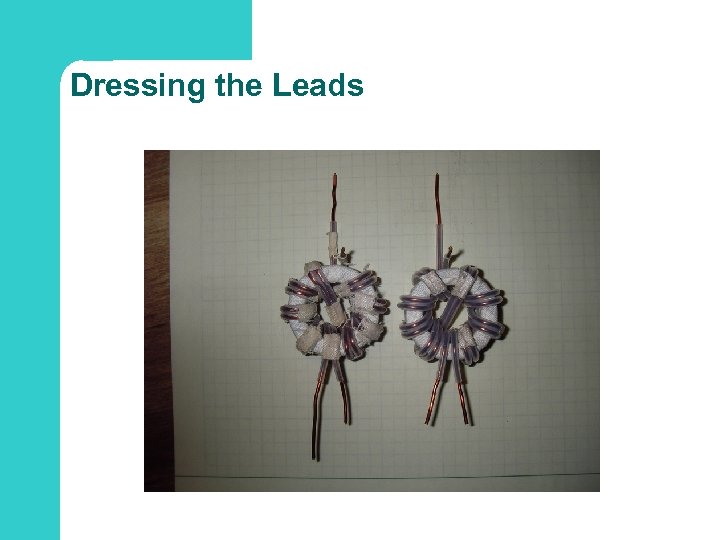
Dressing the Leads
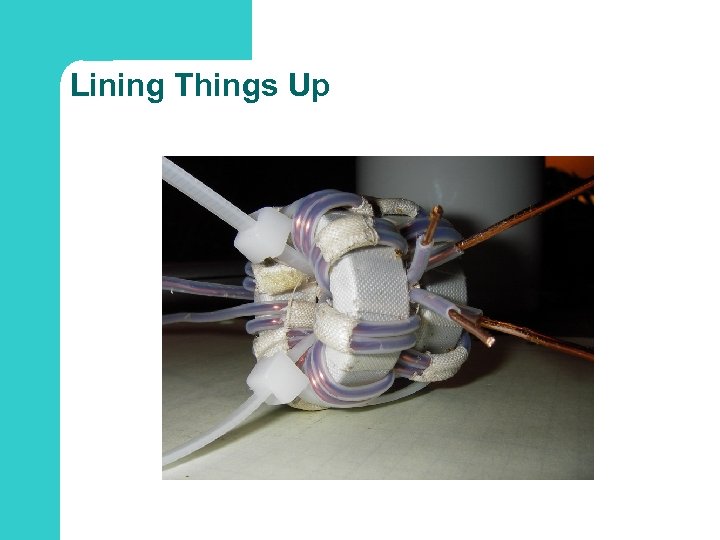
Lining Things Up
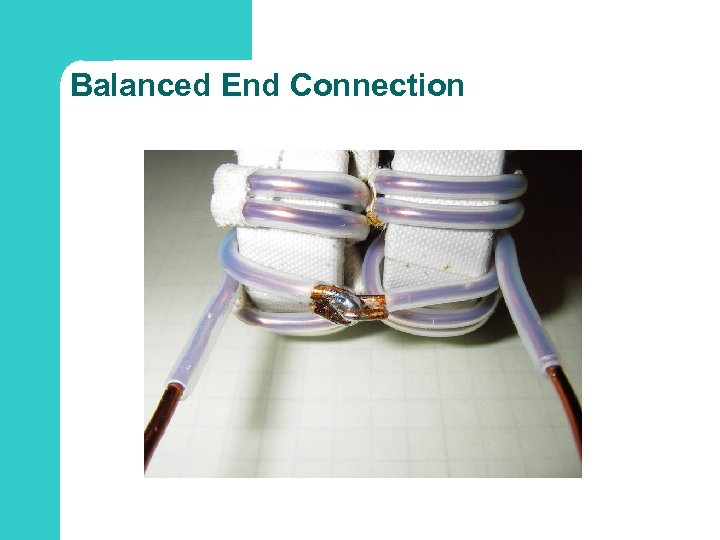
Balanced End Connection
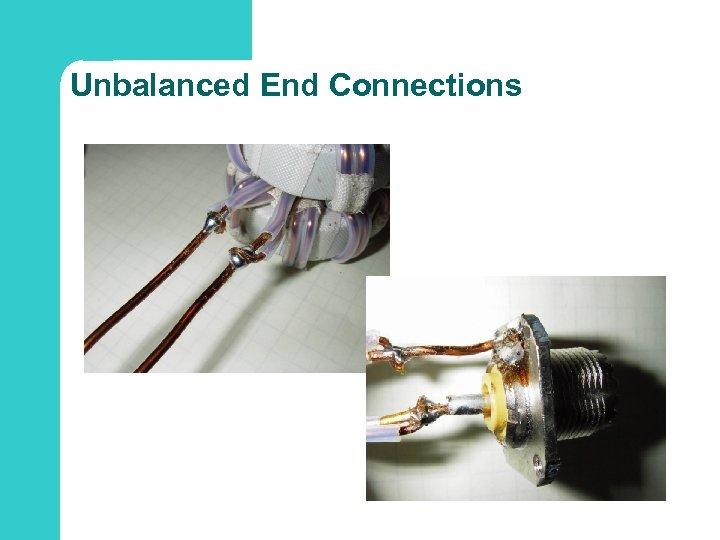
Unbalanced End Connections
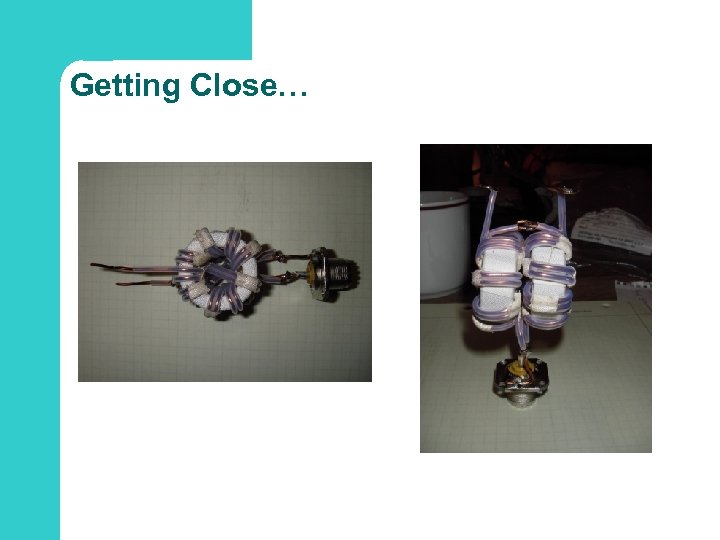
Getting Close…
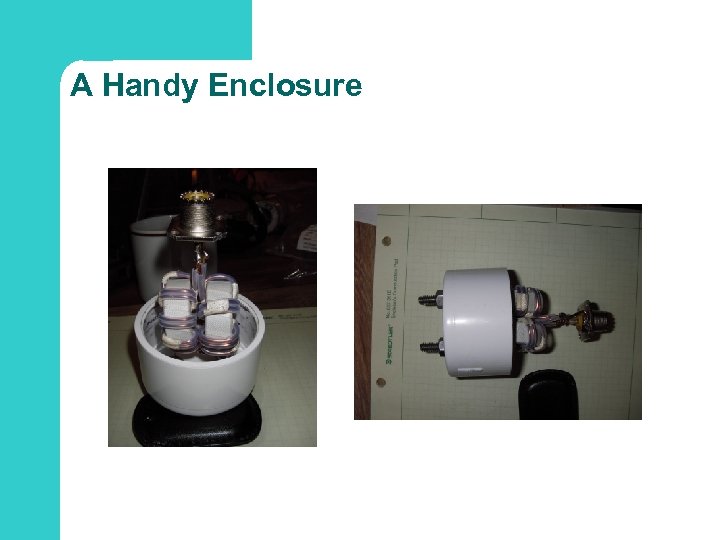
A Handy Enclosure
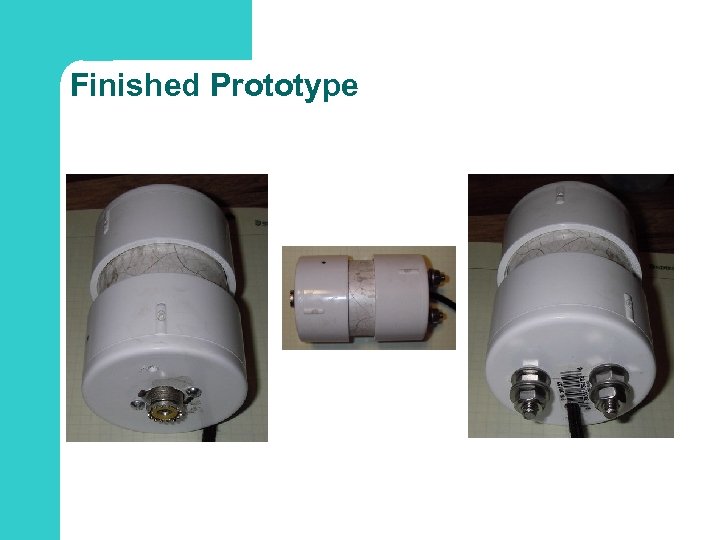
Finished Prototype
Additional Reading… l Lewallen’s Article – l 4: 1 QRP Balun – l http: //www. n 0 ss. net/qrp_4 -1_guanella-type_balun. pdf Putting a Balun and a Tuner Together, W 9 CF – l www. eznec. com/Amateur/Articles/Baluns. pdf http: //fermi. la. asu. edu/w 9 cf/articles/balun. pdf Hybrid Tuner Balun, ZS 1 AN – http: //www. arrl. org/qex/2005/qx 9 roos. pdf
Скачать презентацию Balun Unun Construction Mike N 1 IW Outline
782ab019728e883891fc90d76092a1ba.ppt