 Скачать презентацию Багатопотокове програмування Потік thread це частина програми
OOP_L8.ppt
- Количество слайдов: 22



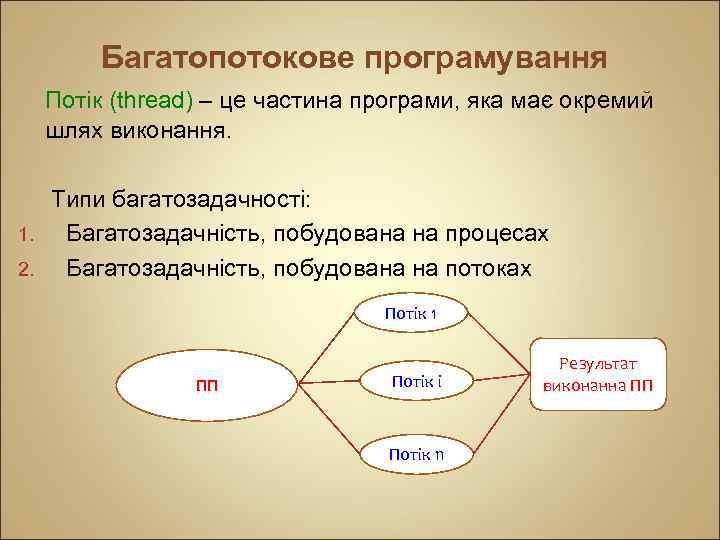
Багатопотокове програмування Потік (thread) – це частина програми, яка має окремий шлях виконання. Типи багатозадачності: 1. Багатозадачність, побудована на процесах 2. Багатозадачність, побудована на потоках Потік 1 ПП Потік i Потік n Результат виконанна ПП
Модель потоків Java Стани потоків: Виконання Готовність до виконання Призупинення виконання Відновлення виконання Блокування Переривання виконання
Клас Thread та інтерфейс Runnable Методи управління потоками класу Thread: get. Name get. Priority is. Alive join run sleep start
Головний потік Загальна форма: static Thread current. Thread()
![Управління головним потоком (1) class Current. Thread. Demo { public static void main(String args[])](https://present5.com/presentation/111891495_165492783/image-5.jpg "Управління головним потоком (1) class Current. Thread. Demo { public static void main(String args[])")
Управління головним потоком (1) class Current. Thread. Demo { public static void main(String args[]) { Thread t = Thread. current. Thread(); System. out. println("Current thread: " + t); // change the name of the thread t. set. Name("My Thread"); System. out. println("After name change: " + t); try { for(int n = 5; n > 0; n--) { System. out. println(n); Thread. sleep(1000); } } catch (Interrupted. Exception e) { System. out. println("Main thread interrupted"); } } } Current thread: Thread[main, 5, main] After name change: Thread[My Thread, 5, main] 5 4 3 2 1
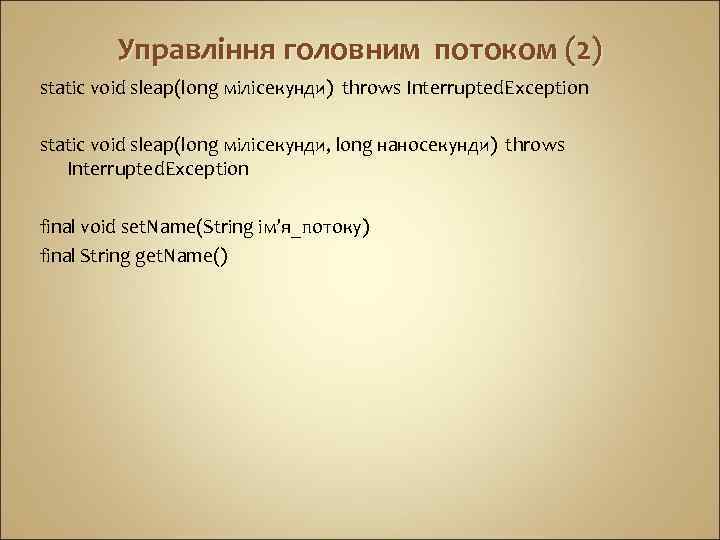
Управління головним потоком (2) static void sleap(long мілісекунди) throws Interrupted. Exception static void sleap(long мілісекунди, long наносекунди) throws Interrupted. Exception final void set. Name(String ім’я_потоку) final String get. Name()
Створення потоку Способи створення потоку: 1. 2. Реалізація інтейфесу Runnable Розширення класу Thread
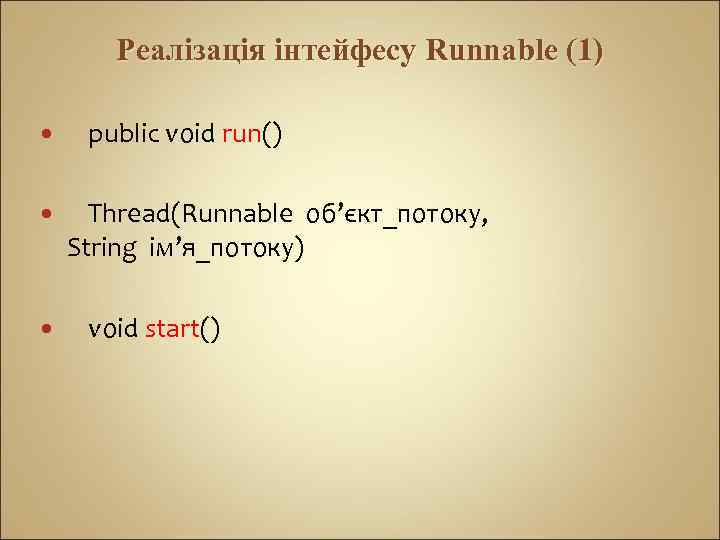
Реалізація інтейфесу Runnable (1) public void run() Thread(Runnable об’єкт_потоку, String ім’я_потоку) void start()
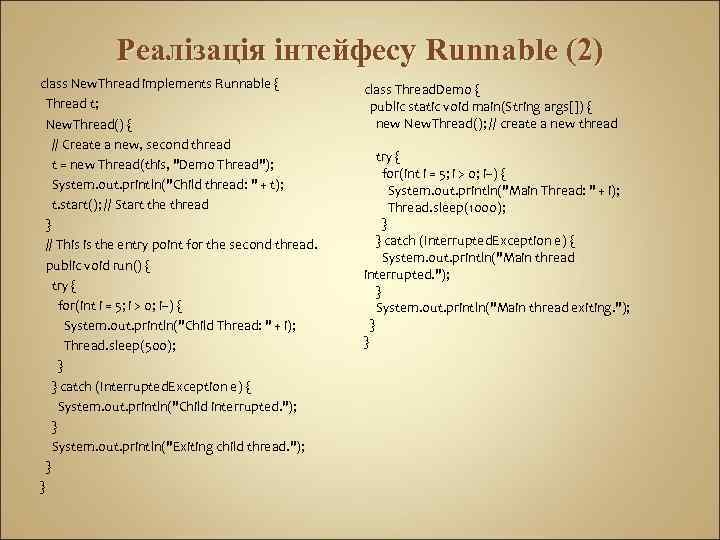
Реалізація інтейфесу Runnable (2) class New. Thread implements Runnable { Thread t; New. Thread() { // Create a new, second thread t = new Thread(this, "Demo Thread"); System. out. println("Child thread: " + t); t. start(); // Start the thread } // This is the entry point for the second thread. public void run() { try { for(int i = 5; i > 0; i--) { System. out. println("Child Thread: " + i); Thread. sleep(500); } } catch (Interrupted. Exception e) { System. out. println("Child interrupted. "); } System. out. println("Exiting child thread. "); } } class Thread. Demo { public static void main(String args[]) { new New. Thread(); // create a new thread try { for(int i = 5; i > 0; i--) { System. out. println("Main Thread: " + i); Thread. sleep(1000); } } catch (Interrupted. Exception e) { System. out. println("Main thread interrupted. "); } System. out. println("Main thread exiting. "); } }
![Реалізація інтейфесу Runnable (3) Child thread: Thread[Demo Thread, 5, main] Main Thread: 5 Child](https://present5.com/presentation/111891495_165492783/image-10.jpg "Реалізація інтейфесу Runnable (3) Child thread: Thread[Demo Thread, 5, main] Main Thread: 5 Child")
Реалізація інтейфесу Runnable (3) Child thread: Thread[Demo Thread, 5, main] Main Thread: 5 Child Thread: 4 Main Thread: 4 Child Thread: 3 Child Thread: 2 Main Thread: 3 Child Thread: 1 Exiting child thread. Main Thread: 2 Main Thread : 1 Main Thread exiting.
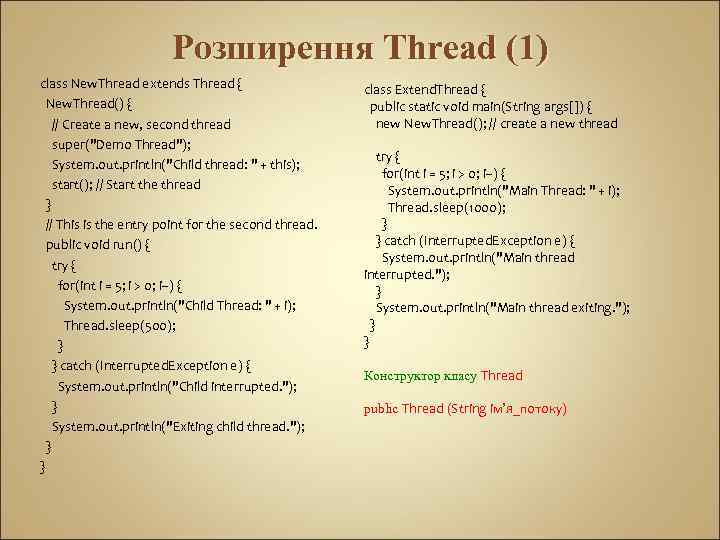
Розширення Thread (1) class New. Thread extends Thread { New. Thread() { // Create a new, second thread super("Demo Thread"); System. out. println("Child thread: " + this); start(); // Start the thread } // This is the entry point for the second thread. public void run() { try { for(int i = 5; i > 0; i--) { System. out. println("Child Thread: " + i); Thread. sleep(500); } } catch (Interrupted. Exception e) { System. out. println("Child interrupted. "); } System. out. println("Exiting child thread. "); } } class Extend. Thread { public static void main(String args[]) { new New. Thread(); // create a new thread try { for(int i = 5; i > 0; i--) { System. out. println("Main Thread: " + i); Thread. sleep(1000); } } catch (Interrupted. Exception e) { System. out. println("Main thread interrupted. "); } System. out. println("Main thread exiting. "); } } Конструктор класу Thread public Thread (String ім’я_потоку)
![Розширення Thread (2) Child thread: Thread[Demo Thread, 5, main] Main Thread: 5 Child Thread:](https://present5.com/presentation/111891495_165492783/image-12.jpg "Розширення Thread (2) Child thread: Thread[Demo Thread, 5, main] Main Thread: 5 Child Thread:")
Розширення Thread (2) Child thread: Thread[Demo Thread, 5, main] Main Thread: 5 Child Thread: 4 Main Thread: 4 Child Thread: 3 Child Thread: 2 Main Thread: 3 Child Thread: 1 Exiting child thread. Main Thread: 2 Main Thread : 1 Main Thread exiting.
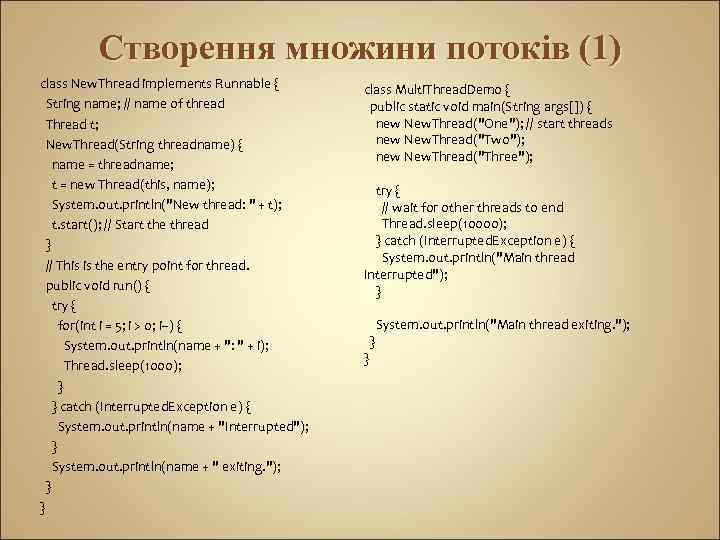
Створення множини потоків (1) class New. Thread implements Runnable { String name; // name of thread Thread t; New. Thread(String threadname) { name = threadname; t = new Thread(this, name); System. out. println("New thread: " + t); t. start(); // Start the thread } // This is the entry point for thread. public void run() { try { for(int i = 5; i > 0; i--) { System. out. println(name + ": " + i); Thread. sleep(1000); } } catch (Interrupted. Exception e) { System. out. println(name + "Interrupted"); } System. out. println(name + " exiting. "); } } class Multi. Thread. Demo { public static void main(String args[]) { new New. Thread("One"); // start threads new New. Thread("Two"); new New. Thread("Three"); try { // wait for other threads to end Thread. sleep(10000); } catch (Interrupted. Exception e) { System. out. println("Main thread Interrupted"); } } } System. out. println("Main thread exiting. ");
![Створення множини потоків (2) New thread: Thread[One, 5, main] New thread: Thread[Two, 5, main]](https://present5.com/presentation/111891495_165492783/image-14.jpg "Створення множини потоків (2) New thread: Thread[One, 5, main] New thread: Thread[Two, 5, main]")
Створення множини потоків (2) New thread: Thread[One, 5, main] New thread: Thread[Two, 5, main] New thread: Thread[Three, 5, main] One: 5 Two: 5 Three: 5 One: 4 Two: 4 Three: 4 One: 3 Three: 3 Two: 3 One: 2 Three: 2 Two: 2 One: 1 Three: 1 One exiting. Two exiting. Three exiting. Main thread exiting.
Використання is. Alive() та join() (1) final Boolean is. Alive() final void join() throws Interrrupted. Exception
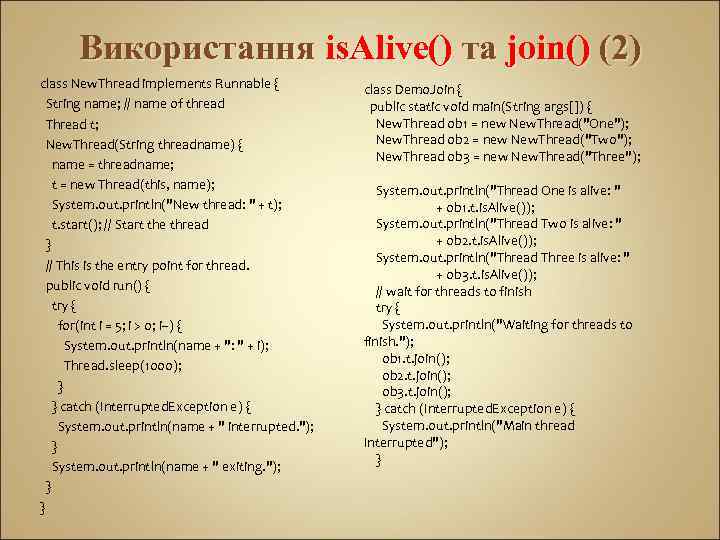
Використання is. Alive() та join() (2) class New. Thread implements Runnable { String name; // name of thread Thread t; New. Thread(String threadname) { name = threadname; t = new Thread(this, name); System. out. println("New thread: " + t); t. start(); // Start the thread } // This is the entry point for thread. public void run() { try { for(int i = 5; i > 0; i--) { System. out. println(name + ": " + i); Thread. sleep(1000); } } catch (Interrupted. Exception e) { System. out. println(name + " interrupted. "); } System. out. println(name + " exiting. "); } } class Demo. Join { public static void main(String args[]) { New. Thread ob 1 = new New. Thread("One"); New. Thread ob 2 = new New. Thread("Two"); New. Thread ob 3 = new New. Thread("Three"); System. out. println("Thread One is alive: " + ob 1. t. is. Alive()); System. out. println("Thread Two is alive: " + ob 2. t. is. Alive()); System. out. println("Thread Three is alive: " + ob 3. t. is. Alive()); // wait for threads to finish try { System. out. println("Waiting for threads to finish. "); ob 1. t. join(); ob 2. t. join(); ob 3. t. join(); } catch (Interrupted. Exception e) { System. out. println("Main thread Interrupted"); }
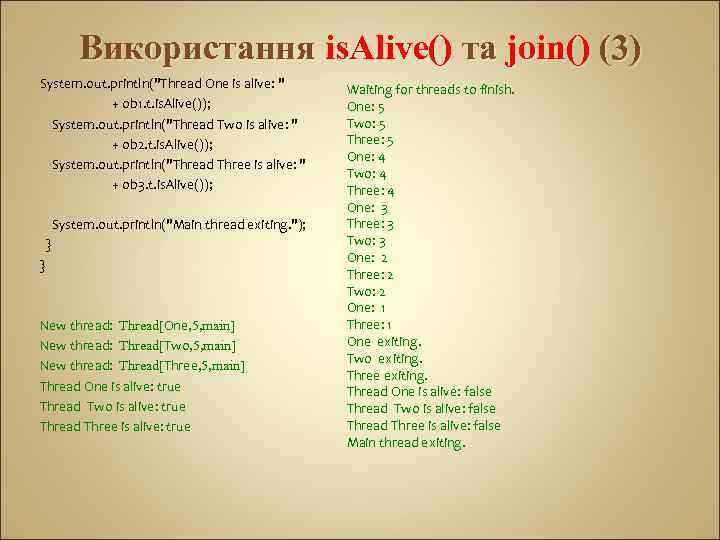
Використання is. Alive() та join() (3) System. out. println("Thread One is alive: " + ob 1. t. is. Alive()); System. out. println("Thread Two is alive: " + ob 2. t. is. Alive()); System. out. println("Thread Three is alive: " + ob 3. t. is. Alive()); System. out. println("Main thread exiting. "); } } New thread: Thread[One, 5, main] New thread: Thread[Two, 5, main] New thread: Thread[Three, 5, main] Thread One is alive: true Thread Two is alive: true Thread Three is alive: true Waiting for threads to finish. One: 5 Two: 5 Three: 5 One: 4 Two: 4 Three: 4 One: 3 Three: 3 Two: 3 One: 2 Three: 2 Two: 2 One: 1 Three: 1 One exiting. Two exiting. Three exiting. Thread One is alive: false Thread Two is alive: false Thread Three is alive: false Main thread exiting.
Пріоритети потоків (1) Пріоритет потоку використовується для прийняття рішення при перемиканні від одного потоку, який виконується до іншогою Цей процес називається перемикання контексту Правила перемикання контексту: Потік може добровільно віддати управління 2. Потік може бути перерваний іншим потоком із більшим пріоритетом 1.
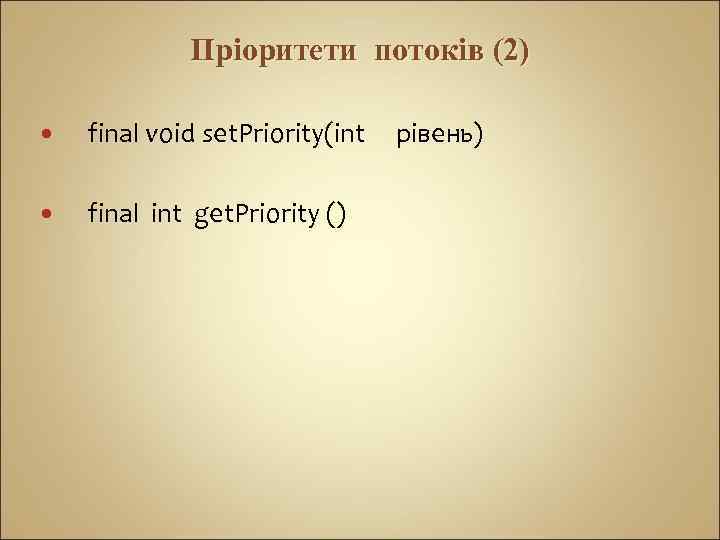
Пріоритети потоків (2) final void set. Priority(int final int get. Priority () рівень)
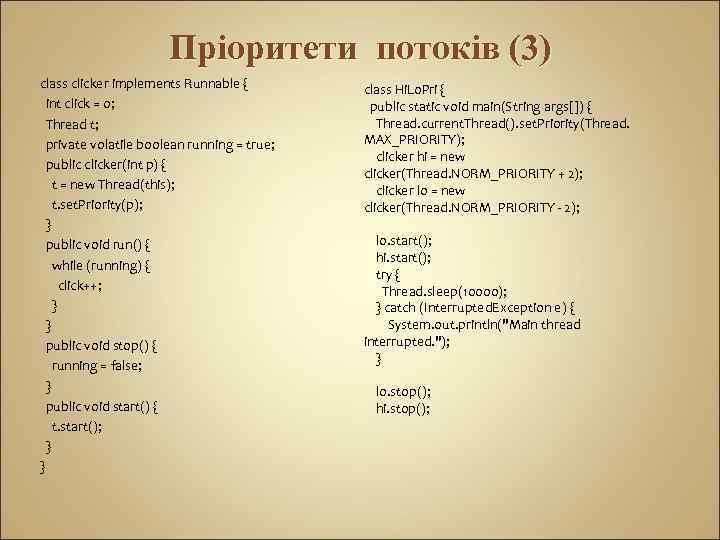
Пріоритети потоків (3) class clicker implements Runnable { int click = 0; Thread t; private volatile boolean running = true; public clicker(int p) { t = new Thread(this); t. set. Priority(p); } public void run() { while (running) { click++; } } public void stop() { running = false; } public void start() { t. start(); } } class Hi. Lo. Pri { public static void main(String args[]) { Thread. current. Thread(). set. Priority(Thread. MAX_PRIORITY); clicker hi = new clicker(Thread. NORM_PRIORITY + 2); clicker lo = new clicker(Thread. NORM_PRIORITY - 2); lo. start(); hi. start(); try { Thread. sleep(10000); } catch (Interrupted. Exception e) { System. out. println("Main thread interrupted. "); } lo. stop(); hi. stop();
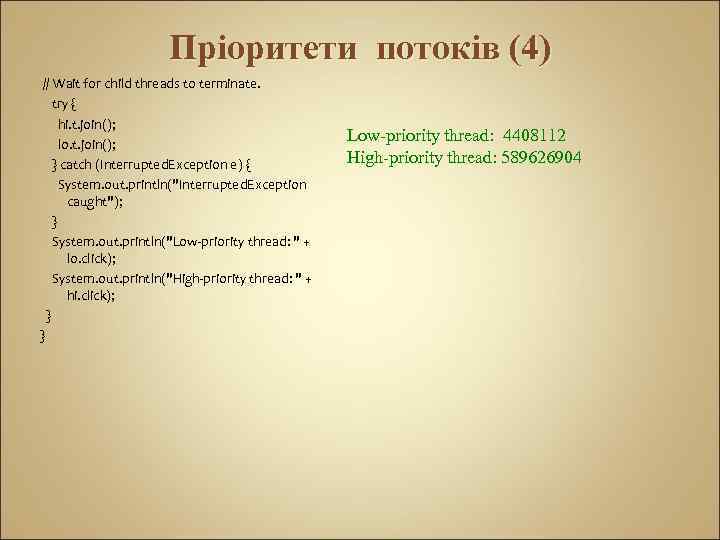
Пріоритети потоків (4) // Wait for child threads to terminate. try { hi. t. join(); lo. t. join(); } catch (Interrupted. Exception e) { System. out. println("Interrupted. Exception caught"); } System. out. println("Low-priority thread: " + lo. click); System. out. println("High-priority thread: " + hi. click); } } Low-priority thread: 4408112 High-priority thread: 589626904
Синхронізація потоків Багатопотоковість дає можливість асинхронної поведінки Монітор - це керуючий механізм, який приймає тільки один потік в одиницю часу.
Скачать презентацию Багатопотокове програмування Потік thread це частина програми
OOP_L8.ppt