 Скачать презентацию Background of Japan n n Population 127 330
b05be32a9bf3e000557d072b3f9e6a47.ppt
- Количество слайдов: 27



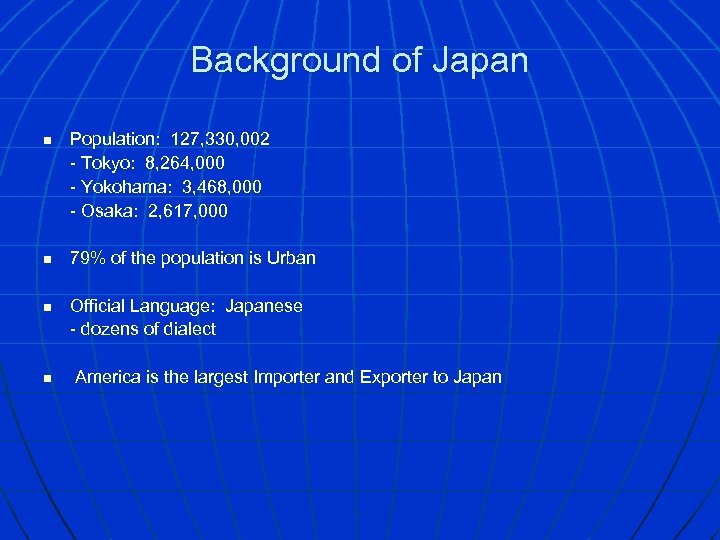
Background of Japan n n Population: 127, 330, 002 - Tokyo: 8, 264, 000 - Yokohama: 3, 468, 000 - Osaka: 2, 617, 000 79% of the population is Urban Official Language: Japanese - dozens of dialect America is the largest Importer and Exporter to Japan
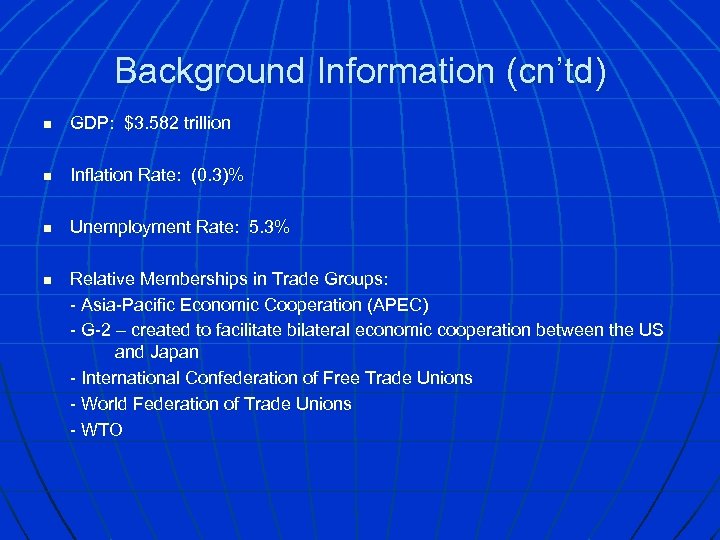
Background Information (cn’td) n GDP: $3. 582 trillion n Inflation Rate: (0. 3)% n Unemployment Rate: 5. 3% n Relative Memberships in Trade Groups: - Asia-Pacific Economic Cooperation (APEC) - G-2 – created to facilitate bilateral economic cooperation between the US and Japan - International Confederation of Free Trade Unions - World Federation of Trade Unions - WTO
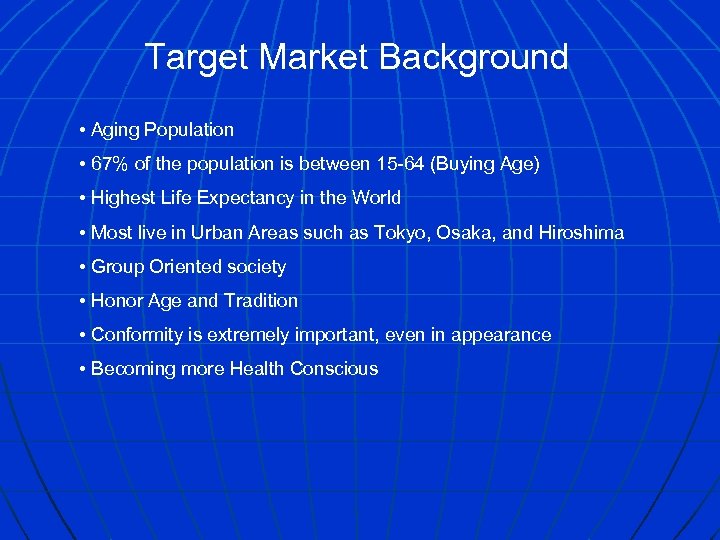
Target Market Background • Aging Population • 67% of the population is between 15 -64 (Buying Age) • Highest Life Expectancy in the World • Most live in Urban Areas such as Tokyo, Osaka, and Hiroshima • Group Oriented society • Honor Age and Tradition • Conformity is extremely important, even in appearance • Becoming more Health Conscious
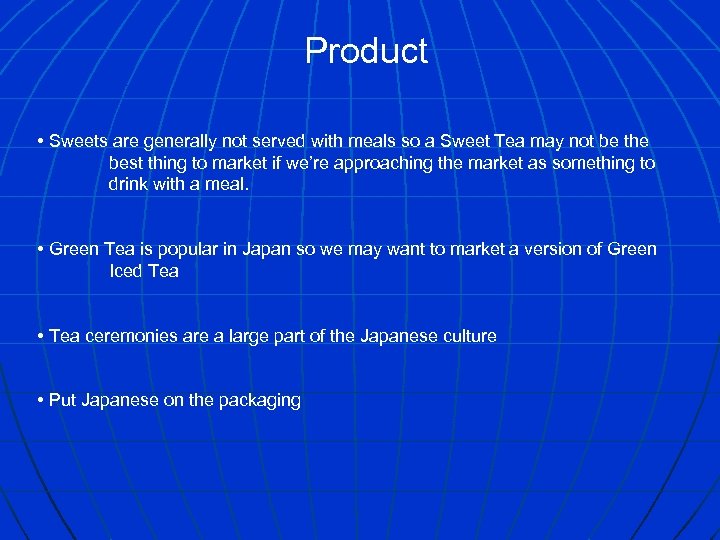
Product • Sweets are generally not served with meals so a Sweet Tea may not be the best thing to market if we’re approaching the market as something to drink with a meal. • Green Tea is popular in Japan so we may want to market a version of Green Iced Tea • Tea ceremonies are a large part of the Japanese culture • Put Japanese on the packaging
Product Packaging • Consumers appreciate re-closable functions on their soft drinks • Popular sizes for soft drinks are between 0 -500 ml sold in cans and plastics • The current package of Lipton can be used because the colors that offend are orange and black neither of which appear on our labels. • Japanese are very superstitious of the number 4 so we shouldn’t sell it in packages of 4. • Refrigerators in Japan are much smaller than in America
Promotions • Sales Promotion - Products being associated with other items • Public Relations • Event Sponsorship - Sports • Advertising - Media Outlets - What’s appealing • Direct Marketing - Mailings/Emails etc. • Personal Selling - Not the most effective way to market Ice Tea
Sales Promotion • Associating with Movies an example is when Pepsi associated their product with Star Wars by putting the figurines of the characters on the bottle • In the United States we’ve associated with MTV for the Brisk Brand. Japan’s teens enjoy MTV.
Event Sponsorship • Sporting Events - Baseball (national sport) - Sumo Wrestling (big spectator sport) - Soccer, Volleyball, Tennis and Jogging - Golf (popular with men) • Concerts
Advertising • Media Outlets - Television - Radio - Newspaper - Billboards - Internet • What’s Appealing - Celebrity endorsements are very successful - Group Oriented so ads with groups of people are appealing
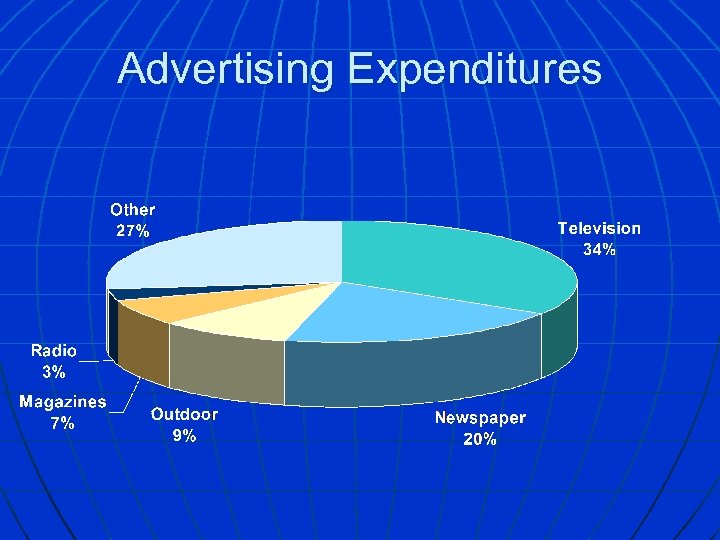
Advertising Expenditures
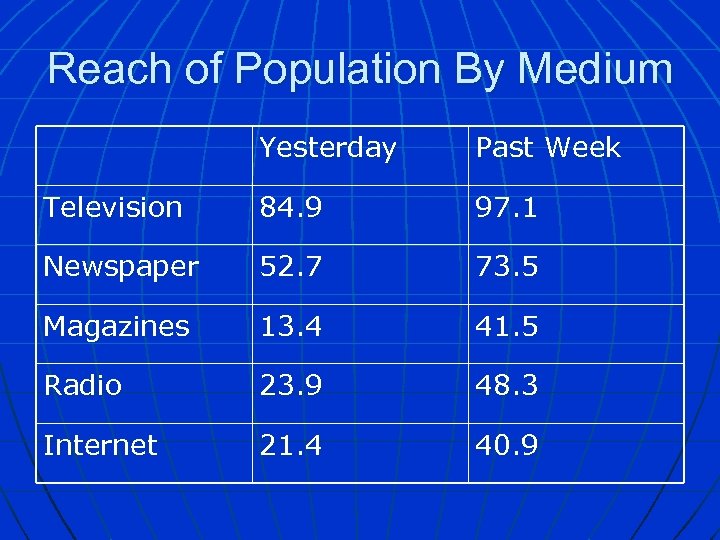
Reach of Population By Medium Yesterday Past Week Television 84. 9 97. 1 Newspaper 52. 7 73. 5 Magazines 13. 4 41. 5 Radio 23. 9 48. 3 Internet 21. 4 40. 9
Television n Yearly Expenditures: Over 17 billion Dollars n Average viewing per day by adults: 216 minutes n TV peak time is considered 7 pm-11 pm n Cannot buy just peak time; slots sold in packages n Average cost runs around $18, 000 n Reaches on average 2 million households
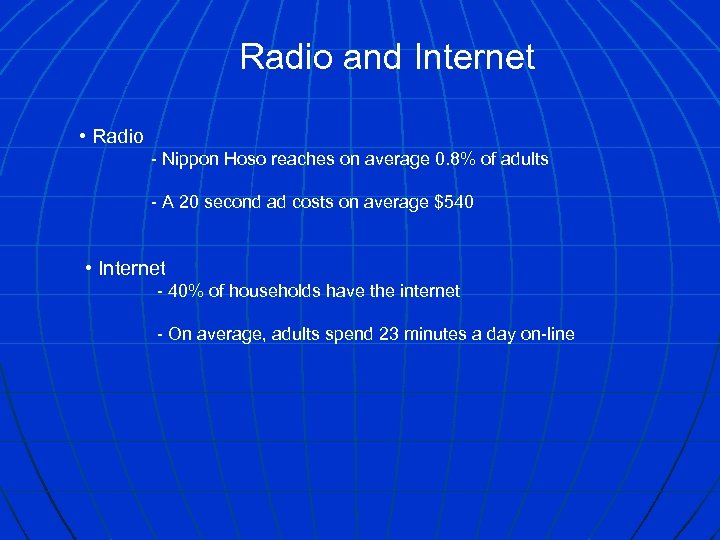
Radio and Internet • Radio - Nippon Hoso reaches on average 0. 8% of adults - A 20 second ad costs on average $540 • Internet - 40% of households have the internet - On average, adults spend 23 minutes a day on-line
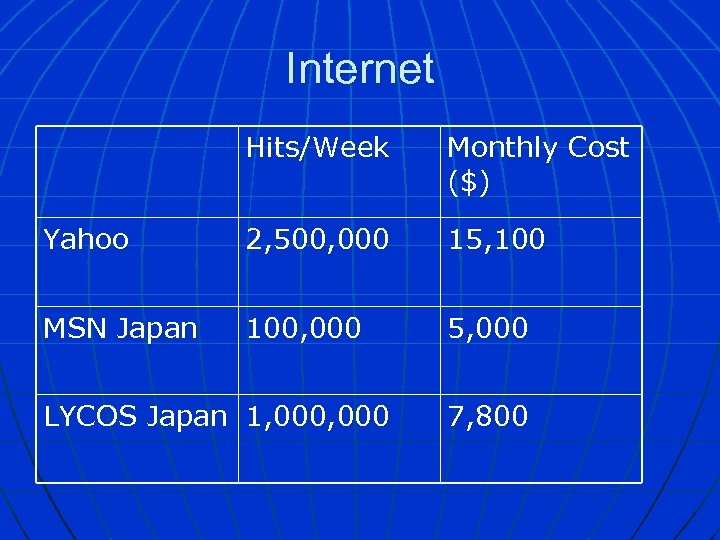
Internet Hits/Week Monthly Cost ($) Yahoo 2, 500, 000 15, 100 MSN Japan 100, 000 5, 000 LYCOS Japan 1, 000 7, 800
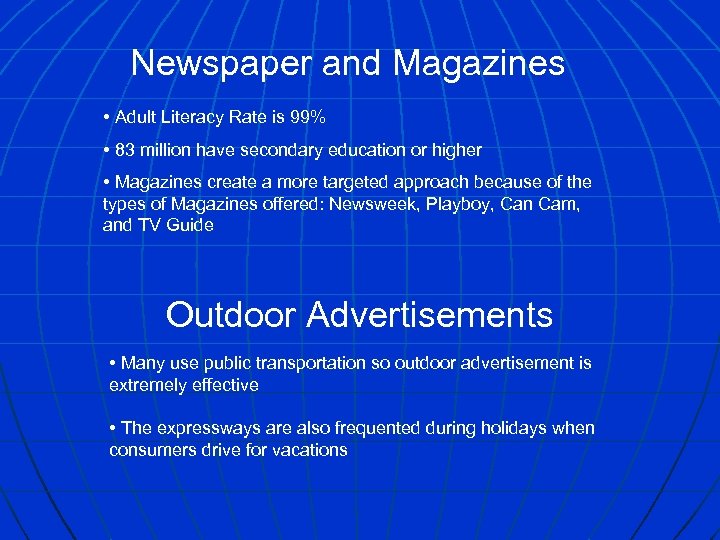
Newspaper and Magazines • Adult Literacy Rate is 99% • 83 million have secondary education or higher • Magazines create a more targeted approach because of the types of Magazines offered: Newsweek, Playboy, Can Cam, and TV Guide Outdoor Advertisements • Many use public transportation so outdoor advertisement is extremely effective • The expressways are also frequented during holidays when consumers drive for vacations
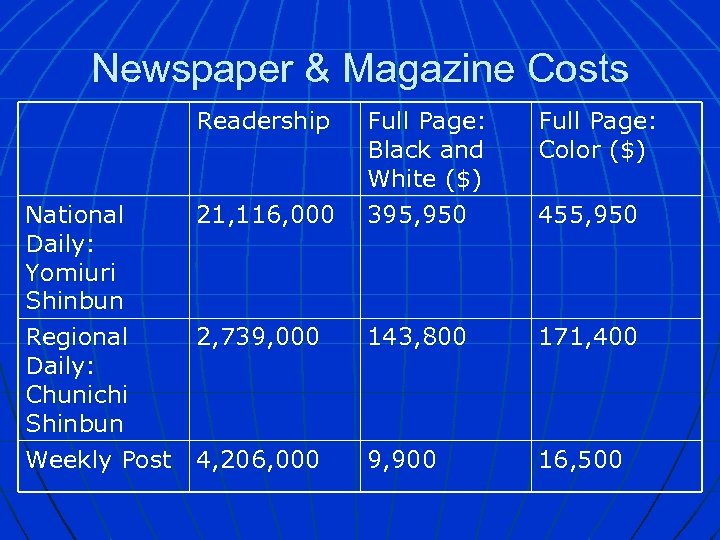
Newspaper & Magazine Costs Readership National 21, 116, 000 Daily: Yomiuri Shinbun Regional 2, 739, 000 Daily: Chunichi Shinbun Weekly Post 4, 206, 000 Full Page: Black and White ($) 395, 950 Full Page: Color ($) 143, 800 171, 400 9, 900 16, 500 455, 950
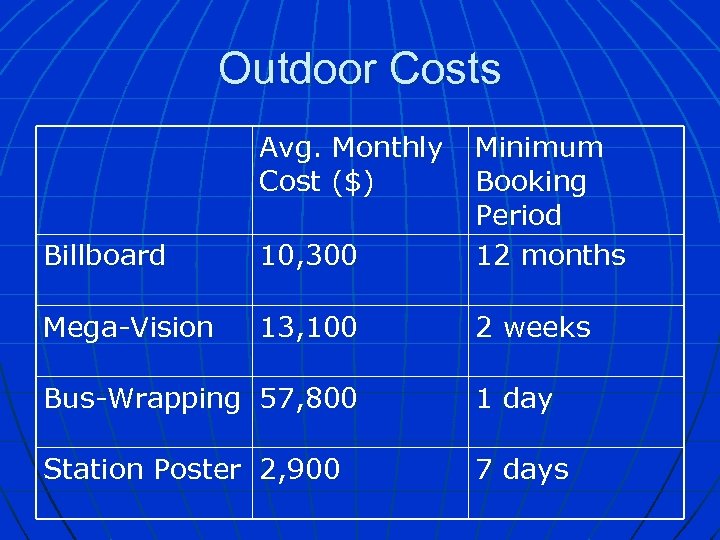
Outdoor Costs Billboard Avg. Monthly Minimum Cost ($) Booking Period 10, 300 12 months Mega-Vision 13, 100 2 weeks Bus-Wrapping 57, 800 1 day Station Poster 2, 900 7 days
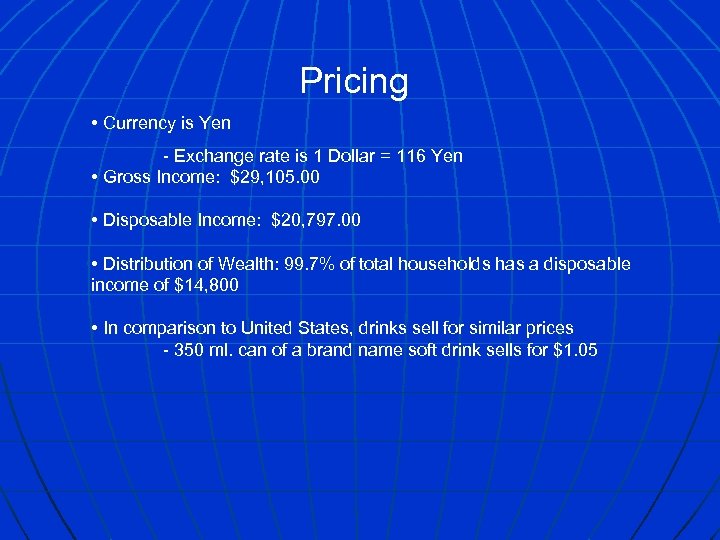
Pricing • Currency is Yen - Exchange rate is 1 Dollar = 116 Yen • Gross Income: $29, 105. 00 • Disposable Income: $20, 797. 00 • Distribution of Wealth: 99. 7% of total households has a disposable income of $14, 800 • In comparison to United States, drinks sell for similar prices - 350 ml. can of a brand name soft drink sells for $1. 05
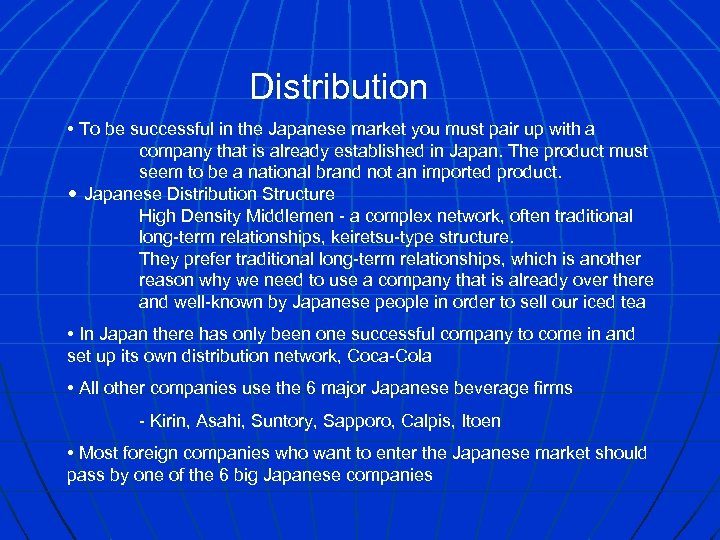
Distribution • To be successful in the Japanese market you must pair up with a company that is already established in Japan. The product must seem to be a national brand not an imported product. • Japanese Distribution Structure High Density Middlemen - a complex network, often traditional long-term relationships, keiretsu-type structure. They prefer traditional long-term relationships, which is another reason why we need to use a company that is already over there and well-known by Japanese people in order to sell our iced tea • In Japan there has only been one successful company to come in and set up its own distribution network, Coca-Cola • All other companies use the 6 major Japanese beverage firms - Kirin, Asahi, Suntory, Sapporo, Calpis, Itoen • Most foreign companies who want to enter the Japanese market should pass by one of the 6 big Japanese companies
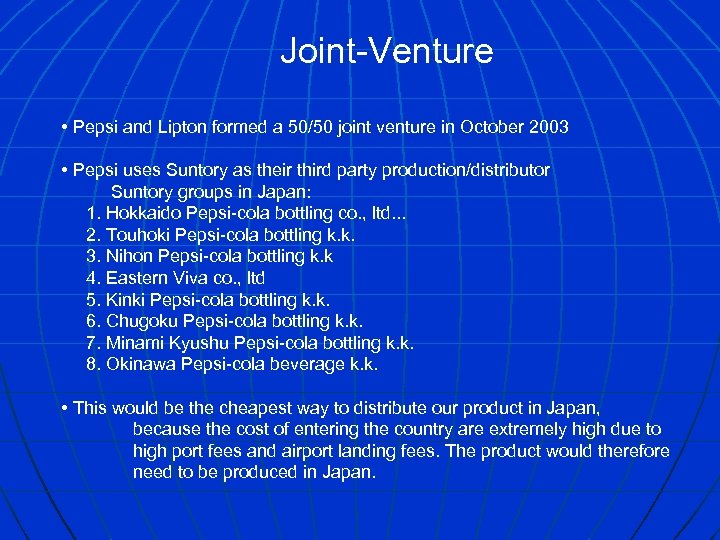
Joint-Venture • Pepsi and Lipton formed a 50/50 joint venture in October 2003 • Pepsi uses Suntory as their third party production/distributor Suntory groups in Japan: 1. Hokkaido Pepsi-cola bottling co. , ltd. . . 2. Touhoki Pepsi-cola bottling k. k. 3. Nihon Pepsi-cola bottling k. k 4. Eastern Viva co. , ltd 5. Kinki Pepsi-cola bottling k. k. 6. Chugoku Pepsi-cola bottling k. k. 7. Minami Kyushu Pepsi-cola bottling k. k. 8. Okinawa Pepsi-cola beverage k. k. • This would be the cheapest way to distribute our product in Japan, because the cost of entering the country are extremely high due to high port fees and airport landing fees. The product would therefore need to be produced in Japan.
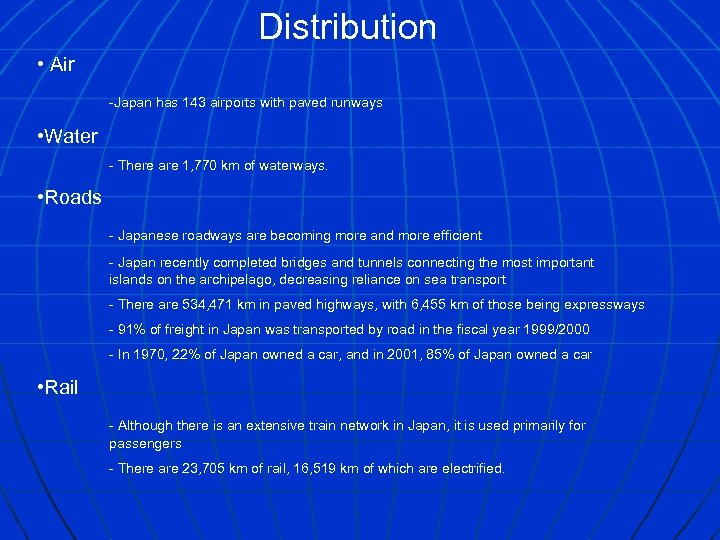
Distribution • Air -Japan has 143 airports with paved runways • Water - There are 1, 770 km of waterways. • Roads - Japanese roadways are becoming more and more efficient - Japan recently completed bridges and tunnels connecting the most important islands on the archipelago, decreasing reliance on sea transport - There are 534, 471 km in paved highways, with 6, 455 km of those being expressways - 91% of freight in Japan was transported by road in the fiscal year 1999/2000 - In 1970, 22% of Japan owned a car, and in 2001, 85% of Japan owned a car • Rail - Although there is an extensive train network in Japan, it is used primarily for passengers - There are 23, 705 km of rail, 16, 519 km of which are electrified.
Distribution • The Japanese Logistics market is undergoing massive reconstruction. • Japanese domestic freight heavily concentrates on truck routes due to geographical factors and the highly developed domestic road infrastructure. • Shifting logistics to rail/sea transportation is has been recognized as the Japanese as a needed reform due to environmental issues • Corporations focus centering on the systematic process, and operational cost reduction rather than reducing distribution cost of products at the last end-user stage. • Regarding the grocery sector, there are now too many intermediate distribution points. According to an industrial analyst's estimate, only one-eighth of the current number of distribution centers would be adequate for this market sector.
Place • Supermarkets/hypermarkets - Growing numbers due to the ongoing relaxation of the Large-Scale Retail Law - Maxvalu Supermarkets - Aeon Co. Ltd • Vending machines - Single most important retail distribution channel for sports nutrition and soft drinks (40. 2% value share in 2001) from - Widespread use of vending machines is one of the most unique characteristics of Japanese distribution, with over 4 million vending machines in Japan selling everything alcoholic drinks to razors and from magazines to rice. - Common place on roadsides and outside supermarkets and convenience stores • Convenience stores - 7/11 s and Ministop Convenience Stores - Daiei is the largest retailers • Home Delivery - Soft drinks began a home delivery of 10 -litre bottles. It could be useful for the Tea distribution
Competition • Bottled Water - Suntory Ltd most important manufacturer • Soft Drinks - Coca-Cola Co. number one player in the market 53. 2% - Asahi Soft Drinks Co 11. 8% of Market - Suntory Ltd. 10. 3% of Market • Sports Drinks - dominated by rehydration drinks and energy drinks - Otsuka Pharmaceutical leader in 2001 - Coca-Cola ranked second with 20. 7% • Fruit Juice - Many Manufacturers with different base industries: fruit grower cooperatives, Fruit juice specialist, and other drink manufacturers that don’t focus solely on fruit. • Other Tea Brands
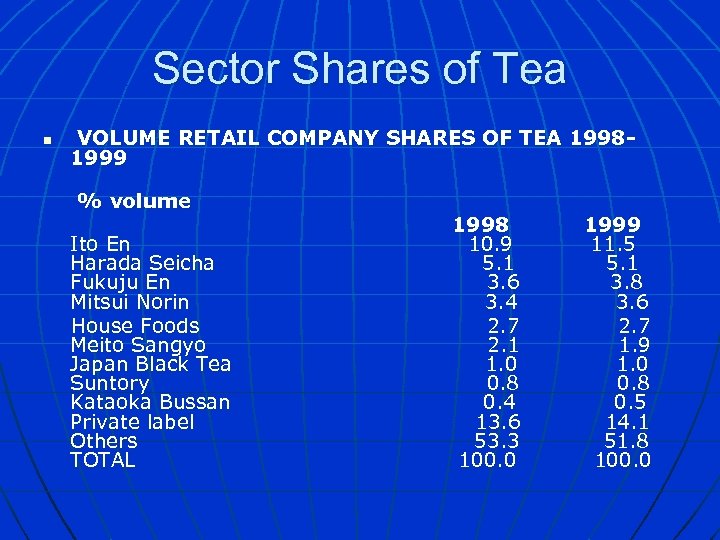
Sector Shares of Tea n VOLUME RETAIL COMPANY SHARES OF TEA 19981999 % volume 1998 1999 Ito En 10. 9 11. 5 Harada Seicha 5. 1 Fukuju En 3. 6 3. 8 Mitsui Norin 3. 4 3. 6 House Foods 2. 7 Meito Sangyo 2. 1 1. 9 Japan Black Tea 1. 0 Suntory 0. 8 Kataoka Bussan 0. 4 0. 5 Private label 13. 6 14. 1 Others 53. 3 51. 8 TOTAL 100. 0
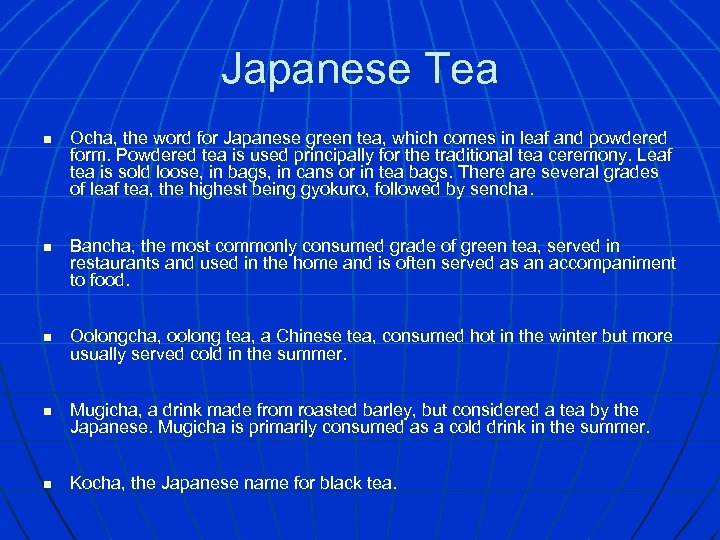
Japanese Tea n n n Ocha, the word for Japanese green tea, which comes in leaf and powdered form. Powdered tea is used principally for the traditional tea ceremony. Leaf tea is sold loose, in bags, in cans or in tea bags. There are several grades of leaf tea, the highest being gyokuro, followed by sencha. Bancha, the most commonly consumed grade of green tea, served in restaurants and used in the home and is often served as an accompaniment to food. Oolongcha, oolong tea, a Chinese tea, consumed hot in the winter but more usually served cold in the summer. Mugicha, a drink made from roasted barley, but considered a tea by the Japanese. Mugicha is primarily consumed as a cold drink in the summer. Kocha, the Japanese name for black tea.
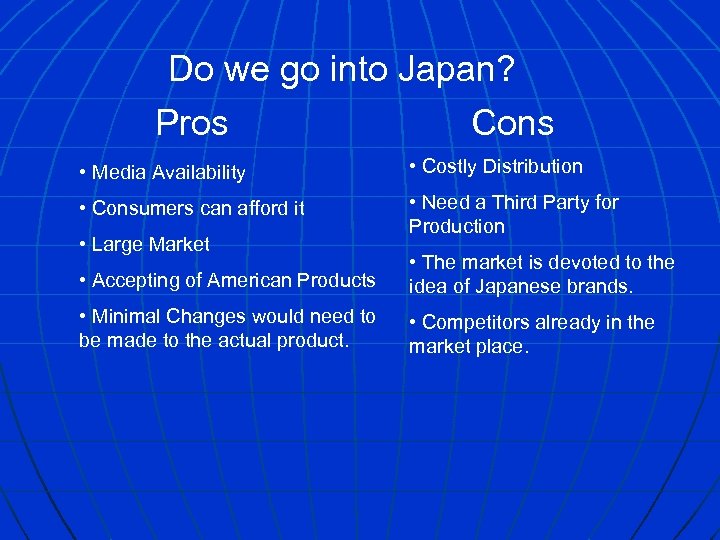
Do we go into Japan? Pros Cons • Media Availability • Costly Distribution • Consumers can afford it • Need a Third Party for Production • Large Market • Accepting of American Products • The market is devoted to the idea of Japanese brands. • Minimal Changes would need to be made to the actual product. • Competitors already in the market place.
Скачать презентацию Background of Japan n n Population 127 330
b05be32a9bf3e000557d072b3f9e6a47.ppt