 Скачать презентацию Background I O Concurrency Brad Karp UCL Computer Science
c8a1462485bef5e3c2f03cb2c96d5e7b.ppt
- Количество слайдов: 26



Background: I/O Concurrency Brad Karp UCL Computer Science CS GZ 03 / M 030 2 nd October, 2008
Outline • “Worse Is Better” and Distributed Systems • Problem: Naïve single-process server leaves system resources idle; I/O blocks – Goal: I/O concurrency – Goal: CPU concurrency • Solutions – Multiple processes – One process, many threads – Event-driven I/O (not in today’s lecture) 2
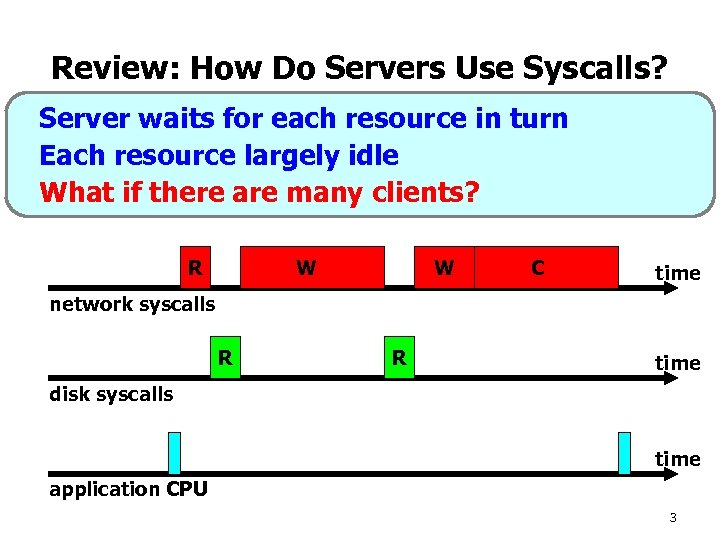
Review: How Do Servers Use Syscalls? Server waits for each resource in turn • Consider server_1() web Each resource largely idle server (in handout) What if there are many clients? R W W C time network syscalls R R time disk syscalls time application CPU 3
Performance and Concurrency • Under heavy load, server_1(): – Leaves resources idle – …and has a lot of work to do! • Why? – Software poorly structured! – What would a better structure look like? 4
Solution: I/O Concurrency • Can we overlap I/O with other useful work? Yes: – Web server: if files in disk cache, I/O wait spent mostly blocked on write to network – Networked file system client: could compile first part of file while fetching second part • Performance benefits potentially huge – Say one client causes disk I/O, 10 ms – If other clients’ requests in cache, could serve 100 other clients during that time! 5
One Process May Be Better Than You Think • OS provides I/O concurrency to application transparently when it can, e. g. , – Filesystem does read-ahead into disk buffer cache; write-behind from disk buffer cache – Networking code copies arriving packets into application’s kernel socket buffer; copies app’s data into kernel socket buffer on write() 6
I/O Concurrency with Multiple Processes • Idea: start new UNIX process for each client connection/request • Master process assigns new connections to child processes • Now plenty of work to keep system busy! – One process blocks in syscall, others can process arriving requests • Structure of software still simple – See server_2() in webserver. c – fork() after accept() – Otherwise, software structure unchanged! 7
Multiple Processes: More Benefits • Isolation – Bug while processing one client’s request leaves other clients/requests unaffected – Processes do interact, but OS arbitrates (e. g. , “lock the disk request queue”) • CPU concurrency for “free” – If more than one CPU in box, each process may run on one CPU 8
CPU Concurrency • Single machine may have multiple CPUs, one shared memory – Symmetric Multiprocessor (SMP) PCs – Intel Core Duo • I/O concurrency tools often help with CPU concurrency – But way more work for OS designer! • Generally, CPU concurrency way less important than I/O concurrency – Factor of 2 X, not 100 X – Very hard to program to get good scaling – Easier to buy 2 machines (see future lectures!) 9
Problems with Multiple Processes • fork() may be expensive – Memory for new address space – 300 us minimum on modern PC running UNIX • Processes fairly isolated by default – Memory not shared – How do you build web cache on server visible to all processes? – How do you simply keep statistics? 10
Concurrency with Threads • Similar to multiple processes • Difference: one address space – All threads share same process’ memory – One stack per thread, inside process • Seems simple: single-process structure! • Programmer needs to use locks • One thread can corrupt another (i. e. , no cross-request isolation) 11
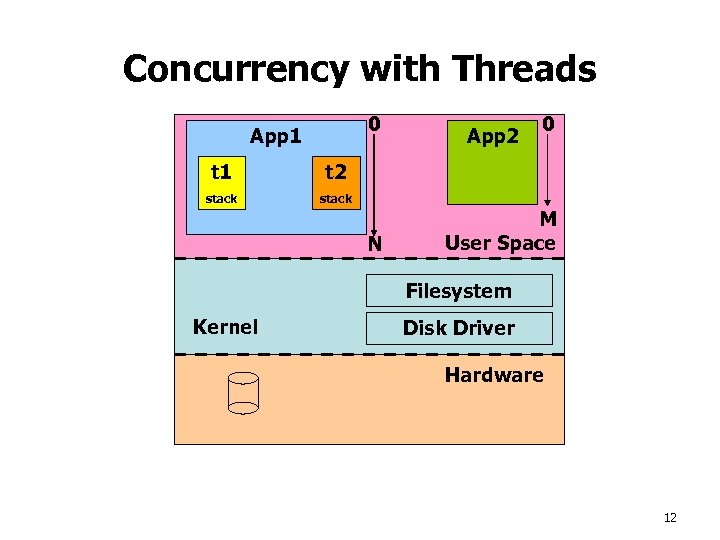
Concurrency with Threads 0 App 1 t 1 0 t 2 stack App 2 stack N M User Space Filesystem Kernel Disk Driver Hardware 12
Threads: Low-Level Details Are Hard! • Suppose thread calls read() (or other blocking syscall) – Does whole process block until I/O done? – If so, no I/O concurrency! • Two solutions: – Kernel-supported threads – User-supported threads 13
Kernel-Supported Threads • OS kernel aware of each thread – Knows if thread blocks, e. g. , disk read wait – Can schedule another thread • Kernel requirements: – Per-thread kernel stack – Per-thread tables (e. g. , saved registers) • Semantics: – Per-process: address space, file descriptors – Per-thread: user stack, kernel state 14
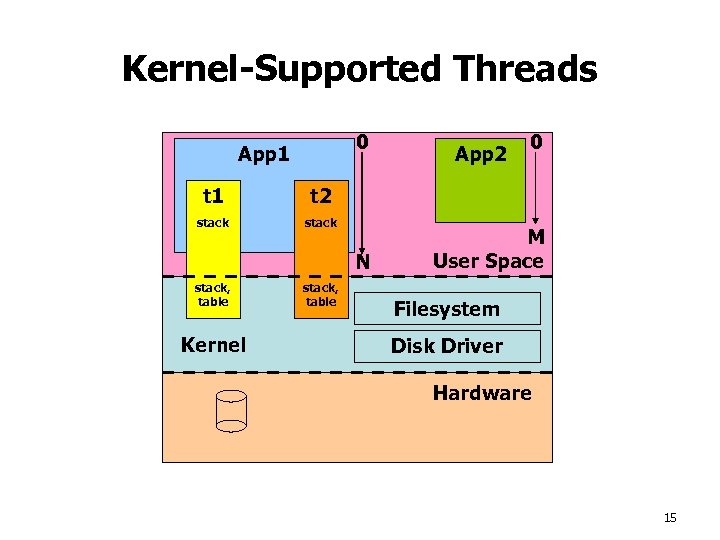
Kernel-Supported Threads 0 App 1 t 1 stack 0 t 2 stack App 2 N stack, table Kernel stack, table M User Space Filesystem Disk Driver Hardware 15
Kernel Threads: Trade-Offs • Kernel can schedule one thread per CPU – Fits our goals well: both CPU and I/O concurrency • But kernel threads expensive, like processes: – Kernel must help create each thread – Kernel must help with thread context switch! • Which thread took a page fault? – Lock/unlock must invoke kernel, but heavily used • Kernel threads not portable; not offered by many OSes 16
User-Level Threads • Purely inside user process; kernel oblivious • Scheduler within user process for process’ own threads – In addition to kernel’s process scheduler • User-level scheduler must – Know when thread makes blocking syscall – Not block process; switch to another thread – Know when I/O done, to wake up original thread 17
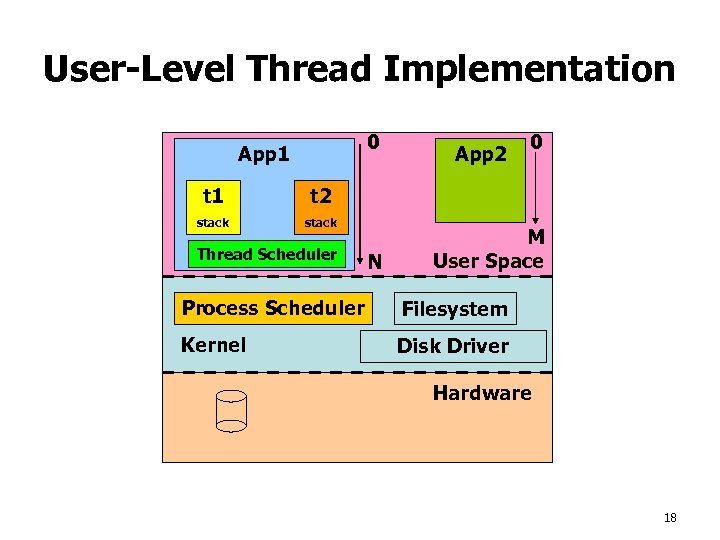
User-Level Thread Implementation 0 App 1 t 1 stack 0 t 2 stack App 2 Thread Scheduler N M User Space Process Scheduler Filesystem Kernel Disk Driver Hardware 18
User-Level Threads: Details • Apps linked against thread library • Library contains “fake” read(), write(), accept(), &c. syscalls • Library can start non-blocking syscall operations • Library marks threads as waiting, switches to runnable thread • Kernel notifies library of I/O completion and other events; library marks waiting thread runnable 19
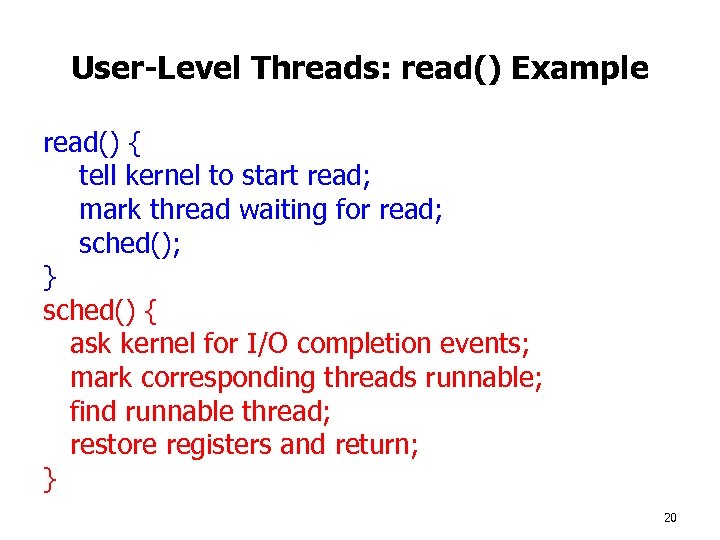
User-Level Threads: read() Example read() { tell kernel to start read; mark thread waiting for read; sched(); } sched() { ask kernel for I/O completion events; mark corresponding threads runnable; find runnable thread; restore registers and return; } 20
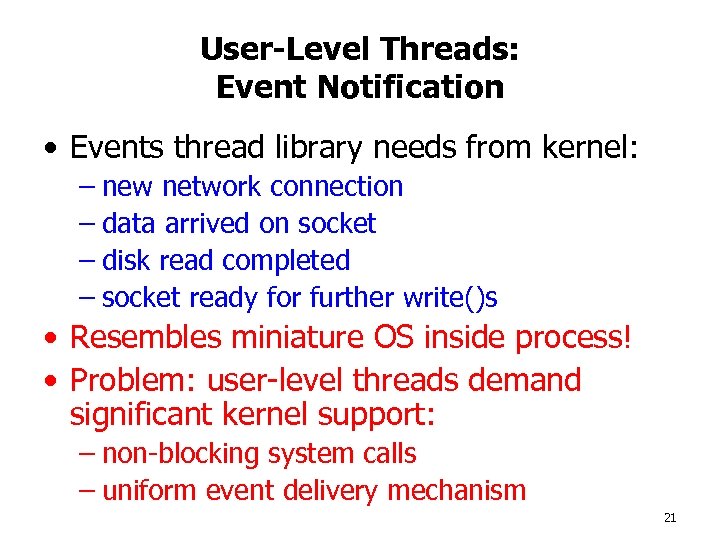
User-Level Threads: Event Notification • Events thread library needs from kernel: – new network connection – data arrived on socket – disk read completed – socket ready for further write()s • Resembles miniature OS inside process! • Problem: user-level threads demand significant kernel support: – non-blocking system calls – uniform event delivery mechanism 21
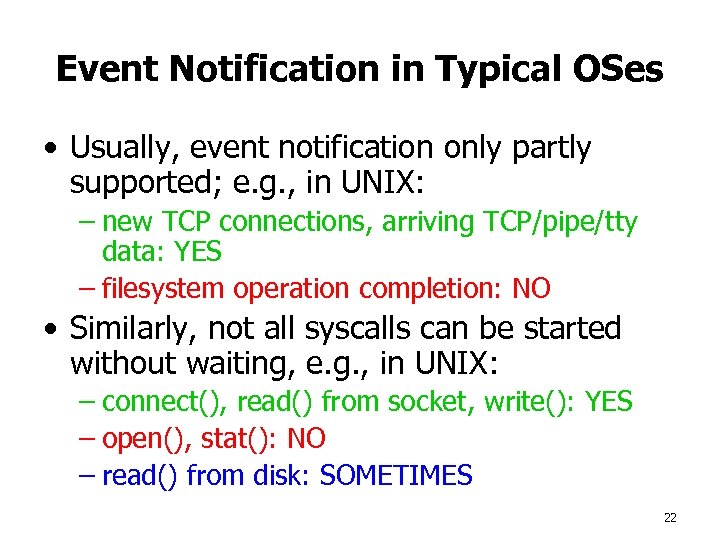
Event Notification in Typical OSes • Usually, event notification only partly supported; e. g. , in UNIX: – new TCP connections, arriving TCP/pipe/tty data: YES – filesystem operation completion: NO • Similarly, not all syscalls can be started without waiting, e. g. , in UNIX: – connect(), read() from socket, write(): YES – open(), stat(): NO – read() from disk: SOMETIMES 22
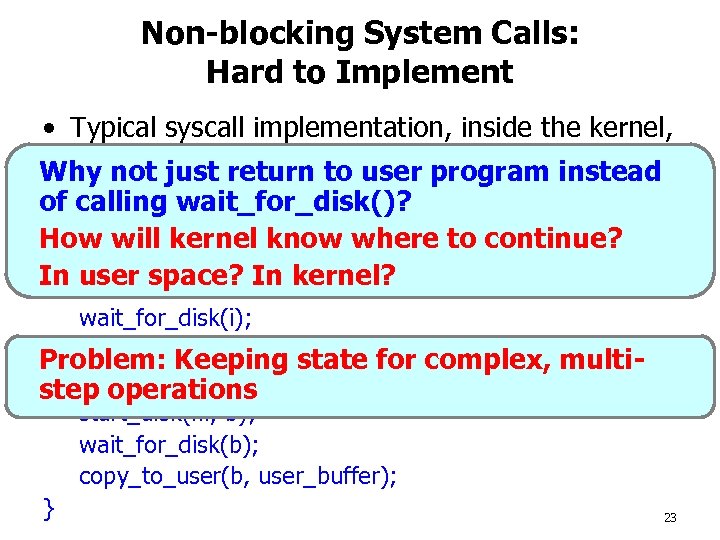
Non-blocking System Calls: Hard to Implement • Typical syscall implementation, inside the kernel, e. g. , for read() (sys_read. c): Why not just return to user program instead sys_read(fd, user_buffer, n) { of calling wait_for_disk()? // read the file’s i-node from disk How will kernel know where to continue? struct inode *I = alloc_inode(); In user space? In kernel? start_disk(…, i); wait_for_disk(i); // the i-node tells us where for complex, multi. Problem: Keeping state the data are; read it. struct buf *b = alloc_buf(i->…); step operations start_disk(…, b); wait_for_disk(b); copy_to_user(b, user_buffer); } 23
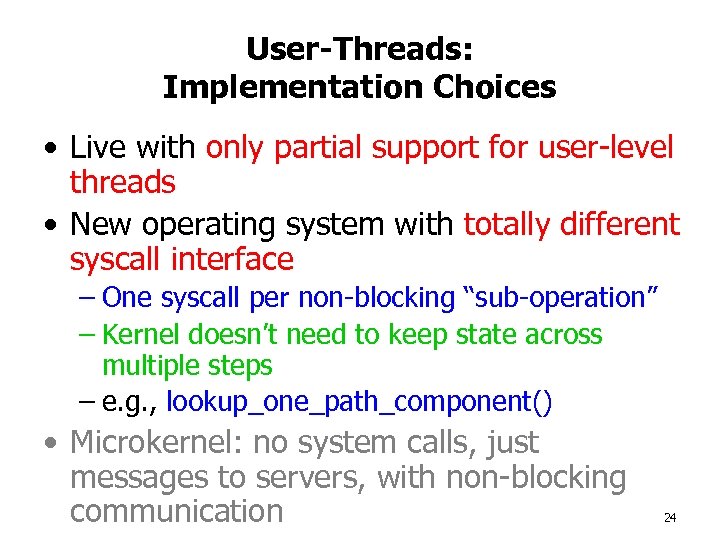
User-Threads: Implementation Choices • Live with only partial support for user-level threads • New operating system with totally different syscall interface – One syscall per non-blocking “sub-operation” – Kernel doesn’t need to keep state across multiple steps – e. g. , lookup_one_path_component() • Microkernel: no system calls, just messages to servers, with non-blocking communication 24
Threads: Programming Difficulty • Sharing of data structures in one address space • Even on single CPU, thread model necessitates CPU concurrency – Locks often needed for mutual exclusion on data structures – May only have wanted to overlap I/O wait! • Events usually occur one-at-a-time – Can we do CPU sequentially, and overlap only wait for I/O? – Yes: event-driven programming 25
Event-Driven Programming • Foreshadowed by user-level threads implementation – Organize software around event arrival • Write software in state-machine style – “When event X occurs, execute this function. ” • Library support for registering interest in events (e. g. , data available to read()) • Desirable properties: – Serial nature of events preserved – Programmer sees only one event/function at a time 26
Скачать презентацию Background I O Concurrency Brad Karp UCL Computer Science
c8a1462485bef5e3c2f03cb2c96d5e7b.ppt