 Скачать презентацию Bab 7 Outsourcing To Make OR To Buy
66a77076c905a0fb658bb22c66d0f543.ppt
- Количество слайдов: 23



Bab 7 Outsourcing: To Make OR To Buy 1
Key Concepts • Outsourcing: A Growth Industry • Strategic Issues » Core Competencies » Supplier Dominance » The Creation of Strategic Vulnerabilities » The Dangers of Vertical Integration • Horizontal Integration » New Product Development and Outsourcing » Lean Manufacturing • Tactical Decisions 2 Hoetomo Lembito
Key Concepts • Factors Influencing Make-or-Buy Decisions » » » » » 3 Cost Considerations Time Capacity Control of Production or Quality Business Process Outsourcing Technology Risk and Maturity Unreliable Suppliers’ Specialized Knowledge and Research Small-Volume Requirements Limited Facilities Hoetomo Lembito
Key Concepts • Factors Continued » Work Force Stability » Multiple-Source Policy » Managerial and Control Considerations » Procurement and Inventory Considerations • Netsourcing • The Volatile Nature of the Make-or-Buy Situation » Dangers of Outsourcing • Administration of Make-or-Buy Activities » Chief Resource Officer » Framework for Outsourcing » Executive Level Involvement 4 Hoetomo Lembito
Outsourcing and WCSM • Outsourcing has become a way to increase an organization’s flexibility to meet rapidly changing market conditions, focus on core competencies and develop competitive advantage. • As a result, the need for World Class Supply Management. SM has intensified and positioned supply managers as agents of strategic change critical to supply chain success. 5 Hoetomo Lembito
Views on Outsourcing • “Today’s manufacturing focus means learning how not to make things - how not to make the parts that divert a company from cultivating its skills - parts its suppliers could make more efficiently. ” (Ravi Venkatesan) • “Manufacturing strategy is about creating operating capabilities a company needs for the future. ” (R. H. Hayes and G. P. Pisano) 6 Hoetomo Lembito
Outsourcing: A Growth Industry • Outsourcing is increasing rapidly » Not just materials, many business functions are being outsourced • Outsourcing can enable: » Leveraging of the supplier’s expertise » Increases in innovation • And result in: » lower staffing levels » reduced costs » more flexibility 7 Hoetomo Lembito
Strategic Issues • Core Competencies • Supplier Dominance • The Creation of Strategic Vulnerabilities • The Dangers of Vertical Integration 8 Hoetomo Lembito
Horizontal Integration • Outsourcing all non-critical activities is a trend » The idea is to achieve significant cost leverage • To identify non-critical activities, the firm’s core competencies must be defined » All other activities are candidates for outsourcing 9 Hoetomo Lembito
From A Strategic Level: What Should Not Be Outsourced 1. An item that is critical to the success of the product 2. An item that requires specialized design, manufacturing skills or equipment 3. An item that fits well within the firm’s core competencies 10 Hoetomo Lembito
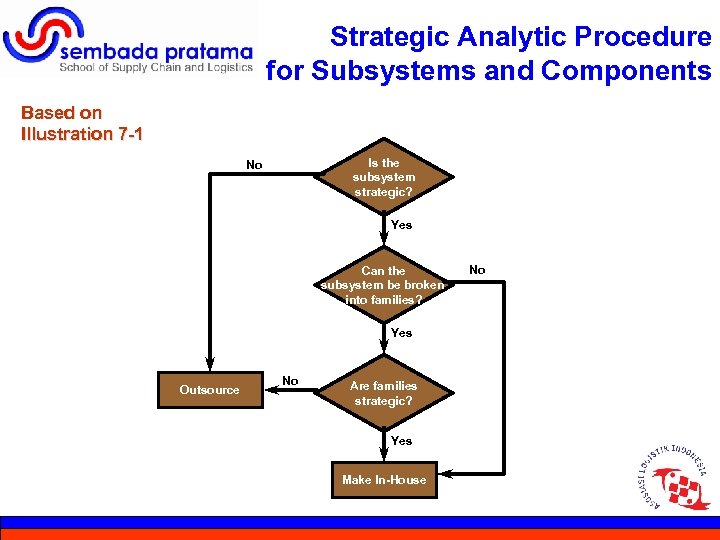
Strategic Analytic Procedure for Subsystems and Components Based on Illustration 7 -1 Is the subsystem strategic? No Yes Can the subsystem be broken into families? Yes Outsource No Are families strategic? Yes Make In-House 11 Hoetomo Lembito No No
Make or Buy at Tactical Level • Poor supplier performance • Changing sales demand • Restricted manufacturing capability • Modification of product • Increased manufacturing capability • Improved supplier capability 12 Hoetomo Lembito
Considerations Which Favor Making 1. 2. 3. 4. 5. 6. 7. 13 Cost considerations Desire to integrate plant operations Use of excess plant capacity Control over production and/or quality Design secrecy required Unreliable suppliers Desire to maintain a stable work force Hoetomo Lembito
Considerations Which Favor Buying 1. Limited production facilities 2. Cost considerations (less expensive to buy) 3. Small-volume requirements 4. Suppliers’ specialized know-how 5. Stable work force (rising sales) 6. Multiple-source policy 7. Indirect managerial control considerations 8. Procurement and inventory considerations 14 Hoetomo Lembito
Major Elements Included in a “To Make” Cost Analysis 1. Delivered purchased material costs 2. Direct labor costs 3. Any follow-on costs stemming from quality and related problems 4. Incremental inventory carrying costs 5. Incremental factory overhead costs 6. Incremental managerial costs 7. Incremental purchasing costs 8. Incremental costs of capital 15 Hoetomo Lembito
Major Elements Included in a “To Buy” Cost Analysis 1. Purchase price of the part 2. Transportation costs 3. Receiving and inspection costs 4. Incremental purchasing costs 5. Any follow-on costs related to quality or service 16 Hoetomo Lembito
Cost Considerations • The time factor (two views) » Short-term view – Focus on direct measurable costs » Long-term view – Also measure hidden costs (storage, inspection, tooling, quality, etc. ) • The capacity factor (2 possibilities) » 1. We are at capacity – Fixed costs are an issue » 2. We are not at capacity – Fixed costs are not as much an issue 17 Hoetomo Lembito
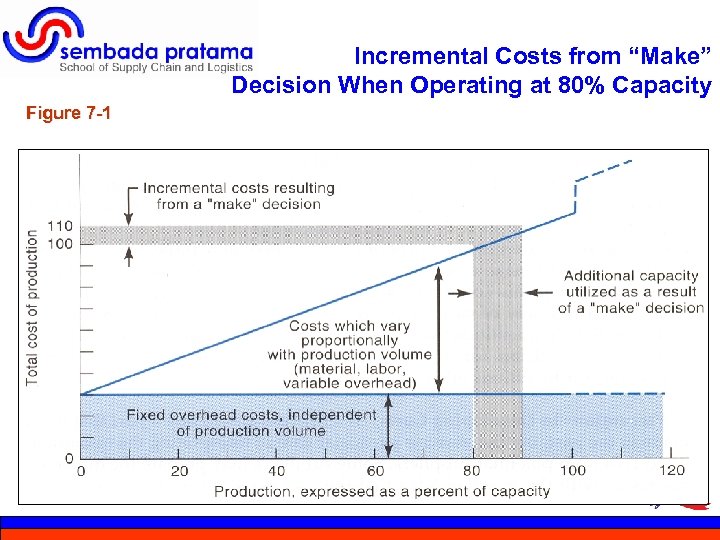
Incremental Costs from “Make” Decision When Operating at 80% Capacity Figure 7 -1 18 Hoetomo Lembito
Netsourcing • Many companies are not readily staffed to keep a company competitive in e-business • As a result, companies are outsourcing infrastructure development and maintenance to “Netsourcers” • Netsourcing has become popular since it allows: » A quick e-business presence » Flexibility to make changes » Sustained performance » Support without the need to train or hire specialized personnel 19 Hoetomo Lembito
The Volatile Nature of the Make-or-Buy Decision • Beware of rigid formulas and rules of thumb • The make‑or‑buy question is influenced by a multitude of diverse factors constantly changing • Under such conditions, few easy decisions turn out well in both the short and the long run • Moreover, the relevant factors vary immensely from one firm to another • Every company should periodically evaluate the effectiveness of its past decisions to generate information helpful in guiding future decisions 20 Hoetomo Lembito
Dangers of Outsourcing • Loss of control • Loss of client focus • Loss of clarity • Loss of cost control • Ineffective management • Loss of confidentiality • Double outsourcing 21 Hoetomo Lembito
Administration of Make-or-Buy Activities • Chief Resource Officer » Manages and initiates outsourcing for direct support to the company’s bottom line • Framework for outsourcing » Information gathering » Strategic roadmap » Decision flowchart » Transition back plan » Review system • Executive level involvement 22 Hoetomo Lembito
Concluding Remarks • Firms are becoming more aware of the strategic dimension of the make-or-buy decision • As technology has advanced, most manufacturing firms have become much more specialized • Cost of materials has continued to increase in many industries 23 Hoetomo Lembito
Скачать презентацию Bab 7 Outsourcing To Make OR To Buy
66a77076c905a0fb658bb22c66d0f543.ppt