 Скачать презентацию B physics at the Tevatron UK HEP Forum
7d1e825862264e00dc54d52ff6127c4d.ppt
- Количество слайдов: 40



B physics at the Tevatron UK HEP Forum “From the Tevatron to the LHC” The Cosener's House, Abingdon, UK April 24 -25, 2004 Rick Jesik Imperial College London Representing the DØ and CDF collaborations
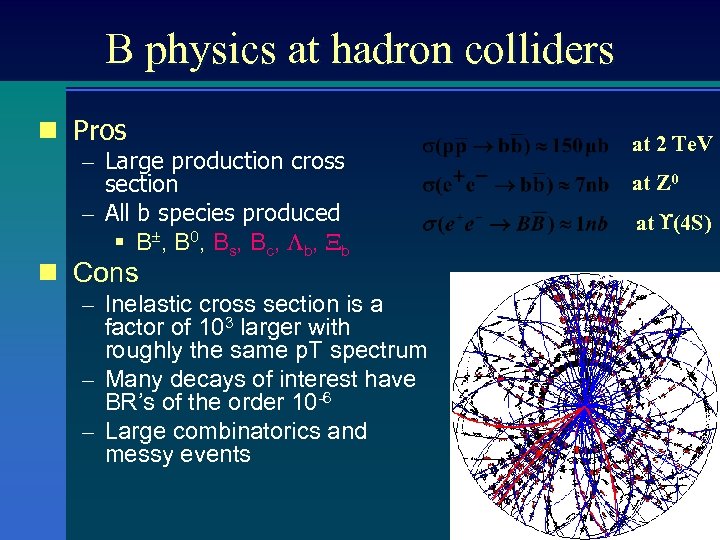
B physics at hadron colliders n Pros – Large production cross section – All b species produced § B , B 0, Bs, Bc, b n Cons – Inelastic cross section is a factor of 103 larger with roughly the same p. T spectrum – Many decays of interest have BR’s of the order 10 -6 – Large combinatorics and messy events at 2 Te. V at Z 0 at (4 S)
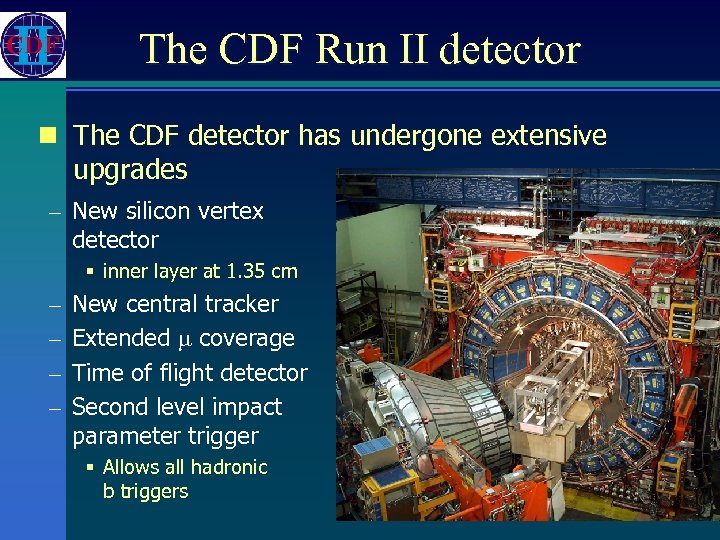
The CDF Run II detector n The CDF detector has undergone extensive upgrades – New silicon vertex detector § inner layer at 1. 35 cm – – New central tracker Extended coverage Time of flight detector Second level impact parameter trigger § Allows all hadronic b triggers
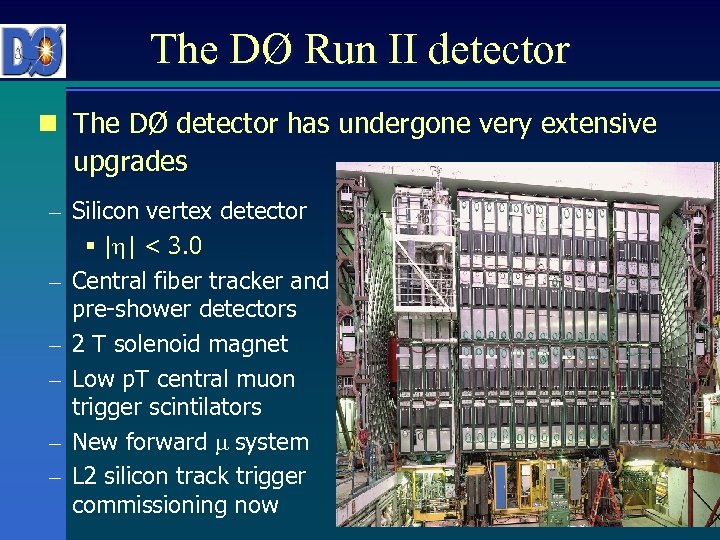
The DØ Run II detector n The DØ detector has undergone very extensive upgrades – Silicon vertex detector § | | < 3. 0 – Central fiber tracker and pre-shower detectors – 2 T solenoid magnet – Low p. T central muon trigger scintilators – New forward system – L 2 silicon track trigger commissioning now
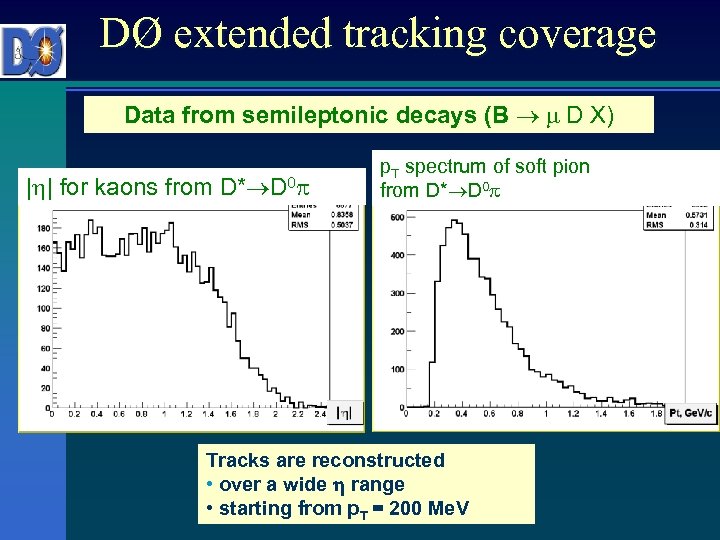
DØ extended tracking coverage Data from semileptonic decays (B D X) | | for kaons from D* D 0 p. T spectrum of soft pion from D* D 0 Tracks are reconstructed • over a wide range • starting from p. T = 200 Me. V
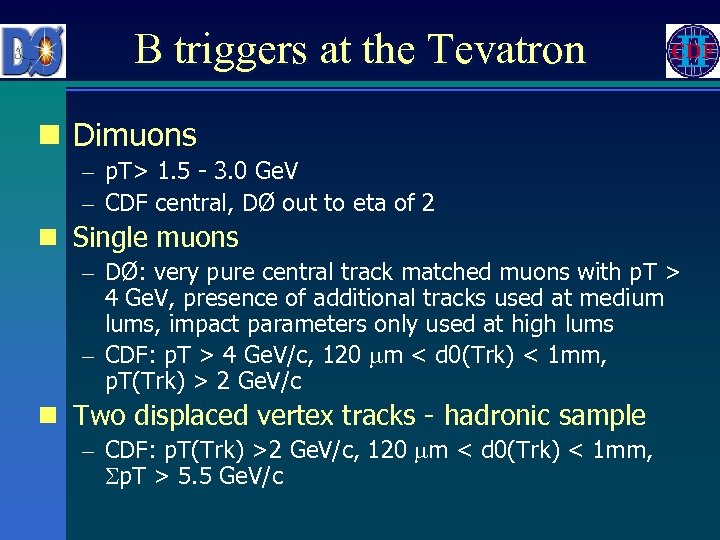
B triggers at the Tevatron n Dimuons – p. T> 1. 5 - 3. 0 Ge. V – CDF central, DØ out to eta of 2 n Single muons – DØ: very pure central track matched muons with p. T > 4 Ge. V, presence of additional tracks used at medium lums, impact parameters only used at high lums – CDF: p. T > 4 Ge. V/c, 120 m < d 0(Trk) < 1 mm, p. T(Trk) > 2 Ge. V/c n Two displaced vertex tracks - hadronic sample – CDF: p. T(Trk) >2 Ge. V/c, 120 m < d 0(Trk) < 1 mm, Sp. T > 5. 5 Ge. V/c
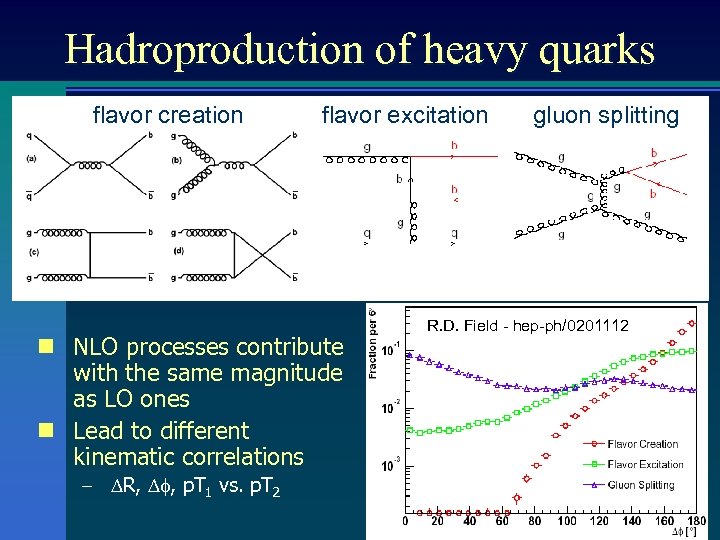
Hadroproduction of heavy quarks flavor creation flavor excitation n NLO processes contribute with the same magnitude as LO ones n Lead to different kinematic correlations – R, f, p. T 1 vs. p. T 2 gluon splitting R. D. Field - hep-ph/0201112
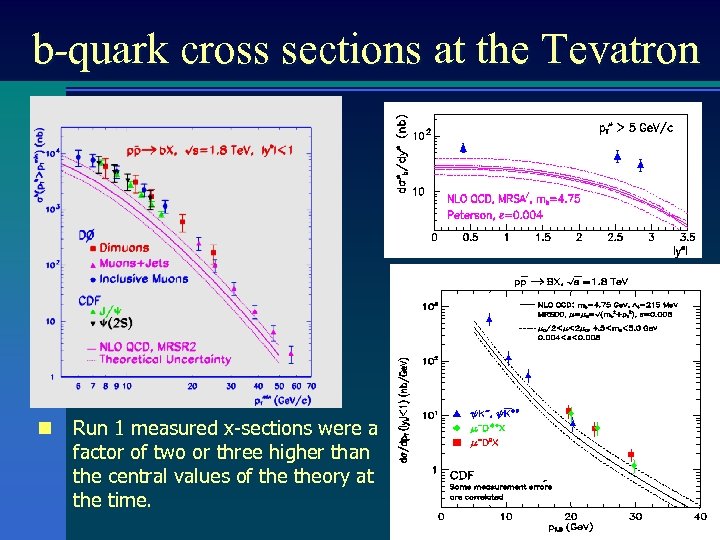
b-quark cross sections at the Tevatron n Run 1 measured x-sections were a factor of two or three higher than the central values of theory at the time.
Large uncertainties n Experimental uncertainties – We don’t measure b-quarks, only B-hadrons § Fragmentation uncertainty – Peterson is not correct – B decay products often not fully reconstructed § Must extrapolate to B-hadron, then b-quark p. T n Theoretical uncertainties – hard scatter really needs NNLO – scale factors (x 2) – quark mass (10%), PDF’s (20%) – k. T effects and fragmentation n Correlations between the above often not included in theory vs. experiment comparisons – Was this merely a 2 discrepancy? – or more?
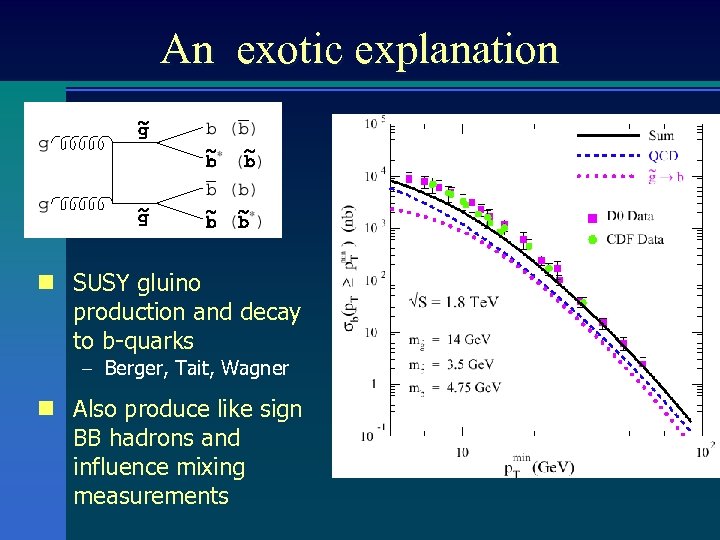
An exotic explanation n SUSY gluino production and decay to b-quarks – Berger, Tait, Wagner n Also produce like sign BB hadrons and influence mixing measurements
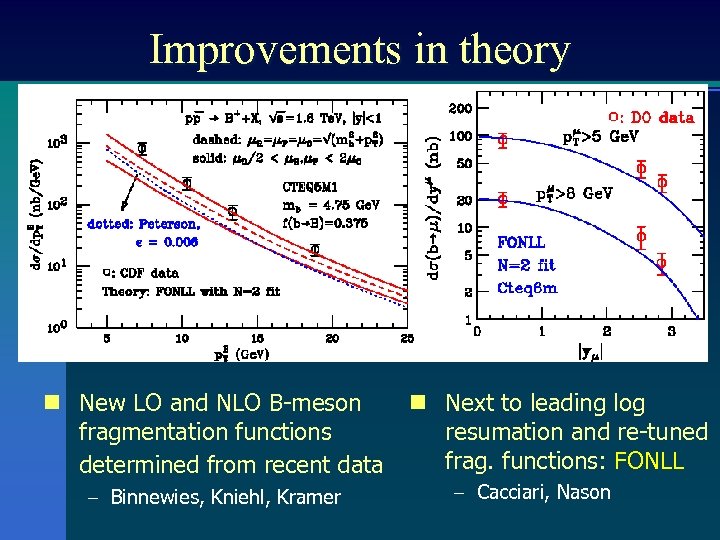
Improvements in theory n New LO and NLO B-meson fragmentation functions determined from recent data – Binnewies, Kniehl, Kramer n Next to leading log resumation and re-tuned frag. functions: FONLL – Cacciari, Nason
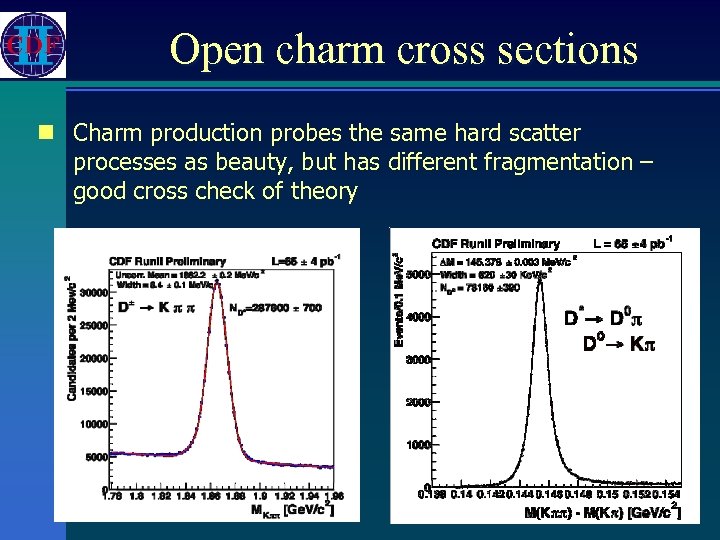
Open charm cross sections n Charm production probes the same hard scatter processes as beauty, but has different fragmentation – good cross check of theory
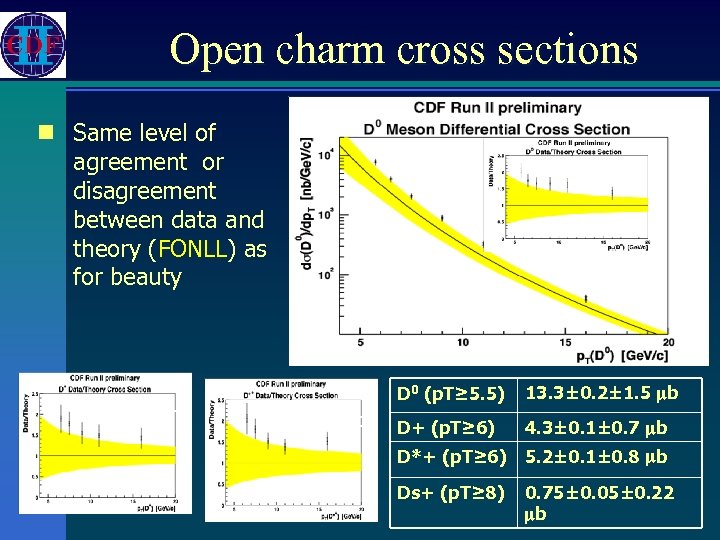
Open charm cross sections n Same level of agreement or disagreement between data and theory (FONLL) as for beauty K D 0 (p. T≥ 5. 5) 13. 3± 0. 2± 1. 5 mb D+ (p. T≥ 6) 4. 3± 0. 1± 0. 7 mb D*+ (p. T≥ 6) 5. 2± 0. 1± 0. 8 mb Ds+ (p. T≥ 8) 0. 75± 0. 05± 0. 22 mb
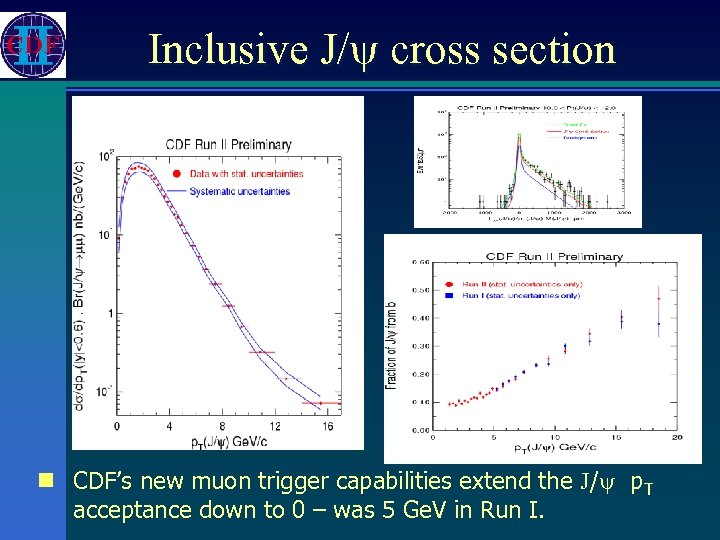
Inclusive J/ cross section n CDF’s new muon trigger capabilities extend the J/ p. T acceptance down to 0 – was 5 Ge. V in Run I.
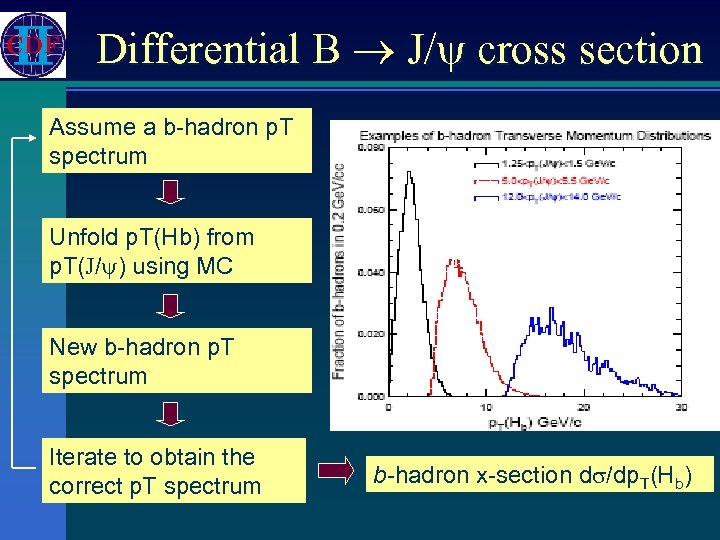
Differential B J/ cross section Assume a b-hadron p. T spectrum Unfold p. T(Hb) from p. T(J/ ) using MC New b-hadron p. T spectrum Iterate to obtain the correct p. T spectrum b-hadron x-section d /dp. T(Hb)
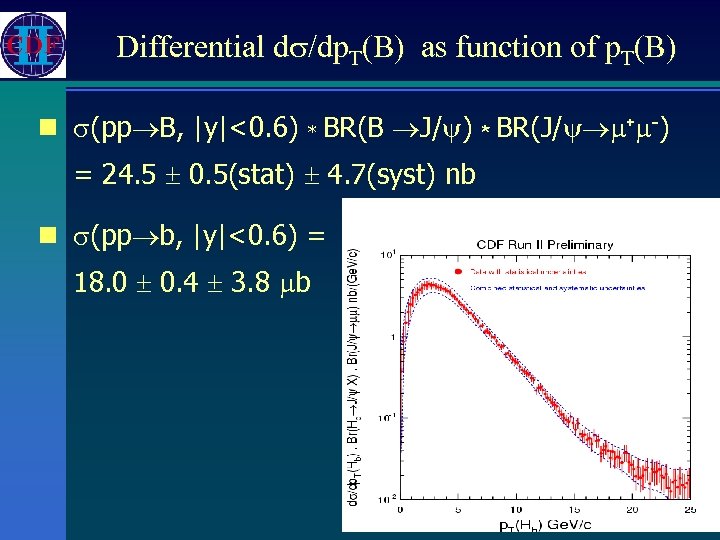
Differential d /dp. T(B) as function of p. T(B) n (pp B, |y|<0. 6) * BR(B J/ ) * BR(J/ + -) = 24. 5 0. 5(stat) 4. 7(syst) nb n (pp b, |y|<0. 6) = 18. 0 0. 4 3. 8 b
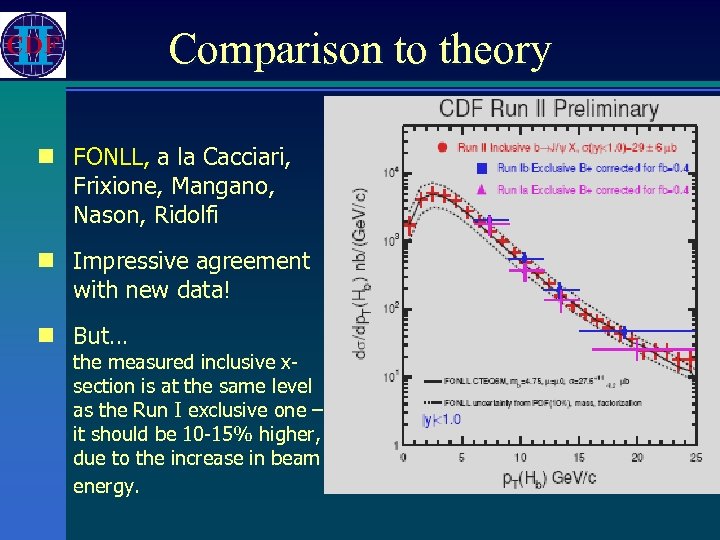
Comparison to theory n FONLL, a la Cacciari, Frixione, Mangano, Nason, Ridolfi n Impressive agreement with new data! n But… the measured inclusive xsection is at the same level as the Run I exclusive one – it should be 10 -15% higher, due to the increase in beam energy.
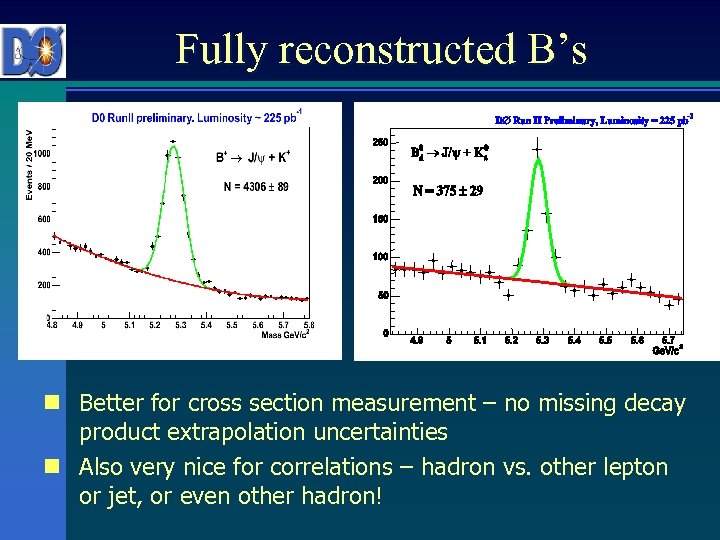
Fully reconstructed B’s n Better for cross section measurement – no missing decay product extrapolation uncertainties n Also very nice for correlations – hadron vs. other lepton or jet, or even other hadron!
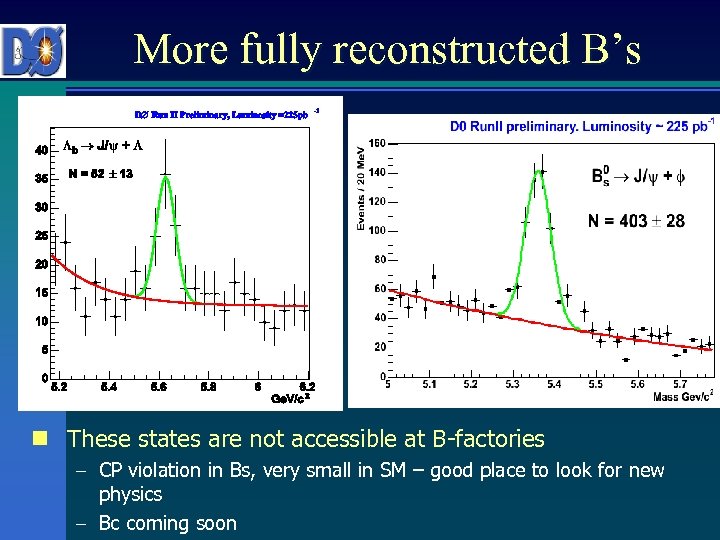
More fully reconstructed B’s n These states are not accessible at B-factories – CP violation in Bs, very small in SM – good place to look for new physics – Bc coming soon
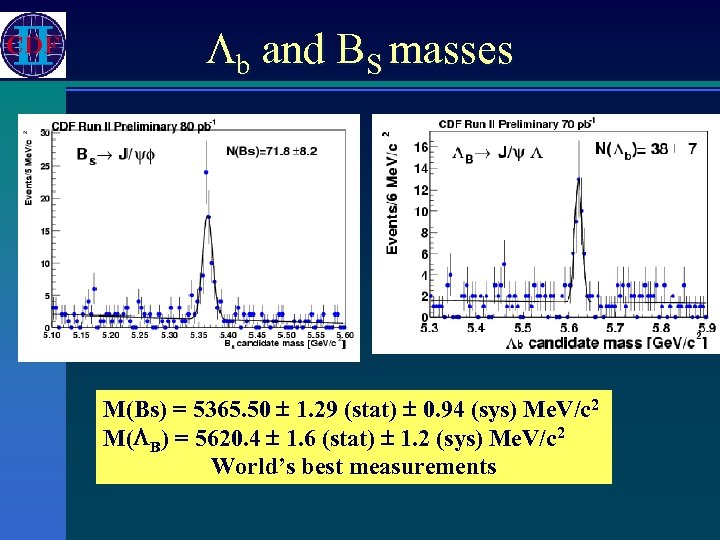
b and BS masses M(Bs) = 5365. 50 1. 29 (stat) 0. 94 (sys) Me. V/c 2 M( B) = 5620. 4 1. 6 (stat) 1. 2 (sys) Me. V/c 2 World’s best measurements
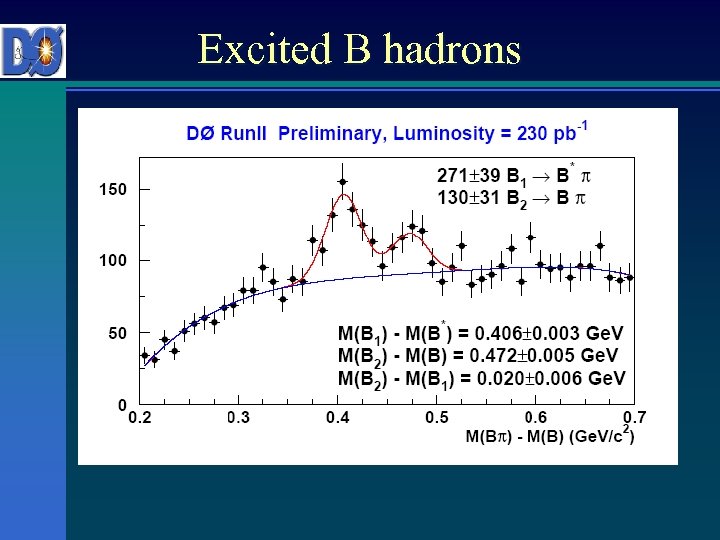
Excited B hadrons
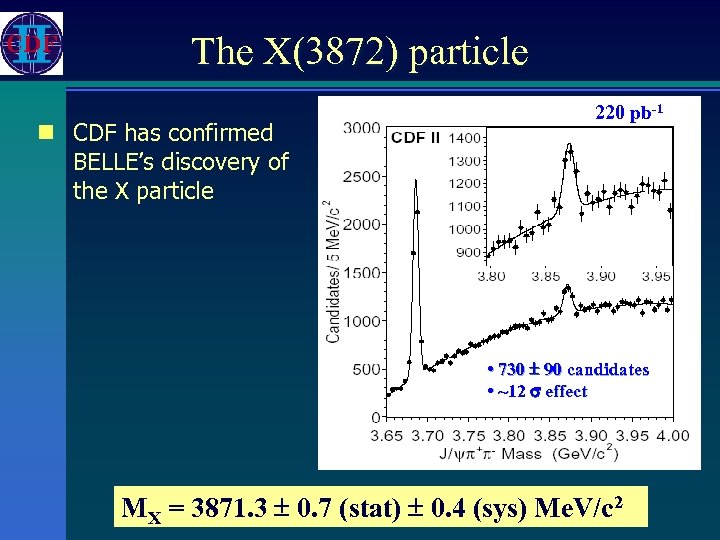
The X(3872) particle n CDF has confirmed BELLE’s discovery of the X particle 220 pb-1 • 730 90 candidates • ~12 s effect MX = 3871. 3 0. 7 (stat) 0. 4 (sys) Me. V/c 2
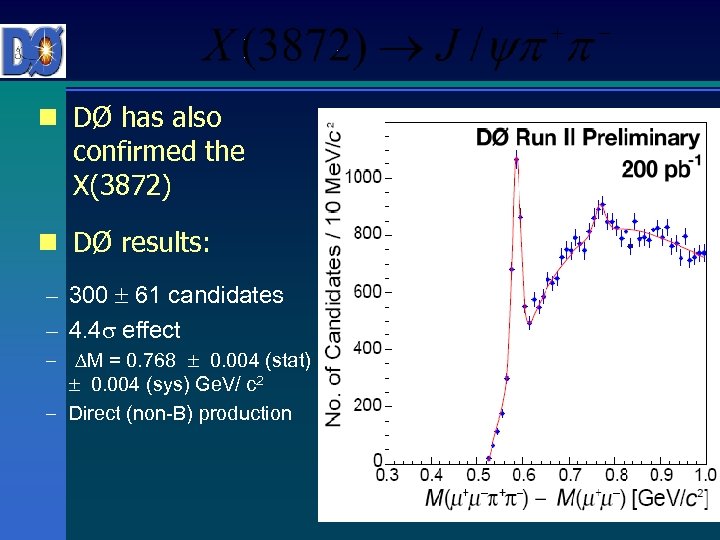
n DØ has also confirmed the X(3872) n DØ results: – 300 61 candidates – 4. 4 effect – M = 0. 768 0. 004 (stat) 0. 004 (sys) Ge. V/ c 2 – Direct (non-B) production
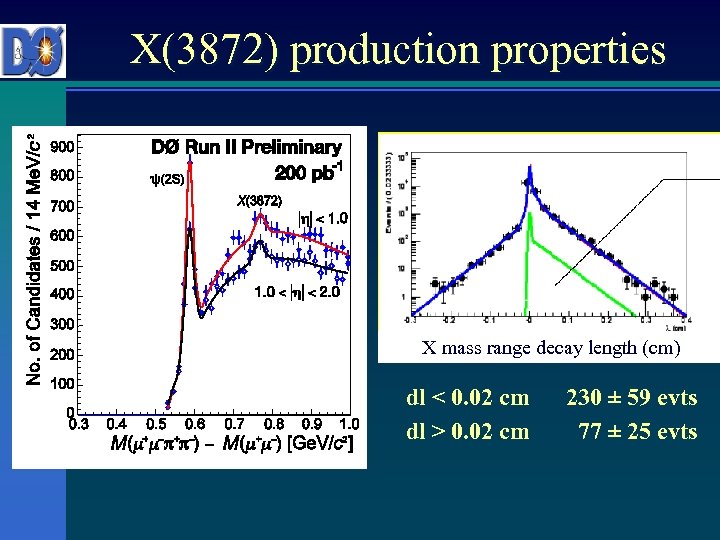
X(3872) production properties D 0 Run II Preliminary X mass range decay length (cm) dl < 0. 02 cm dl > 0. 02 cm 230 ± 59 evts 77 ± 25 evts
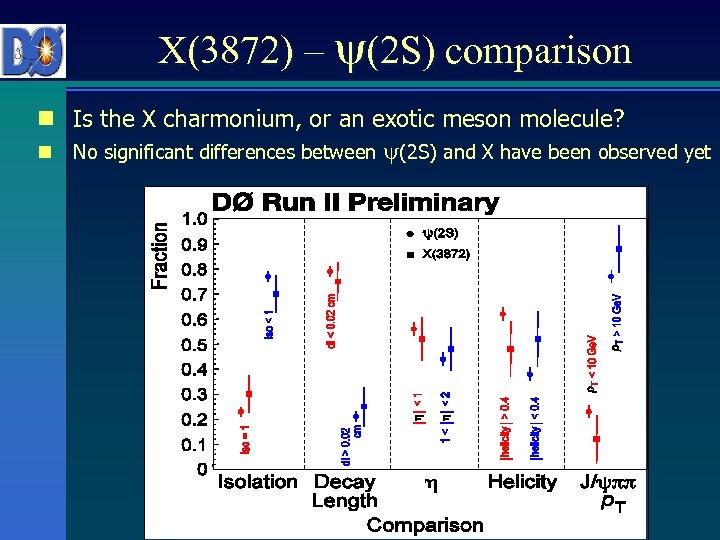
X(3872) – (2 S) comparison n Is the X charmonium, or an exotic meson molecule? n No significant differences between (2 S) and X have been observed yet
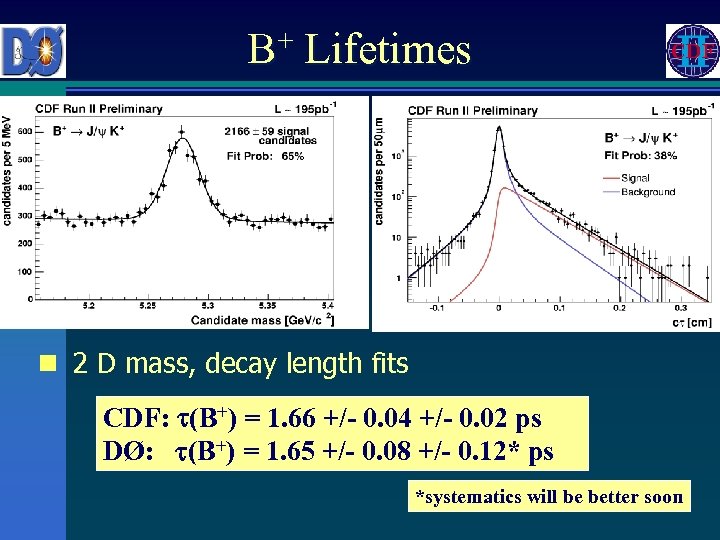
B+ Lifetimes n 2 D mass, decay length fits CDF: (B+) = 1. 66 +/- 0. 04 +/- 0. 02 ps DØ: (B+) = 1. 65 +/- 0. 08 +/- 0. 12* ps *systematics will be better soon
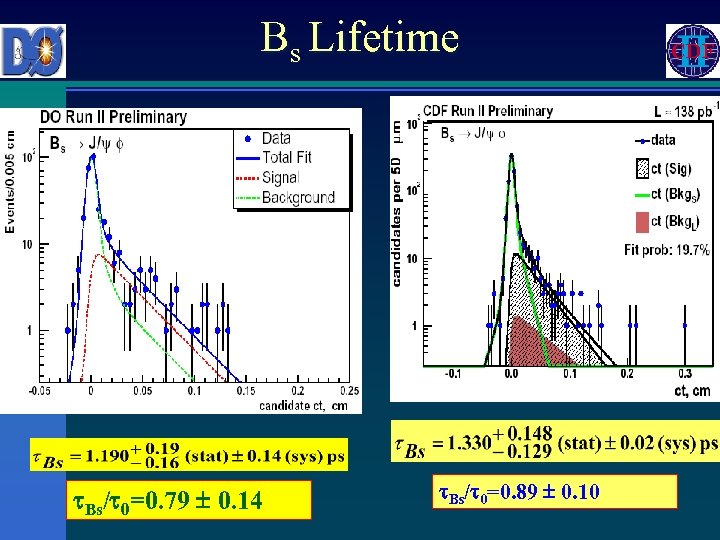
Bs Lifetime Bs/ 0=0. 79 0. 14 Bs/ 0=0. 89 0. 10
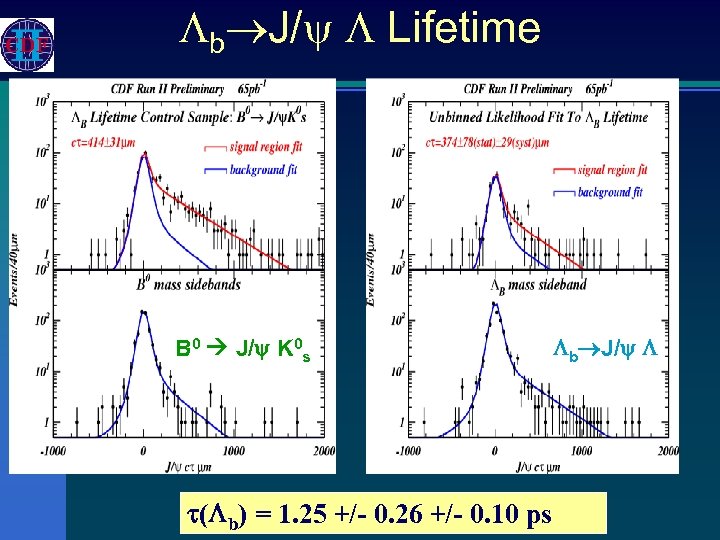
b J/ Lifetime B 0 J/ K 0 s ( b) = 1. 25 +/- 0. 26 +/- 0. 10 ps b J/
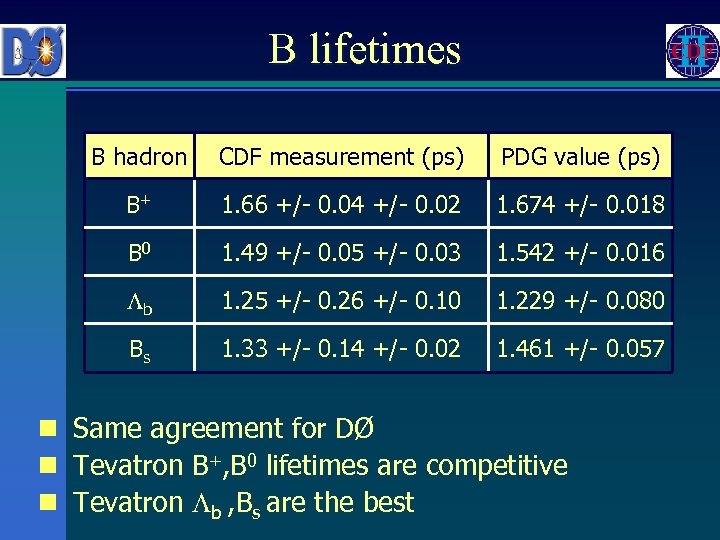
B lifetimes B hadron CDF measurement (ps) PDG value (ps) B+ 1. 66 +/- 0. 04 +/- 0. 02 1. 674 +/- 0. 018 B 0 1. 49 +/- 0. 05 +/- 0. 03 1. 542 +/- 0. 016 b 1. 25 +/- 0. 26 +/- 0. 10 1. 229 +/- 0. 080 Bs 1. 33 +/- 0. 14 +/- 0. 02 1. 461 +/- 0. 057 n Same agreement for DØ n Tevatron B+, B 0 lifetimes are competitive n Tevatron b , Bs are the best
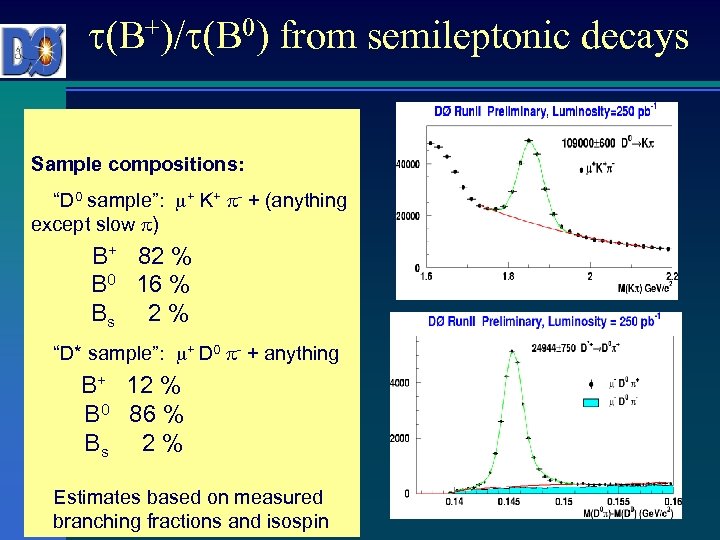
(B+)/ (B 0) from semileptonic decays Sample compositions: “D 0 sample”: + K+ - + (anything except slow ) B+ 82 % B 0 16 % Bs 2 % “D* sample”: + D 0 - + anything B+ 12 % B 0 86 % Bs 2 % Estimates based on measured branching fractions and isospin
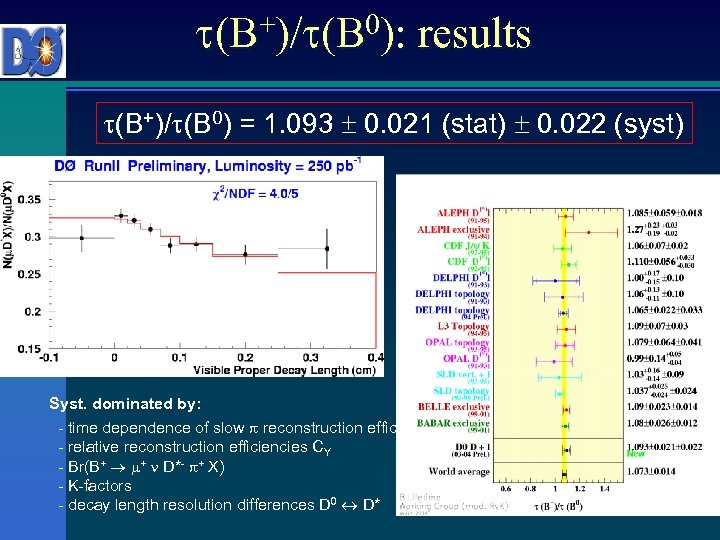
(B+)/ (B 0): results (B+)/ (B 0) = 1. 093 0. 021 (stat) 0. 022 (syst) Syst. dominated by: - time dependence of slow reconstruction efficiency - relative reconstruction efficiencies CY - Br(B+ + D*- + X) - K-factors - decay length resolution differences D 0 D*
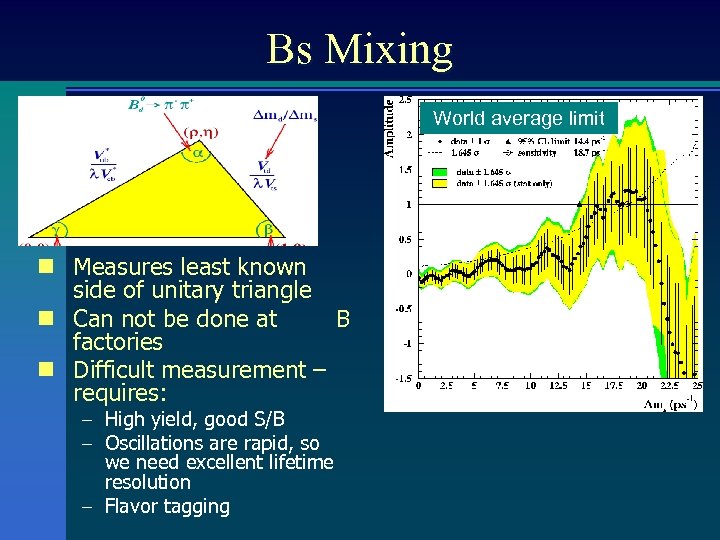
Bs Mixing World average limit n Measures least known side of unitary triangle n Can not be done at B factories n Difficult measurement – requires: – High yield, good S/B – Oscillations are rapid, so we need excellent lifetime resolution – Flavor tagging
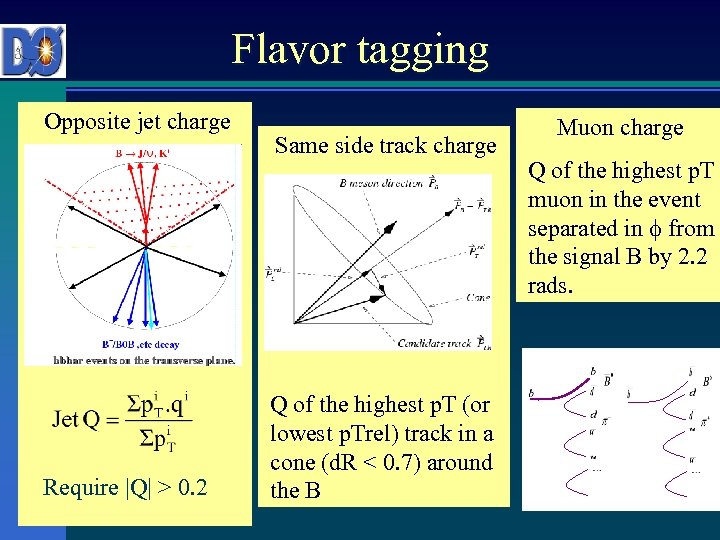
Flavor tagging Opposite jet charge Require |Q| > 0. 2 Same side track charge Q of the highest p. T (or lowest p. Trel) track in a cone (d. R < 0. 7) around the B Muon charge Q of the highest p. T muon in the event separated in f from the signal B by 2. 2 rads.
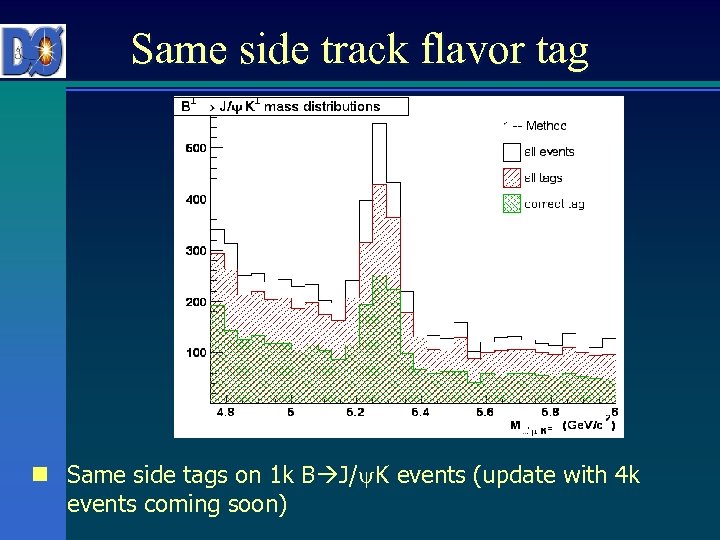
Same side track flavor tag n Same side tags on 1 k B J/ K events (update with 4 k events coming soon)
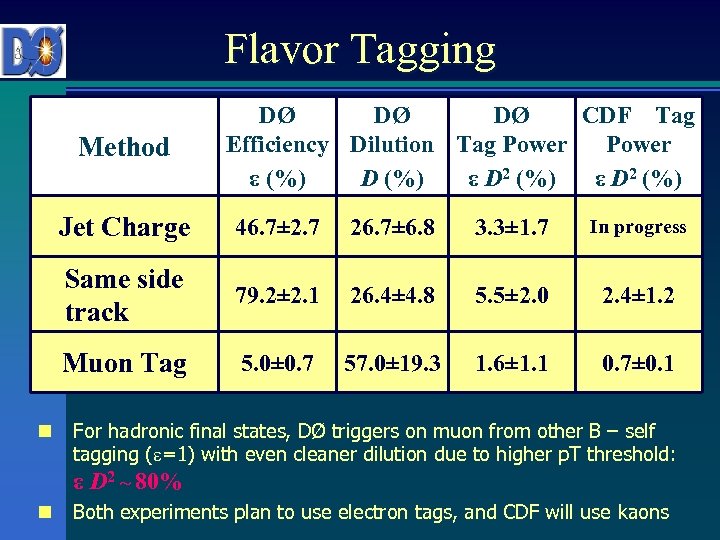
Flavor Tagging Method DØ DØ DØ CDF Tag Efficiency Dilution Tag Power ε (%) D (%) ε D 2 (%) Jet Charge 46. 7± 2. 7 26. 7± 6. 8 3. 3± 1. 7 In progress Same side track 79. 2± 2. 1 26. 4± 4. 8 5. 5± 2. 0 2. 4± 1. 2 Muon Tag 5. 0± 0. 7 57. 0± 19. 3 1. 6± 1. 1 0. 7± 0. 1 n For hadronic final states, DØ triggers on muon from other B – self tagging (e=1) with even cleaner dilution due to higher p. T threshold: ε D 2 ~ 80% n Both experiments plan to use electron tags, and CDF will use kaons
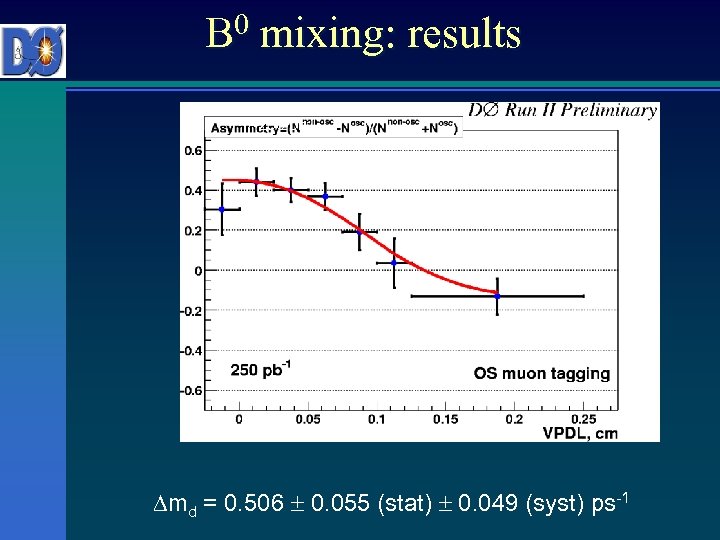
B 0 mixing: results 250 pb-1 md = 0. 506 0. 055 (stat) 0. 049 (syst) ps-1
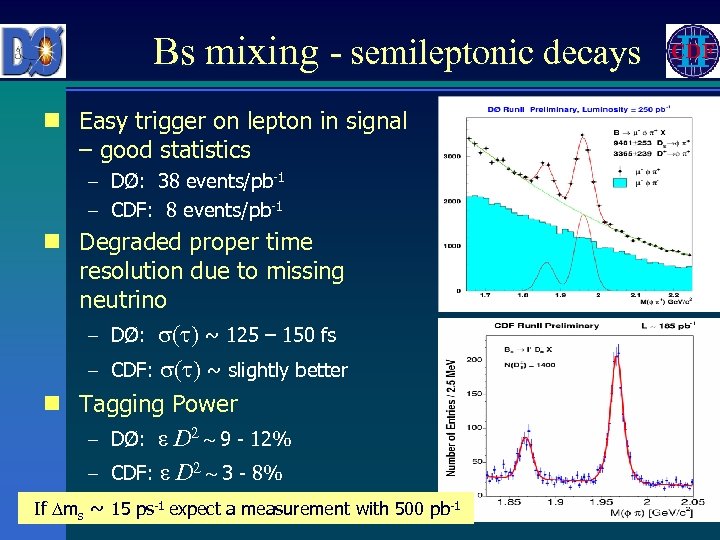
Bs mixing - semileptonic decays n Easy trigger on lepton in signal – good statistics – DØ: 38 events/pb-1 – CDF: 8 events/pb-1 n Degraded proper time resolution due to missing neutrino – DØ: ( ) ~ 125 – 150 fs – CDF: ( ) ~ slightly better n Tagging Power – DØ: ε D 2 ~ 9 - 12% – CDF: ε D 2 ~ 3 - 8% If ms ~ 15 ps-1 expect a measurement with 500 pb-1
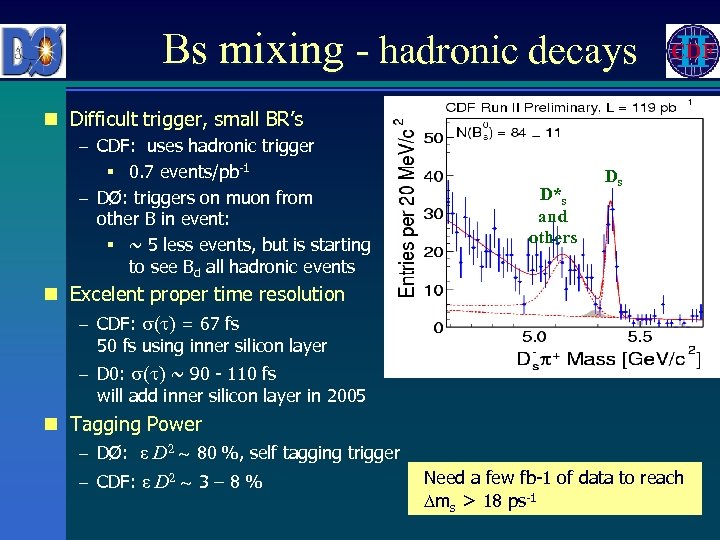
Bs mixing - hadronic decays n Difficult trigger, small BR’s – CDF: uses hadronic trigger § 0. 7 events/pb-1 – DØ: triggers on muon from other B in event: § ~ 5 less events, but is starting to see Bd all hadronic events D*s and others Ds n Excelent proper time resolution – CDF: ( ) = 67 fs 50 fs using inner silicon layer – D 0: ( ) ~ 90 - 110 fs will add inner silicon layer in 2005 n Tagging Power – DØ: ε D 2 ~ 80 %, self tagging trigger – CDF: ε D 2 ~ 3 – 8 % Need a few fb-1 of data to reach ms > 18 ps-1
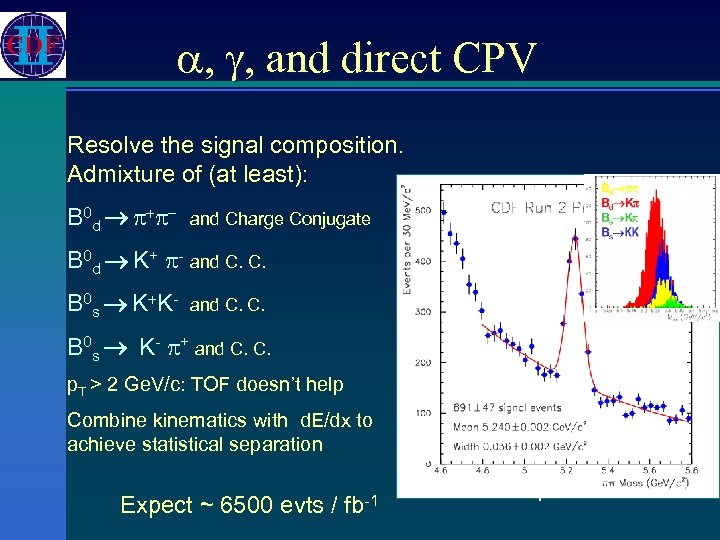
a, g, and direct CPV Resolve the signal composition. Admixture of (at least): B 0 d MC and Charge Conjugate B 0 d K+ - and C. C. B 0 s K K - and C. C. B 0 s K- + and C. C. p. T > 2 Ge. V/c: TOF doesn’t help Combine kinematics with d. E/dx to achieve statistical separation Expect ~ 6500 evts / fb-1 Lumi ~ 180 pb-1
Conclusions n Since the 2003 fall shutdown, the Tevatron has shown substantial improvements n Spring is here, and the Tevatron is blooming with beautiful B results – Some have already been published, many are close § B cross sections, masses, and lifetimes § X production studies n Both Experiments are poised to attack Bs mixing in semileptonic and hadronic decays. – Bd mixing measured – Expect first Bs results this Fall/Winter n Longer term, many CKM measurements (and other interesting analyses) are in the works.
Скачать презентацию B physics at the Tevatron UK HEP Forum
7d1e825862264e00dc54d52ff6127c4d.ppt