


B 2 B versus B 2 C Marketing B 2 C=Business-to-Consumer Market= businesses sell products and services to consumers for household or personal use B 2 B=Business-to-Business Market= businesses sell products and services to other businesses for use in their daily operations or for making other products and services
B 2 C versus B 2 B Marketing The B 2 B market is 5 X as large as the B 2 C market.
Sectors of the B 2 B Market Producers Middlemen Government Units Nonprofits
Sectors of the B 2 B Market Producers – includes all manufacturers and service providers; buy goods to use in making other goods or services Middlemen – buy goods for resale; includes all retailers and wholesalers (distributors, vendors) Government – includes all state, and local governments and govt. agencies Nonprofit – includes charities, schools and universities, museums, etc.
B 2 B Marketing is Different! There are fewer customers and they require dependable relationships and a high level of service. Marketing tends to be done by personal selling (one-on-one) calls to the customer. Specialized media such as trade journals, sales brochures, web sites, trade shows are used rather than traditional mass media.
Emotional or Rational Buyers? (Considerations of B 2 B Buyers) Buyers must purchase according to a set of purchasing specifications Focus on Quality (including ISO certification) Total costs to purchase and use Reliability Value in use Savings possible via e-commerce
What is ISO? A very detailed process for documenting quality according to internationally recognized standards. Some international companies won’t buy from you if you aren’t ISO compliant.
Three Kinds of Organizational Purchases Straight rebuy a routine repurchase that may have been made many times before
Straight rebuy A recurring requirement; buyers have substantial experience with the purchase Information needs are low; little need to evaluate alternative solutions; Routinized response behavior; Selection of vendor from a list of acceptable vendors Choice criteria are well developed Strong predisposition to certain suppliers
Modified rebuy the in-between process where some review of the buying situation is done—though not as much as in new-task buying
Modified rebuy Buyer perceives benefits from a reevaluation of alternatives LIMITED PROBLEM SOLVING THERE ARE TWO TYPES SIMPLE COMPLEX Complex: involves a large set of choice alternatives
New-task buy a firm has a new need and the buyer wants a great deal of information
New task Firm has no experience in purchasing the product; requires extensive problem solving » Strong predispositions toward suppliers do not exist » Two distinct buying decision approaches are employed » Judgmental new task: when unfamiliar with parts, technology, etc. » Strategic new task: when decision is extremely important to the firm
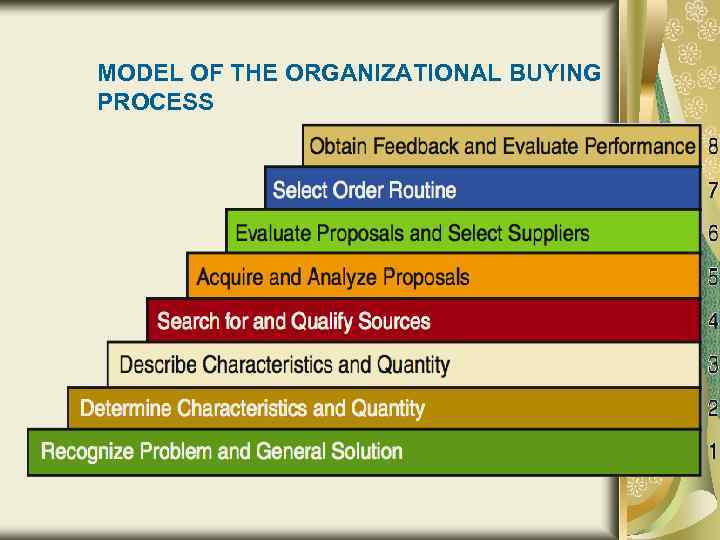
MODEL OF THE ORGANIZATIONAL BUYING PROCESS
Stage 1: Anticipate a Problem/Need/Opportunity and a General Solution • Example: Need to provide employees with a good cup of coffee to enhance productivity.
Stage 2: Determine the Characteristics and Quantity of a Needed Good or Service • Example: Offering a coffee system that brews one cup of coffee at a time according to each employee’s preference.
Stage 3: Describe Characteristics and the Quantity of a Needed Good or Service • Example: Firms need a simple system for brewing a good cup of coffee; quantity requirements are easily correlated to the number of coffee drinkers.
Stage 4: Search for and Qualify Potential Sources • Choice of supplier may be fairly straightforward or very complex.
Stage 5: Acquire and Analyze Proposals • May involve competitive bidding, especially if the buyer is the government or a public agency.
Stage 6: Evaluate Proposals and Select Suppliers • Buyers choose proposal best suited to their needs. • Final choice may involve tradeoffs between feature such as price, reliability, quality, and order accuracy.
Stage 7: Select an Order Routine • Buyer and vendor work out best way to process future purchases.
Stage 8: Obtain Feedback and Evaluate Performance • Buyers measure vendors’ performance. • Larger firms are more likely to use formal evaluation procedures. • Some firms rely on outside organizations to gather quality feedback and summarize results.
The “Buying Center” Business purchases often involve multiple influence "Buying center"—all people who participate in or influence a particular purchase Buying center varies from purchase to purchase Does not appear on the "organizational chart" Structure may be formal or informal
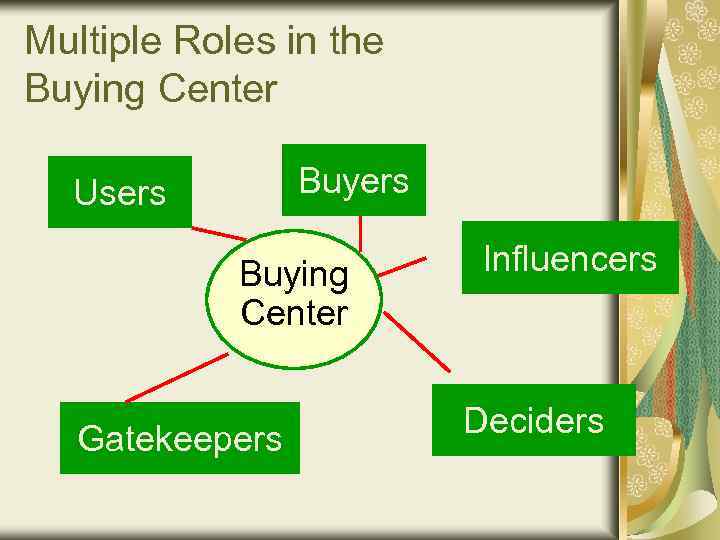
Multiple Roles in the Buying Center Buyers Users Buying Center Gatekeepers Influencers Deciders
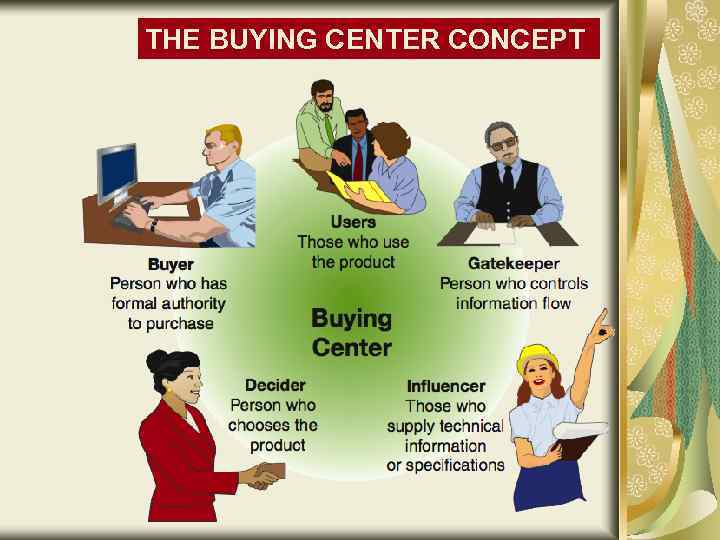
THE BUYING CENTER CONCEPT
The Government Market Government units State governments Local governments Foreign countries
Government Purchasing Usually done by using a bidding process Many layers of approval are required (bureaucratic “red tape”) Specifications are developed prior to releasing the request for bids Many govt. agencies must accept the low bid Routine purchases can be made from an “approved suppliers” list.
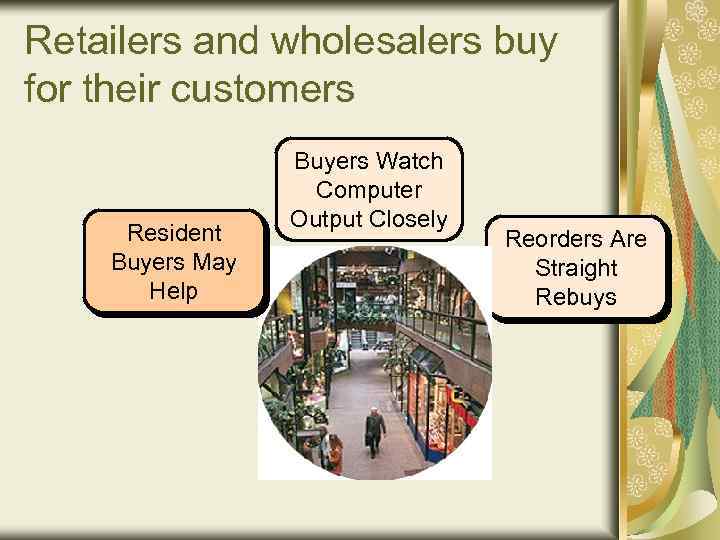
Retailers and wholesalers buy for their customers Resident Buyers May Help Buyers Watch Computer Output Closely Reorders Are Straight Rebuys
Types of E-Commerce Sites Bot Search Tool Sites Collaboration Hubs Exchanges Communities Procurement Hubs Seller’s Sites (provide info and take orders) Catalog Sites
What is a search “bot? ” A special software package that looks at all the sights on the Internet and finds where a specific product is mentioned The bot may compile information and prices or do comparisons between products. Gives buyers a better understanding of what alternatives exist.
