Скачать презентацию Awards 2004 June 9 2004 INTERNATIONAL MICROWAVE
eb3e346cc0212eb03057c342a5d98052.ppt
- Количество слайдов: 36
 Awards 2004 – June 9, 2004 INTERNATIONAL MICROWAVE SYMPOSIUM “MICROWAVE FRONTIERS” Fort Worth, Texas AWARDS MTT-S 2004 IEEE Microwave Theory and Techniques Society

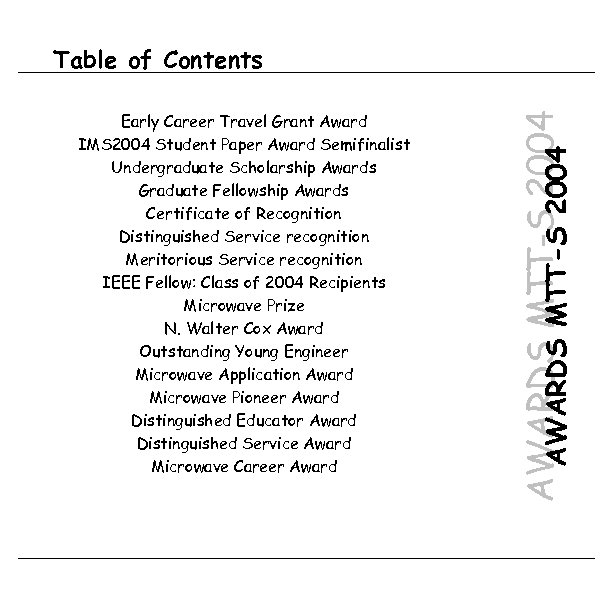 Early Career Travel Grant Award IMS 2004 Student Paper Award Semifinalist Undergraduate Scholarship Awards Graduate Fellowship Awards Certificate of Recognition Distinguished Service recognition Meritorious Service recognition IEEE Fellow: Class of 2004 Recipients Microwave Prize N. Walter Cox Award Outstanding Young Engineer Microwave Application Award Microwave Pioneer Award Distinguished Educator Award Distinguished Service Award Microwave Career Award AWARDS MTT-S 2004 Table of Contents

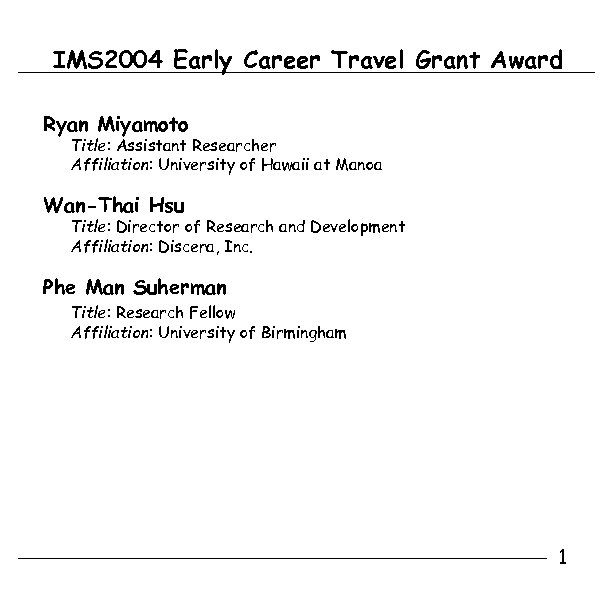 IMS 2004 Early Career Travel Grant Award Ryan Miyamoto Title: Assistant Researcher Affiliation: University of Hawaii at Manoa Wan-Thai Hsu Title: Director of Research and Development Affiliation: Discera, Inc. Phe Man Suherman Title: Research Fellow Affiliation: University of Birmingham 1
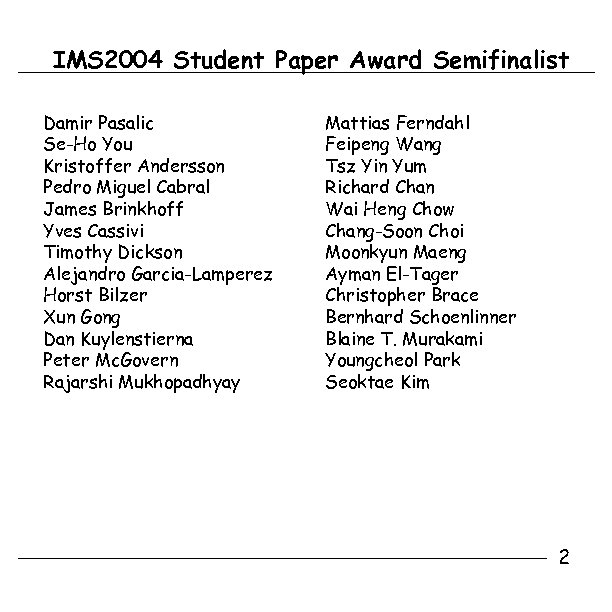 IMS 2004 Student Paper Award Semifinalist Damir Pasalic Se-Ho You Kristoffer Andersson Pedro Miguel Cabral James Brinkhoff Yves Cassivi Timothy Dickson Alejandro Garcia-Lamperez Horst Bilzer Xun Gong Dan Kuylenstierna Peter Mc. Govern Rajarshi Mukhopadhyay Mattias Ferndahl Feipeng Wang Tsz Yin Yum Richard Chan Wai Heng Chow Chang-Soon Choi Moonkyun Maeng Ayman El-Tager Christopher Brace Bernhard Schoenlinner Blaine T. Murakami Youngcheol Park Seoktae Kim 2
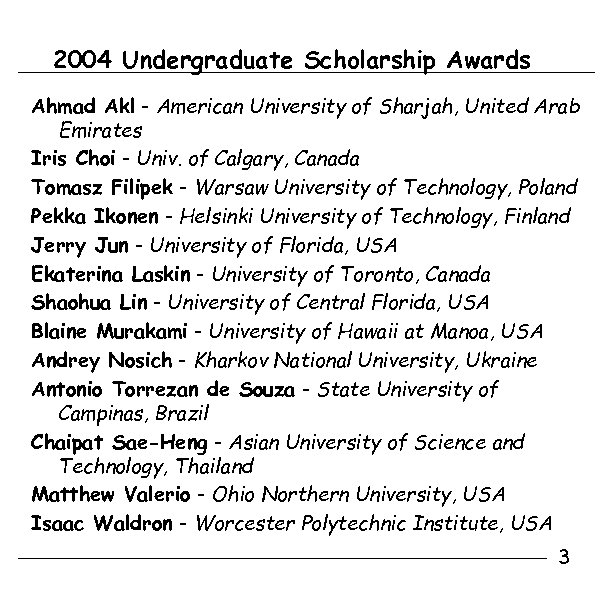 2004 Undergraduate Scholarship Awards Ahmad Akl - American University of Sharjah, United Arab Emirates Iris Choi - Univ. of Calgary, Canada Tomasz Filipek - Warsaw University of Technology, Poland Pekka Ikonen - Helsinki University of Technology, Finland Jerry Jun - University of Florida, USA Ekaterina Laskin - University of Toronto, Canada Shaohua Lin - University of Central Florida, USA Blaine Murakami - University of Hawaii at Manoa, USA Andrey Nosich - Kharkov National University, Ukraine Antonio Torrezan de Souza - State University of Campinas, Brazil Chaipat Sae-Heng - Asian University of Science and Technology, Thailand Matthew Valerio - Ohio Northern University, USA Isaac Waldron - Worcester Polytechnic Institute, USA 3
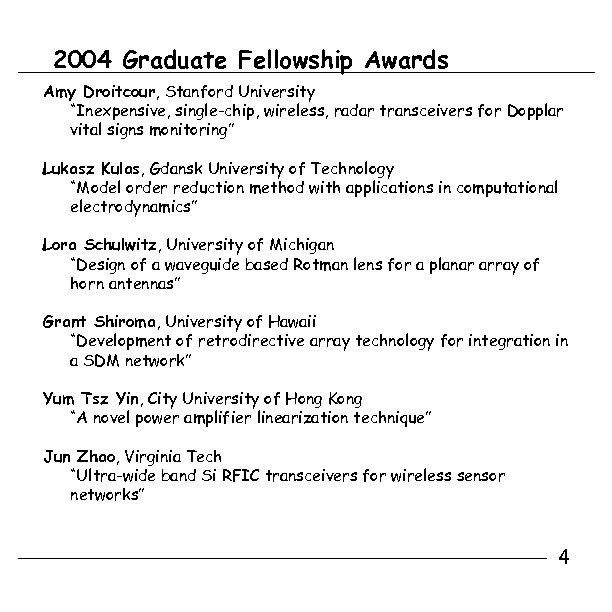 2004 Graduate Fellowship Awards Amy Droitcour, Stanford University “Inexpensive, single-chip, wireless, radar transceivers for Dopplar vital signs monitoring” Lukasz Kulas, Gdansk University of Technology “Model order reduction method with applications in computational electrodynamics” Lora Schulwitz, University of Michigan “Design of a waveguide based Rotman lens for a planar array of horn antennas” Grant Shiroma, University of Hawaii “Development of retrodirective array technology for integration in a SDM network” Yum Tsz Yin, City University of Hong Kong “A novel power amplifier linearization technique” Jun Zhao, Virginia Tech “Ultra-wide band Si RFIC transceivers for wireless sensor networks” 4
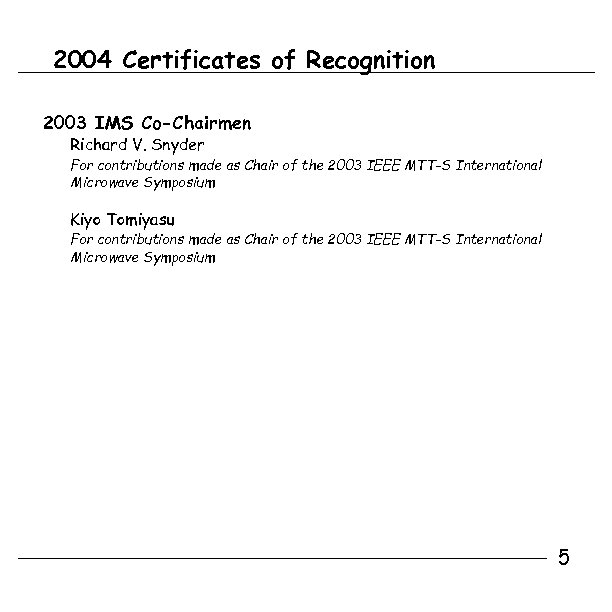 2004 Certificates of Recognition 2003 IMS Co-Chairmen Richard V. Snyder For contributions made as Chair of the 2003 IEEE MTT-S International Microwave Symposium Kiyo Tomiyasu For contributions made as Chair of the 2003 IEEE MTT-S International Microwave Symposium 5
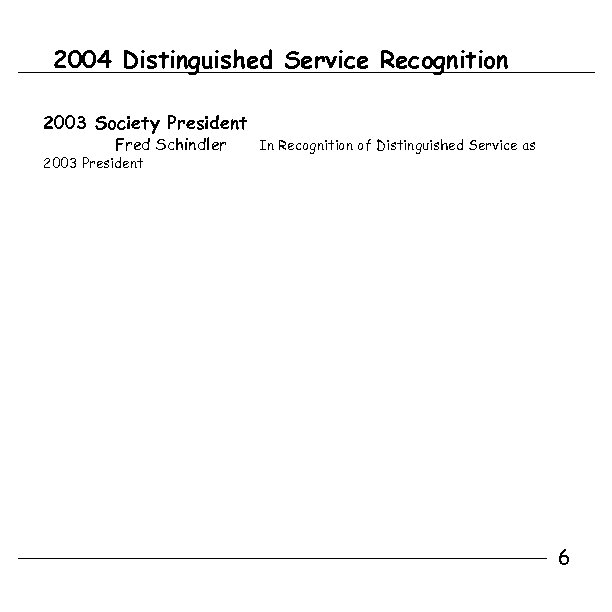 2004 Distinguished Service Recognition 2003 Society President Fred Schindler 2003 President In Recognition of Distinguished Service as 6
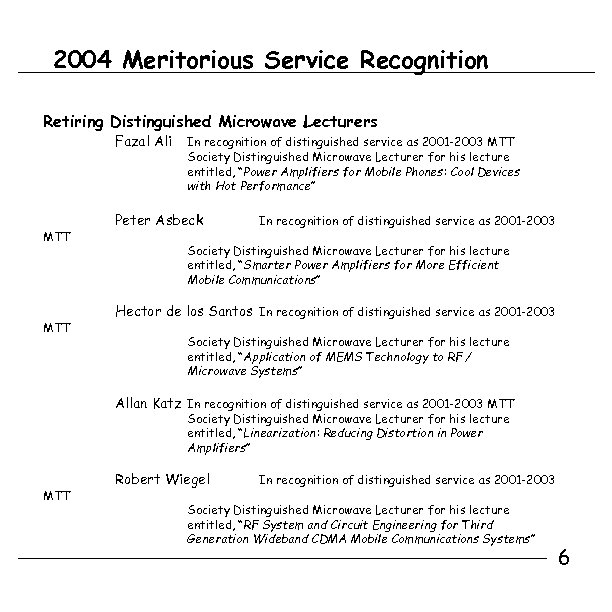 2004 Meritorious Service Recognition Retiring Distinguished Microwave Lecturers Fazal Ali MTT In recognition of distinguished service as 2001 -2003 MTT Society Distinguished Microwave Lecturer for his lecture entitled, “Power Amplifiers for Mobile Phones: Cool Devices with Hot Performance” Peter Asbeck In recognition of distinguished service as 2001 -2003 Society Distinguished Microwave Lecturer for his lecture entitled, “Smarter Power Amplifiers for More Efficient Mobile Communications” Hector de los Santos In recognition of distinguished service as 2001 -2003 Society Distinguished Microwave Lecturer for his lecture entitled, “Application of MEMS Technology to RF / Microwave Systems” Allan Katz In recognition of distinguished service as 2001 -2003 MTT Society Distinguished Microwave Lecturer for his lecture entitled, “Linearization: Reducing Distortion in Power Amplifiers” MTT Robert Wiegel In recognition of distinguished service as 2001 -2003 Society Distinguished Microwave Lecturer for his lecture entitled, “RF System and Circuit Engineering for Third Generation Wideband CDMA Mobile Communications Systems” 6
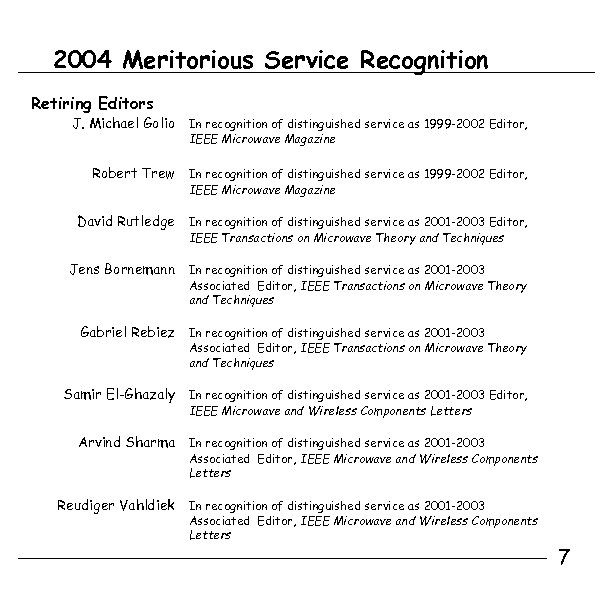 2004 Meritorious Service Recognition Retiring Editors J. Michael Golio In recognition of distinguished service as 1999 -2002 Editor, IEEE Microwave Magazine Robert Trew In recognition of distinguished service as 1999 -2002 Editor, IEEE Microwave Magazine David Rutledge In recognition of distinguished service as 2001 -2003 Editor, IEEE Transactions on Microwave Theory and Techniques Jens Bornemann In recognition of distinguished service as 2001 -2003 Associated Editor, IEEE Transactions on Microwave Theory and Techniques Gabriel Rebiez In recognition of distinguished service as 2001 -2003 Associated Editor, IEEE Transactions on Microwave Theory and Techniques Samir El-Ghazaly In recognition of distinguished service as 2001 -2003 Editor, IEEE Microwave and Wireless Components Letters Arvind Sharma In recognition of distinguished service as 2001 -2003 Associated Editor, IEEE Microwave and Wireless Components Letters Reudiger Vahldiek In recognition of distinguished service as 2001 -2003 Associated Editor, IEEE Microwave and Wireless Components Letters 7
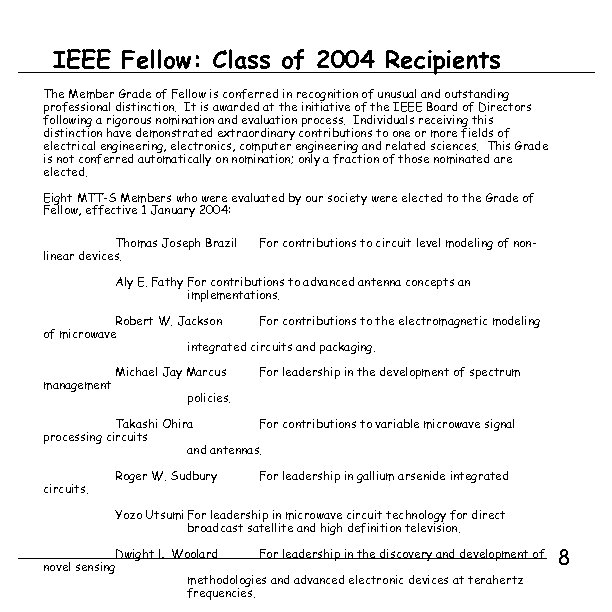 IEEE Fellow: Class of 2004 Recipients The Member Grade of Fellow is conferred in recognition of unusual and outstanding professional distinction. It is awarded at the initiative of the IEEE Board of Directors following a rigorous nomination and evaluation process. Individuals receiving this distinction have demonstrated extraordinary contributions to one or more fields of electrical engineering, electronics, computer engineering and related sciences. This Grade is not conferred automatically on nomination; only a fraction of those nominated are elected. Eight MTT-S Members who were evaluated by our society were elected to the Grade of Fellow, effective 1 January 2004: Thomas Joseph Brazil linear devices. For contributions to circuit level modeling of non- Aly E. Fathy For contributions to advanced antenna concepts an implementations. Robert W. Jackson For contributions to the electromagnetic modeling of microwave integrated circuits and packaging. management Michael Jay Marcus For leadership in the development of spectrum policies. Takashi Ohira For contributions to variable microwave signal processing circuits and antennas. circuits. Roger W. Sudbury For leadership in gallium arsenide integrated Yozo Utsumi For leadership in microwave circuit technology for direct broadcast satellite and high definition television. Dwight L. Woolard For leadership in the discovery and development of novel sensing methodologies and advanced electronic devices at terahertz frequencies. 8
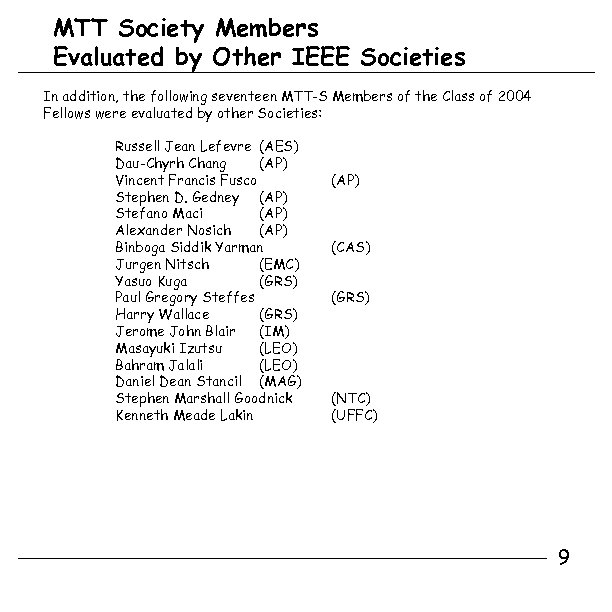 MTT Society Members Evaluated by Other IEEE Societies In addition, the following seventeen MTT-S Members of the Class of 2004 Fellows were evaluated by other Societies: Russell Jean Lefevre (AES) Dau-Chyrh Chang (AP) Vincent Francis Fusco Stephen D. Gedney (AP) Stefano Maci (AP) Alexander Nosich (AP) Binboga Siddik Yarman Jurgen Nitsch (EMC) Yasuo Kuga (GRS) Paul Gregory Steffes Harry Wallace (GRS) Jerome John Blair (IM) Masayuki Izutsu (LEO) Bahram Jalali (LEO) Daniel Dean Stancil (MAG) Stephen Marshall Goodnick Kenneth Meade Lakin (AP) (CAS) (GRS) (NTC) (UFFC) 9
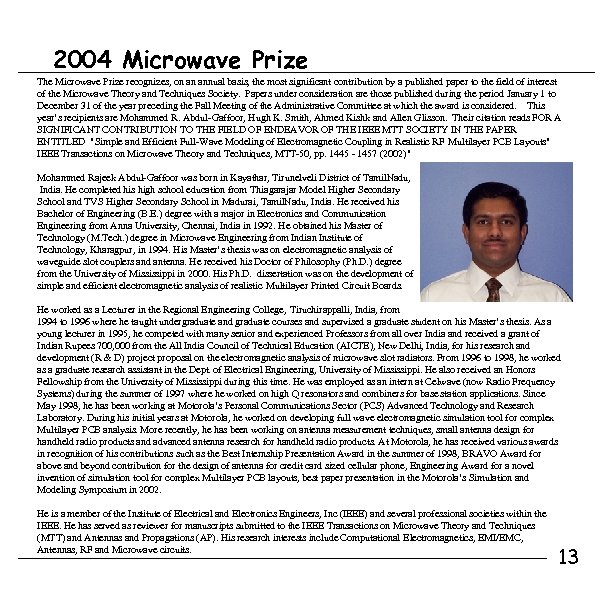 2004 Microwave Prize The Microwave Prize recognizes, on an annual basis, the most significant contribution by a published paper to the field of interest of the Microwave Theory and Techniques Society. Papers under consideration are those published during the period January 1 to December 31 of the year preceding the Fall Meeting of the Administrative Committee at which the award is considered. This year’s recipients are Mohammed R. Abdul-Gaffoor, Hugh K. Smith, Ahmed Kishk and Allen Glisson. Their citation reads FOR A SIGNIFICANT CONTRIBUTION TO THE FIELD OF ENDEAVOR OF THE IEEE MTT SOCIETY IN THE PAPER ENTITLED "Simple and Efficient Full-Wave Modeling of Electromagnetic Coupling in Realistic RF Multilayer PCB Layouts" IEEE Transactions on Microwave Theory and Techniques, MTT-50, pp. 1445 - 1457 (2002)" Mohammed Rajeek Abdul-Gaffoor was born in Kayathar, Tirunelveli District of Tamil. Nadu, India. He completed his high school education from Thiagarajar Model Higher Secondary School and TVS Higher Secondary School in Madurai, Tamil. Nadu, India. He received his Bachelor of Engineering (B. E. ) degree with a major in Electronics and Communication Engineering from Anna University, Chennai, India in 1992. He obtained his Master of Technology (M. Tech. ) degree in Microwave Engineering from Indian Institute of Technology, Kharagpur, in 1994. His Master’s thesis was on electromagnetic analysis of waveguide slot couplers and antenna. He received his Doctor of Philosophy (Ph. D. ) degree from the University of Mississippi in 2000. His Ph. D. dissertation was on the development of simple and efficient electromagnetic analysis of realistic Multilayer Printed Circuit Boards. He worked as a Lecturer in the Regional Engineering College, Tiruchirappalli, India, from 1994 to 1996 where he taught undergraduate and graduate courses and supervised a graduate student on his Master’s thesis. As a young lecturer in 1995, he competed with many senior and experienced Professors from all over India and received a grant of Indian Rupees 700, 000 from the All India Council of Technical Education (AICTE), New Delhi, India, for his research and development (R & D) project proposal on the electromagnetic analysis of microwave slot radiators. From 1996 to 1998, he worked as a graduate research assistant in the Dept. of Electrical Engineering, University of Mississippi. He also received an Honors Fellowship from the University of Mississippi during this time. He was employed as an intern at Celwave (now Radio Frequency Systems) during the summer of 1997 where he worked on high Q resonators and combiners for base station applications. Since May 1998, he has been working at Motorola’s Personal Communications Sector (PCS) Advanced Technology and Research Laboratory. During his initial years at Motorola, he worked on developing full wave electromagnetic simulation tool for complex Multilayer PCB analysis. More recently, he has been working on antenna measurement techniques, small antenna design for handheld radio products and advanced antenna research for handheld radio products. At Motorola, he has received various awards in recognition of his contributions such as the Best Internship Presentation Award in the summer of 1998, BRAVO Award for above and beyond contribution for the design of antenna for credit card sized cellular phone, Engineering Award for a novel invention of simulation tool for complex Multilayer PCB layouts, best paper presentation in the Motorola’s Simulation and Modeling Symposium in 2002. He is a member of the Institute of Electrical and Electronics Engineers, Inc (IEEE) and several professional societies within the IEEE. He has served as reviewer for manuscripts submitted to the IEEE Transactions on Microwave Theory and Techniques (MTT) and Antennas and Propagations (AP). His research interests include Computational Electromagnetics, EMI/EMC, Antennas, RF and Microwave circuits. 13
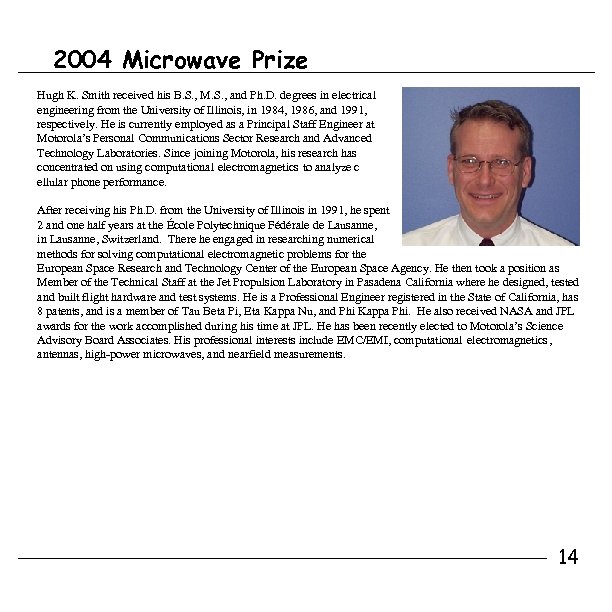 2004 Microwave Prize Hugh K. Smith received his B. S. , M. S. , and Ph. D. degrees in electrical engineering from the University of Illinois, in 1984, 1986, and 1991, respectively. He is currently employed as a Principal Staff Engineer at Motorola’s Personal Communications Sector Research and Advanced Technology Laboratories. Since joining Motorola, his research has concentrated on using computational electromagnetics to analyze c ellular phone performance. After receiving his Ph. D. from the University of Illinois in 1991, he spent 2 and one half years at the École Polytechnique Fédérale de Lausanne, in Lausanne, Switzerland. There he engaged in researching numerical methods for solving computational electromagnetic problems for the European Space Research and Technology Center of the European Space Agency. He then took a position as Member of the Technical Staff at the Jet Propulsion Laboratory in Pasadena California where he designed, tested and built flight hardware and test systems. He is a Professional Engineer registered in the State of California, has 8 patents, and is a member of Tau Beta Pi, Eta Kappa Nu, and Phi Kappa Phi. He also received NASA and JPL awards for the work accomplished during his time at JPL. He has been recently elected to Motorola’s Science Advisory Board Associates. His professional interests include EMC/EMI, computational electromagnetics, antennas, high-power microwaves, and nearfield measurements. 14
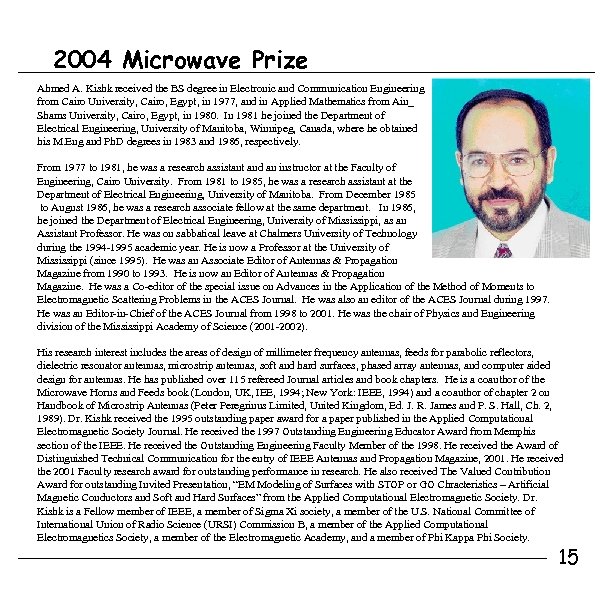 2004 Microwave Prize Ahmed A. Kishk received the BS degree in Electronic and Communication Engineering from Cairo University, Cairo, Egypt, in 1977, and in Applied Mathematics from Ain_ Shams University, Cairo, Egypt, in 1980. In 1981 he joined the Department of Electrical Engineering, University of Manitoba, Winnipeg, Canada, where he obtained his M. Eng and Ph. D degrees in 1983 and 1986, respectively. From 1977 to 1981, he was a research assistant and an instructor at the Faculty of Engineering, Cairo University. From 1981 to 1985, he was a research assistant at the Department of Electrical Engineering, University of Manitoba. From December 1985 to August 1986, he was a research associate fellow at the same department. In 1986, he joined the Department of Electrical Engineering, University of Mississippi, as an Assistant Professor. He was on sabbatical leave at Chalmers University of Technology during the 1994 -1995 academic year. He is now a Professor at the University of Mississippi (since 1995). He was an Associate Editor of Antennas & Propagation Magazine from 1990 to 1993. He is now an Editor of Antennas & Propagation Magazine. He was a Co-editor of the special issue on Advances in the Application of the Method of Moments to Electromagnetic Scattering Problems in the ACES Journal. He was also an editor of the ACES Journal during 1997. He was an Editor-in-Chief of the ACES Journal from 1998 to 2001. He was the chair of Physics and Engineering division of the Mississippi Academy of Science (2001 -2002). His research interest includes the areas of design of millimeter frequency antennas, feeds for parabolic reflectors, dielectric resonator antennas, microstrip antennas, soft and hard surfaces, phased array antennas, and computer aided design for antennas. He has published over 115 refereed Journal articles and book chapters. He is a coauthor of the Microwave Horns and Feeds book (London, UK, IEE, 1994; New York: IEEE, 1994) and a coauthor of chapter 2 on Handbook of Microstrip Antennas (Peter Peregrinus Limited, United Kingdom, Ed. J. R. James and P. S. Hall, Ch. 2, 1989). Dr. Kishk received the 1995 outstanding paper award for a paper published in the Applied Computational Electromagnetic Society Journal. He received the 1997 Outstanding Engineering Educator Award from Memphis section of the IEEE. He received the Outstanding Engineering Faculty Member of the 1998. He received the Award of Distinguished Technical Communication for the entry of IEEE Antennas and Propagation Magazine, 2001. He received the 2001 Faculty research award for outstanding performance in research. He also received The Valued Contribution Award for outstanding Invited Presentation, “EM Modeling of Surfaces with STOP or GO Chracteristics – Artificial Magnetic Conductors and Soft and Hard Surfaces” from the Applied Computational Electromagnetic Society. Dr. Kishk is a Fellow member of IEEE, a member of Sigma Xi society, a member of the U. S. National Committee of International Union of Radio Science (URSI) Commission B, a member of the Applied Computational Electromagnetics Society, a member of the Electromagnetic Academy, and a member of Phi Kappa Phi Society. 15
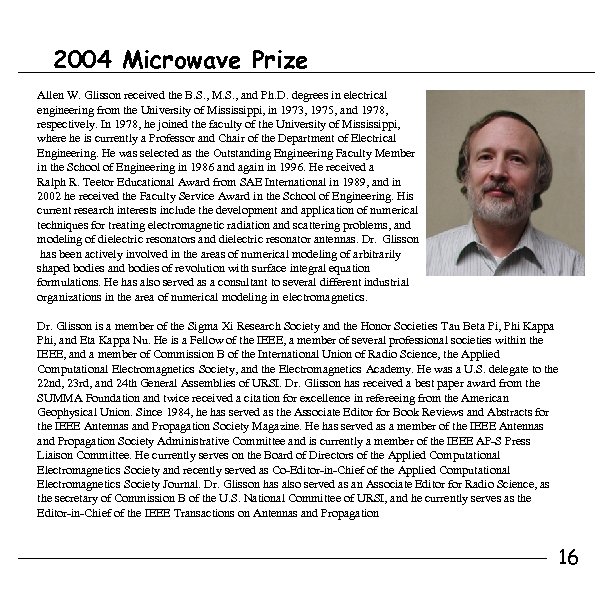 2004 Microwave Prize Allen W. Glisson received the B. S. , M. S. , and Ph. D. degrees in electrical engineering from the University of Mississippi, in 1973, 1975, and 1978, respectively. In 1978, he joined the faculty of the University of Mississippi, where he is currently a Professor and Chair of the Department of Electrical Engineering. He was selected as the Outstanding Engineering Faculty Member in the School of Engineering in 1986 and again in 1996. He received a Ralph R. Teetor Educational Award from SAE International in 1989, and in 2002 he received the Faculty Service Award in the School of Engineering. His current research interests include the development and application of numerical techniques for treating electromagnetic radiation and scattering problems, and modeling of dielectric resonators and dielectric resonator antennas. Dr. Glisson has been actively involved in the areas of numerical modeling of arbitrarily shaped bodies and bodies of revolution with surface integral equation formulations. He has also served as a consultant to several different industrial organizations in the area of numerical modeling in electromagnetics. Dr. Glisson is a member of the Sigma Xi Research Society and the Honor Societies Tau Beta Pi, Phi Kappa Phi, and Eta Kappa Nu. He is a Fellow of the IEEE, a member of several professional societies within the IEEE, and a member of Commission B of the International Union of Radio Science, the Applied Computational Electromagnetics Society, and the Electromagnetics Academy. He was a U. S. delegate to the 22 nd, 23 rd, and 24 th General Assemblies of URSI. Dr. Glisson has received a best paper award from the SUMMA Foundation and twice received a citation for excellence in refereeing from the American Geophysical Union. Since 1984, he has served as the Associate Editor for Book Reviews and Abstracts for the IEEE Antennas and Propagation Society Magazine. He has served as a member of the IEEE Antennas and Propagation Society Administrative Committee and is currently a member of the IEEE AP-S Press Liaison Committee. He currently serves on the Board of Directors of the Applied Computational Electromagnetics Society and recently served as Co-Editor-in-Chief of the Applied Computational Electromagnetics Society Journal. Dr. Glisson has also served as an Associate Editor for Radio Science, as the secretary of Commission B of the U. S. National Committee of URSI, and he currently serves as the Editor-in-Chief of the IEEE Transactions on Antennas and Propagation 16
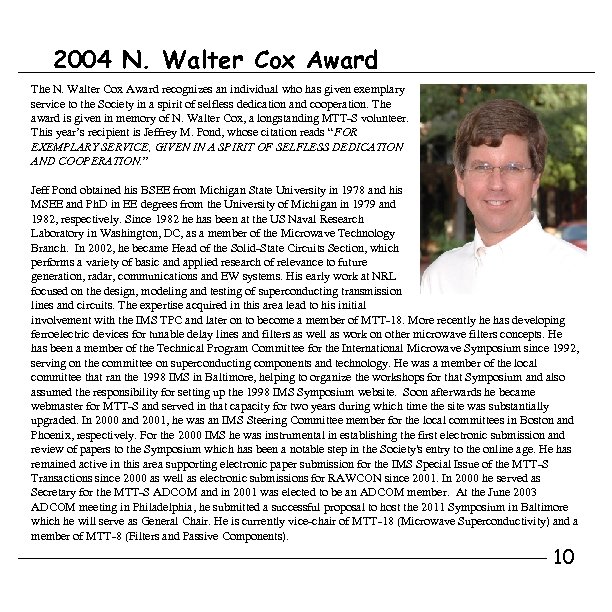 2004 N. Walter Cox Award The N. Walter Cox Award recognizes an individual who has given exemplary service to the Society in a spirit of selfless dedication and cooperation. The award is given in memory of N. Walter Cox, a longstanding MTT-S volunteer. This year’s recipient is Jeffrey M. Pond, whose citation reads “FOR EXEMPLARY SERVICE, GIVEN IN A SPIRIT OF SELFLESS DEDICATION AND COOPERATION. ” Jeff Pond obtained his BSEE from Michigan State University in 1978 and his MSEE and Ph. D in EE degrees from the University of Michigan in 1979 and 1982, respectively. Since 1982 he has been at the US Naval Research Laboratory in Washington, DC, as a member of the Microwave Technology Branch. In 2002, he became Head of the Solid-State Circuits Section, which performs a variety of basic and applied research of relevance to future generation, radar, communications and EW systems. His early work at NRL focused on the design, modeling and testing of superconducting transmission lines and circuits. The expertise acquired in this area lead to his initial involvement with the IMS TPC and later on to become a member of MTT-18. More recently he has developing ferroelectric devices for tunable delay lines and filters as well as work on other microwave filters concepts. He has been a member of the Technical Program Committee for the International Microwave Symposium since 1992, serving on the committee on superconducting components and technology. He was a member of the local committee that ran the 1998 IMS in Baltimore, helping to organize the workshops for that Symposium and also assumed the responsibility for setting up the 1998 IMS Symposium website. Soon afterwards he became webmaster for MTT-S and served in that capacity for two years during which time the site was substantially upgraded. In 2000 and 2001, he was an IMS Steering Committee member for the local committees in Boston and Phoenix, respectively. For the 2000 IMS he was instrumental in establishing the first electronic submission and review of papers to the Symposium which has been a notable step in the Society's entry to the online age. He has remained active in this area supporting electronic paper submission for the IMS Special Issue of the MTT-S Transactions since 2000 as well as electronic submissions for RAWCON since 2001. In 2000 he served as Secretary for the MTT-S ADCOM and in 2001 was elected to be an ADCOM member. At the June 2003 ADCOM meeting in Philadelphia, he submitted a successful proposal to host the 2011 Symposium in Baltimore which he will serve as General Chair. He is currently vice-chair of MTT-18 (Microwave Superconductivity) and a member of MTT-8 (Filters and Passive Components). 10

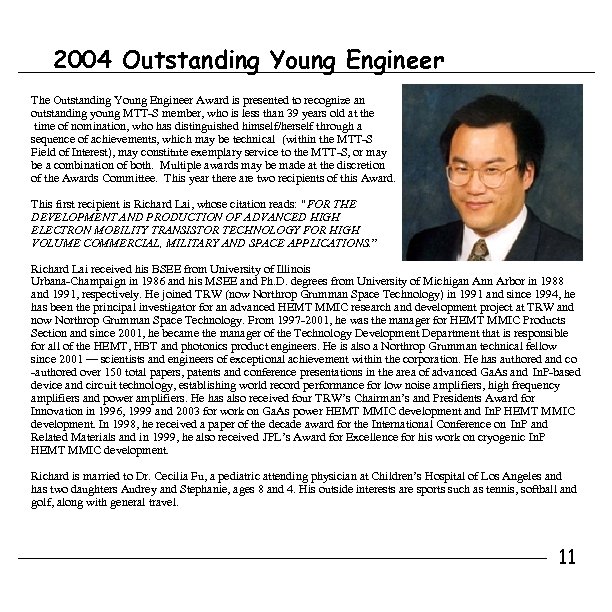 2004 Outstanding Young Engineer The Outstanding Young Engineer Award is presented to recognize an outstanding young MTT-S member, who is less than 39 years old at the time of nomination, who has distinguished himself/herself through a sequence of achievements, which may be technical (within the MTT-S Field of Interest), may constitute exemplary service to the MTT-S, or may be a combination of both. Multiple awards may be made at the discretion of the Awards Committee. This year there are two recipients of this Award. This first recipient is Richard Lai, whose citation reads: " FOR THE DEVELOPMENT AND PRODUCTION OF ADVANCED HIGH ELECTRON MOBILITY TRANSISTOR TECHNOLOGY FOR HIGH VOLUME COMMERCIAL, MILITARY AND SPACE APPLICATIONS. ” Richard Lai received his BSEE from University of Illinois Urbana-Champaign in 1986 and his MSEE and Ph. D. degrees from University of Michigan Ann Arbor in 1988 and 1991, respectively. He joined TRW (now Northrop Grumman Space Technology) in 1991 and since 1994, he has been the principal investigator for an advanced HEMT MMIC research and development project at TRW and now Northrop Grumman Space Technology. From 1997 -2001, he was the manager for HEMT MMIC Products Section and since 2001, he became the manager of the Technology Development Department that is responsible for all of the HEMT, HBT and photonics product engineers. He is also a Northrop Grumman technical fellow since 2001 — scientists and engineers of exceptional achievement within the corporation. He has authored and co -authored over 150 total papers, patents and conference presentations in the area of advanced Ga. As and In. P-based device and circuit technology, establishing world record performance for low noise amplifiers, high frequency amplifiers and power amplifiers. He has also received four TRW’s Chairman’s and Presidents Award for Innovation in 1996, 1999 and 2003 for work on Ga. As power HEMT MMIC development and In. P HEMT MMIC development. In 1998, he received a paper of the decade award for the International Conference on In. P and Related Materials and in 1999, he also received JPL’s Award for Excellence for his work on cryogenic In. P HEMT MMIC development. Richard is married to Dr. Cecilia Fu, a pediatric attending physician at Children’s Hospital of Los Angeles and has two daughters Audrey and Stephanie, ages 8 and 4. His outside interests are sports such as tennis, softball and golf, along with general travel. 11

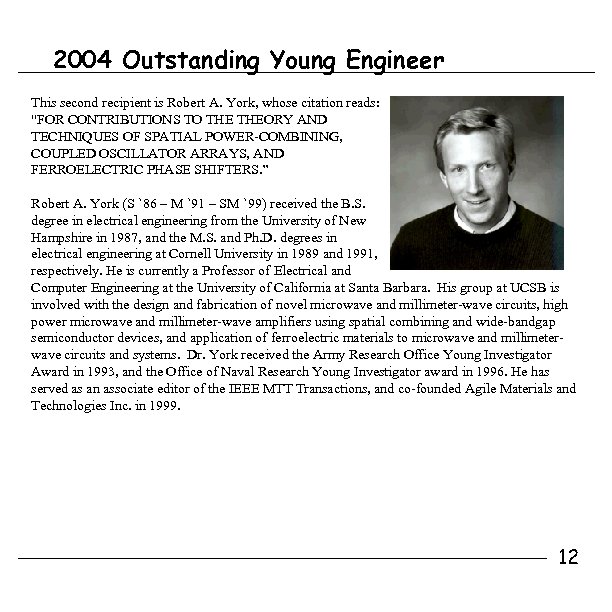 2004 Outstanding Young Engineer This second recipient is Robert A. York, whose citation reads: "FOR CONTRIBUTIONS TO THEORY AND TECHNIQUES OF SPATIAL POWER-COMBINING, COUPLED OSCILLATOR ARRAYS, AND FERROELECTRIC PHASE SHIFTERS. ” Robert A. York (S `86 – M `91 – SM `99) received the B. S. degree in electrical engineering from the University of New Hampshire in 1987, and the M. S. and Ph. D. degrees in electrical engineering at Cornell University in 1989 and 1991, respectively. He is currently a Professor of Electrical and Computer Engineering at the University of California at Santa Barbara. His group at UCSB is involved with the design and fabrication of novel microwave and millimeter-wave circuits, high power microwave and millimeter-wave amplifiers using spatial combining and wide-bandgap semiconductor devices, and application of ferroelectric materials to microwave and millimeterwave circuits and systems. Dr. York received the Army Research Office Young Investigator Award in 1993, and the Office of Naval Research Young Investigator award in 1996. He has served as an associate editor of the IEEE MTT Transactions, and co-founded Agile Materials and Technologies Inc. in 1999. 12

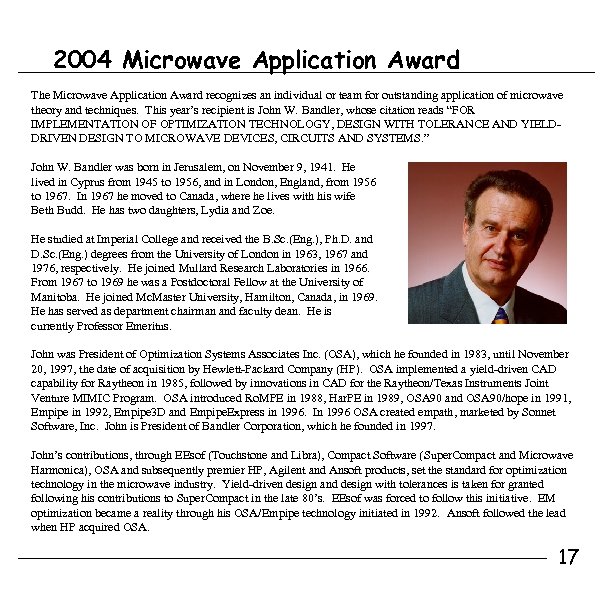 2004 Microwave Application Award The Microwave Application Award recognizes an individual or team for outstanding application of microwave theory and techniques. This year’s recipient is John W. Bandler, whose citation reads “FOR IMPLEMENTATION OF OPTIMIZATION TECHNOLOGY, DESIGN WITH TOLERANCE AND YIELDDRIVEN DESIGN TO MICROWAVE DEVICES, CIRCUITS AND SYSTEMS. ” John W. Bandler was born in Jerusalem, on November 9, 1941. He lived in Cyprus from 1945 to 1956, and in London, England, from 1956 to 1967. In 1967 he moved to Canada, where he lives with his wife Beth Budd. He has two daughters, Lydia and Zoe. He studied at Imperial College and received the B. Sc. (Eng. ), Ph. D. and D. Sc. (Eng. ) degrees from the University of London in 1963, 1967 and 1976, respectively. He joined Mullard Research Laboratories in 1966. From 1967 to 1969 he was a Postdoctoral Fellow at the University of Manitoba. He joined Mc. Master University, Hamilton, Canada, in 1969. He has served as department chairman and faculty dean. He is currently Professor Emeritus. John was President of Optimization Systems Associates Inc. (OSA), which he founded in 1983, until November 20, 1997, the date of acquisition by Hewlett-Packard Company (HP). OSA implemented a yield-driven CAD capability for Raytheon in 1985, followed by innovations in CAD for the Raytheon/Texas Instruments Joint Venture MIMIC Program. OSA introduced Ro. MPE in 1988, Har. PE in 1989, OSA 90 and OSA 90/hope in 1991, Empipe in 1992, Empipe 3 D and Empipe. Express in 1996. In 1996 OSA created empath, marketed by Sonnet Software, Inc. John is President of Bandler Corporation, which he founded in 1997. John’s contributions, through EEsof (Touchstone and Libra), Compact Software (Super. Compact and Microwave Harmonica), OSA and subsequently premier HP, Agilent and Ansoft products, set the standard for optimization technology in the microwave industry. Yield-driven design and design with tolerances is taken for granted following his contributions to Super. Compact in the late 80’s. EEsof was forced to follow this initiative. EM optimization became a reality through his OSA/Empipe technology initiated in 1992. Ansoft followed the lead when HP acquired OSA. 17
 2004 Microwave Application Award John was Associate Editor of the IEEE Transactions on Microwave Theory and Techniques (1969 -1974), member of the editorial board and guest editor of several special issues (1974, 1992, 1997, 2004). He served on the editorial boards or as guest editor of other journals, most recently Optimization and Engineering Special Issue on Surrogate Modelling and Space Mapping for Engineering Optimization (2001). He was a Chair of the MTT-1 Technical Committee on Computer-Aided Design. John published more than 360 papers. He contributed to Modern Filter Theory and Design, Wiley- Interscience, 1973 and to Analog Methods for Computer-aided Analysis and Diagnosis, Marcel Dekker, Inc. , 1988. IEEE Press and Artech House have reprinted many of his papers. Al Wexler and Bill Getsinger encouraged John’s initial work. Witold Kellermann and Shahrokh Daijavad were early OSA collaborators. Bob Pucel and Jim Rautio helped propel OSA’s advance. Steve Chen, Radek Biernacki and Q. J. Zhang seminally contributed to OSA’s impact. John’s twenty-five years of collaboration with Kaj Madsen continues. John became a Fellow of the IEEE in 1978, the Royal Society of Canada in 1987 and the Canadian Academy of Engineering in 2003. He received the Automatic Radio Frequency Techniques Group (ARFTG) Automated Measurements Career Award in 1994. In 1977 John was invited and attended a dinner and a reception in Ottawa attended by Her Majesty the Queen and His Royal Highness the Duke of Edinburgh. The occasion was the Queen’s Silver Jubilee and a tribute to young Canadians who had achieved excellence in the Arts and Sciences. In 1995 he began painting, principally in acrylic, inspired by abstract, expressionist and surrealist works. He is currently completing the first draft of his first novel, set in Cyprus during the island’s violent final years as a British Crown colony. 18
 2004 Microwave Pioneer Award The Microwave Pioneer Award recognizes an individual or a team not exceeding three persons having made outstanding pioneering technical contributions that advance microwave theory and techniques and described in an archival paper published at least 20 years prior to the year of the award. This year’s recipient is Gerald F. Ross, whose citation reads: " FOR PIONEERING CONTRIBUTIONS TO THEORY AND DEVELOPMENT OF TIME-DOMAIN ELECTROMAGNETICS AND ITS APPLICATION TO METROLOGY AND ULTRA-WIDEBAND RADAR AND COMMUNICATION SYSTEMS. ” Gerald Ross was born in 1930 and educated, primarily, in the New York City area. Early on, he attended Brooklyn Technical High School where at 15 he became the youngest person in the United States to receive a FCC First Class radiotelephone license. After high school, he attended the City College of New York (CCNY) where he graduated with a BEE degree in 1952. After graduation, he accepted a position as a Research Assistant at the Willow Run Research Center, Ann Arbor, Michigan. He worked at this position for six months, when he agreed to accept a field assignment at the University’s Air Force test site in Alamogordo, New Mexico. At this site, he developed the electronics for the nose-on radar cross section of targets in anticipation of the ICBM threat that occurred years later. Shortly thereafter, he was called to active duty where he served as an Electronics Officer in Alamogordo doing the same work. When released from the Air Force in 1953, he returned to NYC to marry and found an electronics position at the Sperry Gyroscope Company. While working at Sperry he attended night classes at the, then, Polytechnic Institute. He eventually received his MEE (1955) and his Ph. D. (1963) from Brooklyn Polytechnic Institute (now Polytechnic University). 19
 2004 Microwave Pioneer Award Before receiving his Ph. D. degree, he had asked Professor Athanasios Papoulis to be his dissertation advisor. At that time, Professor Papoulis was writing his now famous book on “The Fourier Integral and its Applications”. And Gerald Ross was his only student. After receiving his Ph. D. in June 1963, Gerald Ross continued working in microwave network and antenna design using time domain electromagnetic techniques; this work has continued for another 40 years. After graduation, he transferred to the Sperry Research Center, Sudbury, where as a Department Manager, he hired a group of 16 very talented engineers that helped him over the period of 1965 -1980 to further solve and develop many of the time domain electromagnetic techniques that are still being used today. In 1980, Dr. Ross formed ANRO Engineering where the work in time domain electromagnetics continues today. Some of the areas developed include metrology, short-range radar, and communication systems known today and referred to by many as Ultra Wideband (UWB) technology. His peers recognize, for example, that his work in time domain metrology was instrumental in the development of the stealth aircraft. Now others are doing this work in the field of tissue research. Dr. Ross was elected as a University Fellow at Polytechnic University for his contributions to microwaves technology in 1990. He was elected a Member of the National Academy of Engineering for his contributions to UWB technology and time domain metrology in 1995. He has published more than 70 papers in accredited journals and is a contributing author to three texts, and holds 60 patents in the field. Dr. Ross is currently CEO and Chairman of ANRO Engineering and also Chairman of, Ana. Lux, Inc, a spin-off company, incorporating both UWB and optical technology 20
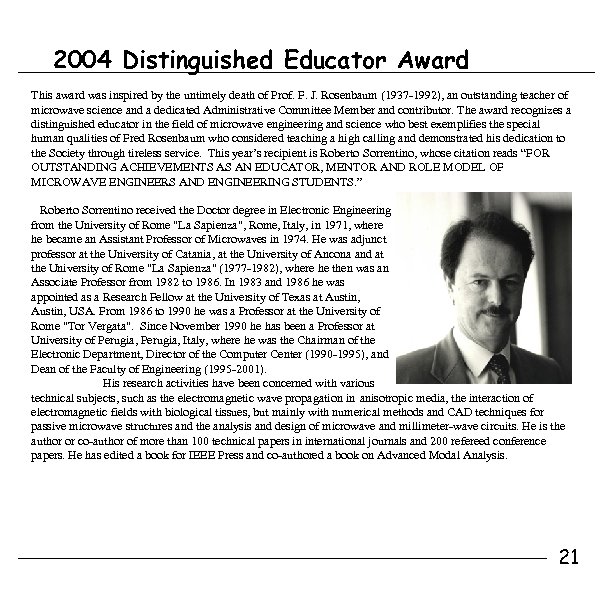 2004 Distinguished Educator Award This award was inspired by the untimely death of Prof. F. J. Rosenbaum (1937 -1992), an outstanding teacher of microwave science and a dedicated Administrative Committee Member and contributor. The award recognizes a distinguished educator in the field of microwave engineering and science who best exemplifies the special human qualities of Fred Rosenbaum who considered teaching a high calling and demonstrated his dedication to the Society through tireless service. This year’s recipient is Roberto Sorrentino, whose citation reads “FOR OUTSTANDING ACHIEVEMENTS AS AN EDUCATOR, MENTOR AND ROLE MODEL OF MICROWAVE ENGINEERS AND ENGINEERING STUDENTS. ” Roberto Sorrentino received the Doctor degree in Electronic Engineering from the University of Rome "La Sapienza", Rome, Italy, in 1971, where he became an Assistant Professor of Microwaves in 1974. He was adjunct professor at the University of Catania, at the University of Ancona and at the University of Rome "La Sapienza" (1977 -1982), where he then was an Associate Professor from 1982 to 1986. In 1983 and 1986 he was appointed as a Research Fellow at the University of Texas at Austin, USA. From 1986 to 1990 he was a Professor at the University of Rome "Tor Vergata". Since November 1990 he has been a Professor at University of Perugia, Italy, where he was the Chairman of the Electronic Department, Director of the Computer Center (1990 -1995), and Dean of the Faculty of Engineering (1995 -2001). His research activities have been concerned with various technical subjects, such as the electromagnetic wave propagation in anisotropic media, the interaction of electromagnetic fields with biological tissues, but mainly with numerical methods and CAD techniques for passive microwave structures and the analysis and design of microwave and millimeter-wave circuits. He is the author or co-author of more than 100 technical papers in international journals and 200 refereed conference papers. He has edited a book for IEEE Press and co-authored a book on Advanced Modal Analysis. 21
 2004 Distinguished Educator Award In 1990 he has become a Fellow of the IEEE “for contribution to the modelling of planar and quasi-planar microwave and millimeter-wave circuits”. In 1993 he was the recipient of the MTT-S Meritorious Service Award. From January 1995 through April 1998 he was the Editor-in-Chief of the IEEE Microwave and Guided Wave Letters. In 2000 he was one of the recipients of the IEEE Third Millennium Medal. From 1984 through 1987 he was the Chairman of the IEEE Section of Central and South Italy and was the founder of the local MTT/AP Chapter that he chaired from 1984 to 1987. He served on the Administrative Committee of the IEEE Microwave Theory and Techniques Society from 1998 to 2003. He is the Chairman of the Technical Committee MTT-1 on Computer-Aided Design. Roberto Sorrentino served the International Union of Radio Science (URSI) as Vice Chair (1993 -1996) then Chair (1996 -1999) of the Commission D (Electronics and Photonics). Since 1996 he has been the Chairman of the Management Committee of the European Microwave Conference. He was one of the founders of the European Microwave Association (Eu. MA) and has been its President since its constitution in 1998. In 2002 he was among the founders and first President of the Italian Electromagnetic Society ( SIEm) that he is still presiding. Since 1998 he has been a member of the High Technical Council of the Italian Ministry of Communications. 22
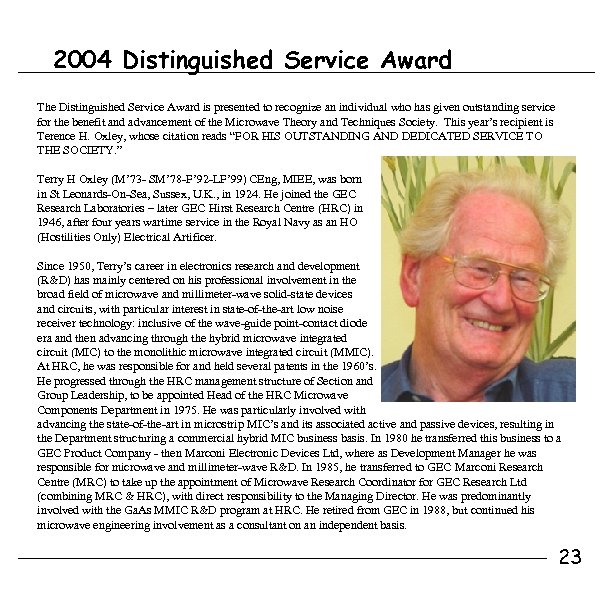 2004 Distinguished Service Award The Distinguished Service Award is presented to recognize an individual who has given outstanding service for the benefit and advancement of the Microwave Theory and Techniques Society. This year’s recipient is Terence H. Oxley, whose citation reads “FOR HIS OUTSTANDING AND DEDICATED SERVICE TO THE SOCIETY. ” Terry H Oxley (M’ 73 - SM’ 78 -F’ 92 -LF’ 99) CEng, MIEE, was born in St Leonards-On-Sea, Sussex, U. K. , in 1924. He joined the GEC Research Laboratories – later GEC Hirst Research Centre (HRC) in 1946, after four years wartime service in the Royal Navy as an HO (Hostilities Only) Electrical Artificer. Since 1950, Terry’s career in electronics research and development (R&D) has mainly centered on his professional involvement in the broad field of microwave and millimeter-wave solid-state devices and circuits, with particular interest in state-of-the-art low noise receiver technology: inclusive of the wave-guide point-contact diode era and then advancing through the hybrid microwave integrated circuit (MIC) to the monolithic microwave integrated circuit (MMIC). At HRC, he was responsible for and held several patents in the 1960’s. He progressed through the HRC management structure of Section and Group Leadership, to be appointed Head of the HRC Microwave Components Department in 1975. He was particularly involved with advancing the state-of-the-art in microstrip MIC’s and its associated active and passive devices, resulting in the Department structuring a commercial hybrid MIC business basis. In 1980 he transferred this business to a GEC Product Company - then Marconi Electronic Devices Ltd, where as Development Manager he was responsible for microwave and millimeter-wave R&D. In 1985, he transferred to GEC Marconi Research Centre (MRC) to take up the appointment of Microwave Research Coordinator for GEC Research Ltd (combining MRC & HRC), with direct responsibility to the Managing Director. He was predominantly involved with the Ga. As MMIC R&D program at HRC. He retired from GEC in 1988, but continued his microwave engineering involvement as a consultant on an independent basis. 23
 2004 Distinguished Service Award Terry has authored or co-authored some 100 scientific/technical publications and has edited many monographs/books/etc. He has participated in many professional committees and working parties, including classified meetings. He has been involved in many worldwide technical conferences: as speaker, panel session member, technical program committee (TPC) member, etc. He has lectured at many UK University microwave courses, including the internationally attended UK Microwave Vacation School series, organized by Leeds University. Awards have included Her Majesty’s Silver Jubilee Medal in 1977 for his contribution to advancements in microwave components; and in 1989, the GEC Nelson Gold Medal for Company technical achievement. Elected as an IEEE Fellow in 1992, he achieved Life Fellow status in 1999. Some of his many professional activities since retirement from the GEC have included: Chairman of the IEEE UKRI MTT/ED/AP/LEO Chapter Administrative Committee; Editor for the IEEE EDS Newsletter; European liaison for IEEE MTT-S; and TPC service for the MTT-S International Microwave Symposium, the Military Microwaves and the Microwave & RF Conference events. During this period, he received the IEEE Region 8 Section Volunteer Award and the IEEE MTT-S Meritorious Service Award 24
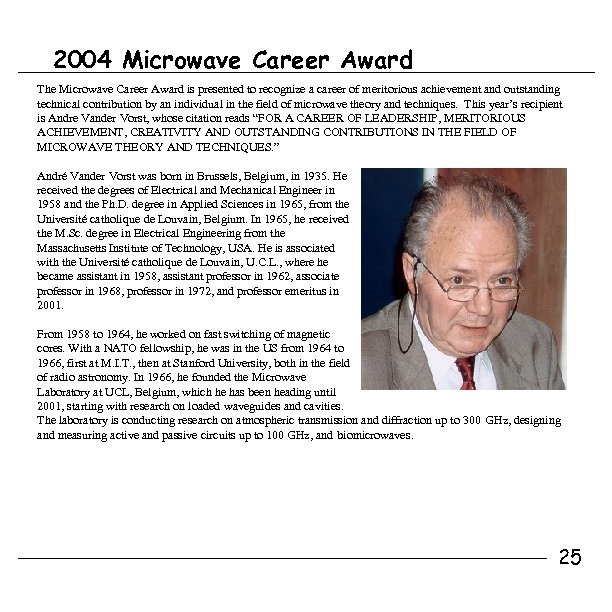 2004 Microwave Career Award The Microwave Career Award is presented to recognize a career of meritorious achievement and outstanding technical contribution by an individual in the field of microwave theory and techniques. This year’s recipient is Andre Vander Vorst, whose citation reads “FOR A CAREER OF LEADERSHIP, MERITORIOUS ACHIEVEMENT, CREATIVITY AND OUTSTANDING CONTRIBUTIONS IN THE FIELD OF MICROWAVE THEORY AND TECHNIQUES. ” André Vander Vorst was born in Brussels, Belgium, in 1935. He received the degrees of Electrical and Mechanical Engineer in 1958 and the Ph. D. degree in Applied Sciences in 1965, from the Université catholique de Louvain, Belgium. In 1965, he received the M. Sc. degree in Electrical Engineering from the Massachusetts Institute of Technology, USA. He is associated with the Université catholique de Louvain, U. C. L. , where he became assistant in 1958, assistant professor in 1962, associate professor in 1968, professor in 1972, and professor emeritus in 2001. From 1958 to 1964, he worked on fast switching of magnetic cores. With a NATO fellowship, he was in the US from 1964 to 1966, first at M. I. T. , then at Stanford University, both in the field of radio astronomy. In 1966, he founded the Microwave Laboratory at UCL, Belgium, which he has been heading until 2001, starting with research on loaded waveguides and cavities. The laboratory is conducting research on atmospheric transmission and diffraction up to 300 GHz, designing and measuring active and passive circuits up to 100 GHz, and biomicrowaves. 25
 2004 Microwave Career Award He was Head of the Electrical Engineering Department from 1970 to 1972, Dean of Engineering from 1972 to 1975, Vice-President of the Academic Council from 1973 to 1975, President of the Open School in Economic and Social Politics from 1973 to 1987, all at UCL, Belgium. He has been teaching in four Belgian universities. He is or has been a member of the National Committee of URSI and of various committees on communications, microwaves, and education. He is or has been active in IEEE Region 8 and MTT-S as well as in the European Microwave Conferences. He is a founder member of a number of associations, including social and cultural associations, in particular the European Microwave Association. He is a cofounder and scientific advisor of the company Microwave Circuits and Systems, Mi. C 6. He has authored or coauthored six books, several chapters, and a variety of scientific and technical papers in international journals and proceedings. He is a member of Academia Europaea and The Electromagnetics Academy. He has obtained the Sitel prize 1986, the meritorious service award of the Microwave Theory and Technique Society, I. E. E. E. 1994, and the IEEE Third Millennium Medal, 2000. He is a fellow of the I. E. E. E. 1985 for his contributions in atmospheric microwave propagation, satellite communication earth station design, and numerical analysis of microwave components 26