 Скачать презентацию Avoiding Hobson s Choice In Choosing An Ontology Ontolog
965136712bf87648dab5a300c388007d.ppt
- Количество слайдов: 47



Avoiding Hobson's Choice In Choosing An Ontology Ontolog Presentation 27 April, 2006 Jack Park – jack. park@sri. com Patrick Durusau – patrick@durusau. net © 2006, Jack Park and Patrick Durusau License: http: //creativecommons. org/licenses/by/2. 5/legalcode 1
Abstract Most users of ontologies have either participated in the development of the ontology they use and/or have used it for such a period of time that they have taken ownership of it. Like a hand that grows to fit a tool, users grow comfortable with "their" ontology and can use another only with difficulty and possibly high error rates. When agencies discuss sharing information, the tendency is to offer other participants a "Hobson's Choice" of ontologies. "Of course we will use ontology X. " which just happens to be the ontology of the speaker. Others make similar offers. Much discussion follows. But not very often effective integration of information. In all fairness to the imagined participants in such a discussion, unfamiliar ontologies can lead to errors and/or misunderstandings that may actually impede the interchange, pardon, the accurate interchange information. Super-ontologies don't help much when they lack the granularity needed for real tasks and simply put off the day of reckoning when actual data has to move between agencies. 2
The Topic Maps Reference Model is a paradigm for constructing a mapping of ontologies that enables users to use "their" ontologies while integrating information that may have originated in ontologies that are completely foreign or even unknown to the user. Such mappings can support full auditing of the process of integrating information to enable users to develop a high degree of confidence in the mapping. Topic maps rely upon the fact that every part of an ontology is in fact representing a subject. And the subject that is being represented is known from the properties of those representatives. Such representatives are called subject proxies in the Topic Maps Reference Model. Those properties are used as the basis for determining when two or more subject proxies represent the same subject. Information from two or more representatives of the same subject can be merged together, providing users with information about a subject that may not have been known in their ontology. Park and Durusau explore the philosophical, theoretical and practical steps needed to avoid a Hobson's Choice in ontology discussions and to use the Topic Maps Reference Model to effectively integrate information with a high degree of confidence in the results. All while enabling users to use the ontology that is most familiar and comfortable for them. 3
Outline • • Hobson’s Choice Choosing an Ontology Federation Subject Maps Federating Ontologies with Subject Maps Observations Conclusion 4
Hobson’s Choice • Cambridge, England 16 th-17 th Century • Renting horses to students, who requested the same horses • Some horses being overworked • Hobson’s Choice: Take the horse closest to the door, or take none at all • Appearance of free choice where none exists at all 5
Who uses ontologies? • Fact: – Most knowledge/information users rely on ontologies of one sort or another • Including libraries, research institutes, financial institutes, schools, governments, and more • Premise: – All meaningful information is recorded with respect to some ontology • That is, all information is thought to mean something when recorded 6
Where do ontologies come from? • • Handed out at graduation? No. Wedding present? No With Drivers License? No With Voter Registration? No • Hmmm, where do ontologies come from? 7
Where Ontologies Come From • People use concepts that represent their world view – Those concepts have relationships to other concepts – Those concepts and relationships are associated with the real world – Actions are taken and reasoning based upon those concepts • Bottom line is that we are the source of ontologies 8
Hobson’s Choice and Ontologies • To “ontologize” Ontolog an ontology is required • Which ontology? “Well, the one closest to my door of course!” • Problem: We all have different doors next to which stand our ontologies. • Solution: “The choice is obvious, we will use (insert your ontology). ” 9
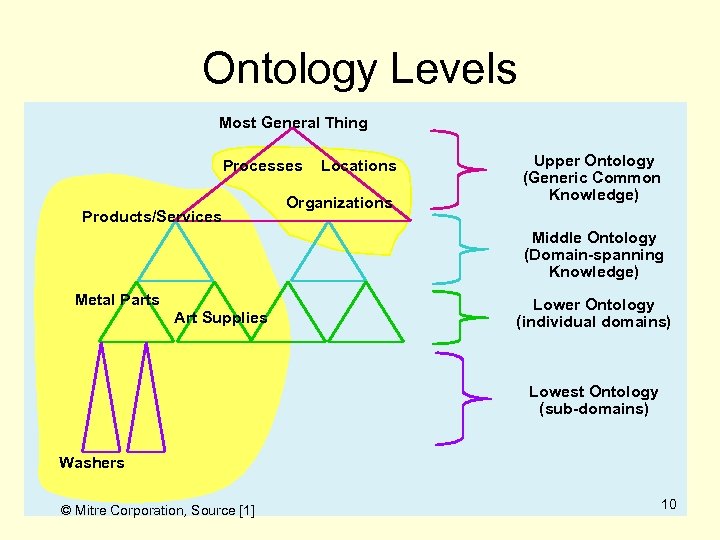
Ontology Levels Most General Thing Processes Products/Services Locations Organizations Upper Ontology (Generic Common Knowledge) Middle Ontology (Domain-spanning Knowledge) Metal Parts Art Supplies Lower Ontology (individual domains) Lowest Ontology (sub-domains) Washers © Mitre Corporation, Source [1] 10
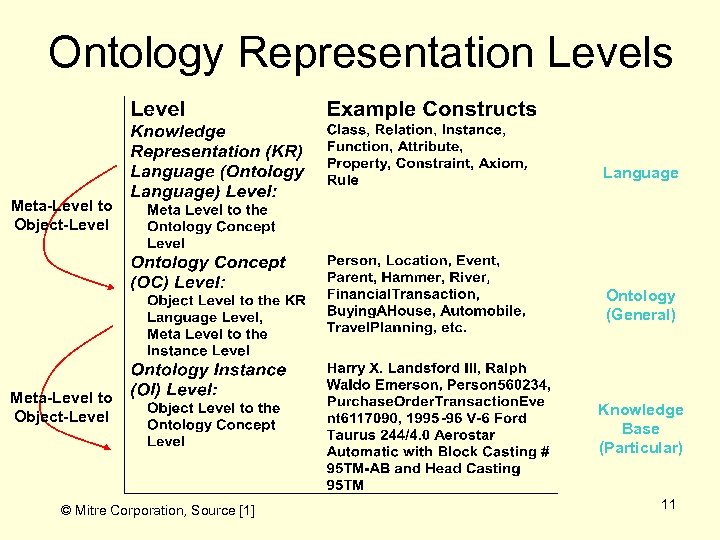
Ontology Representation Levels Language Meta-Level to Object-Level Ontology (General) Meta-Level to Object-Level © Mitre Corporation, Source [1] Knowledge Base (Particular) 11
Freedom of Choice? • Facts – Upper ontologies are diverse – Middle ontologies are even more diverse – Lower ontologies are more diverse still • Premise: Ontological diversity is a given and increases as we approach users. • Conclusion: Do we give users a Hobson’s Choice? My way or the highway? • Federation anyone? 12
Federation • Requirements – Use with any ontology (formal or otherwise) – Maintain ontological diversity – Merge information from diverse ontologies – Maintain audit trails for information – Preserve individual world views in merged subjects – Create wormholes between ontologies 13
Federation 2 • Benefits – No Hobson’s choice for architects, designers or users of information systems – User interact with system that reflects their world view (greater accuracy, less training) – Designers build systems using their world views – Architects reach understandings that span particular world views 14
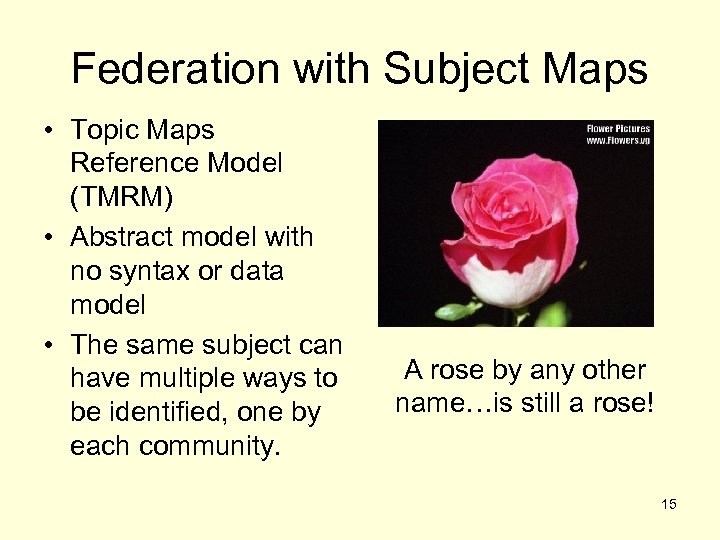
Federation with Subject Maps • Topic Maps Reference Model (TMRM) • Abstract model with no syntax or data model • The same subject can have multiple ways to be identified, one by each community. A rose by any other name…is still a rose! 15
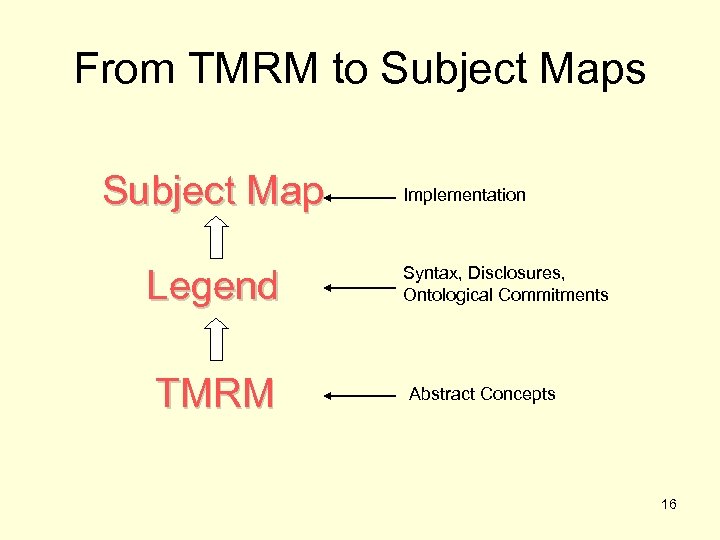
From TMRM to Subject Maps Subject Map Legend TMRM Implementation Syntax, Disclosures, Ontological Commitments Abstract Concepts 16
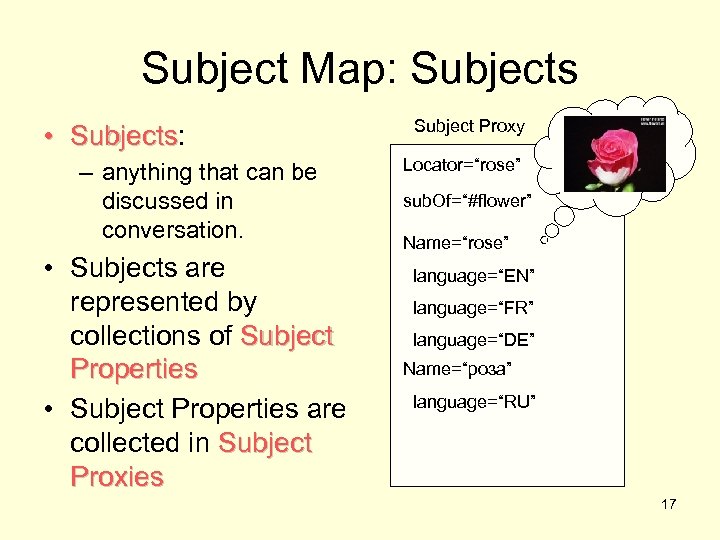
Subject Map: Subjects • Subjects: Subjects – anything that can be discussed in conversation. • Subjects are represented by collections of Subject Properties • Subject Properties are collected in Subject Proxies Subject Proxy Locator=“rose” sub. Of=“#flower” Name=“rose” language=“EN” language=“FR” language=“DE” Name=“роза” language=“RU” 17
Subject Map: Subject Proxies • One, and only one proxy exists for any particular subject in a subject map. • Proxies serve as binding points for all that is known about a subject • Proxies marshal properties: – Subject Identity – Relationships with other subjects – Other properties of the subject 18
Subject Map: Subject Properties • Properties are key/value pairs • Property Keys are references to other subjects disclosed* in the map • Property values can be – References to other proxies – Literals * More on disclosure following 19
Subject Map: Disclosure • TMRM specifies the requirement for a legend • Legend authors disclose: disclose – Merging rules – Subject Property types • Legends govern the ontological commitments that can made by a proxy author 20
Subject Map: Merging • Merging rules define when two or more proxies represent the same subject • If subject maps are merged from different property/merging disclosures (legends), those disclosures continue to govern the properties they define 21
Subject Maps/RDF: Separated at Birth? • Triples: – RDF: subject : predicate : object • Subjects, predicates, objects: identified by single URI – TMRM: subject : (key : value) (repeatable) Subject identified by any number of key/value pairs. Subjects do not appear in a subject map but are identified in one. 22
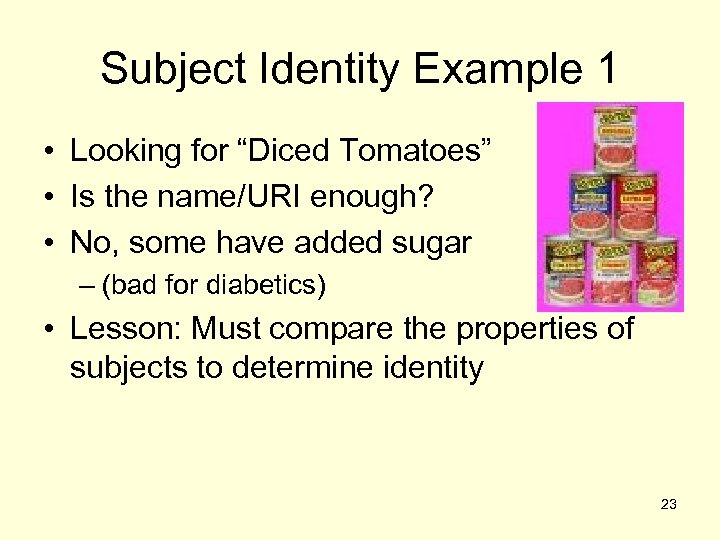
Subject Identity Example 1 • Looking for “Diced Tomatoes” • Is the name/URI enough? • No, some have added sugar – (bad for diabetics) • Lesson: Must compare the properties of subjects to determine identity 23
Example 1 Extended • Keys of the diced tomatoes – Nutrition information: all list sugar – Ingredients: some list sugar • So which to consider? Nutrition or Ingredients? • Keys alone are not enough – Must know which subject each key represents 24
Subject Identity Summary • • Properties identify subjects Properties = key/value pairs Keys are references to subject proxies Values maybe references to subject proxies • Properties represent ontological commitments of the author 25
Federation with Subject Maps • Concepts in ontologies represent subjects • Concepts in ontologies have properties (either literals or relationships to other concepts) • Need to disclose the properties that identify the subject to be represented (basis for merging rules) 26
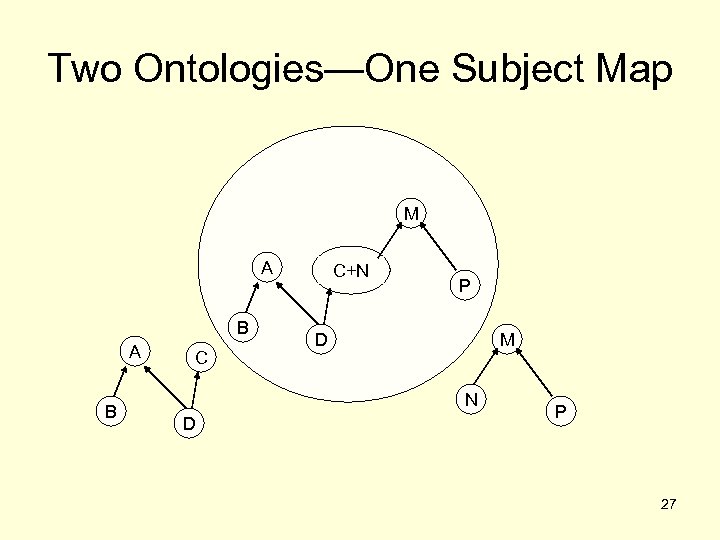
Two Ontologies—One Subject Map M A B C C+N P D M N D P 27
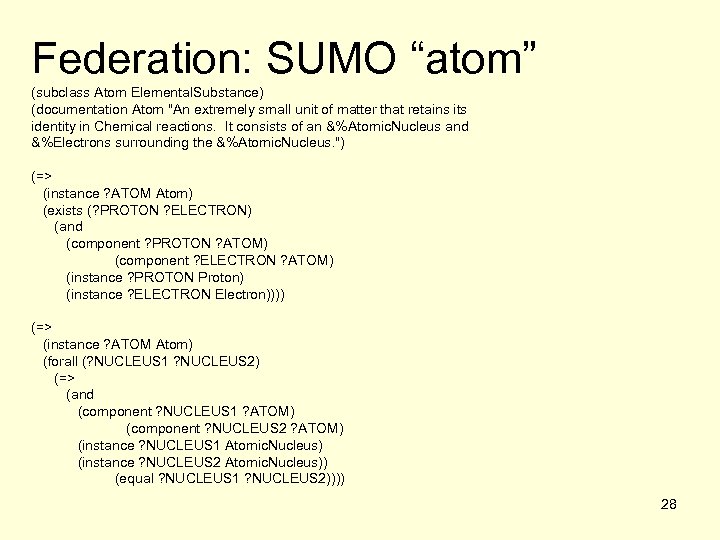
Federation: SUMO “atom” (subclass Atom Elemental. Substance) (documentation Atom "An extremely small unit of matter that retains its identity in Chemical reactions. It consists of an &%Atomic. Nucleus and &%Electrons surrounding the &%Atomic. Nucleus. ") (=> (instance ? ATOM Atom) (exists (? PROTON ? ELECTRON) (and (component ? PROTON ? ATOM) (component ? ELECTRON ? ATOM) (instance ? PROTON Proton) (instance ? ELECTRON Electron)))) (=> (instance ? ATOM Atom) (forall (? NUCLEUS 1 ? NUCLEUS 2) (=> (and (component ? NUCLEUS 1 ? ATOM) (component ? NUCLEUS 2 ? ATOM) (instance ? NUCLEUS 1 Atomic. Nucleus) (instance ? NUCLEUS 2 Atomic. Nucleus)) (equal ? NUCLEUS 1 ? NUCLEUS 2)))) 28
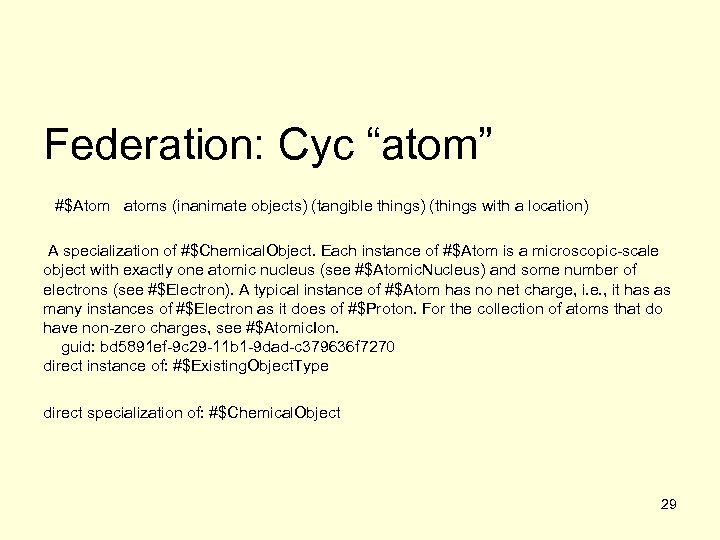
Federation: Cyc “atom” #$Atom atoms (inanimate objects) (tangible things) (things with a location) A specialization of #$Chemical. Object. Each instance of #$Atom is a microscopic-scale object with exactly one atomic nucleus (see #$Atomic. Nucleus) and some number of electrons (see #$Electron). A typical instance of #$Atom has no net charge, i. e. , it has as many instances of #$Electron as it does of #$Proton. For the collection of atoms that do have non-zero charges, see #$Atomic. Ion. guid: bd 5891 ef-9 c 29 -11 b 1 -9 dad-c 379636 f 7270 direct instance of: #$Existing. Object. Type direct specialization of: #$Chemical. Object 29
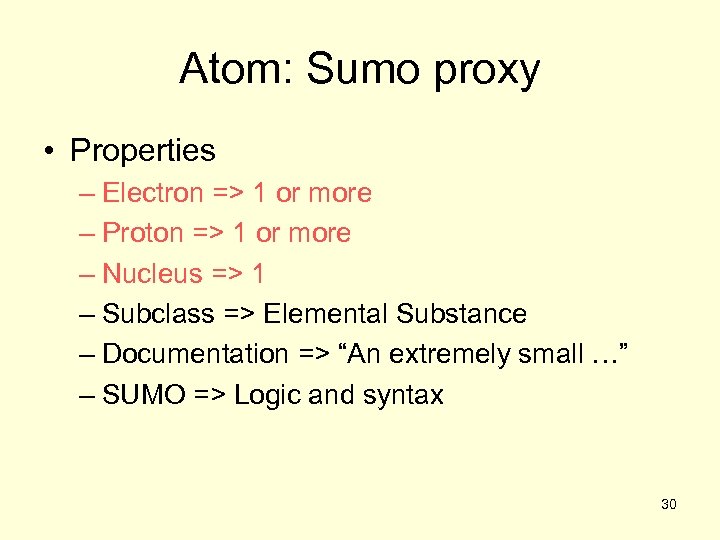
Atom: Sumo proxy • Properties – Electron => 1 or more – Proton => 1 or more – Nucleus => 1 – Subclass => Elemental Substance – Documentation => “An extremely small …” – SUMO => Logic and syntax 30
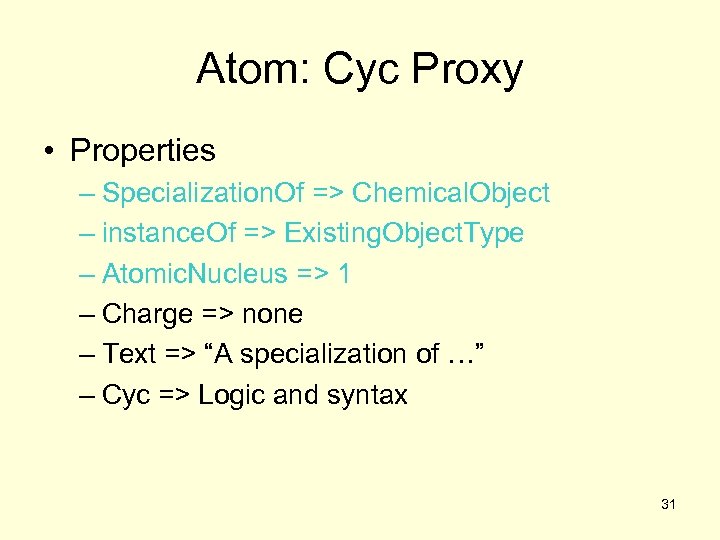
Atom: Cyc Proxy • Properties – Specialization. Of => Chemical. Object – instance. Of => Existing. Object. Type – Atomic. Nucleus => 1 – Charge => none – Text => “A specialization of …” – Cyc => Logic and syntax 31
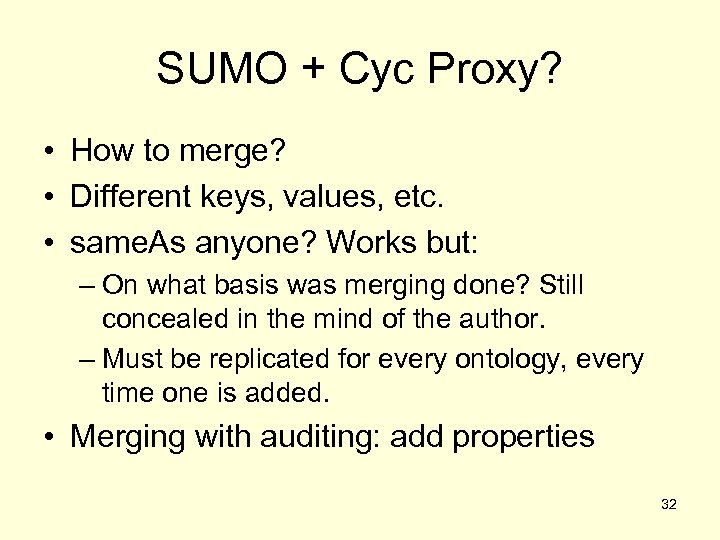
SUMO + Cyc Proxy? • How to merge? • Different keys, values, etc. • same. As anyone? Works but: – On what basis was merging done? Still concealed in the mind of the author. – Must be replicated for every ontology, every time one is added. • Merging with auditing: add properties 32
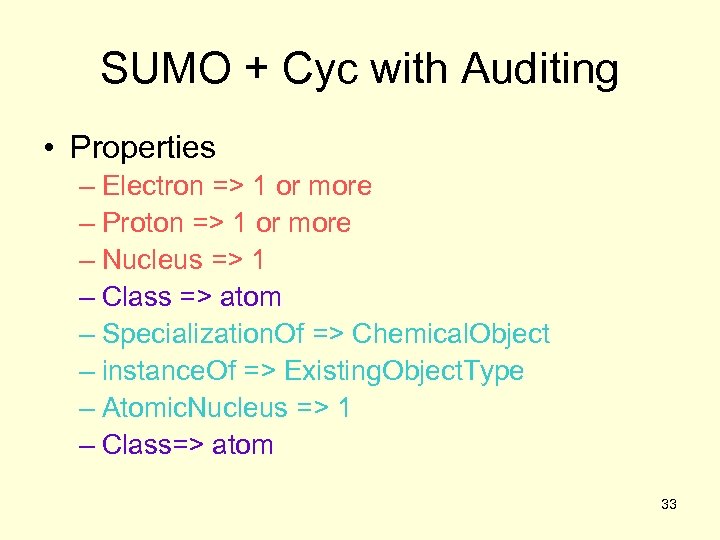
SUMO + Cyc with Auditing • Properties – Electron => 1 or more – Proton => 1 or more – Nucleus => 1 – Class => atom – Specialization. Of => Chemical. Object – instance. Of => Existing. Object. Type – Atomic. Nucleus => 1 – Class=> atom 33
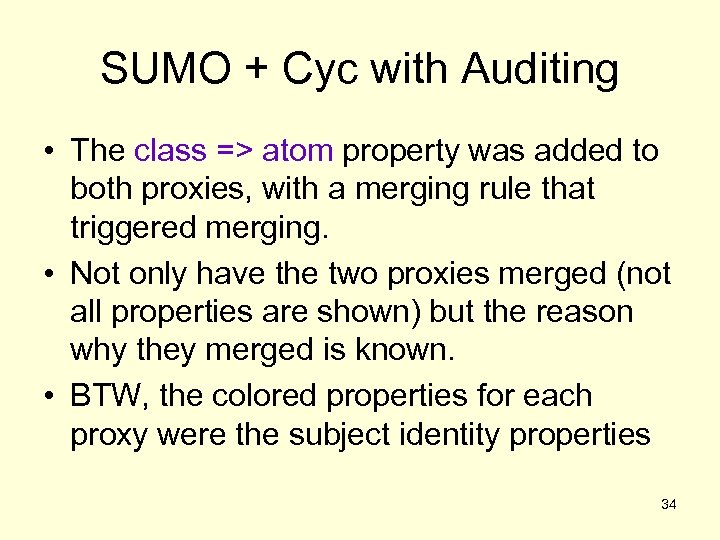
SUMO + Cyc with Auditing • The class => atom property was added to both proxies, with a merging rule that triggered merging. • Not only have the two proxies merged (not all properties are shown) but the reason why they merged is known. • BTW, the colored properties for each proxy were the subject identity properties 34
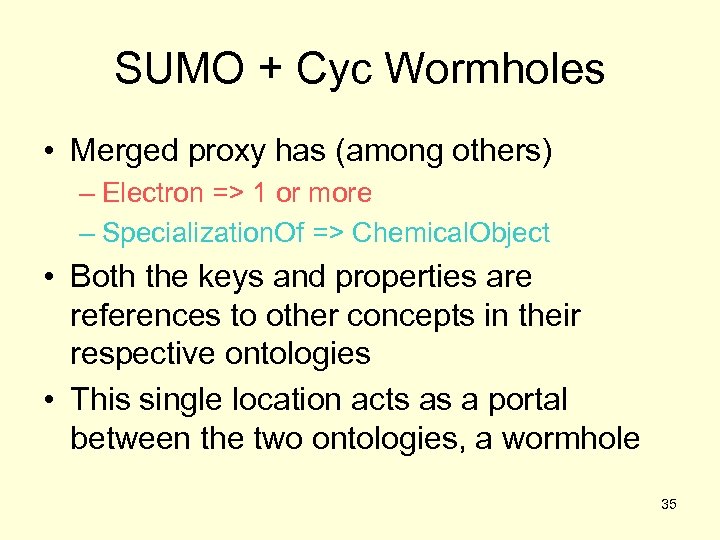
SUMO + Cyc Wormholes • Merged proxy has (among others) – Electron => 1 or more – Specialization. Of => Chemical. Object • Both the keys and properties are references to other concepts in their respective ontologies • This single location acts as a portal between the two ontologies, a wormhole 35
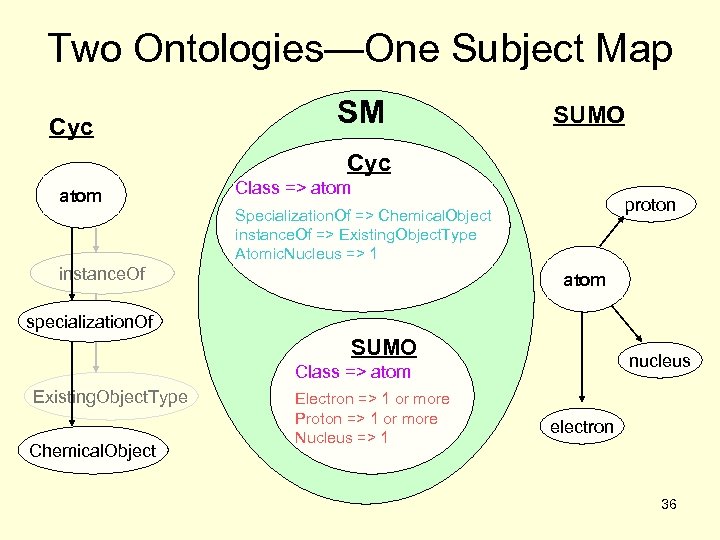
Two Ontologies—One Subject Map Cyc SM SUMO Cyc atom Class => atom proton Specialization. Of => Chemical. Object instance. Of => Existing. Object. Type Atomic. Nucleus => 1 instance. Of atom specialization. Of SUMO nucleus Class => atom Existing. Object. Type Chemical. Object Electron => 1 or more Proton => 1 or more Nucleus => 1 electron 36
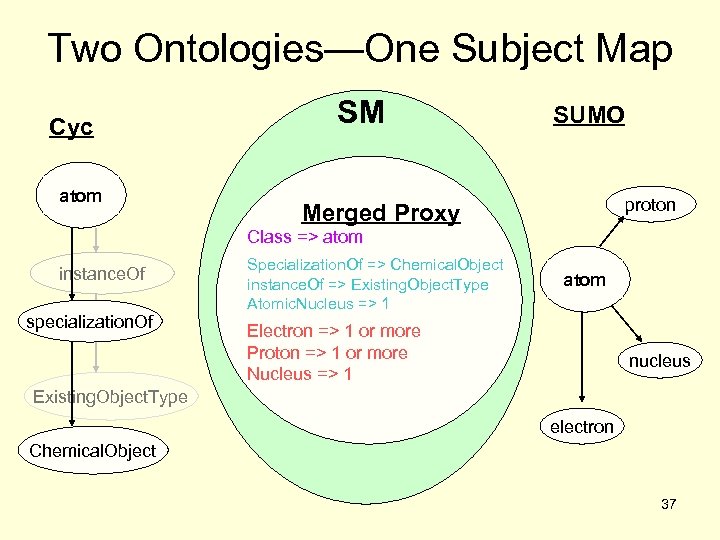
Two Ontologies—One Subject Map Cyc atom SM SUMO proton Merged Proxy Class => atom instance. Of specialization. Of Specialization. Of => Chemical. Object instance. Of => Existing. Object. Type Atomic. Nucleus => 1 atom Electron => 1 or more Proton => 1 or more Nucleus => 1 nucleus Existing. Object. Type electron Chemical. Object 37
Food Aid Example • Delivery of food aid – How many trucks capable of carrying 2, 000 pounds of aid? • Problem: – From different ontologies, different property types (different names) that actually represent the same property: • Load capacity vs. Rated weight • Solution: – Disclose merge rules that cause those property types to merge as representing the same subject. • Result: – Query for trucks returns the correct number, with use of either term. 38
Intelligence Example • Federating the workproduct of two analysts – Analyst # 1 • <Israel> <Vote. To. Halt. Payments><Hamas> – Analyst # 2 • <Israel><Decide. To. Stop. Payments><Palestine> • Disclosures allow a map to recognize: – Vote. To. Halt. Payments same subject as Decide. To. Stop. Payments – Hamas serves as a proxy for Palestine in this context • Both work products merge 39
Intelligence Example Extended • How does merging happen? – Combination of • Automated merging – Merge rules as disclosed in legends • Human suggestions – Human dialog » Part of federation facilities – Reach Agreements – Manual intervention/override of merge process 40
Observations • Preserves all information from merged ontologies • Provides a wormhole/portal between ontologies • Provides explicit definition of subject sameness • Supports auditable merging of information from different ontologies 41
Observations 2 • Business systems (accounting/inventory) have differing ontologies • If disclose what subjects are being identified, can map directly into such systems • Auditors become able to peer down into otherwise incompatible or inconsistent information systems 42
Observations 3 • Not required to be top down ontolgoies (expensive/time consuming) • Empowers users to make their own ontologies • Enables users to use their ontologies, not foreign or unfamiliar ones • Mapping possible between ontologies with incompatible or inconsistent assumptions 43
Subject Map Coda • Subject maps have no required syntax or structure (read use existing information systems in place) • Subject maps leverage on existing ontologies and expertise • Subject maps enable wormholes between ontologies • Subject maps depend upon existing expertise in ontological work 44
Conclusion • Do subject maps replace ontologies? – No • Can subject maps federate ontologies? – Yes • Do subject maps empower users? – Yes • Do subject maps empower ontologists? – Yes 45
Postscript • Remember the properties of subjects? – Exist before data has been “ontologized” • Can view data as per your ontology or your data as it would appear in another ontology • Subject maps enable ontological reasoning even in the absence of data being formally “ontologized. ” 46
![References [1] Obrst, Leo, Ontolog Invited Speaker, 2006 -01 -19, Ontology. Spectrum. Semantic. Models-Leo.](https://present5.com/presentation/965136712bf87648dab5a300c388007d/image-47.jpg "References [1] Obrst, Leo, Ontolog Invited Speaker, 2006 -01 -19, Ontology. Spectrum. Semantic. Models-Leo.")
References [1] Obrst, Leo, Ontolog Invited Speaker, 2006 -01 -19, Ontology. Spectrum. Semantic. Models-Leo. Obrst_20060112. ppt http: //ontolog. cim 3. net/cgi-bin/wiki. pl? Conference. Call_2006_01_12 47
Скачать презентацию Avoiding Hobson s Choice In Choosing An Ontology Ontolog
965136712bf87648dab5a300c388007d.ppt