 Скачать презентацию Avoiding Embedded Negatives 1 Help yourself to coffee
33ea34b45b012cb3c7425b24e0b82248.ppt
- Количество слайдов: 38



Avoiding Embedded Negatives 1. Help yourself to coffee and rolls. 2. Remove page 6, find a partner and together rephrase each of these questions to remove any negative overtones. 3. Write your phrases on a Post-it Note and place under the appropriate poster. © 2009 by ICE 21 1
Ground Rules/Group Norms • Be fully present. • Please save all sidebar conversations until break. • Honor other opinions - even the coach. • Put cell phones on vibrate. • Take breaks as needed. • Follow the 10 minute rule. • Use the Burning Thoughts Poster for questions. • Relax and have fun! © 2009 by ICE 21 • Are there any others? 2
Agenda • • • Welcome, Introductions Induction History Ground Rules/Group Norms and Outcomes Mentor Hats Mentoring Conversation Formative Assessment Components IL Professional Teaching Standards (IPTS) IL Continuum of Teacher Development (ICTD) IPTS SNAPSHOTS Illinois-specific Documents – Moving Toward… – IL Induction Program Standards – IL Induction Program Continuum • Wrap Up and Evaluation © 2009 by ICE 21 3
Outcomes Participants will: • Review the language, skills and attitudes of a mentoring conversation • Understand the role of formative assessment in a program of beginning teacher support • Practice using the IL Continuum of Teacher Development to guide the beginning teacher’s self-assessment • Develop skills in using the IPTS (Illinois Professional Teaching Standards) SNAPSHOTS © 2009 by ICE 21 4
Avoiding Embedded Negatives 1. Help yourself to coffee and rolls. 2. Remove page 6, find a partner and together rephrase each of these questions to remove any negative overtones. 3. Write your phrases on a Post-it Note and tape on the appropriate poster. - - © 2009 by ICE 21 5
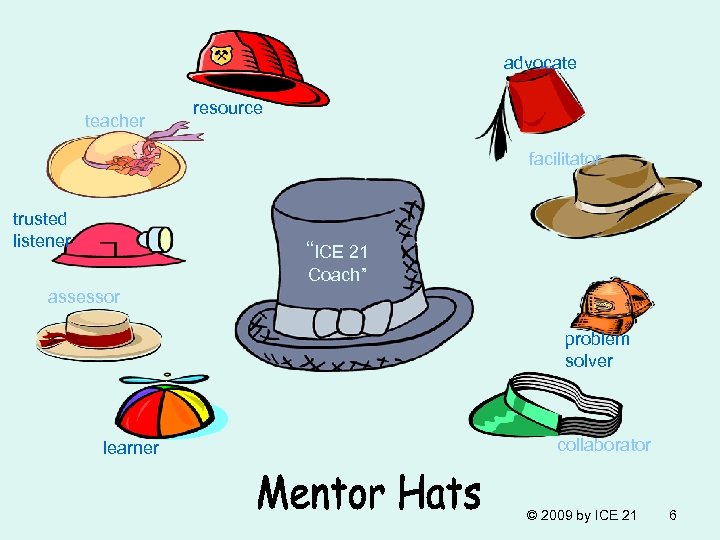
advocate teacher resource facilitator trusted listener “ICE 21 Coach” assessor problem solver learner collaborator © 2009 by ICE 21 6

• Assess the Beginning Teacher’s Needs • Establish a Focus for Work • Support the Teacher’s Movement Forward • Promote Accountability © 2009 by ICE 21 7
Mini Vignettes Small Group Activity 1. 2. 3. Split into groups of 3 to 4 participants. Select a conversation starter or “mini vignette” from the envelope. Practice 3 -4 different ways of responding to the beginning teacher’s comment. – – – 4. Use a teachable moment Paraphrase Clarify Offer suggestions Ask mediational questions Provide nonjudgmental responses Be prepared to read your vignette(s) and your responses. © 2009 by ICE 21 8
Formative Assessment is … • Teacher-driven • An ongoing measurement of growth over time • Objective and data-based • Responsive to teacher’s developmental needs • Interactive and collaborative • Based on teaching standards using a variety of assessment tools © 2009 by ICE 21 9
Why Formative Assessment? • Focuses the beginning teacher’s growth • Guides the work of the mentor • Establishes professional norms of inquiry into and reflection upon practice • Parallels the key role of assessment in effective instructional practices © 2009 by ICE 21 10
IL Professional Teaching Standards(IPTS) Five Purposes To provide a common language around classroom practice To help identify areas of professional growth To guide the design and implementation of professional development experiences To link teacher preparation with Induction and ongoing development To move from an Illinois Initial Certificate to a Standard Certificate © 2009 by ICE 21 11
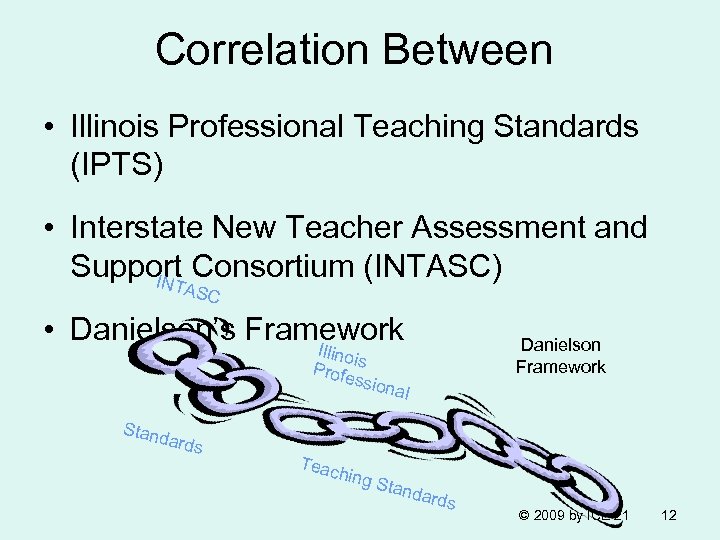
Correlation Between • Illinois Professional Teaching Standards (IPTS) • Interstate New Teacher Assessment and Support Consortium (INTASC) INT ASC • Danielson’s Framework I Danielson Framework llinoi Profe s ssion a l Stan dard s Teac hing Stan dard s © 2009 by ICE 21 12

Illinois Professional Teaching Standards (IPTS) © 2009 by ICE 21 13
Illinois Professional Teaching Standards (IPTS) #1 Teaching Diverse Students #2 Content Area and Pedagogical Knowledge #3 Planning for Differentiated Instruction #4 Learning Environment #5 Instructional Delivery #6 Reading, Writing and Oral Communication #7 Assessment #8 Collaborative Relationships #9 Professionalism, Leadership and Advocacy © 2009 by ICE 21 14
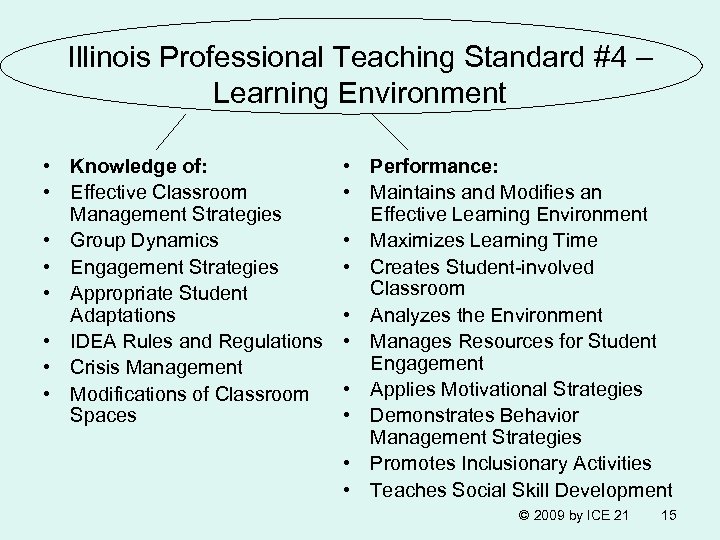
Illinois Professional Teaching Standard #4 – Learning Environment • Knowledge of: • Effective Classroom Management Strategies • Group Dynamics • Engagement Strategies • Appropriate Student Adaptations • IDEA Rules and Regulations • Crisis Management • Modifications of Classroom Spaces • Performance: • Maintains and Modifies an Effective Learning Environment • Maximizes Learning Time • Creates Student-involved Classroom • Analyzes the Environment • Manages Resources for Student Engagement • Applies Motivational Strategies • Demonstrates Behavior Management Strategies • Promotes Inclusionary Activities • Teaches Social Skill Development © 2009 by ICE 21 15
Standards Activity Instructions v Break participants into an appropriate number of groups and assign IPT Standards 2, 3 and 5, pages 20, 21, 22, 23 and 24. v Each group will condense and rewrite the IPTS Knowledge or Performance Indicators for their assigned Standard on their graphic organizer. v Have each group report out. © 2009 by ICE 21 16
Continuum Activity © 2009 by ICE 21 17
What is a Continuum? • • • Knowledge Indicators Performance Indicators Levels of Practice Descriptors Indicators © 2009 by ICE 21 18
y? h W Illinois Continuum of Teacher Development (ICTD) • Identified Need of Illinois • Stakeholder Involvement • Teacher-friendly Language • Self-assessment Tool • ISBE-endorsed W y? h Why ? © 2009 by ICE 21 19
Illinois Continuum of Teacher Development Uses • To help the beginning teacher and mentor collaboratively assess the beginning teacher’s level of proficiency • To help the beginning teacher set clear professional goals • To guide the mentor’s support and assistance • To provide a common language to describe and discuss practice © 2009 by ICE 21 20
ICTD Glossary of Terms • General Induction • Special Education • Research © 2009 by ICE 21 21
ICTD Structure & Organization • Knowledge Indicators • Performance Indicators • Descriptors © 2009 by ICE 21 22
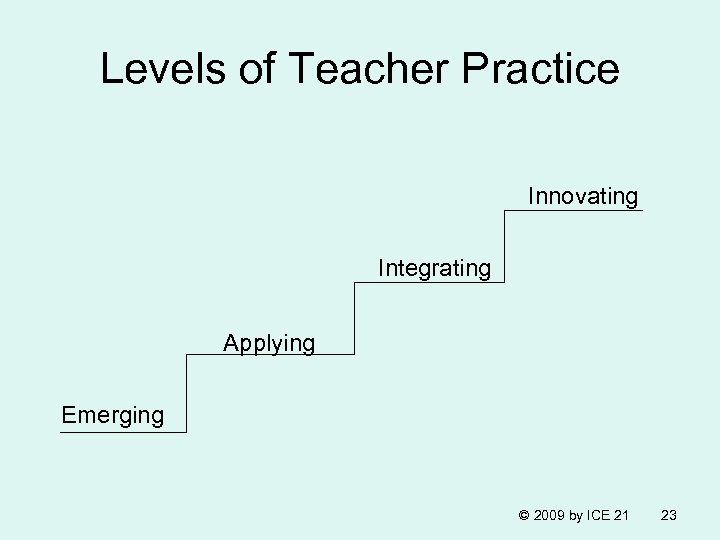
Levels of Teacher Practice Innovating Integrating Applying Emerging © 2009 by ICE 21 23
Julie’s Focus Areas © 2009 by ICE 21 24
Activity Instructions for Teacher Profile Individually: 1. Read the scenario, P-49. 2. Indicate where this teacher would fall using the ICTD, Standard #4. In table groups: 3. As it relates to this lesson, brainstorm one to two questions using the stems to get the conversation with your beginning teacher started. 4. Extract evidence of the teacher’s level of development in each of the 6 indicators using the Table Continuum. 5. Place dots on the ICTD Wall Continuum reflecting your table’s consensus. If your table feels that there is not enough evidence shown to assess a particular indicator, place a dot to the far right of the indicator. If your table feels that they a “pre-emerging”, place a dot to the left in the indicator column. © 2009 by ICE 21 25
Formative Assessment Tool IPTS SNAPSHOT Components What’s Working Current Focus – Challenges – Concerns Teacher’s and Mentor’s Next Steps Next Meeting Date and Focus IPTS Descriptors and Coding © 2009 by ICE 21 26
Formative Assessment Tool IPTS SNAPSHOT Component 1 What’s Working © 2009 by ICE 21 27
Formative Assessment Tool IPTS SNAPSHOT Component 2 Current Focus Challenges Concerns © 2009 by ICE 21 28
Formative Assessment Tool IPTS SHAPSHOT Component 3 Teacher’s and Mentor’s Next Steps © 2009 by ICE 21 29
Formative Assessment Tool IPTS SNAPSHOT Component 4 Next Meeting Date and Focus © 2009 by ICE 21 30
Formative Assessment Tool IPTS SNAPSHOT Component 5 IPTS Descriptors and Coding © 2009 by ICE 21 31
IPTS SNAPSHOT Functions The SNAPSHOT provides… 1. Focus and clarity 2. Ongoing assessment data 3. Possible solutions, actions, next steps 4. Accountability (for both the beginning teacher and the mentor) 5. Guidance for mentor’s support Foundations in Mentoring Adapted from New Teacher Center @ University of California, Santa Cruz © 2009 by ICE 21 32
IPTS SNAPSHOT 1. 2. 3. 4. Numbers 1, 3 and 5 will assume the “mentor” role and will observe the video from the mentor’s perspective. Numbers 2, 4 and 6 will assume the “beginning teacher” role and observe the video from the beginning teacher’s perspective. After viewing the video, #1 and #2 will work together in pairs using Standard 2; #3 and #4 will work together in pairs using Standard 3; #5 and #6 will work together in pairs using Standard 5. Use the assigned IPTS SNAPSHOT to guide your mentoring conversation. The “mentor” should actually record on the SNAPSHOT. © 2009 by ICE 21 33
FORMATIVE ASSESSMENT TOOL Continuum for Self-assessment 1. “M” and “B. T. ” partners continue to work together. 2. Use the IPTS SNAPSHOT and the appropriate ICTD to guide the selfassessment process between “M” and “B. T. ”. Place an “X” and date on the Continuum where you see the beginning teacher for each of the indicators. © 2009 by ICE 21 34
ard Tow ing ov M ent cum Do © 2009 by ICE 21 35
tion uc Ind IL ram rog P rds da tan S © 2009 by ICE 21 36
ion uct Ind IL ram rog P uum tin Con © 2009 by ICE 21 37
© 2009 by ICE 21 38
Скачать презентацию Avoiding Embedded Negatives 1 Help yourself to coffee
33ea34b45b012cb3c7425b24e0b82248.ppt