


 Скачать презентацию Aviation Sensors and Products for Hurricane Applications Road
068bb3c4ceded674dd8ff21dc531db48.ppt
- Количество слайдов: 13
 Aviation Sensors and Products for Hurricane Applications Road Weather Management Workshop April 9, 2001 Robert G. Hallowell MIT Lincoln Laboratory RGH 4/9/01 Hurricane Conf MIT Lincoln Laboratory
 Outline • Overview of Aviation Weather Products (MIT/LL) • Hurricane Applications – Advantages of Integrating Sensors – Wind Estimations – Automated Storm Tracking • RGH 4/9/01 Hurricane Conf Summary MIT Lincoln Laboratory
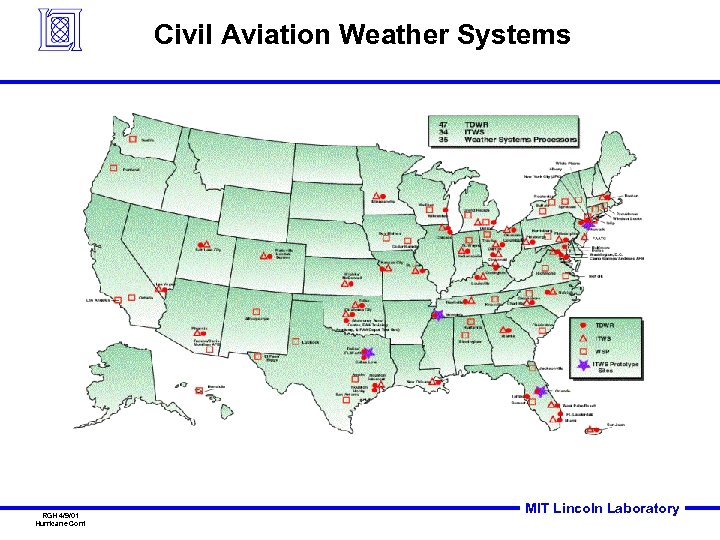 Civil Aviation Weather Systems RGH 4/9/01 Hurricane Conf MIT Lincoln Laboratory
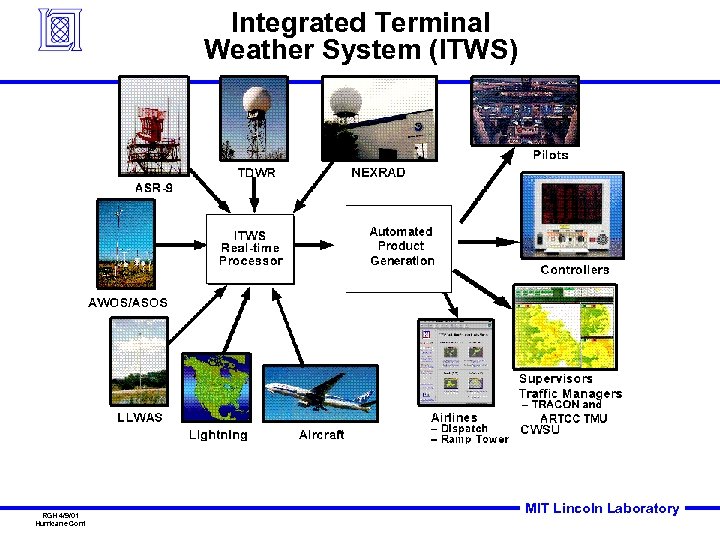 Integrated Terminal Weather System (ITWS) RGH 4/9/01 Hurricane Conf MIT Lincoln Laboratory
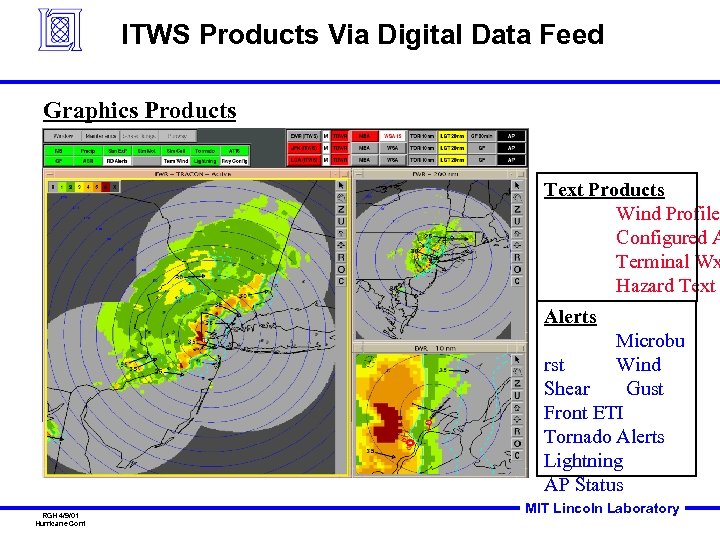 ITWS Products Via Digital Data Feed Graphics Products Text Products Wind Profile Configured A Terminal Wx Hazard Text Alerts Microbu rst Wind Shear Gust Front ETI Tornado Alerts Lightning AP Status RGH 4/9/01 Hurricane Conf MIT Lincoln Laboratory
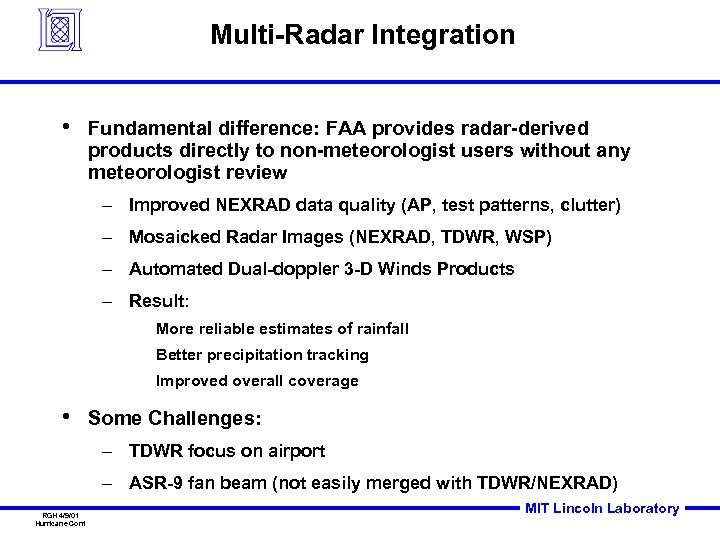 Multi-Radar Integration • Fundamental difference: FAA provides radar-derived products directly to non-meteorologist users without any meteorologist review – Improved NEXRAD data quality (AP, test patterns, clutter) – Mosaicked Radar Images (NEXRAD, TDWR, WSP) – Automated Dual-doppler 3 -D Winds Products – Result: More reliable estimates of rainfall Better precipitation tracking Improved overall coverage • Some Challenges: – TDWR focus on airport – ASR-9 fan beam (not easily merged with TDWR/NEXRAD) RGH 4/9/01 Hurricane Conf MIT Lincoln Laboratory
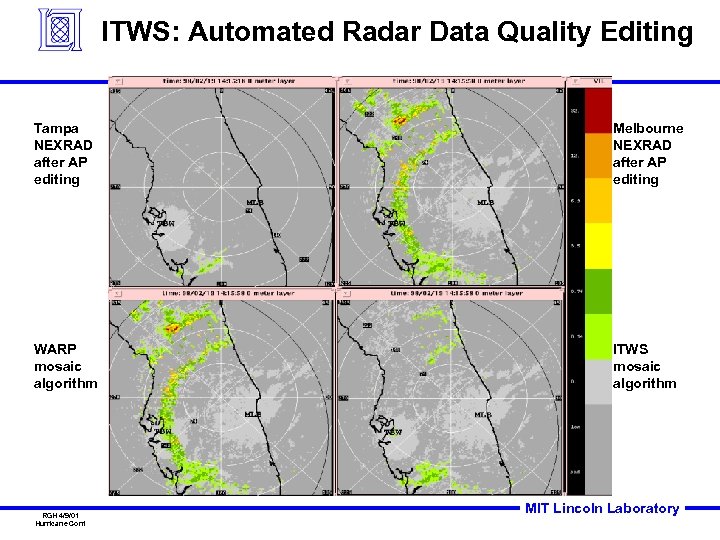 ITWS: Automated Radar Data Quality Editing Tampa NEXRAD after AP editing Melbourne NEXRAD after AP editing WARP mosaic algorithm ITWS mosaic algorithm RGH 4/9/01 Hurricane Conf MIT Lincoln Laboratory
 ITWS: Dual-Doppler Winds RGH 4/9/01 Hurricane Conf MIT Lincoln Laboratory
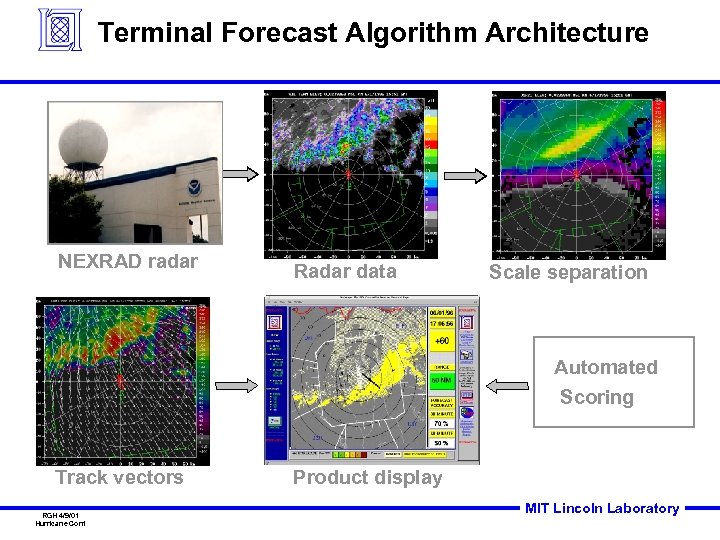 Terminal Forecast Algorithm Architecture NEXRAD radar Radar data Scale separation Automated Scoring Track vectors RGH 4/9/01 Hurricane Conf Product display MIT Lincoln Laboratory
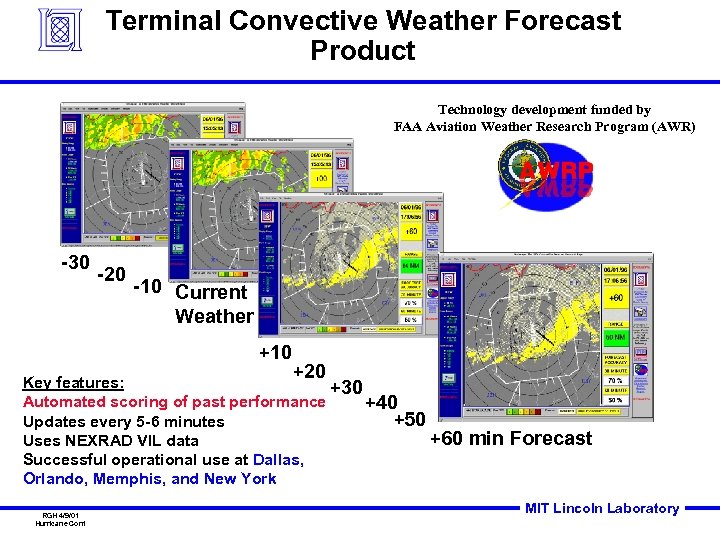 Terminal Convective Weather Forecast Product Technology development funded by FAA Aviation Weather Research Program (AWR) -30 -20 -10 Current Weather +10 +20 Key features: +30 Automated scoring of past performance +40 +50 Updates every 5 -6 minutes +60 Uses NEXRAD VIL data Successful operational use at Dallas, Orlando, Memphis, and New York RGH 4/9/01 Hurricane Conf min Forecast MIT Lincoln Laboratory
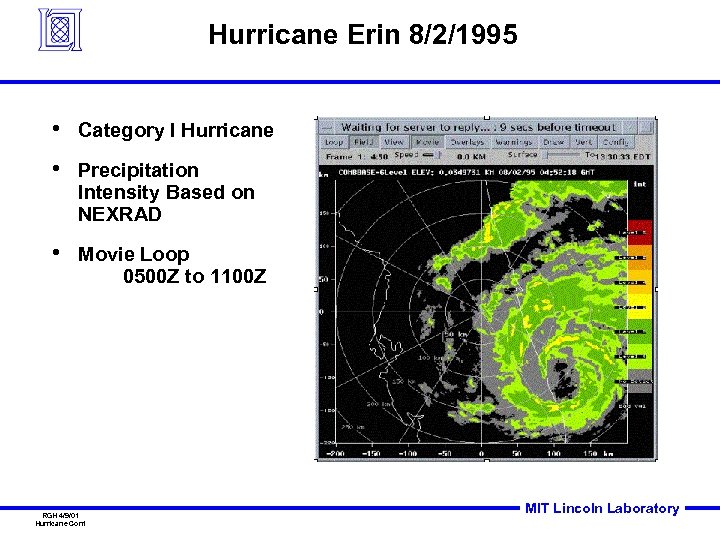 Hurricane Erin 8/2/1995 • Category I Hurricane • Precipitation Intensity Based on NEXRAD • Movie Loop 0500 Z to 1100 Z RGH 4/9/01 Hurricane Conf MIT Lincoln Laboratory
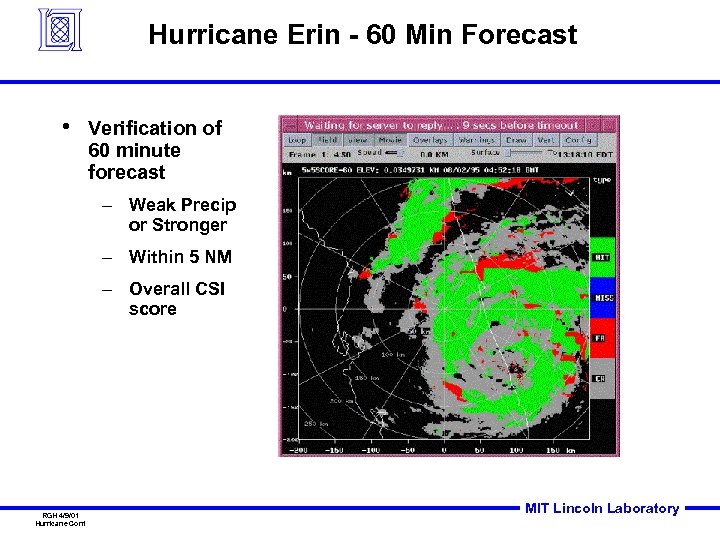 Hurricane Erin - 60 Min Forecast • Verification of 60 minute forecast – Weak Precip or Stronger – Within 5 NM – Overall CSI score RGH 4/9/01 Hurricane Conf MIT Lincoln Laboratory
 Summary • Multiple FAA weather radars and derived products coming on-line (ITWS 2002 -2004, CIWS 2001, MIAWS 2001 -2003) • FAA/NWS radar integration has been extremely successful operationally for the FAA • ITWS winds products (microbursts, 3 -d winds) could be enhanced for hurricane applications • Storm tracking technology (0 -2 hours) could assist in early flood warnings RGH 4/9/01 Hurricane Conf MIT Lincoln Laboratory