 Скачать презентацию Available treatments Presented by Anastassia Kostenko Student number
POSTER A1.ppt
- Количество слайдов: 1



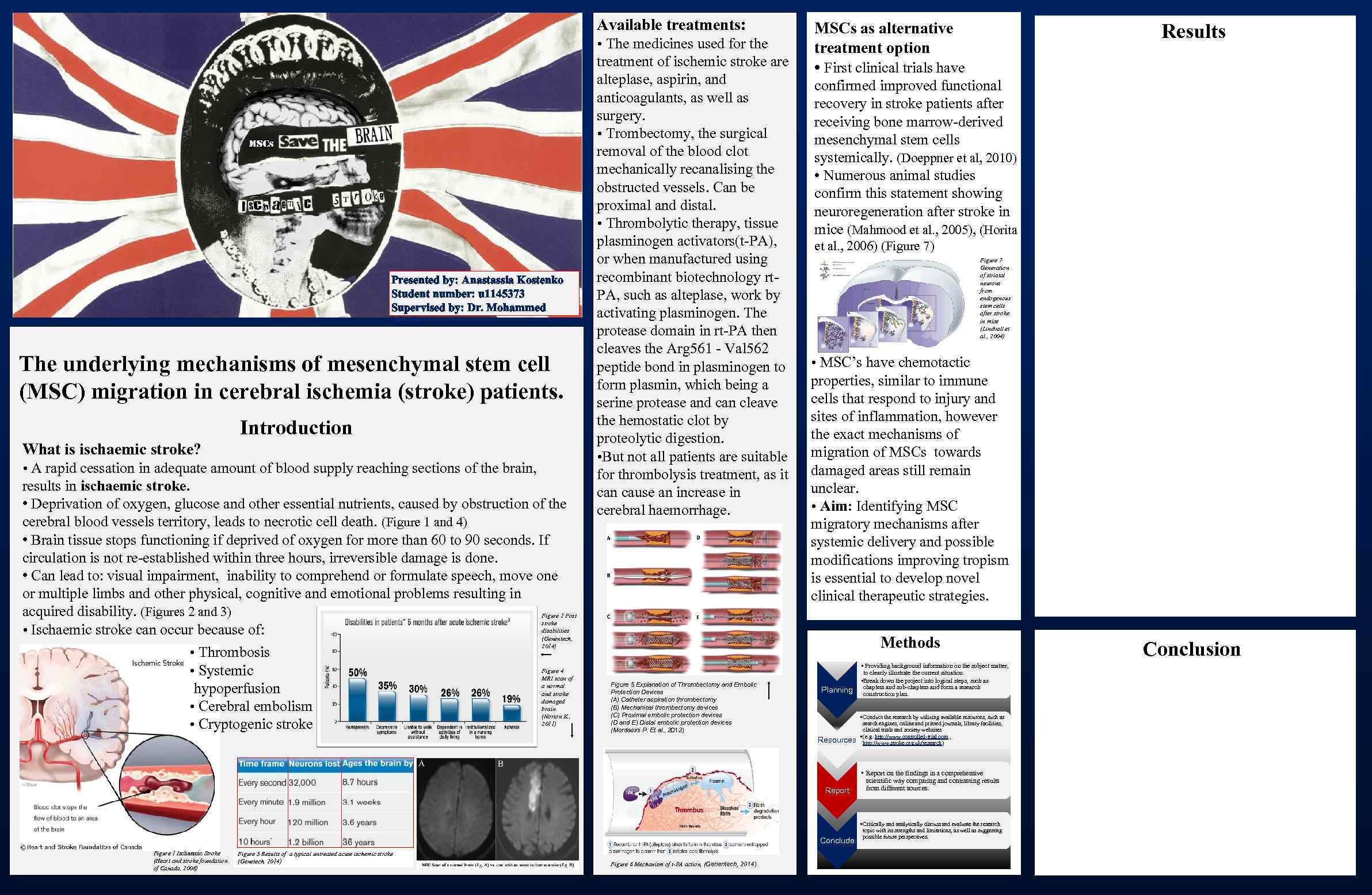
Available treatments: Presented by: Anastassia Kostenko Student number: u 1145373 Supervised by: Dr. Mohammed Meah The underlying mechanisms of mesenchymal stem cell (MSC) migration in cerebral ischemia (stroke) patients. Introduction What is ischaemic stroke? • A rapid cessation in adequate amount of blood supply reaching sections of the brain, results in ischaemic stroke. • Deprivation of oxygen, glucose and other essential nutrients, caused by obstruction of the cerebral blood vessels territory, leads to necrotic cell death. (Figure 1 and 4) • Brain tissue stops functioning if deprived of oxygen for more than 60 to 90 seconds. If circulation is not re-established within three hours, irreversible damage is done. • Can lead to: visual impairment, inability to comprehend or formulate speech, move one or multiple limbs and other physical, cognitive and emotional problems resulting in acquired disability. (Figures 2 and 3) Figure 2 Post stroke disabilities • Ischaemic stroke can occur because of: (Genentech, • Thrombosis • Systemic lhypoperfusion • Cerebral embolism • Cryptogenic stroke • The medicines used for the treatment of ischemic stroke are alteplase, aspirin, and anticoagulants, as well as surgery. • Trombectomy, the surgical removal of the blood clot mechanically recanalising the obstructed vessels. Can be proximal and distal. • Thrombolytic therapy, tissue plasminogen activators(t-PA), or when manufactured using recombinant biotechnology rt. PA, such as alteplase, work by activating plasminogen. The protease domain in rt-PA then cleaves the Arg 561 - Val 562 peptide bond in plasminogen to form plasmin, which being a serine protease and can cleave the hemostatic clot by proteolytic digestion. • But not all patients are suitable for thrombolysis treatment, as it can cause an increase in cerebral haemorrhage. MSCs as alternative treatment option • First clinical trials have confirmed improved functional recovery in stroke patients after receiving bone marrow-derived mesenchymal stem cells systemically. (Doeppner et al, 2010) • Numerous animal studies confirm this statement showing neuroregeneration after stroke in mice (Mahmood et al. , 2005), (Horita et al. , 2006) (Figure 7) Figure 7 Generation of striatal neurons from endogenous stem cells after stroke in mice (Lindvall et al. , 2004) • MSC’s have chemotactic properties, similar to immune cells that respond to injury and sites of inflammation, however the exact mechanisms of migration of MSCs towards damaged areas still remain unclear. • Aim: Identifying MSC migratory mechanisms after systemic delivery and possible modifications improving tropism is essential to develop novel clinical therapeutic strategies. Methods 2014) Figure 4 MRI scan of a normal and stroke damaged brain (Norton K. , 2011) Figure 5 Explanation of Thrombectomy and Embolic Protection Devices (A) Catheter aspiration thrombectomy (B) Mechanical thrombectomy devices (C) Proximal embolic protection devices (D and E) Distal embolic protection devices (Mordasini P. Et al. , 2012) Planning Resources Report Conclude Figure 1 Ischaemic Stroke (Heart and stroke foundation of Canada, 2008) Figure 3 Results of a typical untreated acute ischemic stroke (Genetech, 2014) Results Figure 6 Mechanism of t-PA action, (Genentech, 2014) • Providing background information on the subject matter, to clearly illustrate the current situation. • Break down the project into logical steps, such as chapters and sub-chapters and form a research construction plan. • Conduct the research by utilizing available resources, such as search engines, online and printed journals, library facilities, clinical trials and society websites • (e. g. http: //www. controlled-trial. com , http: //www. stroke. org. uk/research) • Report on the findings in a comprehensive scientific way comparing and contrasting results from different sources. • Critically and analytically discuss and evaluate the research topic with its strengths and limitations, as well as suggesting possible future perspectives. Conclusion
Скачать презентацию Available treatments Presented by Anastassia Kostenko Student number
POSTER A1.ppt