


 Скачать презентацию Autora Maité Pérez Montes Articles Definite
037fc6be82a4291e4f46c4327c8a4491.ppt
- Количество слайдов: 48
 Autora: Maité Pérez Montes

 Articles • Definite Article • Indefinite Article • Exercises
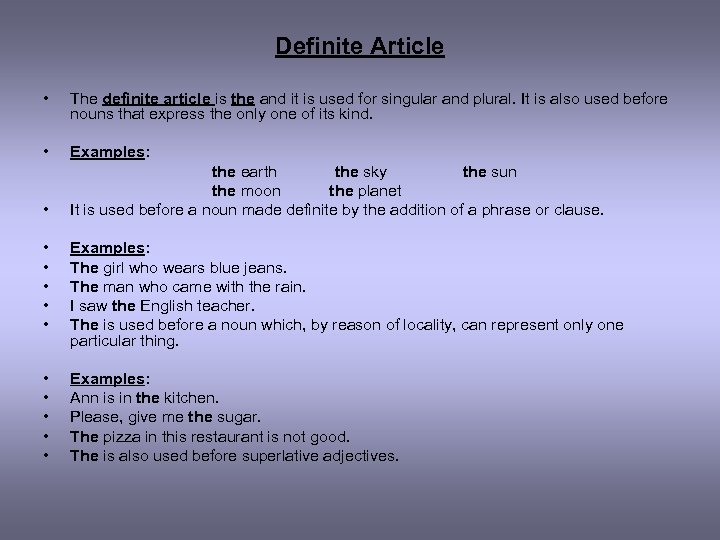 Definite Article • The definite article is the and it is used for singular and plural. It is also used before nouns that express the only one of its kind. • Examples: the earth the sky the sun the moon the planet • It is used before a noun made definite by the addition of a phrase or clause. • • • Examples: The girl who wears blue jeans. The man who came with the rain. I saw the English teacher. The is used before a noun which, by reason of locality, can represent only one particular thing. • • • Examples: Ann is in the kitchen. Please, give me the sugar. The pizza in this restaurant is not good. The is also used before superlative adjectives.
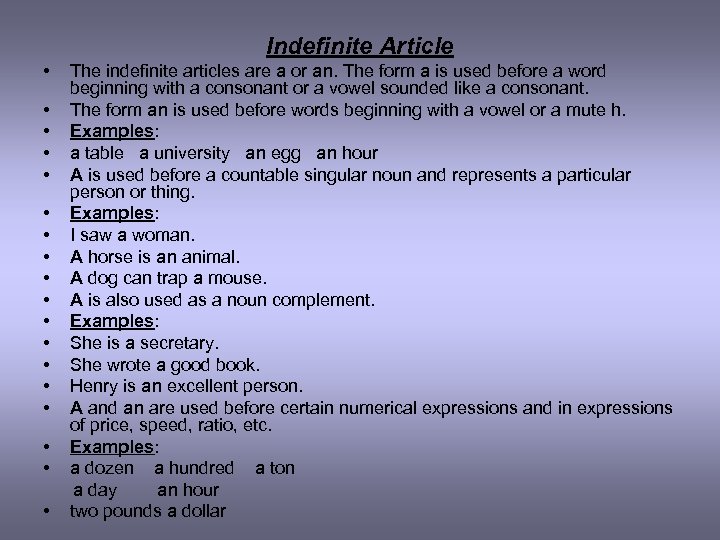 Indefinite Article • The indefinite articles are a or an. The form a is used before a word beginning with a consonant or a vowel sounded like a consonant. • The form an is used before words beginning with a vowel or a mute h. • Examples: • a table a university an egg an hour • A is used before a countable singular noun and represents a particular person or thing. • Examples: • I saw a woman. • A horse is an animal. • A dog can trap a mouse. • A is also used as a noun complement. • Examples: • She is a secretary. • She wrote a good book. • Henry is an excellent person. • A and an are used before certain numerical expressions and in expressions of price, speed, ratio, etc. • Examples: • a dozen a hundred a ton a day an hour • two pounds a dollar
 Exercises • Write the or …. when the can be omitted. • • • • ____ Sky is blue and ____ sun is shining. I don't like to listen ____ news on ____ radio. When they left ____ airport they went ____ home. Cars are producing ____ pollution every day. It's a nice restaurant and ____ food is delicious. Children learn to speak ____ languages fast. Earth rotates around ____ Sun. He left ____ home early and went to ____ movies. Tigers are protected in ____ Indian jungle. ____ envy is one of ____ worst human feelings. ____ shrimps at ____ Henry's restaurant are good. She likes to watch ____ horror films on ____ TV. ____ Spacecrafts were invented in ____ 20 th century.
 Nouns Definition and classification Plural of nouns Possessive case Exercises • • • Definition and classification A noun is the name of anything. They are classified in: common nouns: nouns that are the names given to people, things or places of the same kind. Examples: dog, man, bird, bridge, etc. Proper nouns: nouns given to a particular person, thing or place. They begin with capital letter. Examples: John, Paris, Germany, Amazon, etc. Abstract nouns: nouns that name qualities or ideas that you can not touch or see. Examples: love, speed, beauty, etc.
 Plural of nouns • The plural of nouns are generally formed by adding s to the singular. • Examples: • • car - cars pencil - pencils book - books boat – boats Nouns ending in o, ss, sh, ch, or x form their plural by adding es. • • • Examples: potato - potatoes kiss - kisses brush -brushes church - churches fox – foxes
 • Foreign or abbreviated words ending in o add s only. • • • Examples: photo - photos piano - pianos dynamo – dynamos Nouns ending in y preceded by a consonant form their plurals by changing the y for an i and adding es. Examples: secretary - secretaries baby - babies country - countries Nouns ending in y preceded by a vowel form their plural by adding only s. Examples: toy - toys play - plays donkey - donkeys Some nouns ending in f or fe form their plurals by changing the f or fe for ves. Examples: wolf - wolves knife - knives thief - thieves life – lives There are nouns that form their plural by a vowel change. Examples: man - men woman - women foot – feet tooth - teeth child – children • • • •
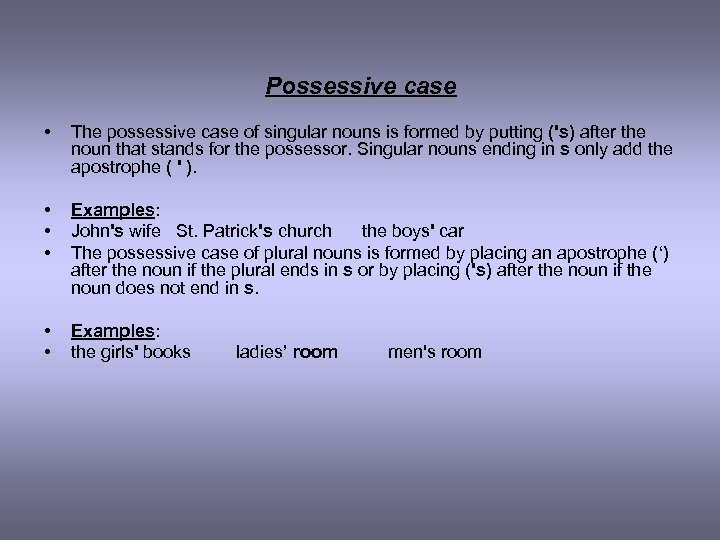 Possessive case • The possessive case of singular nouns is formed by putting ('s) after the noun that stands for the possessor. Singular nouns ending in s only add the apostrophe ( ' ). • • • Examples: John's wife St. Patrick's church the boys' car The possessive case of plural nouns is formed by placing an apostrophe (‘) after the noun if the plural ends in s or by placing ('s) after the noun if the noun does not end in s. • • Examples: the girls' books ladies’ room men's room
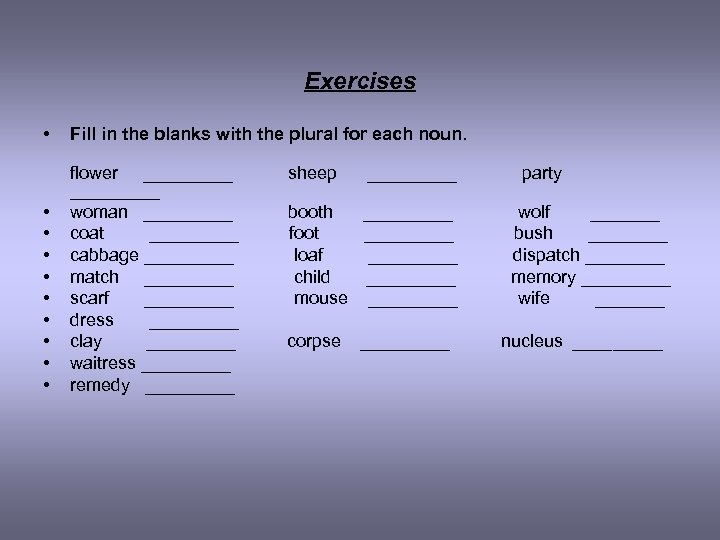 Exercises • Fill in the blanks with the plural for each noun. • • • flower _____ sheep _____ party _____ woman _____ booth _____ wolf _______ coat _____ foot _____ bush ____ cabbage _____ loaf _____ dispatch ____ match _____ child _____ memory _____ scarf _____ mouse _____ wife _______ dress _____ clay _____ corpse _____ nucleus _____ waitress _____ remedy _____

 Pronouns • • • Definition and Gender Personal Case Indefinite Demonstrative Interrogative Possessive Relative Exercises
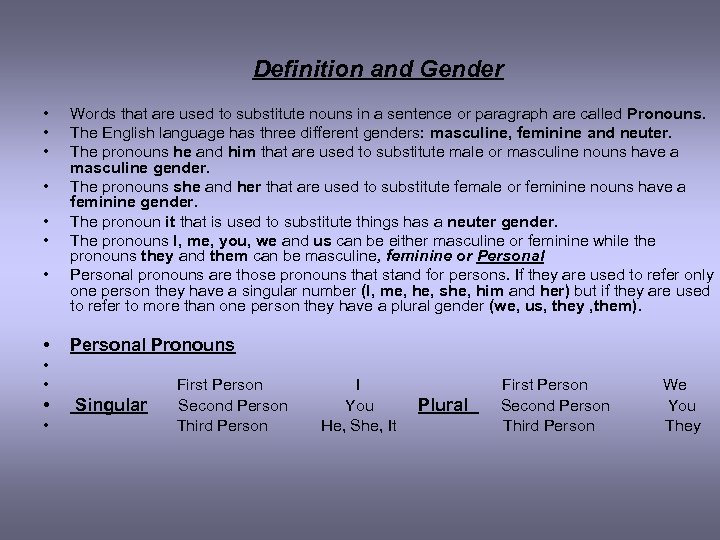 Definition and Gender • • Words that are used to substitute nouns in a sentence or paragraph are called Pronouns. The English language has three different genders: masculine, feminine and neuter. The pronouns he and him that are used to substitute male or masculine nouns have a masculine gender. The pronouns she and her that are used to substitute female or feminine nouns have a feminine gender. The pronoun it that is used to substitute things has a neuter gender. The pronouns I, me, you, we and us can be either masculine or feminine while the pronouns they and them can be masculine, feminine or Personal pronouns are those pronouns that stand for persons. If they are used to refer only one person they have a singular number (I, me, he, she, him and her) but if they are used to refer to more than one person they have a plural gender (we, us, they , them). • Personal Pronouns • • First Person I First Person We Singular Second Person You Plural Second Person You Third Person He, She, It Third Person They • •
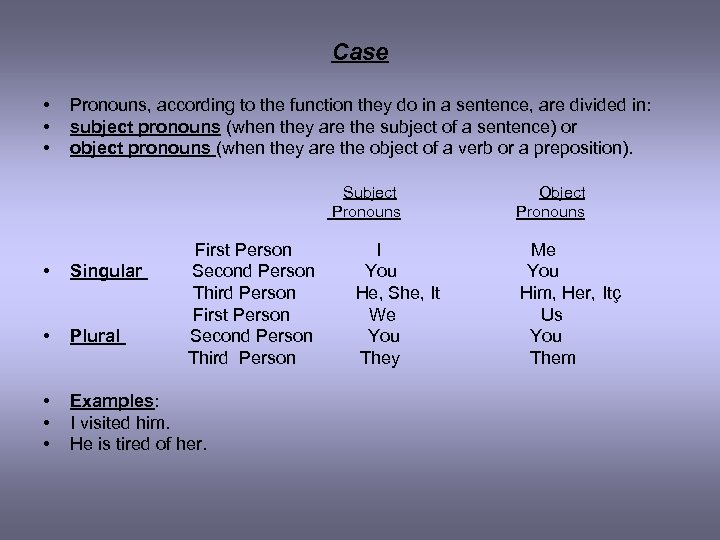 Case • • • Pronouns, according to the function they do in a sentence, are divided in: subject pronouns (when they are the subject of a sentence) or object pronouns (when they are the object of a verb or a preposition). Subject Object Pronouns First Person I Me • Singular Second Person You Third Person He, She, It Him, Her, Itç First Person We Us • Plural Second Person You Third Person They Them • • • Examples: I visited him. He is tired of her.
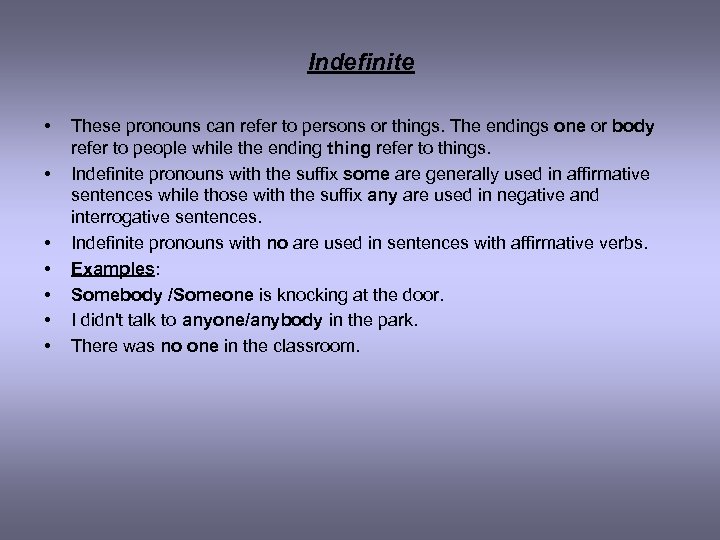 Indefinite • • These pronouns can refer to persons or things. The endings one or body refer to people while the ending thing refer to things. Indefinite pronouns with the suffix some are generally used in affirmative sentences while those with the suffix any are used in negative and interrogative sentences. Indefinite pronouns with no are used in sentences with affirmative verbs. Examples: Somebody /Someone is knocking at the door. I didn't talk to anyone/anybody in the park. There was no one in the classroom.
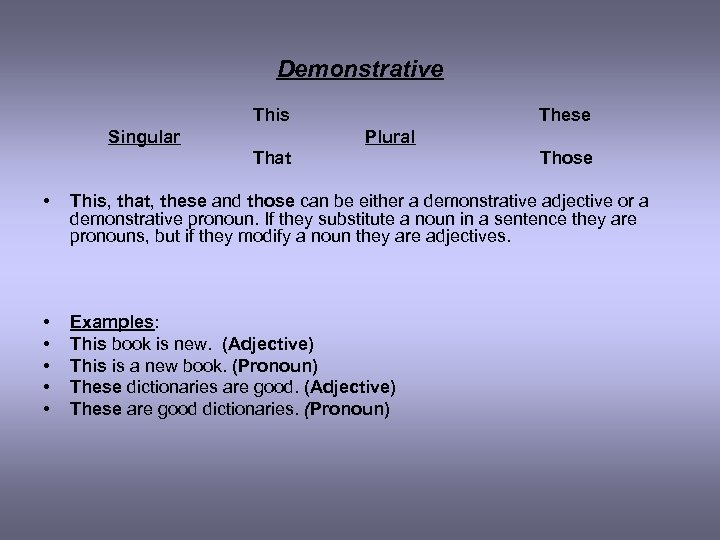 Demonstrative This Singular These Plural That Those • This, that, these and those can be either a demonstrative adjective or a demonstrative pronoun. If they substitute a noun in a sentence they are pronouns, but if they modify a noun they are adjectives. • • • Examples: This book is new. (Adjective) This is a new book. (Pronoun) These dictionaries are good. (Adjective) These are good dictionaries. (Pronoun)
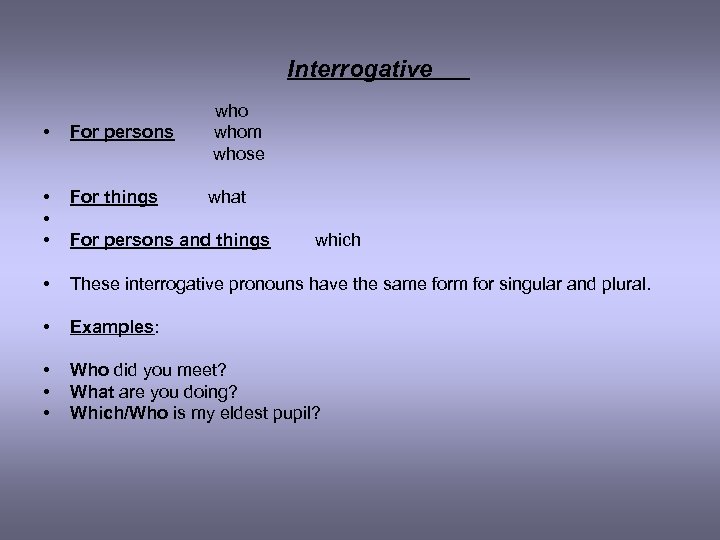 Interrogative who • For persons whom whose • For things what • • For persons and things which • These interrogative pronouns have the same form for singular and plural. • Examples: • • • Who did you meet? What are you doing? Which/Who is my eldest pupil?
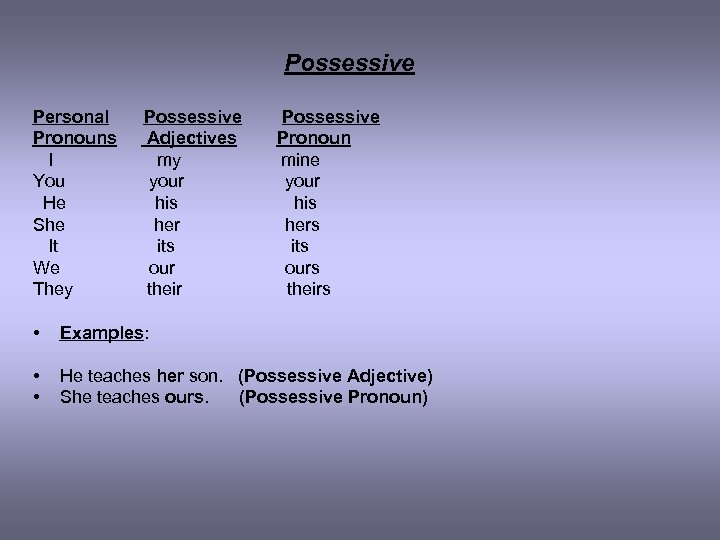 Possessive Personal Possessive Pronouns Adjectives Pronoun I my mine You your He his She her hers It its We our ours They theirs • Examples: • • He teaches her son. (Possessive Adjective) She teaches ours. (Possessive Pronoun)
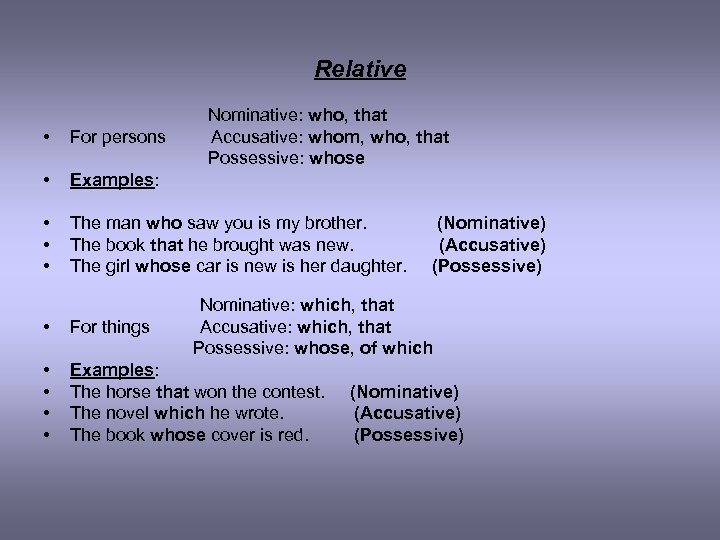 Relative Nominative: who, that • For persons Accusative: whom, who, that Possessive: whose • Examples: • • • The man who saw you is my brother. (Nominative) The book that he brought was new. (Accusative) The girl whose car is new is her daughter. (Possessive) Nominative: which, that • For things Accusative: which, that Possessive: whose, of which • Examples: • The horse that won the contest. (Nominative) • The novel which he wrote. (Accusative) • The book whose cover is red. (Possessive)
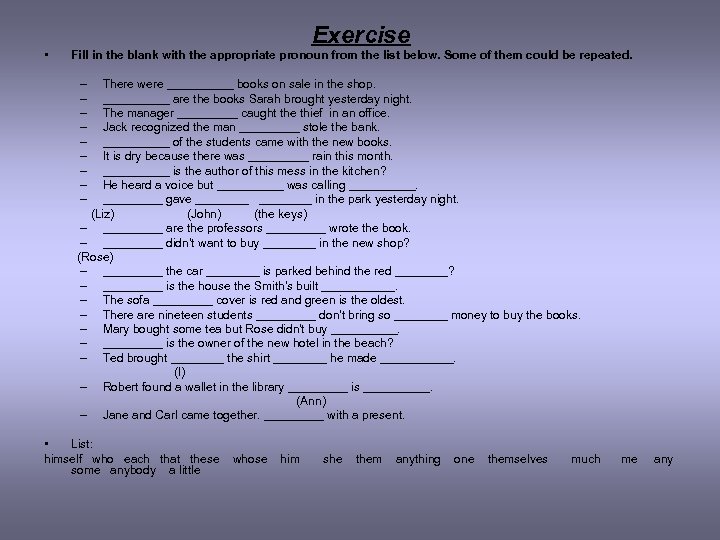 Exercise • Fill in the blank with the appropriate pronoun from the list below. Some of them could be repeated. – There were _____ books on sale in the shop. – _____ are the books Sarah brought yesterday night. – The manager _____ caught the thief in an office. – Jack recognized the man _____ stole the bank. – _____ of the students came with the new books. – It is dry because there was _____ rain this month. – _____ is the author of this mess in the kitchen? – He heard a voice but _____ was calling _____. – _____ gave ________ in the park yesterday night. (Liz) (John) (the keys) – _____ are the professors _____ wrote the book. – _____ didn’t want to buy ____ in the new shop? (Rose) – _____ the car ____ is parked behind the red ____? – _____ is the house the Smith's built ______. – The sofa _____ cover is red and green is the oldest. – There are nineteen students _____ don't bring so ____ money to buy the books. – Mary bought some tea but Rose didn't buy _____. – _____ is the owner of the new hotel in the beach? – Ted brought ____ the shirt ____ he made ______. (I) – Robert found a wallet in the library _____ is _____. (Ann) – Jane and Carl came together. _____ with a present. • List: himself who each that these whose him she them anything one themselves much me any some anybody a little
 Adjectives • • • Definition and Classification Comparison One-syllable adjectives Adjectives of two syllables Adjectives of three or more syllables
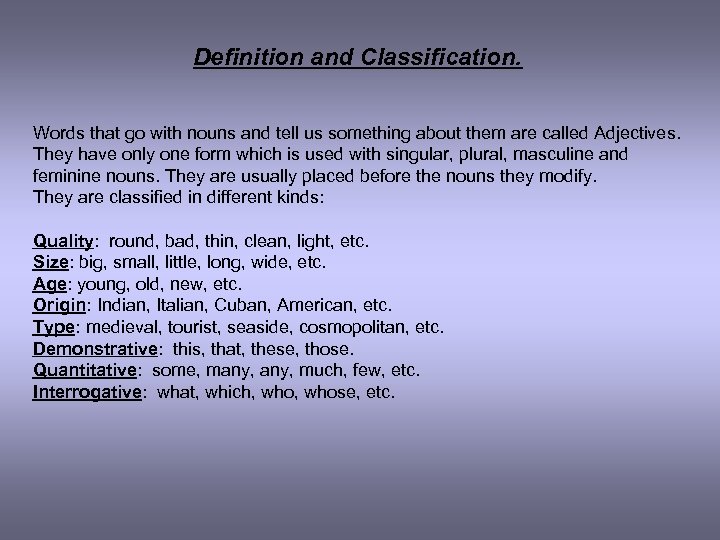 Definition and Classification. Words that go with nouns and tell us something about them are called Adjectives. They have only one form which is used with singular, plural, masculine and feminine nouns. They are usually placed before the nouns they modify. They are classified in different kinds: Quality: round, bad, thin, clean, light, etc. Size: big, small, little, long, wide, etc. Age: young, old, new, etc. Origin: Indian, Italian, Cuban, American, etc. Type: medieval, tourist, seaside, cosmopolitan, etc. Demonstrative: this, that, these, those. Quantitative: some, many, much, few, etc. Interrogative: what, which, whose, etc.
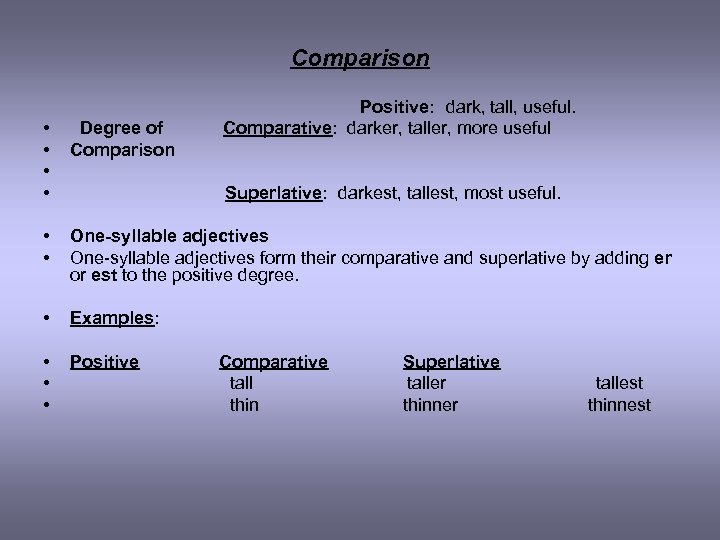 Comparison • • Positive: dark, tall, useful. Degree of Comparative: darker, taller, more useful Comparison Superlative: darkest, tallest, most useful. • • One-syllable adjectives form their comparative and superlative by adding er or est to the positive degree. • Examples: • • • Positive Comparative Superlative taller tallest thinner thinnest
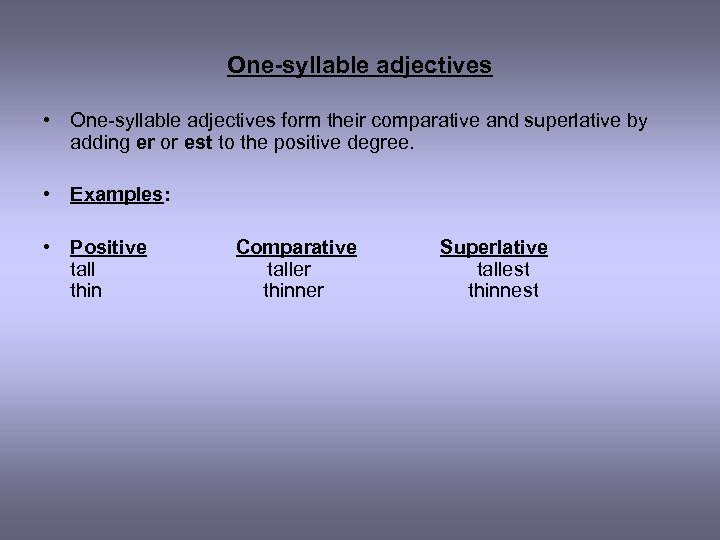 One-syllable adjectives • One-syllable adjectives form their comparative and superlative by adding er or est to the positive degree. • Examples: • Positive Comparative Superlative taller tallest thinner thinnest
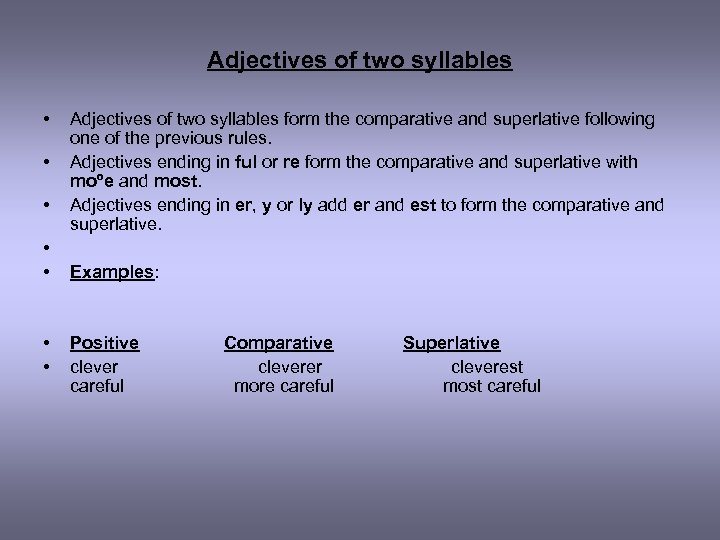 Adjectives of two syllables • • Adjectives of two syllables form the comparative and superlative following one of the previous rules. Adjectives ending in ful or re form the comparative and superlative with moºe and most. Adjectives ending in er, y or ly add er and est to form the comparative and superlative. Examples: Positive Comparative Superlative cleverer cleverest careful more careful most careful
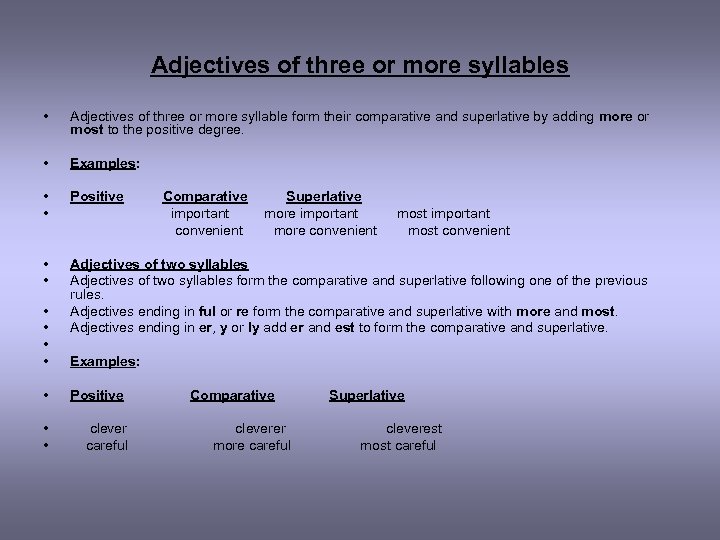 Adjectives of three or more syllables • Adjectives of three or more syllable form their comparative and superlative by adding more or most to the positive degree. • Examples: • Positive Comparative Superlative • important more important most important convenient more convenient most convenient • • • Adjectives of two syllables form the comparative and superlative following one of the previous rules. Adjectives ending in ful or re form the comparative and superlative with more and most. Adjectives ending in er, y or ly add er and est to form the comparative and superlative. Examples: • Positive • • clever cleverer cleverest careful more careful most careful Comparative Superlative
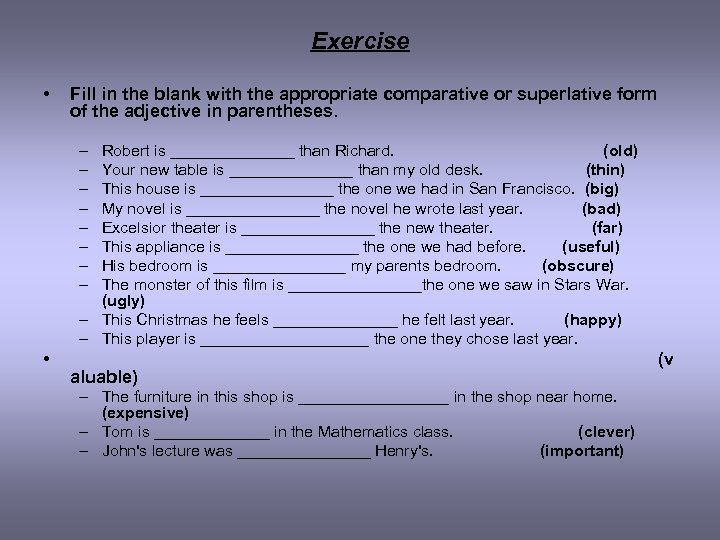 Exercise • Fill in the blank with the appropriate comparative or superlative form of the adjective in parentheses. – – – – Robert is _______ than Richard. (old) Your new table is _______ than my old desk. (thin) This house is ________ the one we had in San Francisco. (big) My novel is ________ the novel he wrote last year. (bad) Excelsior theater is ________ the new theater. (far) This appliance is ________ the one we had before. (useful) His bedroom is ________ my parents bedroom. (obscure) The monster of this film is ________the one we saw in Stars War. (ugly) – This Christmas he feels _______ he felt last year. (happy) – This player is __________ the one they chose last year. • aluable) – The furniture in this shop is _________ in the shop near home. (expensive) – Tom is _______ in the Mathematics class. (clever) – John's lecture was ________ Henry's. (important) (v
 Adverbs • Formation • Kinds • Exercises
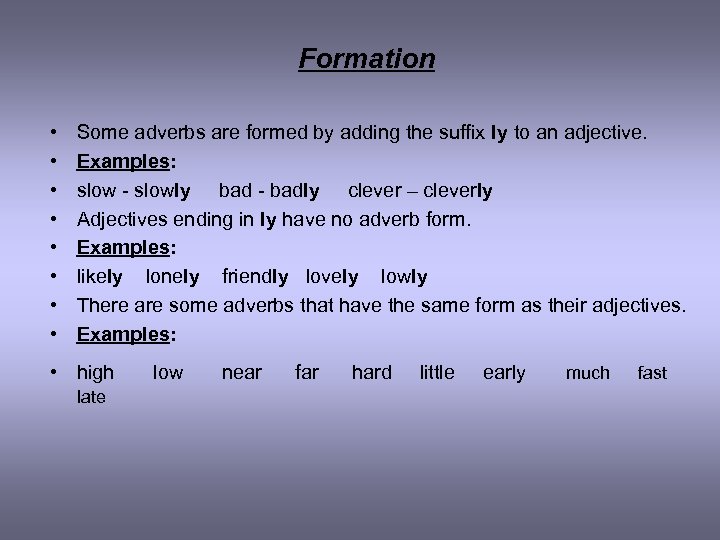 Formation • • Some adverbs are formed by adding the suffix ly to an adjective. Examples: slow - slowly bad - badly clever – cleverly Adjectives ending in ly have no adverb form. Examples: likely lonely friendly lovely lowly There are some adverbs that have the same form as their adjectives. Examples: • high low near far hard little early much fast late
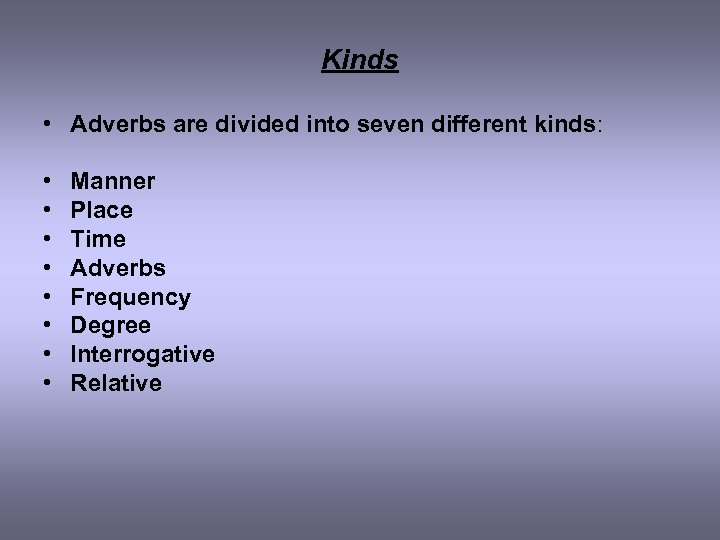 Kinds • Adverbs are divided into seven different kinds: • Manner • Place • Time • Adverbs • Frequency • Degree • Interrogative • Relative
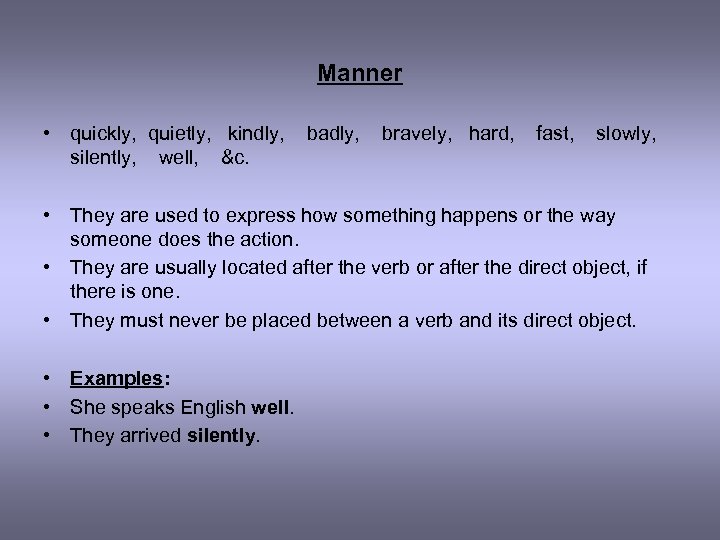 Manner • quickly, quietly, kindly, badly, bravely, hard, fast, slowly, silently, well, &c. • They are used to express how something happens or the way someone does the action. • They are usually located after the verb or after the direct object, if there is one. • They must never be placed between a verb and its direct object. • Examples: • She speaks English well. • They arrived silently.
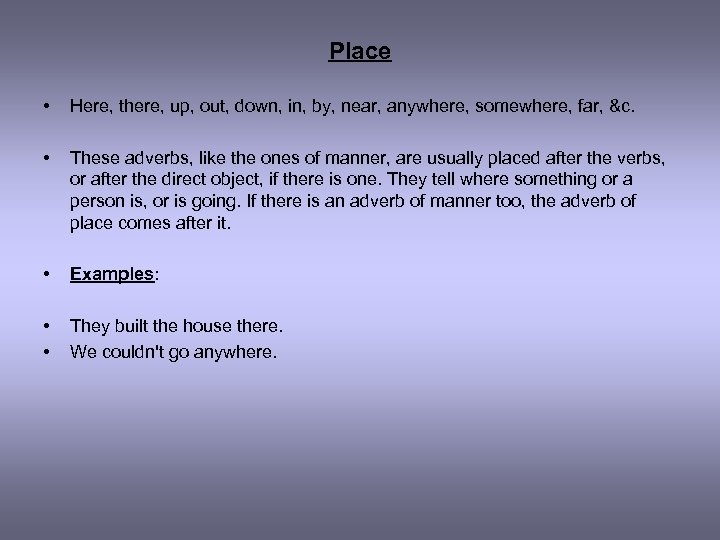 Place • Here, there, up, out, down, in, by, near, anywhere, somewhere, far, &c. • These adverbs, like the ones of manner, are usually placed after the verbs, or after the direct object, if there is one. They tell where something or a person is, or is going. If there is an adverb of manner too, the adverb of place comes after it. • Examples: • • They built the house there. We couldn't go anywhere.
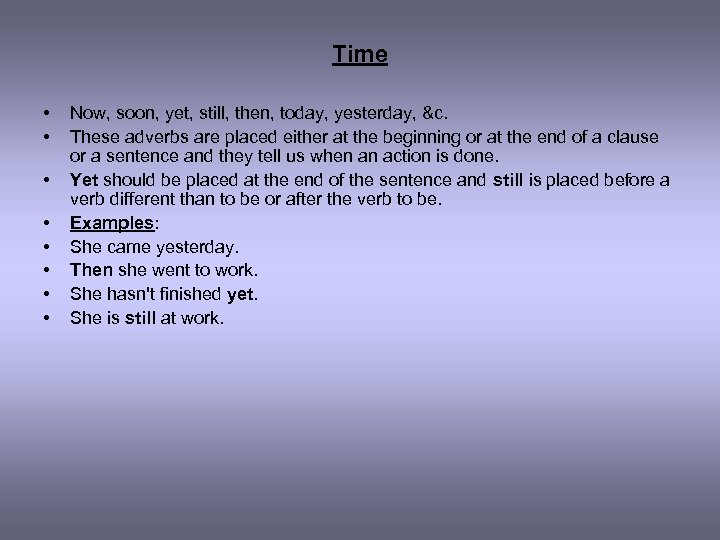 Time • • Now, soon, yet, still, then, today, yesterday, &c. These adverbs are placed either at the beginning or at the end of a clause or a sentence and they tell us when an action is done. Yet should be placed at the end of the sentence and still is placed before a verb different than to be or after the verb to be. Examples: She came yesterday. Then she went to work. She hasn't finished yet. She is still at work.
 Frequency • often, always, ever, never, usually, rarely, sometimes, seldom, once, twice, &c. • They are placed after the simple tenses of the verb To Be and before the simple tenses of verbs different than the verb To Be. • They are placed after the first auxiliary with verbal tenses that have more than one verb. • Adverbs of frequency are often placed before the auxiliary when they are used in emphatic answers to questions. • Examples: • She is always late to class. • The train rarely arrives on time. • They have never been abroad.
 Degree Almost, nearly, quite, just, barely, hardly, too, scarcely, very, rather, fairly, extremely, &c. They can modify either an adjective or another adverb. These modifiers are placed before the words they modify. The underlined ones can also modify verbs. They are placed before the main verb in simple tenses and after the auxiliary in tenses of more than one verb. Examples: The soup is too hot. He knows her quite well.
 Interrogative • Why, what, when, where, how. • They are generally used in questions to ask the reason, the time, the place or the way an action is performed. • Examples: • • Why did he come so early? When is he leaving? Where do you study? How long is this road?
 Relative • Why, when, where. • They are generally used to substitute a preposition and the relative pronoun which. • Why replaces for which and it is used for reasons. • Example: • The reason for which he left = The reason why he left. • When replaces in/on which and it is used for time. • Example: • The day on which he comes = The day when he comes. • Where replaces in which and it is used for place. • Example: • The truck in which he moved = The truck where he moved.
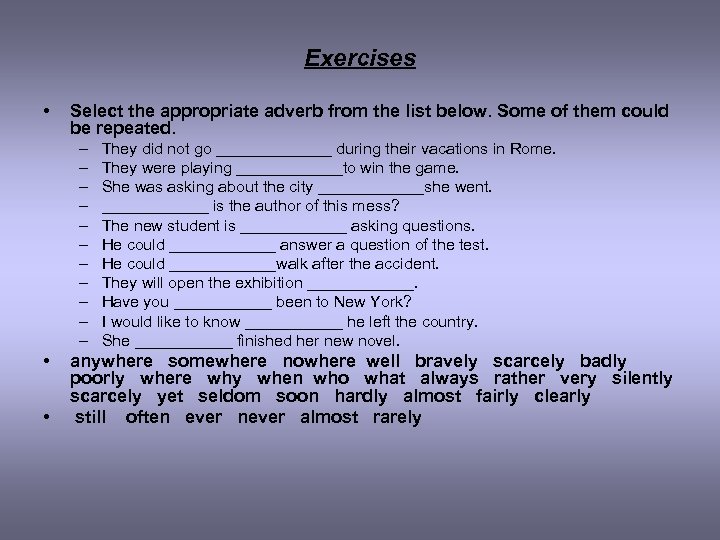 Exercises • Select the appropriate adverb from the list below. Some of them could be repeated. – – – • • They did not go _______ during their vacations in Rome. They were playing ______to win the game. She was asking about the city ______she went. ______ is the author of this mess? The new student is ______ asking questions. He could ______ answer a question of the test. He could ______walk after the accident. They will open the exhibition ______. Have you ______ been to New York? I would like to know ______ he left the country. She ______ finished her new novel. anywhere somewhere nowhere well bravely scarcely badly poorly where why when who what always rather very silently scarcely yet seldom soon hardly almost fairly clearly still often ever never almost rarely
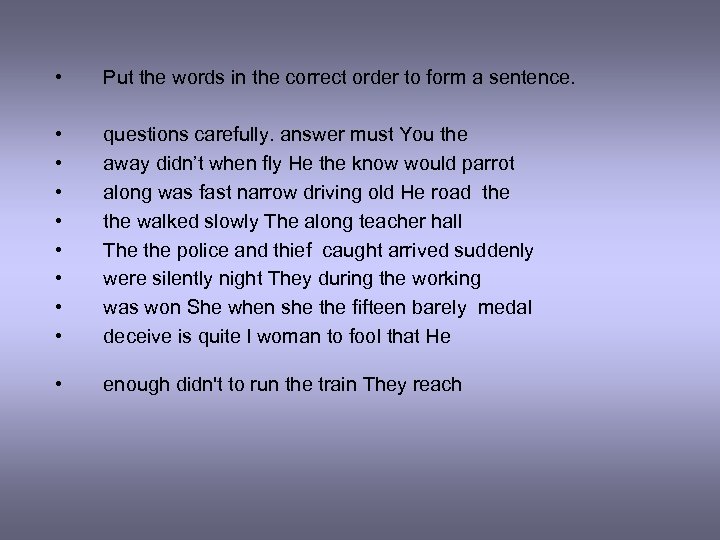 • Put the words in the correct order to form a sentence. • • questions carefully. answer must You the away didn’t when fly He the know would parrot along was fast narrow driving old He road the walked slowly The along teacher hall The the police and thief caught arrived suddenly were silently night They during the working was won She when she the fifteen barely medal deceive is quite l woman to fool that He • enough didn't to run the train They reach
 Prepositions • • • Introduction Position Time and Date Exercises
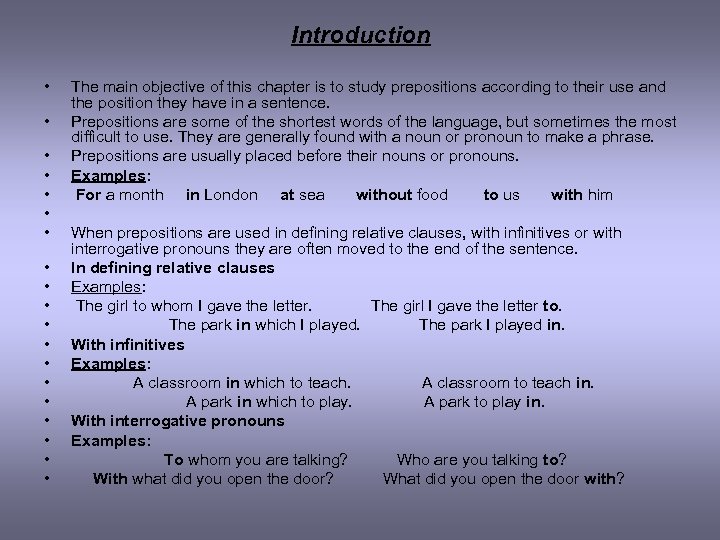 Introduction • • • • • The main objective of this chapter is to study prepositions according to their use and the position they have in a sentence. Prepositions are some of the shortest words of the language, but sometimes the most difficult to use. They are generally found with a noun or pronoun to make a phrase. Prepositions are usually placed before their nouns or pronouns. Examples: For a month in London at sea without food to us with him When prepositions are used in defining relative clauses, with infinitives or with interrogative pronouns they are often moved to the end of the sentence. In defining relative clauses Examples: The girl to whom I gave the letter. The girl I gave the letter to. The park in which I played. The park I played in. With infinitives Examples: A classroom in which to teach. A classroom to teach in. A park in which to play. A park to play in. With interrogative pronouns Examples: To whom you are talking? Who are you talking to? With what did you open the door? What did you open the door with?
 Time • • • • Till and until are used for time but when from is omitted only till can be used. Examples: We studied from six to / until ten. We studied English till nine. From can be used for place or time while since can only be used for time. Examples: He ran from 6 to 7. 30 a. m. She traveled from Rio to Havana. She has been traveling since Monday morning. For is used for a period of time while since is used when there is a definite point of time where the action begins and it continues to the time of speaking. Examples: for six years for a week for a month She has been waiting since he left. During is used with known periods of time or periods previously defined. It is followed by the name of the period or by the, this, that or those.
 Time and Date • • • At is used when it refers to a specific time of the day or with a period of time that doesn't cover only one day. Examples: At six o'clock at noon at night at Christmas On is used when it refers to a day only. Examples: on Monday on July 23 rd on Christmas Day In is used when it refers to a period of time. Examples: in August in Summer in the morning in 1941
 Place • At is used with a small village, an address, a certain point as a bridge, a cross-road or a bus stop. • In is used with a country, a town, a forest or any enclosed place. • There is a slight difference between at and in: • At means inside, outside or beside the place while in means inside only. • Either at or in can be used with a building, an office, a public place, a river or a sea. • In is used for location as explained before while into is used to indicate entrance with a verb of motion. • • Examples: They are in the kitchen. They went into the bedroom. She fell into the pool.
 Exercises • Write the appropriate preposition in the blanks. Some prepositions could be repeated. A famous writer wrote a book title "His Life" but it was never published. One day when he was traveling Madrid Barcelona his car crashed another car a bridge and fell the river. A passer-by who saw the accident save the author's life because the writer didn't know how swim. As a prove his gratitude he invited the man dinner _____his home, and as he knew he owned his life the passer-by, he gave him a copy his book _____ pay his life "His Life".
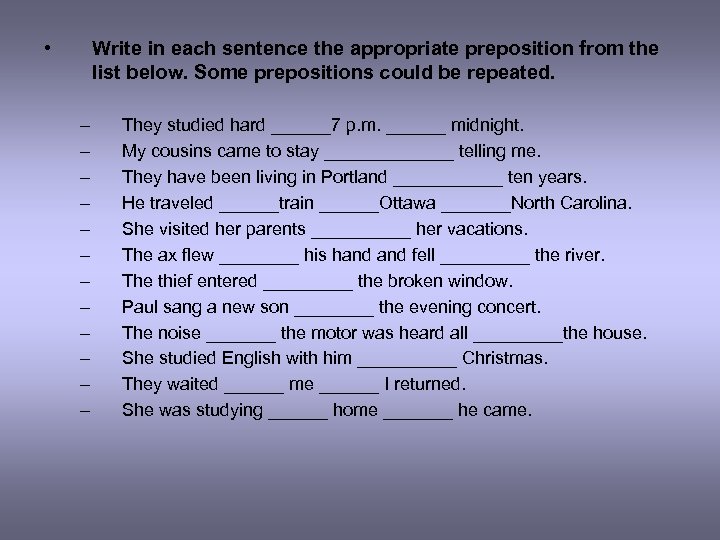 • Write in each sentence the appropriate preposition from the list below. Some prepositions could be repeated. – – – They studied hard ______7 p. m. ______ midnight. My cousins came to stay _______ telling me. They have been living in Portland ______ ten years. He traveled ______train ______Ottawa _______North Carolina. She visited her parents _____ her vacations. The ax flew ____ his hand fell _____ the river. The thief entered _____ the broken window. Paul sang a new son ____ the evening concert. The noise _______ the motor was heard all _____the house. She studied English with him _____ Christmas. They waited ______ me ______ I returned. She was studying ______ home _______ he came.