 Скачать презентацию Autonomous Semantic Web Services Katia Sycara Intelligent Software
c2df66b550dd148d8f7b33b9db336089.ppt
- Количество слайдов: 61



Autonomous Semantic Web Services Katia Sycara Intelligent Software Agents and Web Technologies Lab Carnegie Mellon University katia@cs. cmu. edu http: //www. cs. cmu. edu/~softagents/
ISRI-Seminar-05 Talk Overview The Vision Requirements and Challenges Web Services Semantic Web Multi Agent Systems (MAS) Semantic Web Services OWL-S Future Directions 2
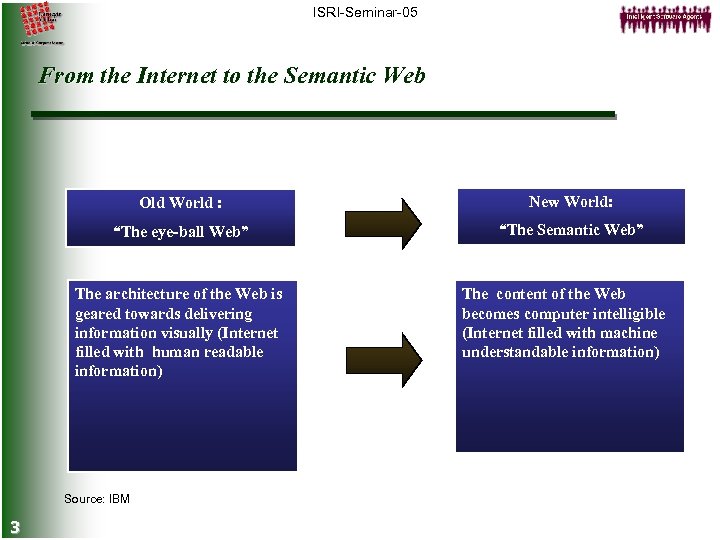
ISRI-Seminar-05 From the Internet to the Semantic Web Old World : New World: “The eye-ball Web” “The Semantic Web” The architecture of the Web is geared towards delivering information visually (Internet filled with human readable information) Source: IBM 3 The content of the Web becomes computer intelligible (Internet filled with machine understandable information)
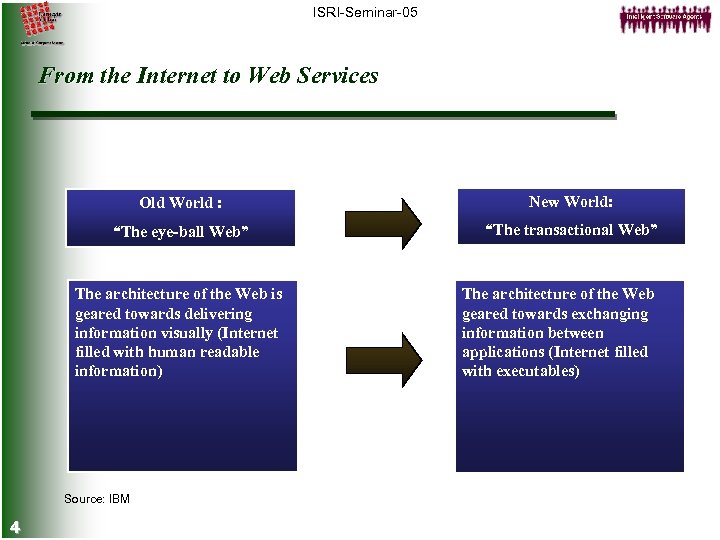
ISRI-Seminar-05 From the Internet to Web Services Old World : New World: “The eye-ball Web” “The transactional Web” The architecture of the Web is geared towards delivering information visually (Internet filled with human readable information) Source: IBM 4 The architecture of the Web geared towards exchanging information between applications (Internet filled with executables)
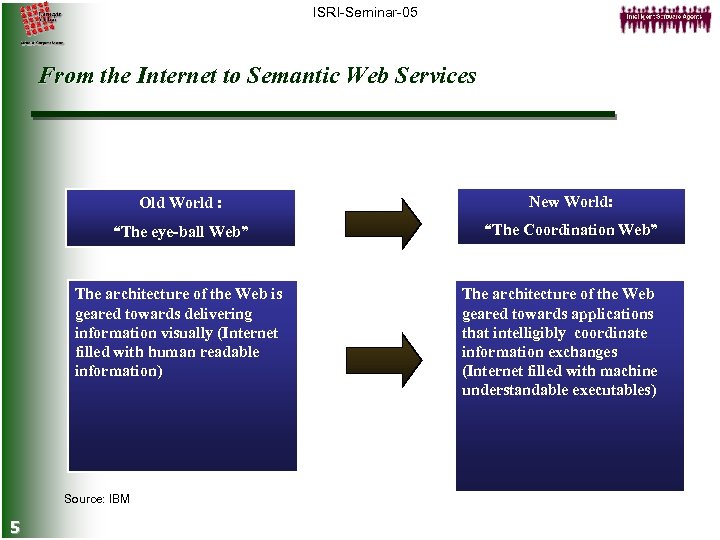
ISRI-Seminar-05 From the Internet to Semantic Web Services Old World : New World: “The eye-ball Web” “The Coordination Web” The architecture of the Web is geared towards delivering information visually (Internet filled with human readable information) Source: IBM 5 The architecture of the Web geared towards applications that intelligibly coordinate information exchanges (Internet filled with machine understandable executables)
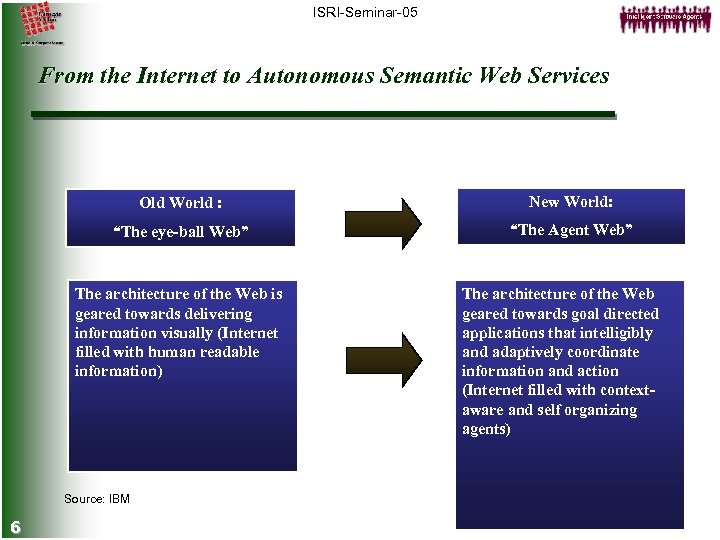
ISRI-Seminar-05 From the Internet to Autonomous Semantic Web Services Old World : New World: “The eye-ball Web” “The Agent Web” The architecture of the Web is geared towards delivering information visually (Internet filled with human readable information) Source: IBM 6 The architecture of the Web geared towards goal directed applications that intelligibly and adaptively coordinate information and action (Internet filled with contextaware and self organizing agents)
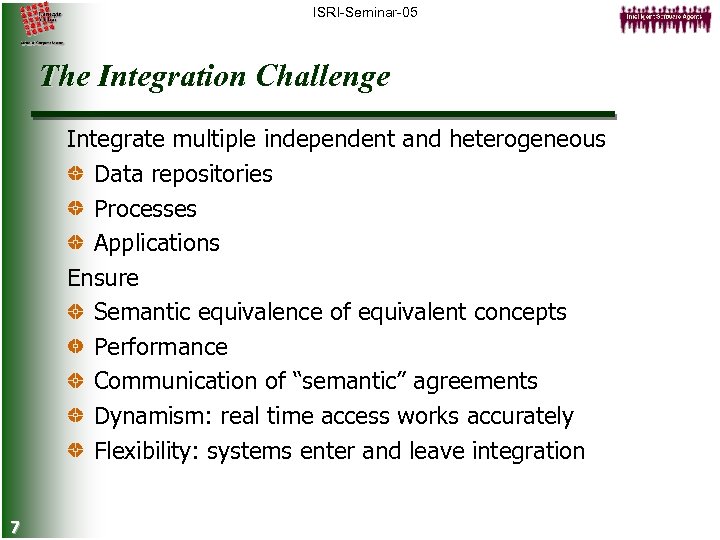
ISRI-Seminar-05 The Integration Challenge Integrate multiple independent and heterogeneous Data repositories Processes Applications Ensure Semantic equivalence of equivalent concepts Performance Communication of “semantic” agreements Dynamism: real time access works accurately Flexibility: systems enter and leave integration 7
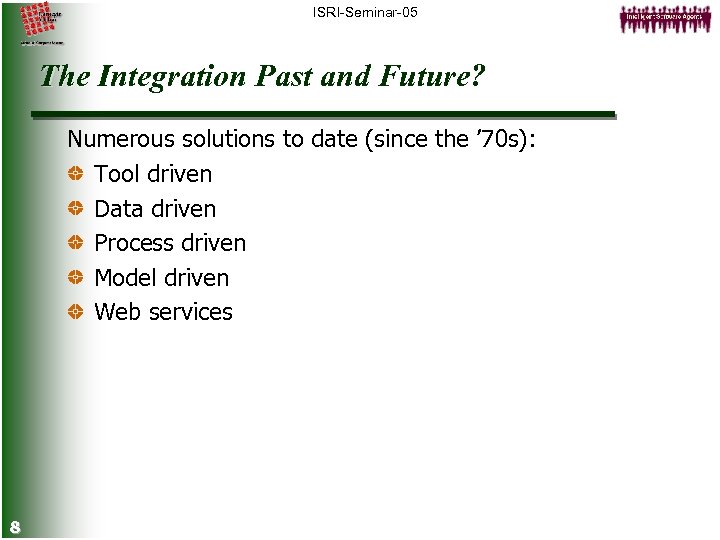
ISRI-Seminar-05 The Integration Past and Future? Numerous solutions to date (since the ’ 70 s): Tool driven Data driven Process driven Model driven Web services 8
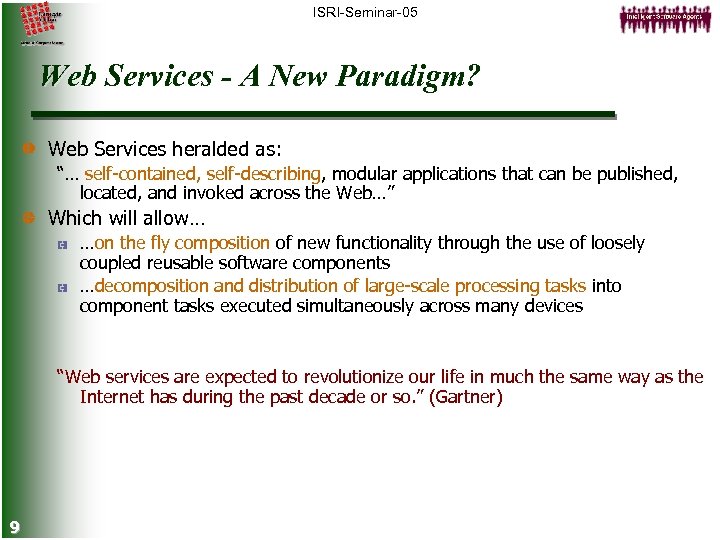
ISRI-Seminar-05 Web Services - A New Paradigm? Web Services heralded as: “… self-contained, self-describing, modular applications that can be published, located, and invoked across the Web…” Which will allow… …on the fly composition of new functionality through the use of loosely coupled reusable software components …decomposition and distribution of large-scale processing tasks into component tasks executed simultaneously across many devices “Web services are expected to revolutionize our life in much the same way as the Internet has during the past decade or so. ” (Gartner) 9
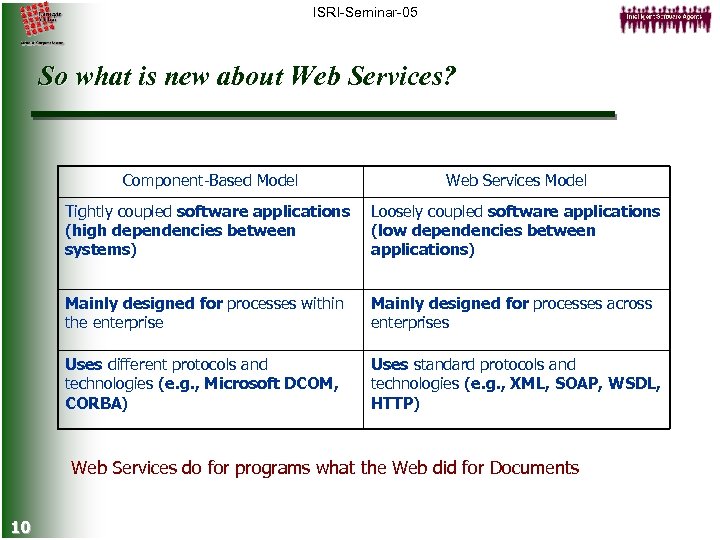
ISRI-Seminar-05 So what is new about Web Services? Component-Based Model Web Services Model Tightly coupled software applications (high dependencies between systems) Loosely coupled software applications (low dependencies between applications) Mainly designed for processes within the enterprise Mainly designed for processes across enterprises Uses different protocols and technologies (e. g. , Microsoft DCOM, CORBA) Uses standard protocols and technologies (e. g. , XML, SOAP, WSDL, HTTP) Web Services do for programs what the Web did for Documents 10
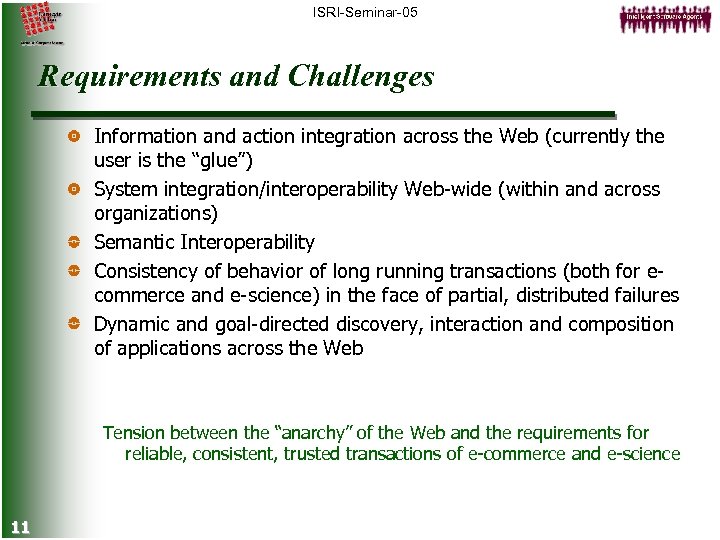
ISRI-Seminar-05 Requirements and Challenges Information and action integration across the Web (currently the user is the “glue”) System integration/interoperability Web-wide (within and across organizations) Semantic Interoperability Consistency of behavior of long running transactions (both for ecommerce and e-science) in the face of partial, distributed failures Dynamic and goal-directed discovery, interaction and composition of applications across the Web Tension between the “anarchy” of the Web and the requirements for reliable, consistent, trusted transactions of e-commerce and e-science 11

ISRI-Seminar-05 Current State: Web Services Standards SOAP: XML based web services communication protocol Limitations Unbounded message format Has no communicative speech acts (cannot determine intention of actors or type of the message) WSDL: Structured mechanism to describe a WS interface Abstract operations that a Web Service can perform Format of messages it can process Protocols it can support Physical bindings to URIs and protocols Limitations No semantics for message sequencing and correlation No semantics for message content 12
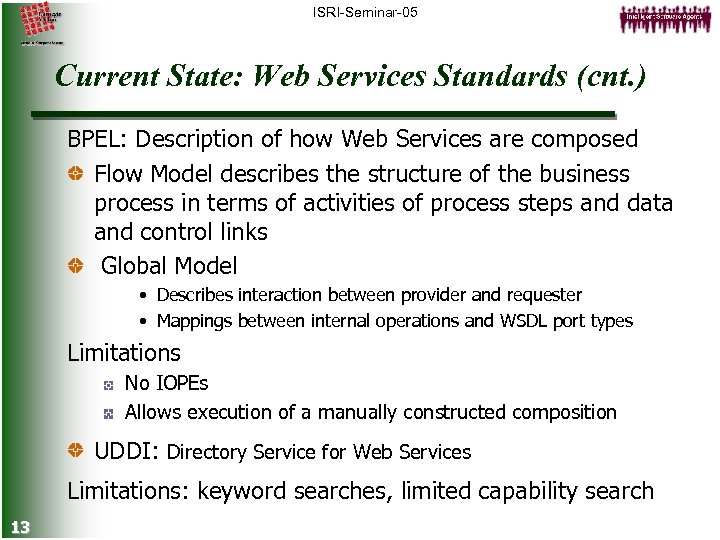
ISRI-Seminar-05 Current State: Web Services Standards (cnt. ) BPEL: Description of how Web Services are composed Flow Model describes the structure of the business process in terms of activities of process steps and data and control links Global Model • Describes interaction between provider and requester • Mappings between internal operations and WSDL port types Limitations No IOPEs Allows execution of a manually constructed composition UDDI: Directory Service for Web Services Limitations: keyword searches, limited capability search 13
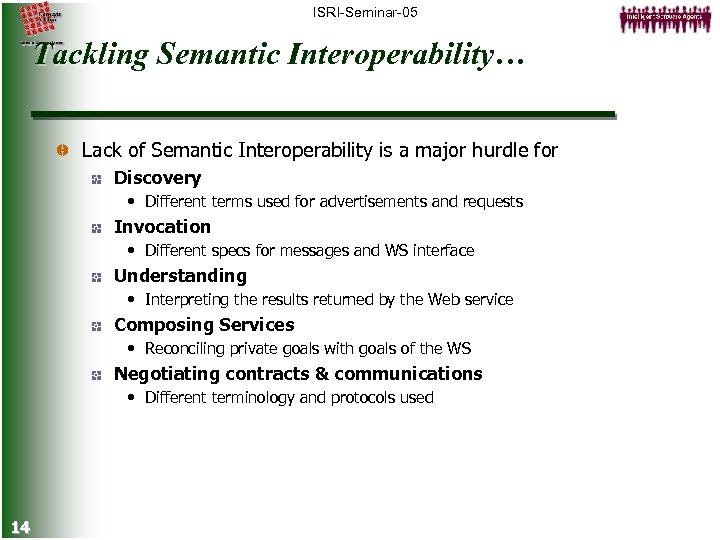
ISRI-Seminar-05 Tackling Semantic Interoperability… Lack of Semantic Interoperability is a major hurdle for Discovery • Different terms used for advertisements and requests Invocation • Different specs for messages and WS interface Understanding • Interpreting the results returned by the Web service Composing Services • Reconciling private goals with goals of the WS Negotiating contracts & communications • Different terminology and protocols used 14
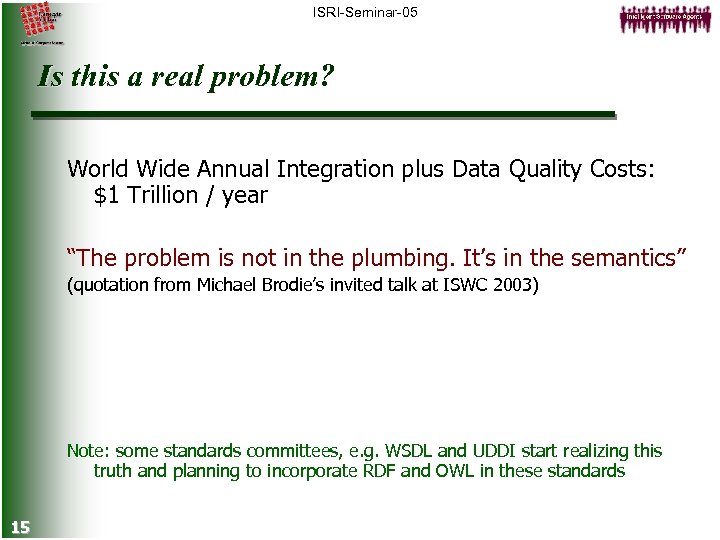
ISRI-Seminar-05 Is this a real problem? World Wide Annual Integration plus Data Quality Costs: $1 Trillion / year “The problem is not in the plumbing. It’s in the semantics” (quotation from Michael Brodie’s invited talk at ISWC 2003) Note: some standards committees, e. g. WSDL and UDDI start realizing this truth and planning to incorporate RDF and OWL in these standards 15
ISRI-Seminar-05 Three Significant Technological Visions Semantic Web Multi Agent Systems (MAS) Semantic Web Services 16
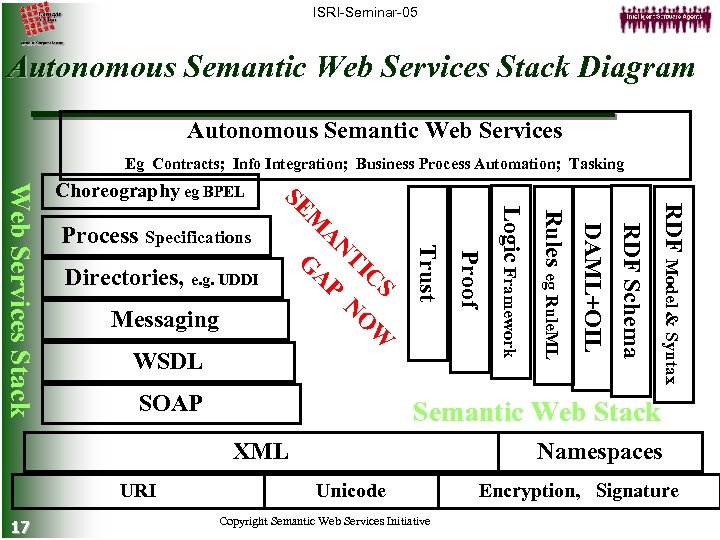
ISRI-Seminar-05 Autonomous Semantic Web Services Stack Diagram Autonomous Semantic Web Services Eg Contracts; Info Integration; Business Process Automation; Tasking RDF Model & Syntax RDF Schema 17 DAML+OIL Semantic Web Stack XML URI Rules eg Rule. ML W O N SOAP Logic Framework S P C TI N A WSDL Proof G Messaging Trust Directories, e. g. UDDI A Process Specifications M SE Web Services Stack Choreography eg BPEL Namespaces Unicode Copyright Semantic Web Services Initiative Encryption, Signature
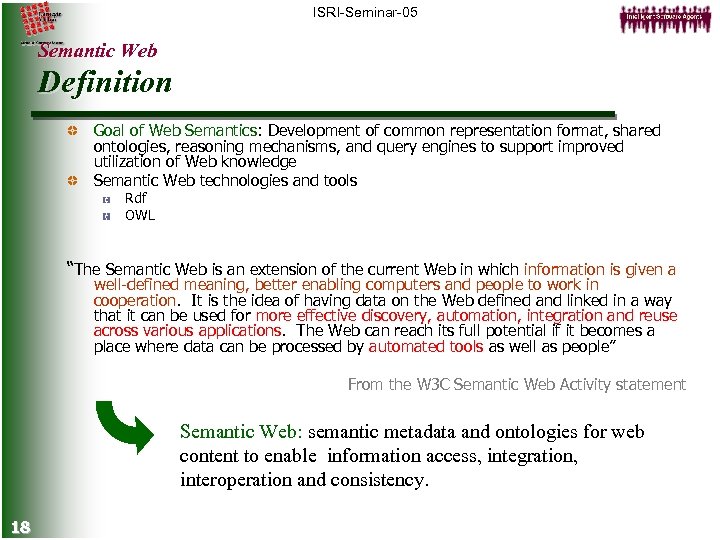
ISRI-Seminar-05 Semantic Web Definition Goal of Web Semantics: Development of common representation format, shared ontologies, reasoning mechanisms, and query engines to support improved utilization of Web knowledge Semantic Web technologies and tools Rdf OWL “The Semantic Web is an extension of the current Web in which information is given a well-defined meaning, better enabling computers and people to work in cooperation. It is the idea of having data on the Web defined and linked in a way that it can be used for more effective discovery, automation, integration and reuse across various applications. The Web can reach its full potential if it becomes a place where data can be processed by automated tools as well as people” From the W 3 C Semantic Web Activity statement Semantic Web: semantic metadata and ontologies for web content to enable information access, integration, interoperation and consistency. 18
ISRI-Seminar-05 Semantic Web OWL is a W 3 C standard OWL is a Description Logic-based Language: provides the basic constructs to describe ontologies Definition of concepts Relations between concepts Special relation: subclass for generalization Effectively computable • Good optimization algorithms support inference OWL specifications W 3 C page on OWL • http: //www. w 3 c. org/2001/sw/Web. Ont/ OWL Guide and language reference • http: //www. w 3. org/TR/owl-guide/ • http: //www. w 3. org/TR/owl-ref/ Tutorials Costello and Jacobs’ OWL tutorial: http: //www. xfront. com/owl 19
ISRI-Seminar-05 RCal Calendar Agent Retsina Semantic Web Calendar Agent supports: Browsing of agendas and schedules marked up in OWL & RDF Invocation of related tasks, such as scheduling meetings and email Integration of selected meetings and events into MS Outlook Can parse markup using several ontologies, including Hybrid ICal Calendar Ontology Dublin Core Ontology Friend-of-a-Friend Ontology Schedule markup using other ontologies can be accessed via translation agents DMA 2 ICal Agent converts OWL Meeting Agenda markup into ICal Markup. http: //www. daml. ri. cmu. edu/Cal 20
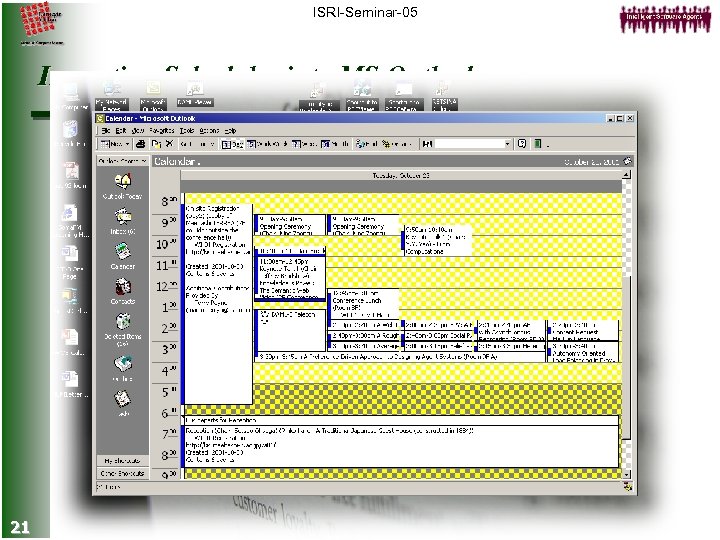
ISRI-Seminar-05 Importing Schedules into MS Outlook 21
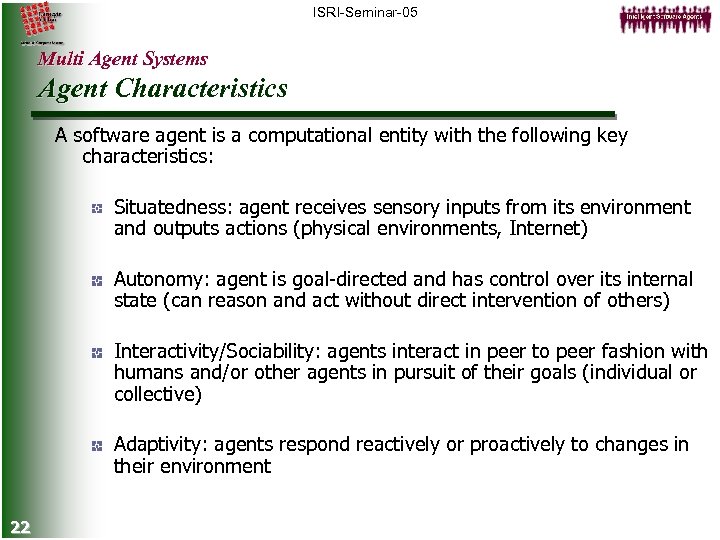
ISRI-Seminar-05 Multi Agent Systems Agent Characteristics A software agent is a computational entity with the following key characteristics: Situatedness: agent receives sensory inputs from its environment and outputs actions (physical environments, Internet) Autonomy: agent is goal-directed and has control over its internal state (can reason and act without direct intervention of others) Interactivity/Sociability: agents interact in peer to peer fashion with humans and/or other agents in pursuit of their goals (individual or collective) Adaptivity: agents respond reactively or proactively to changes in their environment 22
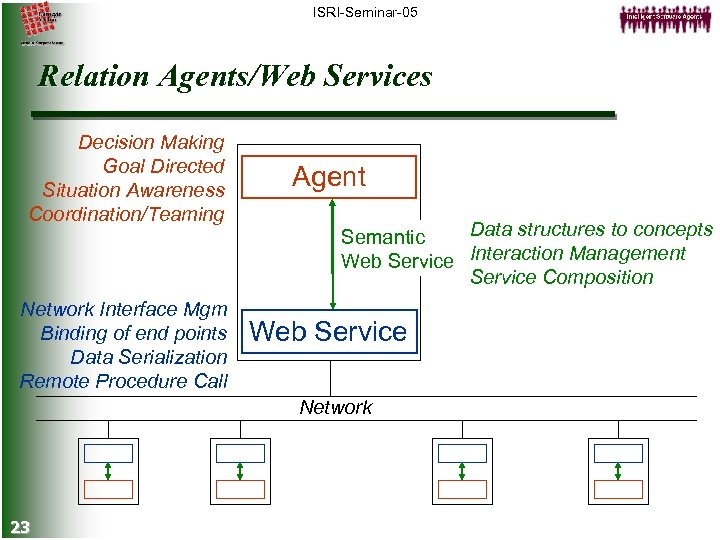
ISRI-Seminar-05 Relation Agents/Web Services Decision Making Goal Directed Situation Awareness Coordination/Teaming Network Interface Mgm Binding of end points Data Serialization Remote Procedure Call Agent Data structures to concepts Semantic Web Service Interaction Management Service Composition Web Service Network 23
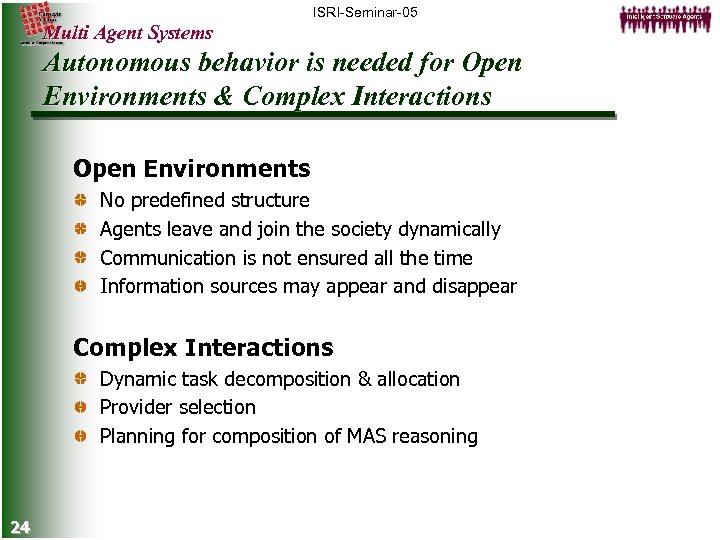
ISRI-Seminar-05 Multi Agent Systems Autonomous behavior is needed for Open Environments & Complex Interactions Open Environments No predefined structure Agents leave and join the society dynamically Communication is not ensured all the time Information sources may appear and disappear Complex Interactions Dynamic task decomposition & allocation Provider selection Planning for composition of MAS reasoning 24
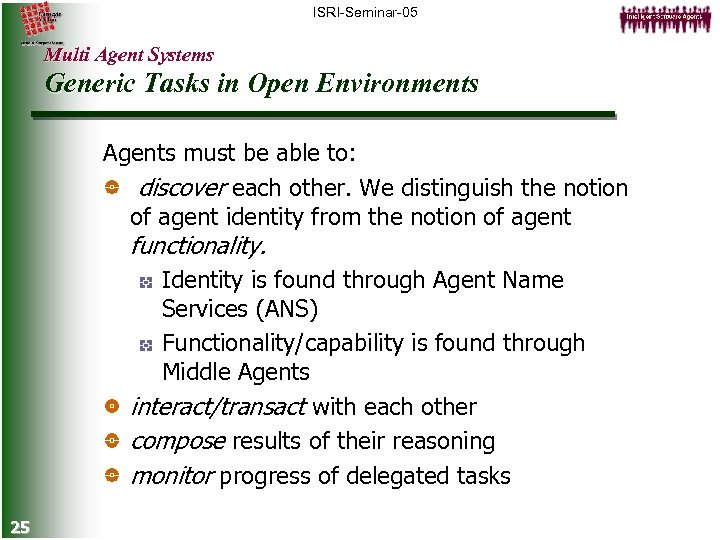
ISRI-Seminar-05 Multi Agent Systems Generic Tasks in Open Environments Agents must be able to: discover each other. We distinguish the notion of agent identity from the notion of agent functionality. Identity is found through Agent Name Services (ANS) Functionality/capability is found through Middle Agents interact/transact with each other compose results of their reasoning monitor progress of delegated tasks 25
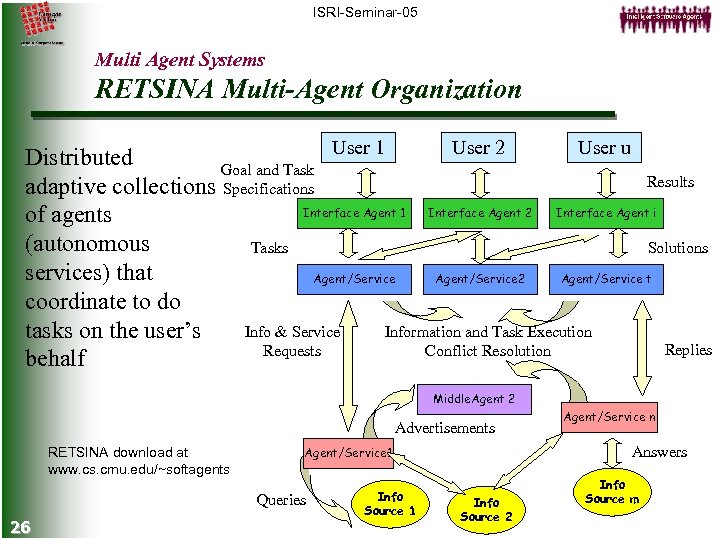
ISRI-Seminar-05 Multi Agent Systems RETSINA Multi-Agent Organization User 1 User 2 User u Distributed Goal and Task Results adaptive collections Specifications Interface Agent 1 Interface Agent 2 Interface Agent i of agents (autonomous Tasks Solutions services) that Agent/Service 2 Agent/Service t coordinate to do Info & Service Information and Task Execution tasks on the user’s Replies Requests Conflict Resolution behalf Middle. Agent 2 Advertisements RETSINA download at www. cs. cmu. edu/~softagents Queries 26 Answers Agent/Service 1 Info Source 1 Agent/Service n Info Source 2 Info Source m
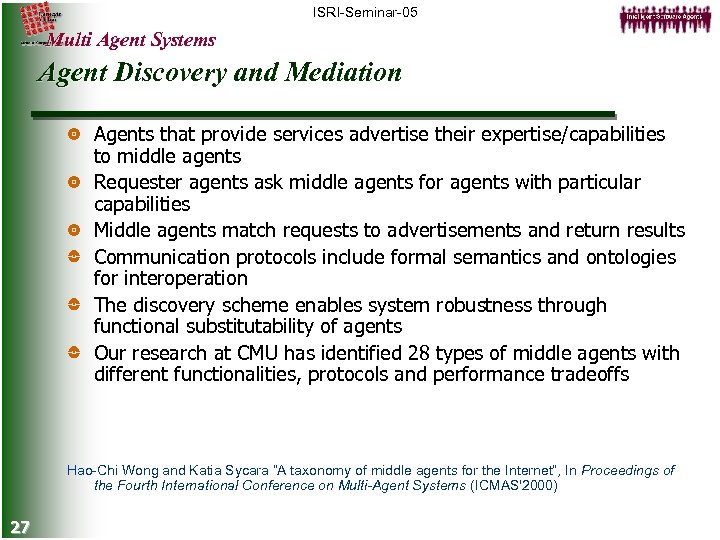
ISRI-Seminar-05 Multi Agent Systems Agent Discovery and Mediation Agents that provide services advertise their expertise/capabilities to middle agents Requester agents ask middle agents for agents with particular capabilities Middle agents match requests to advertisements and return results Communication protocols include formal semantics and ontologies for interoperation The discovery scheme enables system robustness through functional substitutability of agents Our research at CMU has identified 28 types of middle agents with different functionalities, protocols and performance tradeoffs Hao-Chi Wong and Katia Sycara “A taxonomy of middle agents for the Internet”, In Proceedings of the Fourth International Conference on Multi-Agent Systems (ICMAS'2000) 27
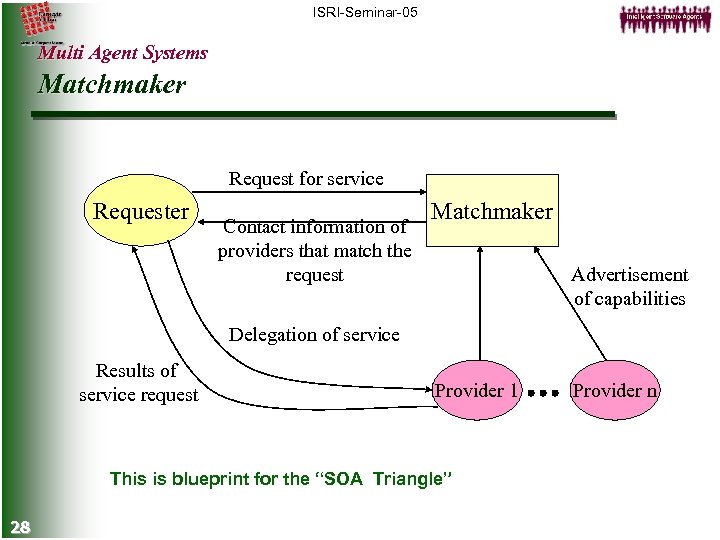
ISRI-Seminar-05 Multi Agent Systems Matchmaker Request for service Requester Contact information of providers that match the request Matchmaker Advertisement of capabilities Delegation of service Results of service request Provider 1 This is blueprint for the “SOA Triangle” 28 Provider n
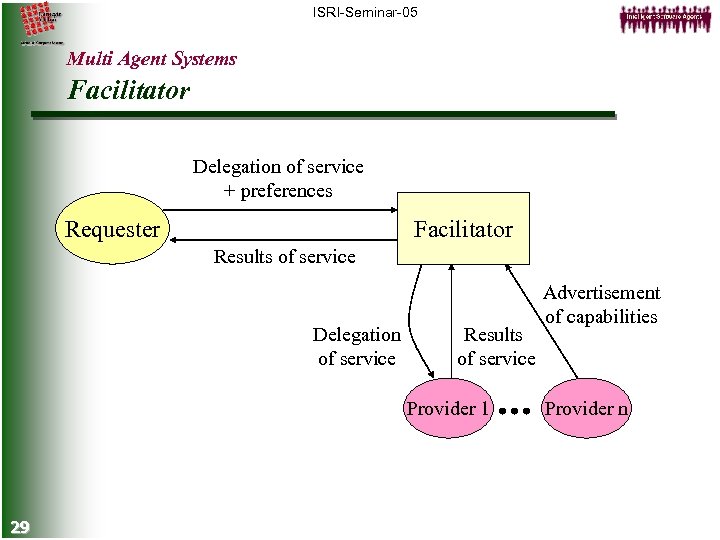
ISRI-Seminar-05 Multi Agent Systems Facilitator Delegation of service + preferences Requester Facilitator Results of service Delegation of service Results of service Provider 1 29 Advertisement of capabilities Provider n
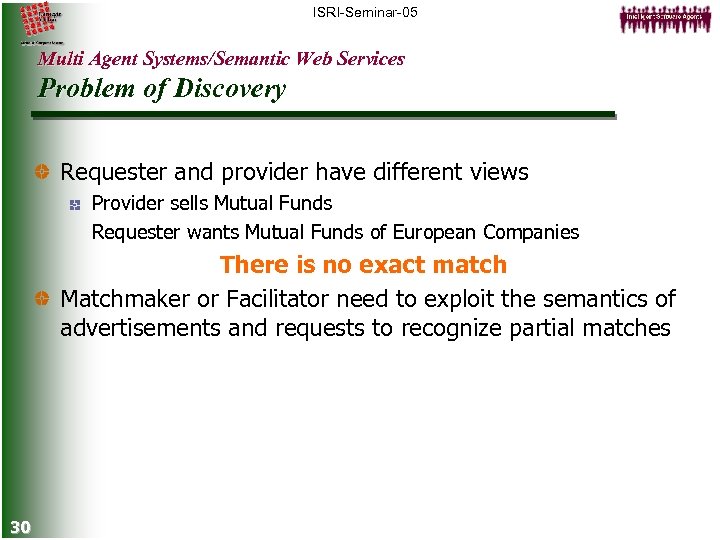
ISRI-Seminar-05 Multi Agent Systems/Semantic Web Services Problem of Discovery Requester and provider have different views Provider sells Mutual Funds Requester wants Mutual Funds of European Companies There is no exact match Matchmaker or Facilitator need to exploit the semantics of advertisements and requests to recognize partial matches 30
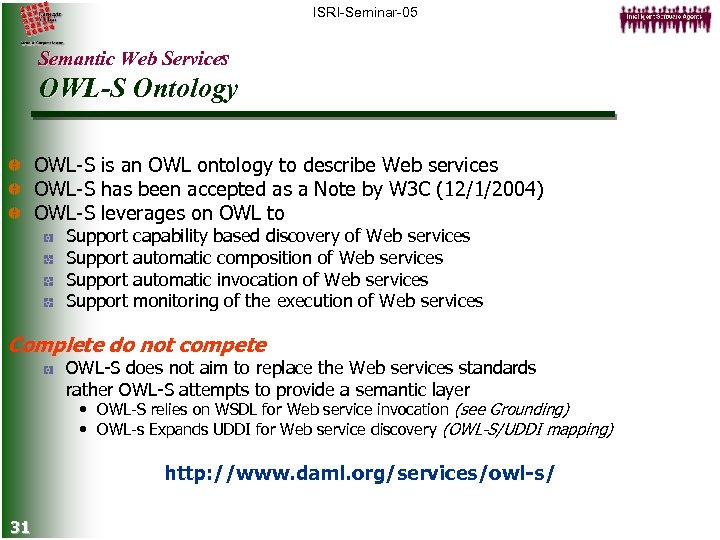
ISRI-Seminar-05 Semantic Web Services OWL-S Ontology OWL-S is an OWL ontology to describe Web services OWL-S has been accepted as a Note by W 3 C (12/1/2004) OWL-S leverages on OWL to Support capability based discovery of Web services automatic composition of Web services automatic invocation of Web services monitoring of the execution of Web services Complete do not compete OWL-S does not aim to replace the Web services standards rather OWL-S attempts to provide a semantic layer • OWL-S relies on WSDL for Web service invocation (see Grounding) • OWL-s Expands UDDI for Web service discovery (OWL-S/UDDI mapping) http: //www. daml. org/services/owl-s/ 31
ISRI-Seminar-05 Semantic Web Services Acknowledgements to the OWL-S Web Services Coalition BBN: Mark Burstein CMU: Katia Sycara, Massimo Paolucci, Naveen Srinivasan De Montfort University: Monika Solanki ISI: Jerry Hobbs U. Of Maryland: Bijan Parsia Nokia: Ora Lassila Southampton: Terry Payne Stanford KSL: Deborah Mc. Guiness SRI: David Martin U. Of Toronto: Sheila Mc. Ilraith Vrije Universiteit: Marta Sabou Yale: Drew Mc. Dermott 32
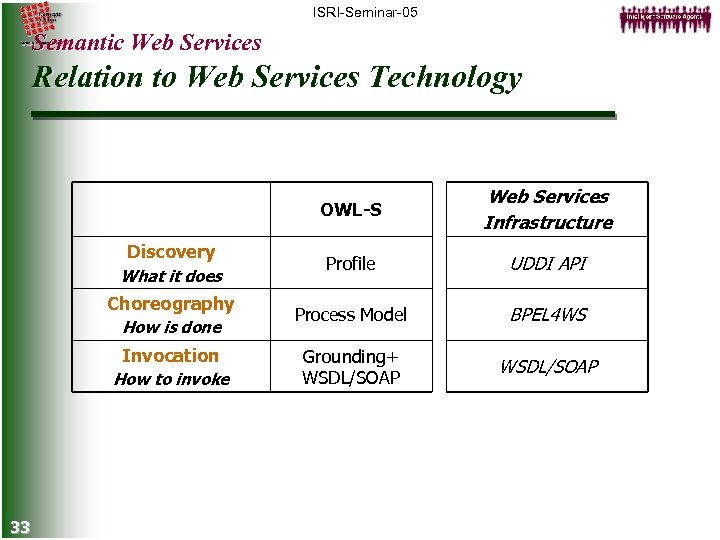
ISRI-Seminar-05 Semantic Web Services Relation to Web Services Technology OWL-S Discovery What it does Choreography How is done Invocation How to invoke 33 Web Services Infrastructure Profile UDDI API Process Model BPEL 4 WS Grounding+ WSDL/SOAP
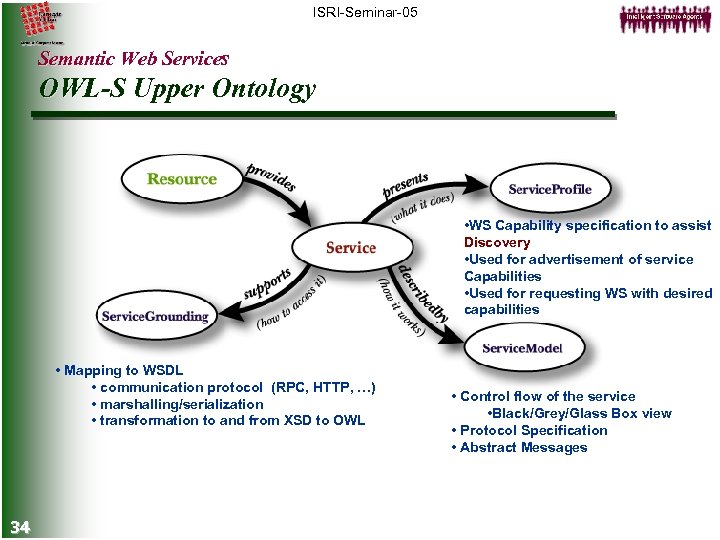
ISRI-Seminar-05 Semantic Web Services OWL-S Upper Ontology • WS Capability specification to assist Discovery • Used for advertisement of service Capabilities • Used for requesting WS with desired capabilities • Mapping to WSDL • communication protocol (RPC, HTTP, …) • marshalling/serialization • transformation to and from XSD to OWL 34 • Control flow of the service • Black/Grey/Glass Box view • Protocol Specification • Abstract Messages
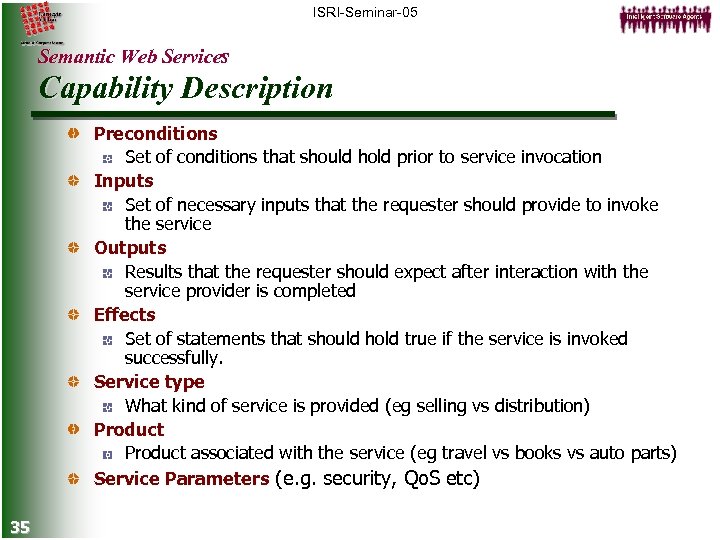
ISRI-Seminar-05 Semantic Web Services Capability Description Preconditions Set of conditions that should hold prior to service invocation Inputs Set of necessary inputs that the requester should provide to invoke the service Outputs Results that the requester should expect after interaction with the service provider is completed Effects Set of statements that should hold true if the service is invoked successfully. Service type What kind of service is provided (eg selling vs distribution) Product associated with the service (eg travel vs books vs auto parts) Service Parameters (e. g. security, Qo. S etc) 35
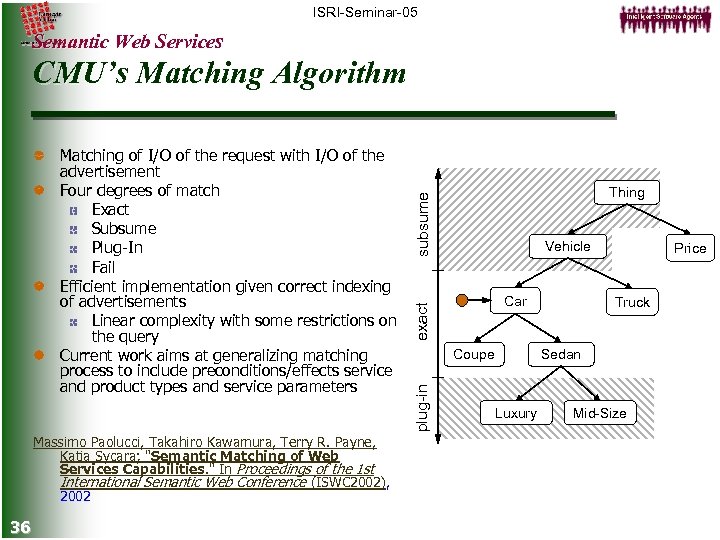
ISRI-Seminar-05 Semantic Web Services CMU’s Matching Algorithm Massimo Paolucci, Takahiro Kawamura, Terry R. Payne, Katia Sycara; "Semantic Matching of Web Services Capabilities. " In Proceedings of the 1 st International Semantic Web Conference (ISWC 2002), 2002 36 subsume Thing Vehicle exact Car Coupe plug-in Matching of I/O of the request with I/O of the advertisement Four degrees of match Exact Subsume Plug-In Fail Efficient implementation given correct indexing of advertisements Linear complexity with some restrictions on the query Current work aims at generalizing matching process to include preconditions/effects service and product types and service parameters Price Truck Sedan Luxury Mid-Size
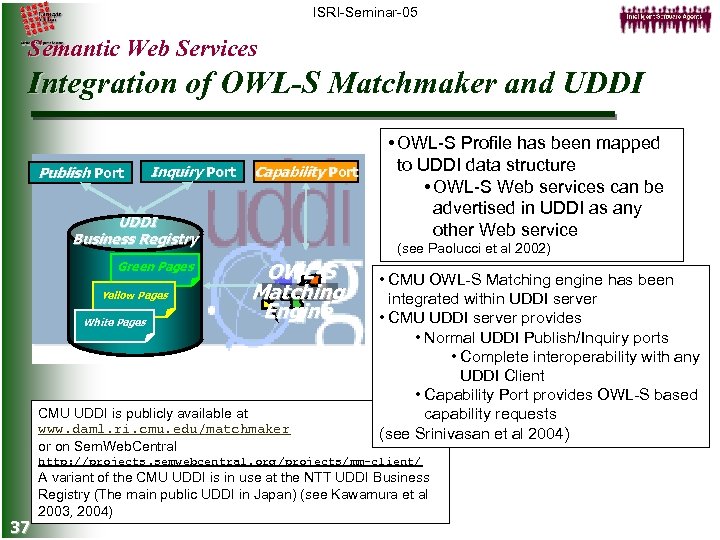
ISRI-Seminar-05 Semantic Web Services Integration of OWL-S Matchmaker and UDDI Publish Port Inquiry Port Capability Port UDDI Business Registry Green Pages Yellow Pages White Pages • OWL-S Profile has been mapped to UDDI data structure • OWL-S Web services can be advertised in UDDI as any other Web service (see Paolucci et al 2002) OWL-S Matching Engine CMU UDDI is publicly available at www. daml. ri. cmu. edu/matchmaker or on Sem. Web. Central • CMU OWL-S Matching engine has been integrated within UDDI server • CMU UDDI server provides • Normal UDDI Publish/Inquiry ports • Complete interoperability with any UDDI Client • Capability Port provides OWL-S based capability requests (see Srinivasan et al 2004) http: //projects. semwebcentral. org /projects/mm-client/ 37 A variant of the CMU UDDI is in use at the NTT UDDI Business Registry (The main public UDDI in Japan) (see Kawamura et al 2003, 2004)
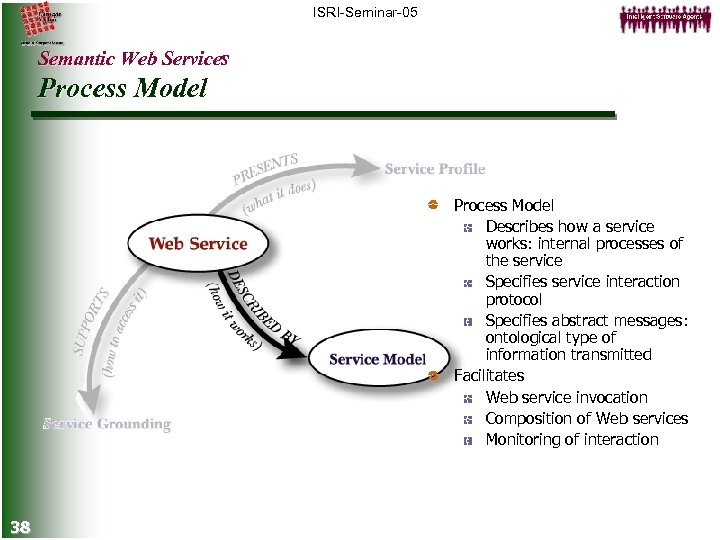
ISRI-Seminar-05 Semantic Web Services Process Model Describes how a service works: internal processes of the service Specifies service interaction protocol Specifies abstract messages: ontological type of information transmitted Facilitates Web service invocation Composition of Web services Monitoring of interaction 38
ISRI-Seminar-05 Semantic Web Services Definition of Process A Process represents a transformation (function). It is characterized by four parameters Inputs: the inputs that the process requires Preconditions: the conditions that are required for the process to run correctly Results: a process may have different outcomes depending on some condition • Condition: under what condition the result occurs • Outputs: the data that results from the execution of the process • Effects: real world changes resulting from the execution of the process 39
ISRI-Seminar-05 Semantic Web Services Composite Processes specify how processes work together to compute a complex function Composite processes define 1. Control Flow Specify the temporal relations between the executions of the different sub-processes 2. Data Flow Specify how the data produced by one process is transferred to another process 40
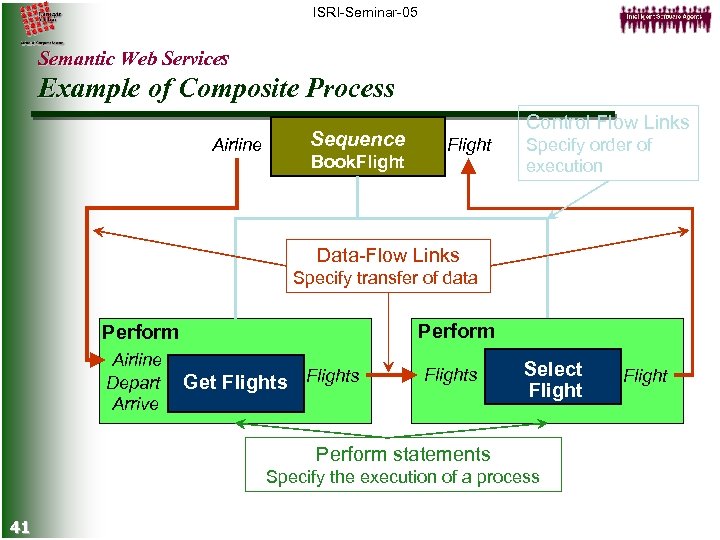
ISRI-Seminar-05 Semantic Web Services Example of Composite Process Sequence Airline Book. Flight Control Flow Links Flight Specify order of execution Data-Flow Links Specify transfer of data Perform Airline Depart Arrive Get Flights Select Flight Perform statements Specify the execution of a process 41 Flight
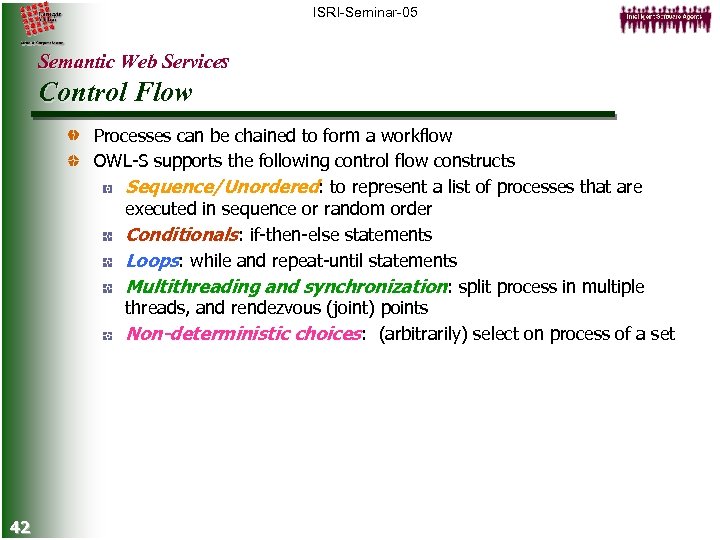
ISRI-Seminar-05 Semantic Web Services Control Flow Processes can be chained to form a workflow OWL-S supports the following control flow constructs Sequence/Unordered: to represent a list of processes that are executed in sequence or random order Conditionals: if-then-else statements Loops: while and repeat-until statements Multithreading and synchronization: split process in multiple threads, and rendezvous (joint) points Non-deterministic choices: (arbitrarily) select on process of a set 42
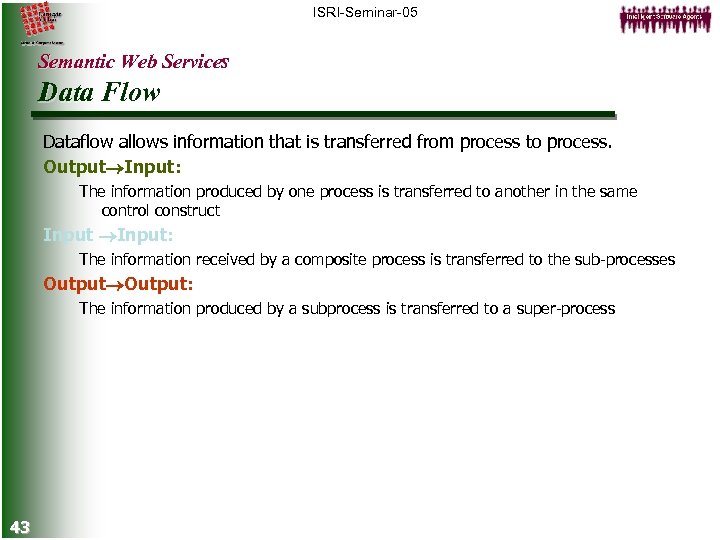
ISRI-Seminar-05 Semantic Web Services Data Flow Dataflow allows information that is transferred from process to process. Output Input: The information produced by one process is transferred to another in the same control construct Input: The information received by a composite process is transferred to the sub-processes Output: The information produced by a subprocess is transferred to a super-process 43
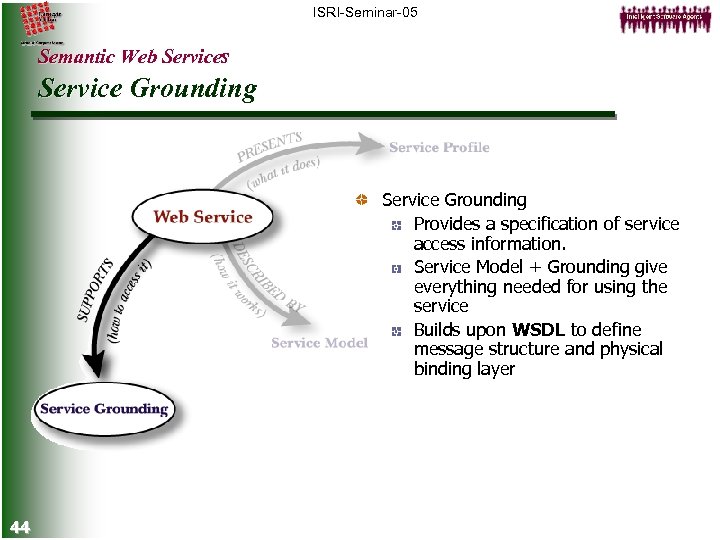
ISRI-Seminar-05 Semantic Web Services Service Grounding Provides a specification of service access information. Service Model + Grounding give everything needed for using the service Builds upon WSDL to define message structure and physical binding layer 44
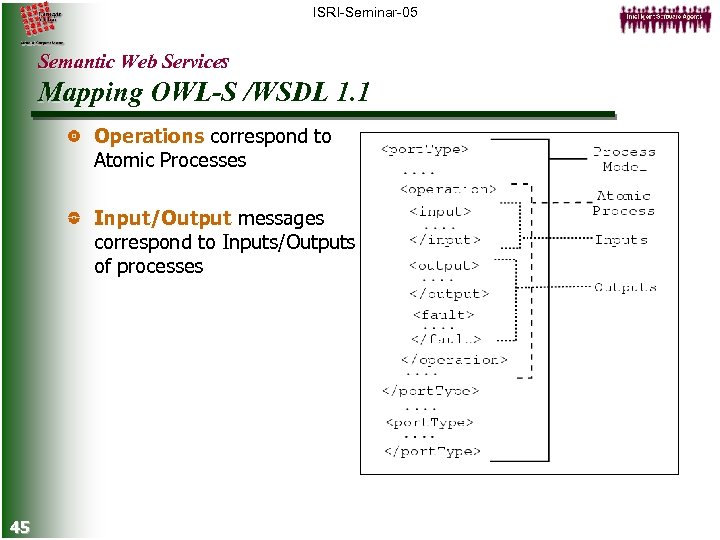
ISRI-Seminar-05 Semantic Web Services Mapping OWL-S /WSDL 1. 1 Operations correspond to Atomic Processes Input/Output messages correspond to Inputs/Outputs of processes 45
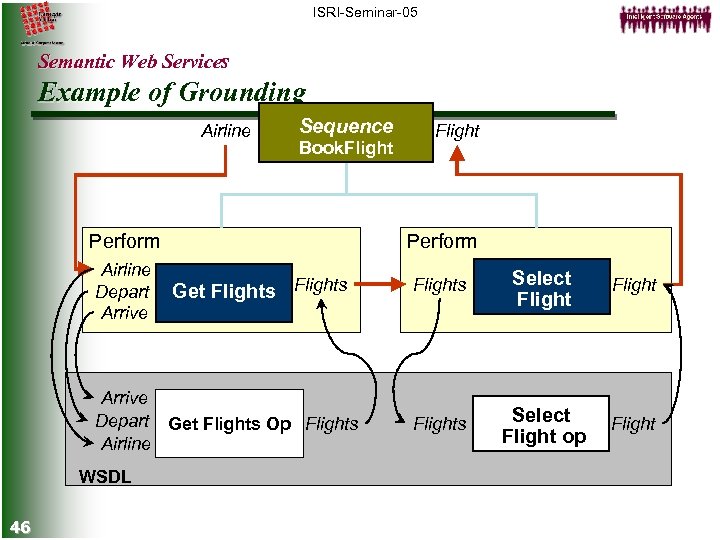
ISRI-Seminar-05 Semantic Web Services Example of Grounding Airline Sequence Book. Flight Perform Airline Depart Arrive Get Flights Arrive Depart Get Flights Op Flights Airline WSDL 46 Flights Select Flight op Flight
ISRI-Seminar-05 Semantic Web Services Result of using the Grounding Invocation mechanism for OWL-S Invocation based on WSDL Different types of invocation supported by WSDL can be used with OWL-S Clear separation between service description and invocation/implementation Service description is needed to reason about the service • Decide how to use it • Decide how what information to send and what to expect Service invocation may be based on SOAP and XSD types The crucial point is that the information that travels on the wire is the same information used in the ontologies Allows any web service to be represented using OWL-S For example: Amazon. com 47
ISRI-Seminar-05 Semantic Web Services Mapping OWL-S to WSDL OWL-S invocation is based on the Grounding Map atomic processes into WSDL operations Use XSLT to map between XML Schema data structures and Ontological Information Invocation procedure totally separated from semantic description of Web service • Invocation may be modified without changing semantic description Any Web service can be described in OWL-S without modifying the WSDL description of the service • Amazon’s Web service has been described in OWL-S maintaining Amazon’s XML-Schema data types 48
ISRI-Seminar-05 Semantic Web Services OWL-S Virtual Machine OWL-S VM a generic processor for the OWL-S Process Model Uses OWL-S to represent service descriptions It can interact with any OWL-S Web service Based on the Process Model formal semantics (Ankolekar et al 2002) Implements grounding mapping to WSDL Uses OWL to represent information to exchange between Web services Actively adopts logic inference to reason about OWL-S and OWL ontologies Exploits Web services technology such as Axis and WSIF for actual invocation and message exchange Anupriya Ankolekar, Frank Huch, Katia Sycara. "Concurrent Execution Semantics for DAML-S with Subtypes. " In The First International Semantic Web Conference (ISWC) , 2002. Massimo Paolucci, Anupriya Ankolekar, Naveen Srinivasan and Katia Sycara, "The DAML-S Virtual Machine, " In Proceedings of the Second International Semantic Web Conference (ISWC) , 2003, 49
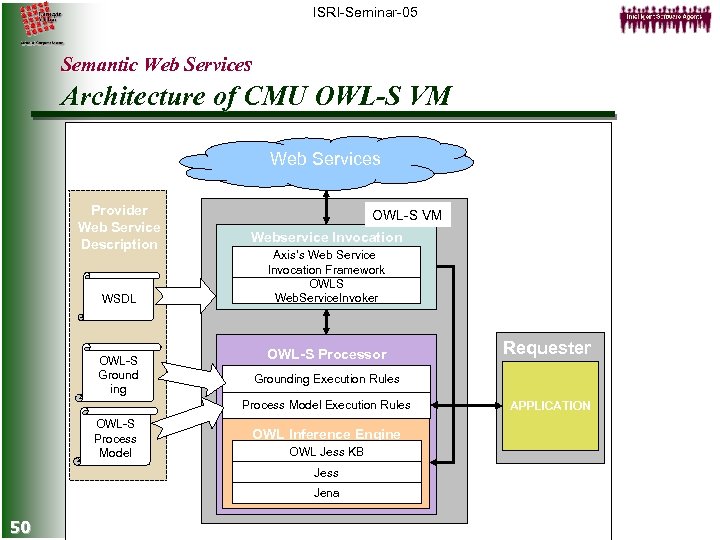
ISRI-Seminar-05 Semantic Web Services Architecture of CMU OWL-S VM Web Services SOAP Provider Web Service Description WSDL OWL-S Ground ing OWL-S VM Webservice Invocation Axis’s Web Service Invocation Framework OWLS Web. Service. Invoker OWL-S Processor Grounding Execution Rules Process Model Execution Rules OWL-S Process Model OWL Inference Engine OWL Jess KB Jess Jena 50 Requester APPLICATION
ISRI-Seminar-05 Semantic Web Services WSDL 2 OWL-S Converter Provides partial conversion from WSDL Web service descriptions to OWL-S descriptions Generates complete specification of Grounding Partial Specification of the Process Model • Including Atomic Processes Partial Model of the Profile Resulting models require additional annotations to include semantic descriptions Combined with Java 2 WSDL to provide Java 2 OWL-S Web Based Interface http: //www. daml. ri. cmu. edu/wsdl 2 owls/ Download: http: //projects. semwebcentral. org/projects/wsdl 2 owl-s/ 51
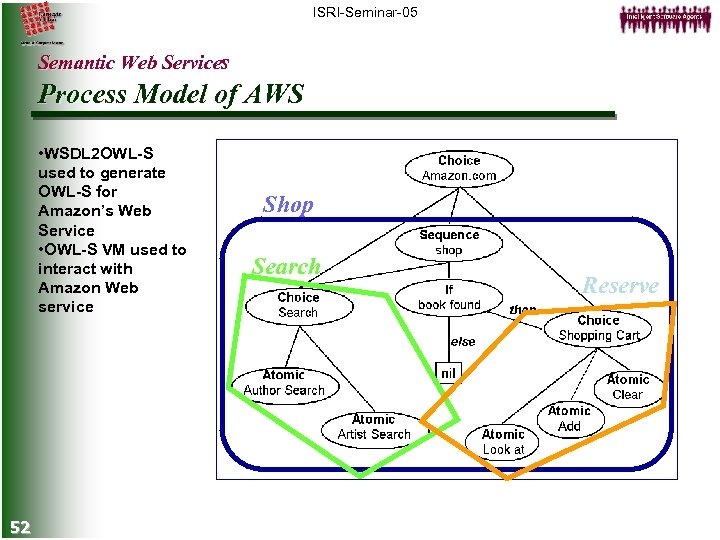
ISRI-Seminar-05 Semantic Web Services Process Model of AWS • WSDL 2 OWL-S used to generate OWL-S for Amazon’s Web Service • OWL-S VM used to interact with Amazon Web service 52 Shop Search Reserve
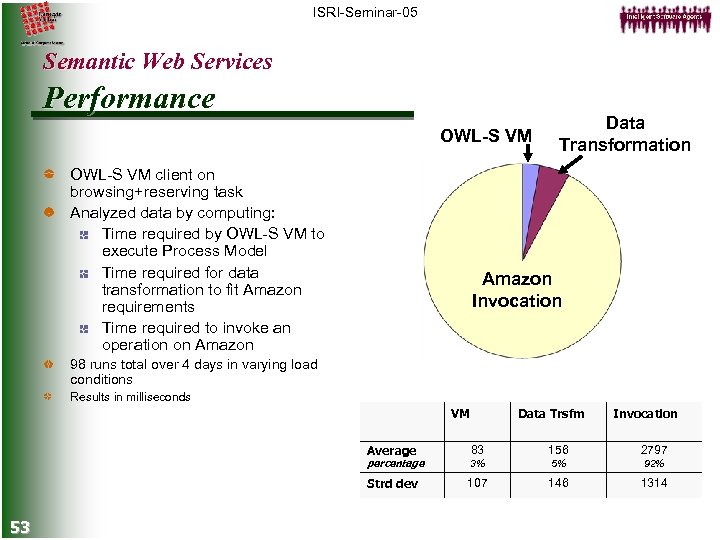
ISRI-Seminar-05 Semantic Web Services Performance OWL-S VM client on browsing+reserving task Analyzed data by computing: Time required by OWL-S VM to execute Process Model Time required for data transformation to fit Amazon requirements Time required to invoke an operation on Amazon Data Transformation Amazon Invocation 98 runs total over 4 days in varying load conditions Results in milliseconds VM Average Data Trsfm Invocation percentage 156 2797 5% 92% Strd dev 53 83 3% 107 146 1314
ISRI-Seminar-05 Autonomous Semantic Web Services Problem of Composition No single Web service may achieve all goals of an agent Composition is the process of chaining results from different Web services automatically Planning problem How do the Web services fit together? Interoperation problem How does the information returned fit together? 54
ISRI-Seminar-05 Autonomous Semantic Web Services CMU Composition Architecture Exploits Retsina Architecture for WS composition OWL-S/UDDI Matchmaker for discovery Retsina planner to control the agent • Use interleaving of planning and execution to allow communication while planning OWL Reasoner OWL-S Virtual Machine to communicate and invoke Web Services Katia Sycara, Massimo Paolucci, Anupriya Ankolekar and Naveen Srinivasan, "Automated Discovery, Interaction and Composition of Semantic Web services, " Journal of Web Semantics, Volume 1, Issue 1, September 2003, pp. 27 -46 55
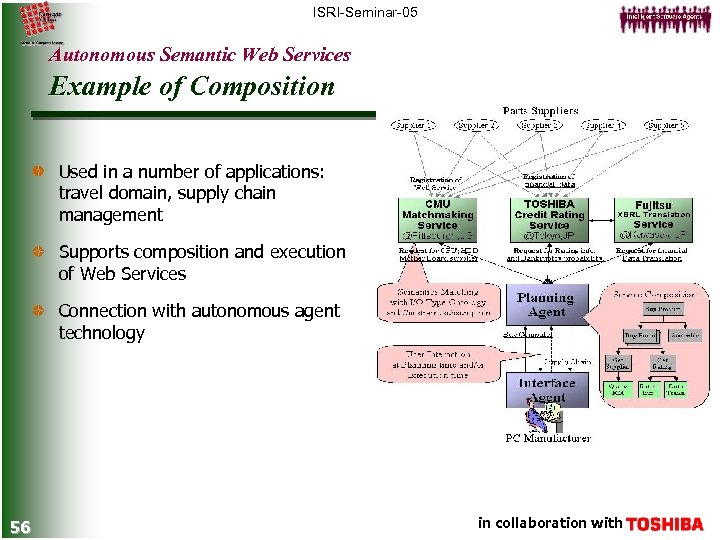
ISRI-Seminar-05 Autonomous Semantic Web Services Example of Composition Used in a number of applications: travel domain, supply chain management Supports composition and execution of Web Services Connection with autonomous agent technology 56 in collaboration with
ISRI-Seminar-05 Semantic Web Services Security and Policies No standard OWL-S representation for Security and Policies has been published yet But experimentation already under going Adoption of a solution will depend on WS security standards Security Experiments with • representing security capability/requirements for discovery • Representing security information in Process Model. Policies: Experiments combining OWL-S and Rei statements included in Process Model to constrain the use of a Web service (see Kagal 2004) Recent work on Formal Verification of OWL-S Process Models provides a way to certify adherence to a policy Grit Denker, Lalana Kagal, Tim Finin, Massimo Paolucci, Naveen Srinivasan and Katia Sycara, "Security For DAML Web Services: Annotation and Matchmaking" In Proceedings of the Second International Semantic Web Conference (ISWC 2003), Sandial Island, Fl, USA, October 2003, pp 335 -350. Anupriya Ankolekar, Massimo Paolucci, and Katia Sycara Spinning the OWL-S Process Model -- Toward the Verification of the OWL-S Process Models In Proceedings of Workshop on Semantic Web Services: Preparing to Meet the World of Business Applications (ISWC 2004) 57
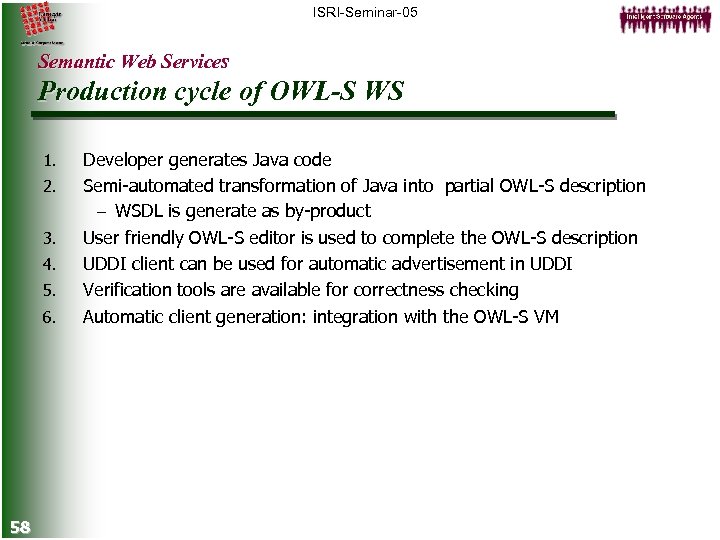
ISRI-Seminar-05 Semantic Web Services Production cycle of OWL-S WS 1. 2. 3. 4. 5. 6. 58 Developer generates Java code Semi-automated transformation of Java into partial OWL-S description – WSDL is generate as by-product User friendly OWL-S editor is used to complete the OWL-S description UDDI client can be used for automatic advertisement in UDDI Verification tools are available for correctness checking Automatic client generation: integration with the OWL-S VM
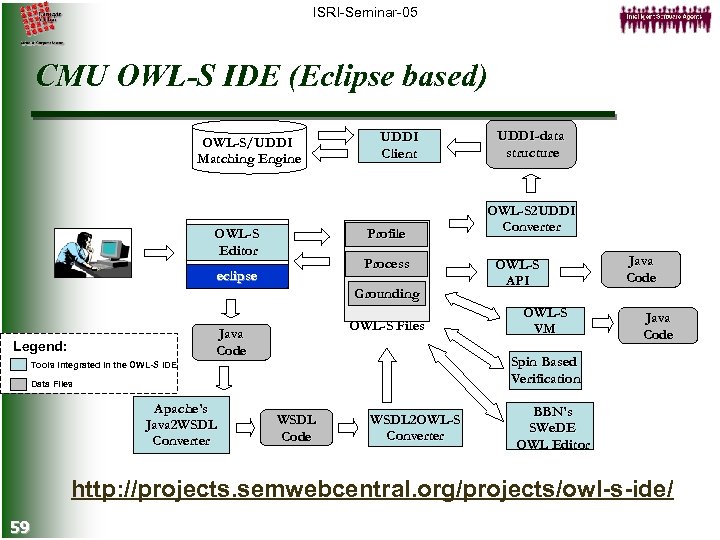
ISRI-Seminar-05 CMU OWL-S IDE (Eclipse based) OWL-S/UDDI Matching Engine OWL-S Editor UDDI Client Profile Process eclipse Grounding OWL-S Files Java Code Legend: OWL-S 2 UDDI Converter OWL-S API OWL-S VM Java Code Spin Based Verification Tools integrated in the OWL-S IDE 10/22/04 Data Files Apache’s Java 2 WSDL Converter UDDI-data structure WSDL Code WSDL 2 OWL-S Converter BBN’s SWe. DE OWL Editor http: //projects. semwebcentral. org/projects/owl-s-ide/ 59
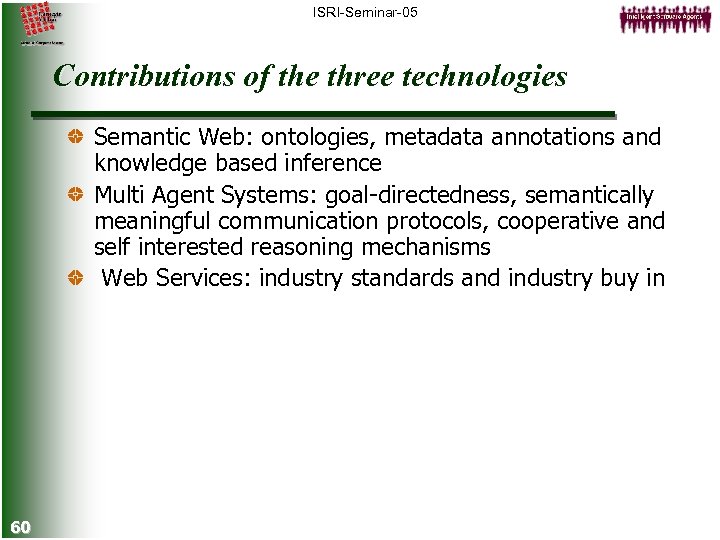
ISRI-Seminar-05 Contributions of the three technologies Semantic Web: ontologies, metadata annotations and knowledge based inference Multi Agent Systems: goal-directedness, semantically meaningful communication protocols, cooperative and self interested reasoning mechanisms Web Services: industry standards and industry buy in 60
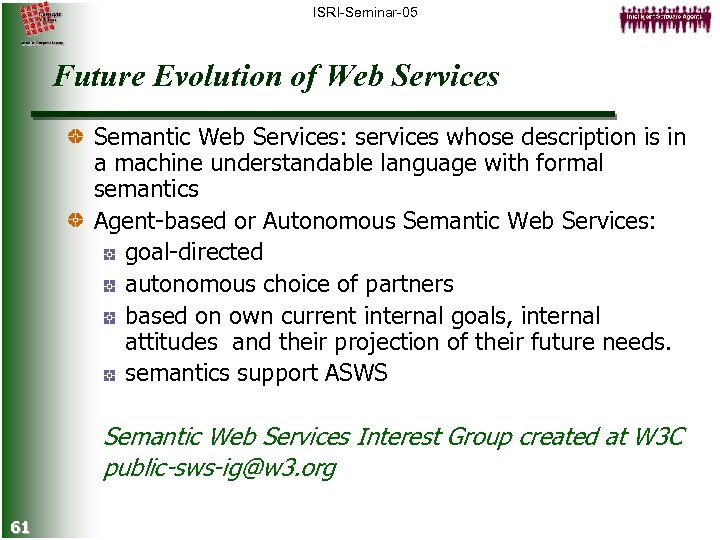
ISRI-Seminar-05 Future Evolution of Web Services Semantic Web Services: services whose description is in a machine understandable language with formal semantics Agent-based or Autonomous Semantic Web Services: goal-directed autonomous choice of partners based on own current internal goals, internal attitudes and their projection of their future needs. semantics support ASWS Semantic Web Services Interest Group created at W 3 C public-sws-ig@w 3. org 61
Скачать презентацию Autonomous Semantic Web Services Katia Sycara Intelligent Software
c2df66b550dd148d8f7b33b9db336089.ppt