 Скачать презентацию Autonomous Mobility for Military Scout Vehicles and Potential
1e0f7da03f0473d1aeacecf40c157f57.ppt
- Количество слайдов: 19



Autonomous Mobility for Military Scout Vehicles and Potential Driver Assistance System Spinoffs Scott Myers, President General Dynamics Robotic Systems Richard Bishop Consulting May 1, 1999 @ ITSA Boston
Military Needs • Unmanned vehicles: core resource for 21 st century armed forces • Robots act as force multipliers • Robots replace humans in high-risk situations • Soldiers supervise several robotic systems, leveraging available (and scarce) manpower 2
Demo III Program • Focus: develop, demonstrate, and experiment with unmanned scout vehicles • Sponsor: US DOD Joint Robotics Program • Manager: US Army Research Lab (ARL) & Tank-automotive Research, Engineering, and Development Center (TARDEC) • Funding: $50 M during 1998 -2001 • Follows Demo I (1980’s) and Demo II (early 1990’s) 3
Demo III Technical Elements • (1) Concerted Technology Thrust -developing advanced technology for autonomous mobility • (2) Modeling/Simulation/Experimentation -examining the impact of this technology on military operations • (3) Technology Integration -- Integrate technology into 4 testbed platforms: Experimental Unmanned Vehicles (XUVs) 4
General Dynamics Robotics Systems • Advanced manufacturing / engineering, automation/sortation/process control electronics, image processing inspection, & robotic-content products for commercial customers • Leader in the development of robotic and autonomous systems for Do. D tactical and security applications – MDARS-E system: advanced autonomous vehicle for perimeter security • Robust Obstacle Avoidance System • Precision GPS-based Navigation System • Intrusion Detection System ( radar and image based target acquisition and tracking) • Interconnected via Controller Area Network (CAN) Local Area Bus • Prime Contractor / System Integrator for Demo III 5
Demo III Supporting Team • • Sarnoff Laboratories SAIC Center for Intelligent Systems NASA Jet Propulsion Laboratory (JPL) National Institute of Standards and Technology (NIST) 6
Demo III Program Goals • Enable small, survivable unmanned vehicles (XUVs) to tactically maneuver over rugged terrain • Maneuver at speeds comparable to manned vehicles, employing similar behaviors as manned missions – Implies significant obstacle detection smarts (both positive and negative obstacles) 7
Demo III Technology: Perception for Autonomous Mobility • Requirements call for: – – – on-road mobility (40 mph) off-road mobility (20 mph) day / night operations inclement weather stealthy operation (hug tree lines, etc. ) • Must detect, classify, and intelligently respond to positive/negative obstacles: – Examples: • On-road: vehicles, people, animals, road edges • Off-road: trees, bushes, rocks, ravines, wire fences, overhanging branches 8
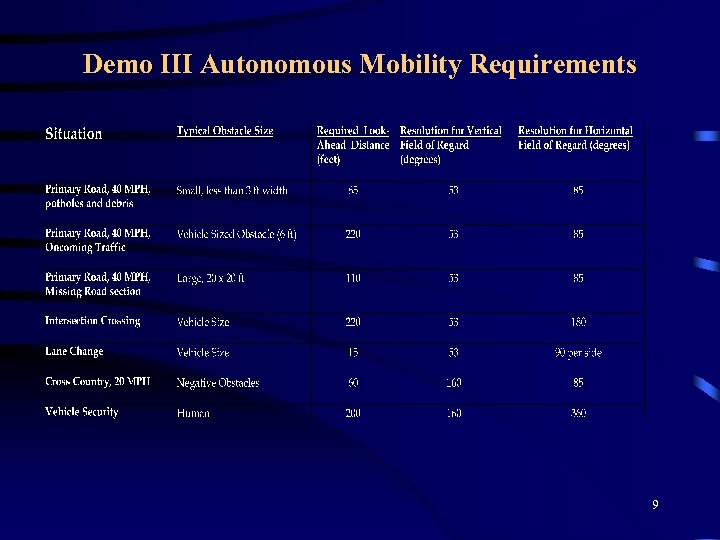
Demo III Autonomous Mobility Requirements 9
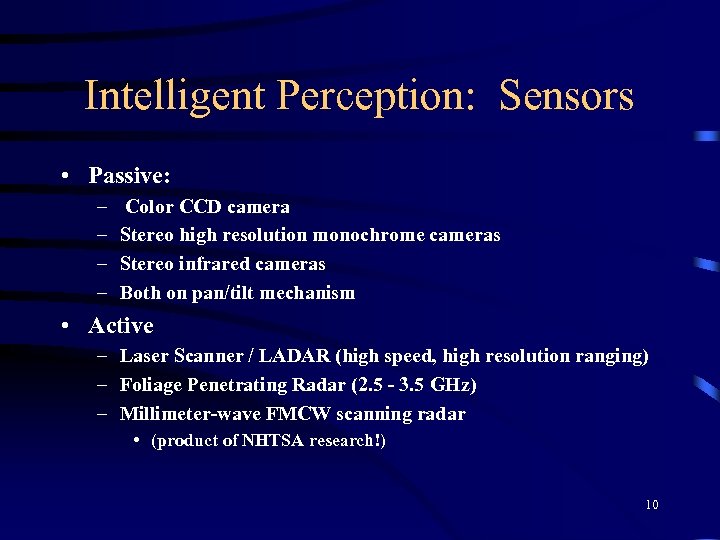
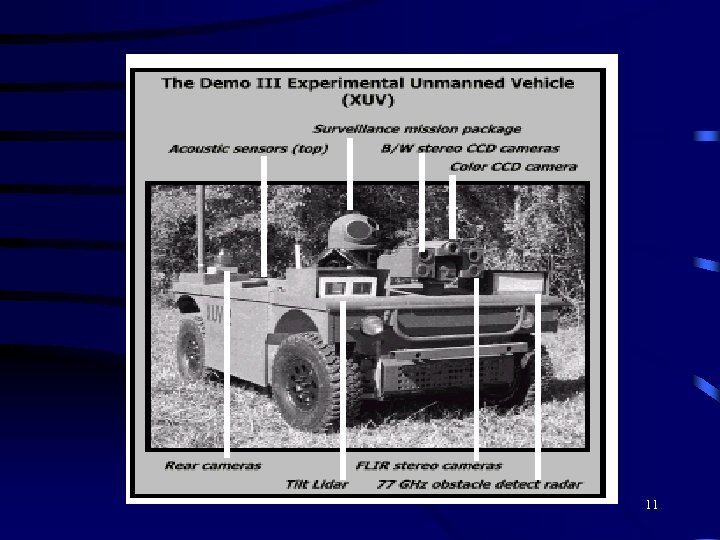
Intelligent Perception: Sensors • Passive: – – Color CCD camera Stereo high resolution monochrome cameras Stereo infrared cameras Both on pan/tilt mechanism • Active – Laser Scanner / LADAR (high speed, high resolution ranging) – Foliage Penetrating Radar (2. 5 - 3. 5 GHz) – Millimeter-wave FMCW scanning radar • (product of NHTSA research!) 10
11
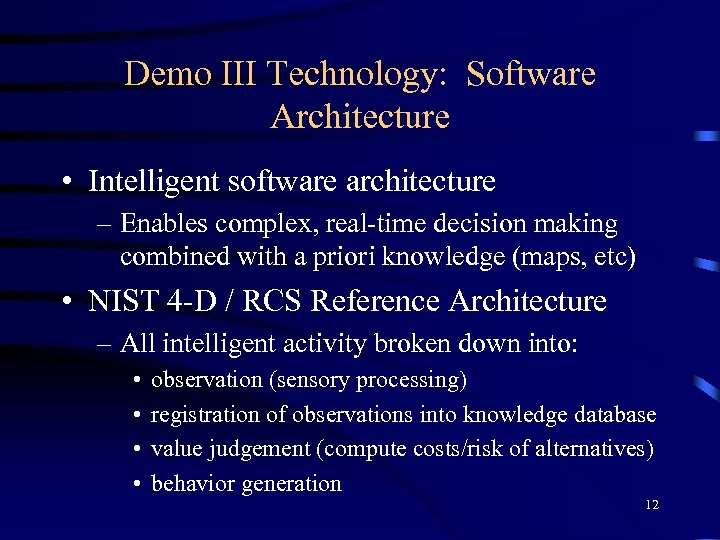
Demo III Technology: Software Architecture • Intelligent software architecture – Enables complex, real-time decision making combined with a priori knowledge (maps, etc) • NIST 4 -D / RCS Reference Architecture – All intelligent activity broken down into: • • observation (sensory processing) registration of observations into knowledge database value judgement (compute costs/risk of alternatives) behavior generation 12
Demo III Technology • Navigation – using P/Y code military GPS, inertial referencing, and wheel encoders • Vetronics (vehicle electronics) – plug-n-play approach – fly-by-wire vehicle controls – standard Controller Area Network (CAN) bus structure • Reconaissance Module – Enables detection of targets and target designation – Sensor suite includes camera, FLIR, laser rangefinder, acoustic sensors 13
Demo III: Demo Alpha • September 1999 -- initial program demo • Aberdeen Proving Ground (modest terrain) • Capabilities shown to military VIPs: – Two XUV vehicles operated by troops – 20 mph on-road, 10 mph off-road required (exceeded) – Successful detection / avoidance of rocks, poles, trees, roadside signs – Negative obstacle detection not implemented – Stereo vision (using active gaze control) very effective 14
Demo III: Demo Bravo • October 2000 at Ft. Knox, Kentucky – Very challenging terrain, more realistic military situations – Extensive troop usage; engineers “in the background” • New capabilities: – Road following, convoying, negative obstacle handling – Sensor suite: MMW radar, foliage-penetrating radar, stereo infrared and visible-spectrum cameras, 15 laser rangefinder
Demo III: Spinoffs to Intelligent Vehicles for Transportation • Demo III represents the largest federal investment in advanced vehicle technology • Program provides advanced technology which can support goals of USDOT IVI and vehicle industry: – collision warning / avoidance – driver assistance systems – automated vehicle systems • Also applicable to non-highway industrial vehicles 16
Demo III: Spinoffs to Intelligent Vehicles for Transportation • Intelligent Perception: – approaching machine intelligence which can perceive and classify surroundings at human levels • Obstacle Detection: – typical roadway obstacles as well as potholes • Low Speed Automation (Stop-n-Go): – initial application of automation? • Electronic Towbar (heavy truck convoying): – Military already considering transferring Demo III technology to truck operations 17
Demo III: Spinoffs to Intelligent Vehicles for Transportation • Transit Bus Electronic Guidance: – understanding of complex urban street scenarios • Sensor Fusion: – Multiple modality sensor suites essential to IV’s • Sensor Testbed: – Evaluating a wide range of sensor types • Architectures: – direct transfer to in-vehicle architectures 18
Conclusion • Demo III leading technology development for super-smart vehicles • Overall robotic vehicle program focus expected to grow dramatically within DOD – Demo III funding increases under discussion – Future Combat Vehicle development beginning – Robotics Alliance being established • Information Sharing – Periodic program updates available at www. ivsource. net – Or send email to Richard. Bishop@mindspring. com 19
Скачать презентацию Autonomous Mobility for Military Scout Vehicles and Potential
1e0f7da03f0473d1aeacecf40c157f57.ppt