


 Скачать презентацию Autômatos Celulares Disciplina SER 301 Análise Espacial de
9233130b36cdb183a207c491a90ccf3f.ppt
- Количество слайдов: 74
 Autômatos Celulares Disciplina SER 301 Análise Espacial de Dados Geográficos Líliam C. Castro Medeiros lccastro@dpi. inpe. br
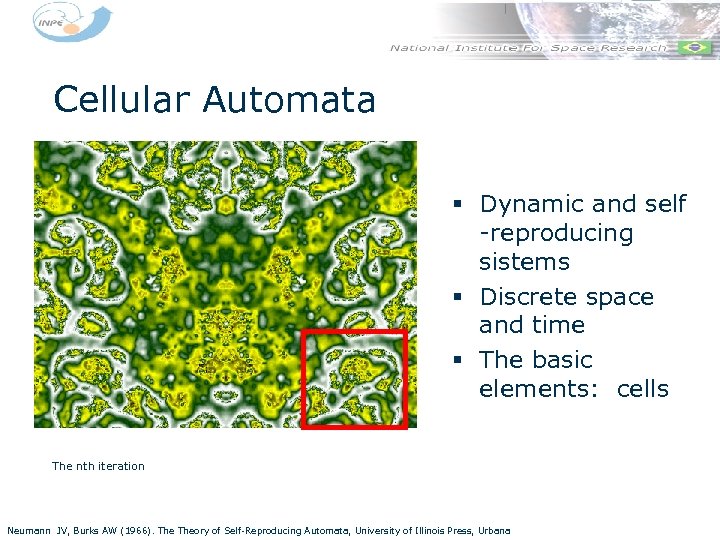
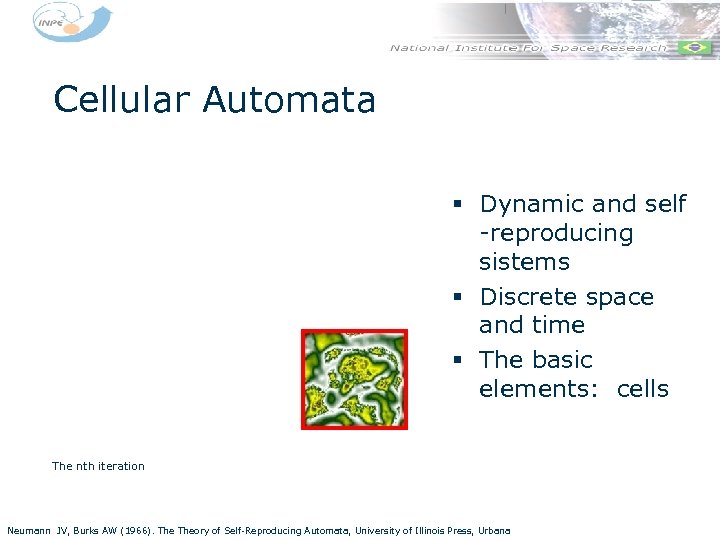
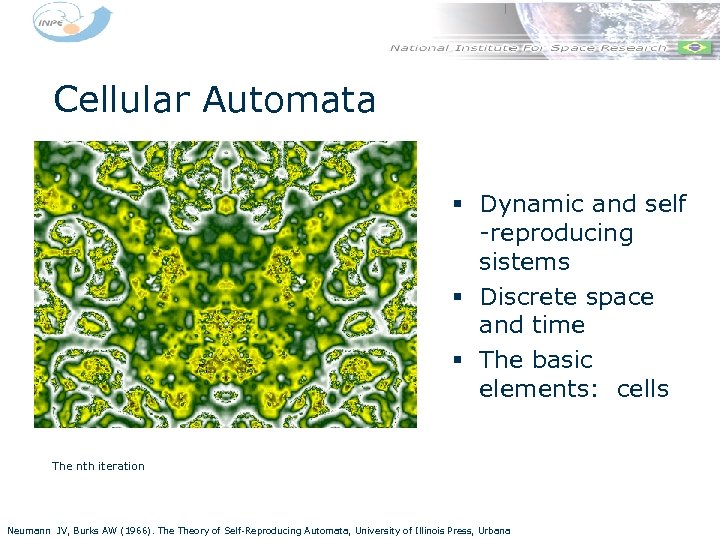 Cellular Automata § Dynamic and self -reproducing sistems § Discrete space and time § The basic elements: cells The nth iteration Neumann JV, Burks AW (1966). Theory of Self-Reproducing Automata, University of Illinois Press, Urbana
 Cellular Automata § Dynamic and self -reproducing sistems § Discrete space and time § The basic elements: cells The nth iteration Neumann JV, Burks AW (1966). Theory of Self-Reproducing Automata, University of Illinois Press, Urbana
 Cellular Automata § Dynamic and self -reproducing sistems § Discrete space and time § The basic elements: cells The nth iteration Neumann JV, Burks AW (1966). Theory of Self-Reproducing Automata, University of Illinois Press, Urbana
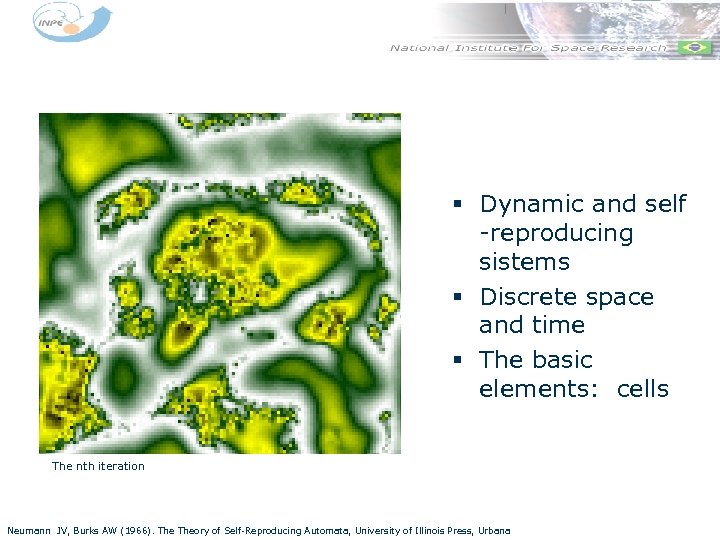 § Dynamic and self -reproducing sistems § Discrete space and time § The basic elements: cells The nth iteration Neumann JV, Burks AW (1966). Theory of Self-Reproducing Automata, University of Illinois Press, Urbana
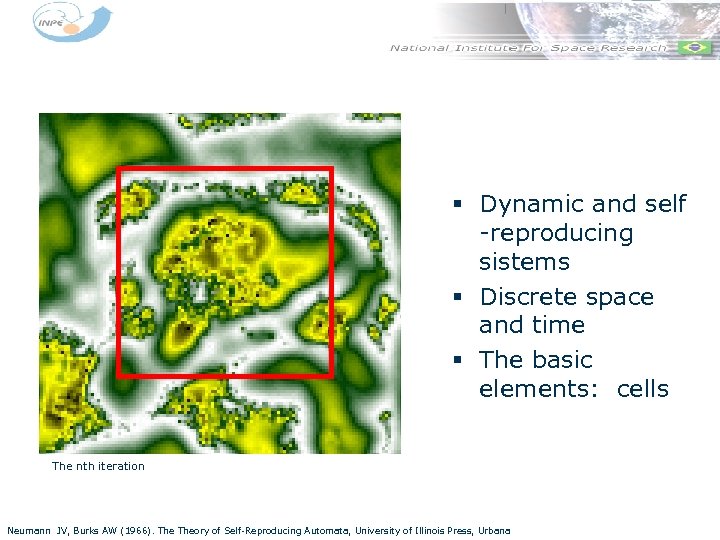 § Dynamic and self -reproducing sistems § Discrete space and time § The basic elements: cells The nth iteration Neumann JV, Burks AW (1966). Theory of Self-Reproducing Automata, University of Illinois Press, Urbana
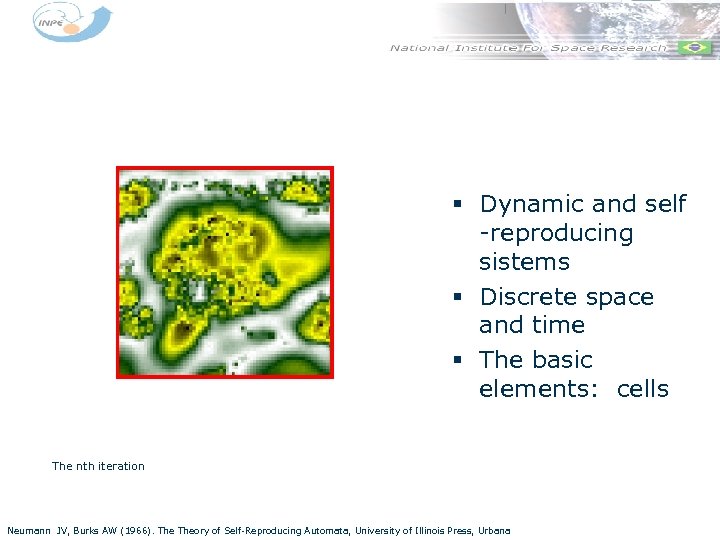 § Dynamic and self -reproducing sistems § Discrete space and time § The basic elements: cells The nth iteration Neumann JV, Burks AW (1966). Theory of Self-Reproducing Automata, University of Illinois Press, Urbana
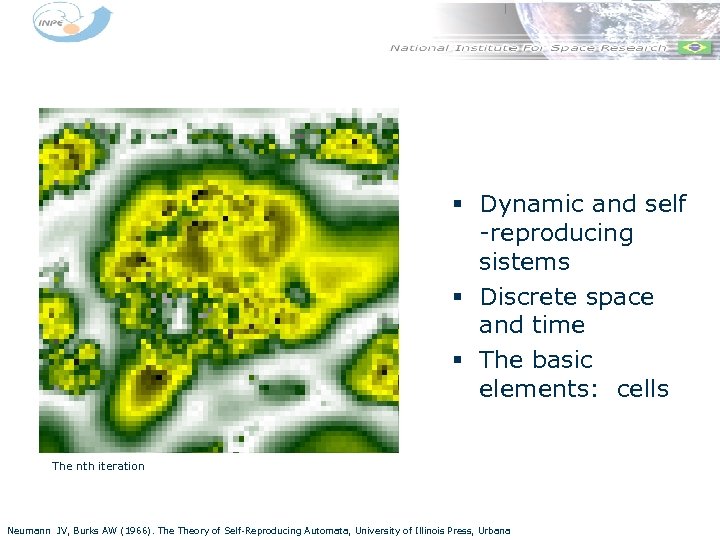 § Dynamic and self -reproducing sistems § Discrete space and time § The basic elements: cells The nth iteration Neumann JV, Burks AW (1966). Theory of Self-Reproducing Automata, University of Illinois Press, Urbana
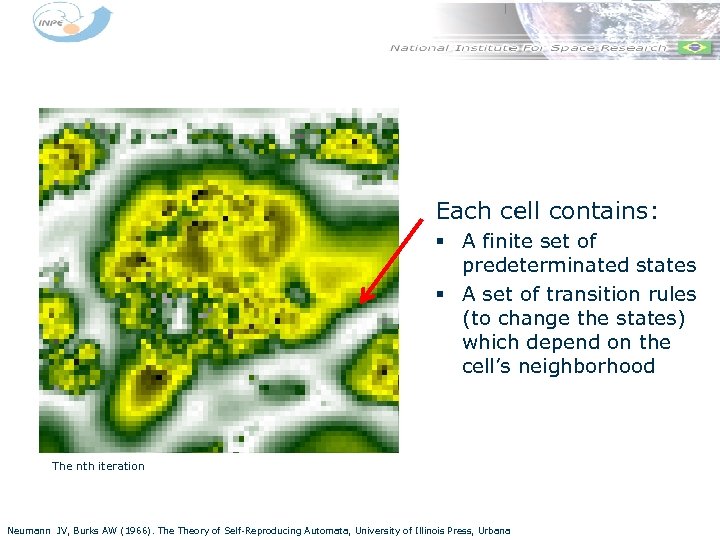 Each cell contains: § A finite set of predeterminated states § A set of transition rules (to change the states) which depend on the cell’s neighborhood The nth iteration Neumann JV, Burks AW (1966). Theory of Self-Reproducing Automata, University of Illinois Press, Urbana
 10 Source: Rita Zorzenon’s slide
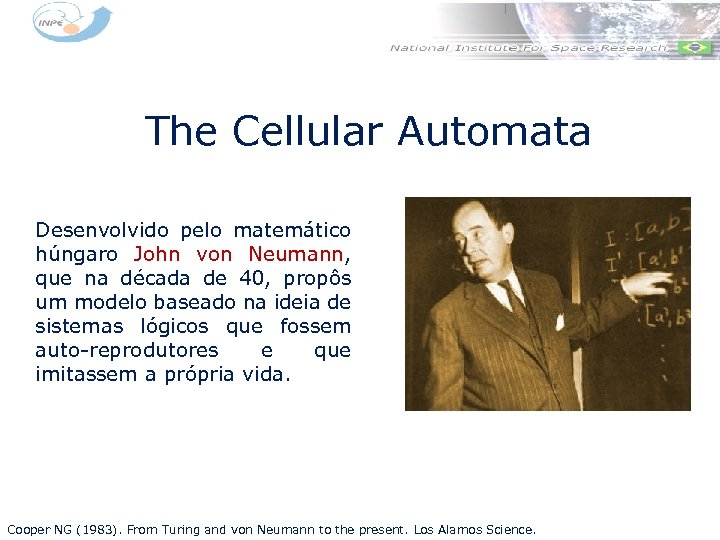 The Cellular Automata Desenvolvido pelo matemático húngaro John von Neumann, que na década de 40, propôs um modelo baseado na ideia de sistemas lógicos que fossem auto-reprodutores e que imitassem a própria vida. Cooper NG (1983). From Turing and von Neumann to the present. Los Alamos Science.
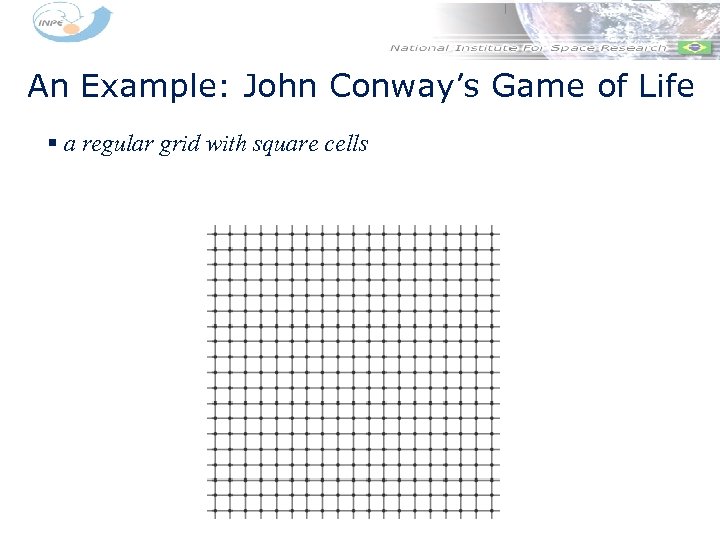 An Example: John Conway’s Game of Life § a regular grid with square cells
 An Example: John Conway’s Game of Life § each cell can be white (alive) or black (dead)
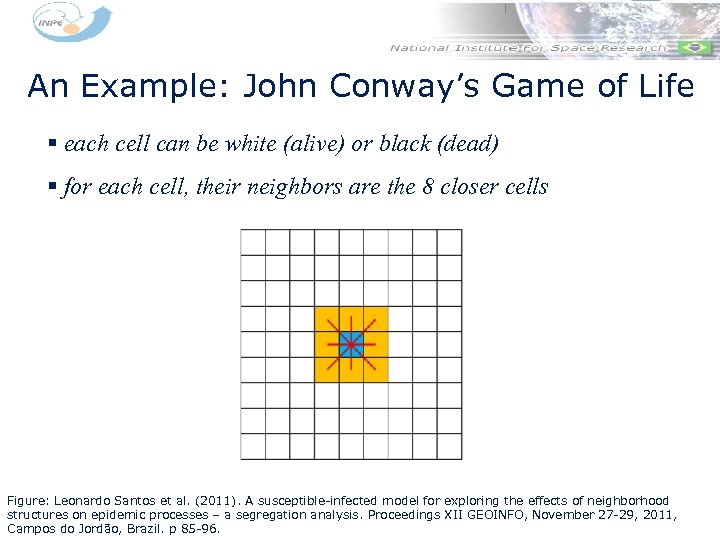 An Example: John Conway’s Game of Life § each cell can be white (alive) or black (dead) § for each cell, their neighbors are the 8 closer cells Figure: Leonardo Santos et al. (2011). A susceptible-infected model for exploring the effects of neighborhood structures on epidemic processes – a segregation analysis. Proceedings XII GEOINFO, November 27 -29, 2011, Campos do Jordão, Brazil. p 85 -96.
 An Example: John Conway’s Game of Life § each cell can be white (alive) or black (dead) § for each cell, their neighbors are the 8 closer cells § at each time step, the state of each cell obey the following rules (executed simultaneously): § the cell survives if there are 2 or 3 alive neighbor cells, otherwise the cell dies § a died cell can change to an alive cell if it has exatly 3 alive neighbors, otherwise it remains dead
 Game of Life John Conway (1970) Possible states: alive or dead Death: by loneliness - one or zero neighbors by overpopulation – more than 4 neighbors Birth: cells with exactly 3 alive neighbors Survival: exactly 2 or exactly 3 alive neighbors Adapted from Adriana Racco’s slide
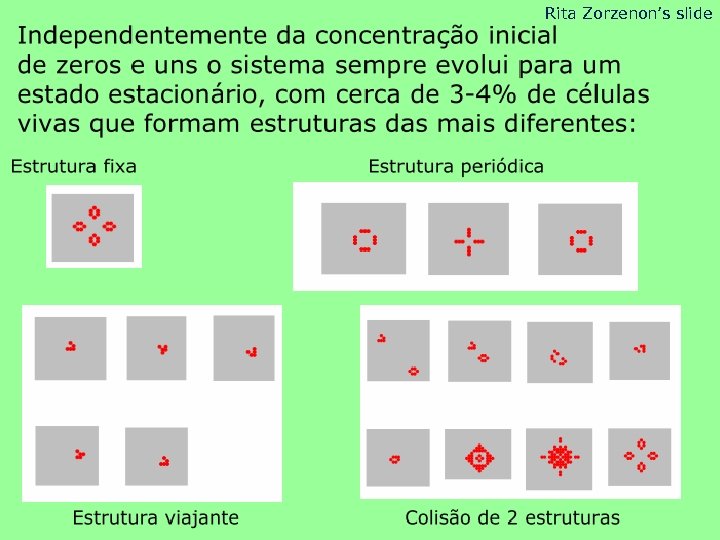 Rita Zorzenon’s slide 17
 Game of Life Some sites to see the Game of Life simulation: http: //www. math. com/students/wonders/life. html or http: //www. bitstorm. org/gameoflife/
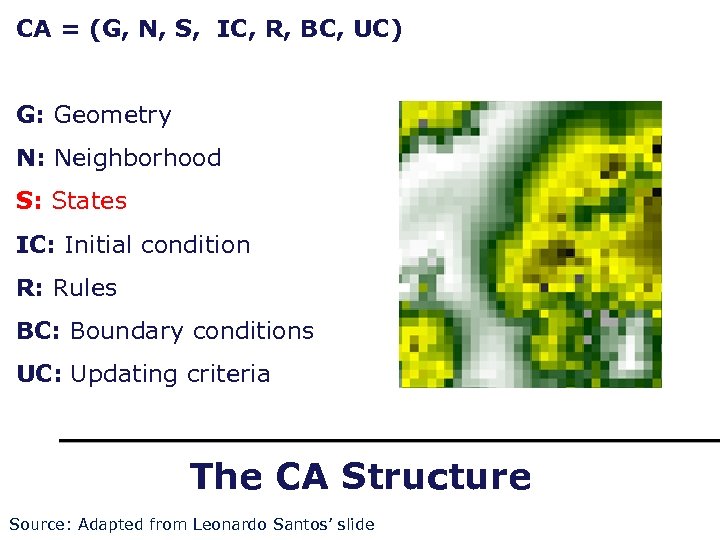
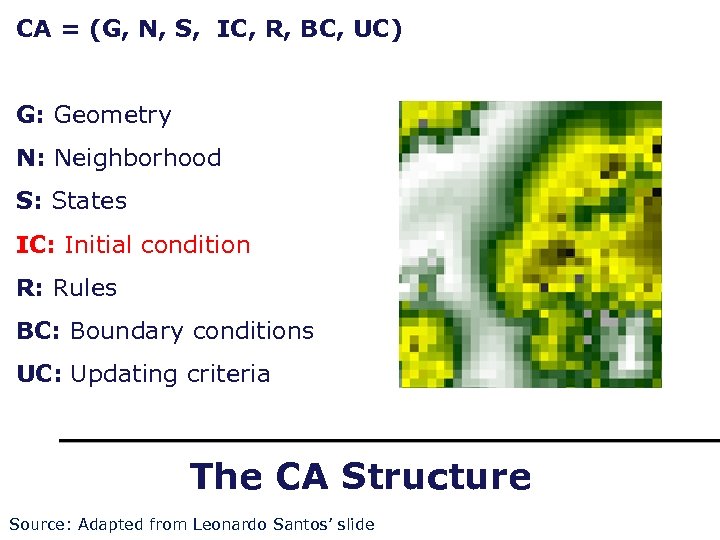
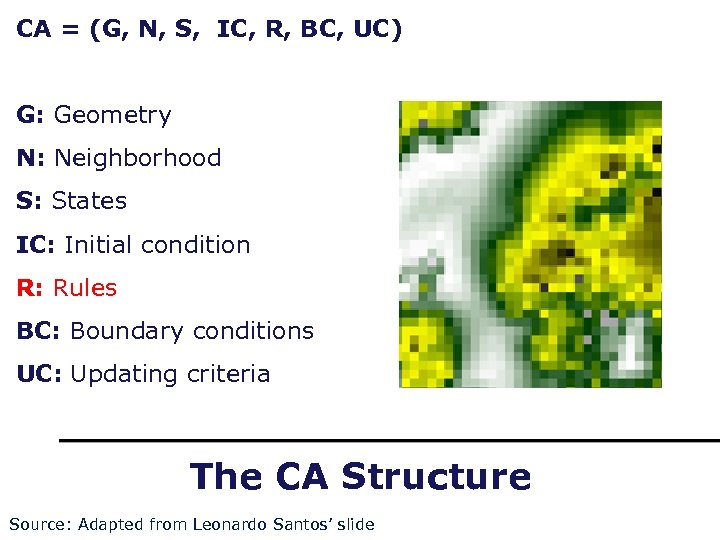
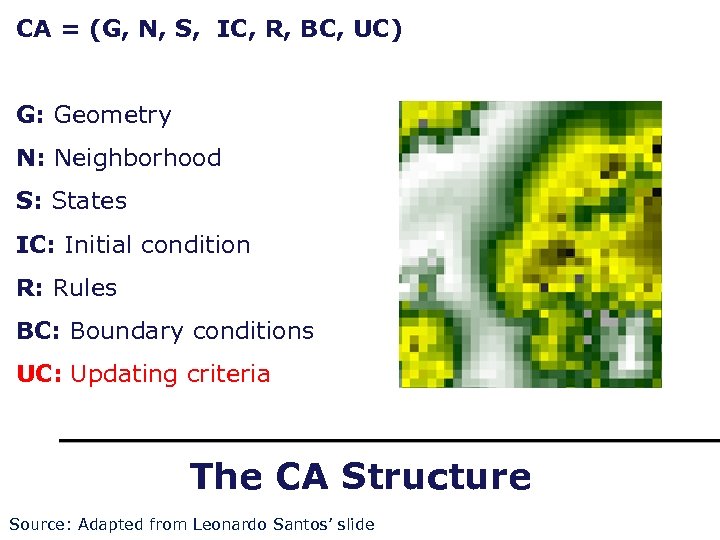
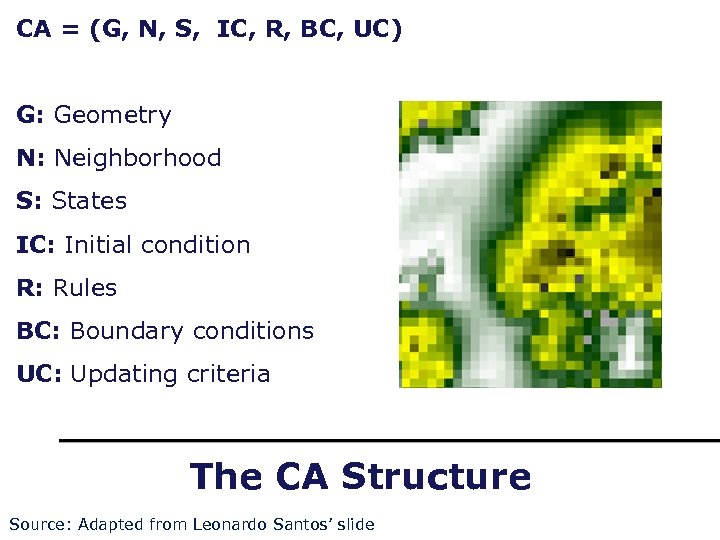 CA = (G, N, S, IC, R, BC, UC) G: Geometry N: Neighborhood S: States IC: Initial condition R: Rules BC: Boundary conditions UC: Updating criteria The CA Structure Source: Adapted from Leonardo Santos’ slide
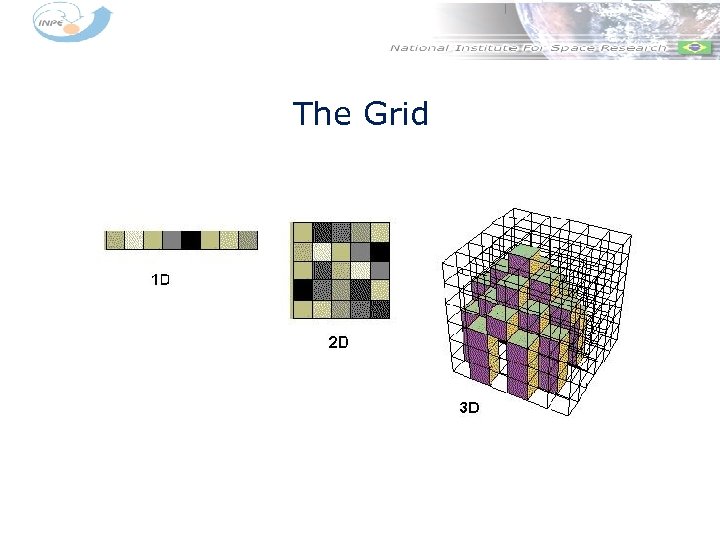 The Grid
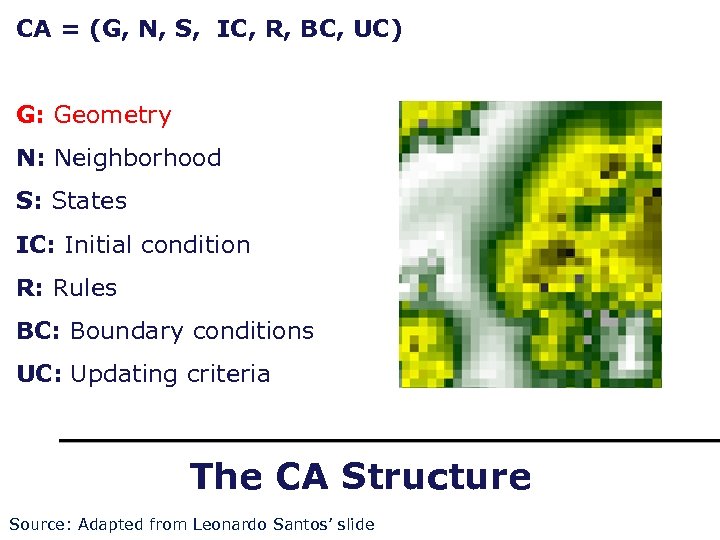 CA = (G, N, S, IC, R, BC, UC) G: Geometry N: Neighborhood S: States IC: Initial condition R: Rules BC: Boundary conditions UC: Updating criteria The CA Structure Source: Adapted from Leonardo Santos’ slide
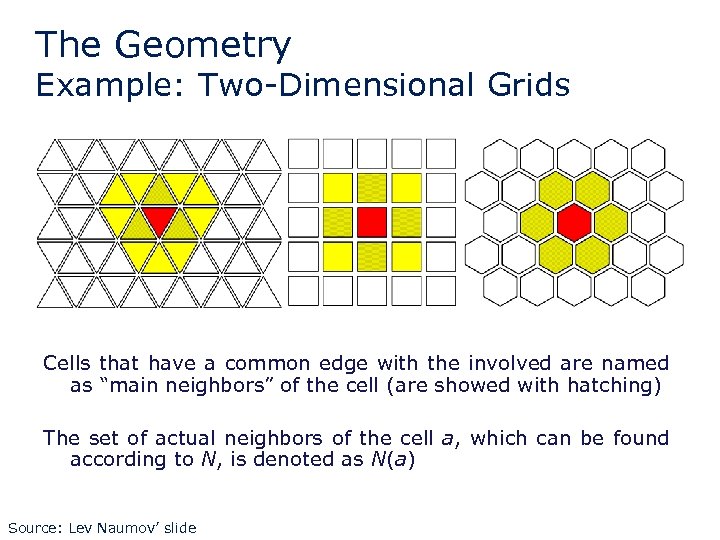 The Geometry Example: Two-Dimensional Grids Cells that have a common edge with the involved are named as “main neighbors” of the cell (are showed with hatching) The set of actual neighbors of the cell a, which can be found according to N, is denoted as N(a) Source: Lev Naumov’ slide
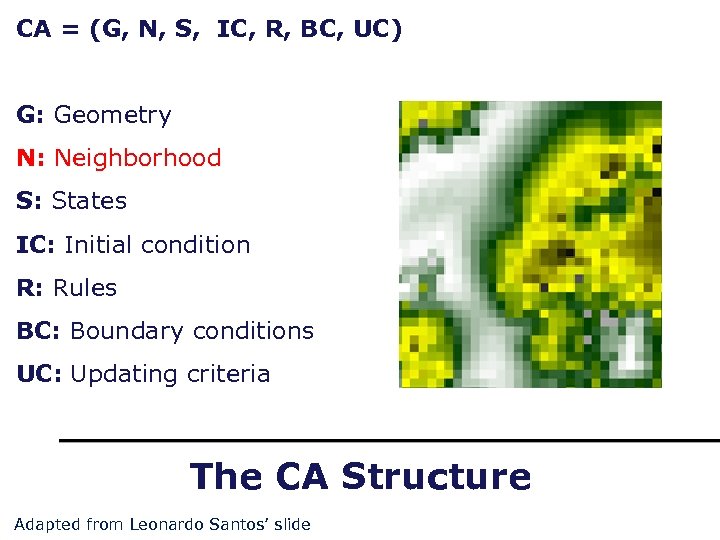 CA = (G, N, S, IC, R, BC, UC) G: Geometry N: Neighborhood S: States IC: Initial condition R: Rules BC: Boundary conditions UC: Updating criteria The CA Structure Adapted from Leonardo Santos’ slide
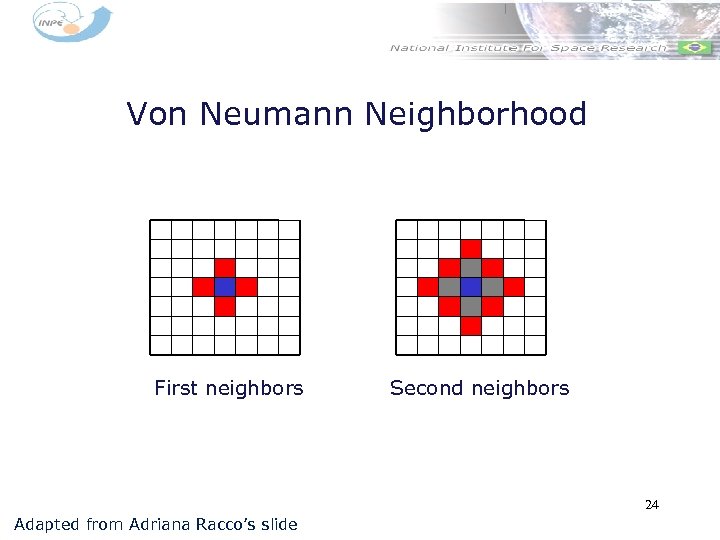 Von Neumann Neighborhood First neighbors Second neighbors 24 Adapted from Adriana Racco’s slide
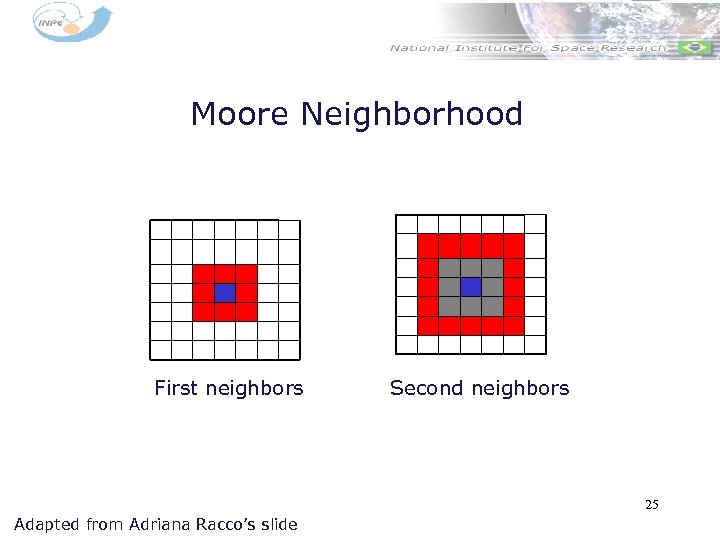 Moore Neighborhood First neighbors Second neighbors 25 Adapted from Adriana Racco’s slide
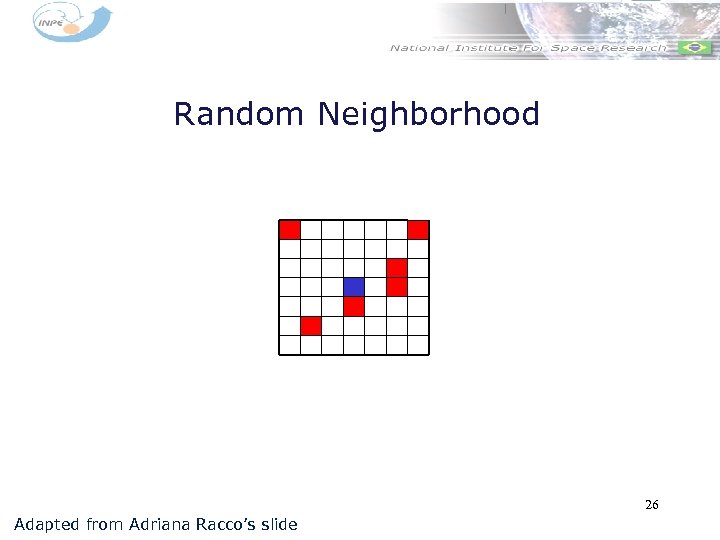 Random Neighborhood 26 Adapted from Adriana Racco’s slide
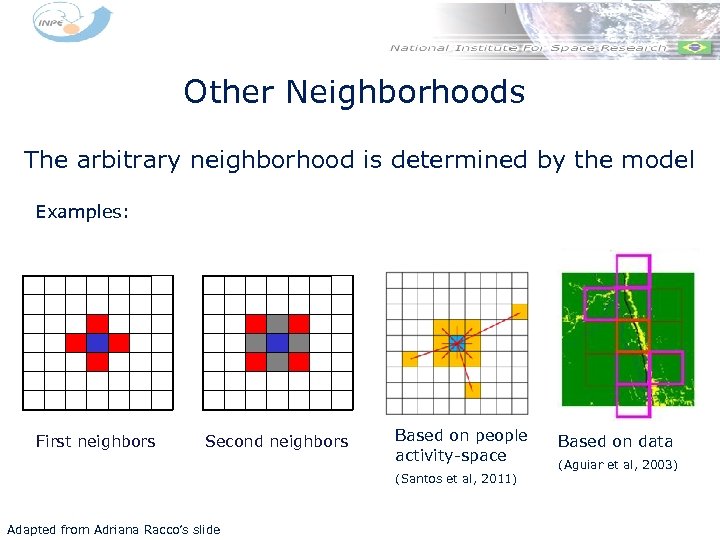 Other Neighborhoods The arbitrary neighborhood is determined by the model Examples: First neighbors Second neighbors Based on people activity-space (Santos et al, 2011) Adapted from Adriana Racco’s slide Based on data (Aguiar et al, 2003)
 Neighborhoods in Time They can be § static: the same neighbors all the time (classical CA) § dynamic: the neighbors can change at each time step
 when: December, 12 th, at 2 p. m. ! where: IAI auditorium
 CA = (G, N, S, IC, R, BC, UC) G: Geometry N: Neighborhood S: States IC: Initial condition R: Rules BC: Boundary conditions UC: Updating criteria The CA Structure Source: Adapted from Leonardo Santos’ slide
 CA = (G, N, S, IC, R, BC, UC) G: Geometry N: Neighborhood S: States IC: Initial condition R: Rules BC: Boundary conditions UC: Updating criteria The CA Structure Source: Adapted from Leonardo Santos’ slide
 CA = (G, N, S, IC, R, BC, UC) G: Geometry N: Neighborhood S: States IC: Initial condition R: Rules BC: Boundary conditions UC: Updating criteria The CA Structure Source: Adapted from Leonardo Santos’ slide
 Rules § The rules may depend on the state of the own cell neighbor’s cells § The rules may be based on influence fields of the geography of the system § They may be deterministic or stochastic § They can depend only on the actual state of the cells Adapted from Adriana Racco’s slide
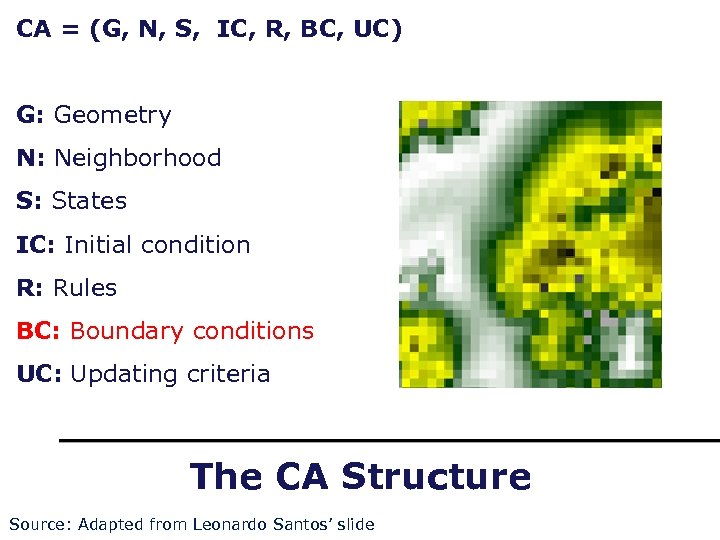 CA = (G, N, S, IC, R, BC, UC) G: Geometry N: Neighborhood S: States IC: Initial condition R: Rules BC: Boundary conditions UC: Updating criteria The CA Structure Source: Adapted from Leonardo Santos’ slide
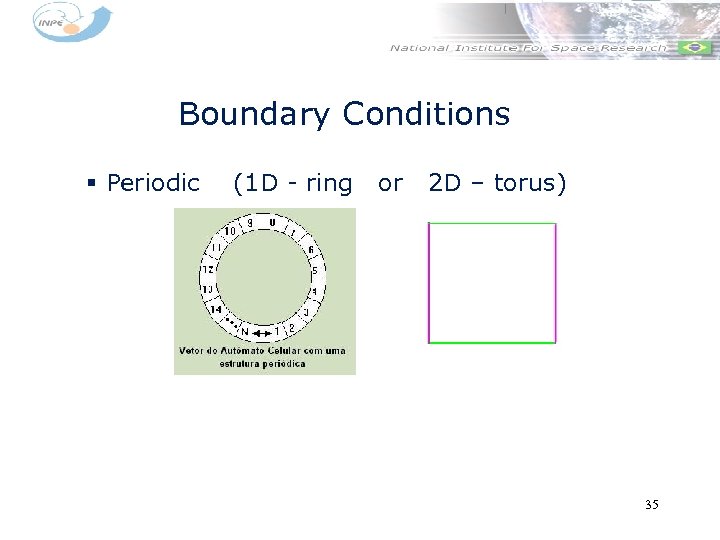 Boundary Conditions § Periodic (1 D - ring or 2 D – torus) 35
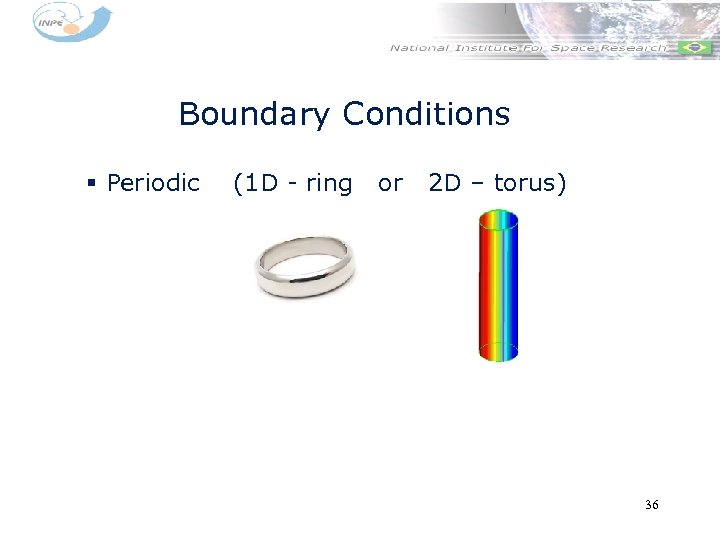 Boundary Conditions § Periodic (1 D - ring or 2 D – torus) 36
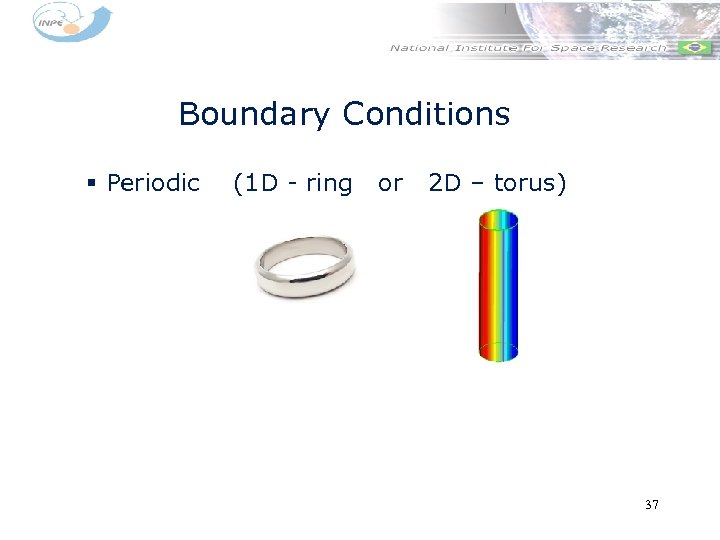 Boundary Conditions § Periodic (1 D - ring or 2 D – torus) 37
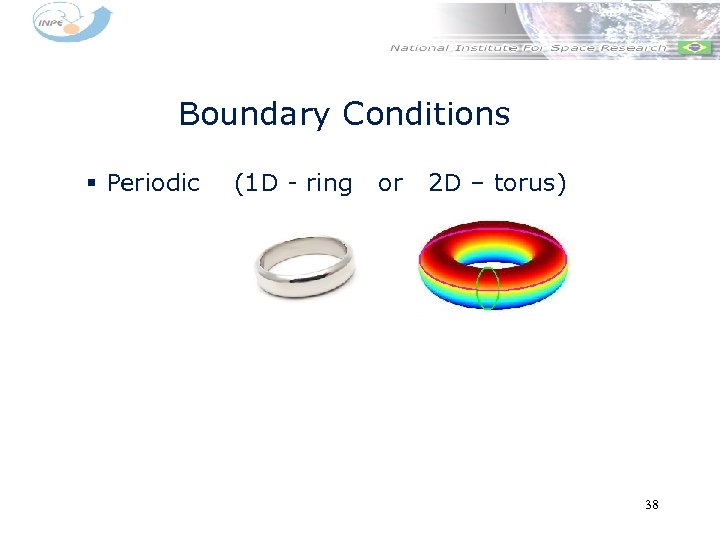 Boundary Conditions § Periodic (1 D - ring or 2 D – torus) 38
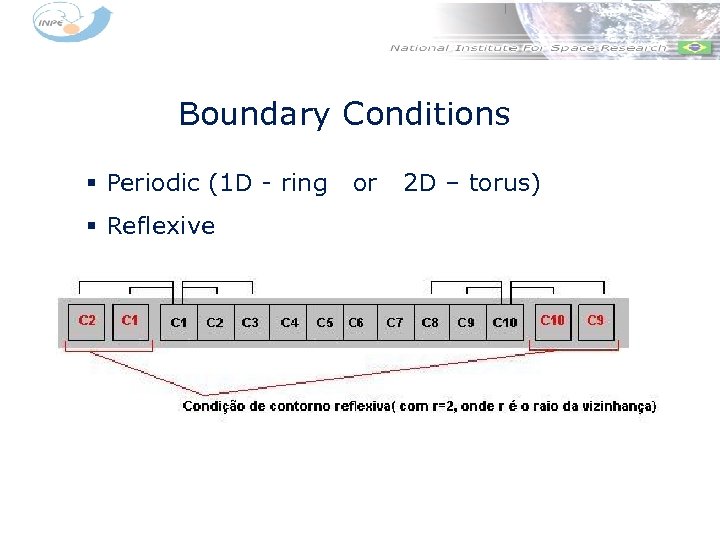 Boundary Conditions § Periodic (1 D - ring § Reflexive or 2 D – torus)
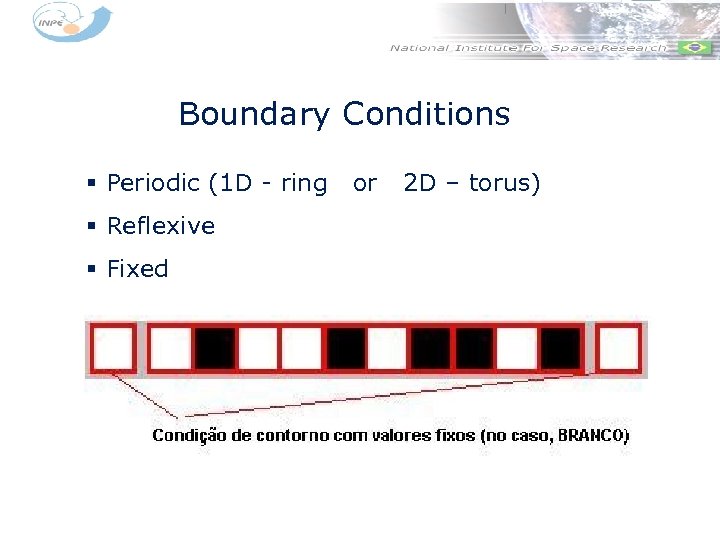 Boundary Conditions § Periodic (1 D - ring § Reflexive § Fixed or 2 D – torus)
 Boundary Conditions § Periodic (1 D - ring or 2 D – torus) § Reflexive § Fixed § Null (the cells located on the borders have as neighbors only those cells immediately adjacent to them into the grid) § Others
 CA = (G, N, S, IC, R, BC, UC) G: Geometry N: Neighborhood S: States IC: Initial condition R: Rules BC: Boundary conditions UC: Updating criteria The CA Structure Source: Adapted from Leonardo Santos’ slide
 Examples of Bidimensional Cellular Automata Models
 44
44
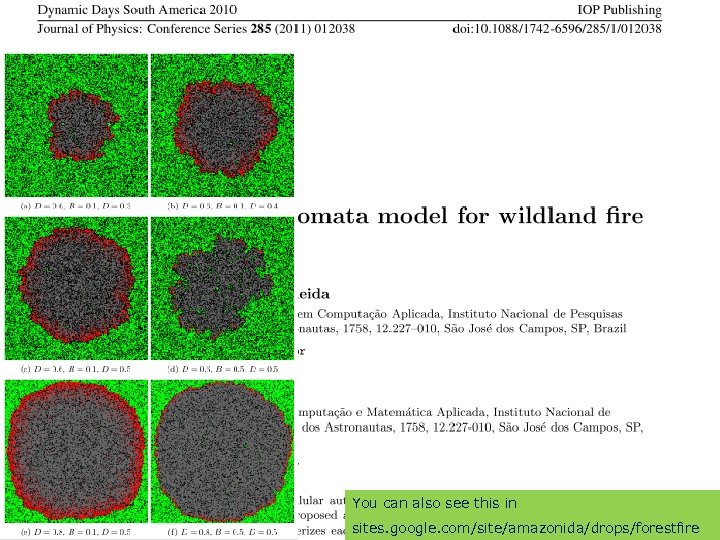 You can also see this in 45 sites. google. com/site/amazonida/drops/forestfire
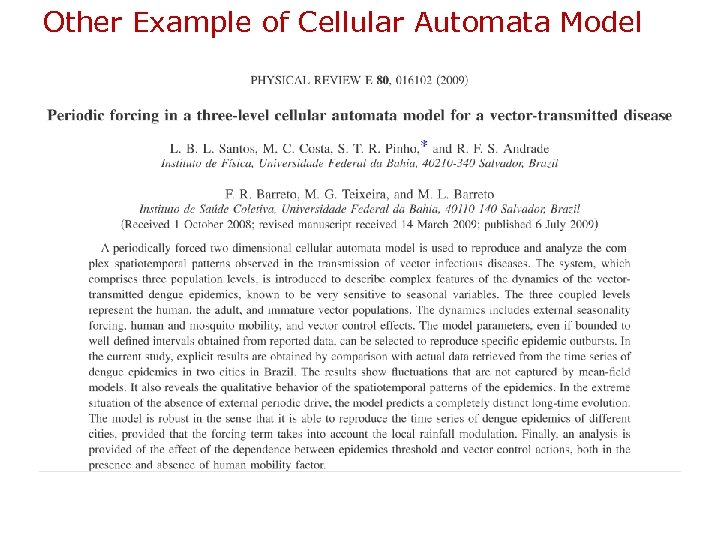
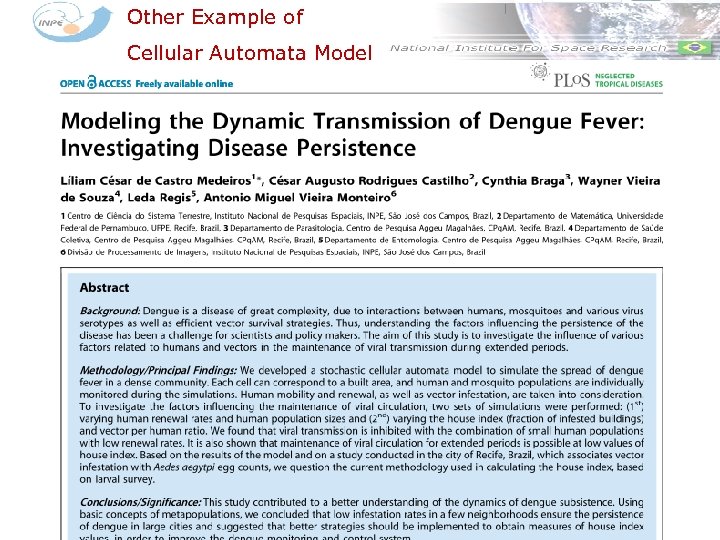 Other Example of Cellular Automata Model
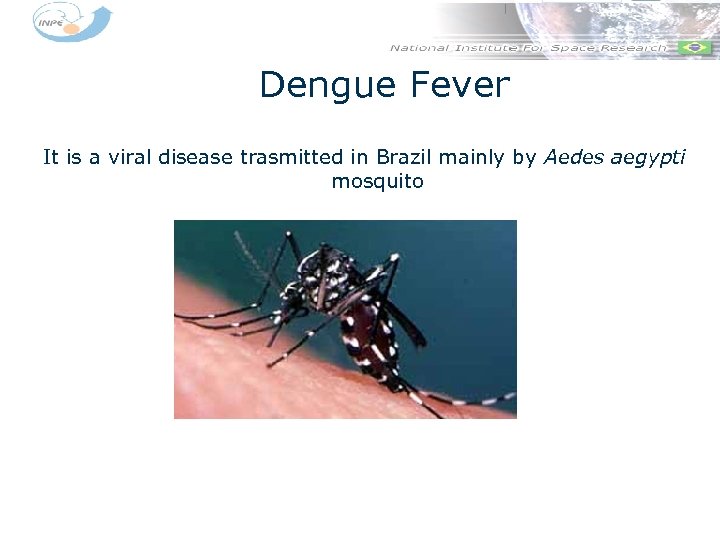 Dengue Fever It is a viral disease trasmitted in Brazil mainly by Aedes aegypti mosquito
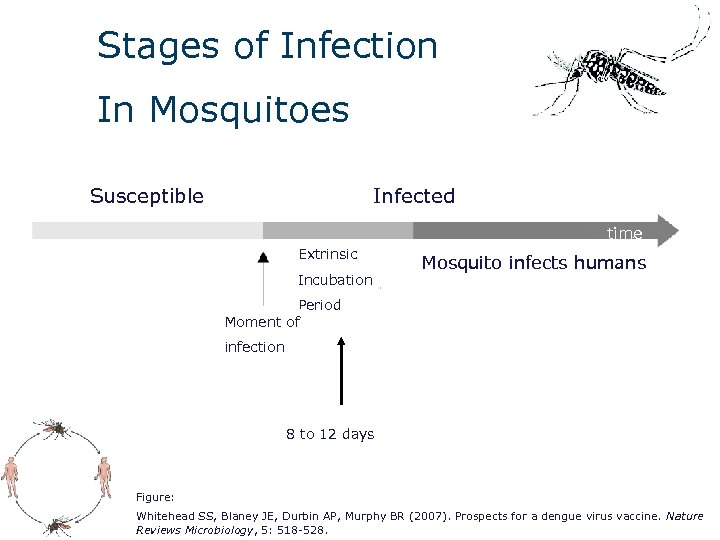 Stages of Infection In Mosquitoes Susceptible Infected time Extrinsic Incubation Mosquito infects humans Period Moment of infection 8 to 12 days Figure: Whitehead SS, Blaney JE, Durbin AP, Murphy BR (2007). Prospects for a dengue virus vaccine. Nature Reviews Microbiology, 5: 518 -528.
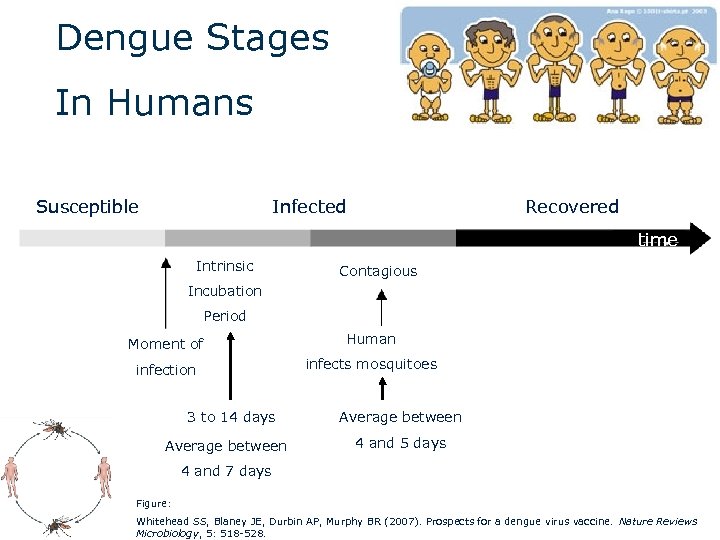 Dengue Stages In Humans Susceptible Infected Recovered time Intrinsic Contagious Incubation Period Moment of Human infection infects mosquitoes 3 to 14 days Average between 4 and 5 days 4 and 7 days Figure: Whitehead SS, Blaney JE, Durbin AP, Murphy BR (2007). Prospects for a dengue virus vaccine. Nature Reviews Microbiology, 5: 518 -528.
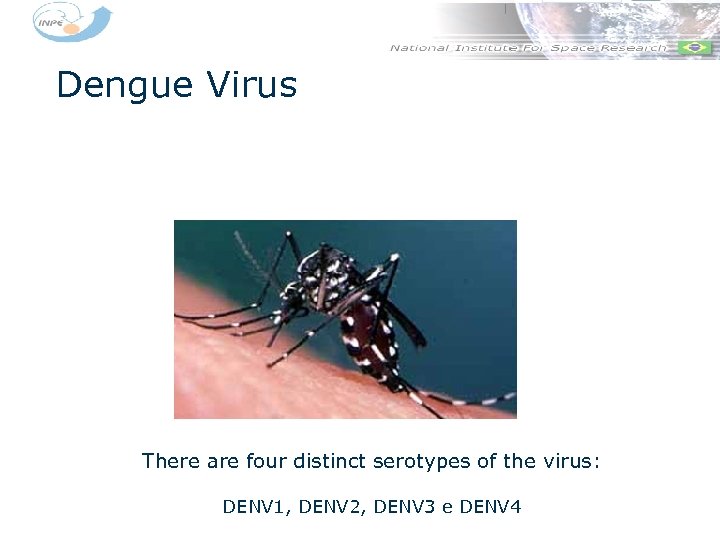 Dengue Virus There are four distinct serotypes of the virus: DENV 1, DENV 2, DENV 3 e DENV 4
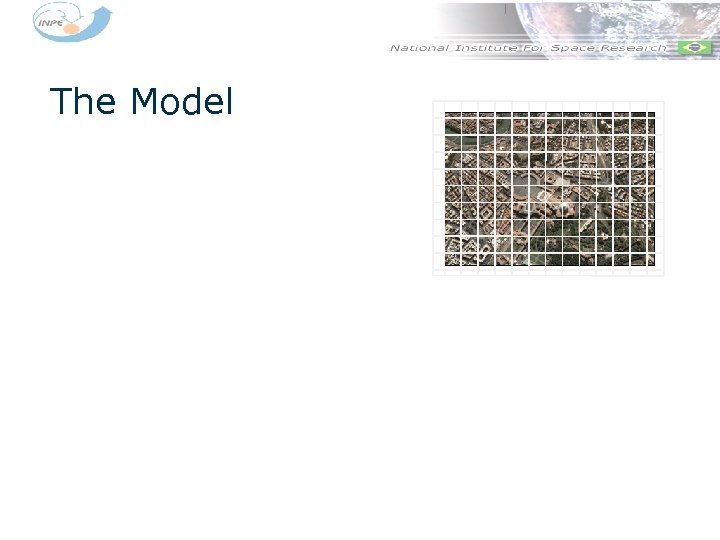 The Model
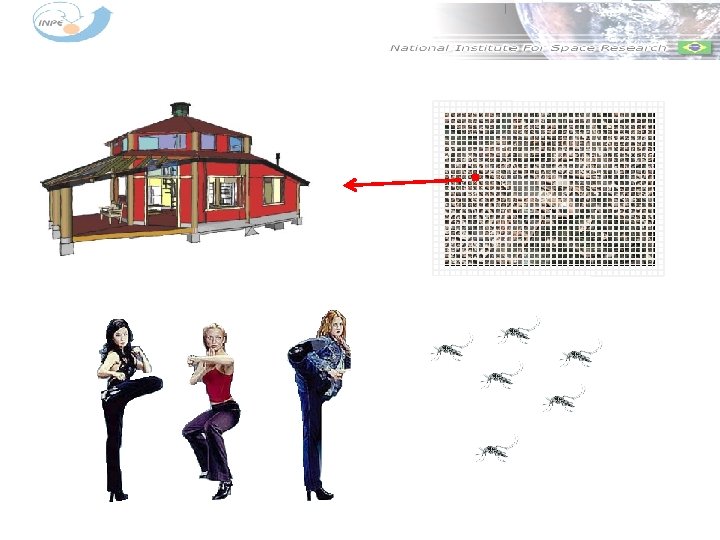
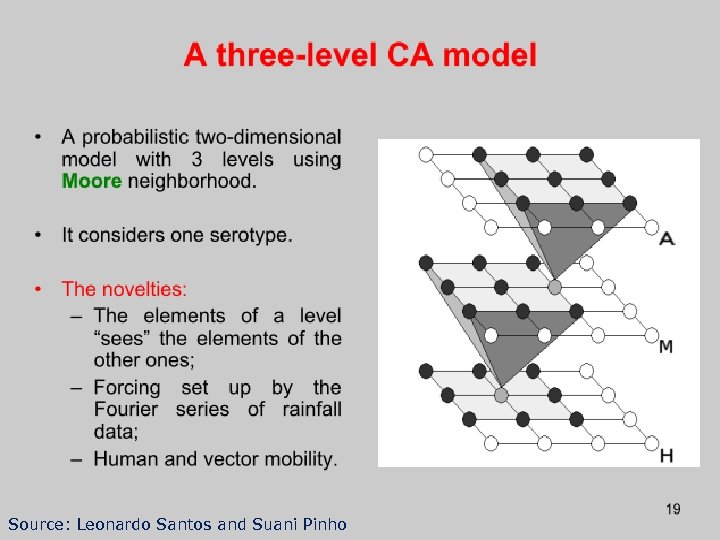
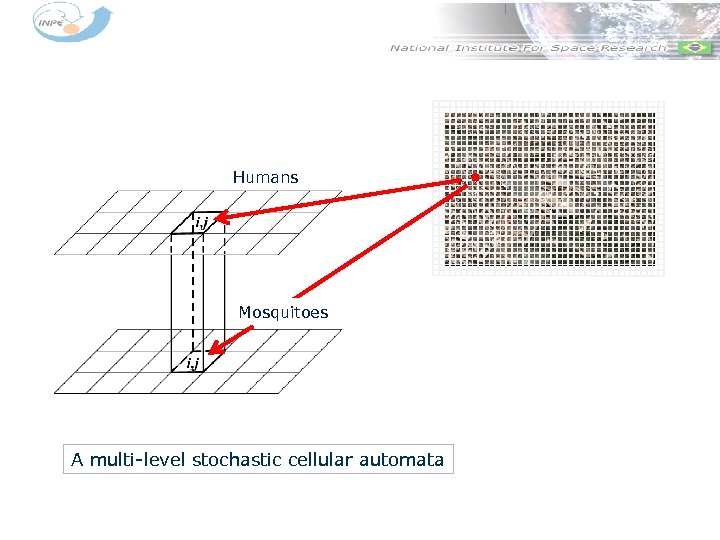 Humans Mosquitoes A multi-level stochastic cellular automata
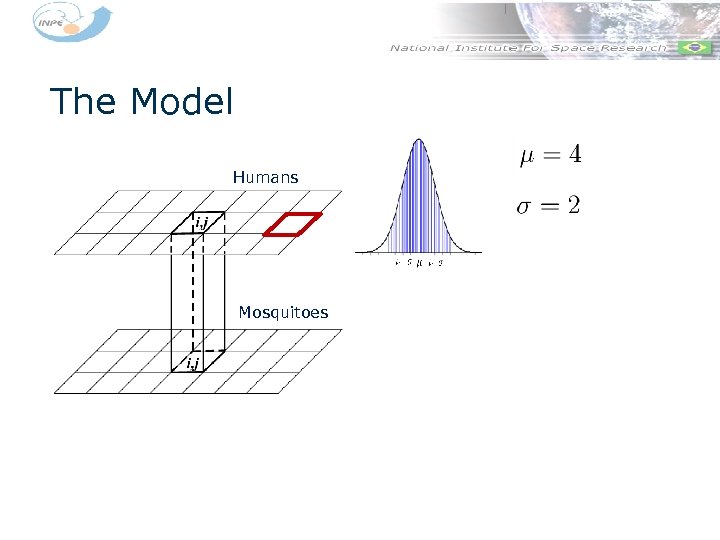 The Model Humans Mosquitoes
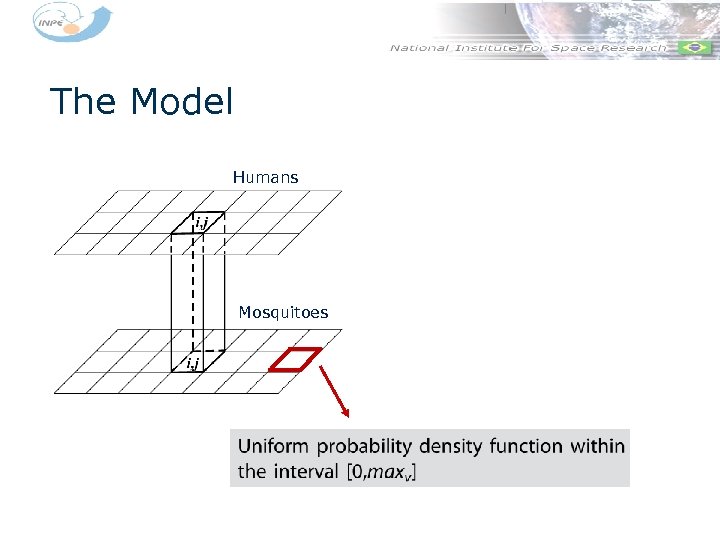 The Model Humans Mosquitoes
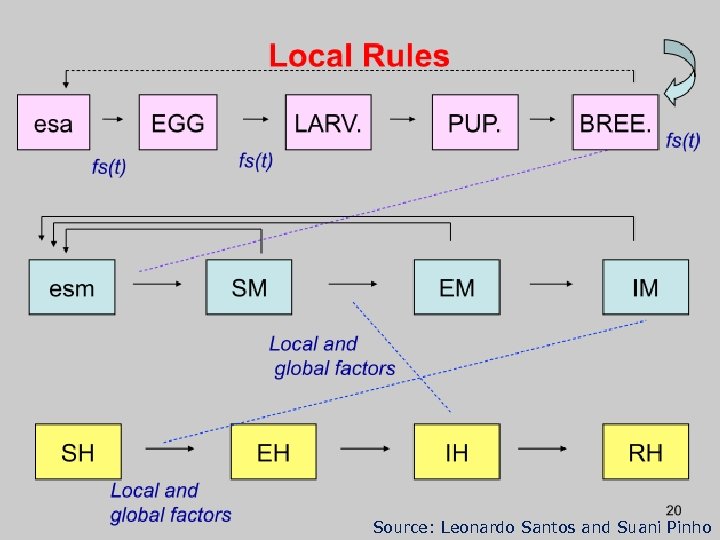
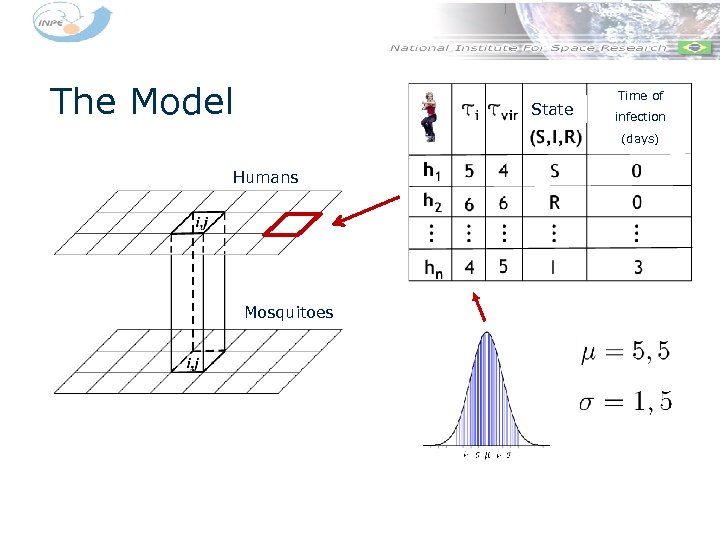 The Model State Time of infection (days) Humans Mosquitoes
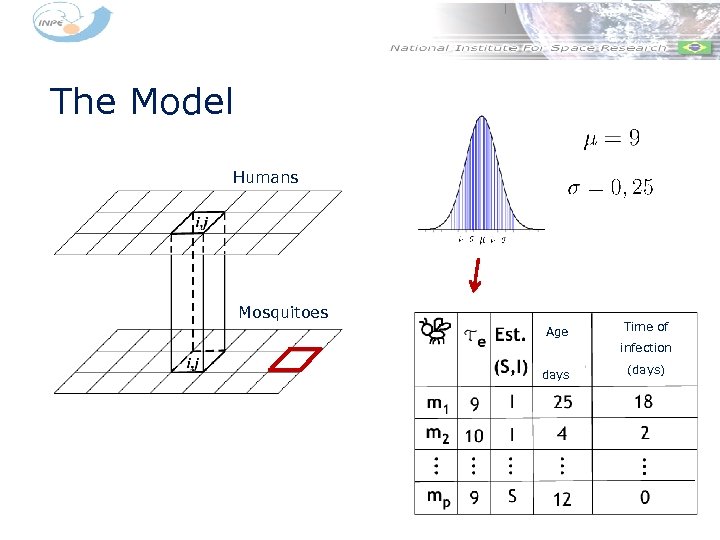 The Model Humans Mosquitoes Age Time of infection days (days)
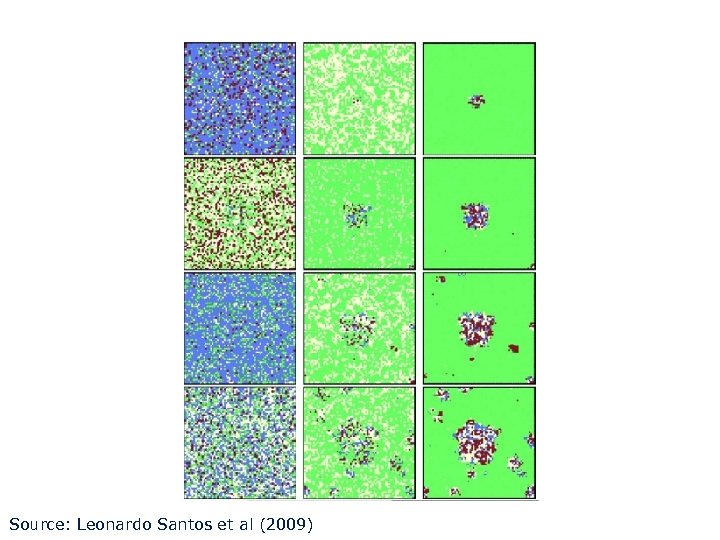
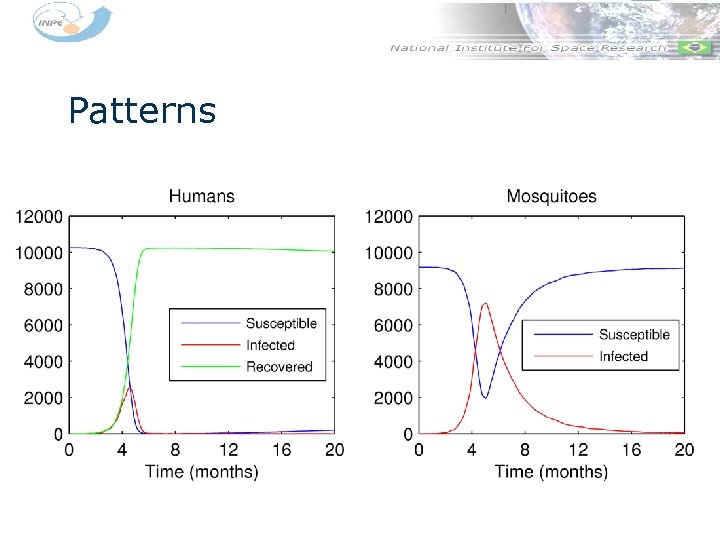 Patterns
 Model Considerations § § § § Human mobility Asymptomatic people Human renewal House infestation Vector density per household Each iteration corresponds to a day Periodic boundary conditions
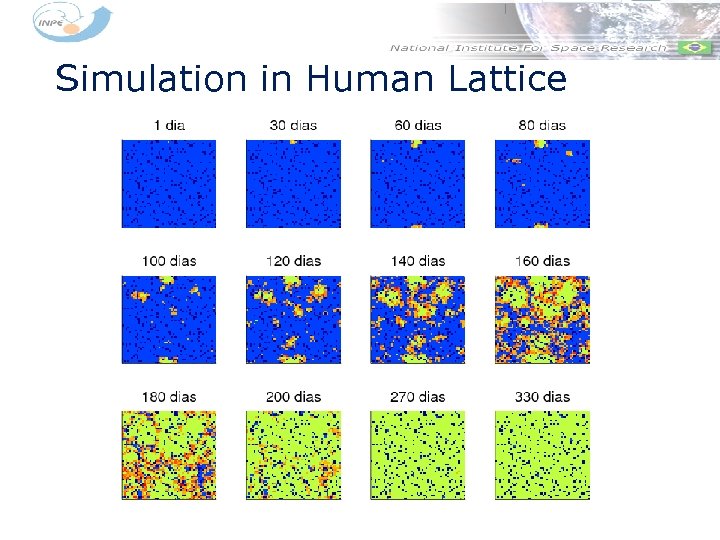 Simulation in Human Lattice Inicialmente:
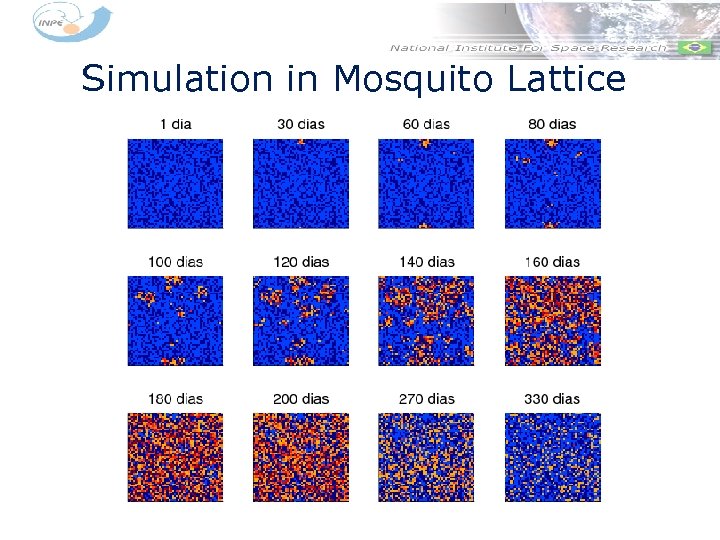 Simulation in Mosquito Lattice Inicialmente: Um único humano infectado
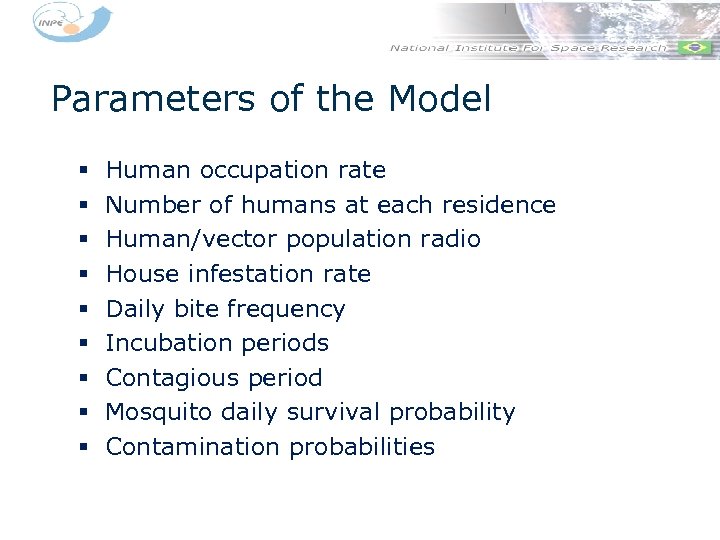 Parameters of the Model § § § § § Human occupation rate Number of humans at each residence Human/vector population radio House infestation rate Daily bite frequency Incubation periods Contagious period Mosquito daily survival probability Contamination probabilities
 Other Example of Cellular Automata Model
 65 Source: Leonardo Santos and Suani Pinho
 66 Source: Leonardo Santos and Suani Pinho
 Source: Leonardo Santos et al (2009)
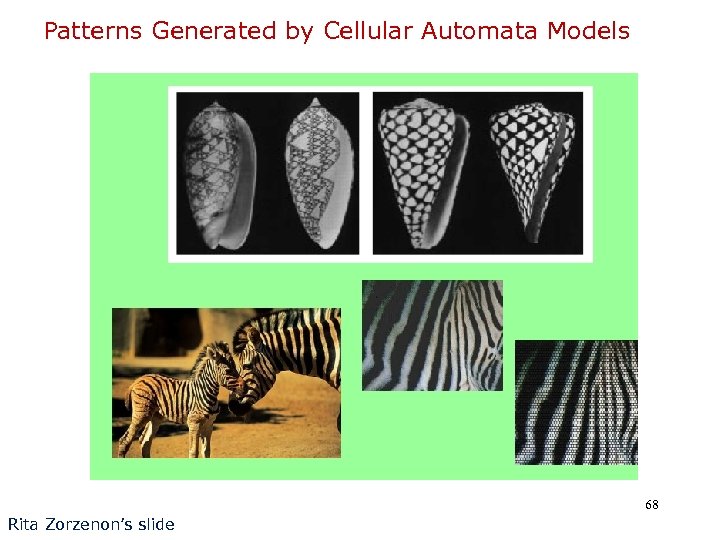 Patterns Generated by Cellular Automata Models 68 Rita Zorzenon’s slide
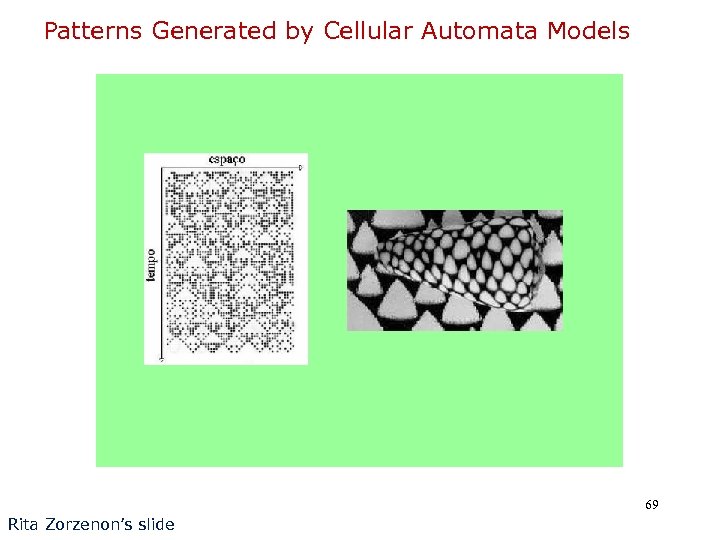 Patterns Generated by Cellular Automata Models 69 Rita Zorzenon’s slide
 Terra. ME § Is a programming environment for spatial dynamical modeling. It supports cellular automata, agent-based models and network models running in 2 D cell spaces. § It provides an interface to Terra. Lib geographical database, allowing models direct access to geospatial data. www. terrame. org
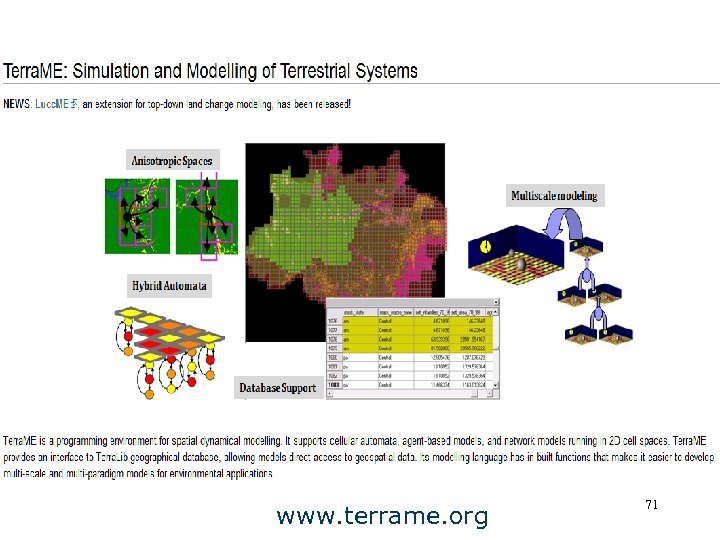 www. terrame. org 71
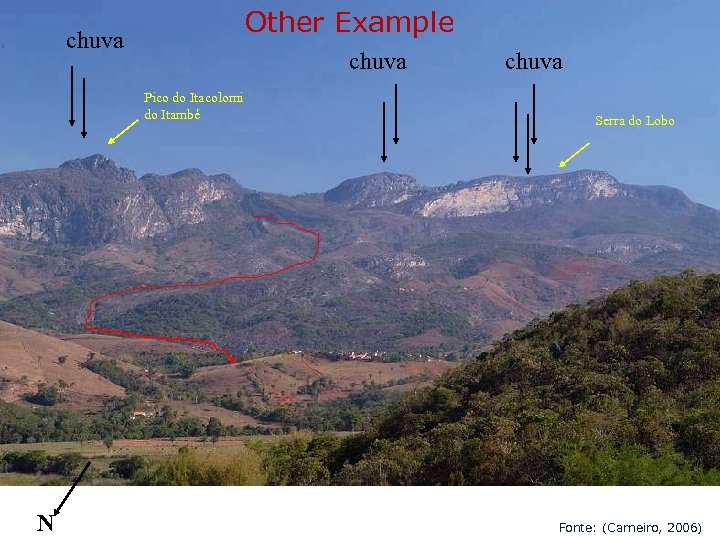 Other Example chuva Pico do Itacolomi do Itambé N chuva Serra do Lobo Fonte: (Carneiro, 2006)
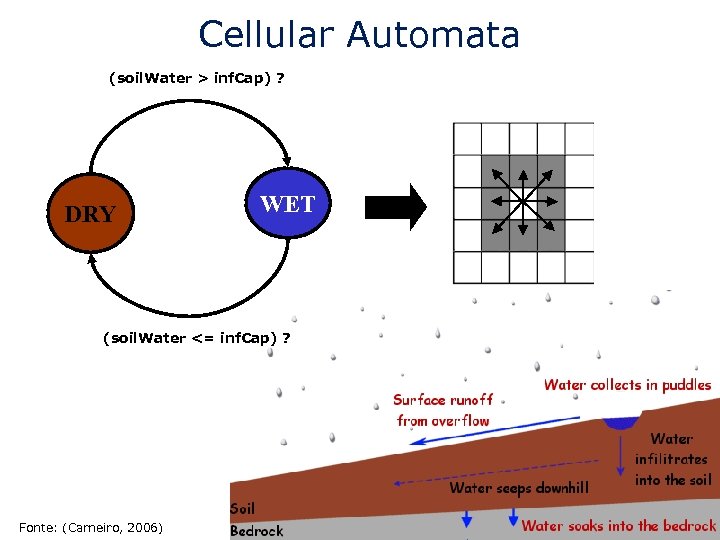 Cellular Automata (soil. Water > inf. Cap) ? DRY WET (soil. Water <= inf. Cap) ? Fonte: (Carneiro, 2006)
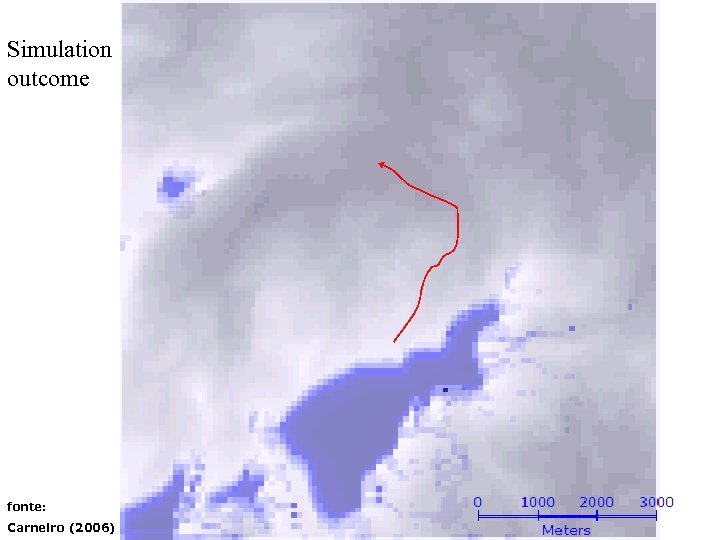 Simulation outcome fonte: Carneiro (2006)