


 Скачать презентацию AUTOMATING THE TERASCAN IMAGE PROCESS Mentor Keisha Wilkins
31b05a19c035b4f27b0129d39f2439cd.ppt
- Количество слайдов: 13
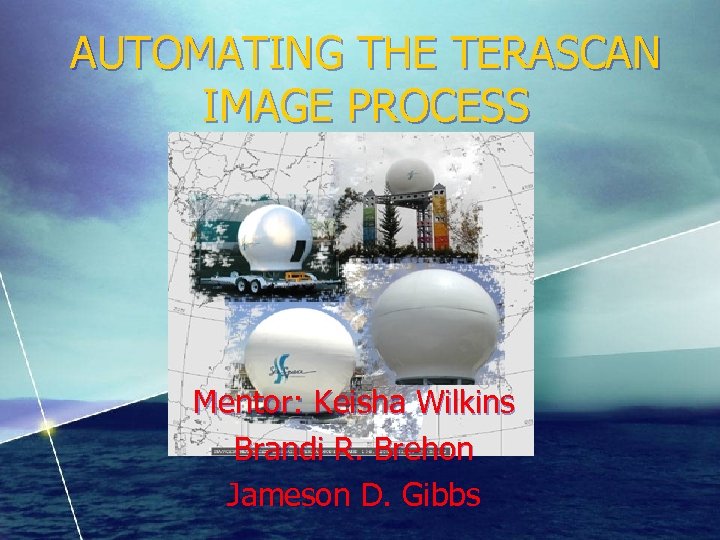 AUTOMATING THE TERASCAN IMAGE PROCESS Mentor: Keisha Wilkins Brandi R. Brehon Jameson D. Gibbs
 Abstract Since the establishment of the Center Of Excellence and Remote Sensing Education and Research (CERSER) in 2002, the center has remotely sensed Advanced Very High Resolution Radiometer (AVHRR) and Sea Wide Field-of-View Sensor (Sea. WIFS) data. The data has been processed, annotated, and converted into. tiff files manually by using a series of Tera. Scan and LINUX commands. This process is time-consuming and requires a person to physically be at the Tera. Scan machine. The objective of the 2005 -2006 Remote Sensing Team will be to automate the process of creating AVHRR images. This will be accomplished by first creating a Tera. Scan dataset that delimits a geographical area of the Earth and specifies a map projection and pixel resolution, also known as a ‘master’, to the areas of North Carolina and Virginia. In addition, a script will be created which will process raw AVHRR data from the passdisk using the ‘master’. Next, a coastal boundary, gridlines, wedge, and a legend will be overlayed on the processed image. The image will then be converted into a. tiff file. Once images have been processed and converted into a picture, they will be sent to the server, which automates the process and eliminates the need for the individual to manually process the data.
 Using the Tera. Scan system, CERSER has provided remotely sensed Advanced Very High Resolution Radiometer (AVHRR) and Sea Wide Field-of-View Sensor (Sea. WIFS) data for research during the summer and academic years. The 2005 -2006 Remote Sensing Team automated the process of creating AVHRR images by implementing a script that automatically processes datasets and FTPs them to the CERSER server.
 Tera. Scan is an integrated system of hardware and software designed for automated reception of data from meteorological and environmental satellites and for processing the data into images and data overlay. Tera. Scan software: • Based on UNIX Operating system • Consists of more than five hundred command-line functions for the reception and processing of satellite data. • Contains a set of reference files and databases • Contains a set of graphical user interfaces (GUIs)
 Tera. Scan functions: • ingesting raw satellite telemetry or industry standard archive format data • defining area of interest maps using various projections and remapping data to those maps • managing datasets • retrieving and setting data sets and variable attributes such as variable units. Terascan imports data into its own Terascan data format (TDF). TDF is an extremely versatile format capable of assimilating a wide variety of data types, shapes, and sizes.
 ‘MASTER’ - Before creating the script for automating the Tera. Scan process a ‘master’ must be produced. A ‘master’ is a Tera. Scan dataset that defines a geographical area of the Earth and specifies a map projection.
 ‘Master’ This function generates a master dataset containing attributes that parameterize an earth transform. • This transform relates line and sample • coordinates to latitude and longitude coordinates for a user-defined geographical region using a user-specified map projection. 'master' defines the region by the center latitude and longitude, and the pixel size at the center.
 Master Datasets Master datasets are used by a variety of ingest functions such as hrptin and rtdin to limit data extraction to only the rectangular subset of sensor data that intersects the geographical area specified by the dataset. ü ü ü These datasets contain dimensions and attributes that display various overlays geopolitical boundaries Latitude and longitude grids The coast of North Carolina and Virginia is utilized in the creating of the master dataset used in automating the Tera. Scan system and any data falling outside the master dataset is discarded.
 Methodology • The first step used in creating the script was inputing the function hrptin into the C -shell window. • hrptin creates Tera. Scan AVHRR datasets from HRPT telemetry data. • Input telemetry data can be read from the pass disk or standard UNIX disk files. Multiple passes on tape or the pass disk can be processed at once.
 Parameters of the Script
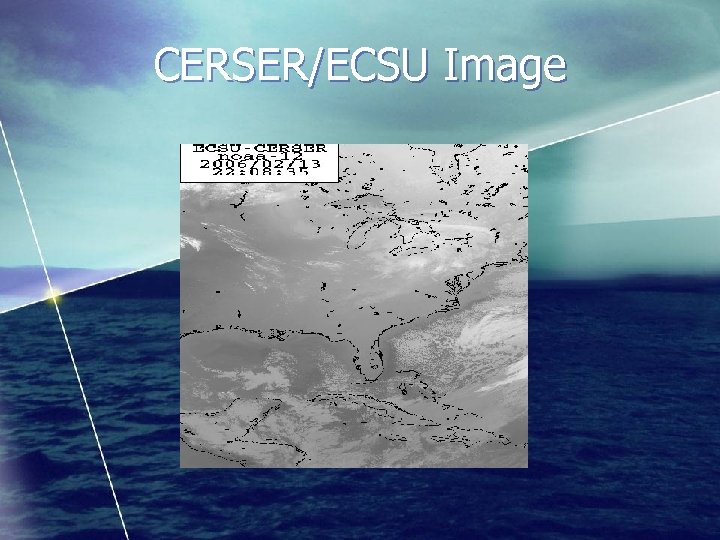 CERSER/ECSU Image
 Future Research Suggestions for future research would be to locate a way for the script to run without any manual input.
 Acknowledgments • Dr. Linda Hayden • Keisha Wilkins • Dr. Malcolm Le. Compte