


 Скачать презентацию Automating the Committee Meeting Intelligent Integration of Information
628bc7e99dd7bace6d68b0e436dbdaff.ppt
- Количество слайдов: 42
 Automating the Committee Meeting: Intelligent Integration of Information From Diverse Sources Pedrito Maynard-Zhang Department of Computer Science & Systems Analysis
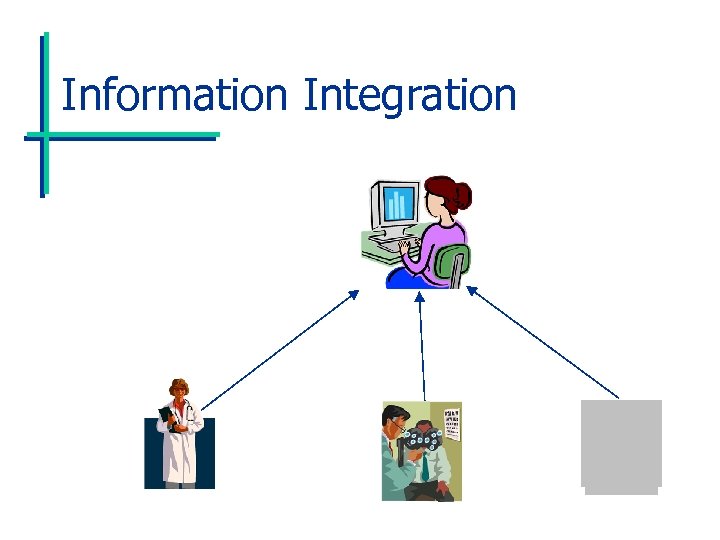
 Information Integration Information integration is ubiquitous: • Committee meetings • Research papers • Information retrieval on the web • Assessing intelligence on the battlefield • …
 Information Integration
 Outline • Introduction • Automating Information Integration – Database Integration – Model Integration – Conflict Resolution and Meta-Information • Integrating Learned Probabilistic Information • Conclusion and Current Work
 Multi-Disciplinary Research • Databases (e. g. , Halevy’s group at U. of Washington) • Artificial Intelligence (e. g. , Stanford’s Knowledge Systems Laboratory) • Business (e. g. , MIT-Sloan’s Aggregators Group) • Decision Analysis (e. g. , Clemen & Winkler’s work at Duke)
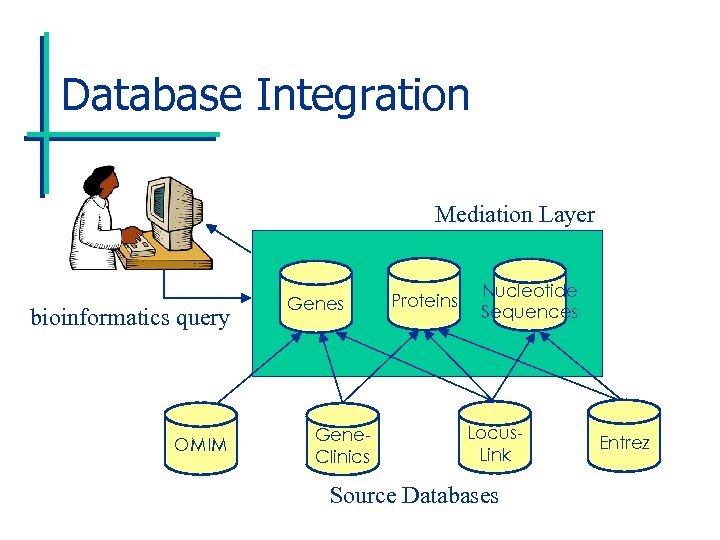 Database Integration Mediation Layer bioinformatics query OMIM Genes Gene. Clinics Proteins Nucleotide Sequences Locus. Link Source Databases Entrez
 Database Integration • Application: Querying distributed databases • Examples – Bioinformatics – Corporate data management – Question-answer systems on the web – Detecting bioterrorism
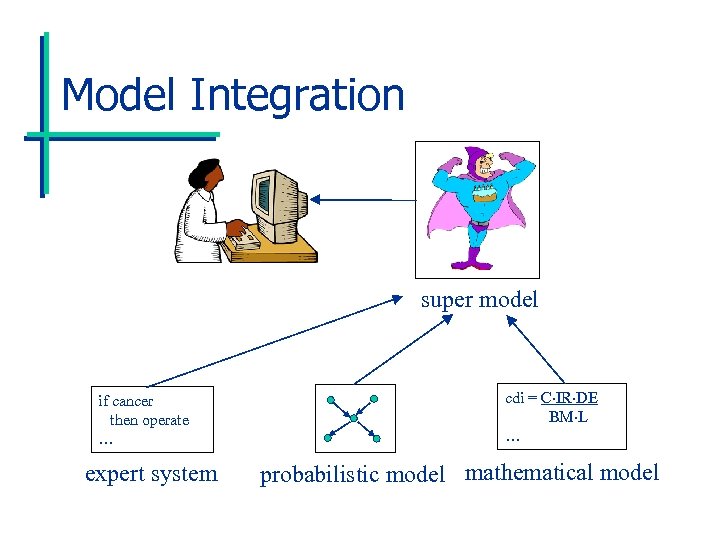 Model Integration super model if cancer then operate … expert system cdi = C IR DE BM L … probabilistic model mathematical model
 Model Integration • Applications: Diagnosis and prediction • Examples: – Medical diagnosis – NASA spacecraft design and diagnosis – Expert system integration – Combining commonsense knowledge bases
 Challenges • Efficient query processing and optimization – Parsing XML • Defining expressive yet tractable mediator languages • Handling heterogeneous source languages – Wrapper technology development
 Challenges • Resolving ontological differences – e. g. , realizing that the field “Name” for one source stores the same information as “First Name” and “Last Name” for another. • Detecting conflicts • Resolving conflicts – Resolution done manually in practice – We can automate more!
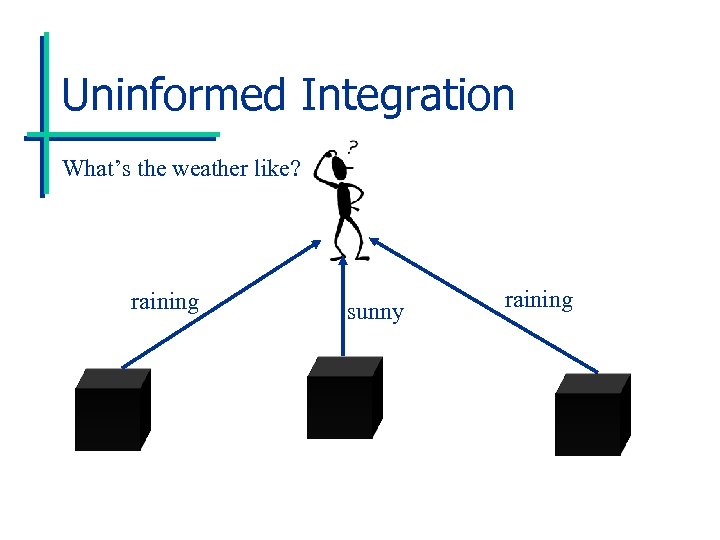 Uninformed Integration What’s the weather like? raining sunny raining
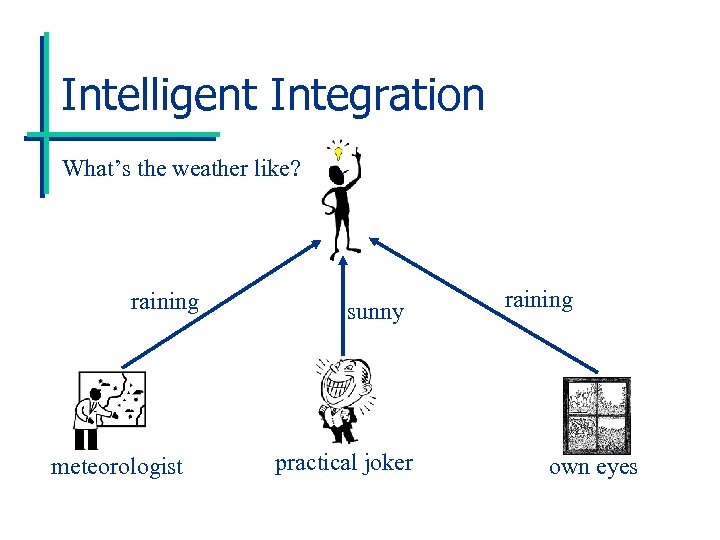 Intelligent Integration What’s the weather like? raining meteorologist sunny practical joker raining own eyes
 Types of Meta-Information • Credibility, experience, political clout • Areas of expertise • How source acquired information: – Source’s sources – Processes source used to accumulate information • Structure of the data representation
 Outline • Introduction • Automating Information Integration • Integrating Learned Probabilistic Information – – – Medical Scenario Semantic Framework Lin. OP-Based Aggregation Aggregating Bayesian Networks Experimental Validation • Conclusion and Current Work
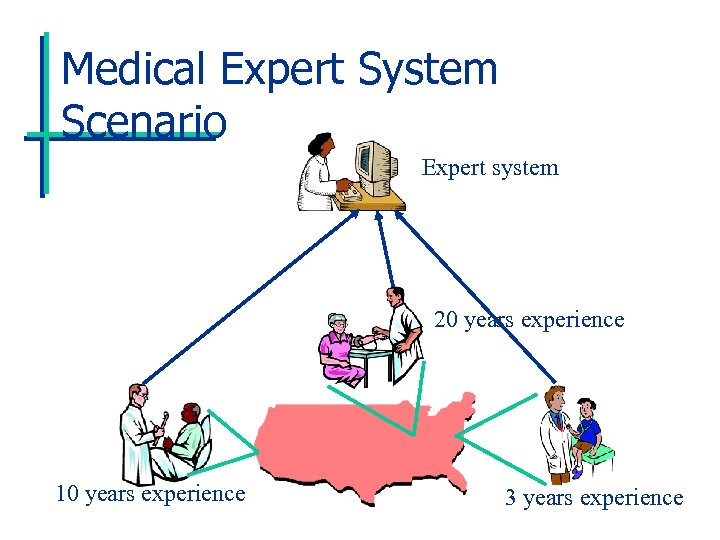 Medical Expert System Scenario Expert system 20 years experience 10 years experience 3 years experience
 Source Meta-Information • Doctors learned probabilistic models from patient data using some known standard learning algorithm. • We know the relative amount of experience doctors have had (i. e. , years of practice).
 Popular Aggregation Approaches • Intuition approach: Take simple weighted averages, etc. unexpected behavior • Axiomatic approach: Find aggregation algorithm satisfying certain “obvious” properties impossibility results • Problem: Not semantically grounded
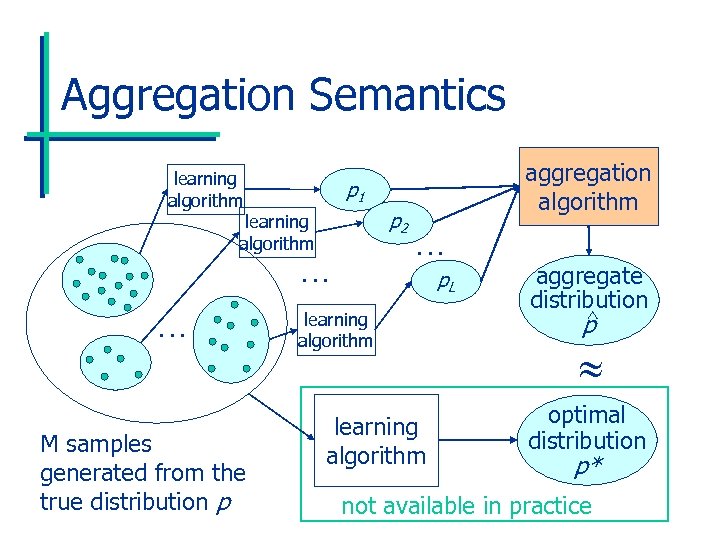 Aggregation Semantics learning algorithm p 1 p 2 learning algorithm … … M samples generated from the true distribution p aggregation algorithm … p. L learning algorithm aggregate distribution ^ p optimal distribution p* not available in practice
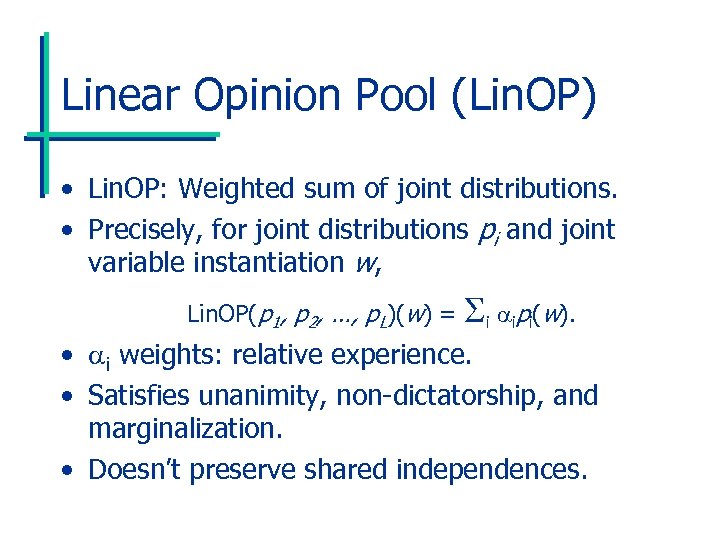 Linear Opinion Pool (Lin. OP) • Lin. OP: Weighted sum of joint distributions. • Precisely, for joint distributions pi and joint variable instantiation w, Lin. OP(p 1, p 2, …, p. L)(w) = i ipi(w). • i weights: relative experience. • Satisfies unanimity, non-dictatorship, and marginalization. • Doesn’t preserve shared independences.
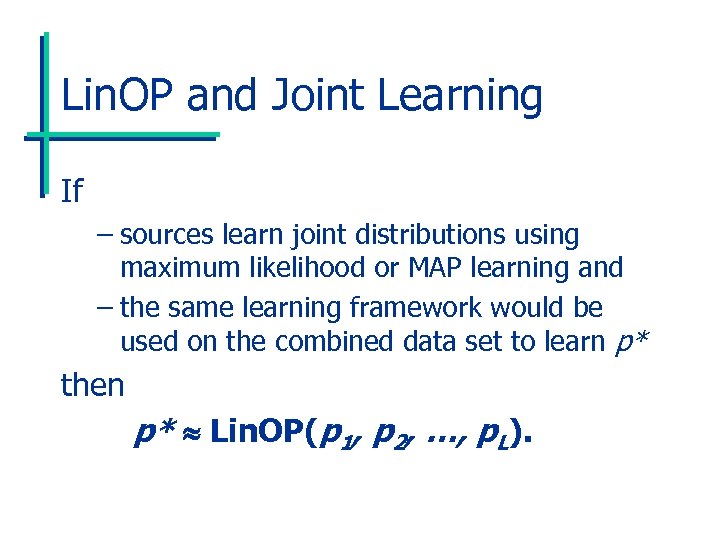 Lin. OP and Joint Learning If – sources learn joint distributions using maximum likelihood or MAP learning and – the same learning framework would be used on the combined data set to learn p* then p* Lin. OP(p 1, p 2, …, p. L).
 Bayesian Network (BN) • Summary: Compact, graphical representation of a probability distribution. • Definition: Directed acyclic graph (DAG) over nodes (random variables); each node has a local conditional probability distribution (CPD) associated with it. • Exploits causal structure in the domain.
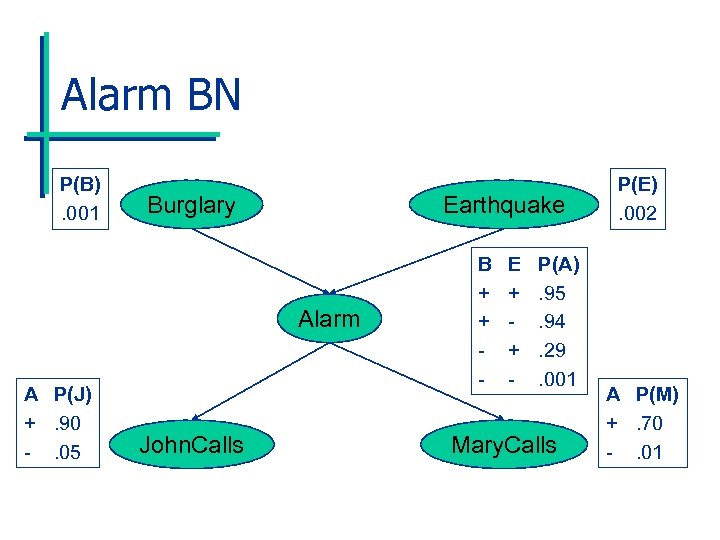 Alarm BN P(B). 001 Burglary Earthquake Alarm A P(J) +. 90 -. 05 John. Calls B + + - E + + - P(A). 95. 94. 29. 001 Mary. Calls P(E). 002 A P(M) +. 70 -. 01
 BN Advantages • Compact representation and graph encodes conditional independences. • Elicitation easy in practice. • Inference efficient in practice. • Can be learned from data. • Deployed successfully – medical diagnosis, Microsoft Office, NASA Mission Control, and more.
 BN Learning • Idea: Select BN most likely to have generated data. • Standard algorithm: – Search over structures by adding, deleting, and reversing edges. – Parameterize and score structures using statistics from the data. – Penalize complex structures.
 Aggregating BNs • Each source i learns BN pi. • p* is the BN we would learn from the combined data set. • We want to approximate p* as closely as possible by aggregating p 1, …, p. L. • Source information: estimates for the relative experience of the sources and the total amount of data seen (M).
 AGGR: BN Aggregation Algorithm • Idea: Use BN learning algorithm. • Problem: We don’t have data. • Key observation: We can use Lin. OP to approximate the statistics needed for the parameterization and scoring steps! • Also, we can use Lin. OP properties to make algorithm reasonably efficient.
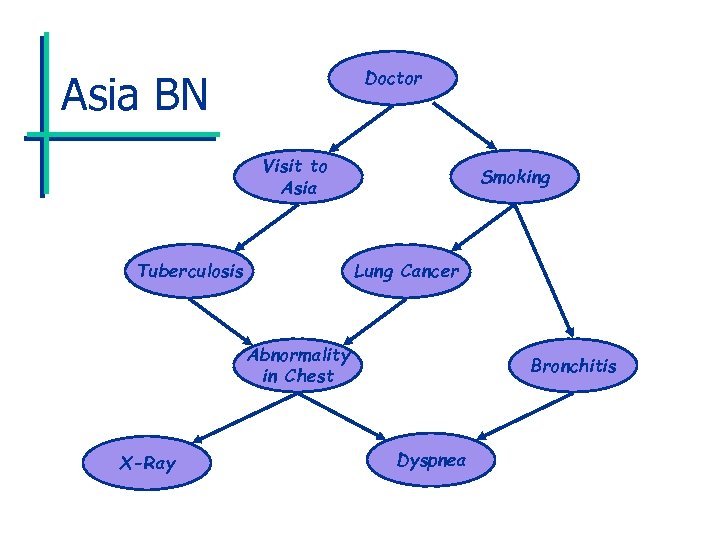
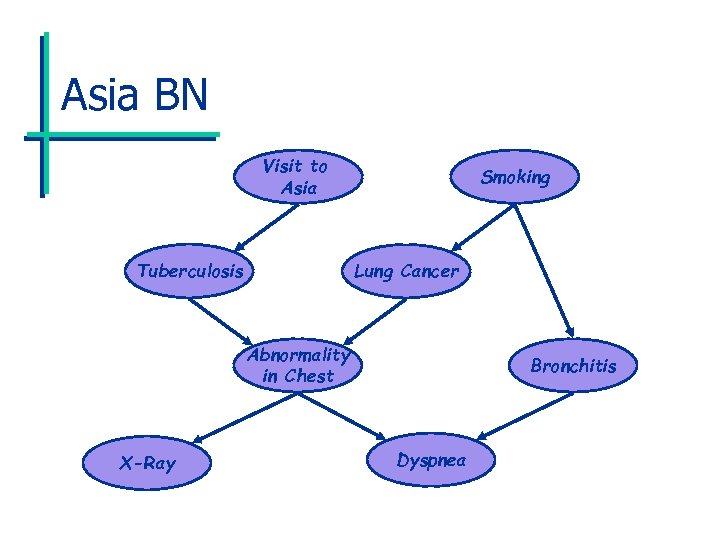 Asia BN Visit to Asia Tuberculosis Smoking Lung Cancer Abnormality in Chest X-Ray Bronchitis Dyspnea
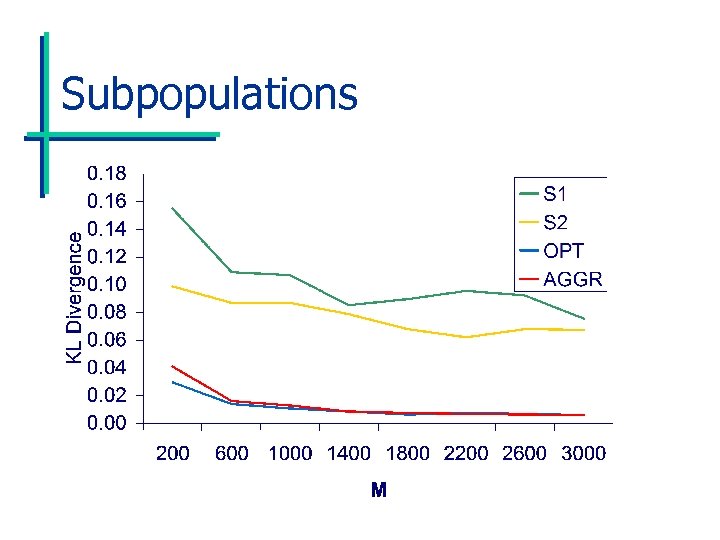
 Experimental Setup • Generate data for sources from wellknown ASIA BN which relates smoking, visiting Asia, and lung cancer. • Compare our algorithm AGGR against the optimal algorithm OPT that has access to the combined data set. • Accuracy measure: KL divergence from generating distribution.
 Sensitivity to M Experiments • Sensitivity to M – Size of the combined data set M varies. – AGGR’s estimate of M is accurate. • Sensitivity to Estimate of M – Size of the combined data set M is fixed. – AGGR’s estimate of M varies.
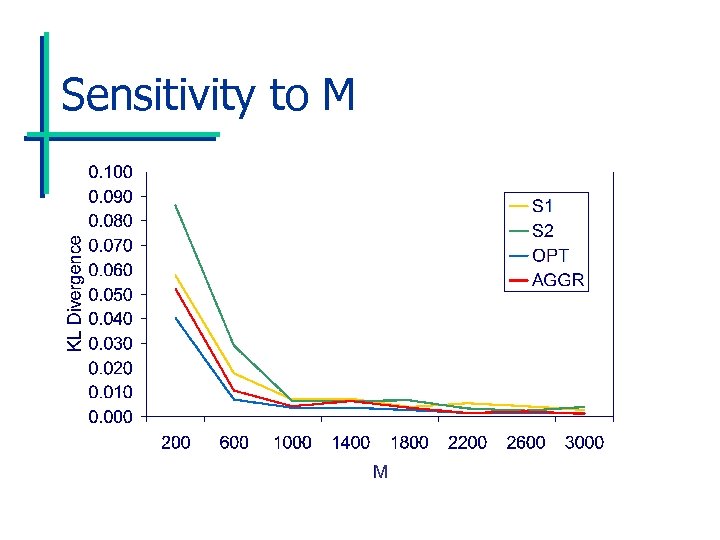 Sensitivity to M
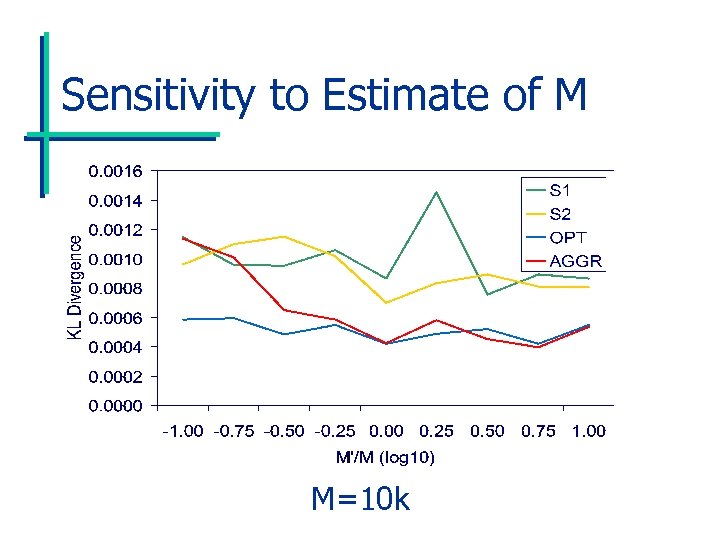 Sensitivity to Estimate of M M=10 k
 Subpopulations • Each source’s data may come from a different subpopulation P(D|Si), where D is the data. • We want to learn P(D). • P(D) = Lin. OP(P(D|S 1), P(D|S 2), …, P(D|SL)) with sources’ weights based on P(Si). • We can apply the same algorithm.
 Subpopulations Experiments • In the Asia network domain, one doctor practices in San Francisco, another in Cincinnati. • Subpopulations have different priors for smoking and having visited Asia, so doctors’ beliefs are biased. • The aggregate distribution comes much closer to the original distribution.
 Doctor Asia BN Visit to Asia Tuberculosis Smoking Lung Cancer Abnormality in Chest X-Ray Bronchitis Dyspnea
 Subpopulations
 Contributions • A semantic framework for aggregating learned probabilistic models. • A Lin. OP-based algorithm for aggregating learned BNs. • Experiments showing algorithm behaves well.
 Outline • Introduction • Automating Information Integration • Integrating Learned Probabilistic Information • Conclusion and Current Work
 Conclusion • Conflict resolution is key in automated information integration. • This is a difficult task in general. • However, information about sources is often readily available. • Principled use of this information can greatly enhance the ability to resolve conflicts intelligently.
 Current Work • Allow dependence between sources’ data sets in probabilistic aggregation work. • Apply semantic framework to aggregation in other learning paradigms. • Explore application of algorithms to database integration, Robo. Cup, stock market prediction, etc. • Making committee meetings obsolete!
 Multi-Agent Research Zone • Research interests: – Information integration – Multi-agent machine learning – Robo. Cup soccer simulation league testbed • Masters students – Jian Xu: Information integration in medical informatics – Linxin Gan: Ensemble learning in stock market prediction
 CSA Graduate Program • Masters in Computer Science • Research areas include: – machine learning, KRR, and MAS – information retrieval, databases, and NLP – networking and virtual environments – simulation and evolutionary computation – software engineering and formal methods http: //unixgen. muohio. edu/~maynarp/ maynarp@muohio. edu