


 Скачать презентацию Automating Systematizing the Generation of Documents Related
126adb3a4bed3f7a001315d266254c29.ppt
- Количество слайдов: 14
 Automating & Systematizing the Generation of Documents Related to Water Rights Tim Wallin Water Rights Program Manager Oregon Water Resources Department June 8, 2015
 Challenges Backlogs make faster & more accurate processing of business products an imperative Document creation & editing is labor-intensive; the introduction of human error by repetitively typing potentially referential information is a certainty Too few staff in IT to respond quickly Objective use technology to facilitate work & eliminate backlogs
 You are a Symbol Manipulator smooth flow of information is vital to success the attention of skilled people is very expensive incrementalism is anything but incremental: – creates FTE out of thin air – allows staff to work at a higher cognitive level
 Solutions Originating rights: use a system of templates with custom macros to receive data from the enterprise database (WRIS) in WORD, & distribute it automatically Transfers: use Excel to compare POU data from two rights in WRIS to highlight differences (QQ = smallest POU “pixel” in WRIS) draw the caseworker’s attention to them (large-scale maps illustrate finer POU details)
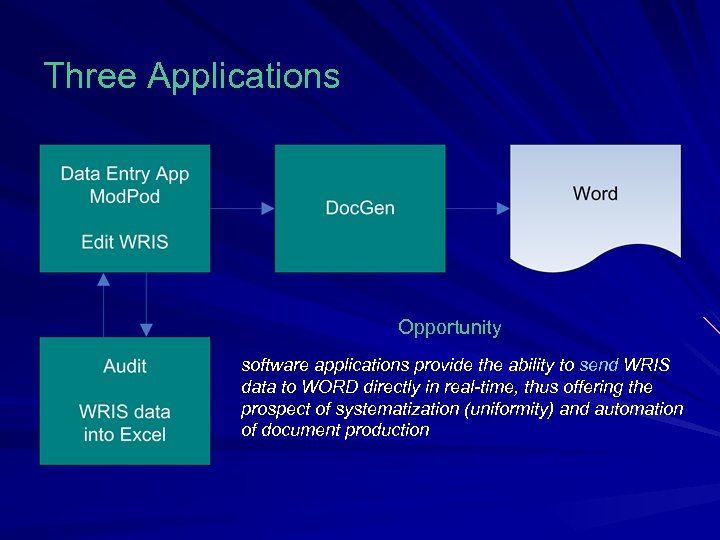 Three Applications Opportunity software applications provide the ability to send WRIS data to WORD directly in real-time, thus offering the prospect of systematization (uniformity) and automation of document production
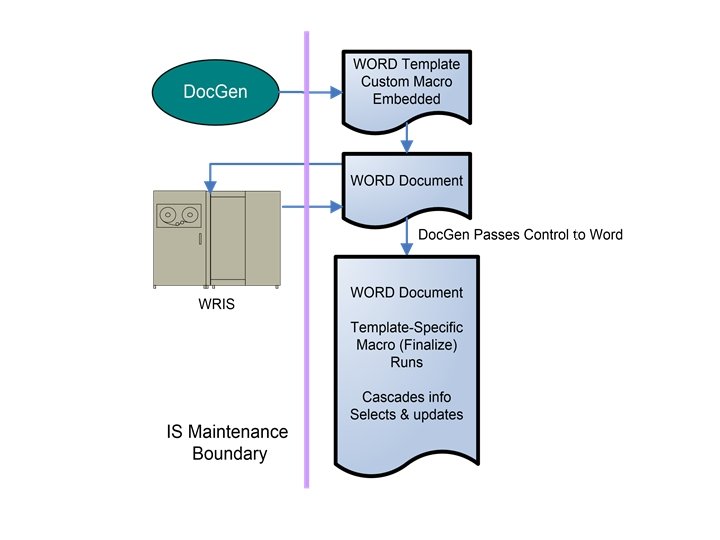
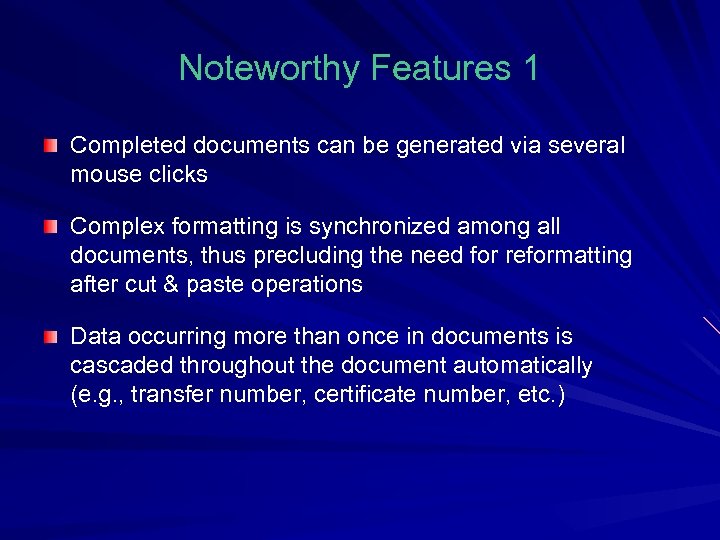 Noteworthy Features 1 Completed documents can be generated via several mouse clicks Complex formatting is synchronized among all documents, thus precluding the need for reformatting after cut & paste operations Data occurring more than once in documents is cascaded throughout the document automatically (e. g. , transfer number, certificate number, etc. )
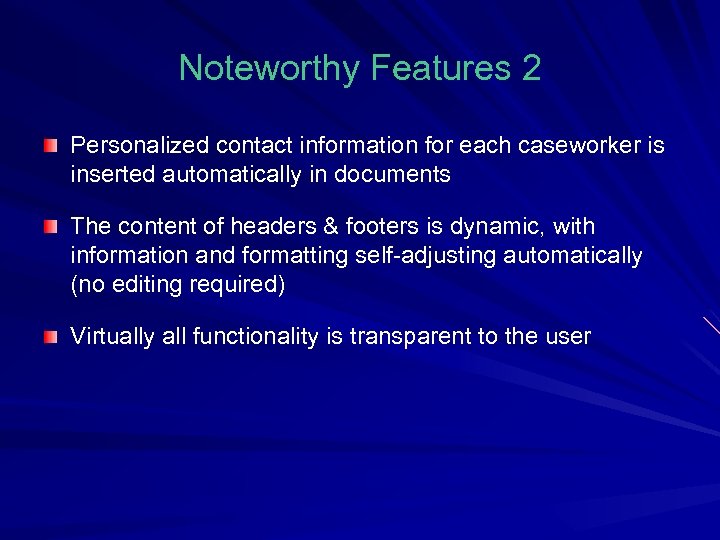 Noteworthy Features 2 Personalized contact information for each caseworker is inserted automatically in documents The content of headers & footers is dynamic, with information and formatting self-adjusting automatically (no editing required) Virtually all functionality is transparent to the user
 Switch to Doc. Generate Final Order & Permit for G-XXXXX
 Switch to Audit Compare POUs for T-XXXXX
 Significance dramatically reduces the introduction & propagation of errors in business processes, & thus WRIS makes resulting documents more uniform speeds document production precludes the preparation, approval, & data-entry for correcting orders (because they don’t exist)
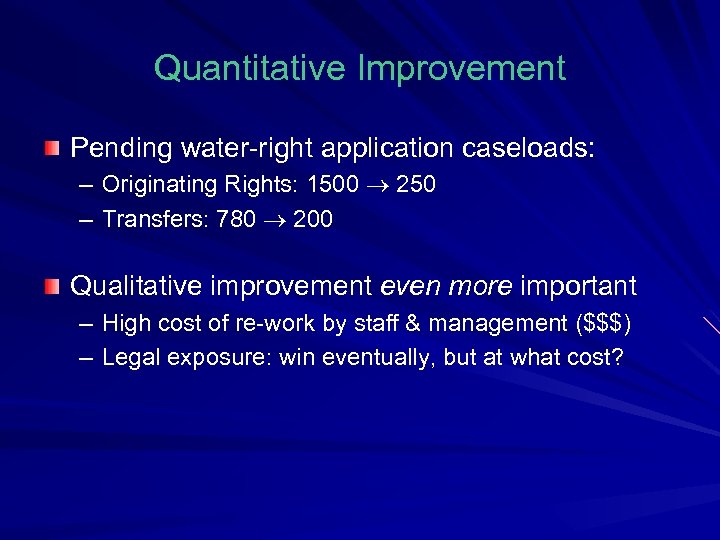 Quantitative Improvement Pending water-right application caseloads: – Originating Rights: 1500 250 – Transfers: 780 200 Qualitative improvement even more important – High cost of re-work by staff & management ($$$) – Legal exposure: win eventually, but at what cost?
 Advantages real-time interaction with WRIS – when used with a WRIS-editing application, allows staff to edit data directly does not require dependence on others staff can “own” the entire edit reduces transactional friction (a trip to Data Center) simpler document-generation system (not path-dependent) allows a simpler electronic file storage & retrieval system for business products allows the Sections to retain control of modifications to document content & formatting frees IS from maintenance programming initial programming investment can be leveraged by all agency staff
 Questions / Comments ? extend Doc. Gen capability across organization: cover letters forms notices ? ?