 Скачать презентацию Automatic Verification of Communicating Data-Aware Web Services Victor
4707d323d0b9812d82dc67dd3d2b1dbb.ppt
- Количество слайдов: 70




Automatic Verification of Communicating Data-Aware Web Services Victor Vianu U. C. San Diego and INRIA-Futurs Joint work with Alin Deutsch, Liying Sui, Dayou Zhou
Web service: service hosted on the Web • Interactive, often data-driven: accesses an underlying database and interacts with users/programs according to explicit or implicit workflow • Complex services: Web service compositions peers communicating asynchronously • Complexity of workflow leads to bugs: see the public database of Web site bugs (Orbitz bug) • Static analysis required -behavior of individual peers -protocols of communication between peers -global properties
This talk: Automatic, sound and complete verification of data-aware Web service compositions • Abstraction of web service compositions: communicating data-aware reactive systems • Verification of single peers and compositions • Experimental results for single peer verification WAVE verifier
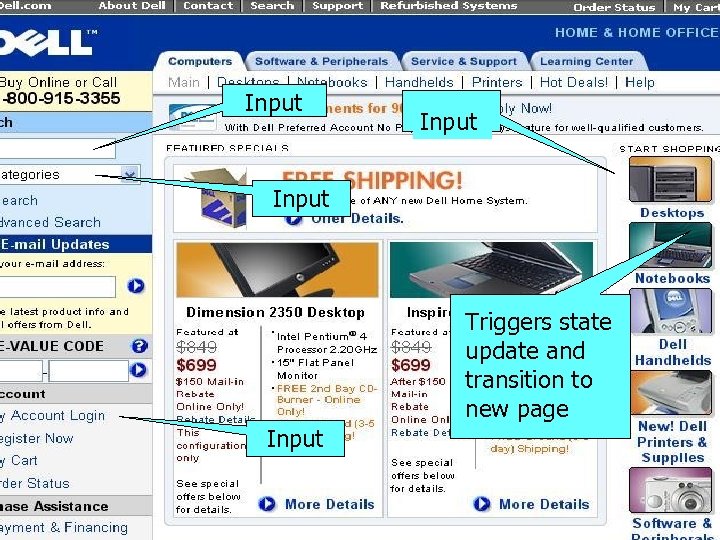
Our target: data-aware Web services
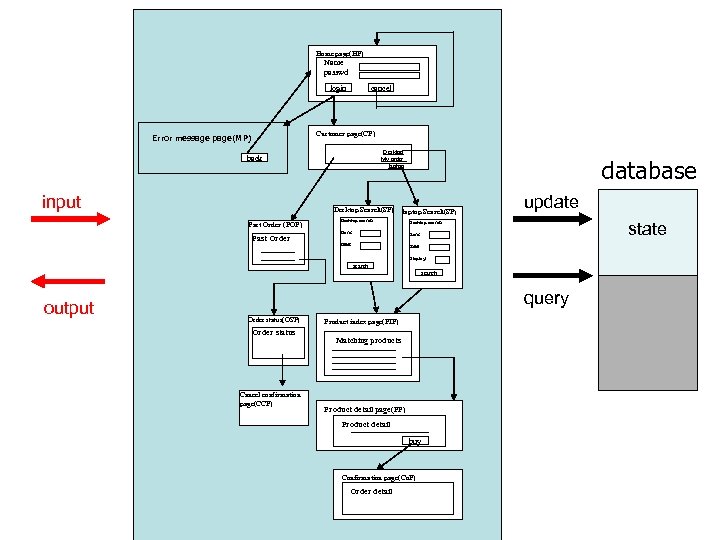
Home page(HP) Name Home page(HP) passwd Name passwd login Error message page(MP) back input cancel Customer page(CP) Desktop My order Desktop laptop My order laptop Desktop Search(SP) Past Order (POP) Past Order database laptop Search(SP) Desktop search Desktop Search(SP) laptop search Desktop search Ram: Hdd: Display: search Order status(OSP) Order status Orderstatus(OSP) Order status Cancel confirmation page(CCP) Product index page(PIP) Matching products Product detail page(PP) Product detail buy Confirmation page(Co. P) Order detail state Display: search output update query
Input Triggers state update and transition to new page Input
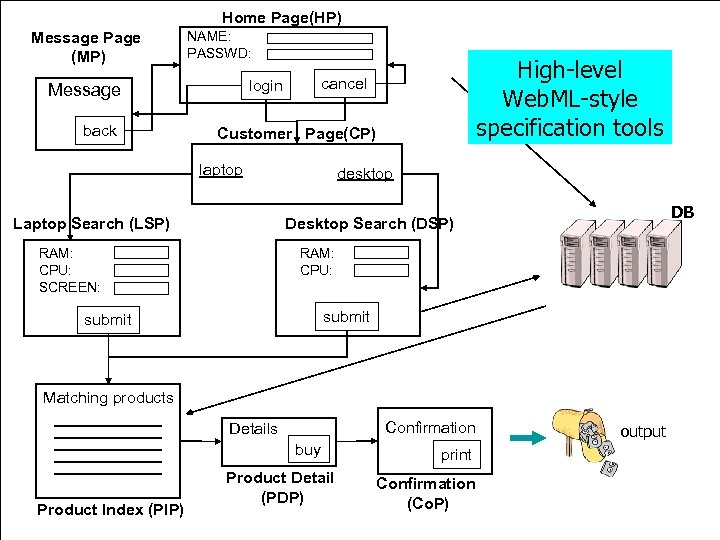
Home Page(HP) Message Page (MP) NAME: PASSWD: Message back High-level Web. ML-style state update specification tools cancel login Customer Page(CP) laptop Laptop Search (LSP) desktop Desktop Search (DSP) RAM: CPU: SCREEN: DB RAM: CPU: submit Matching products Confirmation Details buy Product Index (PIP) Product Detail (PDP) print Confirmation (Co. P) output
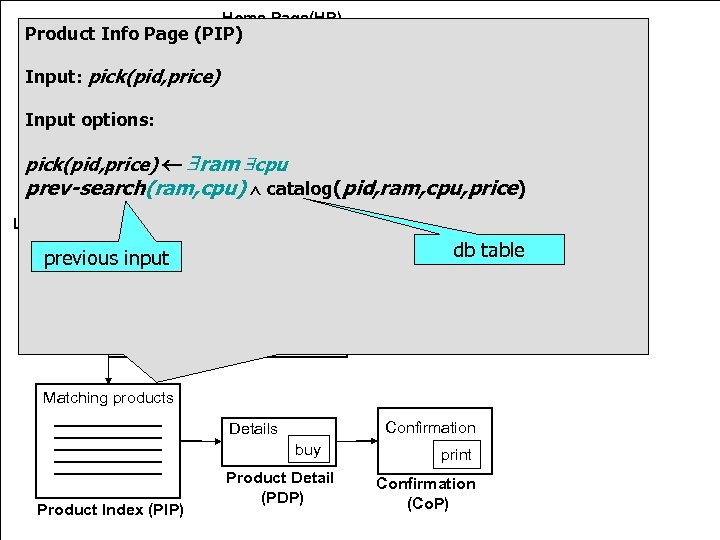
Home Page(HP) Product Info Page (PIP) NAME: Message PASSWD: (MP) Input: pick(pid, price) login Message Input options: back cancel Customer Page(CP) pick(pid, price) ram cpu laptop desktop prev-search(ram, cpu) catalog(pid, ram, cpu, price) Laptop Search (LSP) Desktop Search (DSP) RAM: previous input CPU: RAM: CPU: db table SCREEN: submit Matching products Confirmation Details buy Product Index (PIP) Product Detail (PDP) print Confirmation (Co. P)
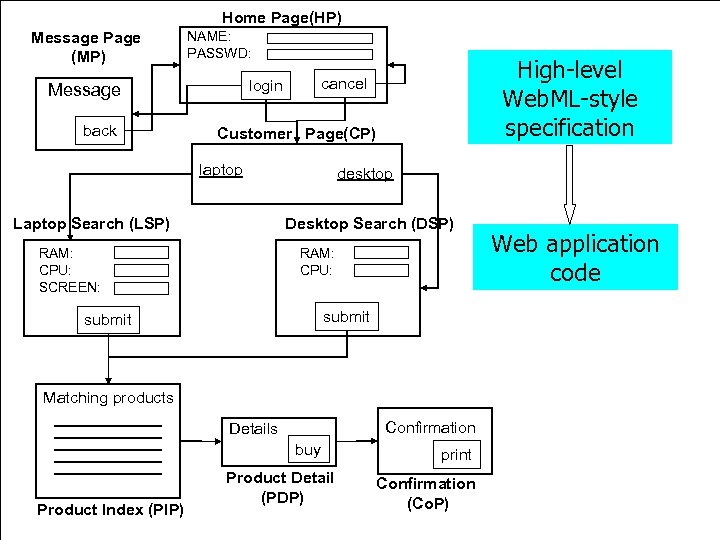
Home Page(HP) Message Page (MP) NAME: PASSWD: Message back High-level Web. ML-style state update specification cancel login Customer Page(CP) laptop Laptop Search (LSP) desktop Desktop Search (DSP) RAM: CPU: SCREEN: RAM: CPU: submit Matching products Confirmation Details buy Product Index (PIP) Product Detail (PDP) print Confirmation (Co. P) Web application code
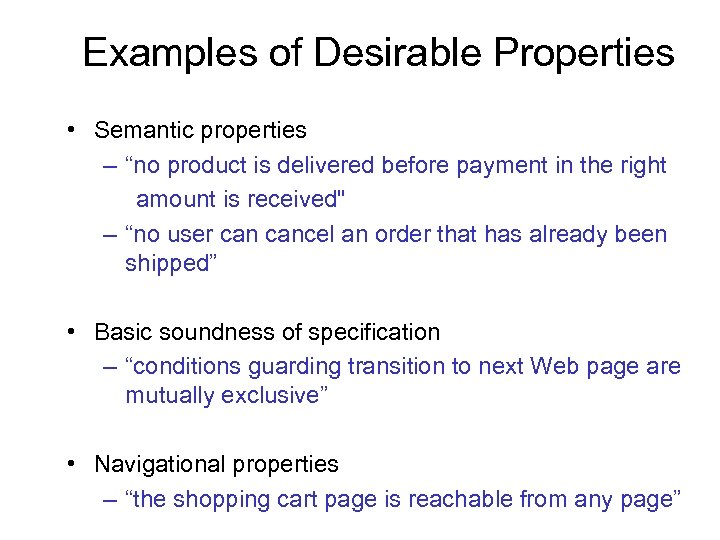
Examples of Desirable Properties • Semantic properties – “no product is delivered before payment in the right amount is received" – “no user cancel an order that has already been shipped” • Basic soundness of specification – “conditions guarding transition to next Web page are mutually exclusive” • Navigational properties – “the shopping cart page is reachable from any page”
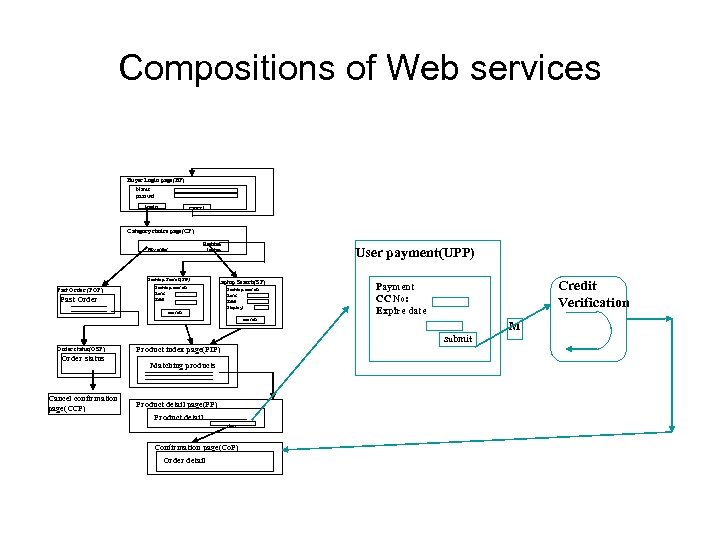
Compositions of Web services Buyer Login page(BP) Name passwd login cancel Category choice page(CP) My order Desktop laptop Desktop Search(SP) Past Order (POP) Past Order User payment(UPP) laptop Search(SP) Desktop search Ram: Hdd: search Desktop search Ram: Hdd: Display: Credit Verification Payment CC No: Expire date search M submit Order status(OSP) Order status Cancel confirmation page(CCP) Product index page(PIP) Matching products Product detail page(PP) Product detail buy Confirmation page(Co. P) Order detail
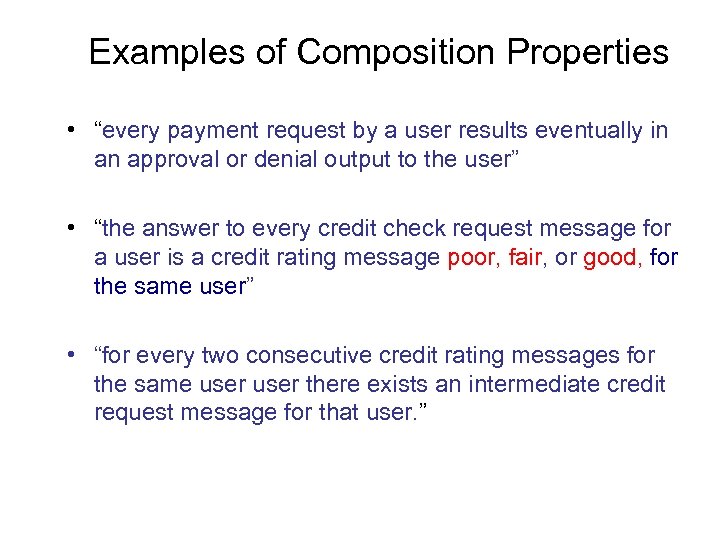
Examples of Composition Properties • “every payment request by a user results eventually in an approval or denial output to the user” • “the answer to every credit check request message for a user is a credit rating message poor, fair, or good, for the same user” • “for every two consecutive credit rating messages for the same user there exists an intermediate credit request message for that user. ”
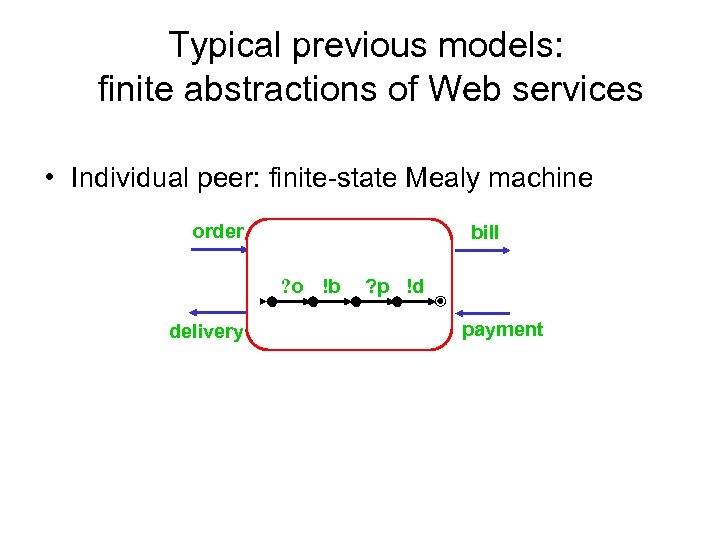
Typical previous models: finite abstractions of Web services • Individual peer: finite-state Mealy machine order bill ? o !b delivery ? p !d payment
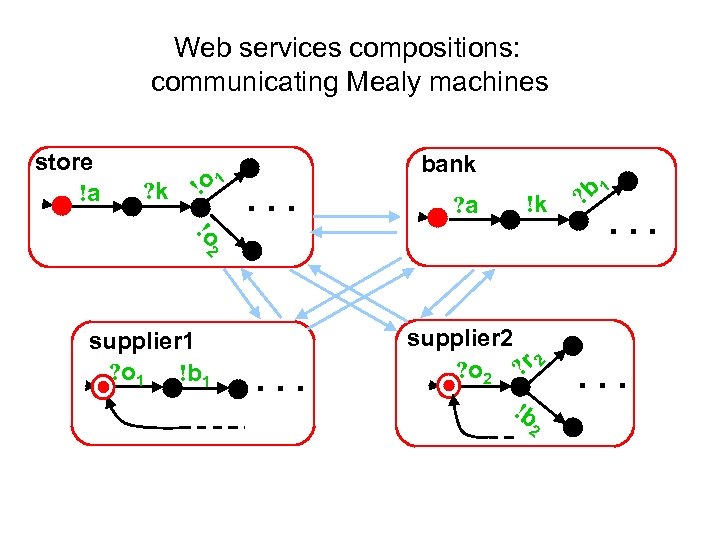
Web services compositions: communicating Mealy machines store !a ? k ! o 1 bank . . . ? a !k !o 2 supplier 1 ? o 1 !b 1 . . . supplier 2 ? o 2 ? r 2 !b 2 1 ? b . . .
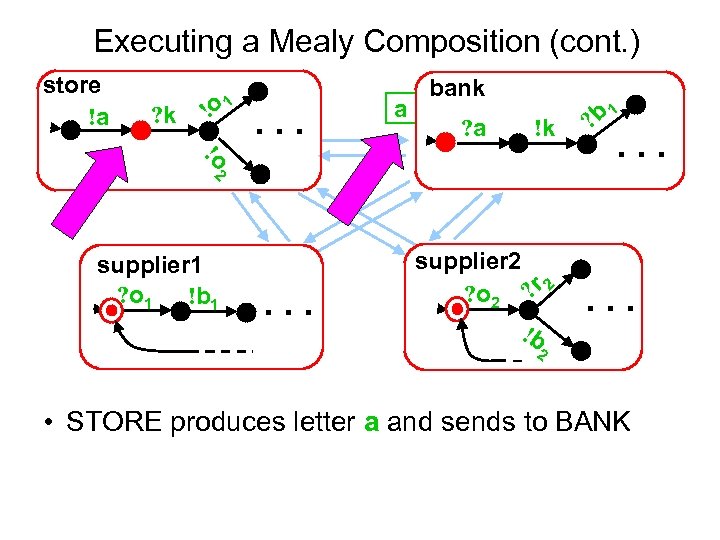
Executing a Mealy Composition (cont. ) store !a ? k !o 1 . . . a bank ? a !k !o 2 supplier 1 ? o 1 !b 1 . . . supplier 2 ? o 2 ? r 2 !b 1 ? b . . . 2 • STORE produces letter a and sends to BANK
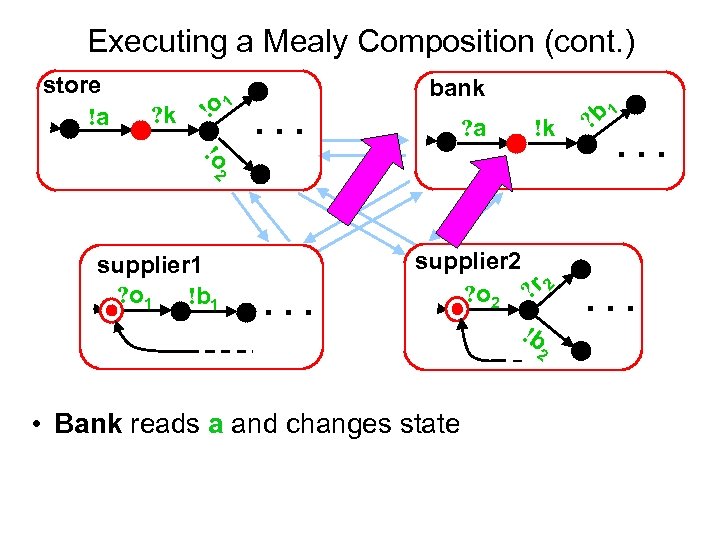
Executing a Mealy Composition (cont. ) store !a ? k !o 1 bank . . . ? a !k !o 2 supplier 1 ? o 1 !b 1 . . . supplier 2 ? o 2 ? r 2 !b 2 • Bank reads a and changes state 1 ? b . . .
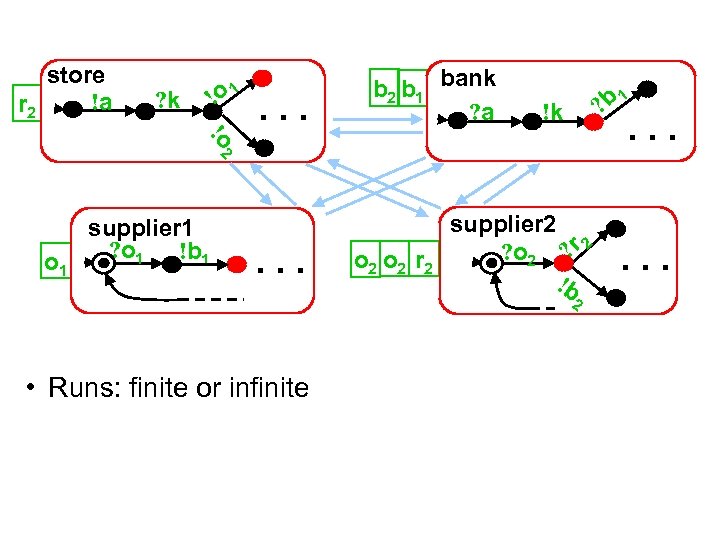
store !a r 2 ! ? k o 1 . . . b 2 b 1 bank ? a 1 ? b !k !o 2 . . . o 1 supplier 1 ? o 1 !b 1 . . . o 2 r 2 supplier 2 ? o 2 ? r 2 !b 2 • Runs: finite or infinite . . .
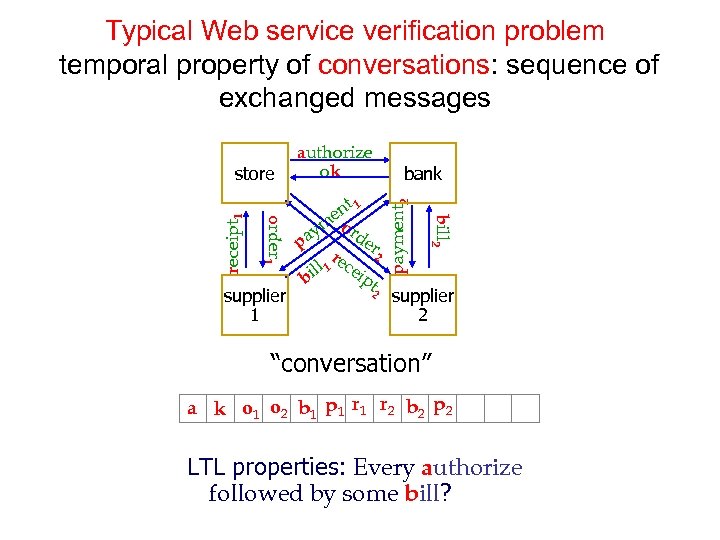
Typical Web service verification problem temporal property of conversations: sequence of exchanged messages supplier 1 payment 2 nt 1 eo m ay rder p 2 r l 1 ecei l pt bi 2 bank bill 2 order 1 receipt 1 store authorize ok supplier 2 “conversation” a k o 1 o 2 b 1 p 1 r 2 b 2 p 2 LTL properties: Every authorize followed by some bill?
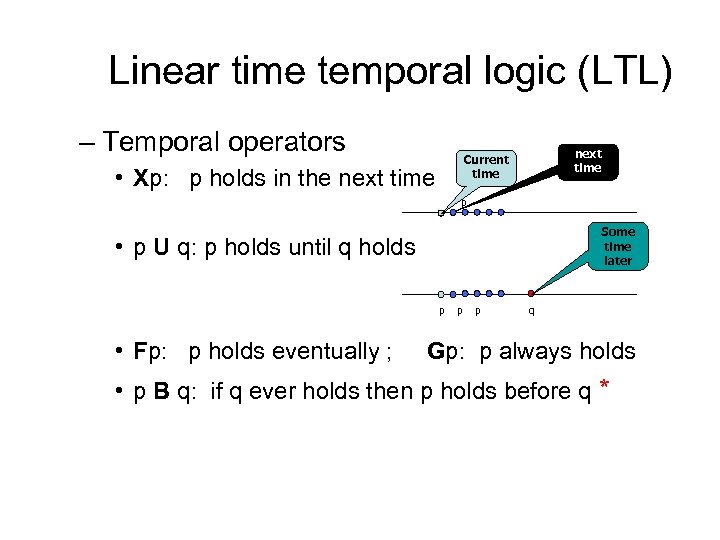
Linear time temporal logic (LTL) – Temporal operators next time Current time • Xp: p holds in the next time p Some time later • p U q: p holds until q holds p • Fp: p holds eventually ; p p q Gp: p always holds • p B q: if q ever holds then p holds before q *
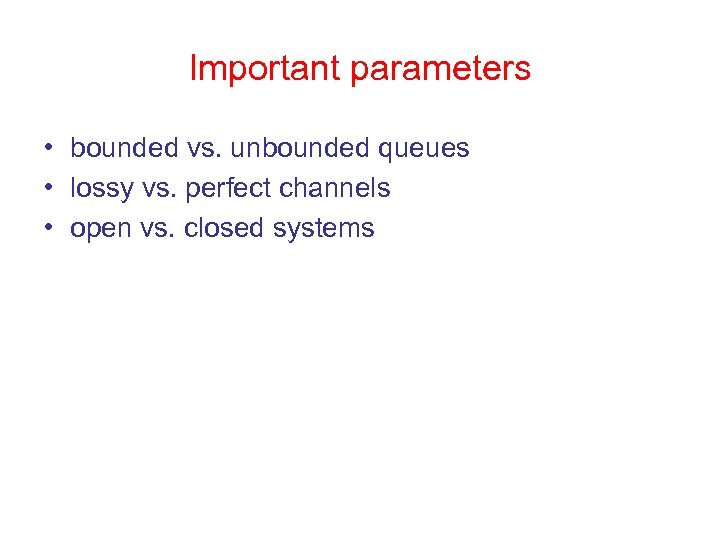
Important parameters • bounded vs. unbounded queues • lossy vs. perfect channels • open vs. closed systems
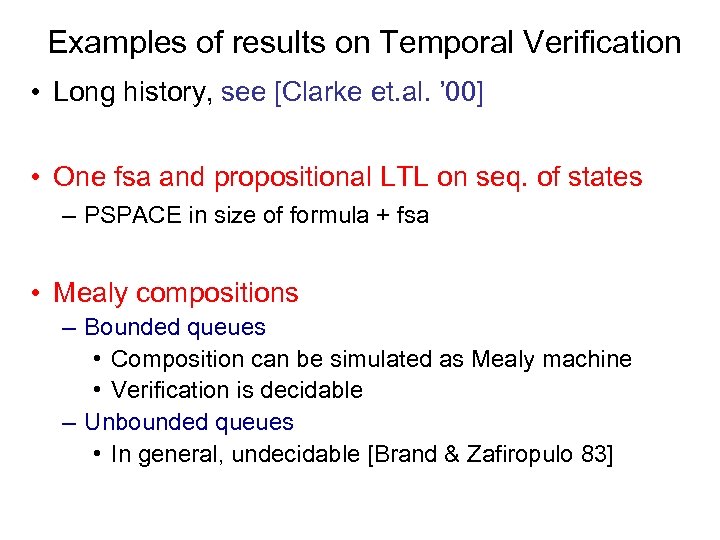
Examples of results on Temporal Verification • Long history, see [Clarke et. al. ’ 00] • One fsa and propositional LTL on seq. of states – PSPACE in size of formula + fsa • Mealy compositions – Bounded queues • Composition can be simulated as Mealy machine • Verification is decidable – Unbounded queues • In general, undecidable [Brand & Zafiropulo 83]
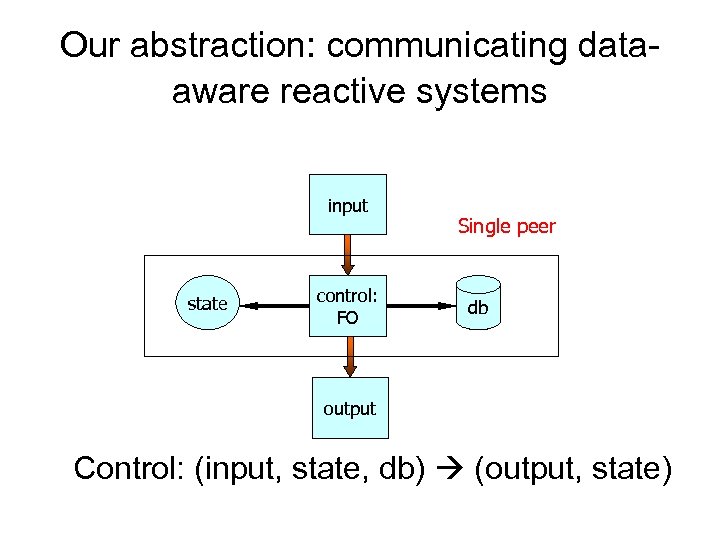
Our abstraction: communicating dataaware reactive systems input state control: FO Single peer db output Control: (input, state, db) (output, state)
History • Relational Transducers Abiteboul+Vianu 1998 • Abstract State Machine Transducers Marc Spielmann 2000 • Here: extension + communication
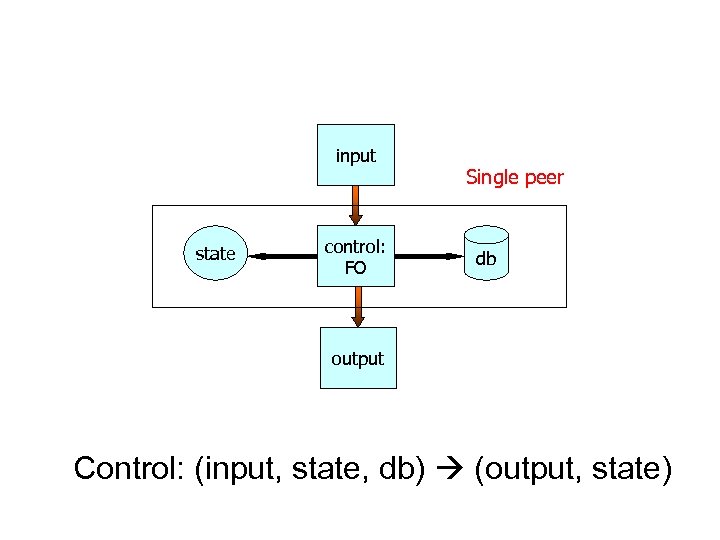
input state control: FO Single peer db output Control: (input, state, db) (output, state)
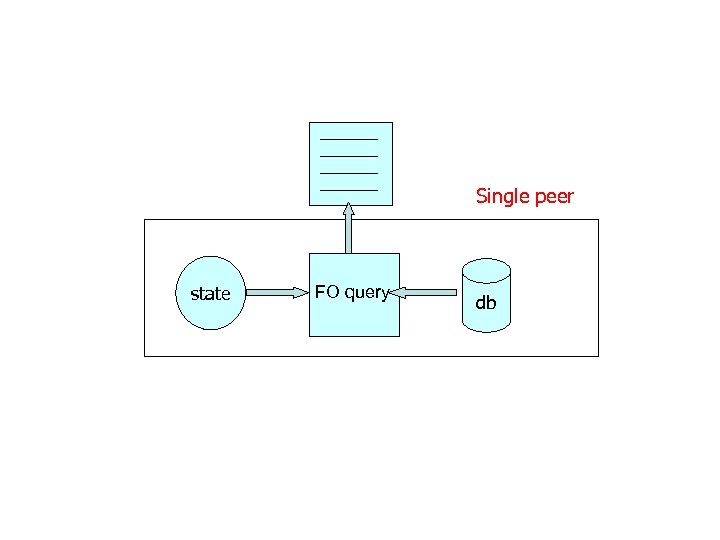
Single peer state FO query db
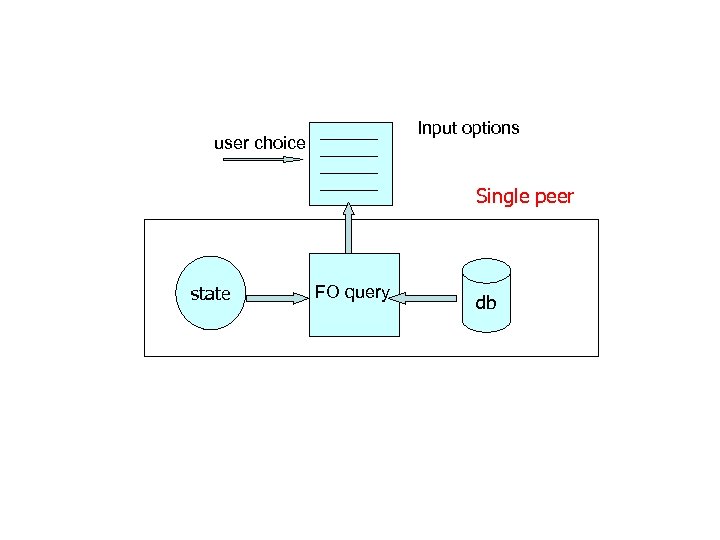
Input options user choice Single peer state FO query db
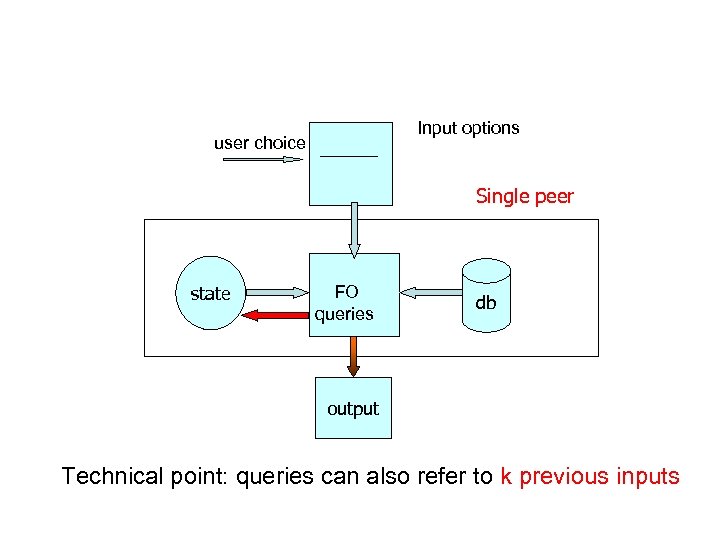
Input options user choice Single peer state FO queries db output Technical point: queries can also refer to k previous inputs
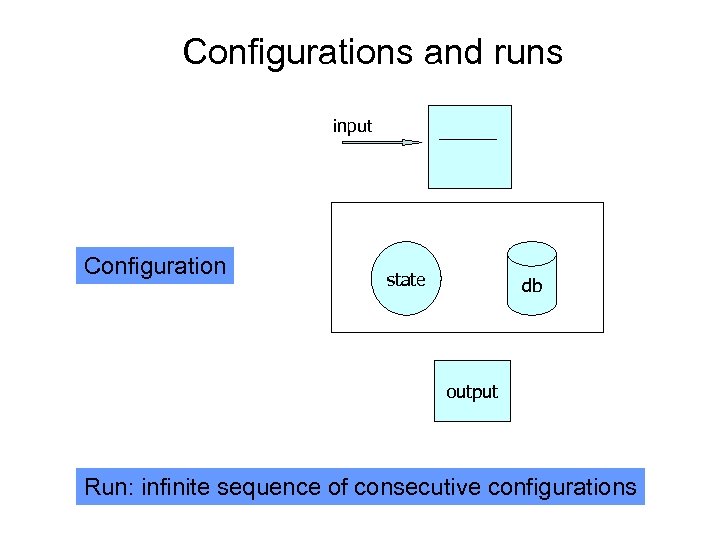
Configurations and runs input Configuration state db output Run: infinite sequence of consecutive configurations
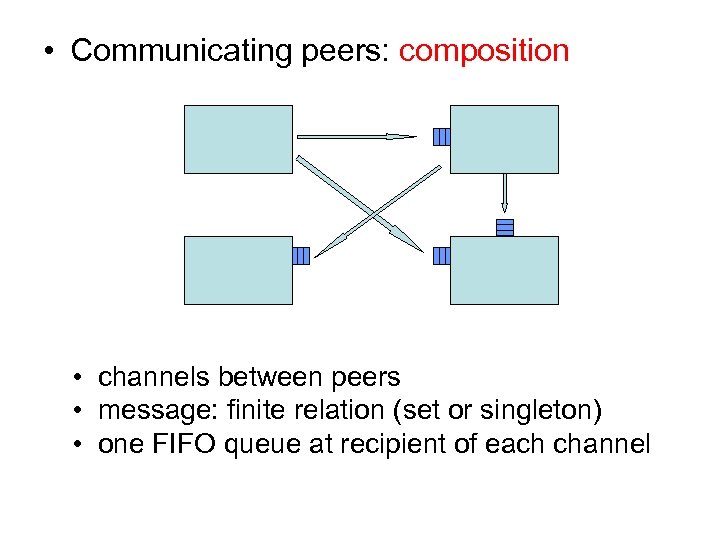
• Communicating peers: composition • channels between peers • message: finite relation (set or singleton) • one FIFO queue at recipient of each channel
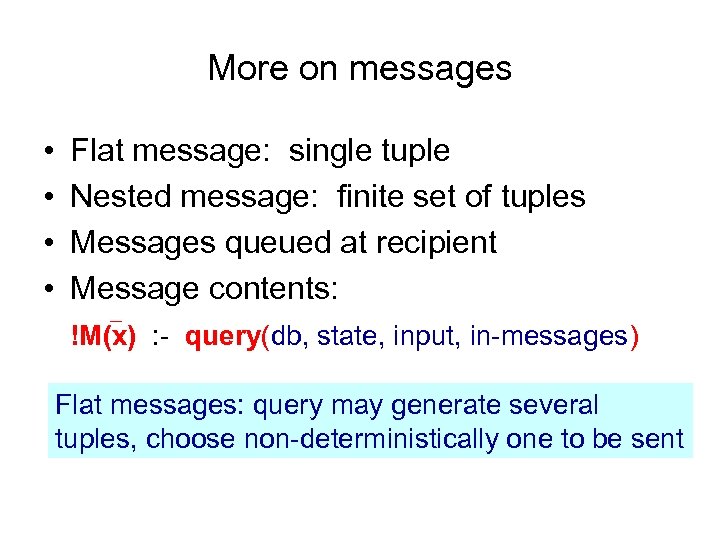
More on messages • • Flat message: single tuple Nested message: finite set of tuples Messages queued at recipient Message contents: !M(x) : - query(db, state, input, in-messages) Flat messages: query may generate several tuples, choose non-deterministically one to be sent
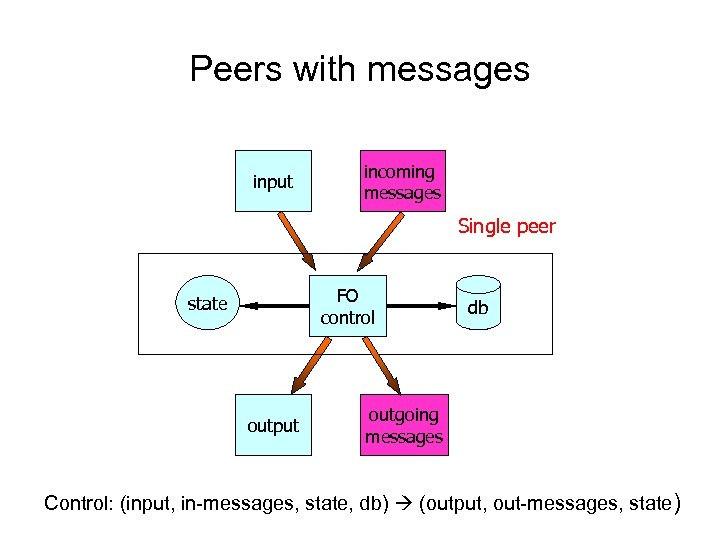
Peers with messages input incoming messages Single peer FO control state output db outgoing messages Control: (input, in-messages, state, db) (output, out-messages, state)
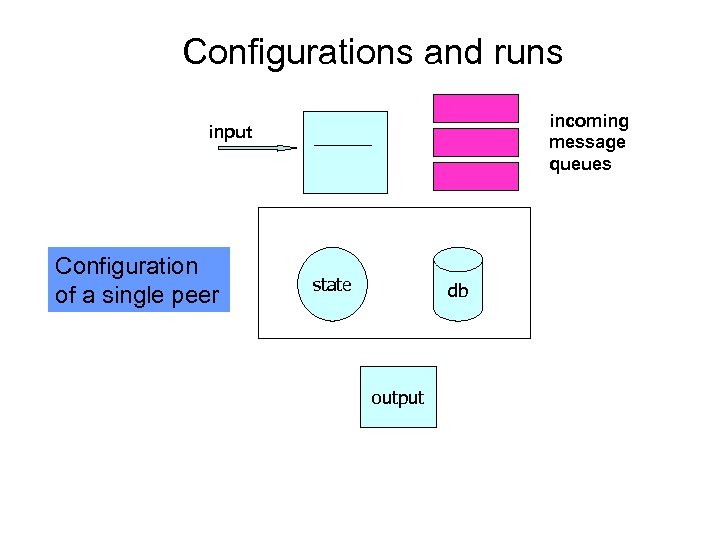
Configurations and runs incoming message queues input Configuration of a single peer state db output
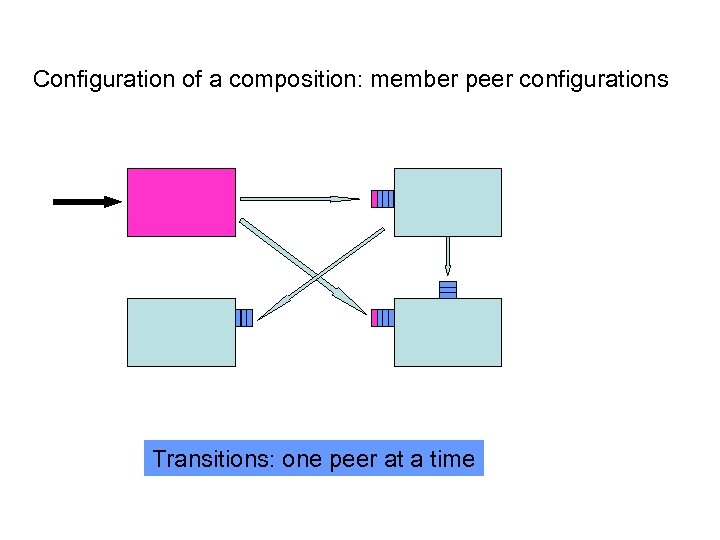
Configuration of a composition: member peer configurations Transitions: one peer at a time
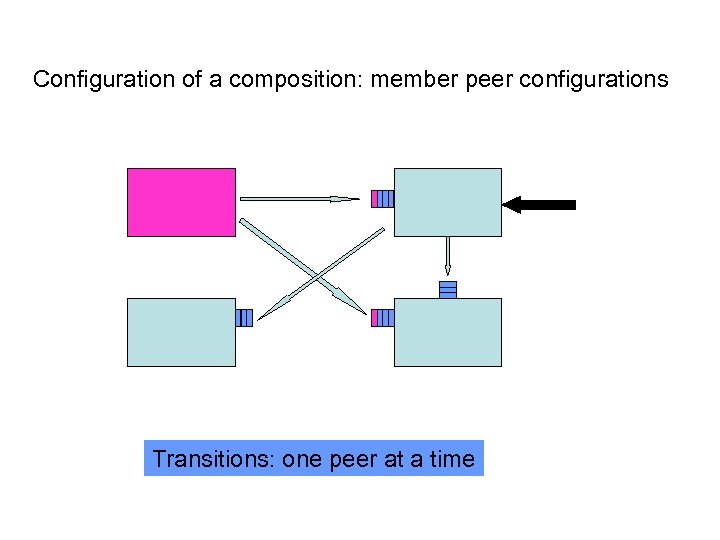
Configuration of a composition: member peer configurations Transitions: one peer at a time
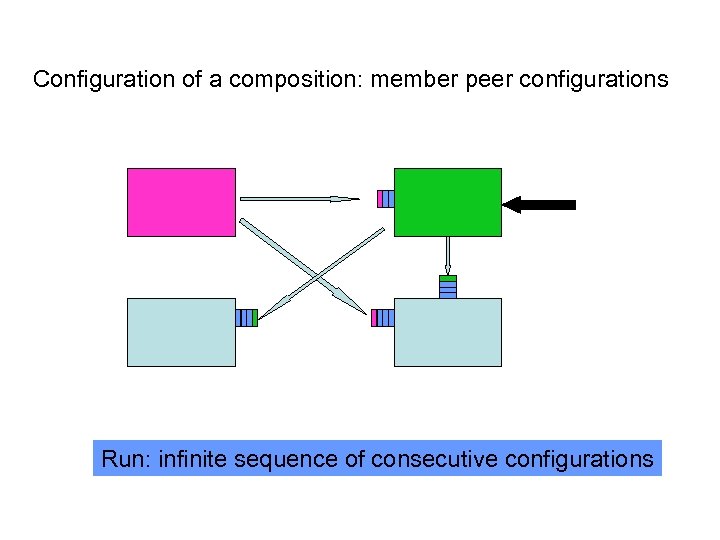
Configuration of a composition: member peer configurations Run: Transitions: one peer at a time configurations infinite sequence of consecutive
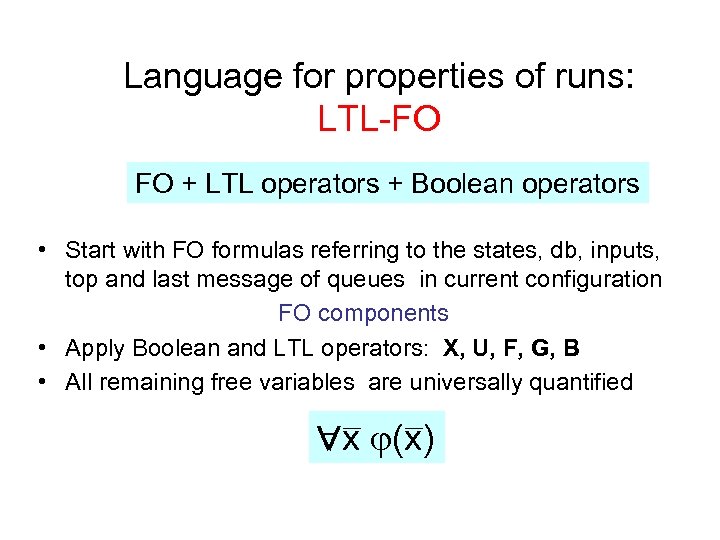
Language for properties of runs: LTL-FO FO + LTL operators + Boolean operators • Start with FO formulas referring to the states, db, inputs, top and last message of queues in current configuration FO components • Apply Boolean and LTL operators: X, U, F, G, B • All remaining free variables are universally quantified x (x)
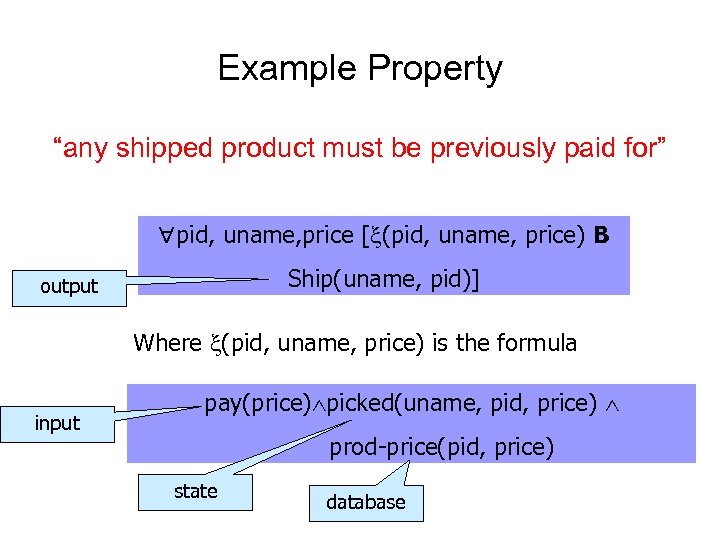
Example Property “any shipped product must be previously paid for” pid, uname, price [ (pid, uname, price) B Ship(uname, pid)] output Where (pid, uname, price) is the formula input pay(price) picked(uname, pid, price) prod-price(pid, price) state database
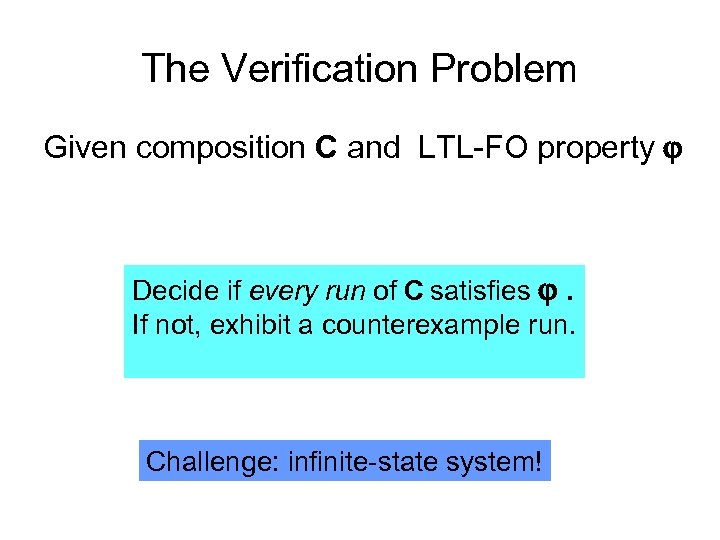
The Verification Problem Given composition C and LTL-FO property Decide if every run of C satisfies . If not, exhibit a counterexample run. Challenge: infinite-state system!
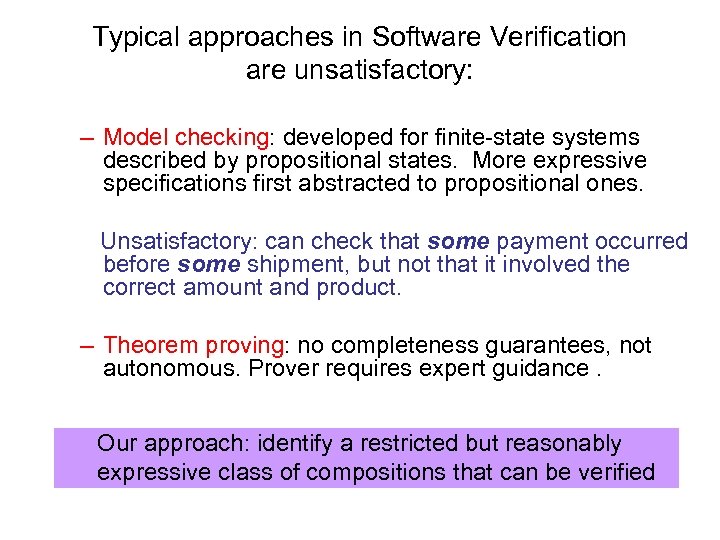
Typical approaches in Software Verification are unsatisfactory: – Model checking: developed for finite-state systems described by propositional states. More expressive specifications first abstracted to propositional ones. Unsatisfactory: can check that some payment occurred before some shipment, but not that it involved the correct amount and product. – Theorem proving: no completeness guarantees, not autonomous. Prover requires expert guidance. Our approach: identify a restricted but reasonably expressive class of compositions that can be verified
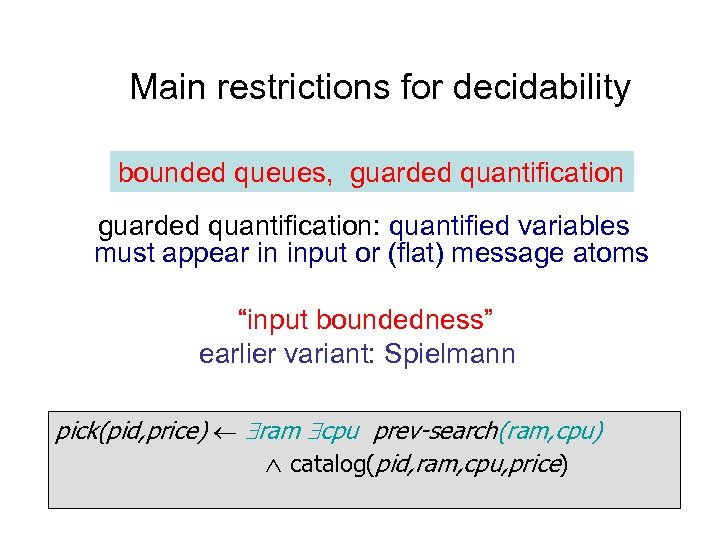
Main restrictions for decidability bounded queues, guarded quantification: quantified variables must appear in input or (flat) message atoms “input boundedness” earlier variant: Spielmann pick(pid, price) ram cpu prev-search(ram, cpu) catalog(pid, ram, cpu, price)
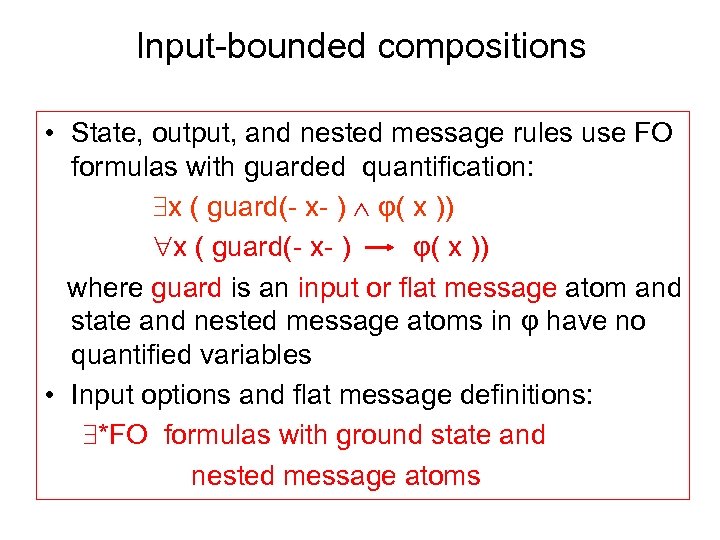
Input-bounded compositions • State, output, and nested message rules use FO formulas with guarded quantification: x ( guard(- x- ) φ( x )) x ( guard(- x- ) φ( x )) where guard is an input or flat message atom and state and nested message atoms in φ have no quantified variables • Input options and flat message definitions: *FO formulas with ground state and nested message atoms
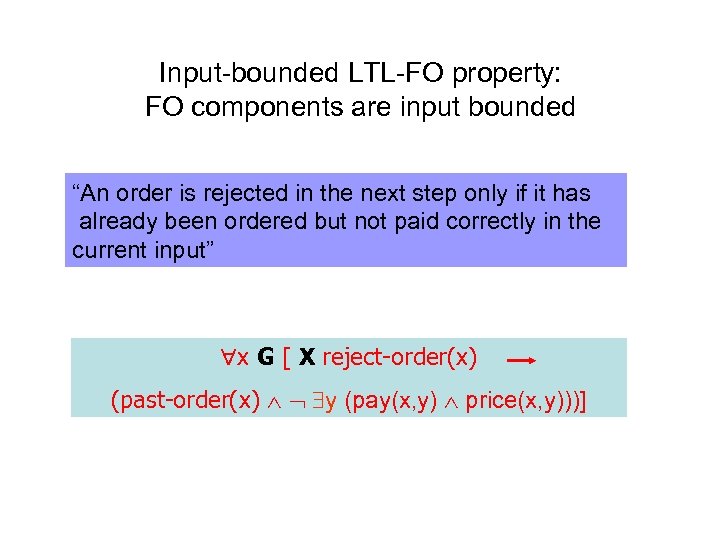
Input-bounded LTL-FO property: FO components are input bounded “An order is rejected in the next step only if it has already been ordered but not paid correctly in the current input” x G [ X reject-order(x) (past-order(x) y (pay(x, y) price(x, y)))]
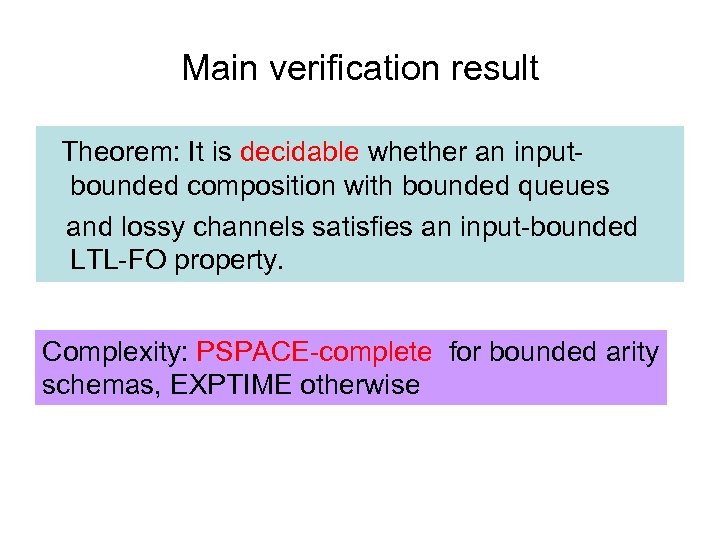
Main verification result Theorem: It is decidable whether an inputbounded composition with bounded queues and lossy channels satisfies an input-bounded LTL-FO property. Complexity: PSPACE-complete for bounded arity schemas, EXPTIME otherwise
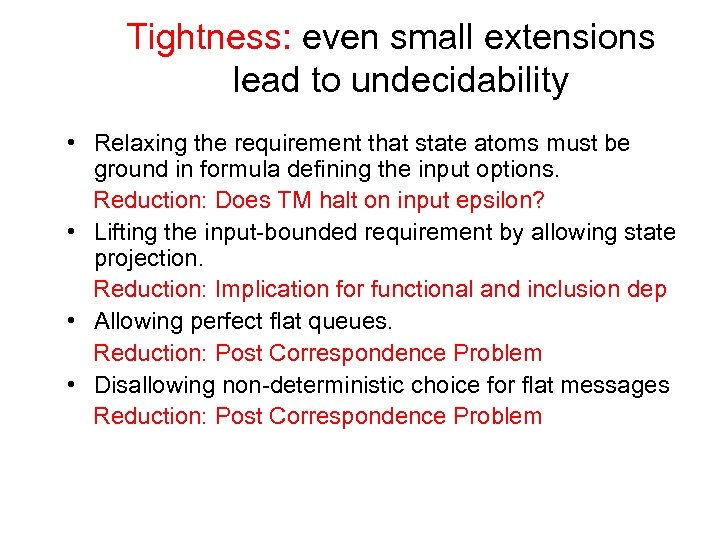
Tightness: even small extensions lead to undecidability • Relaxing the requirement that state atoms must be ground in formula defining the input options. Reduction: Does TM halt on input epsilon? • Lifting the input-bounded requirement by allowing state projection. Reduction: Implication for functional and inclusion dep • Allowing perfect flat queues. Reduction: Post Correspondence Problem • Disallowing non-deterministic choice for flat messages Reduction: Post Correspondence Problem
Expressivity of input-bounded specs Significant parts of the following Web applications could be modeled: • • Dell-like computer shopping website Expedia Barnes&Noble Grand. Prix motor sports Web site See demo site http: //www. db. ucsd. edu
PSPACE verification: outline for single peer To check that C satisfies , verify that there is no run satisfying Recall model checking approach (finite-state): • Build Büchi automaton A( ) for • Build automaton R accepting all runs • Check that there is no counterexample run: emptiness of R A( )
Our case: infinite-state system Same idea: build A( ), then search for counterexample runs accepted by A( ) But: no automaton R for the runs! Problem in searching for counterexample runs: infinite runs infinitely many underlying databases How to limit the search space?
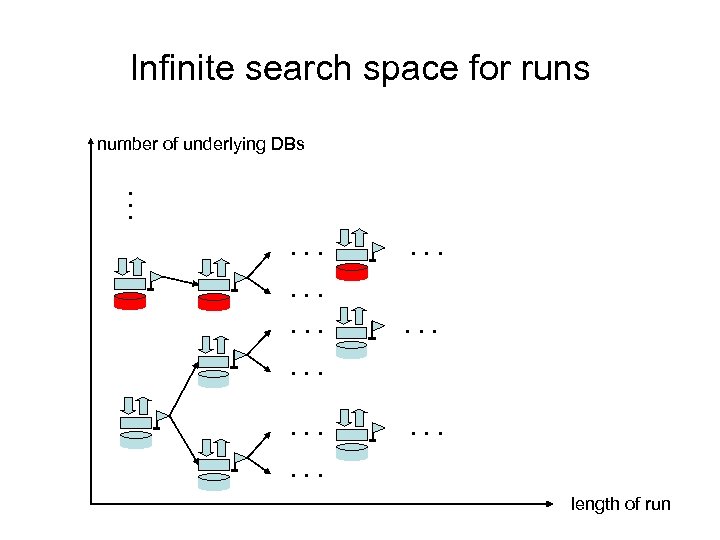
Infinite search space for runs number of underlying DBs . . . . length of run
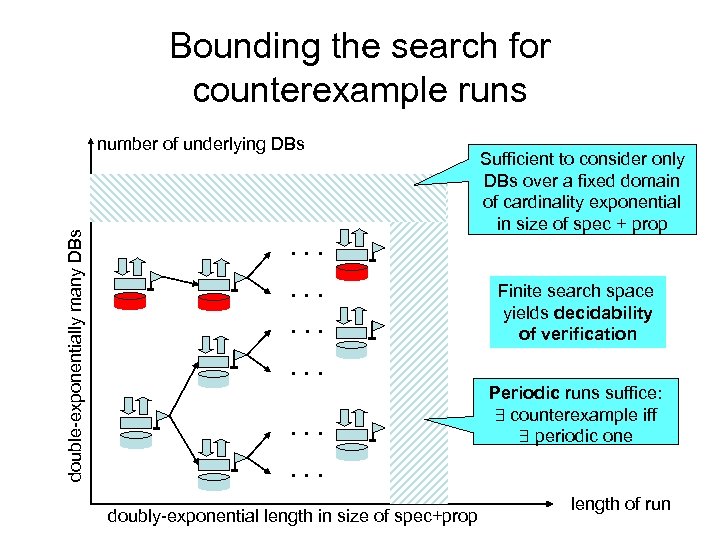
Bounding the search for counterexample runs double-exponentially many DBs number of underlying DBs . . . . Sufficient to consider only DBs over a fixed domain of cardinality exponential in size of spec + prop Finite search space yields decidability of verification . . Periodic runs suffice: counterexample iff periodic one . . . doubly-exponential length in size of spec+prop length of run
Key insight for PSPACE complexity • No need to explicitly materialize entire configuration: • Instead, at each step construct only those portions of DB, states and outputs which can affect property. • Call them pseudoconfigurations.
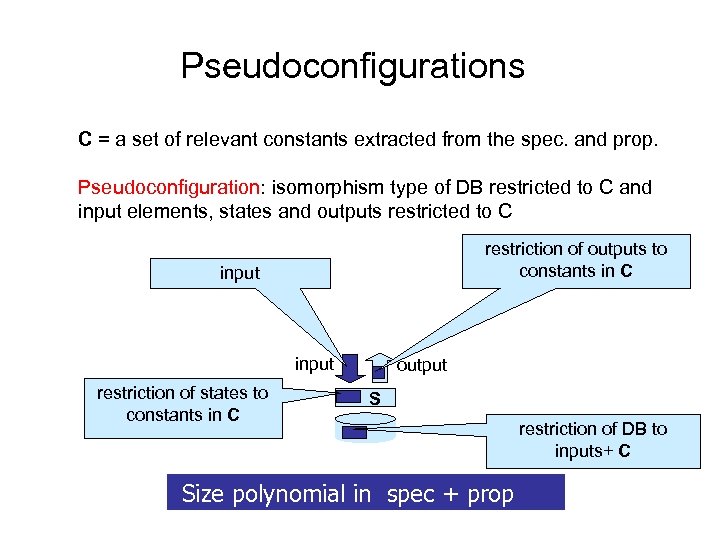
Pseudoconfigurations C = a set of relevant constants extracted from the spec. and prop. Pseudoconfiguration: isomorphism type of DB restricted to C and input elements, states and outputs restricted to C restriction of outputs to constants in C input restriction of states to constants in C output S Size polynomial in spec + prop restriction of DB to inputs+ C
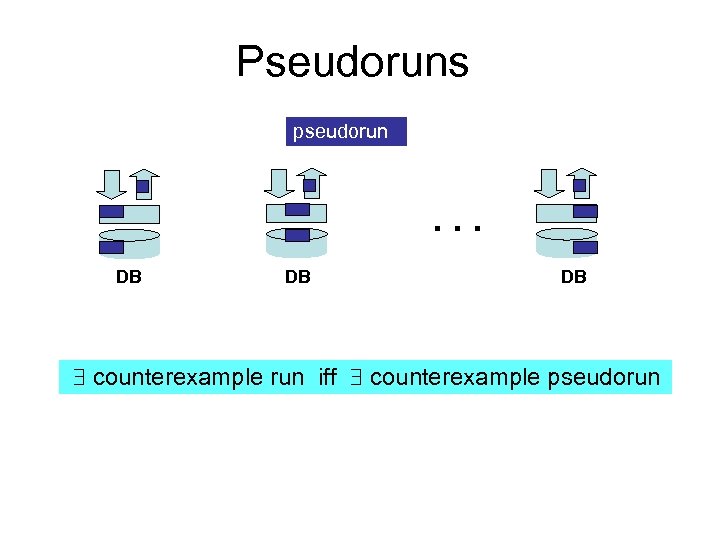
Pseudoruns pseudorun . . . DB DB DB counterexample run iff counterexample pseudorun
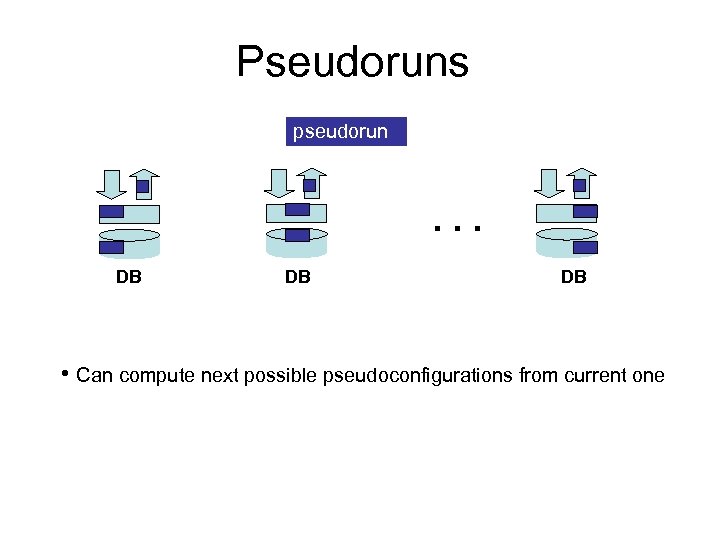
Pseudoruns pseudorun . . . DB DB DB • Can compute next possible pseudoconfigurations from current one
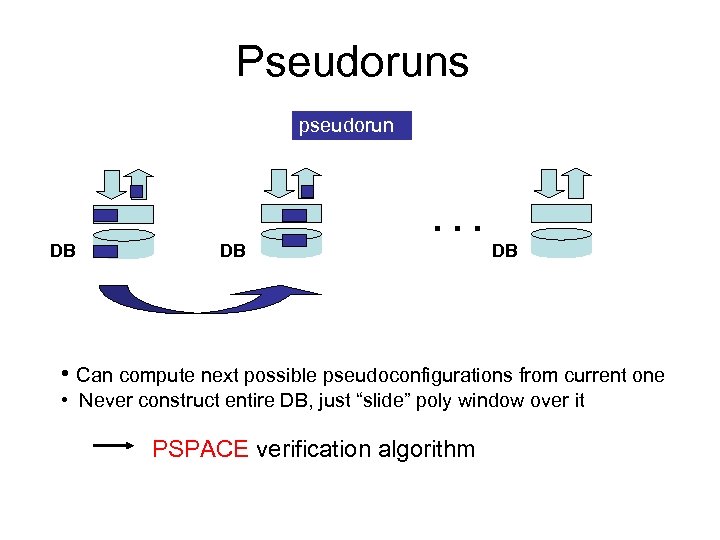
Pseudoruns pseudorun . . . DB DB DB • Can compute next possible pseudoconfigurations from current one • Never construct entire DB, just “slide” poly window over it PSPACE verification algorithm
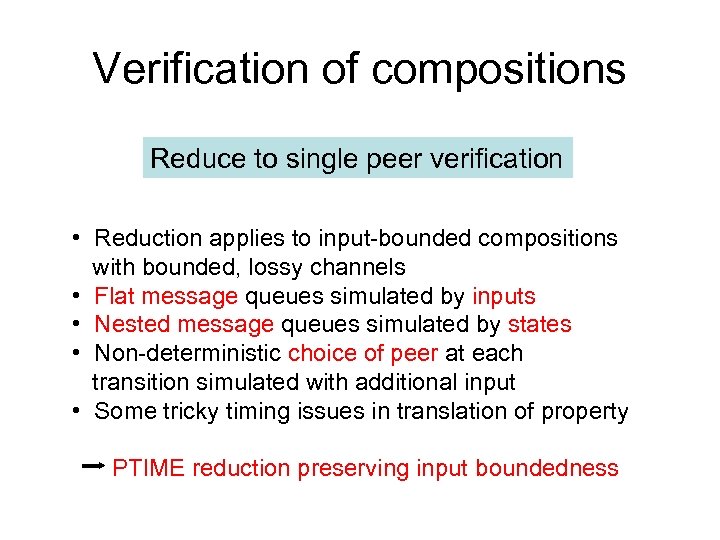
Verification of compositions Reduce to single peer verification • Reduction applies to input-bounded compositions with bounded, lossy channels • Flat message queues simulated by inputs • Nested message queues simulated by states • Non-deterministic choice of peer at each transition simulated with additional input • Some tricky timing issues in translation of property PTIME reduction preserving input boundedness
Additional verification problems • Conversation protocols sequences of messages observed in runs data-agnostic: message parameters ignored data-aware: parameters taken into account • Modular verification specs of some peers not available information limited to input/output behavior
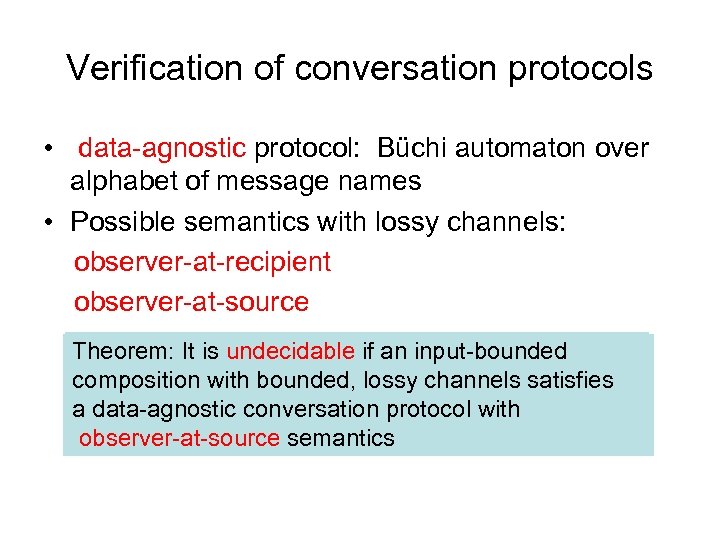
Verification of conversation protocols • data-agnostic protocol: Büchi automaton over alphabet of message names • Possible semantics with lossy channels: observer-at-recipient observer-at-source Theorem: It is PSPACE-complete if an input-bounded undecidable if an input-bounded composition with bounded, lossy channels satisfies a data-agnostic conversation protocol with observer-at-source semantics observer-at-recipient semantics
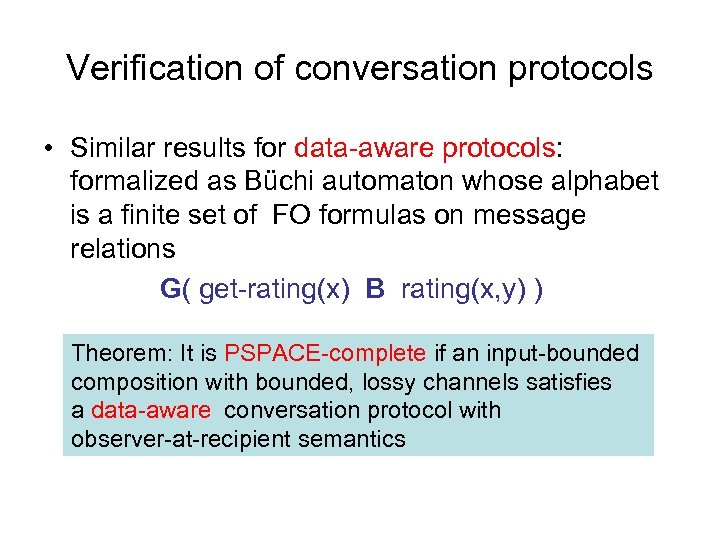
Verification of conversation protocols • Similar results for data-aware protocols: formalized as Büchi automaton whose alphabet is a finite set of FO formulas on message relations G( get-rating(x) B rating(x, y) ) Theorem: It is PSPACE-complete if an input-bounded composition with bounded, lossy channels satisfies a data-aware conversation protocol with observer-at-recipient semantics
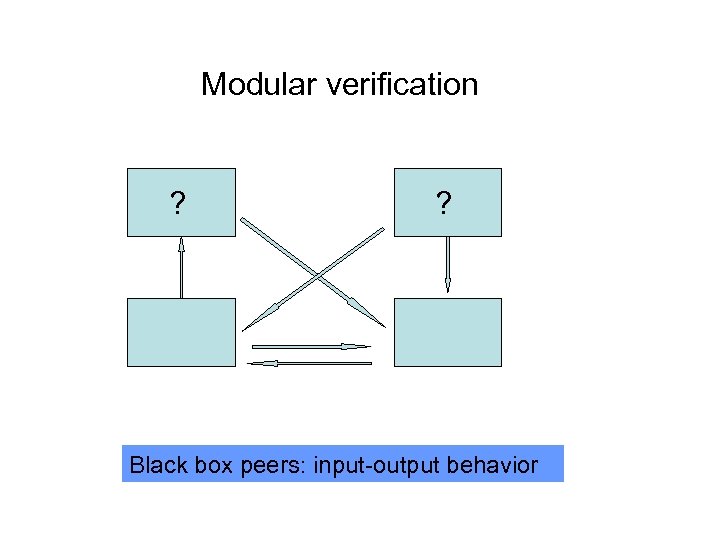
Modular verification ? ? Black box peers: input-output behavior
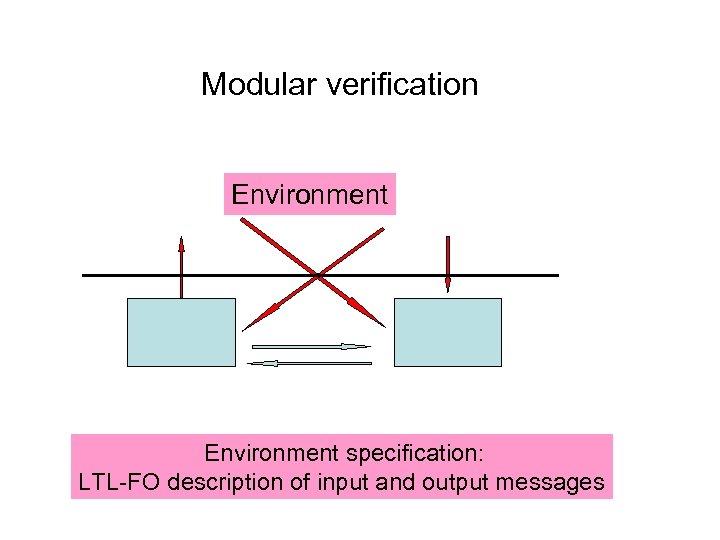
Modular verification Environment specification: LTL-FO description of input and output messages
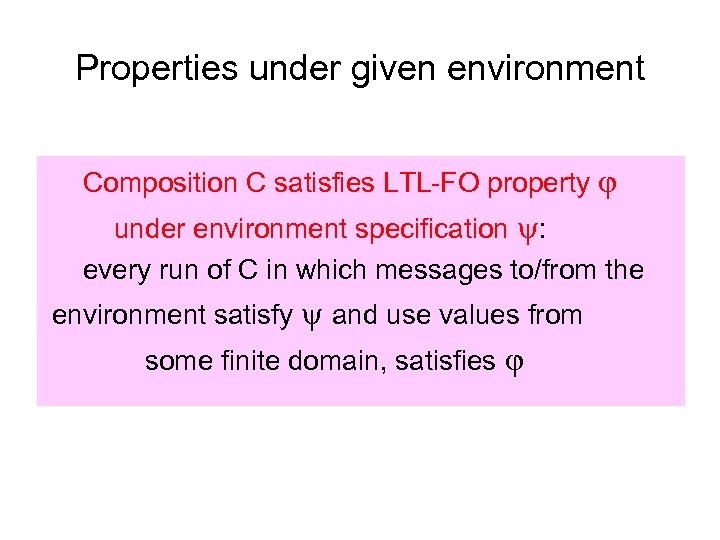
Properties under given environment Composition C satisfies LTL-FO property under environment specification : every run of C in which messages to/from the environment satisfy and use values from some finite domain, satisfies
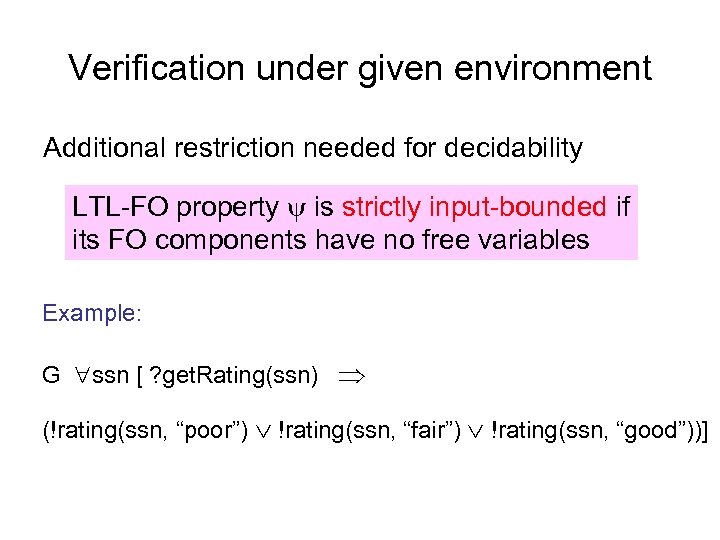
Verification under given environment Additional restriction needed for decidability LTL-FO property is strictly input-bounded if its FO components have no free variables Example: G ssn [ ? get. Rating(ssn) (!rating(ssn, “poor”) !rating(ssn, “fair”) !rating(ssn, “good”))]
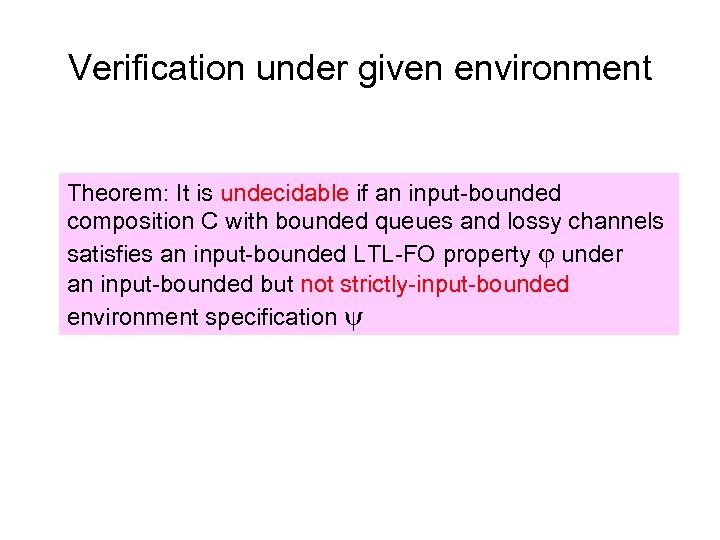
Verification under given environment Theorem: It is PSPACE-complete if an input-bounded undecidable if an input-bounded composition C with bounded queues and lossy channels satisfies an input-bounded LTL-FO property under an input-bounded but not strictly-input-bounded a strictly-input-bounded environment specification
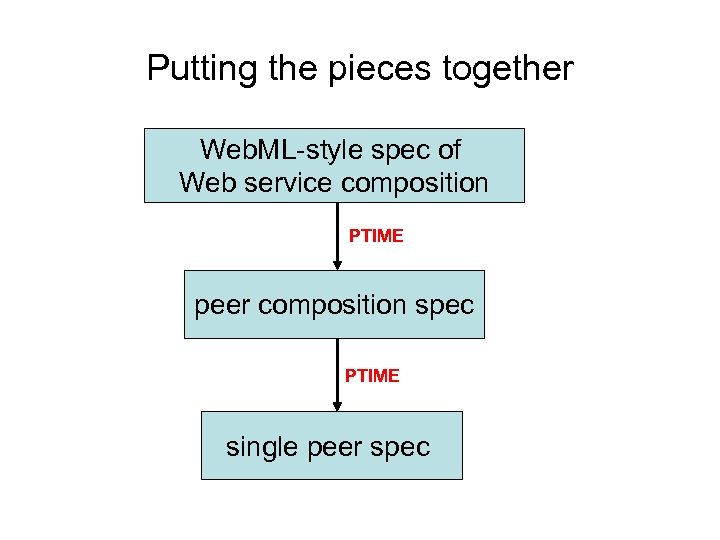
Putting the pieces together Web. ML-style spec of Web service composition PTIME peer composition spec PTIME single peer spec
![Implementation so far WAVE: verifier for single Web service peer [SIGMOD’ 05] • Essentially](https://present5.com/presentation/4707d323d0b9812d82dc67dd3d2b1dbb/image-65.jpg "Implementation so far WAVE: verifier for single Web service peer [SIGMOD’ 05] • Essentially")
Implementation so far WAVE: verifier for single Web service peer [SIGMOD’ 05] • Essentially implements search for a counterexample pseudorun • Many tricks and heuristics to achieve good verification times
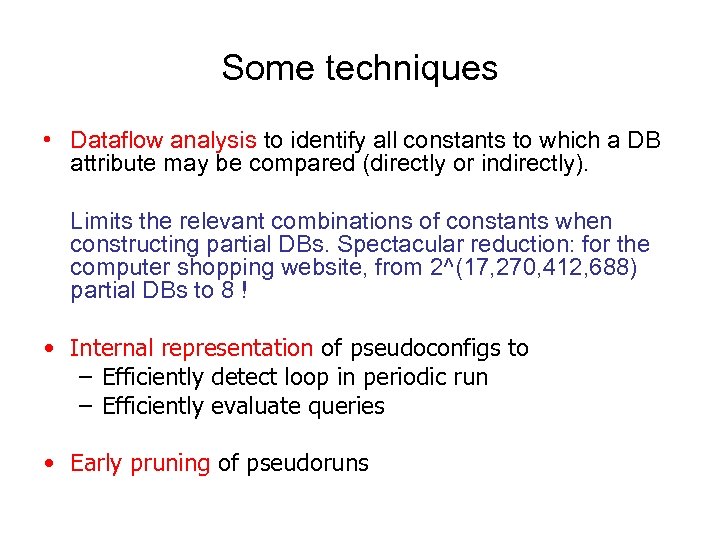
Some techniques • Dataflow analysis to identify all constants to which a DB attribute may be compared (directly or indirectly). Limits the relevant combinations of constants when constructing partial DBs. Spectacular reduction: for the computer shopping website, from 2^(17, 270, 412, 688) partial DBs to 8 ! • Internal representation of pseudoconfigs to – Efficiently detect loop in periodic run – Efficiently evaluate queries • Early pruning of pseudoruns
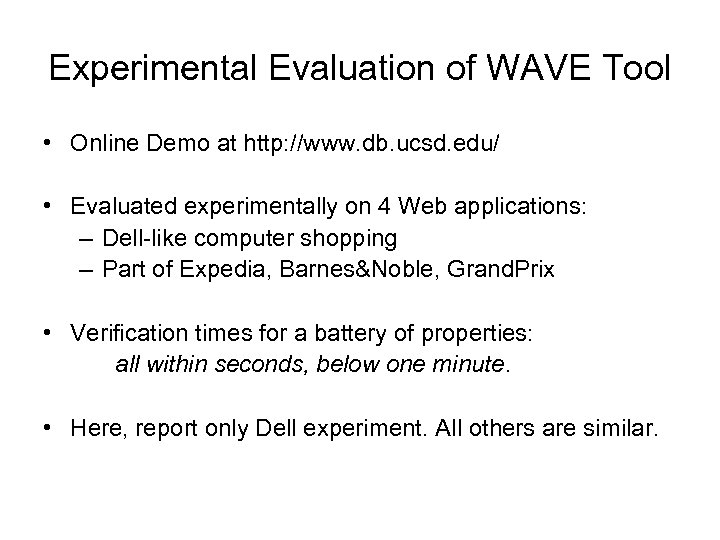
Experimental Evaluation of WAVE Tool • Online Demo at http: //www. db. ucsd. edu/ • Evaluated experimentally on 4 Web applications: – Dell-like computer shopping – Part of Expedia, Barnes&Noble, Grand. Prix • Verification times for a battery of properties: all within seconds, below one minute. • Here, report only Dell experiment. All others are similar.
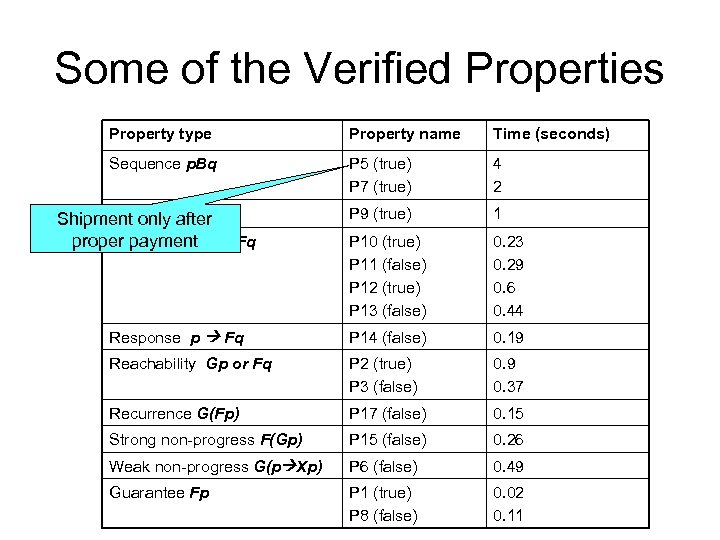
Some of the Verified Properties Property type Property name Time (seconds) Sequence p. Bq P 5 (true) P 7 (true) 4 2 P 9 (true) 1 P 10 (true) P 11 (false) P 12 (true) P 13 (false) 0. 23 0. 29 0. 6 0. 44 Response p Fq P 14 (false) 0. 19 Reachability Gp or Fq P 2 (true) P 3 (false) 0. 9 0. 37 Recurrence G(Fp) P 17 (false) 0. 15 Strong non-progress F(Gp) P 15 (false) 0. 26 Weak non-progress G(p Xp) P 6 (false) 0. 49 Guarantee Fp P 1 (true) P 8 (false) 0. 02 0. 11 Session after Shipment only. Gp Gq proper payment Fq Correlation Fp
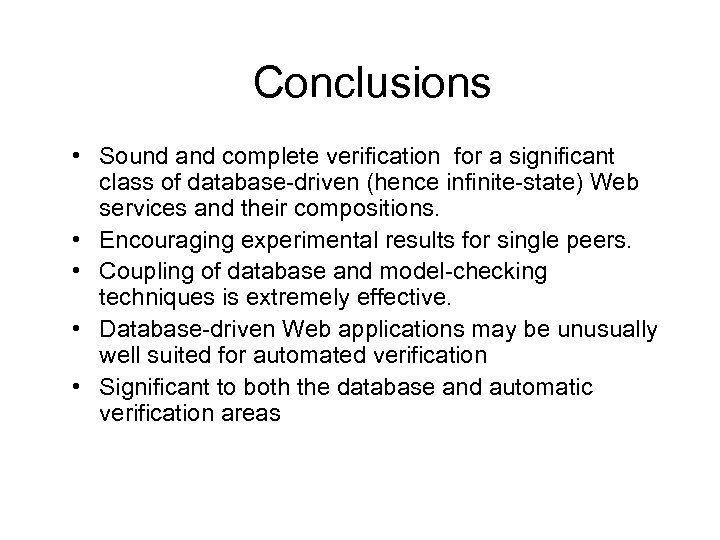
Conclusions • Sound and complete verification for a significant class of database-driven (hence infinite-state) Web services and their compositions. • Encouraging experimental results for single peers. • Coupling of database and model-checking techniques is extremely effective. • Database-driven Web applications may be unusually well suited for automated verification • Significant to both the database and automatic verification areas
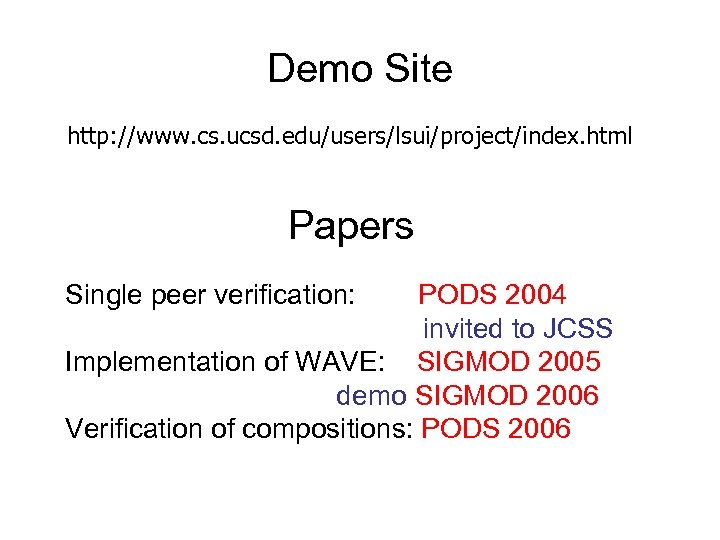
Demo Site http: //www. cs. ucsd. edu/users/lsui/project/index. html Papers Single peer verification: PODS 2004 invited to JCSS Implementation of WAVE: SIGMOD 2005 demo SIGMOD 2006 Verification of compositions: PODS 2006
Скачать презентацию Automatic Verification of Communicating Data-Aware Web Services Victor
4707d323d0b9812d82dc67dd3d2b1dbb.ppt