


 Скачать презентацию Automatic Unit Testing Tools Advanced Software Engineering Seminar
f86596ef33705c467d2aed93f5866a90.ppt
- Количество слайдов: 79
 Automatic Unit Testing Tools Advanced Software Engineering Seminar Benny Pasternak November 2006
 Agenda l l Quick Survey Motivation Unit Test Tools Classification Generation Tools – – l l l 2 JCrasher Eclat Symstra Test Factoring More Tools Future Directions Summary
 Unit Testing – Quick Survey l l l 3 Definition - a method of testing the correctness of a particular module of source code [Wiki] in isolation Becoming a substantial part of software development practice (At Microsoft – 79% practice unit tests) Lots and lots of frameworks and tools out there: x. Unit (JUnit, NUnit, CPPUnit), JCrasher, JTest, Easy. Mock, Rhino. Mock, …
 Motivation for Automatic Unit Testing Tools l Agile methods favor unit testing – – l Lots (and lots) of written software out there – – – 4 Lots of unit tests needed to test units properly (Unit Tests code is often larger than project code) Very helpful in continuous testing (test when idle) Most have no unit tests at all Some have unit tests but not complete Some have broken/outdated unit tests
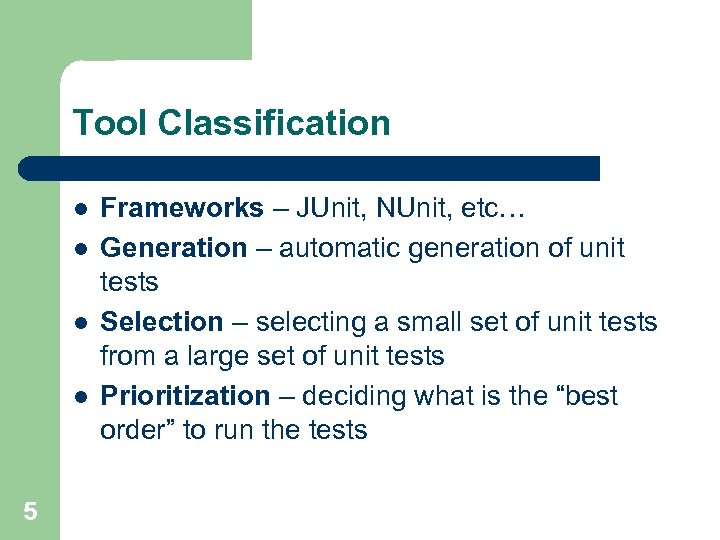 Tool Classification l l 5 Frameworks – JUnit, NUnit, etc… Generation – automatic generation of unit tests Selection – selecting a small set of unit tests from a large set of unit tests Prioritization – deciding what is the “best order” to run the tests
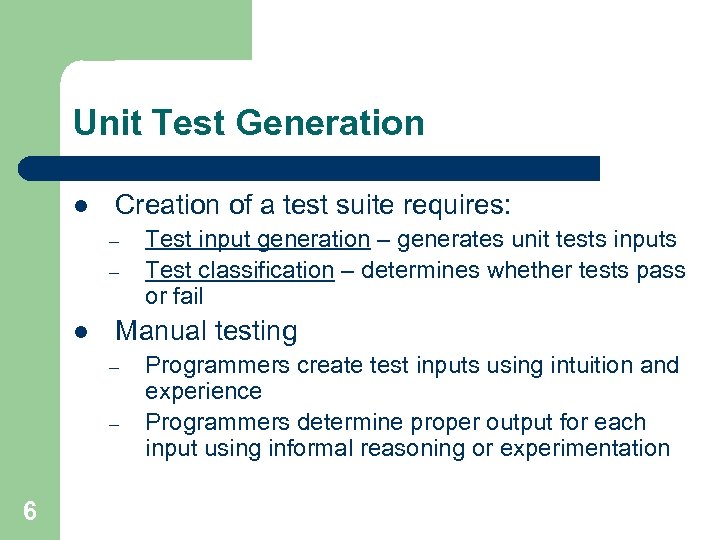 Unit Test Generation l Creation of a test suite requires: – – l Manual testing – – 6 Test input generation – generates unit tests inputs Test classification – determines whether tests pass or fail Programmers create test inputs using intuition and experience Programmers determine proper output for each input using informal reasoning or experimentation
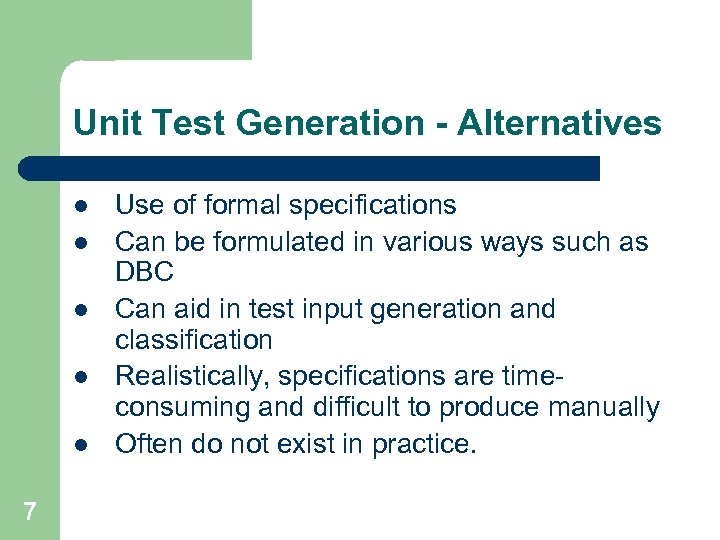 Unit Test Generation - Alternatives l l l 7 Use of formal specifications Can be formulated in various ways such as DBC Can aid in test input generation and classification Realistically, specifications are timeconsuming and difficult to produce manually Often do not exist in practice.
 Unit Test Generation l 8 Goal - provide a bare class (no specifications) to an automatic tool which generates a minimal, but thorough and comprehensive unit test suite.
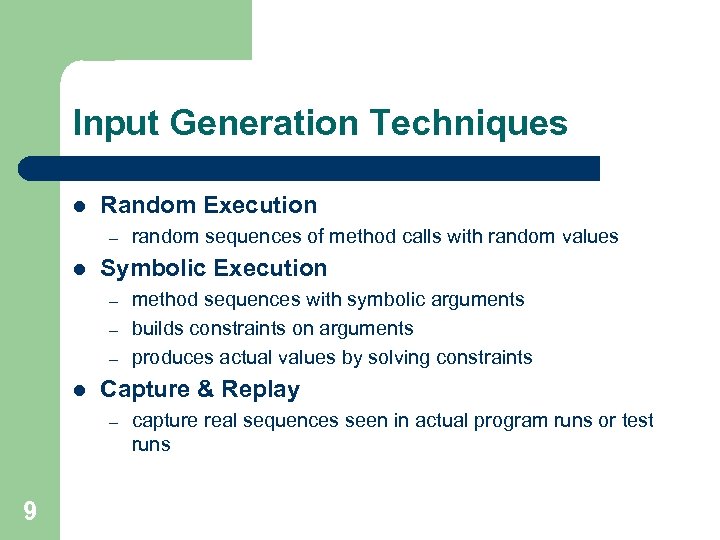 Input Generation Techniques l Random Execution – l Symbolic Execution – – – l method sequences with symbolic arguments builds constraints on arguments produces actual values by solving constraints Capture & Replay – 9 random sequences of method calls with random values capture real sequences seen in actual program runs or test runs
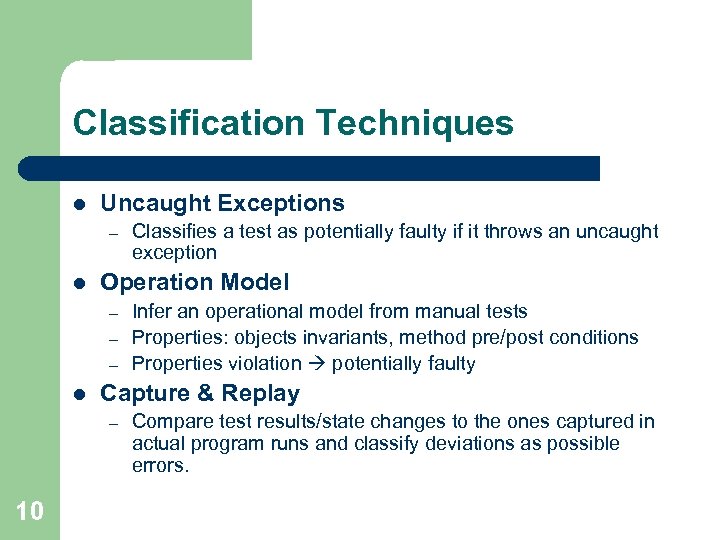 Classification Techniques l Uncaught Exceptions – l Operation Model – – – l Infer an operational model from manual tests Properties: objects invariants, method pre/post conditions Properties violation potentially faulty Capture & Replay – 10 Classifies a test as potentially faulty if it throws an uncaught exception Compare test results/state changes to the ones captured in actual program runs and classify deviations as possible errors.
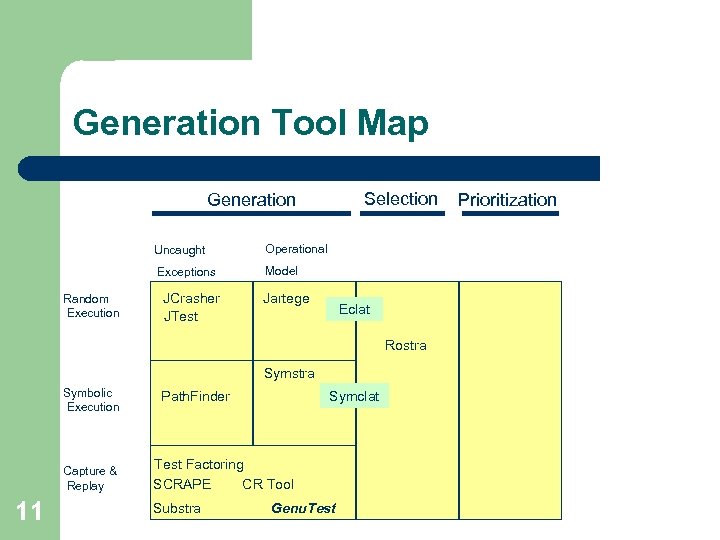 Generation Tool Map Selection Generation Uncaught Exceptions Random Execution Operational Model JCrasher JTest Jartege Eclat Rostra Symbolic Execution Capture & Replay 11 Path. Finder Symclat Test Factoring CR Tool SCRAPE Substra Genu. Test Prioritization
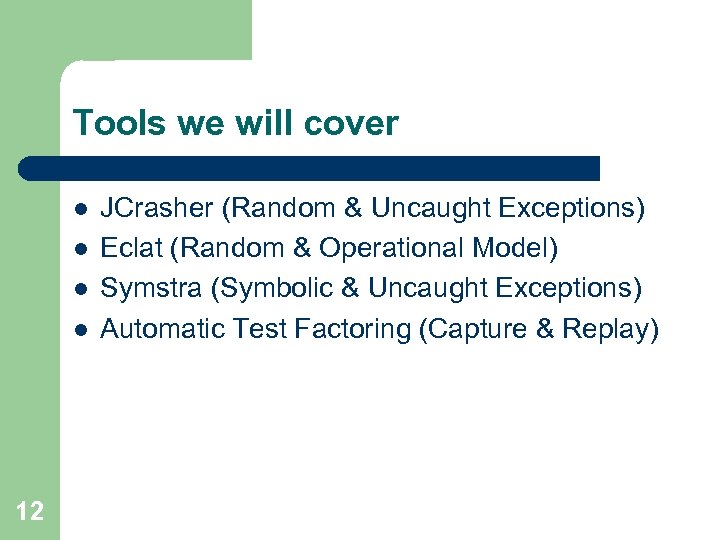 Tools we will cover l l 12 JCrasher (Random & Uncaught Exceptions) Eclat (Random & Operational Model) Symstra (Symbolic & Uncaught Exceptions) Automatic Test Factoring (Capture & Replay)
 JCrasher – An Automatic Robustness Tester for Java (2003) Christoph Csallner Yannis Smaragdakis Available at http: //www-static. cc. gatech. edu/grads/c/csallnch/jcrasher/ 13
 Goal l l 14 Robustness quality goal – “a public method should not throw an unexpected runtime exception when encountering an internal problem, regardless of the parameters provided. ” Goal does not assume anything about domain Robustness goal applies to all classes Function to determine class under test robustness: exception type { pass | fail }
 Parameter Space l Huge parameter space. – – l May not need all combinations to cover all control paths that throw an exception – – 15 Example: m(int, int) has 2^64 param combinations Covering all parameters combination is impossible Pick a random sample Control flow analysis on byte code could derive parameter equivalence class
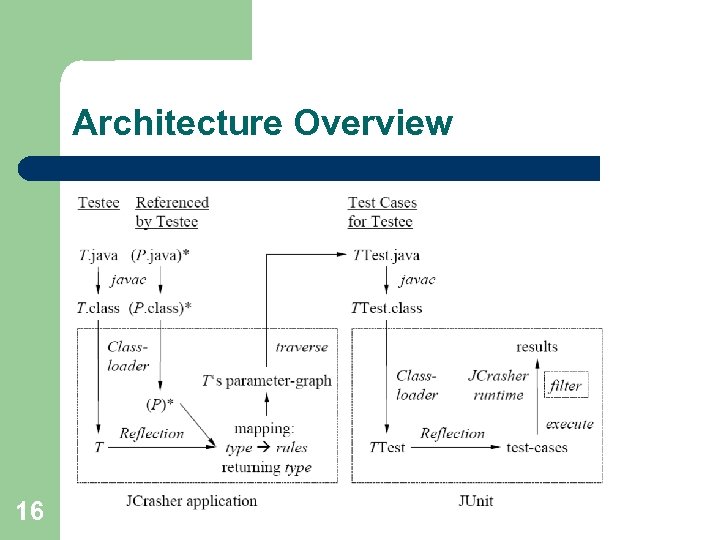 Architecture Overview 16
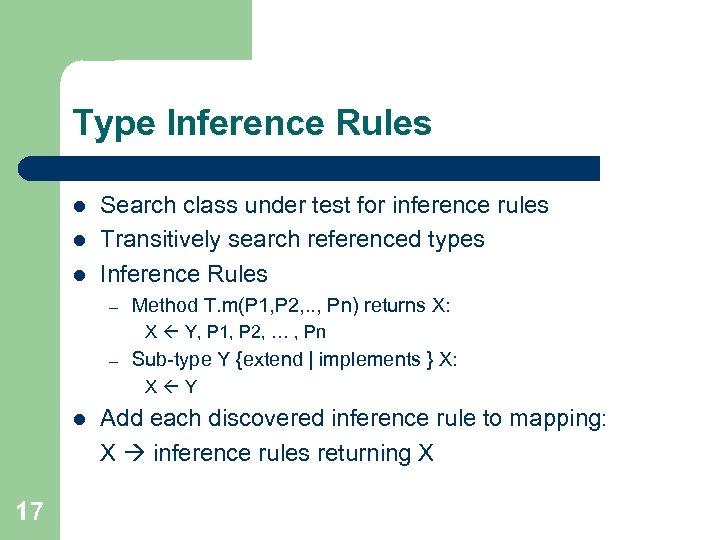 Type Inference Rules l l l Search class under test for inference rules Transitively search referenced types Inference Rules – Method T. m(P 1, P 2, . . , Pn) returns X: X Y, P 1, P 2, … , Pn – Sub-type Y {extend | implements } X: X Y l 17 Add each discovered inference rule to mapping: X inference rules returning X
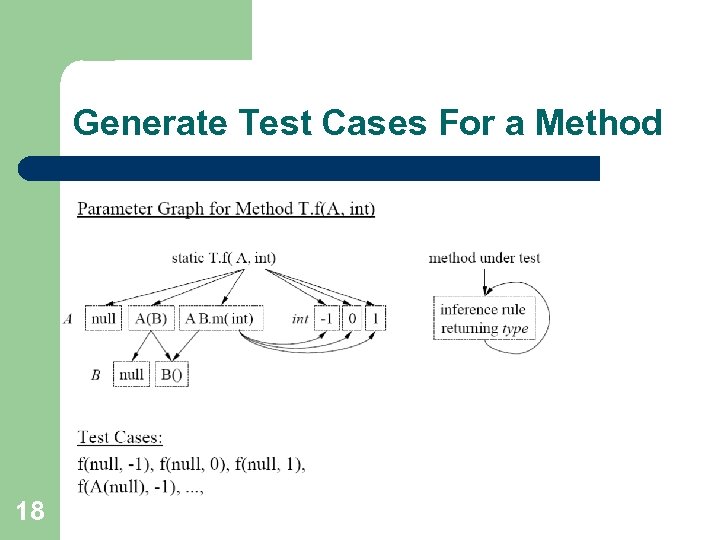 Generate Test Cases For a Method 18
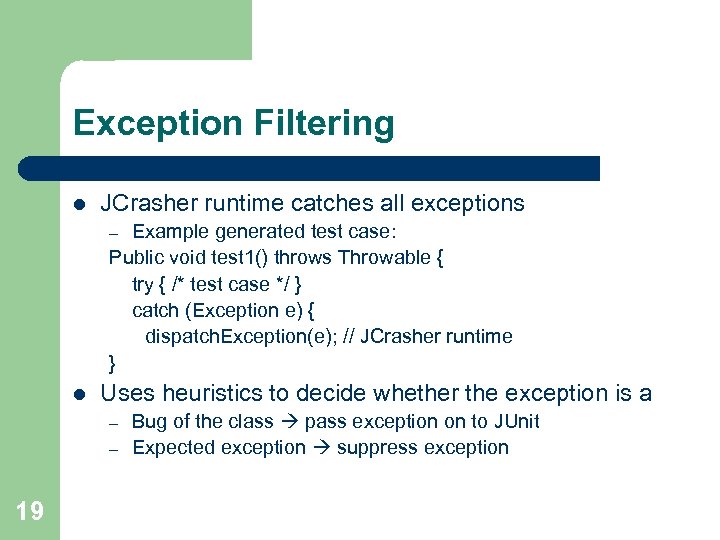 Exception Filtering l JCrasher runtime catches all exceptions Example generated test case: Public void test 1() throws Throwable { try { /* test case */ } catch (Exception e) { dispatch. Exception(e); // JCrasher runtime } – l Uses heuristics to decide whether the exception is a – – 19 Bug of the class pass exception on to JUnit Expected exception suppress exception
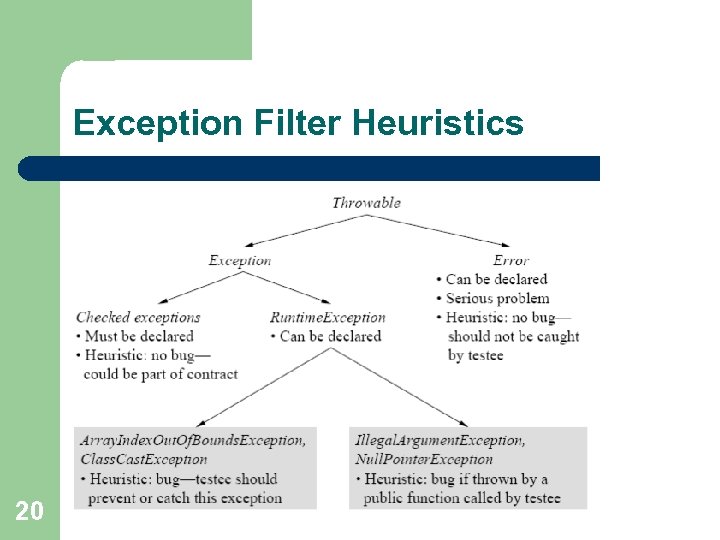 Exception Filter Heuristics 20
 Eclat: Automatic Generation and Classification of Test Inputs (2005) Carlos Pacheco Michael D. Ernst Available at http: //pag. csail. mit. edu/eclat 22
 Eclat - Introduction l l 23 Challenge in testing software is using a small set of test cases revealing many errors as possible. A test case consists of an input and an oracle which determines if the behavior on an input is as expected Input generation can be automated Oracle construction remains a largely manual (unless a formal specification exists) Contribution – Eclat helps creating new test cases (input + oracle)
 Eclat – Overview l l l 24 Uses input selection technique to select a small subset from a large set of test inputs Works by comparing program’s behavior on a given input against an operational model of correct operation Operational model is derived from an example program execution
 Eclat – How? l If program violates the operational model when run on an input, input is classified as: – – – 25 illegal input, program is not required to handle it likely to produce normal operation (despite model violation) likely to reveal a fault
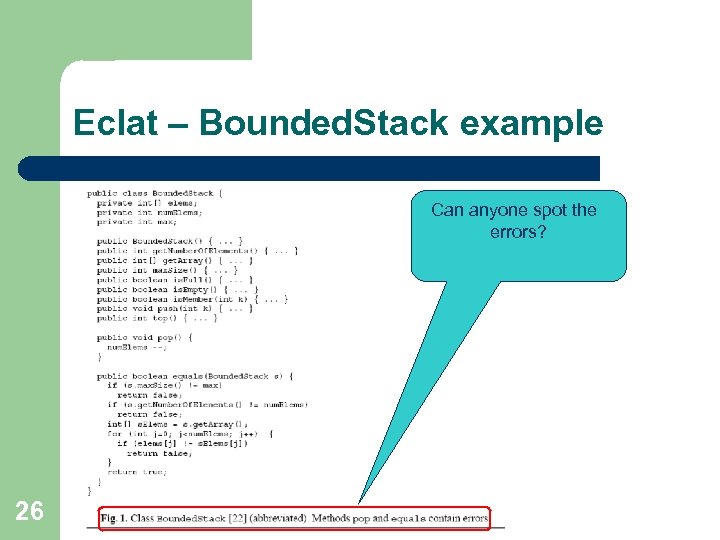 Eclat – Bounded. Stack example Can anyone spot the errors? 26
 Eclat – Bounded. Stack example l l l 27 Implementation and testing code written by two students, an “author” and a “tester” Tester wrote set of axioms and author implemented Tester also wrote manually two test suites (one containing 8 tests, and the other 12) Smaller test suite doesn’t reveal errors, while the Larger one reveals one error Eclat’s Input: Class under test, executable program that exercises the class (in this case the 8 test case test suite)
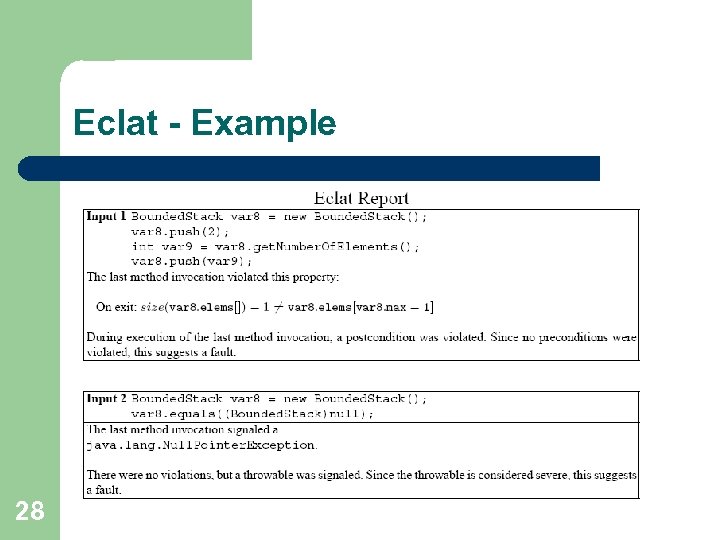 Eclat - Example 28
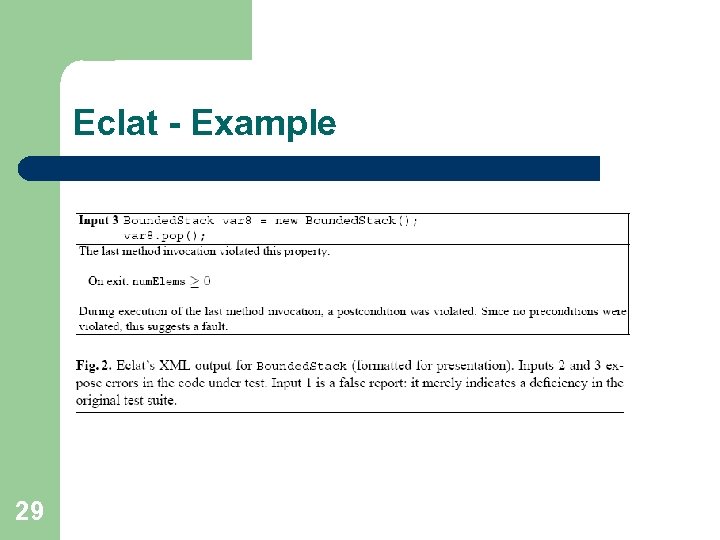 Eclat - Example 29
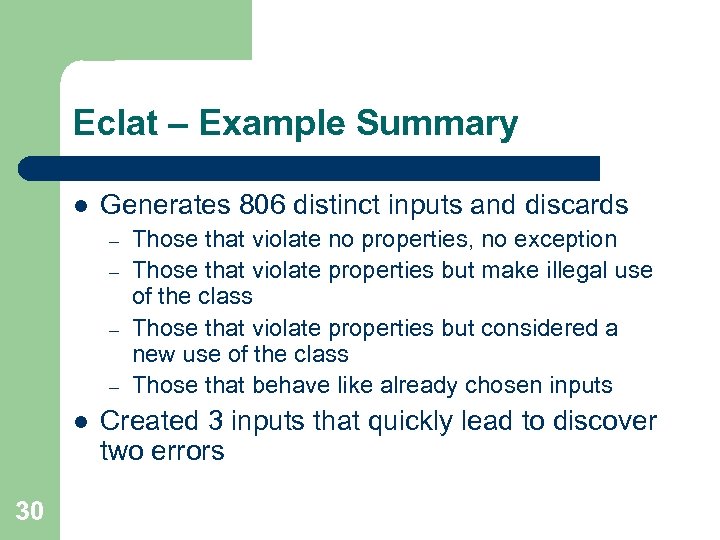 Eclat – Example Summary l Generates 806 distinct inputs and discards – – l 30 Those that violate no properties, no exception Those that violate properties but make illegal use of the class Those that violate properties but considered a new use of the class Those that behave like already chosen inputs Created 3 inputs that quickly lead to discover two errors
 Eclat - Input Selection l Requires three things: – – – 31 Program under test Set of correct executions of the program (for example an existing passing test suite) A source of candidate inputs (illegal, correct, fault revealing)
 Input Selection l Selection technique has three steps: – – – 32 Model Generation – Create an operational model from observing the program’s behavior on correct executions. Classification – Classify each candidate as (1) illegal (2) normal operation (3) fault-revealing. Done by executing the input and comparing behavior against the operational model Reduction – Partition fault-revealing candidates based on their violation pattern and report one candidate from each partition
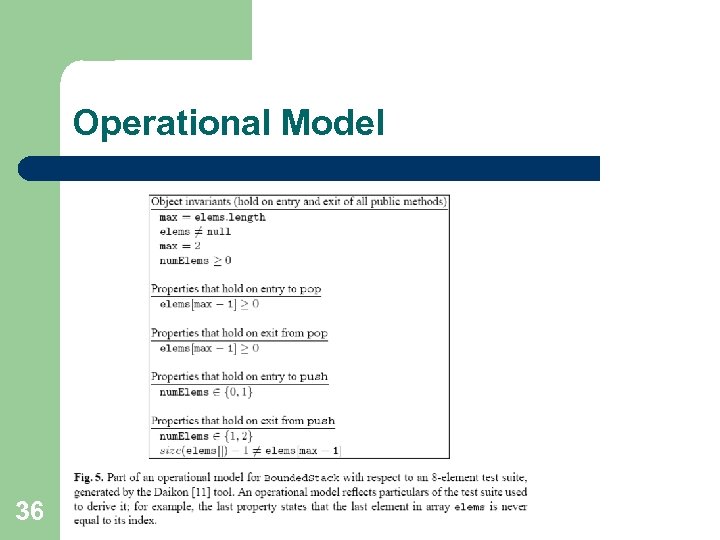
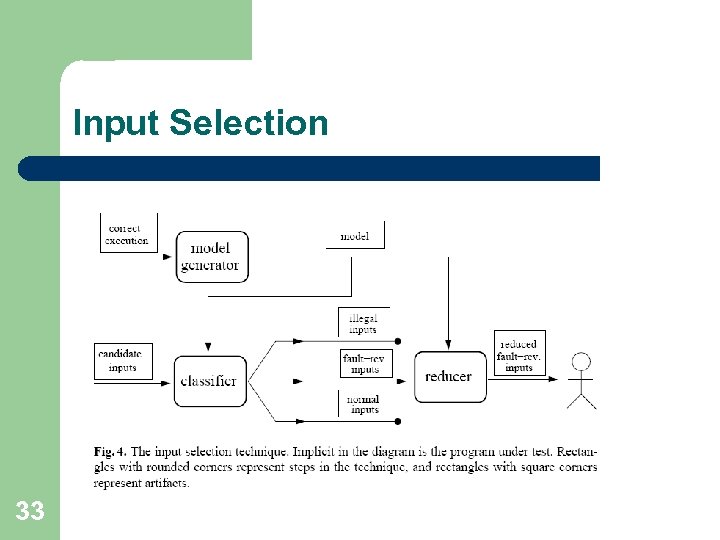 Input Selection 33
 Operational Model l l 34 Consists of properties that hold at the boundary of program components (e. g. , on public method’s entry and exit) Uses operational abstractions generated by the Daikon invariant detector
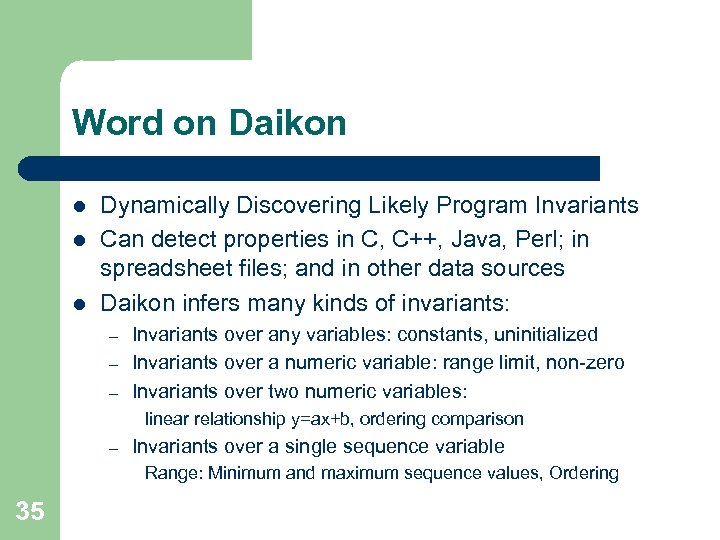 Word on Daikon l l l Dynamically Discovering Likely Program Invariants Can detect properties in C, C++, Java, Perl; in spreadsheet files; and in other data sources Daikon infers many kinds of invariants: – – – Invariants over any variables: constants, uninitialized Invariants over a numeric variable: range limit, non-zero Invariants over two numeric variables: linear relationship y=ax+b, ordering comparison – Invariants over a single sequence variable Range: Minimum and maximum sequence values, Ordering 35
 Operational Model 36
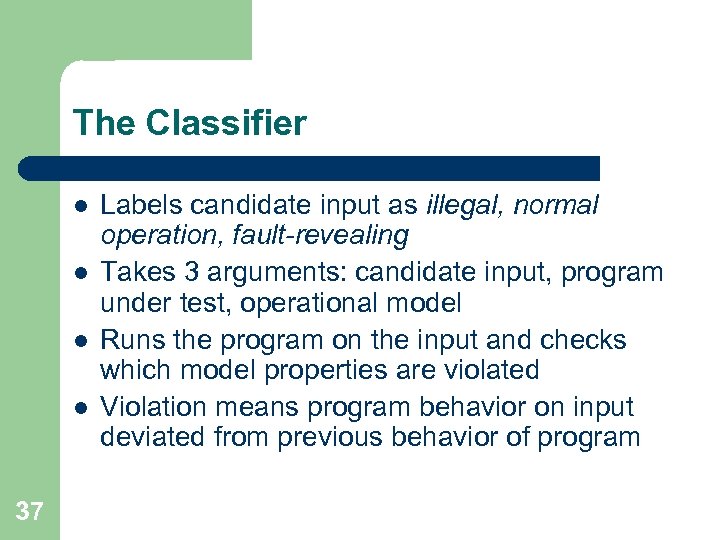 The Classifier l l 37 Labels candidate input as illegal, normal operation, fault-revealing Takes 3 arguments: candidate input, program under test, operational model Runs the program on the input and checks which model properties are violated Violation means program behavior on input deviated from previous behavior of program
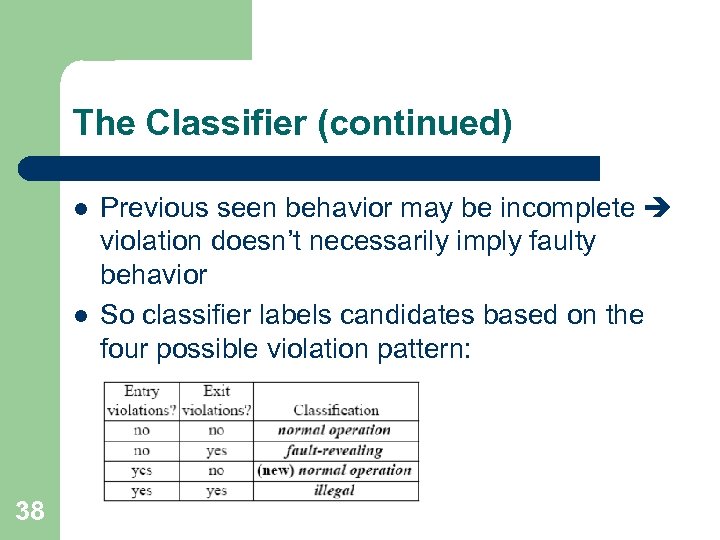 The Classifier (continued) l l 38 Previous seen behavior may be incomplete violation doesn’t necessarily imply faulty behavior So classifier labels candidates based on the four possible violation pattern:
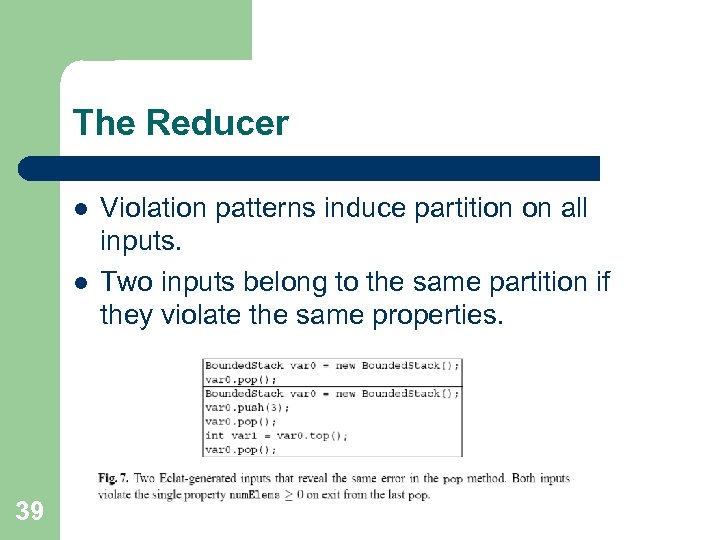 The Reducer l l 39 Violation patterns induce partition on all inputs. Two inputs belong to the same partition if they violate the same properties.
 Classifier Guided Input Generation l l l Unguided bottom-up generation which proceeds in rounds Strategy maintains a growing pool of values used to construct new inputs. Pool is initialized with a set of initial values (a few primitives and a null) Every value in the pool is accompanied by a sequence of method calls that can be run to construct the value New values are created by combining existing values through method calls – – l 40 l e. g. given stack value s and value integer I, s. is. Member(i) creates a new boolean value s. push(i) creates a new stack value In each round, new values are created by calling methods and constructors with values from the pool Each new value is added and its code is emitted as test input
 Combining Generation & Classification l l l Unguided strategy likely to produce interesting inputs and a large number of illegal ones Guided strategy uses classifier to guide the process For each round: – – – l 41 Construct a new set of candidate values (and corresponding inputs) from existing pool Classify new candidates using classifier Discard inputs labeled illegal, add values represented by normal operation to the pool, emit inputs labeled faultrevealing (but don’t add them to the pool) This enhancement removes illegal and faultrevealing inputs from the pool upon discovery
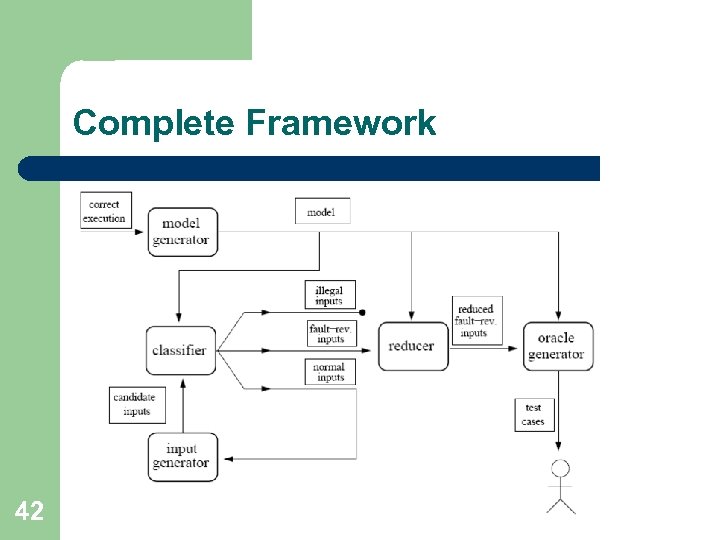 Complete Framework 42
 Other Issues l l 43 Operational Model can be complemented with manual written specifications Evaluated on numerous subject programs Presented independent evaluation of Eclat’s output, the Classifier, the Reducer, Input Generator Eclat revealed unknown errors in the subject programs
 Symstra: Framework for Generating Unit Tests using Symbolic Execution (2005) Tao Xie 44 Darko Marinov Wolfram Schulte David Notkin
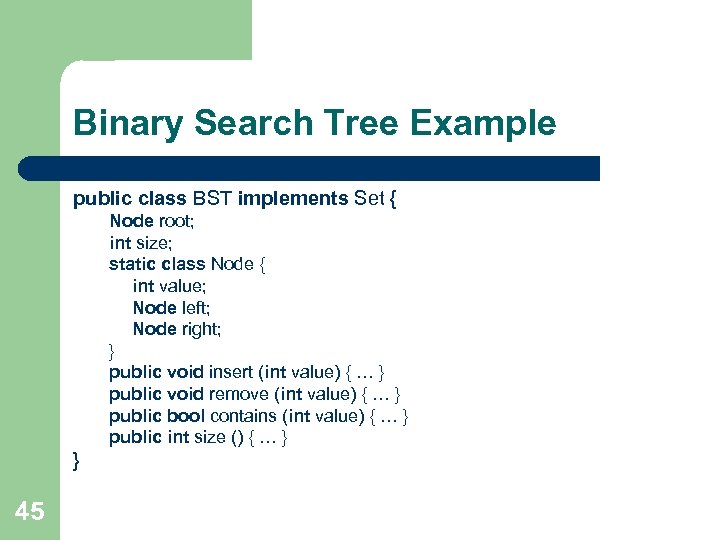 Binary Search Tree Example public class BST implements Set { Node root; int size; static class Node { int value; Node left; Node right; } public void insert (int value) { … } public void remove (int value) { … } public bool contains (int value) { … } public int size () { … } } 45
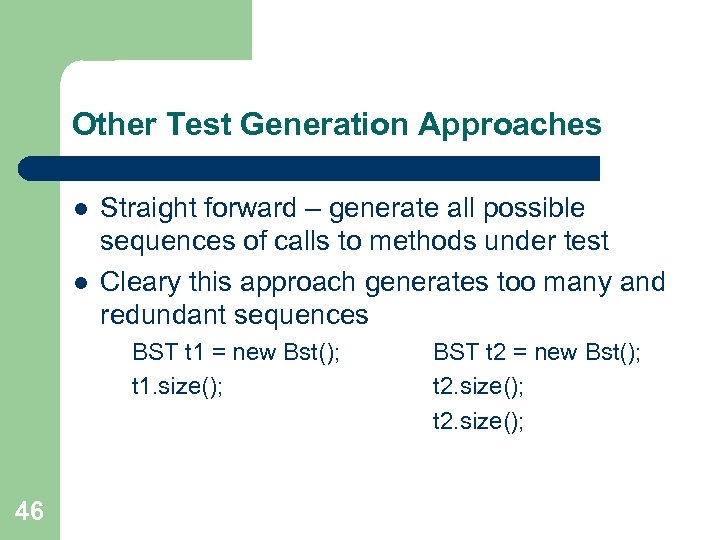 Other Test Generation Approaches l l Straight forward – generate all possible sequences of calls to methods under test Cleary this approach generates too many and redundant sequences BST t 1 = new Bst(); t 1. size(); 46 BST t 2 = new Bst(); t 2. size();
 Other Test Generation Approaches l Concrete-state exploration approach – – 47 Assume a given set of method calls arguments Explore new receiver-object states with method calls (BFS manner)
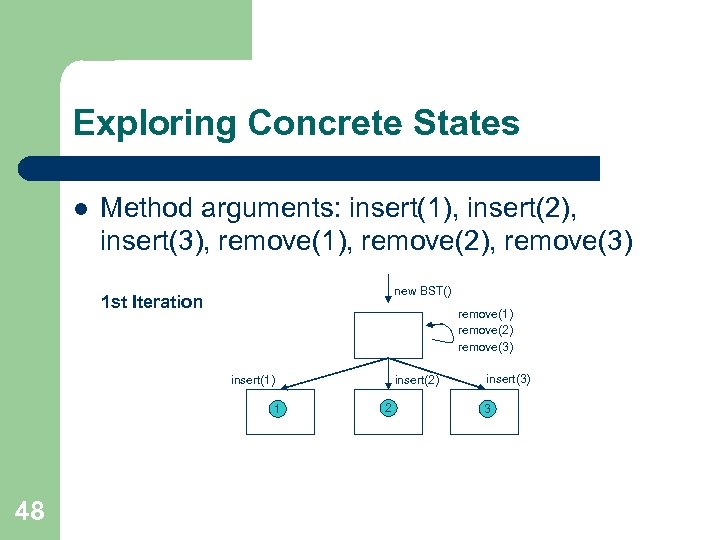 Exploring Concrete States l Method arguments: insert(1), insert(2), insert(3), remove(1), remove(2), remove(3) new BST() 1 st Iteration remove(1) remove(2) remove(3) insert(2) insert(1) 1 48 2 insert(3) 3
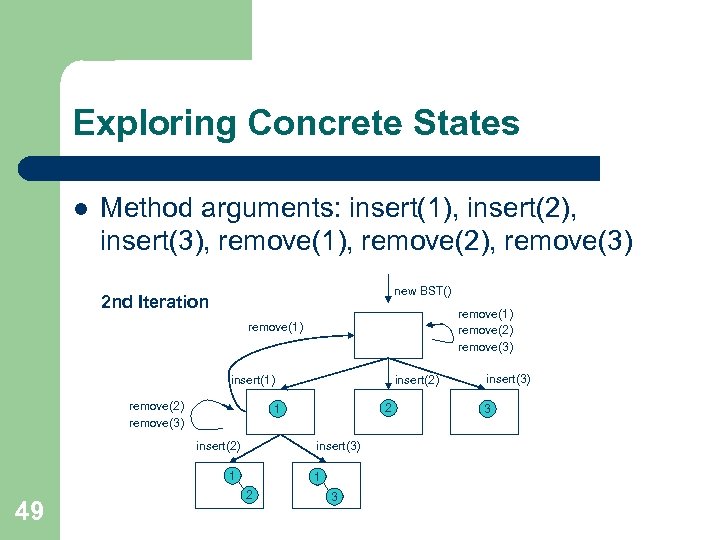 Exploring Concrete States l Method arguments: insert(1), insert(2), insert(3), remove(1), remove(2), remove(3) new BST() 2 nd Iteration remove(1) remove(2) remove(3) remove(1) insert(2) insert(1) remove(2) remove(3) insert(2) insert(3) 1 49 2 1 1 2 3 insert(3) 3
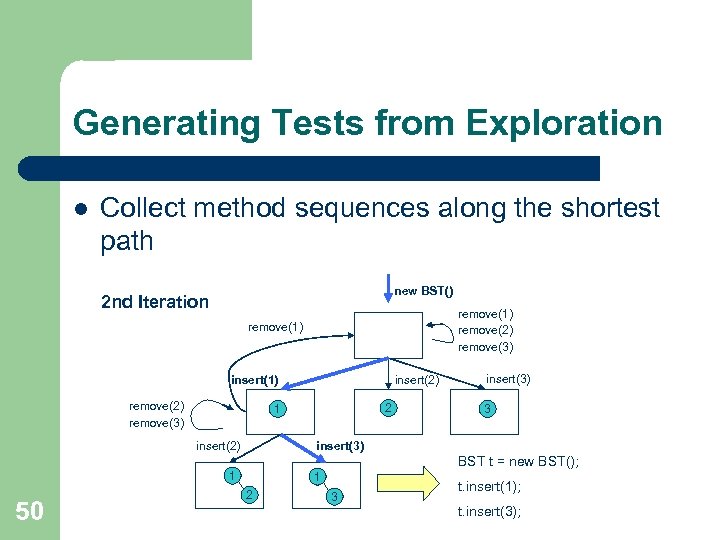 Generating Tests from Exploration l Collect method sequences along the shortest path new BST() 2 nd Iteration remove(1) remove(2) remove(3) remove(1) insert(2) insert(1) remove(2) remove(3) 2 1 insert(2) insert(3) 3 insert(3) BST t = new BST(); 1 50 1 2 3 t. insert(1); t. insert(3);
 Exploring Concrete States Issues l Not solved state explosion problem – – l Requires given set of relevant arguments – 51 Need at least N different insert arguments to reach a BST with size N experiments shows memory runs out when N = 7 in our case insert(1), insert(2), remove(1), …
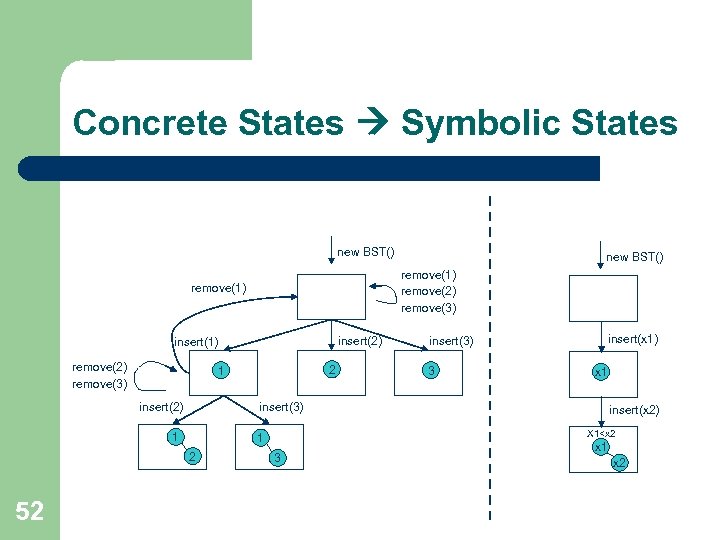 Concrete States Symbolic States new BST() remove(1) remove(2) remove(3) remove(1) insert(2) insert(1) remove(2) remove(3) insert(x 1) insert(3) 3 x 1 insert(3) 1 insert(x 2) X 1
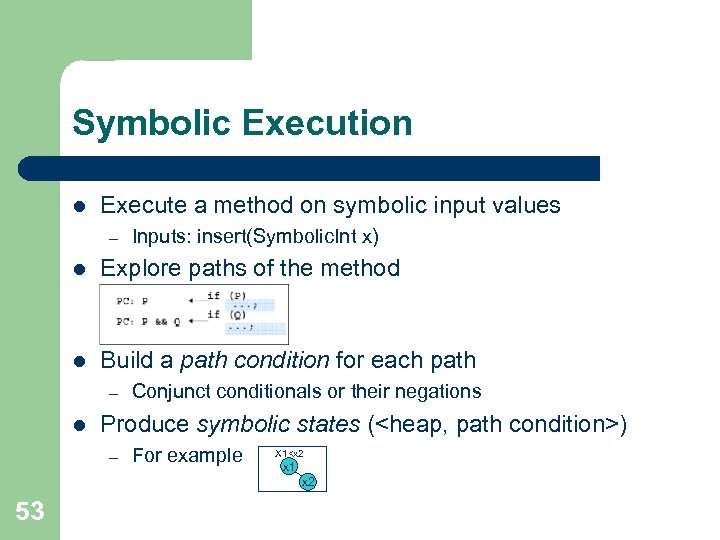 Symbolic Execution l Execute a method on symbolic input values – Inputs: insert(Symbolic. Int x) l Explore paths of the method l Build a path condition for each path – l Conjunct conditionals or their negations Produce symbolic states (
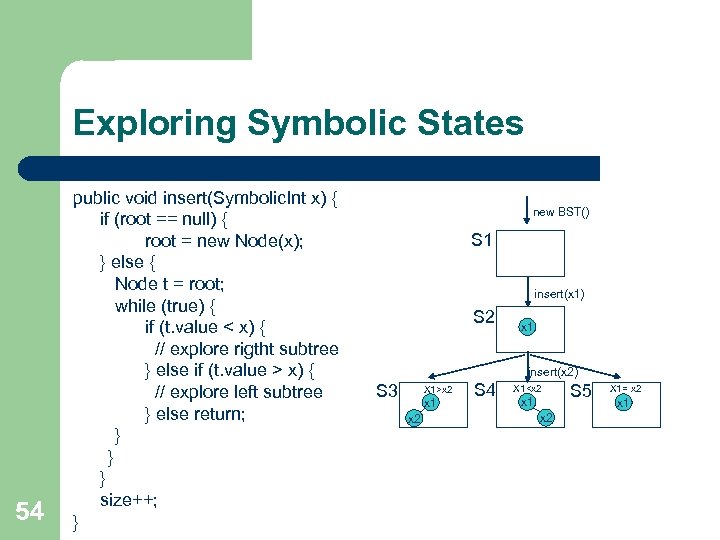 Exploring Symbolic States 54 public void insert(Symbolic. Int x) { if (root == null) { root = new Node(x); } else { Node t = root; while (true) { if (t. value < x) { // explore rigtht subtree } else if (t. value > x) { // explore left subtree } else return; } } } size++; } new BST() S 1 insert(x 1) S 2 x 1 insert(x 2) S 3 X 1>x 2 x 1 x 2 S 4 X 1
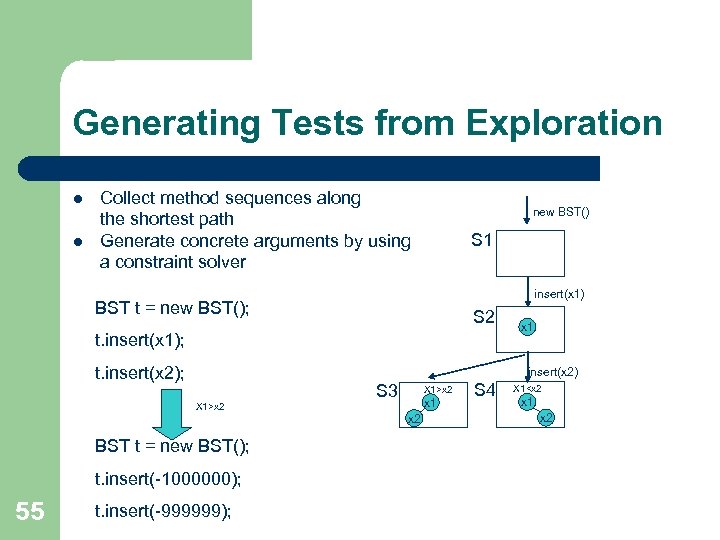 Generating Tests from Exploration l l Collect method sequences along the shortest path Generate concrete arguments by using a constraint solver new BST() S 1 insert(x 1) BST t = new BST(); S 2 t. insert(x 1); t. insert(x 2); insert(x 2) X 1>x 2 BST t = new BST(); t. insert(-1000000); 55 x 1 t. insert(-999999); S 3 X 1>x 2 x 1 x 2 S 4 X 1
 Results 56
 Results 57
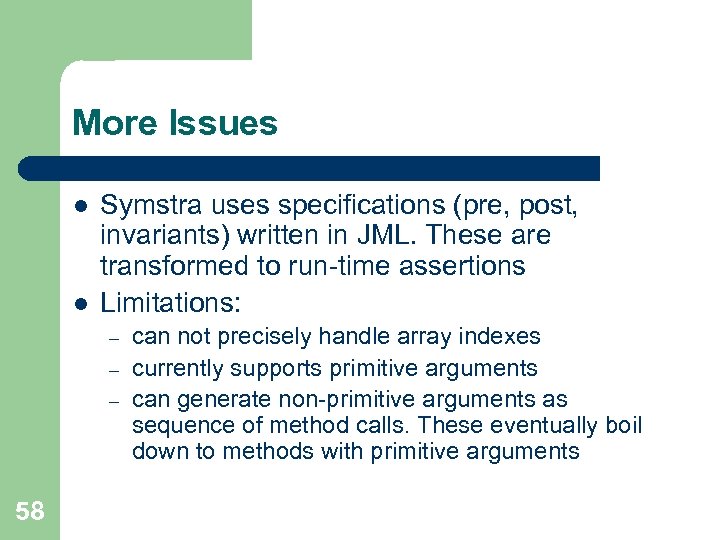 More Issues l l Symstra uses specifications (pre, post, invariants) written in JML. These are transformed to run-time assertions Limitations: – – – 58 can not precisely handle array indexes currently supports primitive arguments can generate non-primitive arguments as sequence of method calls. These eventually boil down to methods with primitive arguments
 Automatic Test Factoring For Java (2005) l l 59 David Saff Shay Artzi Jeff H. Perkins Ernst D. Michael
 Introduction l l Technique to provide benefits of unit tests to a system which has system tests Creates fast, focused unit tests from slow system-wide tests Each new unit test exercises only a subset of the functionality exercised by the system tests. Test factoring takes three inputs: – – – 60 a program a system test partition of the program into “code under test” and (untested) “environment”
 Introduction l l Running factored tests does not execute the “environment”, only the “code under test” This approach replaces the “environment” with mock objects These can simulate expensive resources. If the simulation is faithful then a test that utilizes the mock object can be cheaper Examples of expensive resources: – 61 databases, data structures, disks, network, external hardware
 Capture & Replay technique l l 62 Capture stage executes system tests, recording all interactions between “code under test” and “environment” in a “transcript” In replay, “code under test” is executed as usual, but points of interaction with the “environment”, the value recorded in the “transcript” is used
 Mock Objects l l l 63 Implemented with a lookup tables – “transcript” Transcript contains list of expected method calls Entry consists of: method name, args, retval Mock maintains an index into the transcript. When called, mock verifies that method name and args are consistent with transcript, returns the retval and increments index
 Test Factoring inaccuracies l l 64 Let T be “code under test”, E the “environment” and Em the mocked “environment” Testing T’ (changed T) with Em produces faster results when testing T’ with E, but we can get a Replay. Exception. This indicates that the assumption that T’ uses E the same way T does is wrong In this case, test factoring must be run again with T’ and E to obtain a test result for T’ and to create a new E’m
 Instrumenting Java classes l l Capture technique relies on instrumenting java classes The technique should know how to handle: – – l 65 all of the Java language class loaders native methods Reflection Should be done on bytecode (source code not always available)
 Capturing Technique l l Done by instrumenting java classes The technique should know how to handle: – – l l 66 all of the Java language class loaders native methods Reflection Should be done on bytecode (source code not always available) Instrumented code must co-exist with uninstrumented version. Must have access to original code to avoid infinite loops
 Capturing Technique l Built-in system classes need special care – – 67 Instrumenting must not add or remove fields nor methods in some classes, otherwise the JVM might crash Can not be instrumented dynamically, because the JVM loads around 200 classes before and user code can take effect.
 Capturing Technique l l Need to replace some object references to different (capture/replaying) objects. Can’t be done by subclassing because of – – l l l 68 final classes and methods reflection Use interface introduction, change each class reference to an interface reference When capturing replacement objects implementing the interface are wrappers around the real ones, and record to a transcript arguments and return values When replaying the replacement objects are mock objects
 Complications in capturing l l l l 69 Field access Callbacks Objects passed across the boundary Arrays Native methods and reflection Class loaders Common library optimizations – is String or Array. List part of T or E?
 Case Study l l l 70 Evaluated test factoring on Daikon consists of 347, 000 lines and uses sophisticated constructs: reflection, native calls, callbacks and more… Code is still under development. All errors were real errors made by the developers Recall that, test factoring aims on minimizing testing times Used Daikon’s CVS log. Reconstruct code base before each check-in, and ran the tests with and without test factoring.
 Case Study l l Daikon has unit tests and regression tests Unit Tests are automatically executed each time the code is compiled The 24 regression tests take about 60 minutes to run (15 minutes with make) Simulated continuous testing as a base line. – 71 Runs as many tests as possible as long as the code compiles
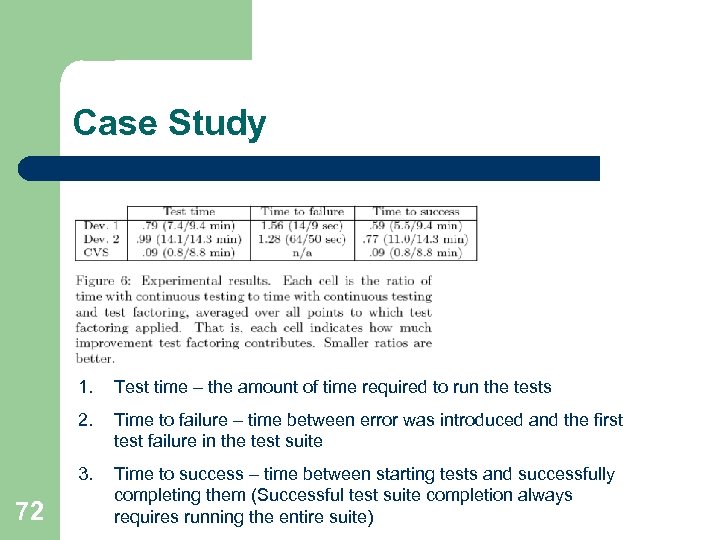 Case Study 1. 2. Time to failure – time between error was introduced and the first test failure in the test suite 3. 72 Test time – the amount of time required to run the tests Time to success – time between starting tests and successfully completing them (Successful test suite completion always requires running the entire suite)
 Other Capture & Replay Tools l Substra: A framework for Automatic Generation of Integration Tests – – – Automatic generation of integration tests. Based on call sequence constraints inferred from initial-test executions or normal runs of subsystem Two types of sequence constraints: l l – 73 Shared subsystem states (m 1 exit states = m 2 entry state) Object define use relationships (if retval r of m 1 is receiver or an argument of m 2) Tool can generate new integration tests that exercise new program behavior.
 Other Capture & Replay Tools l Selective Capture and Replay of Program Executions – – 74 Allows selecting a subsystem of interest Allows capturing at runtime interactions between subsystem and rest of application Allows replaying recorded interaction on subsystem in isolation Efficient technique, capture information only relevant to considered execution
 Other Capture & Replay Tools l Carving Differential Unit Test Cases from System Test Cases – – DUT are a hybrid of unit and system tests Contributions: l l l 75 framework for automating carving and replaying new state based strategy for carving and replay at a method level that offers a range of costs, flexibility, scalability evaluation criteria and empirical assessment when carving and replaying on multiple versions of a Java applications
 Other Capture & Replay Tools l Genu. Test – – Generating unit tests and mock objects from program runs and system tests Technique l l 76 Capturing using Aspect. J features vs “traditional” instrumentation methods Present a concept name mock aspects which intercept calls to objects and mocks their behavior.
 More tools not mentioned… l l l l 77 JTest – commercial product by parasoft Jartege – operational model formed from JML Path. Finder – symbolic execution tool by NASA Symclat – An evolution of Eclat & Symstra Rostra – Framework for detecting redundant object oriented unit tests Orstra – Augmenting Generated Unit-Test Suites with Regression Oracle Checking Agitator – www. agitar. com (I recommend you see their presentation in the site)
 Future Directions l l Further development of the current tools Testing AOP programs – – 78 Test integration of aspects and classes Test advices/aspects in isolation
 Summary l l l Brief reminder of Unit Testing and the importance of automatic tools Many automatic tools out there for many platforms: can be roughly categorized into running frameworks, generation, selection and prioritization Concentrated on various input & oracle generation techniques through four select articles: – – l l 79 JCrasher Eclat Symstra Automatic Test Factoring Didn’t talk about results and evaluation techniques, but the tools do provide good promising results Hope you enjoyed and had fun
 Bibliography 1. 2. 3. 4. 5. 6. 7. 8. 9. 10. 80 Automatic Test Factoring for Java – David Saff, Shay Artzi, Jeff H. Perkins, Michael D. Ernst Selective Capture and Replay of Program Executions – Alessandro Orso and Bryan Kennedy Eclat: Automatic Generation and Classification of Test Inputs – Carlos Pacheco, Michael D. Ernst Orstra: Augmenting Automatically Generated Unit-Test Suites with Regression Oracle Checking Substra: A Framework for Automatic Generation of Integration Tests – Hai Yuan, Tao Xie Carving Differential Unit Test Cases from System Test Cases – Sebastian Elbaum, Hui Nee Chin, Matthew B. Dwyer, Jonathan Dokulil Rostra: A Framework for Detecting Redundant Object-Oriented Unit Tests – Tao Xie, Darko Marinov, David Notkin Symstra: A Framework for Generating Object-Oriented Unit Tests Using Symbolic Execution – Tao Xie, Darko Marinov, Wolfram Schulte, David Notkin An Empirical Comparison of Automated Generation and Classification Techniques for Object Oriented Unit Testing – Marcelo d’Amorim, Carlos Pacheco, Tao Xie, Darko Marinov, Michael D. Ernst JCrasher: An Automatic Robustness Tester for Java – Christoph Csallner, Yannis Smaragdakis