


 Скачать презентацию Automatic Timeline Generation from News Articles Josh Taylor
5f9567f9e8954edcc3d66e7ac3057092.ppt
- Количество слайдов: 19
 Automatic Timeline Generation from News Articles Josh Taylor and Jessica Jenkins
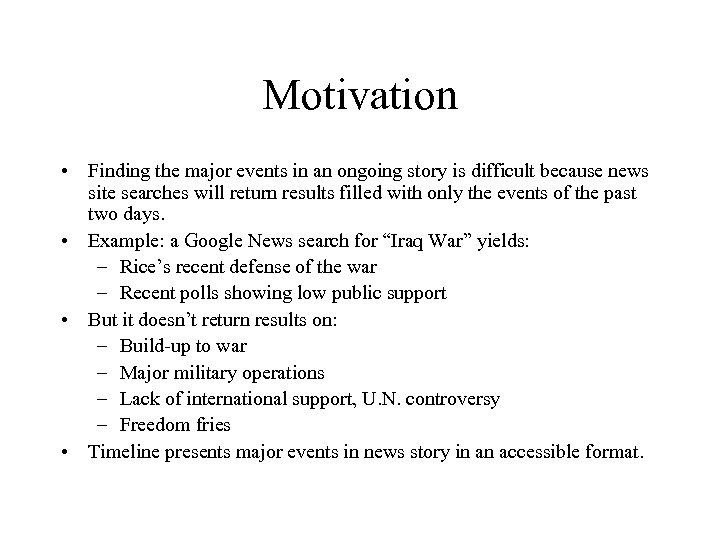 Motivation • Finding the major events in an ongoing story is difficult because news site searches will return results filled with only the events of the past two days. • Example: a Google News search for “Iraq War” yields: – Rice’s recent defense of the war – Recent polls showing low public support • But it doesn’t return results on: – Build-up to war – Major military operations – Lack of international support, U. N. controversy – Freedom fries • Timeline presents major events in news story in an accessible format.
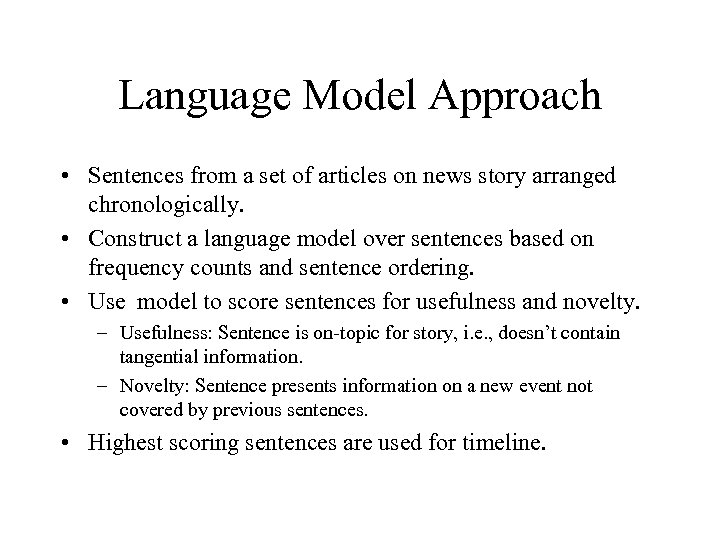 Language Model Approach • Sentences from a set of articles on news story arranged chronologically. • Construct a language model over sentences based on frequency counts and sentence ordering. • Use model to score sentences for usefulness and novelty. – Usefulness: Sentence is on-topic for story, i. e. , doesn’t contain tangential information. – Novelty: Sentence presents information on a new event not covered by previous sentences. • Highest scoring sentences are used for timeline.
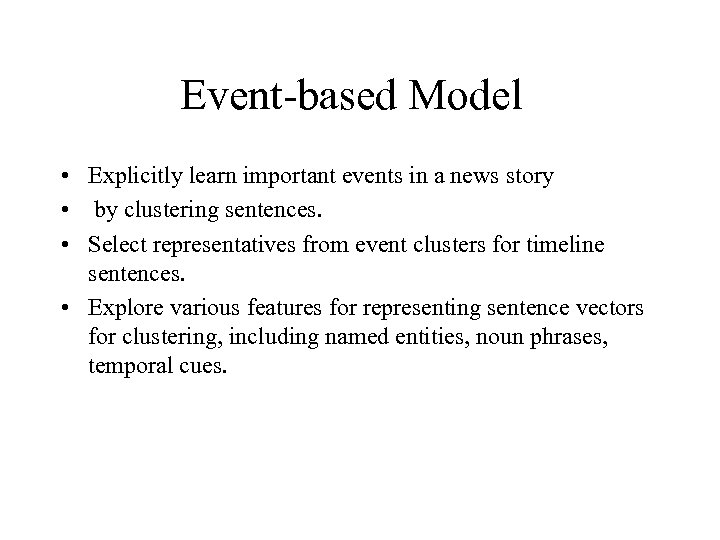 Event-based Model • Explicitly learn important events in a news story • by clustering sentences. • Select representatives from event clusters for timeline sentences. • Explore various features for representing sentence vectors for clustering, including named entities, noun phrases, temporal cues.
 Evaluation • Human annotators generate set of important events in news story. • Each sentence is annotated with a (possibly empty) subset of the events it covers. • Recall and precision measures based on these annotations are applied to the sequence of sentences returned by the system to evaluate the usefulness and novelty (or nonredundancy) of the timeline.
 Information Extraction on Real Estate Rentals Classifieds Eddy Hartanto Ryohei Takahashi
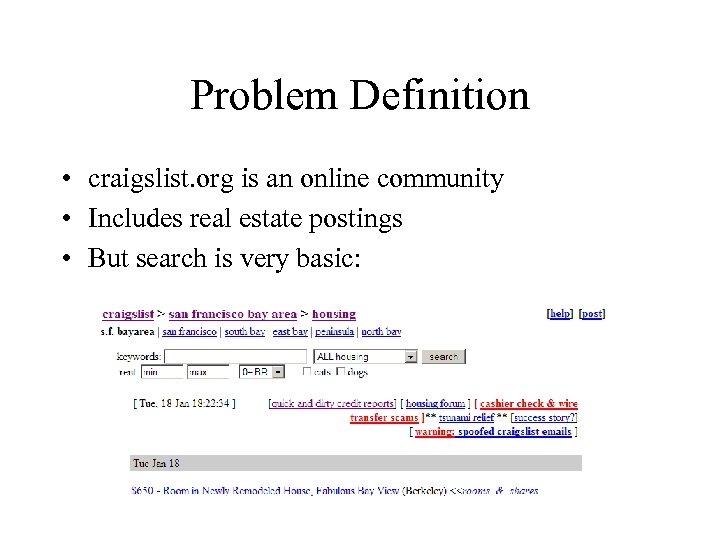 Problem Definition • craigslist. org is an online community • Includes real estate postings • But search is very basic:
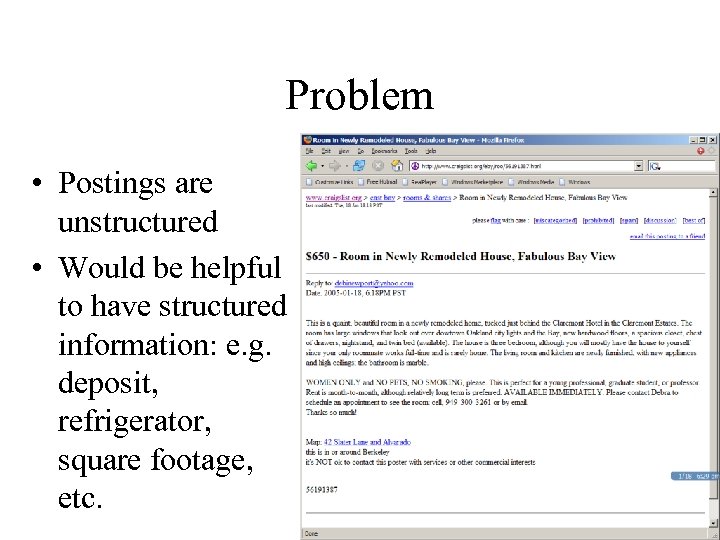 Problem • Postings are unstructured • Would be helpful to have structured information: e. g. deposit, refrigerator, square footage, etc.
 Project Outline • Crawl craigslist’s real estate postings • Extract structured information from unstructured text • Offer parametric search on resulting database
 Implementation Details • Hidden Markov Model – States are fields – Outputs are words – Use Viterbi algorithm to calculate most likely sequence of states • Rule-based pattern matching – Construct rules to identify words in postings that contain field data
 Evaluation Measure • Obtain random subset of postings • Manually fill in fields of database for each of these postings • Calculate precision/recall on a variety of queries on this set of manually tagged data
 Questions and Suggestions • We appreciate your inputs …
 Web Crawling Stanford Events Group members: • Zoe Pi-Chun Chu • Michael Tung
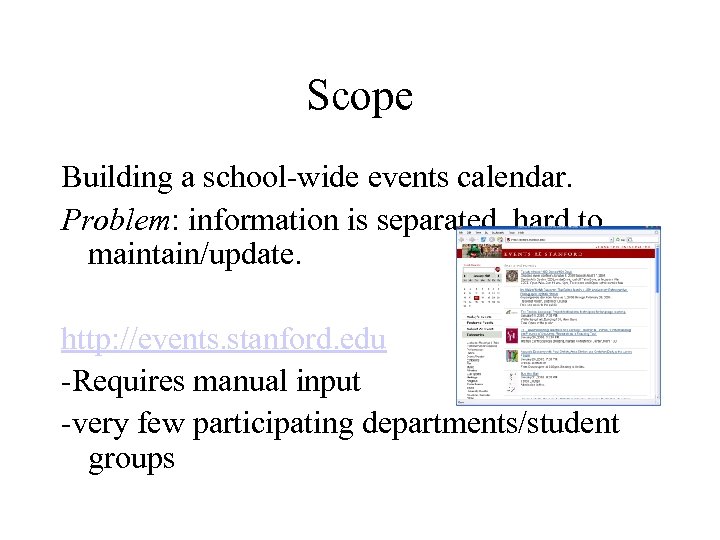 Scope Building a school-wide events calendar. Problem: information is separated, hard to maintain/update. http: //events. stanford. edu -Requires manual input -very few participating departments/student groups
 Solution An automated system Builds events database by crawling: -stanford. edu www pages -newgroups -mailing lists Extract event attributes from text (location, time, type, department, free food, speaker)
 Technologies Java Technology: Build on Apache Tomcat • JSP for dynamically generated webpages • Java. Beans for data storage • Java Mail API • JDBC connects databases • Lucene search engine Databases: My. SQL
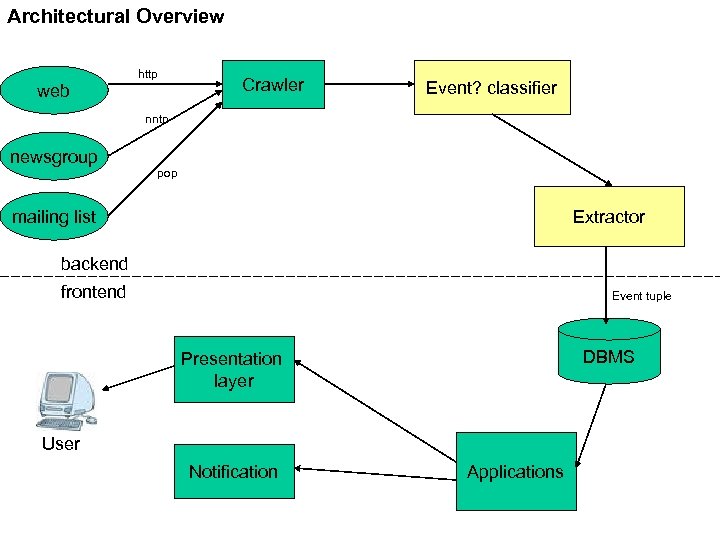 Architectural Overview web http Crawler Event? classifier nntp newsgroup pop Extractor mailing list backend frontend Event tuple DBMS Presentation layer User Notification Applications
 Key Algorithms • Classification – For deciding whether content is an event – Segmenting events Information Extraction -Pattern matching, Part-of-speech tagging -Hidden Markov model
 Evaluation 1. Compute precision/recall on CMU seminar announcements corpus 2. User test – comparison to http: //events. stanford. edu -Features -Usability