


 Скачать презентацию Automatic Programming of Agents via Multi-type Self-Adaptive Genetic
7115ae815577313f82393d929725c963.ppt
- Количество слайдов: 14
 Automatic Programming of Agents via Multi-type, Self-Adaptive Genetic Programming Lee Spector, Hampshire College lspector@hampshire. edu, http: //hampshire. edu/lspector Assistance by Jon Klein
 Overview • Approach and Critical Elements • Technologies: Push, Push. GP, Pushpop, Breve, Swarm. Evolve • Recent Results: Emergence of collective/multicellular organization Environmental/genetic stability and adaptation Push/Breve integration v. 0. 1 • Demo: Swarm. Evolve 1. 5 • Next Steps
 Approach & Critical Elements • Design Approach: Self-adaptive, multi-type genetic programming for automated or semi-automated agent design. • Critical Elements: Autonomy, coordination, adaptation, control, evolution. • Problems: Can agents be automatically generated for complex, dynamic environments? Can agents evolve to become more adaptable to changing environments? • Metrics: Wait time, event response delay, agent lifetime, code parsimony/diversity, evolutionary computational effort, task completion. • Toolkit: Push programming language for evolved agent programs, Push. GP genetic programming system, Pushpop autoconstructive evolution system.
 The Push Programming Language for Evolutionary Computation • Goal: Scale up GP/agents techniques for human-competitive performance in complex, dynamic environments. • Evolve agents that may use: • multiple data types • subroutines (any architecture) • recursion • evolved control structures • evolved evolutionary mechanisms • Push supports all of this using simple, mostly standard GP techniques. • Stack-based language with one stack per type; types include integer, float, Boolean, code, child, type, name.
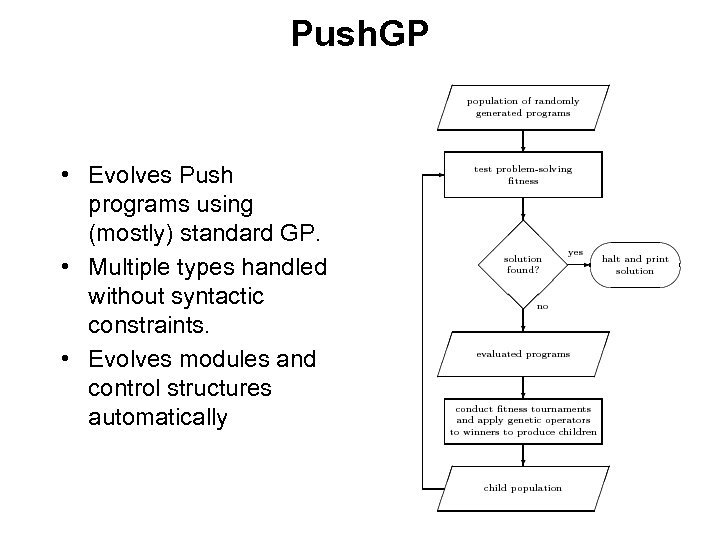 Push. GP • Evolves Push programs using (mostly) standard GP. • Multiple types handled without syntactic constraints. • Evolves modules and control structures automatically
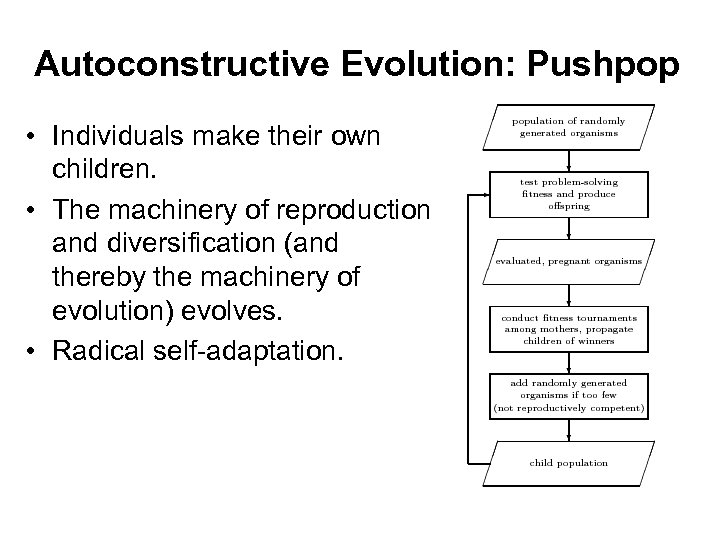 Autoconstructive Evolution: Pushpop • Individuals make their own children. • The machinery of reproduction and diversification (and thereby the machinery of evolution) evolves. • Radical self-adaptation.
 Breve: a 3 D Environment for the Simulation of Decentralized Systems and Artificial Life • Written by Jon Klein, http: //www. spiderland. org/breve • Simplifies the rapid construction of complex 3 D simulations. • Object-oriented scripting language with rich predefined class hierarchy. • Open. GL 3 D graphics with lighting, shadows, and reflection. • Rigid body simulation, collision detection/response, articulated body simulation. • Runge-Kutta 4 th order integrator or Runge-Kutta. Fehlman integrator with adaptive step-size control.
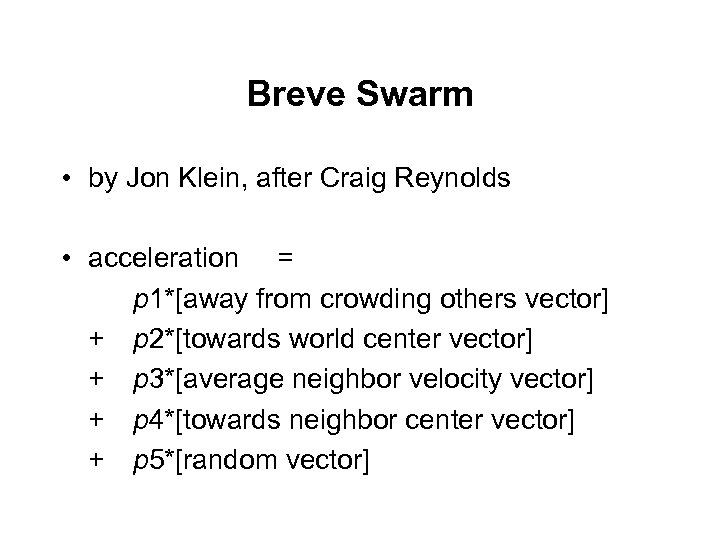 Breve Swarm • by Jon Klein, after Craig Reynolds • acceleration = p 1*[away from crowding others vector] + p 2*[towards world center vector] + p 3*[average neighbor velocity vector] + p 4*[towards neighbor center vector] + p 5*[random vector]
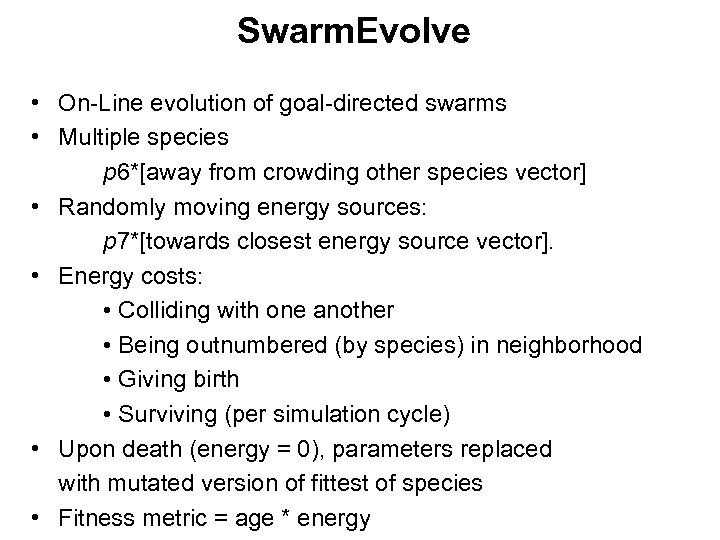 Swarm. Evolve • On-Line evolution of goal-directed swarms • Multiple species p 6*[away from crowding other species vector] • Randomly moving energy sources: p 7*[towards closest energy source vector]. • Energy costs: • Colliding with one another • Being outnumbered (by species) in neighborhood • Giving birth • Surviving (per simulation cycle) • Upon death (energy = 0), parameters replaced with mutated version of fittest of species • Fitness metric = age * energy
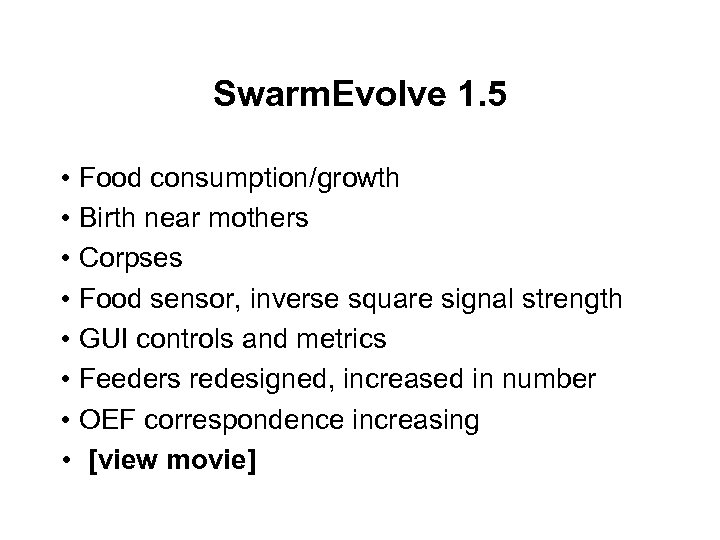 Swarm. Evolve 1. 5 • Food consumption/growth • Birth near mothers • Corpses • Food sensor, inverse square signal strength • GUI controls and metrics • Feeders redesigned, increased in number • OEF correspondence increasing • [view movie]
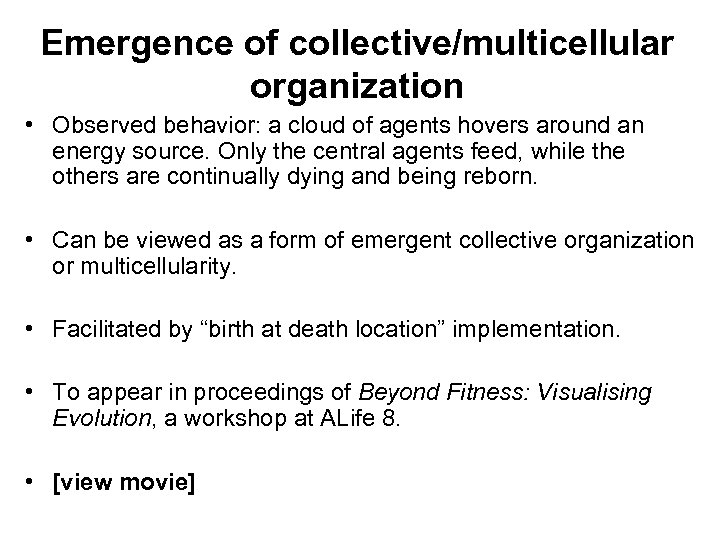 Emergence of collective/multicellular organization • Observed behavior: a cloud of agents hovers around an energy source. Only the central agents feed, while the others are continually dying and being reborn. • Can be viewed as a form of emergent collective organization or multicellularity. • Facilitated by “birth at death location” implementation. • To appear in proceedings of Beyond Fitness: Visualising Evolution, a workshop at ALife 8. • [view movie]
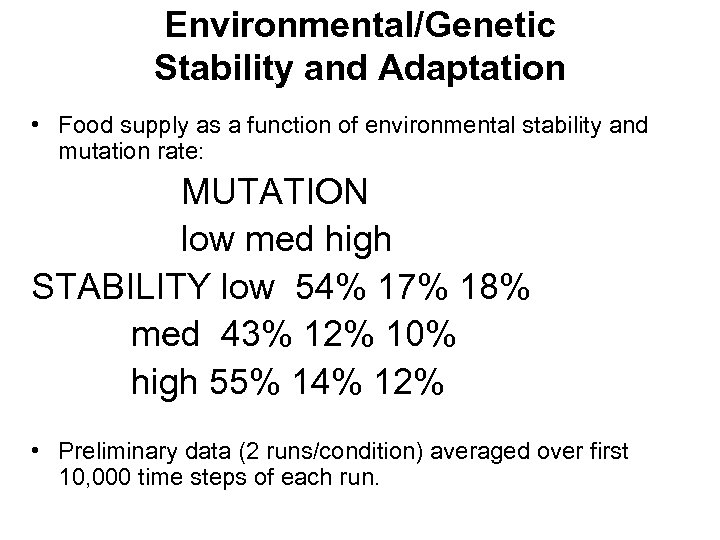 Environmental/Genetic Stability and Adaptation • Food supply as a function of environmental stability and mutation rate: MUTATION low med high STABILITY low 54% 17% 18% med 43% 12% 10% high 55% 14% 12% • Preliminary data (2 runs/condition) averaged over first 10, 000 time steps of each run.
![[Demo: Swarm. Evolve 1. 5]](https://present5.com/presentation/7115ae815577313f82393d929725c963/image-13.jpg "[Demo: Swarm. Evolve 1. 5]") [Demo: Swarm. Evolve 1. 5]
[Demo: Swarm. Evolve 1. 5]
 Next Steps • Enhance complexity/realism/OEF integration. • Species-specific controls and metrics. • Structured feeder behavior; agent-responsive. • Leverage Push/Breve integration for evolution of arbitrary agent control programs and group (species) distinctions. • Integrate MIT/BBN elementary adaptive modules. • Provide “evolution” components for Taskable Agent Software Kit.