


 Скачать презентацию Automatic inference of clinical workflow events using spatial-temporal
79e538d417b5ad1d0fd5ddf9021b87f1.ppt
- Количество слайдов: 41
 Automatic inference of clinical workflow events using spatial-temporal tracking Rich Martin, Rutgers University, Dept. of Computer Science Contributors and Collaborators: Eiman Elnahrawy, Rich Howard, Yanyong Zhang, Rutgers Rich Rauscher, Penn State Rob Eisenstein, UMDNJ, Robert Sweeny, JSUMC And many students Penn State, November 2009
 Outline • Promise of Sensor Networks and Cyber-Physical Systems • Application Overview: – Workflow for an Emergency Department • Recent Results: – Events, Localization and Tracking – Workflow • Open Research Challenges and Future Work 2
 The Promise: A New Application Class • Observation and control of objects and conditions in physical space • Driven by technology trends • Will create a new class of applications • Will drive existing systems in new ways 3
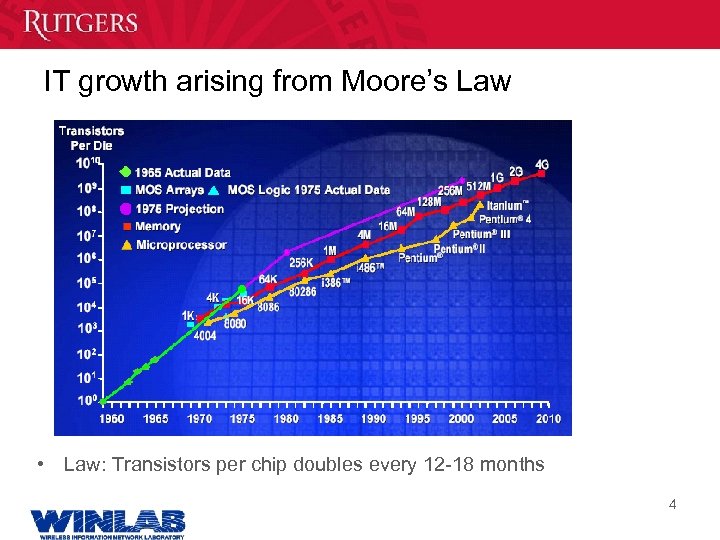 IT growth arising from Moore’s Law • Law: Transistors per chip doubles every 12 -18 months 4
 Impacts of Moore’s Law • Increased power and memory of traditional systems – 386, 486, Pentium I, III • Corollary: Bell’s Law – Every 10 years a new: • Computing platform • Industry around the new platform – Driven by cost, power, size reductions due to Moore’s law 5
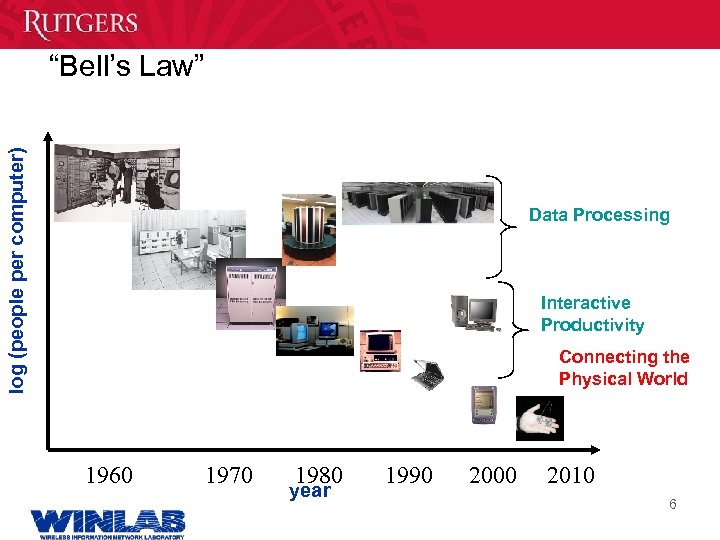 log (people per computer) “Bell’s Law” Data Processing Interactive Productivity Connecting the Physical World 1960 1970 1980 year 1990 2000 2010 6
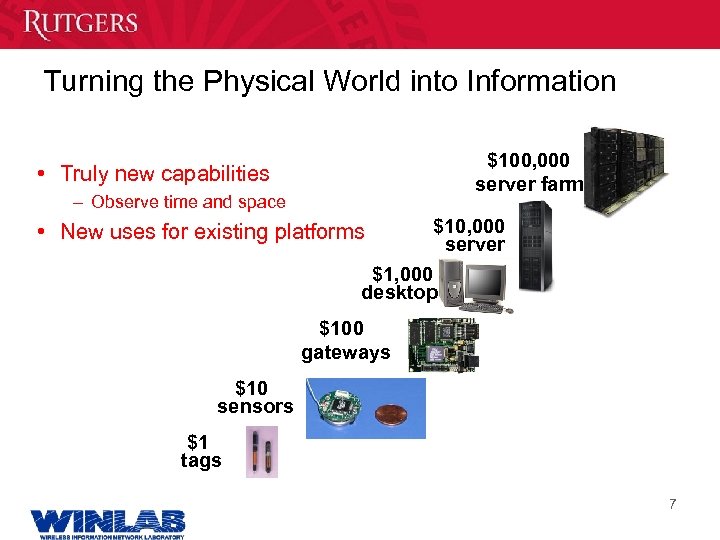 Turning the Physical World into Information $100, 000 server farm • Truly new capabilities – Observe time and space $10, 000 server $1, 000 desktop • New uses for existing platforms $100 gateways $10 sensors $1 tags 7
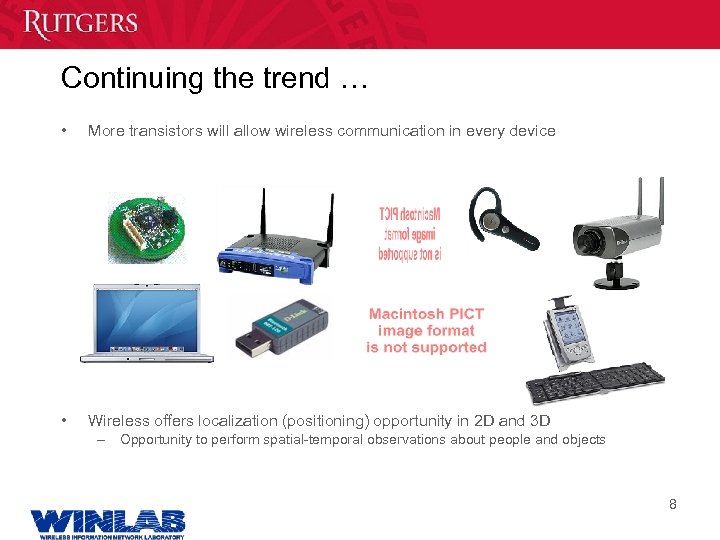 Continuing the trend … • More transistors will allow wireless communication in every device • Wireless offers localization (positioning) opportunity in 2 D and 3 D – Opportunity to perform spatial-temporal observations about people and objects 8
 Work over the past 10 years • 1999: Smart dust project • 2001: Rene Mote • 2002 -2005: • Monitoring applications – Petrels, Zebras, Vineyards, Redwoods, Volcanos, Snipers • • Network protocols: MAC, routing Low energy platforms Languages Operating systems • 2007 -present – Integration (IP networks) 9
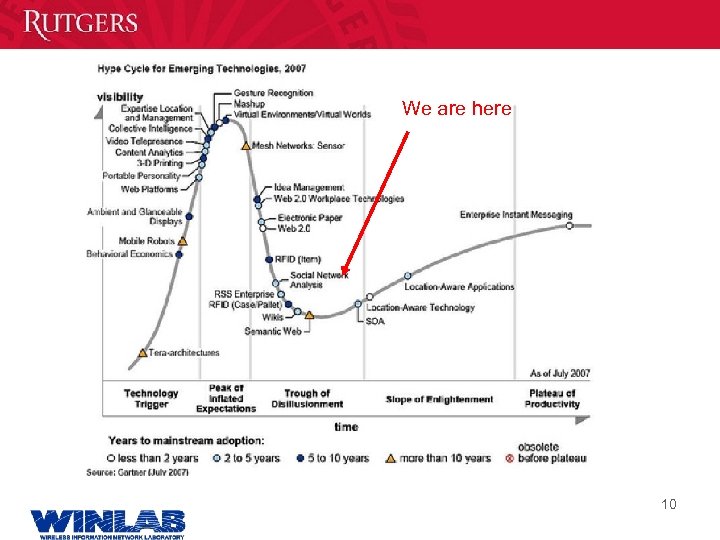 We are here 10
 Driving the technology… • Cyber-physical application past the peak • Next: vertical app silos to drive the research • Analogy: networking in the 1980’s • Rest of this talk: A novel application for workflow management in a hospital emergency department 11
 Healthcare Workflow for an Emergency Department • Goal: Improve patient throughput – Less waiting time for patients – Increased revenue for the ED • Go from 120 patients/day -> 150/day • Approach: – Automatically deduce clinical events from spatial-temporal primitives of patients, staff, equipment • Assume everything has a wireless device – Translate clinical events into workflow actions that improve throughput 12
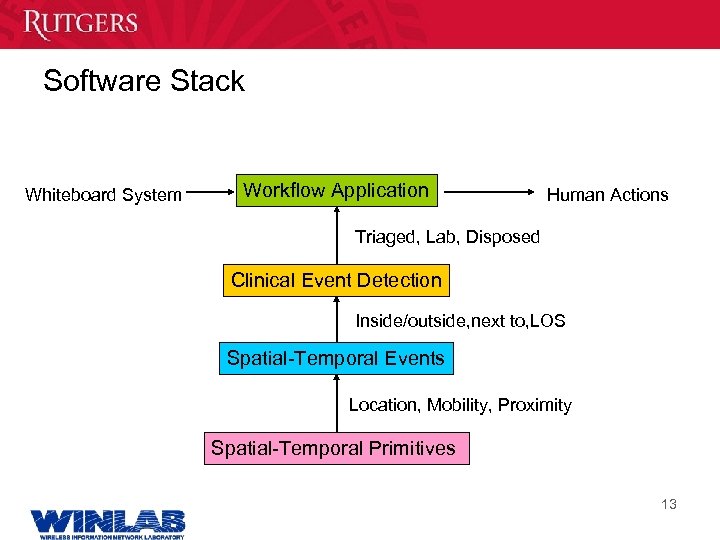 Software Stack Whiteboard System Workflow Application Human Actions Triaged, Lab, Disposed Clinical Event Detection Inside/outside, next to, LOS Spatial-Temporal Events Location, Mobility, Proximity Spatial-Temporal Primitives 13
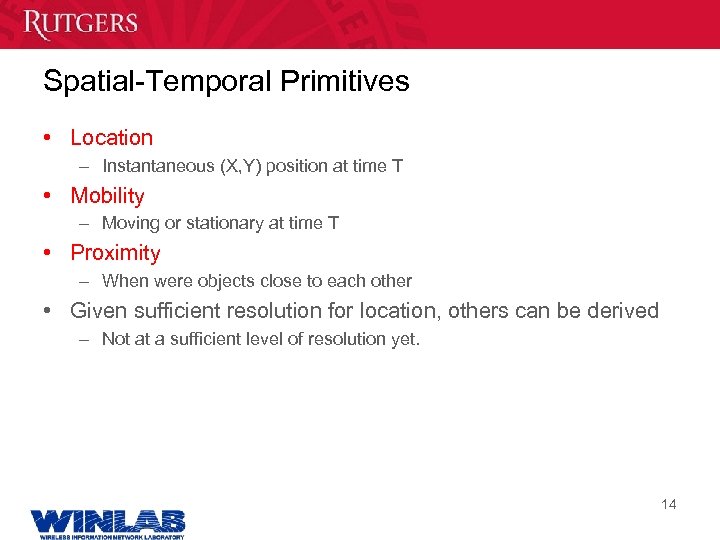 Spatial-Temporal Primitives • Location – Instantaneous (X, Y) position at time T • Mobility – Moving or stationary at time T • Proximity – When were objects close to each other • Given sufficient resolution for location, others can be derived – Not at a sufficient level of resolution yet. 14
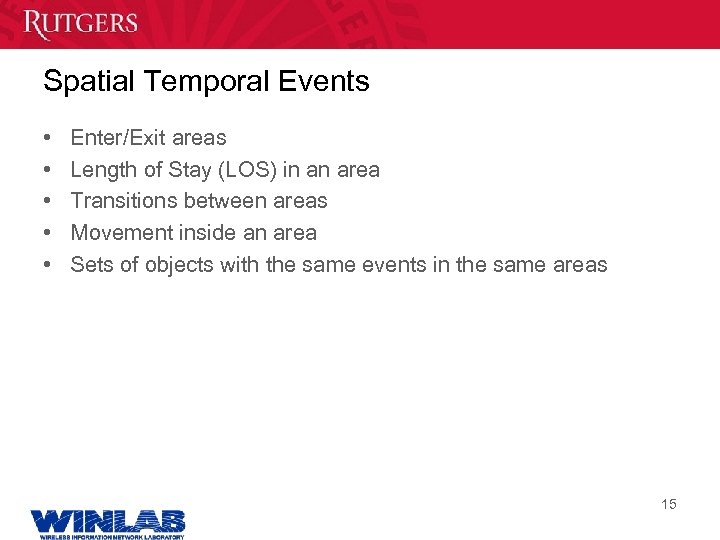 Spatial Temporal Events • • • Enter/Exit areas Length of Stay (LOS) in an area Transitions between areas Movement inside an area Sets of objects with the same events in the same areas 15
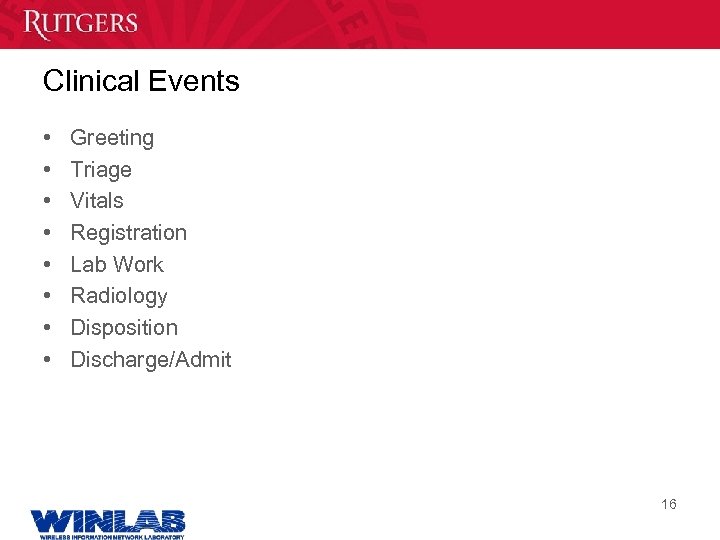 Clinical Events • • Greeting Triage Vitals Registration Lab Work Radiology Disposition Discharge/Admit 16
 Workflow improvement: • Treatment is a pipelined process • Bubbles in the pipeline cause delays • Dynamically reorganize activity to keep a smooth pipeline: – Pull nursing staff from treatment to triage during surge – Move physicians between units – Have staff push on process delays taking too long • Lab, radiology, transport – Introduce accountability to change behavior 17
 Current Research • Roll-Call – High density active RFID tags • Rich Howard and Yanyong Zhang, Rutgers • Primitives and Spatial Events: – GRAIL – Localization – Mobility Detection 18
 Roll-Call • Goal: High density, low cost active RFID tags + readers • 1, 500 tags/reader possible with 1 second beacon rate (simulated) – 100 + actual, (not enough tags!) 19
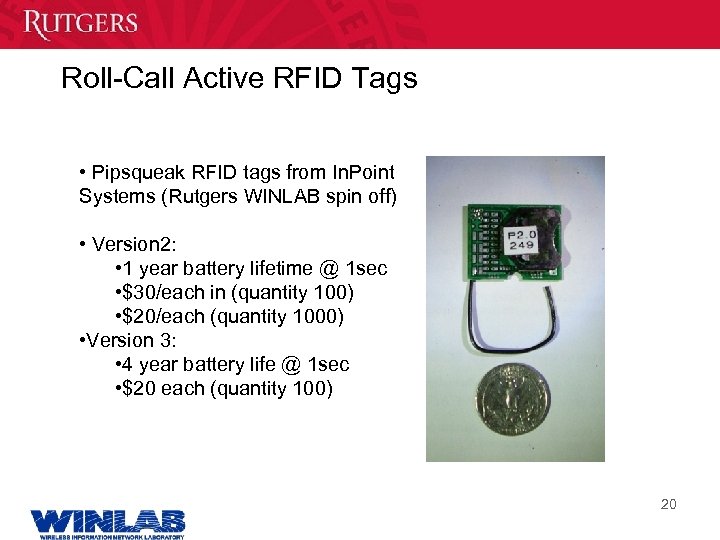 Roll-Call Active RFID Tags • Pipsqueak RFID tags from In. Point Systems (Rutgers WINLAB spin off) • Version 2: • 1 year battery lifetime @ 1 sec • $30/each in (quantity 100) • $20/each (quantity 1000) • Version 3: • 4 year battery life @ 1 sec • $20 each (quantity 100) 20
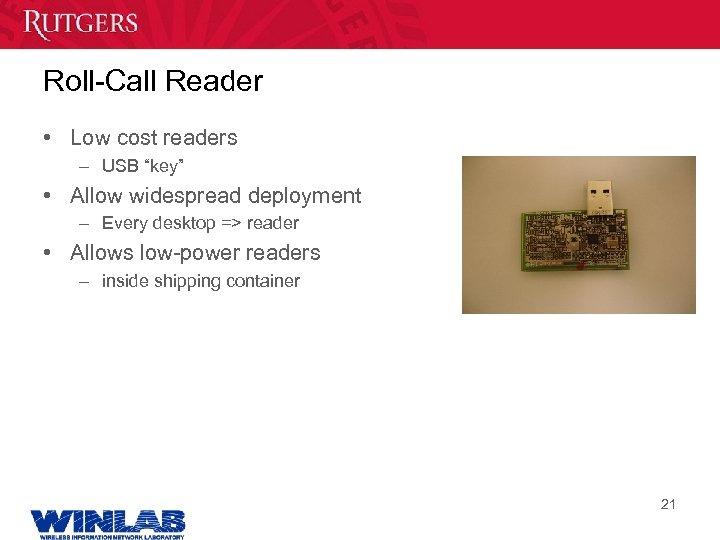 Roll-Call Reader • Low cost readers – USB “key” • Allow widespread deployment – Every desktop => reader • Allows low-power readers – inside shipping container 21
 Research Challenges • Transmit-only protocols • Compare to 2 -way communication • Group-level time-domain scheduling • Read/listen tags • Low energy read environments • Energy management • Tag-level • Global/Area 22
 GRAIL: Motivation • Maintains real time position of everything • Plausible: – $2 active tag (including battery) ($20 -30 today) – $0. 25 passive tags ($0. 5 - $4 today) • Use in Cyber-Physical applications 23
 GRAIL opportunity and vision • General purpose localization analogous to general purpose communication. – Support any wireless device with little/no modification – Supports vast range of performance • Devices: Passive tag/Active Tag/Zigbee/Phone/Laptop • Scales: City/campus/building/floor/room/shelf/drawer – Localize in any environment the device could be in – Only return device position to the people of concern (privacy, security features) • Permissions, Butlers, Anonymized IDs, Expirations 24
 GRAIL Project “We reject: kings, presidents, and voting. We believe in: rough consensus and running code” -David Clark, IETF meeting, July 1992 • Open source infrastructure for localization – http: //grailrtls. sourceforge. net – Need to move community beyond algorithms • Allows independent progress on different fronts: – Physical layers, algorithms, services • Used by Rutgers, Stevens, Lafayette 25
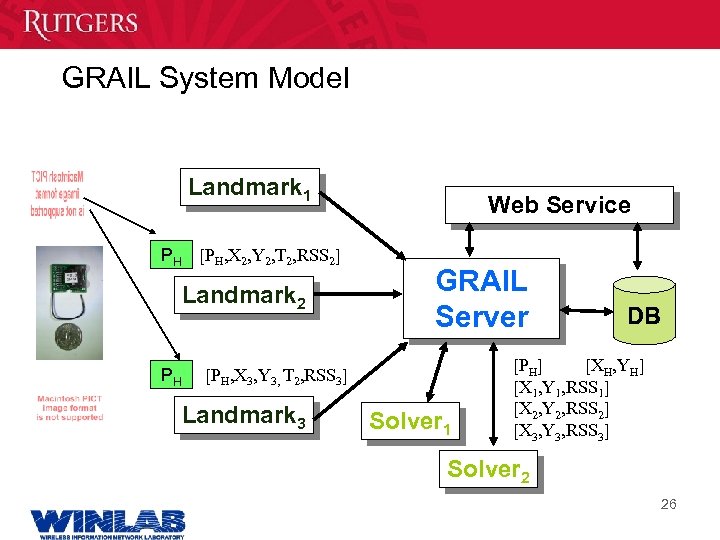 GRAIL System Model Landmark 1 PH [PH, X 2, Y 2, T 2, RSS 2] Landmark 2 PH Web Service GRAIL Server [PH, X 3, Y 3, T 2, RSS 3] Landmark 3 Solver 1 DB [PH] [XH, YH] [X 1, Y 1, RSS 1] [X 2, Y 2, RSS 2] [X 3, Y 3, RSS 3] Solver 2 26
 Example PDA/Wi. Fi Tracking 1. Reception 2. Nurses Room 3. Examination Room 4. Physician Room 5. Side Desk x : Localized estimate (+/- 1 : Ground truth : Landmark 27
 Tracking Demo http: //www. screentoaster. com/watch/st. V 0 p. WSk. BIR 1 x. YR 1 VVUltc. V 1 FW 28
 Technical Lessons • Expect 10 -15 ft. accuracy • Probably OK for most applications • Pipsqueak RFID tags as good a Wi. Fi • Requires slightly denser deployment • Good antenna exposure critical • Must hide tags and expose antenna too • Can we mix an array of technologies? • Passive tags, bluetooth phones? 29
 Mobility Detection • Detect if a device is moving or is stationary • Approach: – Record Received Signal Strength over Time Window – Compare histograms of RSS using: • Mean • Variance • Earth Mover’s Distance (EMD) – Threshold detection • Threshold found using 9 fold x validation and RIPPER alg on 1 room 30
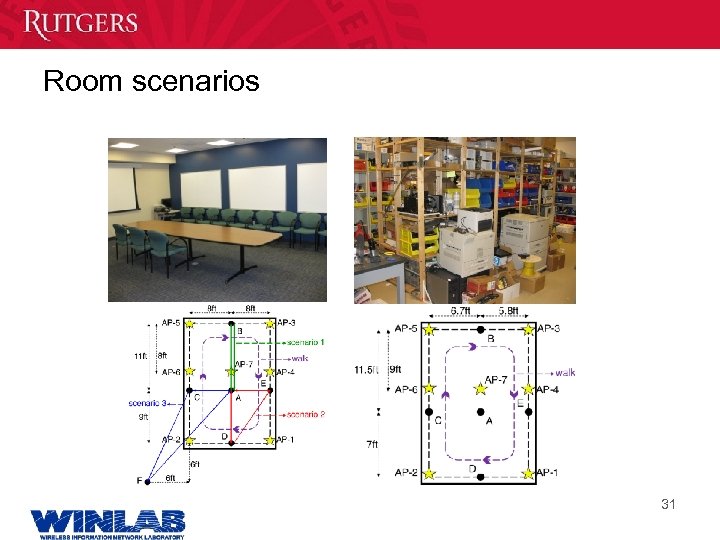 Room scenarios 31
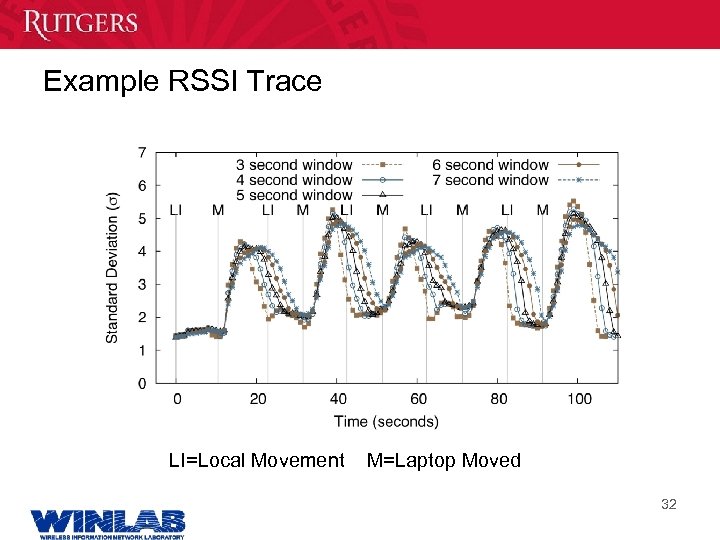 Example RSSI Trace LI=Local Movement M=Laptop Moved 32
 Detection Results 33
 Clinical Event Detection • Rule sets for mapping Spatial-Temporal primitives and events to clinical events • Map XY primitives to room (areas) event – Enter/leave, Length of Stay (LOS) • Room-level sequences + equipment mobility-> clinical events – Use streaming database abstractions (e. g. esper) 34
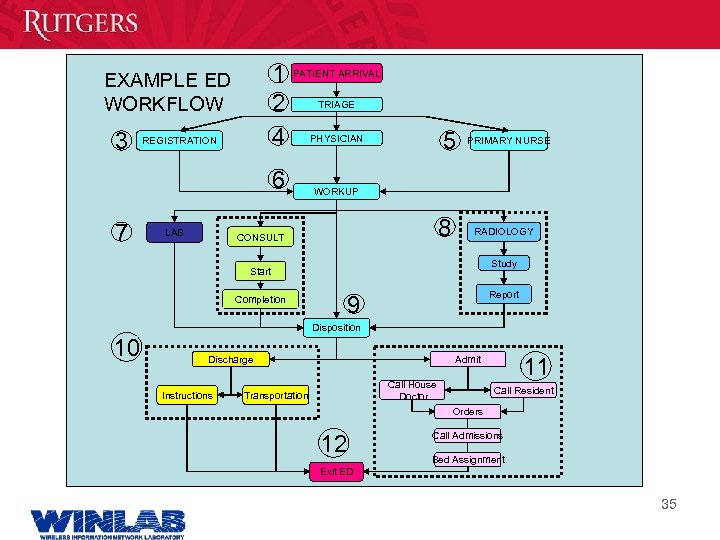 1 2 4 EXAMPLE ED WORKFLOW 3 REGISTRATION PATIENT ARRIVAL 6 7 LAB TRIAGE 5 PHYSICIAN PRIMARY NURSE WORKUP 8 CONSULT RADIOLOGY Study Start Report 9 Completion Disposition 10 Discharge Instructions 11 Admit Call House Doctor Transportation Call Resident Orders 12 Call Admissions Bed Assignment Exit ED 35
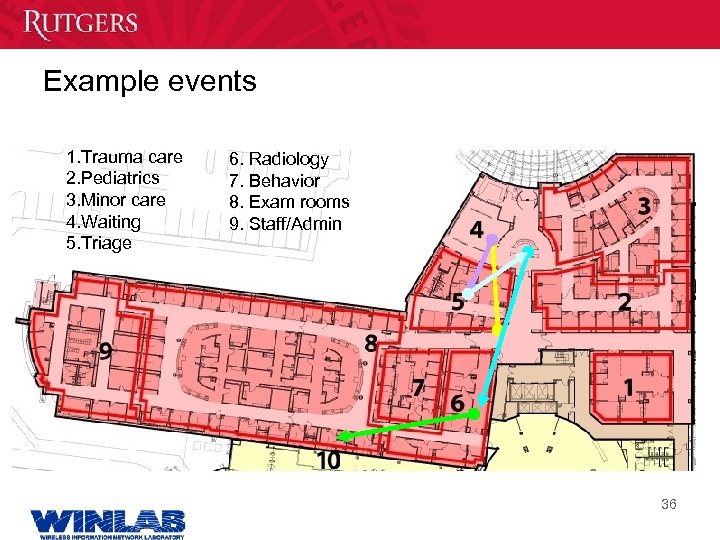 Example events 1. Trauma care 2. Pediatrics 3. Minor care 4. Waiting 5. Triage 6. Radiology 7. Behavior 8. Exam rooms 9. Staff/Admin 36
 Integration with Workflow • Build events into exiting workflow system (YAWL) • Assign new tasks • Change areas/roles (treatment->triage) • Call/inquire about length of time: – Labs, radiology, transport • Reorder tasks • Prioritize patients waiting the longest • Re-organize space? 37
 Outline • Promise of Sensor Networks and Cyber-Physical Systems • Application Overview: – Workflow for an Emergency Department • Recent Results: – Events, Localization and Tracking – Workflow • Open Research Challenges and Future Work 38
 Research Challenges • Integration with the Internet – Global Network Infrastructure sees all traffic, but routes data. Were to include position? • Privacy and security controls – Manage area vs. device owners • Positioning robustness – Bound maximum positioning error 39
 Conclusions • Time for focused application drive – What’s really important vs. what we thought was important • Will require a lot thinking about software stacks – Lower layers, events, 40
 Thank you! 41