


 Скачать презентацию Automatic flare detection and tracking of active regions
2d42d1671e1f610878c4229d0f64e0d6.ppt
- Количество слайдов: 16
 Automatic flare detection and tracking of active regions in EUV images. Véronique Delouille Joint work with Jean-François Hochedez (ROB), Judith de Patoul (ROB), and Vincent Barra (LIMOS) www. sidc. be European Space Weather week 13 -17 November 2006 1
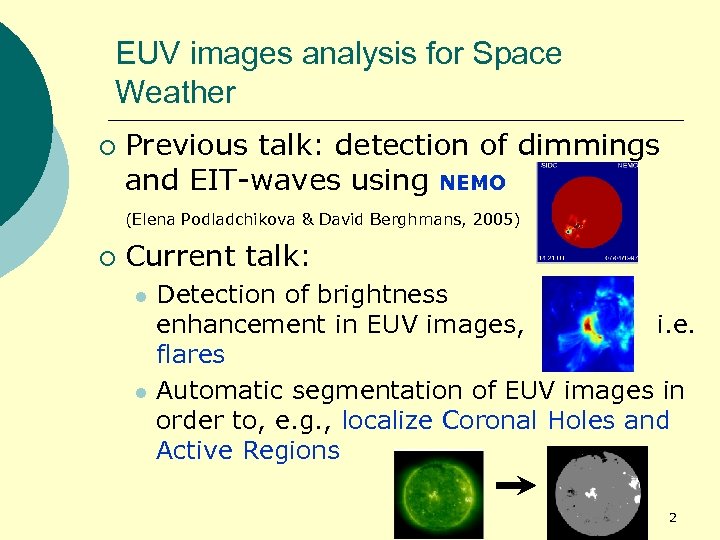 EUV images analysis for Space Weather ¡ Previous talk: detection of dimmings and EIT-waves using NEMO (Elena Podladchikova & David Berghmans, 2005) ¡ Current talk: l l Detection of brightness enhancement in EUV images, i. e. flares Automatic segmentation of EUV images in order to, e. g. , localize Coronal Holes and Active Regions 2
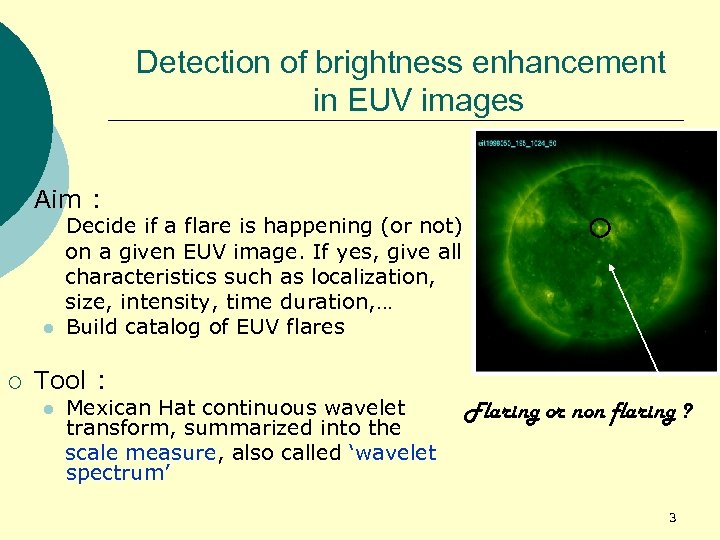 Detection of brightness enhancement in EUV images ¡ Aim : l l ¡ Decide if a flare is happening (or not) on a given EUV image. If yes, give all characteristics such as localization, size, intensity, time duration, … Build catalog of EUV flares Tool : l Mexican Hat continuous wavelet transform, summarized into the scale measure, also called ‘wavelet spectrum’ Flaring or non flaring ? 3
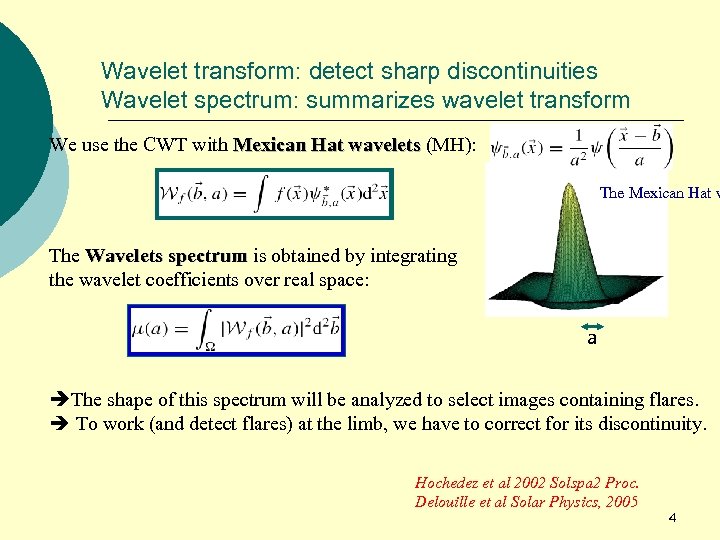 Wavelet transform: detect sharp discontinuities Wavelet spectrum: summarizes wavelet transform We use the CWT with Mexican Hat wavelets (MH): The Mexican Hat w The Wavelets spectrum is obtained by integrating the wavelet coefficients over real space: a The shape of this spectrum will be analyzed to select images containing flares. To work (and detect flares) at the limb, we have to correct for its discontinuity. Hochedez et al 2002 Solspa 2 Proc. Delouille et al Solar Physics, 2005 4
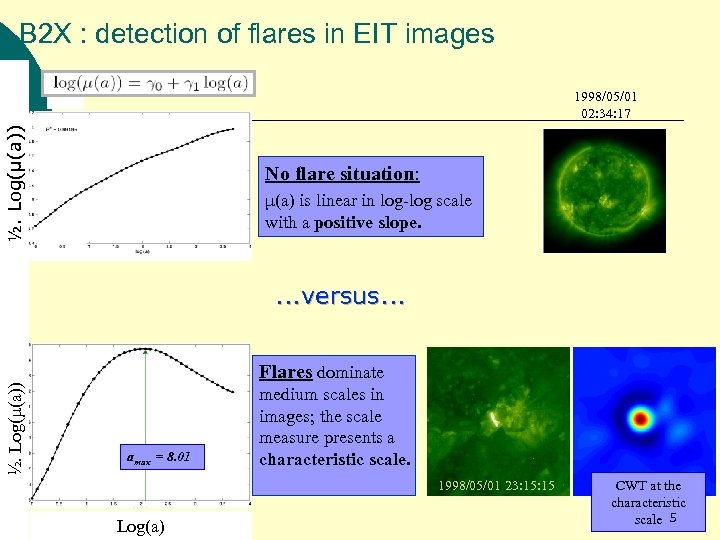 B 2 X : detection of flares in EIT images ½. Log(μ(a)) 1998/05/01 02: 34: 17 No flare situation: μ(a) is linear in log-log scale with a positive slope. ½. Log(μ(a)) …versus. . . Flares dominate amax = 8. 01 medium scales in images; the scale measure presents a characteristic scale. 1998/05/01 23: 15 Log(a) CWT at the characteristic scale 5
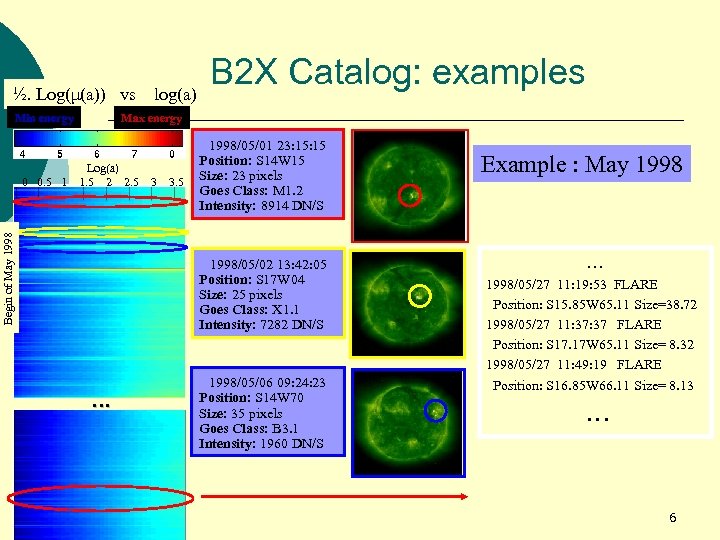 ½. Log(μ(a)) vs Min energy Max energy Log(a) 1. 5 2 2. 5 Begin of May 1998 0 0. 5 1 log(a) B 2 X Catalog: examples 3 3. 5 1998/05/01 23: 15 Position: S 14 W 15 Size: 23 pixels Goes Class: M 1. 2 Intensity: 8914 DN/S 1998/05/02 13: 42: 05 Position: S 17 W 04 Size: 25 pixels Goes Class: X 1. 1 Intensity: 7282 DN/S … 1998/05/06 09: 24: 23 Position: S 14 W 70 Size: 35 pixels Goes Class: B 3. 1 Intensity: 1960 DN/S Example : May 1998 … 1998/05/27 11: 19: 53 FLARE Position: S 15. 85 W 65. 11 Size=38. 72 1998/05/27 11: 37 FLARE Position: S 17. 17 W 65. 11 Size= 8. 32 1998/05/27 11: 49: 19 FLARE Position: S 16. 85 W 66. 11 Size= 8. 13 … 6
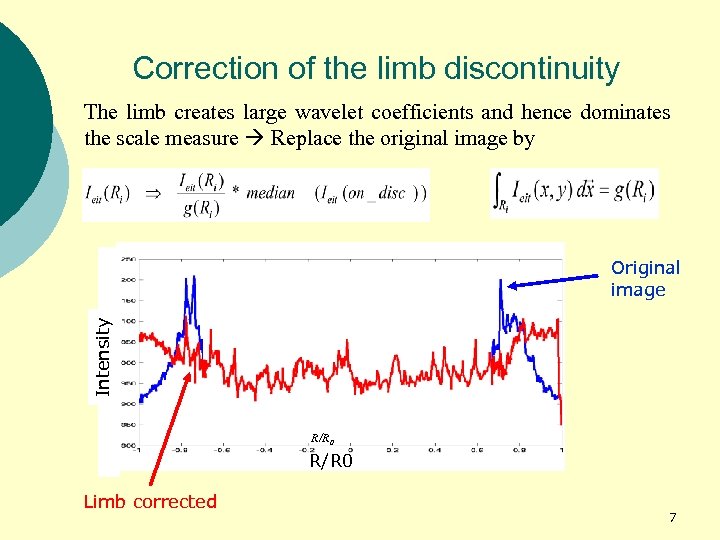 Correction of the limb discontinuity The limb creates large wavelet coefficients and hence dominates the scale measure Replace the original image by Intensity I Original image R/R 0 Limb corrected 7
 B 2 X-flare automatic detection and catalog Website : http: //sidc. be/B 2 X/ Poster of Judith de Patoul on Wednesday: “An automatic flare detection for building EUV flare catalog” 8
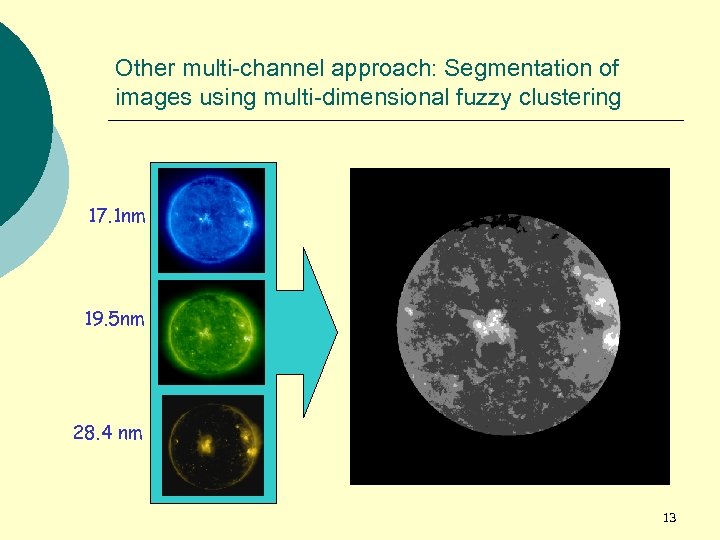
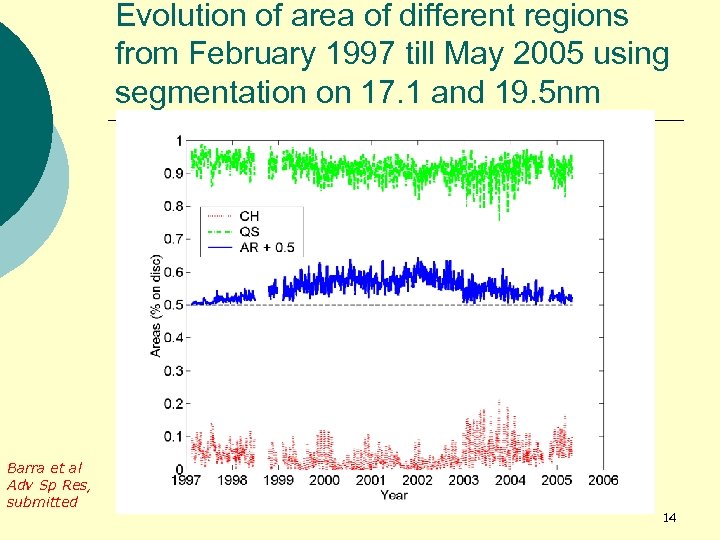
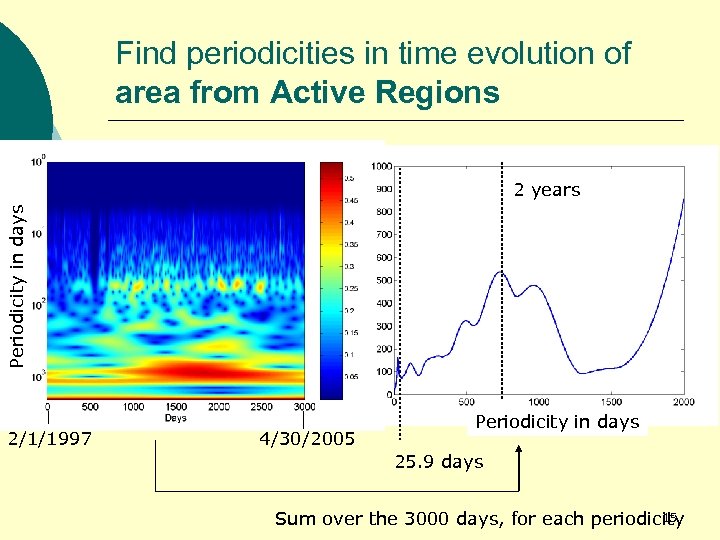
 Multispectral segmentation of EUV images ¡ Aim: separate Coronal Holes (CH), Quiet Sun (QS), and Active Regions (AR) : l l Localize CH (source of fast solar wind) Localize AR (source of flares) … But also … l Analyze time series evolution of area, mean intensity, cumulated intensity of CH, QS, AR separately Bridge the gap between imager telescope and radiometers. 9
 Fuzzy clustering : principle and advantages ¡ Non-fuzzy clustering: attribute to each pixel j a label to a class k Є {CH, QS, AR} l ¡ Fuzzy clustering: attribute a membership value to a class k l ¡ E. g. : pixel j belong to class AR E. g. : pixel j belong 80% to AR, 20% to QS Advantage of Fuzzy Clustering: l l uncertainty present in the images is better handle (noises, separation between types of regions not clear-cut) Inclusion of human expertise is possible 10
 Multispectral aspect: combine 17. 1 and 19. 5 nm EIT images 1. 2. Do fuzzy clustering on each wavelength separately, get membership for pixel j Combine membership for pixel j using a Fusion Operator: ¡ ¡ 3. If information between wavelength is consistent, operator retains the most pertinent information, i. e. it takes the minimum of memberships from 17. 1 and 19. 5 nm If information do not agree, operator acts cautiously, and takes the maximum of both memberships (acts as ensemblist union) Take a decision: attribute pixel j to class k for decision which it has the greatest membership. 11
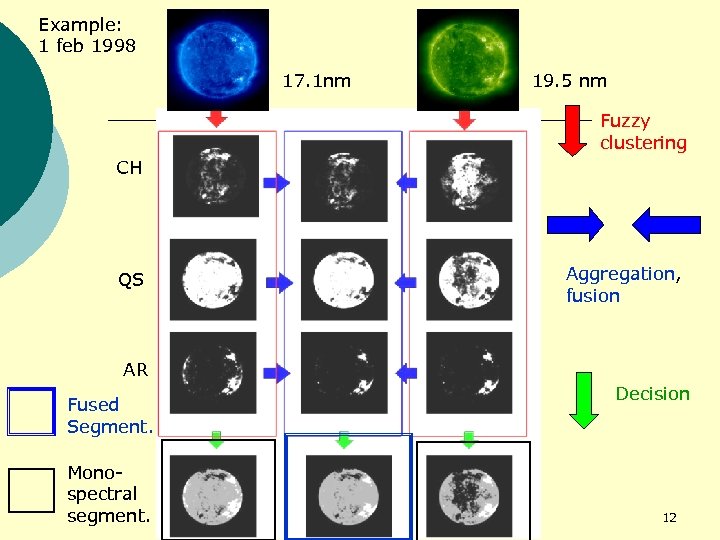 Example: 1 feb 1998 17. 1 nm 19. 5 nm Fuzzy clustering CH QS Aggregation, fusion AR Fused Segment. Monospectral segment. Decision 12
 Other multi-channel approach: Segmentation of images using multi-dimensional fuzzy clustering 17. 1 nm 19. 5 nm 28. 4 nm 13
 Evolution of area of different regions from February 1997 till May 2005 using segmentation on 17. 1 and 19. 5 nm Barra et al Adv Sp Res, submitted 14
 Find periodicities in time evolution of area from Active Regions Periodicity in days 2 years 2/1/1997 4/30/2005 Periodicity in days 25. 9 days 15 Sum over the 3000 days, for each periodicity
 Conclusion ¡ On-disc flare detection using B 2 X l l ¡ Study characteristics of EUV flares: statistics on their duration, position, size, etc, . . . Catalog and real-time detection Segmentation of EUV images l l l Automatic tracking of coronal holes and Active region Separation contribution to intensity from CH, QS, AR Analyses of periodicity in area, mean intensity, cumulated intensity. 16