 Скачать презентацию Automatic Acquisition of Subcategorization Frames for Czech Anoop
9114172fcebfbe748bcc976fffd9f7fc.ppt
- Количество слайдов: 26




Automatic Acquisition of Subcategorization Frames for Czech Anoop Sarkar Daniel Zeman 1 August 2000 Coling 2000 Saarbrücken
The task • Arguments vs. adjuncts. • Discover valid subcategorization frames for each verb. • Learning from data not annotated with SF information. 1 August 2000 Coling 2000 Saarbrücken 2
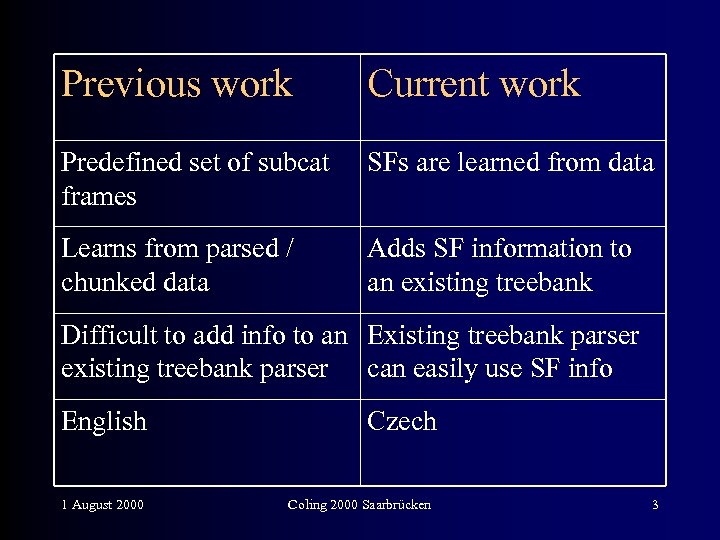
Previous work Current work Predefined set of subcat frames SFs are learned from data Learns from parsed / chunked data Adds SF information to an existing treebank Difficult to add info to an Existing treebank parser existing treebank parser can easily use SF info English 1 August 2000 Czech Coling 2000 Saarbrücken 3
Comparison to previous work • Previous methods use binomial models of miscue probabilities • Current method compares three statistical techniques for hypothesis testing • Useful for treebanks where heuristic techniques cannot be applied (unlike Penn Treebank) 1 August 2000 Coling 2000 Saarbrücken 4
![The Prague Dependency Treebank (PDT) [#, 0] [však, 8] but [mají, 2] have [studenti,](https://present5.com/presentation/9114172fcebfbe748bcc976fffd9f7fc/image-5.jpg "The Prague Dependency Treebank (PDT) [#, 0] [však, 8] but [mají, 2] have [studenti,")
The Prague Dependency Treebank (PDT) [#, 0] [však, 8] but [mají, 2] have [studenti, 1] students [. , 12] [, , 6] [zájem, 5] interest [o, 3] in [fakultě, 7] faculty (dative) [chybí, 10] miss [letos, 9] this year [angličtináři, 11] teachers of English [jazyky, 4] languages 1 August 2000 Coling 2000 Saarbrücken 5
![Output of the algorithm [ZSB] [JE] but [VPP 3 A] have [N 1] students](https://present5.com/presentation/9114172fcebfbe748bcc976fffd9f7fc/image-6.jpg "Output of the algorithm [ZSB] [JE] but [VPP 3 A] have [N 1] students")
Output of the algorithm [ZSB] [JE] but [VPP 3 A] have [N 1] students [ZIP] [VPP 3 A] miss [N 4] interest [R 4] in [N 3] faculty [DB] this year [N 1] teachers of English [NIP 4 A] languages 1 August 2000 Coling 2000 Saarbrücken 6
Statistical methods used • Likelihood ratio test • T-score test • Binomial models of miscue probabilities 1 August 2000 Coling 2000 Saarbrücken 7
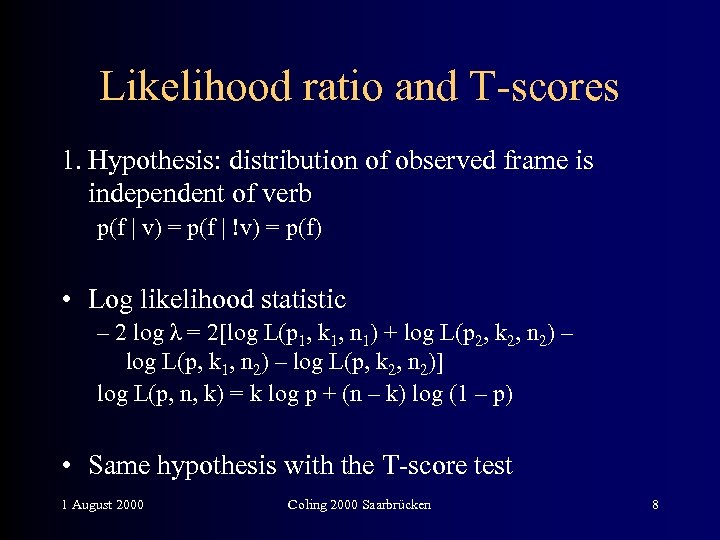
Likelihood ratio and T-scores 1. Hypothesis: distribution of observed frame is independent of verb p(f | v) = p(f | !v) = p(f) • Log likelihood statistic – 2 log λ = 2[log L(p 1, k 1, n 1) + log L(p 2, k 2, n 2) – log L(p, k 1, n 2) – log L(p, k 2, n 2)] log L(p, n, k) = k log p + (n – k) log (1 – p) • Same hypothesis with the T-score test 1 August 2000 Coling 2000 Saarbrücken 8
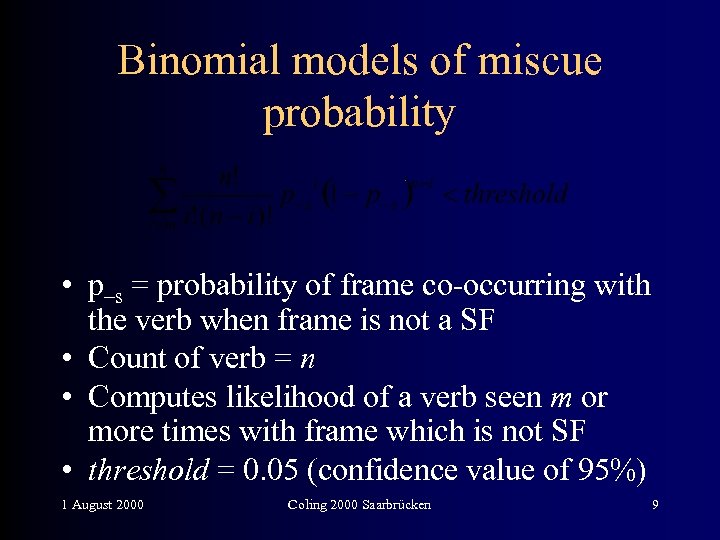
Binomial models of miscue probability • p–s = probability of frame co-occurring with the verb when frame is not a SF • Count of verb = n • Computes likelihood of a verb seen m or more times with frame which is not SF • threshold = 0. 05 (confidence value of 95%) 1 August 2000 Coling 2000 Saarbrücken 9
Relevant properties of Czech • Free word order • Rich morphology 1 August 2000 Coling 2000 Saarbrücken 10
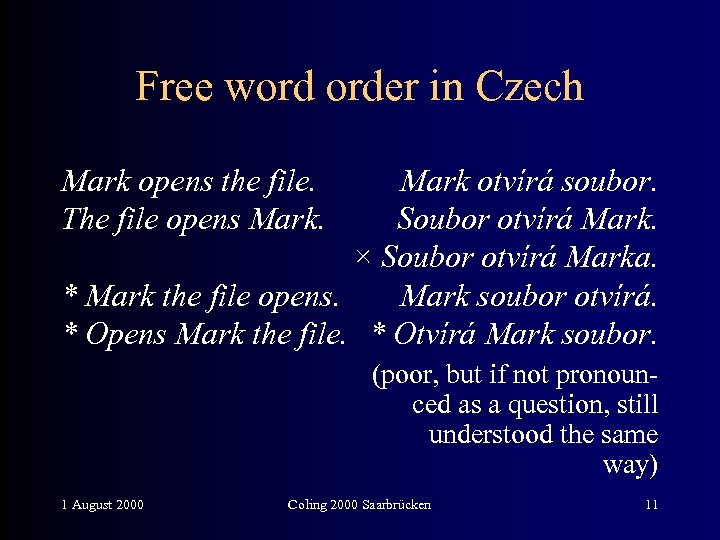
Free word order in Czech Mark opens the file. The file opens Mark otvírá soubor. Soubor otvírá Mark. × Soubor otvírá Marka. * Mark the file opens. Mark soubor otvírá. * Opens Mark the file. * Otvírá Mark soubor. (poor, but if not pronounced as a question, still understood the same way) 1 August 2000 Coling 2000 Saarbrücken 11
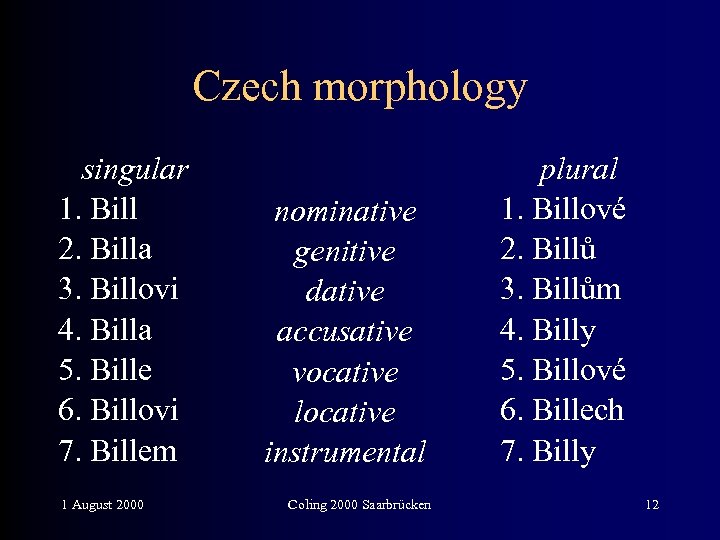
Czech morphology singular 1. Bill 2. Billa 3. Billovi 4. Billa 5. Bille 6. Billovi 7. Billem 1 August 2000 nominative genitive dative accusative vocative locative instrumental Coling 2000 Saarbrücken plural 1. Billové 2. Billů 3. Billům 4. Billy 5. Billové 6. Billech 7. Billy 12
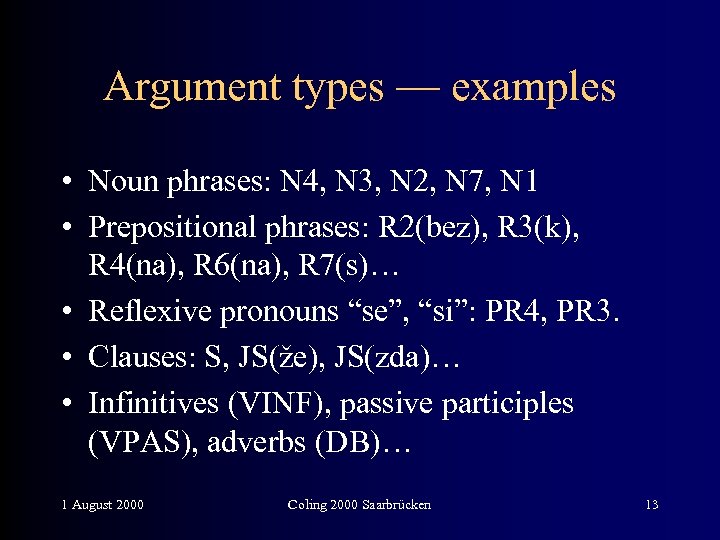
Argument types — examples • Noun phrases: N 4, N 3, N 2, N 7, N 1 • Prepositional phrases: R 2(bez), R 3(k), R 4(na), R 6(na), R 7(s)… • Reflexive pronouns “se”, “si”: PR 4, PR 3. • Clauses: S, JS(že), JS(zda)… • Infinitives (VINF), passive participles (VPAS), adverbs (DB)… 1 August 2000 Coling 2000 Saarbrücken 13
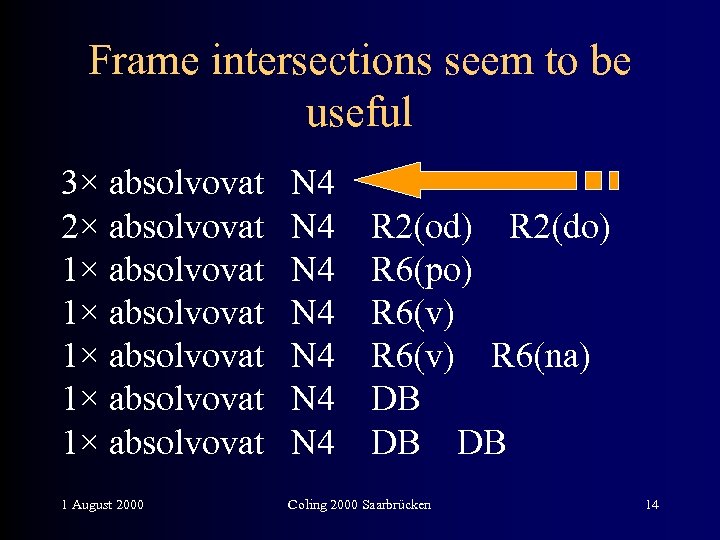
Frame intersections seem to be useful 3× absolvovat N 4 2× absolvovat N 4 R 2(od) R 2(do) 1× absolvovat N 4 R 6(po) 1× absolvovat N 4 R 6(v) R 6(na) 1× absolvovat N 4 DB DB 1 August 2000 Coling 2000 Saarbrücken 14
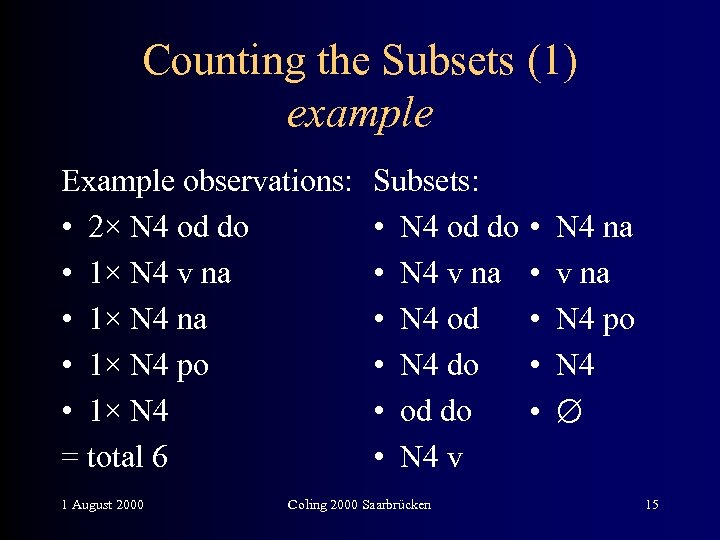
Counting the Subsets (1) example Example observations: • 2× N 4 od do • 1× N 4 v na • 1× N 4 po • 1× N 4 = total 6 1 August 2000 Subsets: • N 4 od do • N 4 v na • N 4 od • N 4 do • od do • N 4 v Coling 2000 Saarbrücken • • • N 4 na v na N 4 po N 4 15
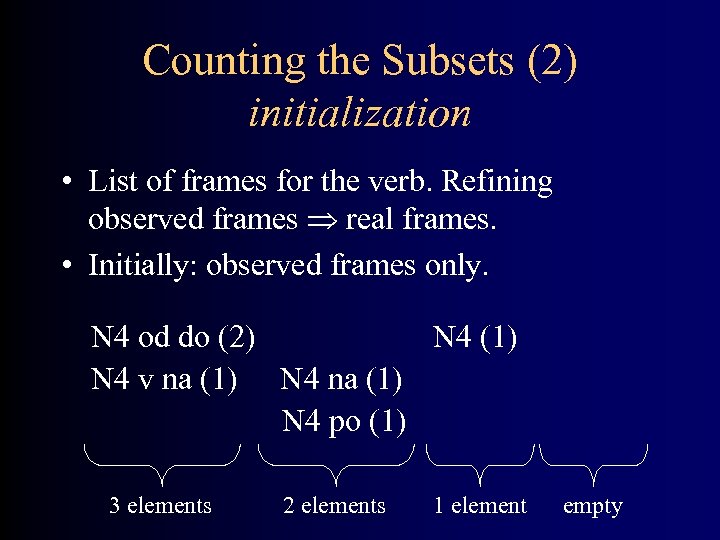
Counting the Subsets (2) initialization • List of frames for the verb. Refining observed frames real frames. • Initially: observed frames only. N 4 od do (2) N 4 (1) N 4 v na (1) N 4 po (1) 3 elements 2 elements 1 element empty
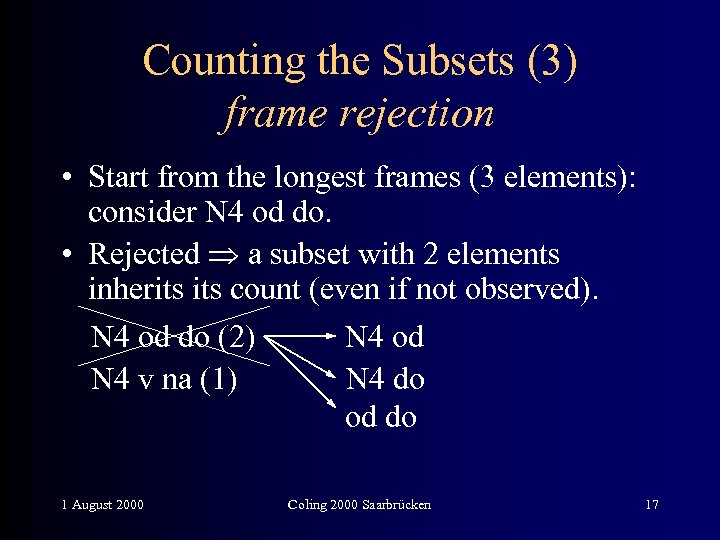
Counting the Subsets (3) frame rejection • Start from the longest frames (3 elements): consider N 4 od do. • Rejected a subset with 2 elements inherits count (even if not observed). N 4 od do (2) N 4 od N 4 v na (1) N 4 do od do 1 August 2000 Coling 2000 Saarbrücken 17
Counting the Subsets (4) successor selection • How to select the successor? • Idea: lowest entropy, strongest preference exponential complexity. • Zero approach: first come, first served (= random selection). • Heuristic 1: highest frequency at the given moment (not observing possible later heritages from other frames). 1 August 2000 Coling 2000 Saarbrücken 18
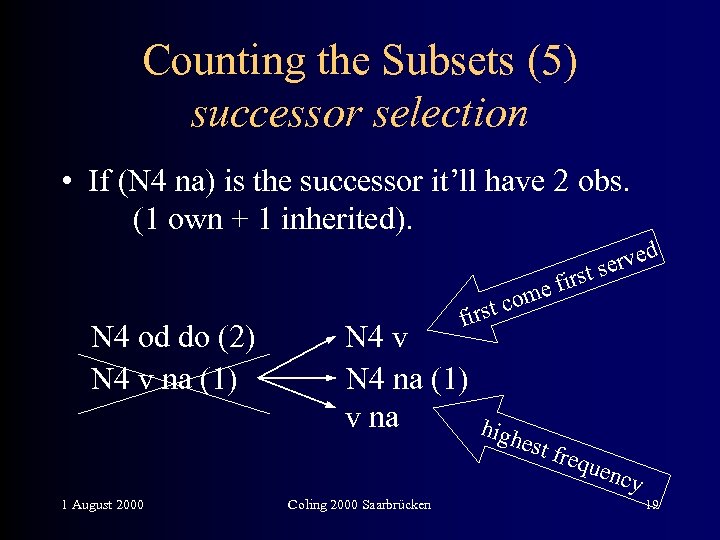
Counting the Subsets (5) successor selection • If (N 4 na) is the successor it’ll have 2 obs. (1 own + 1 inherited). N 4 od do (2) N 4 v na (1) 1 August 2000 f ome c first N 4 v N 4 na (1) v na Coling 2000 Saarbrücken rved e rst s i high est f requ ency 19
Counting the Subsets (7) summary • Random selection (first come first served) leads — surprisingly — to best results. • All rejected frames devise their frequencies to their subsets. • All frames, that are not rejected, are considered real frames of the verb (at least the empty frame should survive). 1 August 2000 Coling 2000 Saarbrücken 20
Results • • 19, 126 sent. (300 K words) training data. 33, 641 verb occurrences. 2, 993 different verbs. 28, 765 observed “dependent” frames. 13, 665 frames after preprocessing. 914 verbs seen 5 or more times. 1, 831 frames survived filtering. 137 frame classes learned (known lbound: 184). 1 August 2000 Coling 2000 Saarbrücken 21
Evaluation method • • No electronic subcategorization dictionary. Only a small (556 verbs) paper dictionary. So I annotated 495 sentences. Evaluation: go through the test data, try to apply a learned frame (longest match wins), compare to annotated arg/adj value (contiguous 0 to 1). • We do not test unknown verbs.
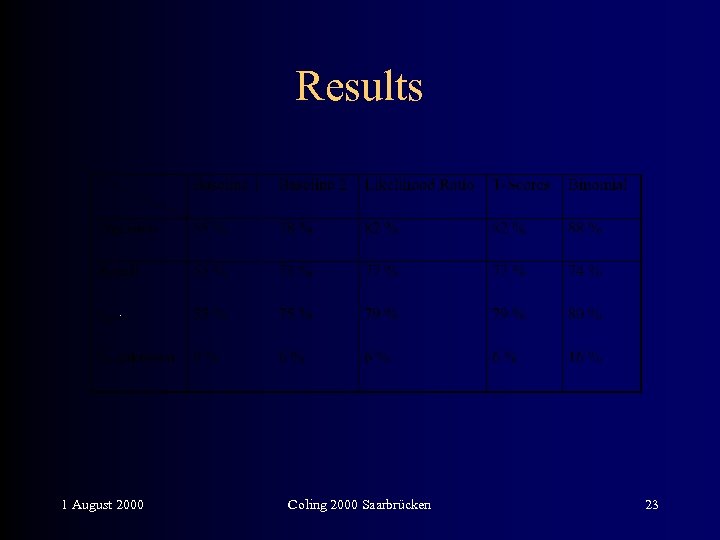
Results 1 August 2000 Coling 2000 Saarbrücken 23
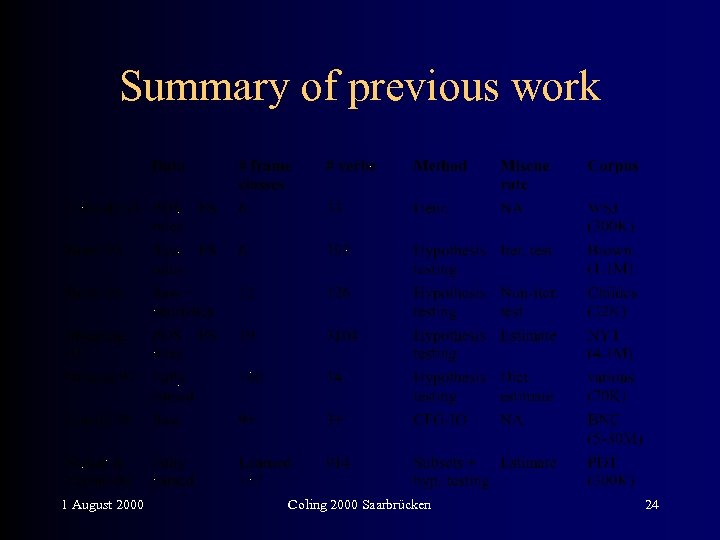
Summary of previous work 1 August 2000 Coling 2000 Saarbrücken 24
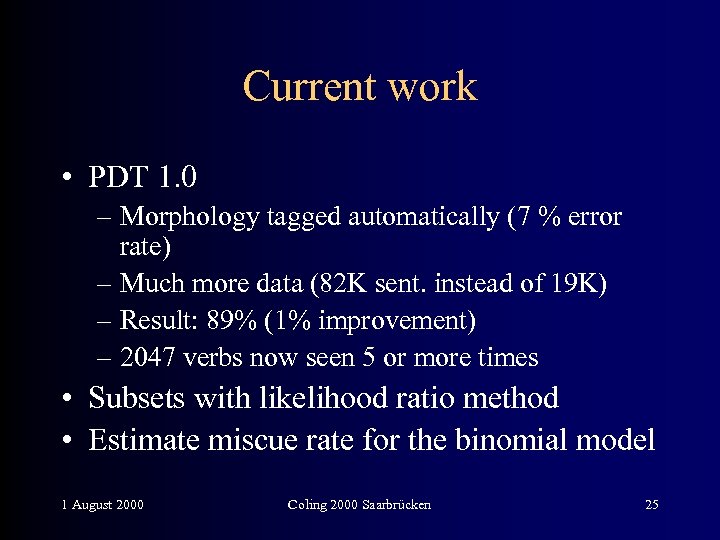
Current work • PDT 1. 0 – Morphology tagged automatically (7 % error rate) – Much more data (82 K sent. instead of 19 K) – Result: 89% (1% improvement) – 2047 verbs now seen 5 or more times • Subsets with likelihood ratio method • Estimate miscue rate for the binomial model 1 August 2000 Coling 2000 Saarbrücken 25
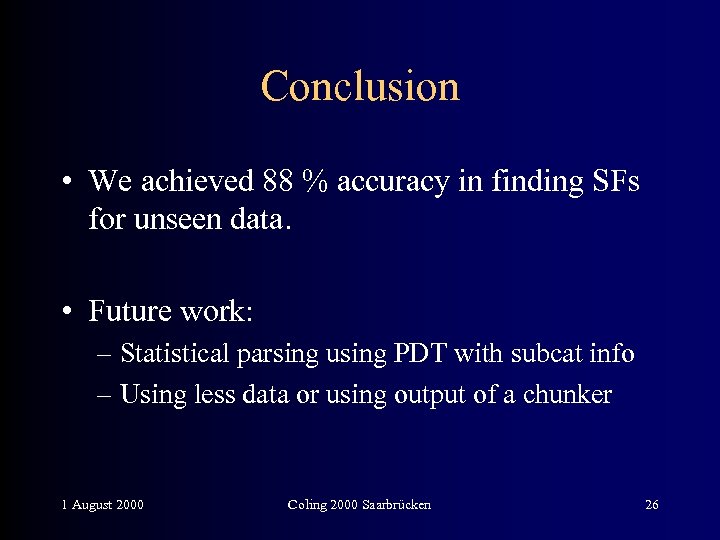
Conclusion • We achieved 88 % accuracy in finding SFs for unseen data. • Future work: – Statistical parsing using PDT with subcat info – Using less data or using output of a chunker 1 August 2000 Coling 2000 Saarbrücken 26
Скачать презентацию Automatic Acquisition of Subcategorization Frames for Czech Anoop
9114172fcebfbe748bcc976fffd9f7fc.ppt