


 Скачать презентацию AUTOMATED VALUATION MODELS OF REAL STATE FOR CADASTRAL
6fc1a45b6fd301613d6ebb8398818cd9.ppt
- Количество слайдов: 40
 AUTOMATED VALUATION MODELS OF REAL STATE FOR CADASTRAL PURPOSES Reform of the Italian cadastral valuation system: regulations, analysis and testing Santiago de Compostela, October 20 th 2006 Antonio de Santis - Santiago de Compostela October 2006
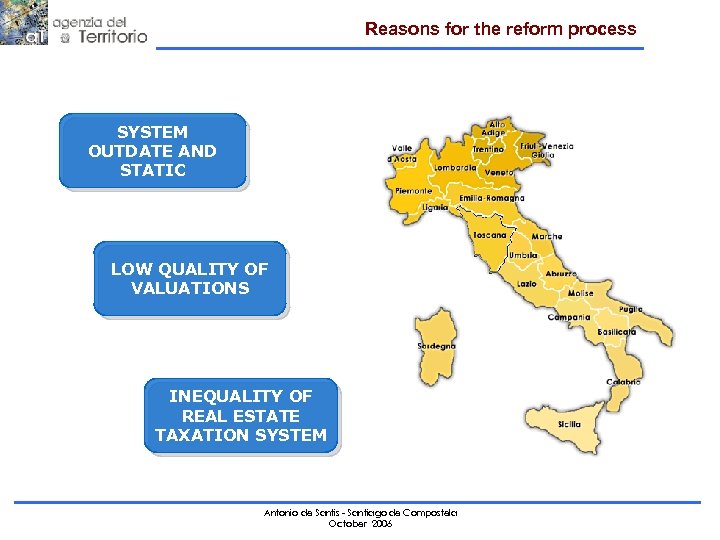 Reasons for the reform process SYSTEM OUTDATE AND STATIC LOW QUALITY OF VALUATIONS INEQUALITY OF REAL ESTATE TAXATION SYSTEM Antonio de Santis - Santiago de Compostela October 2006
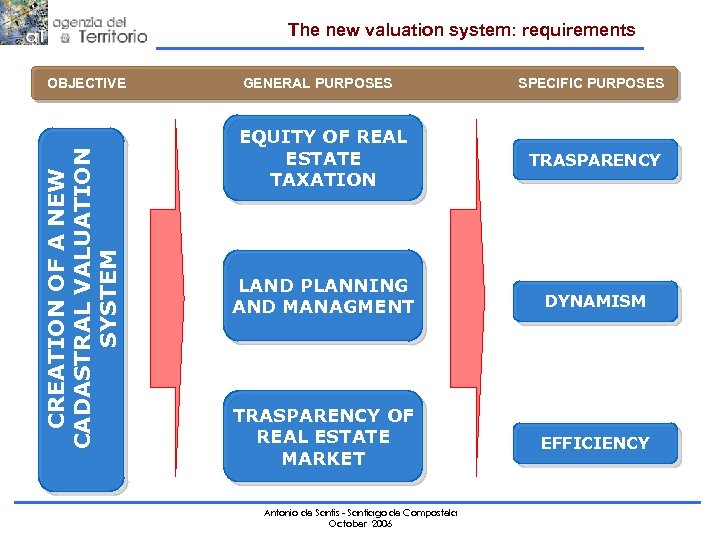 The new valuation system: requirements CREATION OF A NEW CADASTRAL VALUATION SYSTEM OBJECTIVE GENERAL PURPOSES SPECIFIC PURPOSES EQUITY OF REAL ESTATE TAXATION TRASPARENCY LAND PLANNING AND MANAGMENT DYNAMISM TRASPARENCY OF REAL ESTATE MARKET EFFICIENCY Antonio de Santis - Santiago de Compostela October 2006
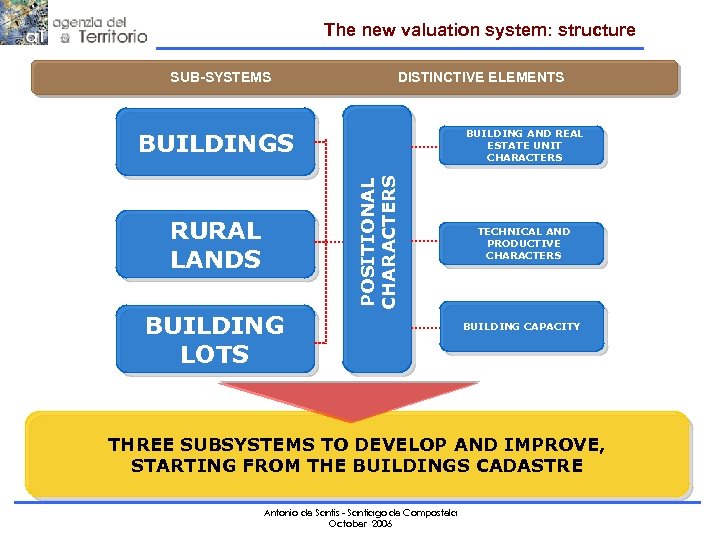 The new valuation system: structure SUB-SYSTEMS DISTINCTIVE ELEMENTS BUILDING AND REAL ESTATE UNIT CHARACTERS POSITIONAL CHARACTERS BUILDINGS RURAL LANDS BUILDING LOTS TECHNICAL AND PRODUCTIVE CHARACTERS BUILDING CAPACITY THREE SUBSYSTEMS TO DEVELOP AND IMPROVE, STARTING FROM THE BUILDINGS CADASTRE Antonio de Santis - Santiago de Compostela October 2006
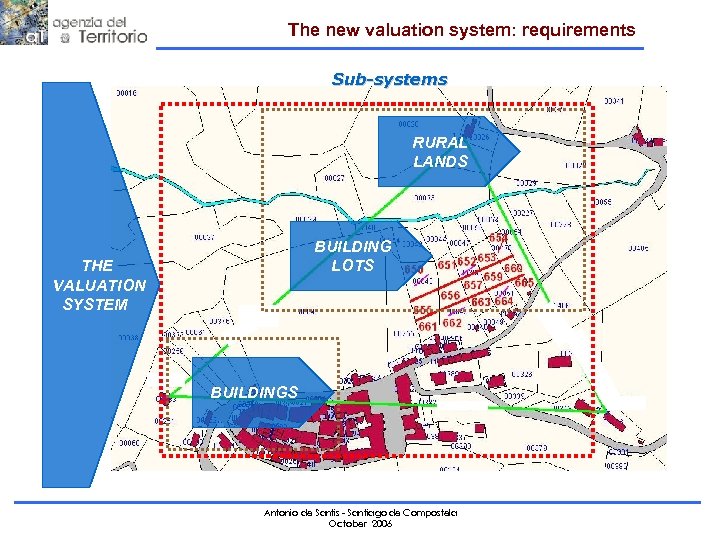 The new valuation system: requirements Sub-systems RURAL LANDS BUILDING LOTS THE VALUATION SYSTEM BUILDINGS Antonio de Santis - Santiago de Compostela October 2006
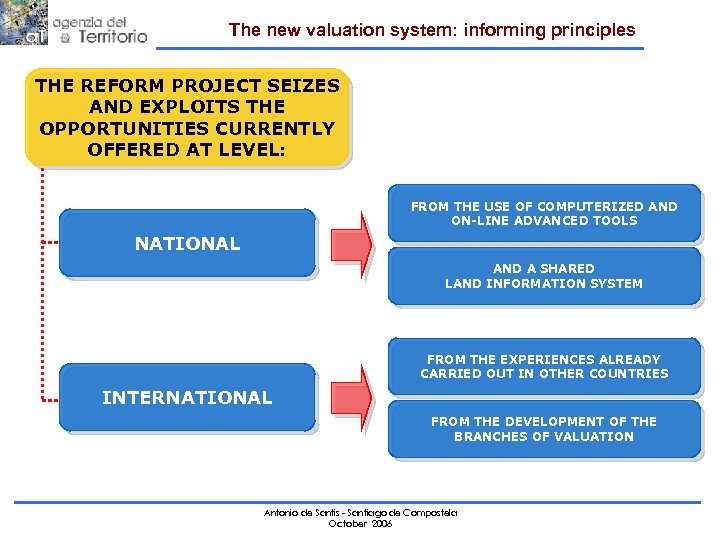 The new valuation system: informing principles THE REFORM PROJECT SEIZES AND EXPLOITS THE OPPORTUNITIES CURRENTLY OFFERED AT LEVEL: FROM THE USE OF COMPUTERIZED AND ON-LINE ADVANCED TOOLS NATIONAL AND A SHARED LAND INFORMATION SYSTEM FROM THE EXPERIENCES ALREADY CARRIED OUT IN OTHER COUNTRIES INTERNATIONAL FROM THE DEVELOPMENT OF THE BRANCHES OF VALUATION Antonio de Santis - Santiago de Compostela October 2006
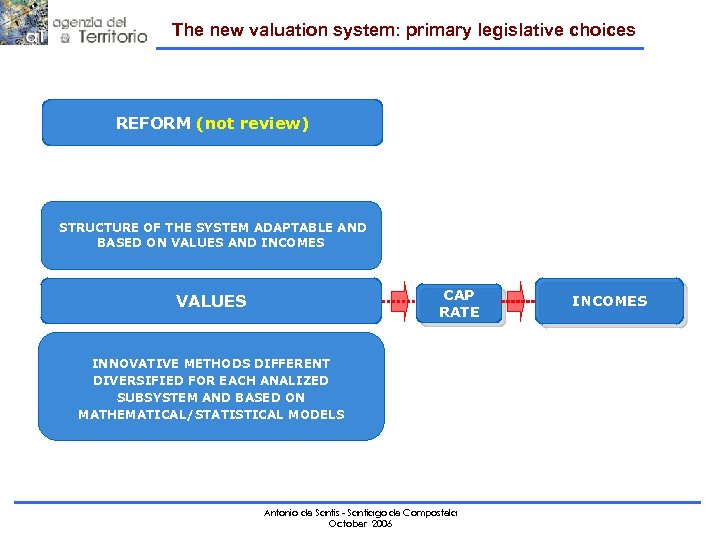 The new valuation system: primary legislative choices REFORM (not review) STRUCTURE OF THE SYSTEM ADAPTABLE AND BASED ON VALUES AND INCOMES CAP RATE VALUES INNOVATIVE METHODS DIFFERENT DIVERSIFIED FOR EACH ANALIZED SUBSYSTEM AND BASED ON MATHEMATICAL/STATISTICAL MODELS Antonio de Santis - Santiago de Compostela October 2006 INCOMES
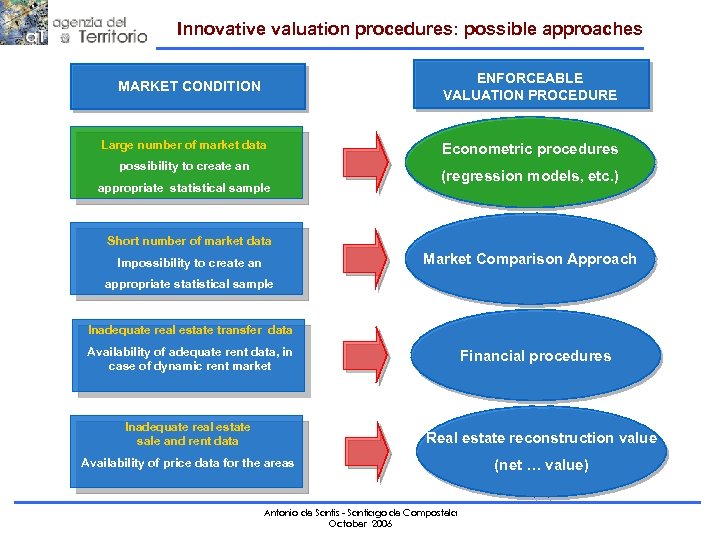 Innovative valuation procedures: possible approaches ENFORCEABLE VALUATION PROCEDURE MARKET CONDITION Large number of market data possibility to create an appropriate statistical sample Econometric procedures (regression models, etc. ) Short number of market data Market Comparison Approach Impossibility to create an appropriate statistical sample Inadequate real estate transfer data Availability of adequate rent data, in case of dynamic rent market Financial procedures Inadequate real estate sale and rent data Real estate reconstruction value Availability of price data for the areas (net … value) Antonio de Santis - Santiago de Compostela October 2006
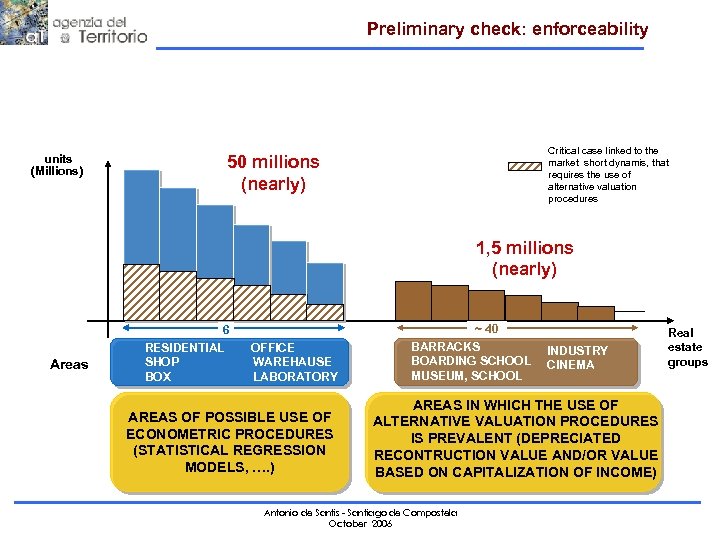 Preliminary check: enforceability units (Millions) Critical case linked to the market short dynamis, that requires the use of alternative valuation procedures 50 millions (nearly) 1, 5 millions (nearly) Areas 6 RESIDENTIAL SHOP BOX OFFICE WAREHAUSE LABORATORY AREAS OF POSSIBLE USE OF ECONOMETRIC PROCEDURES (STATISTICAL REGRESSION MODELS, …. ) ~ 40 BARRACKS BOARDING SCHOOL MUSEUM, SCHOOL INDUSTRY CINEMA AREAS IN WHICH THE USE OF ALTERNATIVE VALUATION PROCEDURES IS PREVALENT (DEPRECIATED RECONTRUCTION VALUE AND/OR VALUE BASED ON CAPITALIZATION OF INCOME) Antonio de Santis - Santiago de Compostela October 2006 Real estate groups
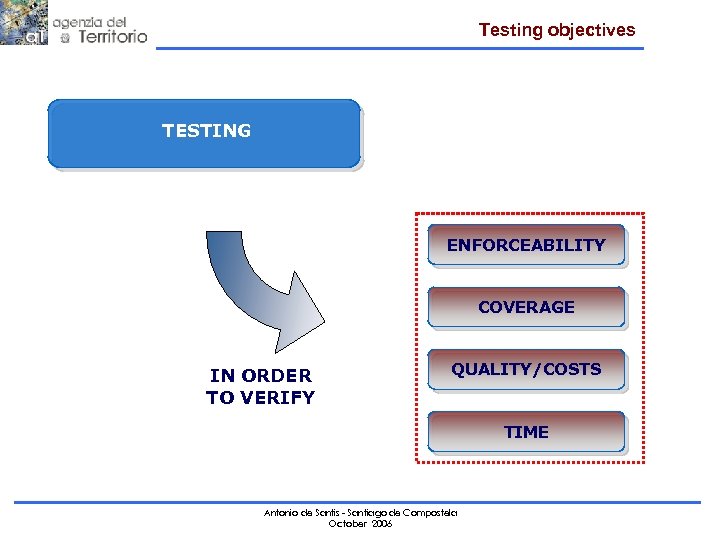 Testing objectives TESTING ENFORCEABILITY COVERAGE IN ORDER TO VERIFY QUALITY/COSTS TIME Antonio de Santis - Santiago de Compostela October 2006
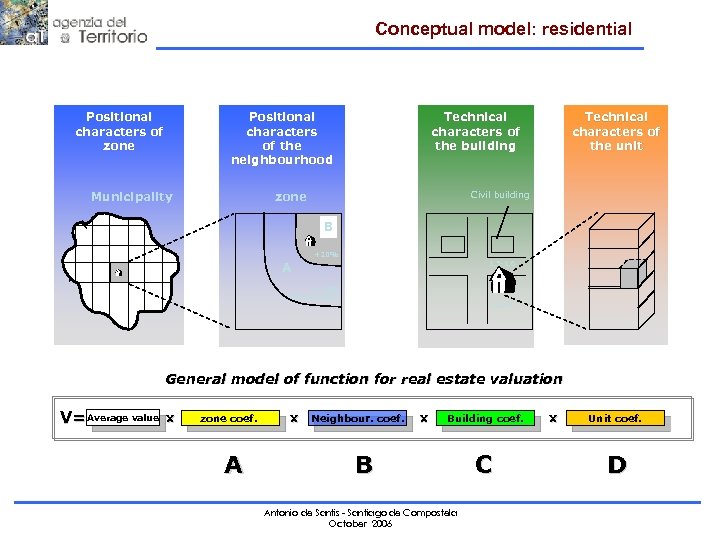 Conceptual model: residential Positional characters of zone Positional characters of the neighbourhood Municipality Technical characters of the building zone Technical characters of the unit Civil building M B +20% 1, 5 -1, 6 A +10% Valore medio 1, 6 -2 General model of function for real estate valuation V= Average value x zone coef. A x Neighbour. coef. x Building coef. B Antonio de Santis - Santiago de Compostela October 2006 C x Unit coef. D
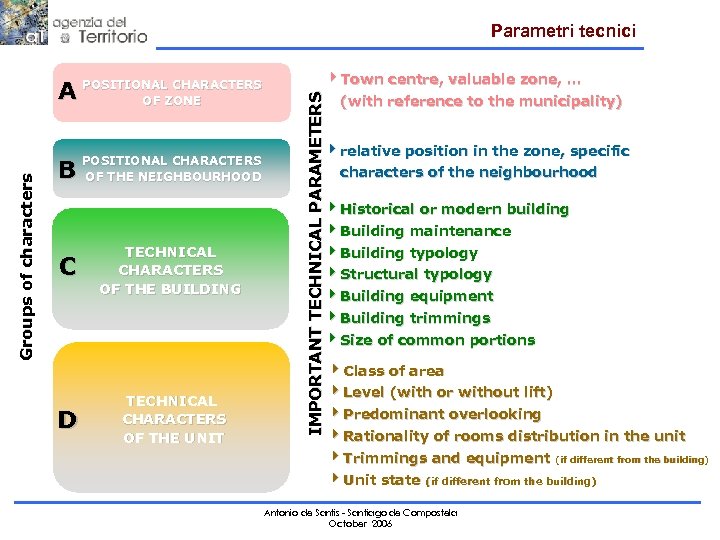 Groups of characters CHARACTERS A POSITIONALZONE OF B POSITIONAL CHARACTERS OF THE NEIGHBOURHOOD IMPORTANT TECHNICAL PARAMETERS Parametri tecnici 4 Town centre, valuable zone, … (with reference to the municipality) 4 relative position in the zone, specific characters of the neighbourhood 4 Historical or modern building 4 Building maintenance C TECHNICAL CHARACTERS OF THE BUILDING 4 Building typology 4 Structural typology 4 Building equipment 4 Building trimmings 4 Size of common portions D TECHNICAL CHARACTERS OF THE UNIT 4 Class of area 4 Level (with or without lift) 4 Predominant overlooking 4 Rationality of rooms distribution in the unit 4 Trimmings and equipment (if different from the building) 4 Unit state (if different from the building) Antonio de Santis - Santiago de Compostela October 2006
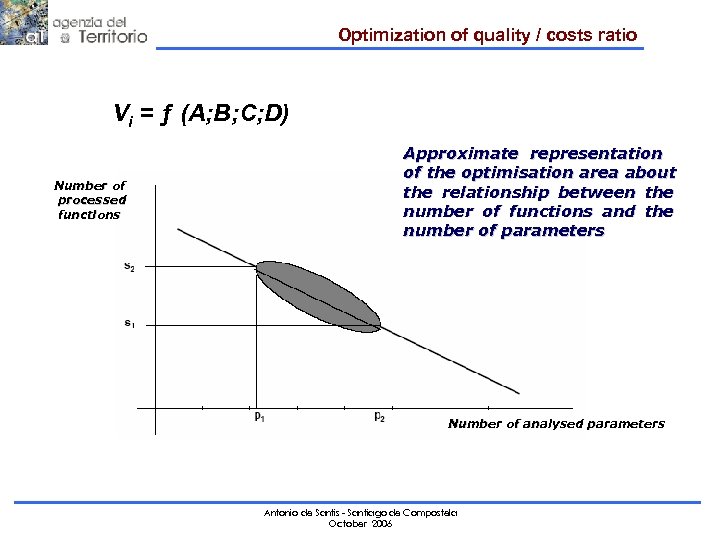 Optimization of quality / costs ratio Vi = ƒ (A; B; C; D) Number of processed functions Approximate representation of the optimisation area about the relationship between the number of functions and the number of parameters Number of analysed parameters Antonio de Santis - Santiago de Compostela October 2006
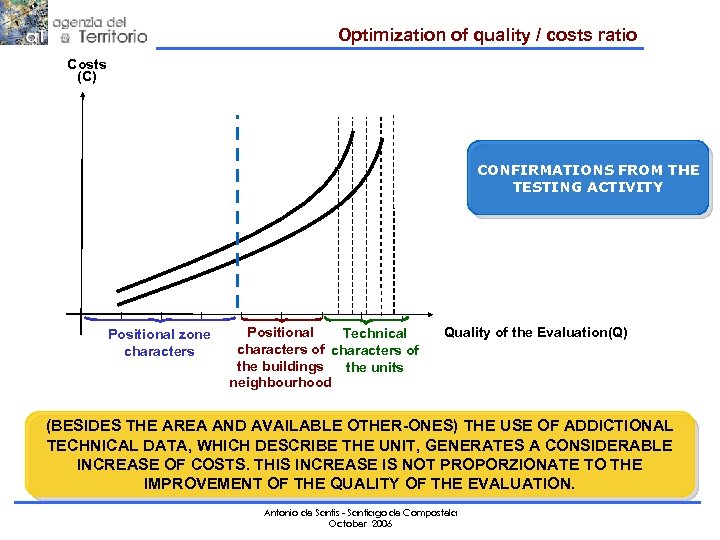 Optimization of quality / costs ratio Costs (C) CONFIRMATIONS FROM THE TESTING ACTIVITY Positional zone characters Positional Technical characters of the buildings the units neighbourhood Quality of the Evaluation(Q) (BESIDES THE AREA AND AVAILABLE OTHER-ONES) THE USE OF ADDICTIONAL TECHNICAL DATA, WHICH DESCRIBE THE UNIT, GENERATES A CONSIDERABLE INCREASE OF COSTS. THIS INCREASE IS NOT PROPORZIONATE TO THE IMPROVEMENT OF THE QUALITY OF THE EVALUATION. Antonio de Santis - Santiago de Compostela October 2006
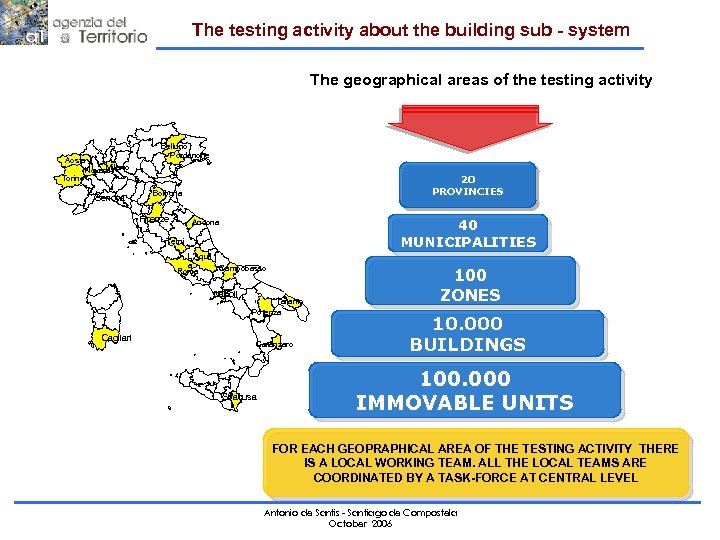 The testing activity about the building sub - system The geographical areas of the testing activity Aosta Milano Novara Torino Genova Belluno Pordenone 20 PROVINCIES Bologna Firenze 40 MUNICIPALITIES Ancona Terni L'Aquil a Campobasso Roma Napoli Cagliari Taranto Potenza Catanzaro Siracusa 100 ZONES 10. 000 BUILDINGS 100. 000 IMMOVABLE UNITS FOR EACH GEOPRAPHICAL AREA OF THE TESTING ACTIVITY THERE IS A LOCAL WORKING TEAM. ALL THE LOCAL TEAMS ARE COORDINATED BY A TASK-FORCE AT CENTRAL LEVEL Antonio de Santis - Santiago de Compostela October 2006
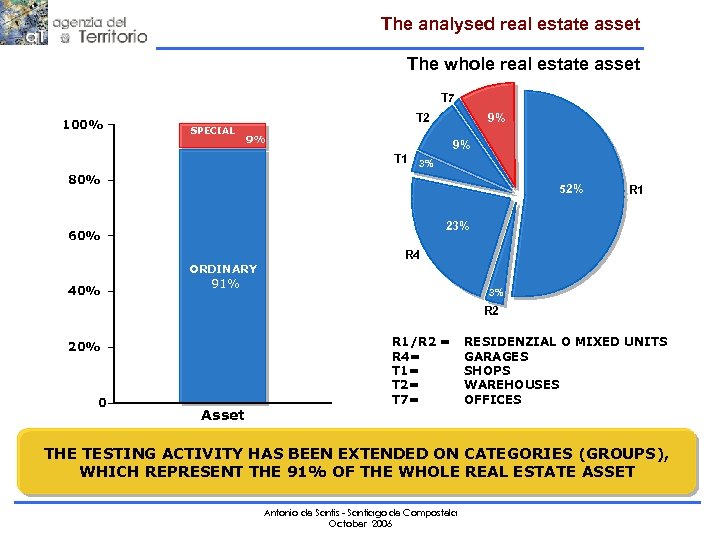 The analysed real estate asset The whole real estate asset T 7 100% T 2 SPECIAL 9% 9% 9% T 1 3% 80% 52% R 1 23% 60% R 4 ORDINARY 40% 91% 3% R 2 R 1/R 2 = R 4= T 1= T 2= T 7= 20% 0 RESIDENZIAL O MIXED UNITS GARAGES SHOPS WAREHOUSES OFFICES Asset THE TESTING ACTIVITY HAS BEEN EXTENDED ON CATEGORIES (GROUPS), WHICH REPRESENT THE 91% OF THE WHOLE REAL ESTATE ASSET Antonio de Santis - Santiago de Compostela October 2006
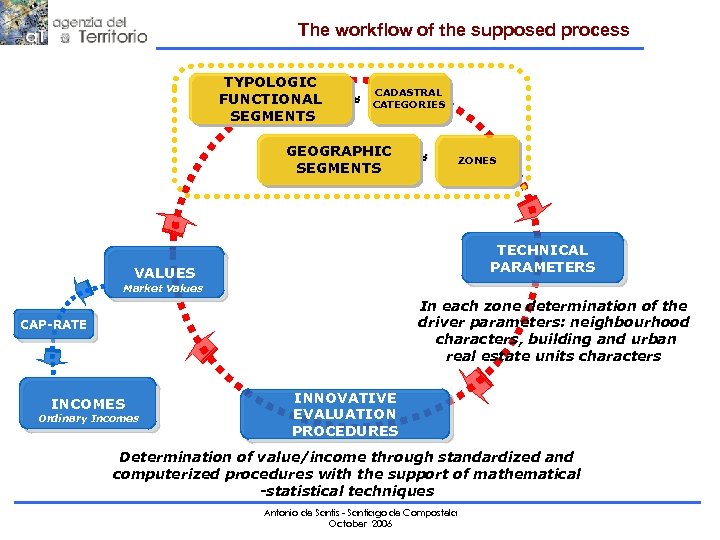 The workflow of the supposed process TYPOLOGIC FUNCTIONAL SEGMENTS ≈ CADASTRAL CATEGORIES GEOGRAPHIC SEGMENTS ≈ ZONES TECHNICAL PARAMETERS VALUES Market Values In each zone determination of the driver parameters: neighbourhood characters, building and urban real estate units characters CAP-RATE INCOMES Ordinary Incomes INNOVATIVE EVALUATION PROCEDURES Determination of value/income through standardized and computerized procedures with the support of mathematical -statistical techniques Antonio de Santis - Santiago de Compostela October 2006
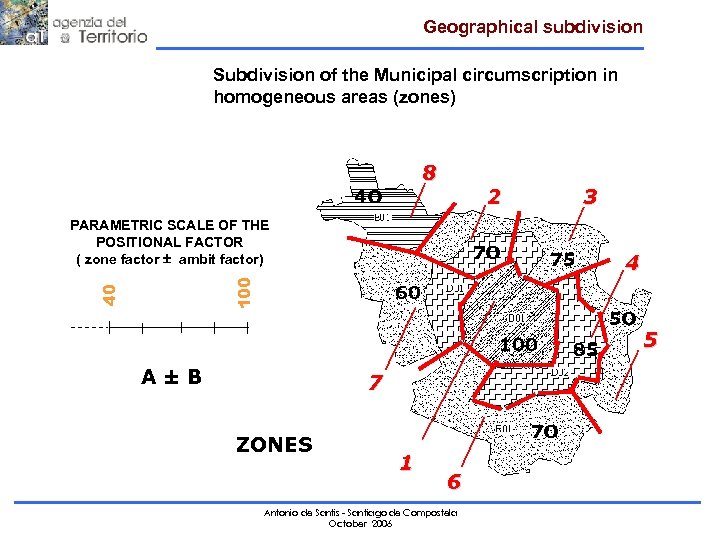 Geographical subdivision Subdivision of the Municipal circumscription in homogeneous areas (zones) 8 4 O 2 PARAMETRIC SCALE OF THE POSITIONAL FACTOR ( zone factor ambit factor) 7 O 100 40 3 75 4 60 5 O 100 A±B 7 ZONES 7 O 1 6 Antonio de Santis - Santiago de Compostela October 2006 85 5
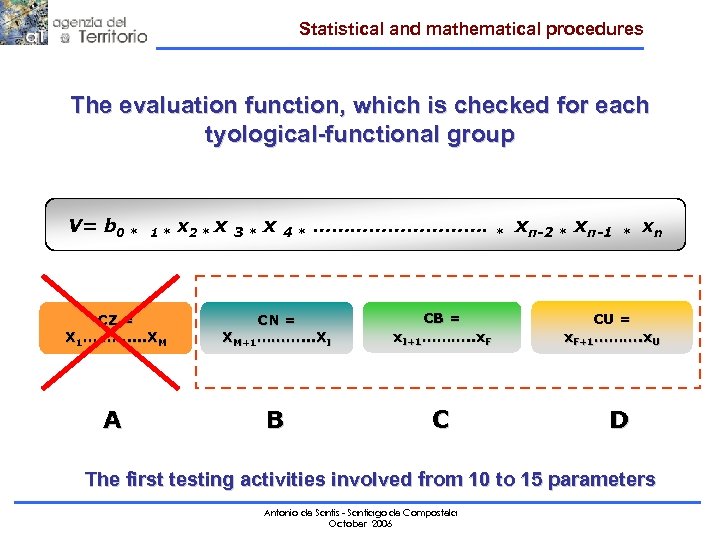 Statistical and mathematical procedures The evaluation function, which is checked for each tyological-functional group V= b 0 * 1* x 2 * x 3* x 4* ……………. CZ = X 1………. . XM CN = XM+1………. . . XI CB = x. I+1………. . x. F A B C * xn-2 * xn-1 * xn CU = x. F+1………. x. U D The first testing activities involved from 10 to 15 parameters Antonio de Santis - Santiago de Compostela October 2006
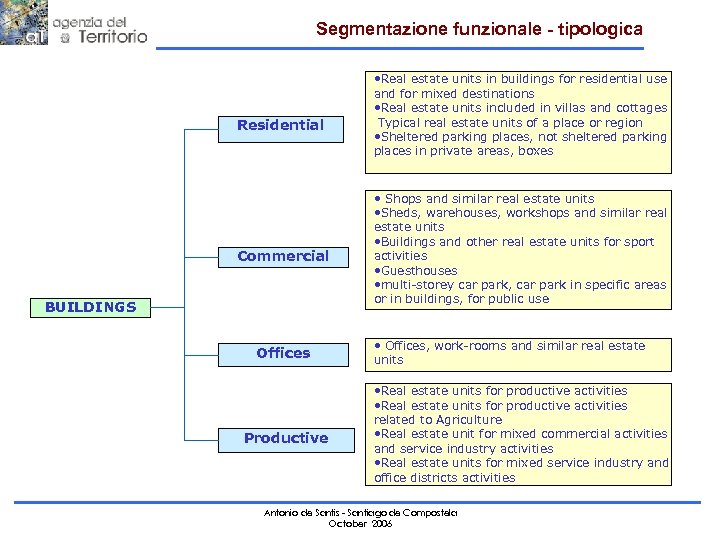 Segmentazione funzionale - tipologica Residential Commercial BUILDINGS Offices Productive • Real estate units in buildings for residential use and for mixed destinations • Real estate units included in villas and cottages Typical real estate units of a place or region • Sheltered parking places, not sheltered parking places in private areas, boxes • Shops and similar real estate units • Sheds, warehouses, workshops and similar real estate units • Buildings and other real estate units for sport activities • Guesthouses • multi-storey car park, car park in specific areas or in buildings, for public use • Offices, work-rooms and similar real estate units • Real estate units for productive activities related to Agriculture • Real estate unit for mixed commercial activities and service industry activities • Real estate units for mixed service industry and office districts activities Antonio de Santis - Santiago de Compostela October 2006
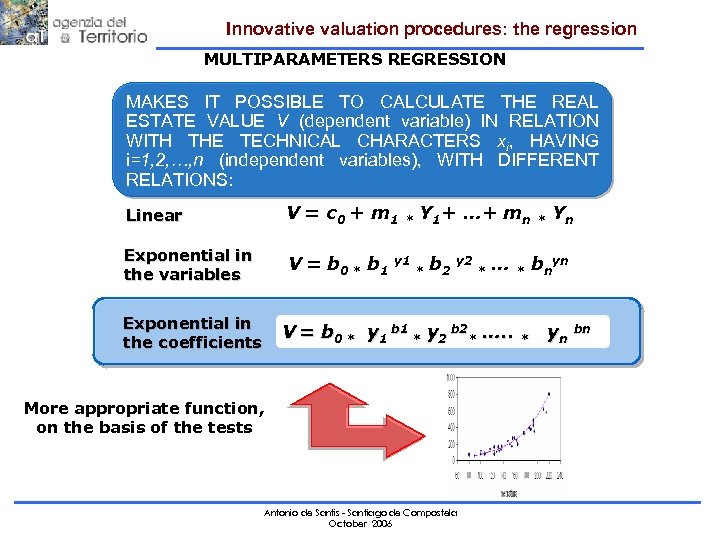 Innovative valuation procedures: the regression MULTIPARAMETERS REGRESSION MAKES IT POSSIBLE TO CALCULATE THE REAL ESTATE VALUE V (dependent variable) IN RELATION WITH THE TECHNICAL CHARACTERS xi, HAVING i=1, 2, …, n (independent variables), WITH DIFFERENT RELATIONS: Linear V = c 0 + m 1 Exponential in the variables V = b 0 * b 1 Exponential in the coefficients * y 1 Y 1+ …+ mn * b 2 y 2 * … V = b 0 * y 1 b 1 * y 2 b 2* …. . More appropriate function, on the basis of the tests Antonio de Santis - Santiago de Compostela October 2006 * * * Yn bnyn yn bn
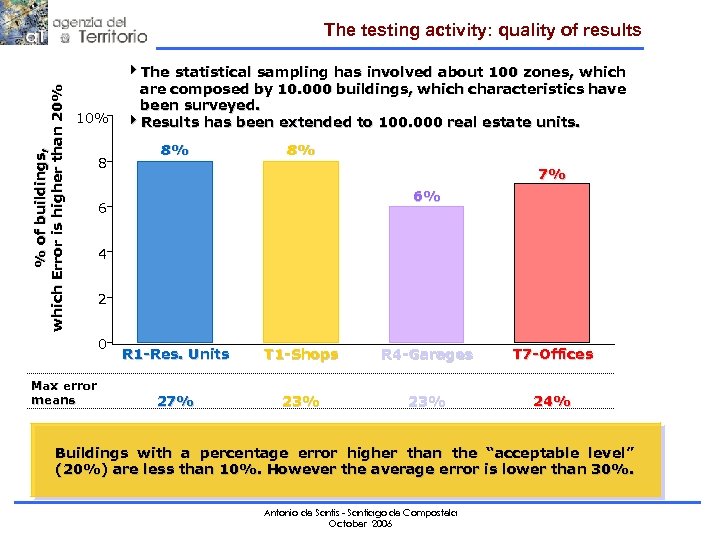 % of buildings, which Error is higher than 20% The testing activity: quality of results 10% 8 8% 8% 7% 6% 6 4 2 0 Max error means 4 The statistical sampling has involved about 100 zones, which are composed by 10. 000 buildings, which characteristics have been surveyed. 4 Results has been extended to 100. 000 real estate units. R 1 -Res. Units T 1 -Shops R 4 -Garages T 7 -Offices 27% 23% 24% Buildings with a percentage error higher than the “acceptable level” (20%) are less than 10%. However the average error is lower than 30%. Antonio de Santis - Santiago de Compostela October 2006
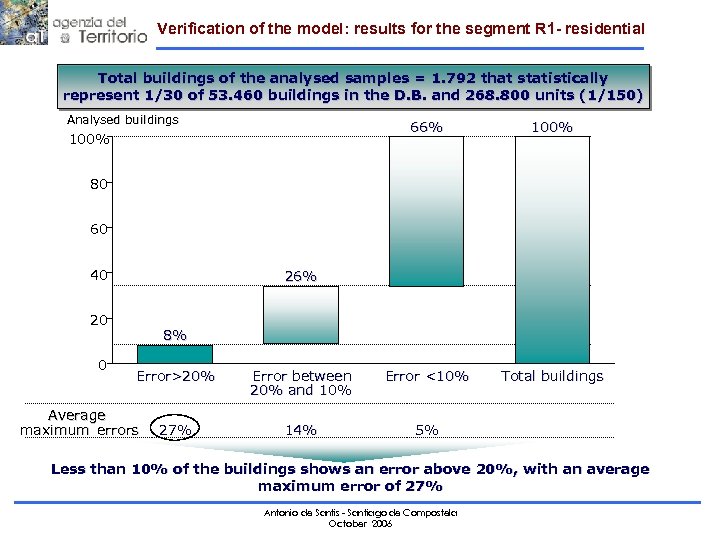 Verification of the model: results for the segment R 1 - residential Total buildings of the analysed samples = 1. 792 that statistically represent 1/30 of 53. 460 buildings in the D. B. and 268. 800 units (1/150) Analysed buildings 66% 100% Error between 20% and 10% Error <10% Total buildings 14% 5% 100% 80 60 40 26% 20 0 8% Error>20% Average maximum errors 27% Less than 10% of the buildings shows an error above 20%, with an average maximum error of 27% Antonio de Santis - Santiago de Compostela October 2006
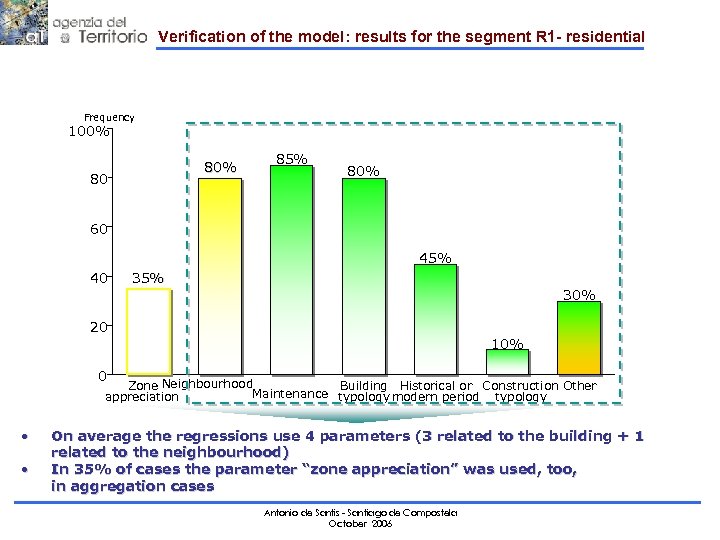 Verification of the model: results for the segment R 1 - residential Frequency 100% 80 85% 80% 60 45% 40 35% 30% 20 10% 0 Zone Neighbourhood Building Historical or Construction Other Maintenance typology modern period typology appreciation • • On average the regressions use 4 parameters (3 related to the building + 1 related to the neighbourhood) In 35% of cases the parameter “zone appreciation” was used, too, in aggregation cases Antonio de Santis - Santiago de Compostela October 2006
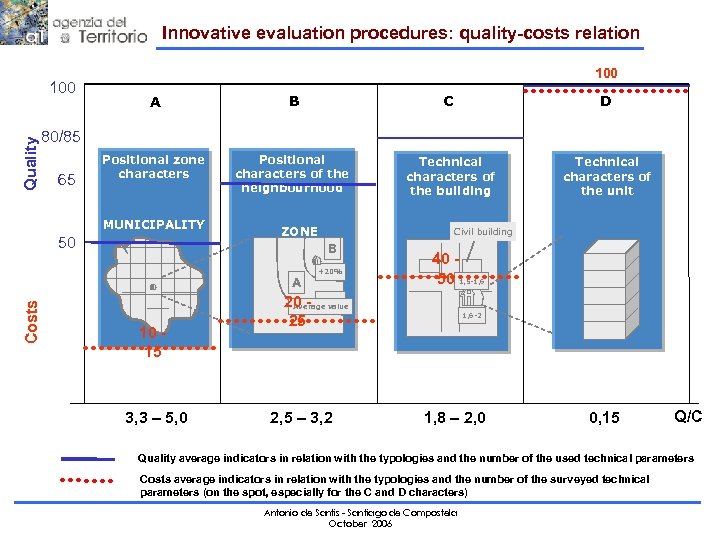 Innovative evaluation procedures: quality-costs relation Quality 100 A B C D Positional zone characters Positional characters of the neighbourhood Technical characters of the building Technical characters of the unit 80/85 65 MUNICIPALITY 50 ZONE M B A Costs Civil building 10 15 3, 3 – 5, 0 +20% 40 50 1, 5 -1, 6 20 - +10% Average value 25 2, 5 – 3, 2 1, 6 -2 1, 8 – 2, 0 0, 15 Q/C Quality average indicators in relation with the typologies and the number of the used technical parameters Costs average indicators in relation with the typologies and the number of the surveyed technical parameters (on the spot, especially for the C and D characters) Antonio de Santis - Santiago de Compostela October 2006
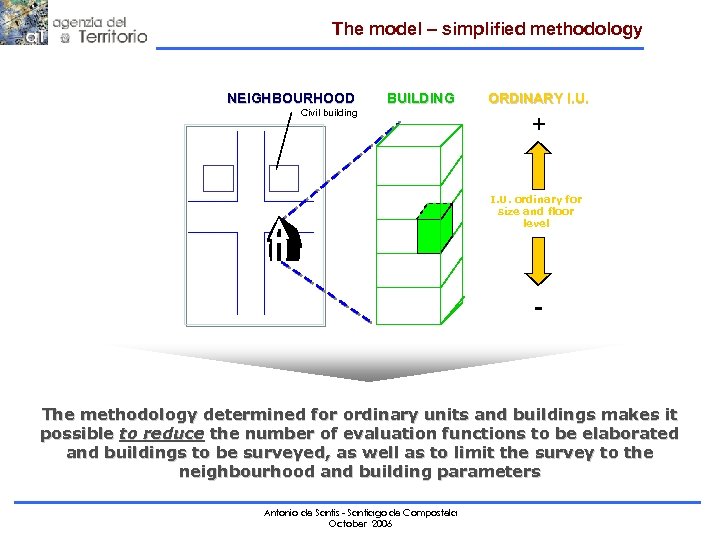 The model – simplified methodology NEIGHBOURHOOD BUILDING Civil building ORDINARY I. U. + I. U. ordinary for size and floor level - The methodology determined for ordinary units and buildings makes it possible to reduce the number of evaluation functions to be elaborated and buildings to be surveyed, as well as to limit the survey to the neighbourhood and building parameters Antonio de Santis - Santiago de Compostela October 2006
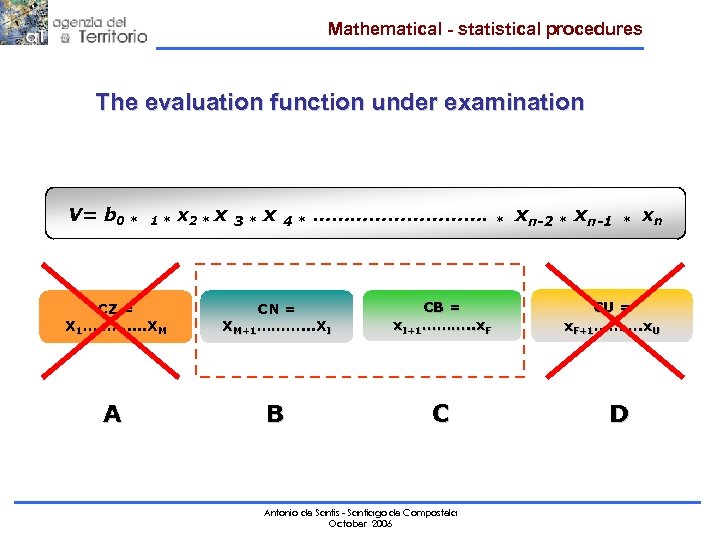 Mathematical - statistical procedures The evaluation function under examination V= b 0 * 1* x 2 * x 3* x 4* ……………. CZ = X 1………. . XM CN = XM+1………. . . XI CB = x. I+1………. . x. F A B C Antonio de Santis - Santiago de Compostela October 2006 * xn-2 * xn-1 * xn CU = x. F+1………. x. U D
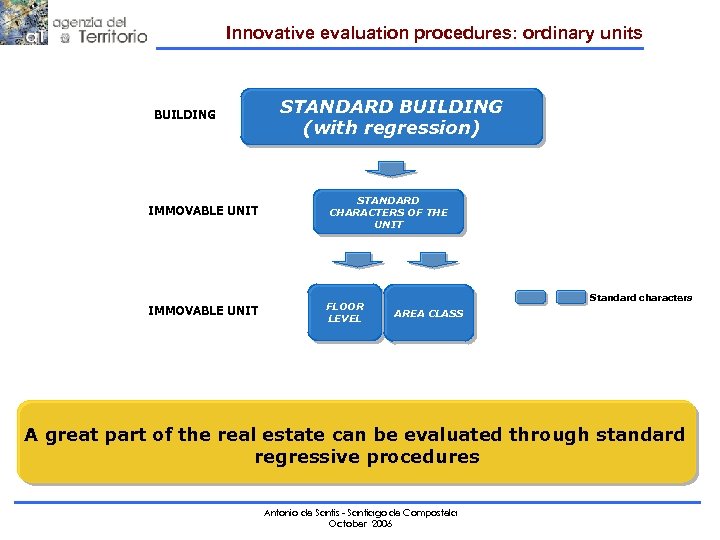 Innovative evaluation procedures: ordinary units BUILDING IMMOVABLE UNIT STANDARD BUILDING (with regression) STANDARD CHARACTERS OF THE UNIT FLOOR LEVEL Standard characters AREA CLASS A great part of the real estate can be evaluated through standard regressive procedures Antonio de Santis - Santiago de Compostela October 2006
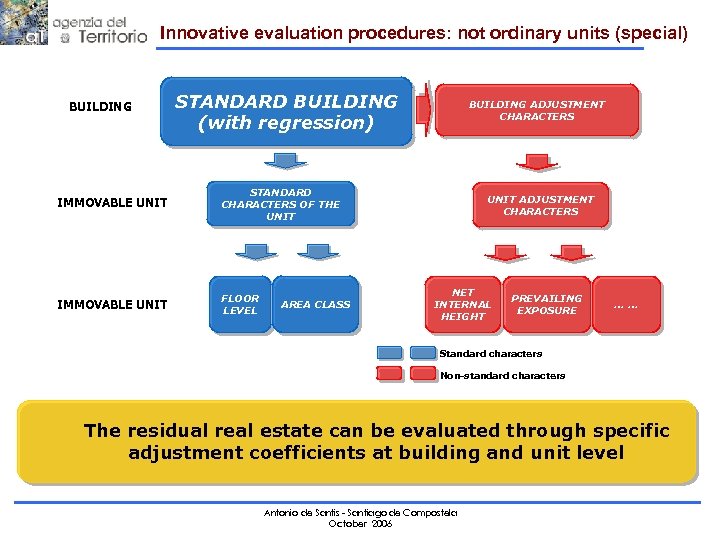 Innovative evaluation procedures: not ordinary units (special) BUILDING STANDARD BUILDING (with regression) IMMOVABLE UNIT STANDARD CHARACTERS OF THE UNIT IMMOVABLE UNIT FLOOR LEVEL BUILDING ADJUSTMENT CHARACTERS AREA CLASS UNIT ADJUSTMENT CHARACTERS NET INTERNAL HEIGHT PREVAILING EXPOSURE …… Standard characters Non-standard characters The residual real estate can be evaluated through specific adjustment coefficients at building and unit level Antonio de Santis - Santiago de Compostela October 2006
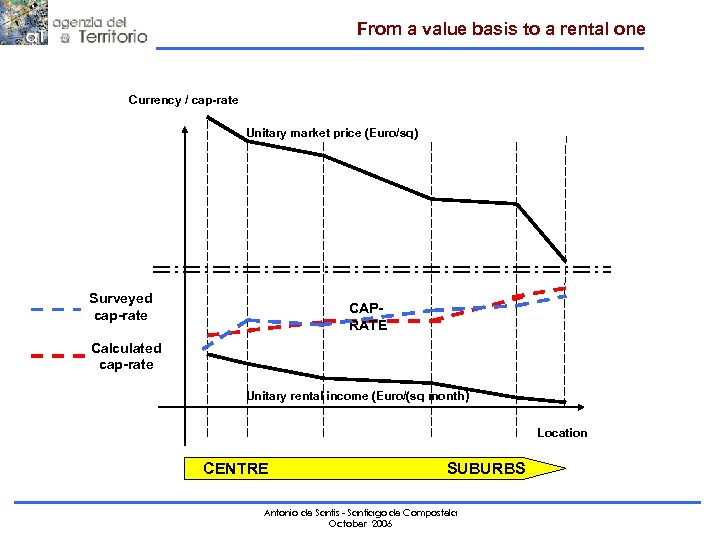 From a value basis to a rental one Currency / cap-rate Unitary market price (Euro/sq) Surveyed cap-rate CAPRATE Calculated cap-rate Unitary rental income (Euro/(sq month ) Location CENTRE SUBURBS Antonio de Santis - Santiago de Compostela October 2006
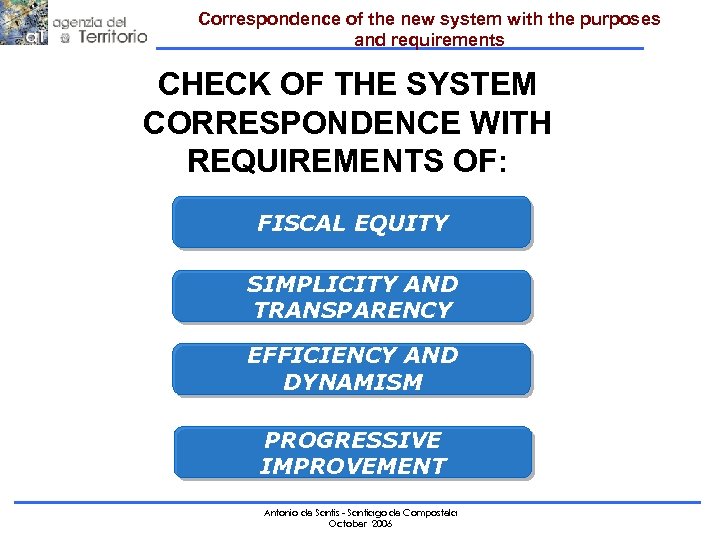 Correspondence of the new system with the purposes and requirements CHECK OF THE SYSTEM CORRESPONDENCE WITH REQUIREMENTS OF: FISCAL EQUITY SIMPLICITY AND TRANSPARENCY EFFICIENCY AND DYNAMISM PROGRESSIVE IMPROVEMENT Antonio de Santis - Santiago de Compostela October 2006
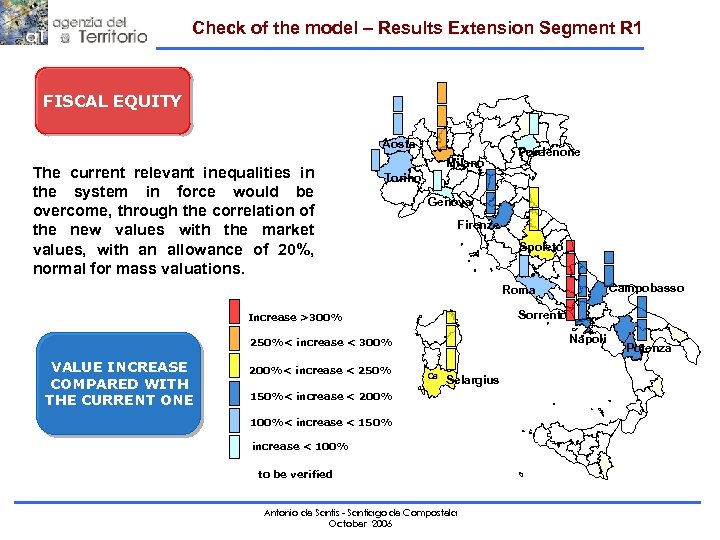 Check of the model – Results Extension Segment R 1 FISCAL EQUITY Aosta The current relevant inequalities in the system in force would be overcome, through the correlation of the new values with the market values, with an allowance of 20%, normal for mass valuations. Milano Pordenone Torino Genova Firenze Spoleto Campobasso Roma Sorrento Increase >300% Napoli 250%< increase < 300% VALUE INCREASE COMPARED WITH THE CURRENT ONE 200%< increase < 250% Ca Selargius 150%< increase < 200% 100%< increase < 150% increase < 100% to be verified Antonio de Santis - Santiago de Compostela October 2006 Potenza
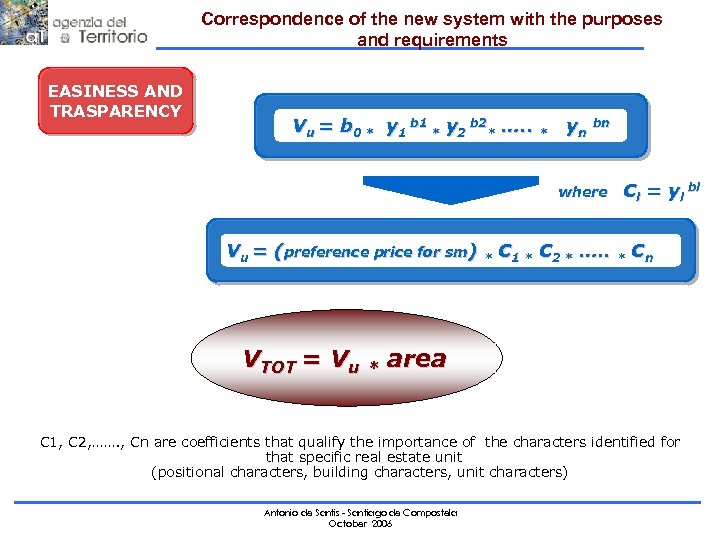 Correspondence of the new system with the purposes and requirements EASINESS AND TRASPARENCY Vu = b 0 * y 1 b 1 * y 2 b 2* …. . * yn bn where Vu = (preference price for sm) * C 1 * C 2 * …. . VTOT = Vu * Ci = yi bi * Cn area C 1, C 2, ……. , Cn are coefficients that qualify the importance of the characters identified for that specific real estate unit (positional characters, building characters, unit characters) Antonio de Santis - Santiago de Compostela October 2006
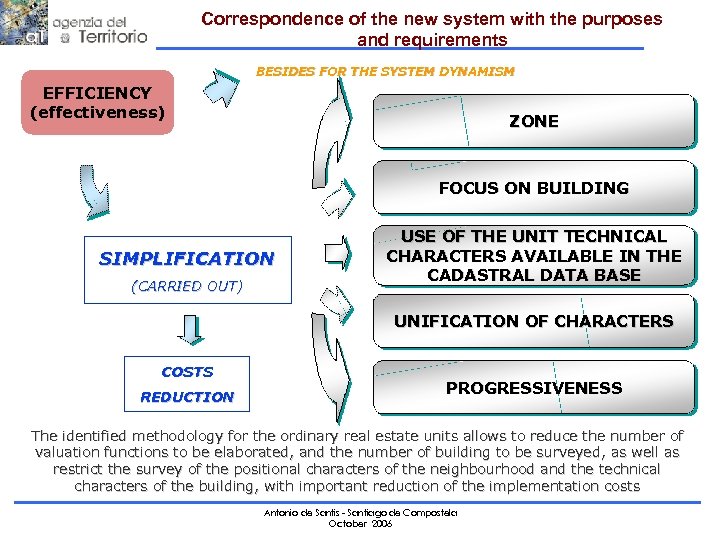 Correspondence of the new system with the purposes and requirements BESIDES FOR THE SYSTEM DYNAMISM EFFICIENCY (effectiveness) ZONE FOCUS ON BUILDING SIMPLIFICATION (CARRIED OUT) USE OF THE UNIT TECHNICAL CHARACTERS AVAILABLE IN THE CADASTRAL DATA BASE UNIFICATION OF CHARACTERS COSTS REDUCTION PROGRESSIVENESS The identified methodology for the ordinary real estate units allows to reduce the number of valuation functions to be elaborated, and the number of building to be surveyed, as well as restrict the survey of the positional characters of the neighbourhood and the technical characters of the building, with important reduction of the implementation costs Antonio de Santis - Santiago de Compostela October 2006
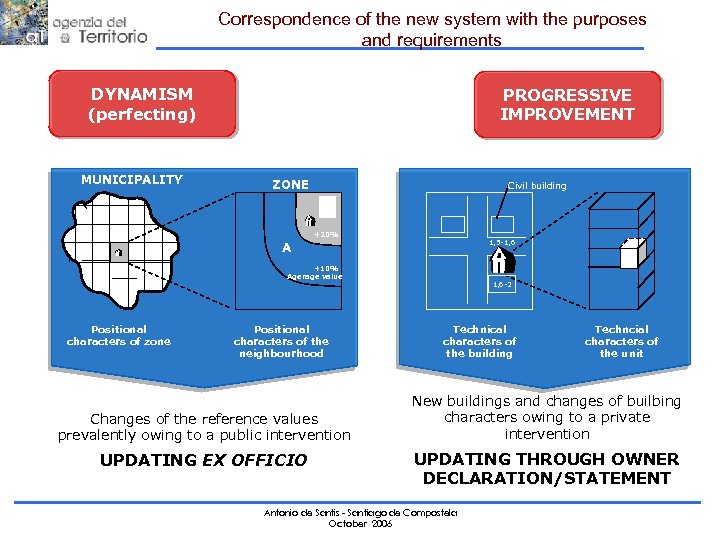 Correspondence of the new system with the purposes and requirements DYNAMISM (perfecting) MUNICIPALITY PROGRESSIVE IMPROVEMENT ZONE Civil building M B +20% 1, 5 -1, 6 A +10% Agerage value Positional characters of zone Positional characters of the neighbourhood Changes of the reference values prevalently owing to a public intervention UPDATING EX OFFICIO 1, 6 -2 Technical characters of the building Techncial characters of the unit New buildings and changes of builbing characters owing to a private intervention UPDATING THROUGH OWNER DECLARATION/STATEMENT Antonio de Santis - Santiago de Compostela October 2006
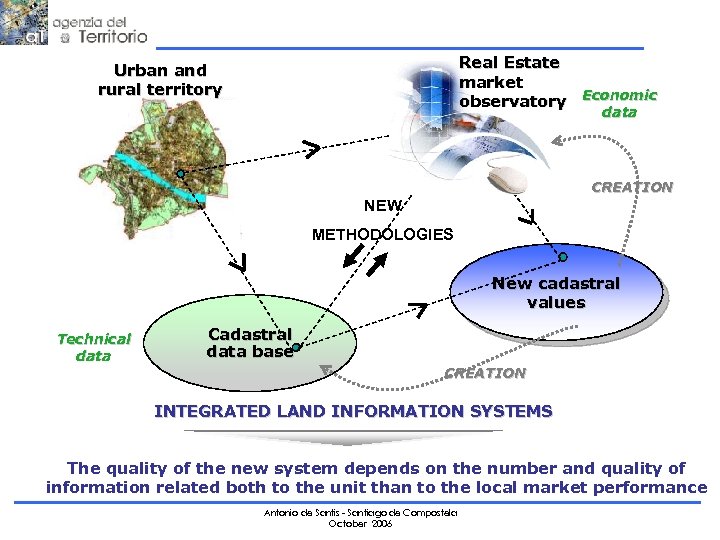 Real Estate market observatory Economic Urban and rural territory data CREATION NEW METHODOLOGIES New cadastral values Technical data Cadastral data base CREATION INTEGRATED LAND INFORMATION SYSTEMS The quality of the new system depends on the number and quality of information related both to the unit than to the local market performance Antonio de Santis - Santiago de Compostela October 2006
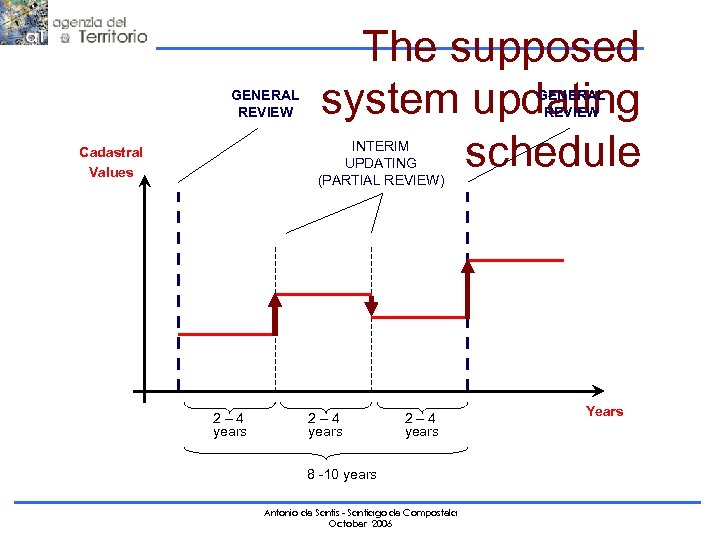 GENERAL REVIEW The supposed system updating schedule GENERAL REVIEW INTERIM UPDATING (PARTIAL REVIEW) Cadastral Values 2– 4 years 8 -10 years Antonio de Santis - Santiago de Compostela October 2006 Years
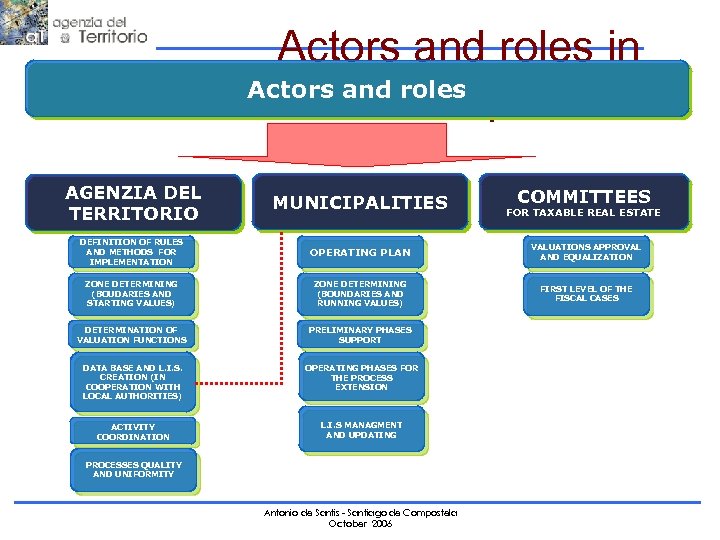 Actors and roles in Actors and roles the reform process AGENZIA DEL TERRITORIO MUNICIPALITIES DEFINITION OF RULES AND METHODS FOR IMPLEMENTATION OPERATING PLAN VALUATIONS APPROVAL AND EQUALIZATION ZONE DETERMINING (BOUDARIES AND STARTING VALUES) ZONE DETERMINING (BOUNDARIES AND RUNNING VALUES) FIRST LEVEL OF THE FISCAL CASES DETERMINATION OF VALUATION FUNCTIONS PRELIMINARY PHASES SUPPORT DATA BASE AND L. I. S. CREATION (IN COOPERATION WITH LOCAL AUTHORITIES) OPERATING PHASES FOR THE PROCESS EXTENSION ACTIVITY COORDINATION L. I. S MANAGMENT AND UPDATING PROCESSES QUALITY AND UNIFORMITY Antonio de Santis - Santiago de Compostela October 2006 COMMITTEES FOR TAXABLE REAL ESTATE
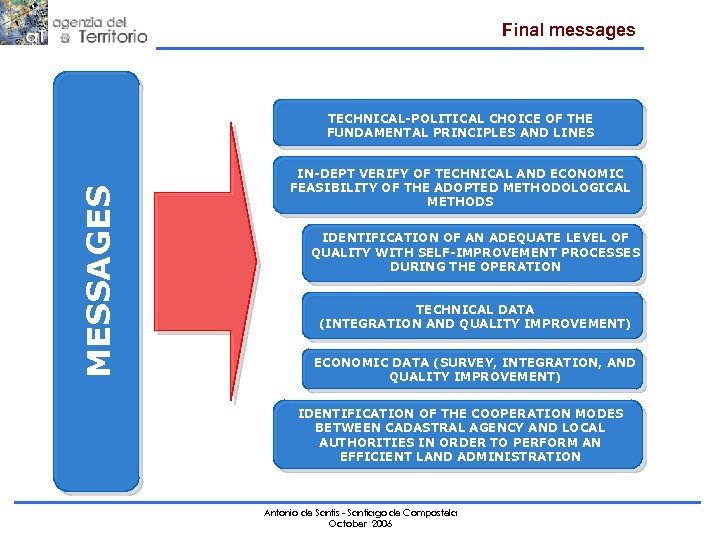 Final messages MESSAGES TECHNICAL-POLITICAL CHOICE OF THE FUNDAMENTAL PRINCIPLES AND LINES IN-DEPT VERIFY OF TECHNICAL AND ECONOMIC FEASIBILITY OF THE ADOPTED METHODOLOGICAL METHODS IDENTIFICATION OF AN ADEQUATE LEVEL OF QUALITY WITH SELF-IMPROVEMENT PROCESSES DURING THE OPERATION TECHNICAL DATA (INTEGRATION AND QUALITY IMPROVEMENT) ECONOMIC DATA (SURVEY, INTEGRATION, AND QUALITY IMPROVEMENT) IDENTIFICATION OF THE COOPERATION MODES BETWEEN CADASTRAL AGENCY AND LOCAL AUTHORITIES IN ORDER TO PERFORM AN EFFICIENT LAND ADMINISTRATION Antonio de Santis - Santiago de Compostela October 2006
 Thank you for your kind attention Antonio de Santis Agenzia del Territorio Central Director for the Technical Development and the International Relations Antonio de Santis - Santiago de Compostela October 2006