


 Скачать презентацию Automated Text summarization Tutorial COLING ACL 98 Eduard
3e7993944111a2297818d7ae59a78e3a.ppt
- Количество слайдов: 110
 Automated Text summarization Tutorial — COLING/ACL’ 98 Eduard Hovy and Daniel Marcu Information Sciences Institute University of Southern California 4676 Admiralty Way, Suite 1001 Marina del Rey, CA 90292 {hovy, marcu}@isi. edu http: //www. isi. edu/natural-language/people/{hovy. html, marcu. html} USC INFORMATION SCIENCES INSTITUTE 1 Eduard Hovy, Daniel Marcu
 an exciting challenge. . . put a book on the scanner, turn the dial to ‘ 2 pages’, and read the result. . . download 1000 documents from the web, send them to the summarizer, and select the best ones by reading the summaries of the clusters. . . forward the Japanese email to the summarizer, select ‘ 1 par’, and skim the translated summary. USC INFORMATION SCIENCES INSTITUTE 2 Eduard Hovy, Daniel Marcu
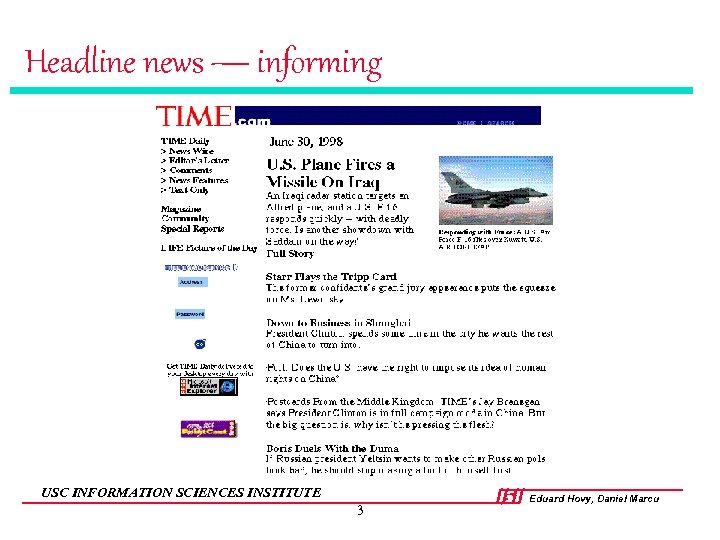 Headline news — informing USC INFORMATION SCIENCES INSTITUTE 3 Eduard Hovy, Daniel Marcu
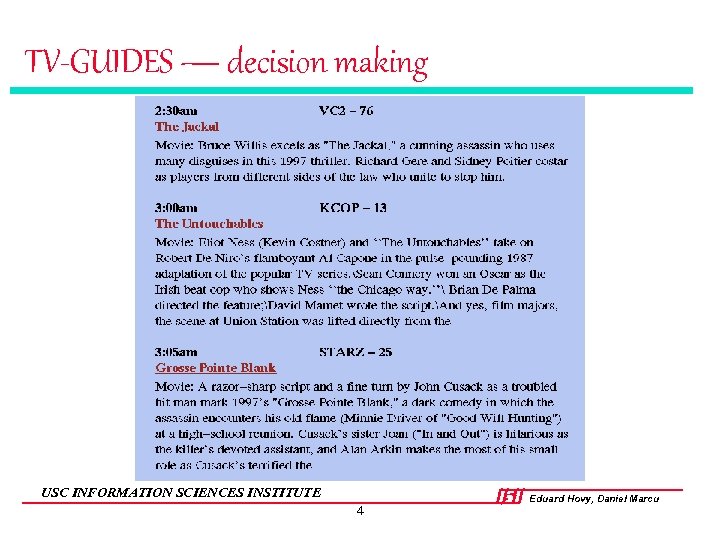 TV-GUIDES — decision making USC INFORMATION SCIENCES INSTITUTE 4 Eduard Hovy, Daniel Marcu
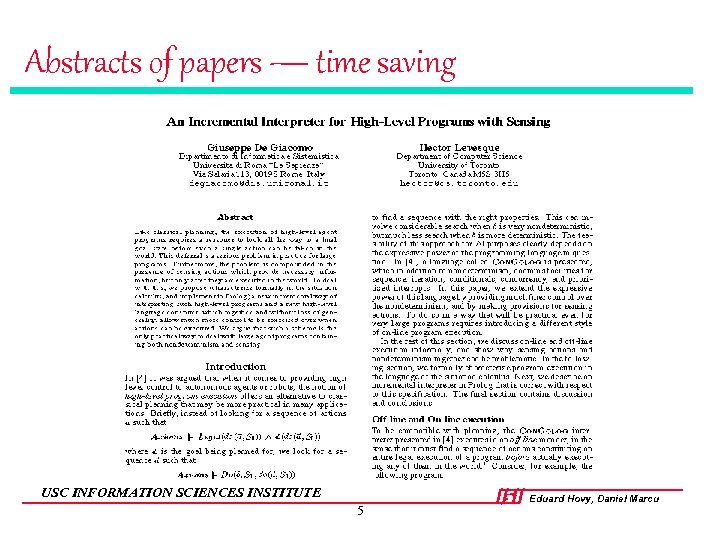 Abstracts of papers — time saving USC INFORMATION SCIENCES INSTITUTE 5 Eduard Hovy, Daniel Marcu
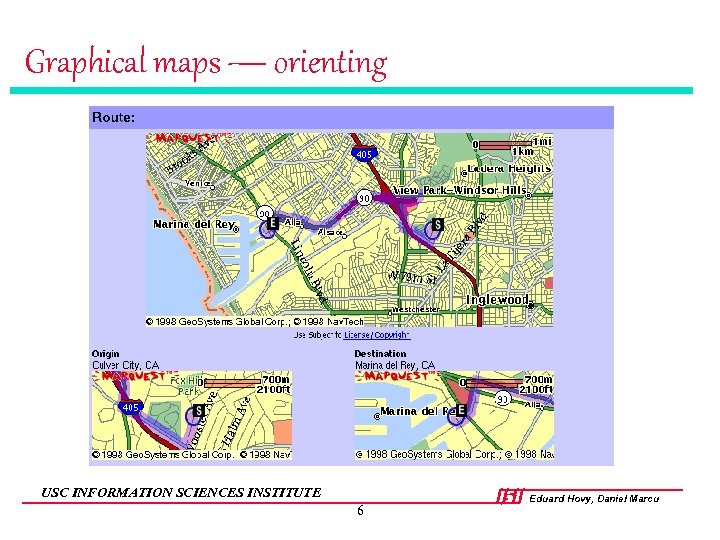 Graphical maps — orienting USC INFORMATION SCIENCES INSTITUTE 6 Eduard Hovy, Daniel Marcu
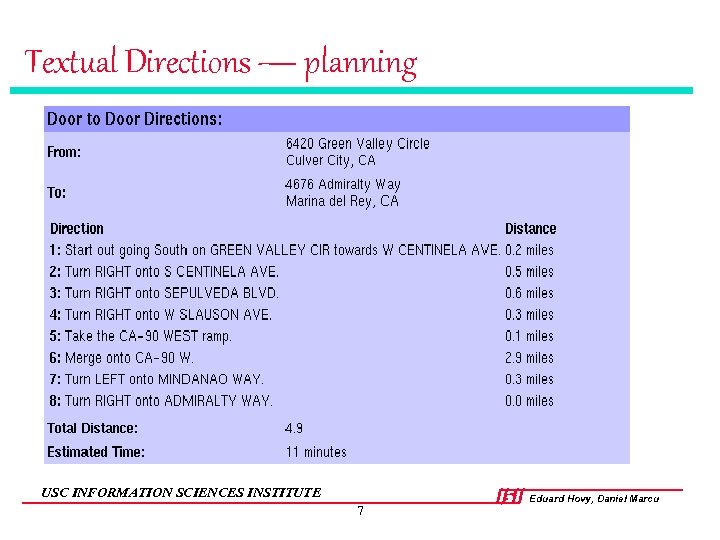 Textual Directions — planning USC INFORMATION SCIENCES INSTITUTE 7 Eduard Hovy, Daniel Marcu
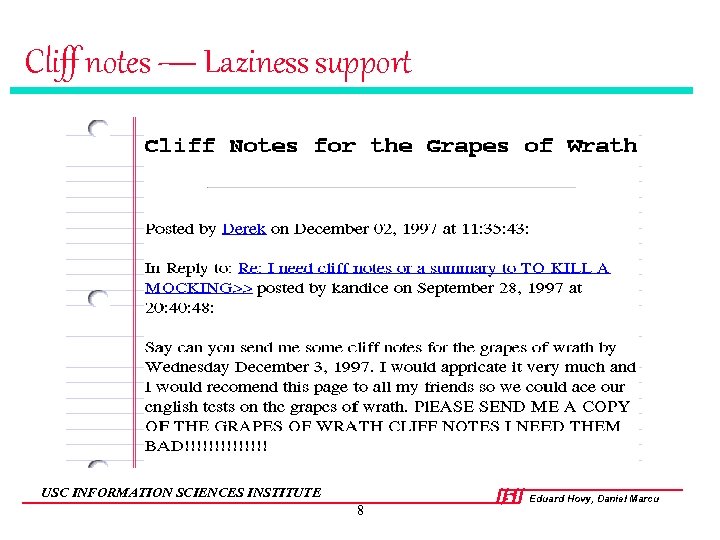 Cliff notes — Laziness support USC INFORMATION SCIENCES INSTITUTE 8 Eduard Hovy, Daniel Marcu
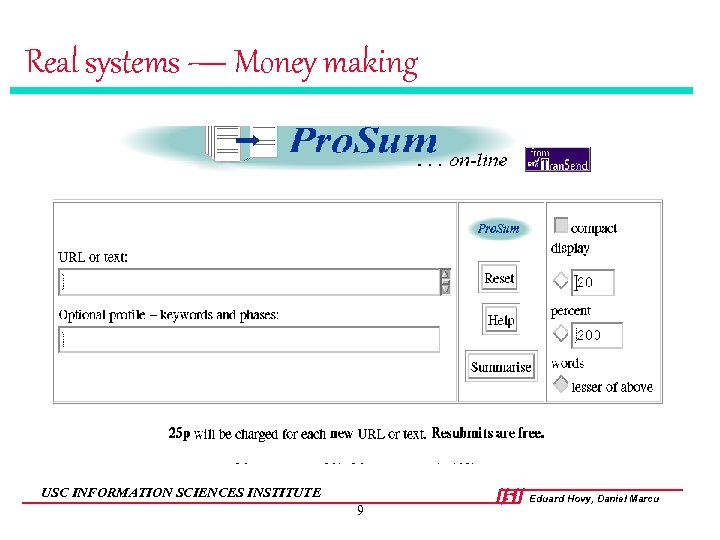 Real systems — Money making USC INFORMATION SCIENCES INSTITUTE 9 Eduard Hovy, Daniel Marcu
 Questions • What kinds of summaries do people want? – What are summarizing, abstracting, gisting, . . . ? • How sophisticated must summ. systems be? – Are statistical techniques sufficient? – Or do we need symbolic techniques and deep understanding as well? • What milestones would mark quantum leaps in summarization theory and practice? – How do we measure summarization quality? USC INFORMATION SCIENCES INSTITUTE 10 Eduard Hovy, Daniel Marcu
 Table of contents 1. Motivation. 2. Genres and types of summaries. 3. Approaches and paradigms. 4. Summarization methods (exercise). 5. Evaluating summaries. 6. The future. USC INFORMATION SCIENCES INSTITUTE 11 Eduard Hovy, Daniel Marcu
 ‘Genres’ of Summary? • Indicative vs. informative. . . used for quick categorization vs. content processing. • Extract vs. abstract. . . lists fragments of text vs. re-phrases content coherently. • Generic vs. query-oriented. . . provides author’s view vs. reflects user’s interest. • Background vs. just-the-news. . . assumes reader’s prior knowledge is poor vs. up-to-date. • Single-document vs. multi-document source. . . based on one text vs. fuses together many texts. USC INFORMATION SCIENCES INSTITUTE 12 Eduard Hovy, Daniel Marcu
 Examples of Genres Exercise: summarize the following texts for the following readers: text 1: Coup Attempt reader 1: your friend, who knows nothing about South Africa. reader 2: someone who lives in South Africa and knows the political position. text 2: childrens’ story reader 3: your 4 -year-old niece. reader 4: the Library of Congress. USC INFORMATION SCIENCES INSTITUTE 13 Eduard Hovy, Daniel Marcu
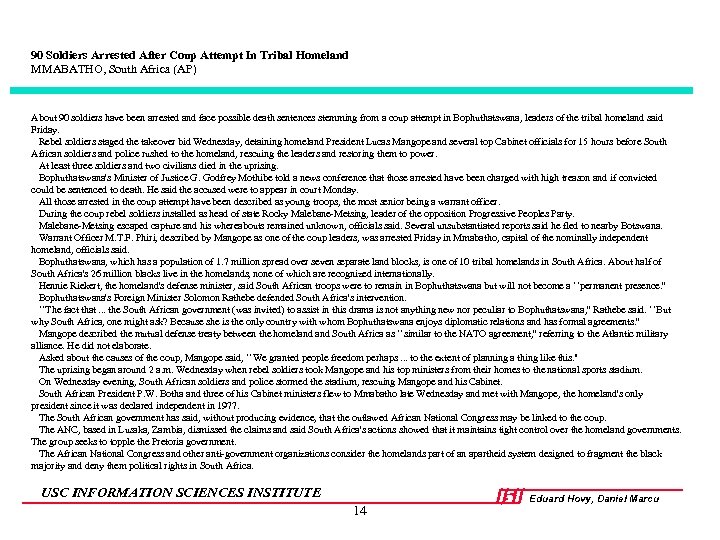 90 Soldiers Arrested After Coup Attempt In Tribal Homeland MMABATHO, South Africa (AP) About 90 soldiers have been arrested and face possible death sentences stemming from a coup attempt in Bophuthatswana, leaders of the tribal homeland said Friday. Rebel soldiers staged the takeover bid Wednesday, detaining homeland President Lucas Mangope and several top Cabinet officials for 15 hours before South African soldiers and police rushed to the homeland, rescuing the leaders and restoring them to power. At least three soldiers and two civilians died in the uprising. Bophuthatswana's Minister of Justice G. Godfrey Mothibe told a news conference that those arrested have been charged with high treason and if convicted could be sentenced to death. He said the accused were to appear in court Monday. All those arrested in the coup attempt have been described as young troops, the most senior being a warrant officer. During the coup rebel soldiers installed as head of state Rocky Malebane-Metsing, leader of the opposition Progressive Peoples Party. Malebane-Metsing escaped capture and his whereabouts remained unknown, officials said. Several unsubstantiated reports said he fled to nearby Botswana. Warrant Officer M. T. F. Phiri, described by Mangope as one of the coup leaders, was arrested Friday in Mmabatho, capital of the nominally independent homeland, officials said. Bophuthatswana, which has a population of 1. 7 million spread over seven separate land blocks, is one of 10 tribal homelands in South Africa. About half of South Africa's 26 million blacks live in the homelands, none of which are recognized internationally. Hennie Riekert, the homeland's defense minister, said South African troops were to remain in Bophuthatswana but will not become a ``permanent presence. '' Bophuthatswana's Foreign Minister Solomon Rathebe defended South Africa's intervention. ``The fact that. . . the South African government (was invited) to assist in this drama is not anything new nor peculiar to Bophuthatswana, '' Rathebe said. ``But why South Africa, one might ask? Because she is the only country with whom Bophuthatswana enjoys diplomatic relations and has formal agreements. '' Mangope described the mutual defense treaty between the homeland South Africa as ``similar to the NATO agreement, '' referring to the Atlantic military alliance. He did not elaborate. Asked about the causes of the coup, Mangope said, ``We granted people freedom perhaps. . . to the extent of planning a thing like this. '' The uprising began around 2 a. m. Wednesday when rebel soldiers took Mangope and his top ministers from their homes to the national sports stadium. On Wednesday evening, South African soldiers and police stormed the stadium, rescuing Mangope and his Cabinet. South African President P. W. Botha and three of his Cabinet ministers flew to Mmabatho late Wednesday and met with Mangope, the homeland's only president since it was declared independent in 1977. The South African government has said, without producing evidence, that the outlawed African National Congress may be linked to the coup. The ANC, based in Lusaka, Zambia, dismissed the claims and said South Africa's actions showed that it maintains tight control over the homeland governments. The group seeks to topple the Pretoria government. The African National Congress and other anti-government organizations consider the homelands part of an apartheid system designed to fragment the black majority and deny them political rights in South Africa. USC INFORMATION SCIENCES INSTITUTE 14 Eduard Hovy, Daniel Marcu
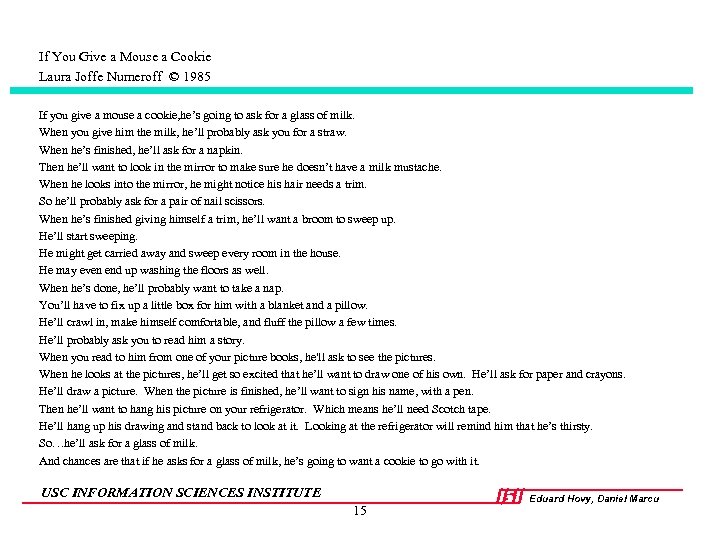 If You Give a Mouse a Cookie Laura Joffe Numeroff © 1985 If you give a mouse a cookie, he’s going to ask for a glass of milk. When you give him the milk, he’ll probably ask you for a straw. When he’s finished, he’ll ask for a napkin. Then he’ll want to look in the mirror to make sure he doesn’t have a milk mustache. When he looks into the mirror, he might notice his hair needs a trim. So he’ll probably ask for a pair of nail scissors. When he’s finished giving himself a trim, he’ll want a broom to sweep up. He’ll start sweeping. He might get carried away and sweep every room in the house. He may even end up washing the floors as well. When he’s done, he’ll probably want to take a nap. You’ll have to fix up a little box for him with a blanket and a pillow. He’ll crawl in, make himself comfortable, and fluff the pillow a few times. He’ll probably ask you to read him a story. When you read to him from one of your picture books, he'll ask to see the pictures. When he looks at the pictures, he’ll get so excited that he’ll want to draw one of his own. He’ll ask for paper and crayons. He’ll draw a picture. When the picture is finished, he’ll want to sign his name, with a pen. Then he’ll want to hang his picture on your refrigerator. Which means he’ll need Scotch tape. He’ll hang up his drawing and stand back to look at it. Looking at the refrigerator will remind him that he’s thirsty. So…he’ll ask for a glass of milk. And chances are that if he asks for a glass of milk, he’s going to want a cookie to go with it. USC INFORMATION SCIENCES INSTITUTE 15 Eduard Hovy, Daniel Marcu
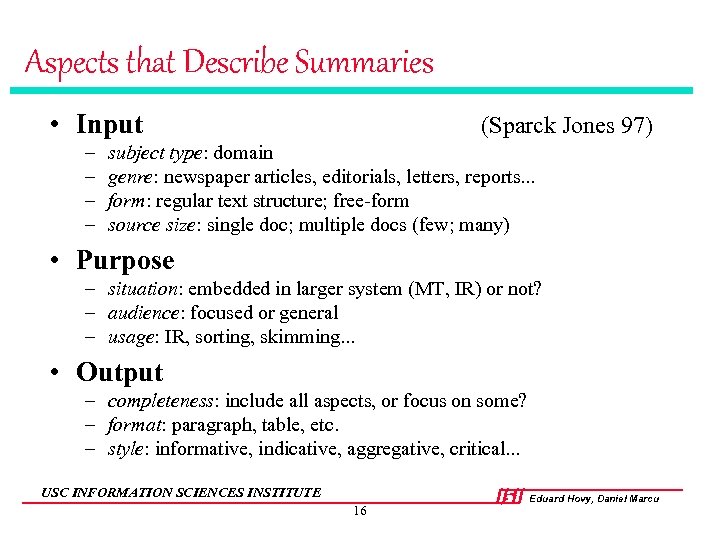 Aspects that Describe Summaries • Input – – (Sparck Jones 97) subject type: domain genre: newspaper articles, editorials, letters, reports. . . form: regular text structure; free-form source size: single doc; multiple docs (few; many) • Purpose – situation: embedded in larger system (MT, IR) or not? – audience: focused or general – usage: IR, sorting, skimming. . . • Output – completeness: include all aspects, or focus on some? – format: paragraph, table, etc. – style: informative, indicative, aggregative, critical. . . USC INFORMATION SCIENCES INSTITUTE 16 Eduard Hovy, Daniel Marcu
 Table of contents 1. Motivation. 2. Genres and types of summaries. 3. Approaches and paradigms. 4. Summarization methods (exercise). 5. Evaluating summaries. 6. The future. USC INFORMATION SCIENCES INSTITUTE 17 Eduard Hovy, Daniel Marcu
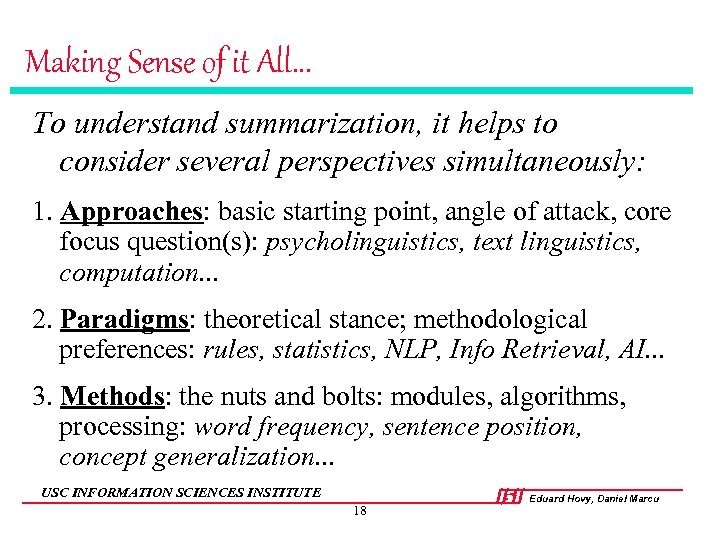 Making Sense of it All. . . To understand summarization, it helps to consider several perspectives simultaneously: 1. Approaches: basic starting point, angle of attack, core focus question(s): psycholinguistics, text linguistics, computation. . . 2. Paradigms: theoretical stance; methodological preferences: rules, statistics, NLP, Info Retrieval, AI. . . 3. Methods: the nuts and bolts: modules, algorithms, processing: word frequency, sentence position, concept generalization. . . USC INFORMATION SCIENCES INSTITUTE 18 Eduard Hovy, Daniel Marcu
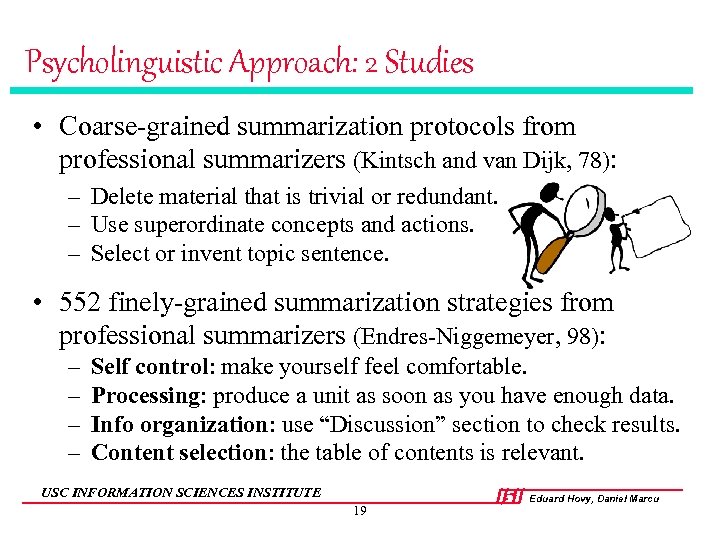 Psycholinguistic Approach: 2 Studies • Coarse-grained summarization protocols from professional summarizers (Kintsch and van Dijk, 78): – Delete material that is trivial or redundant. – Use superordinate concepts and actions. – Select or invent topic sentence. • 552 finely-grained summarization strategies from professional summarizers (Endres-Niggemeyer, 98): – – Self control: make yourself feel comfortable. Processing: produce a unit as soon as you have enough data. Info organization: use “Discussion” section to check results. Content selection: the table of contents is relevant. USC INFORMATION SCIENCES INSTITUTE 19 Eduard Hovy, Daniel Marcu
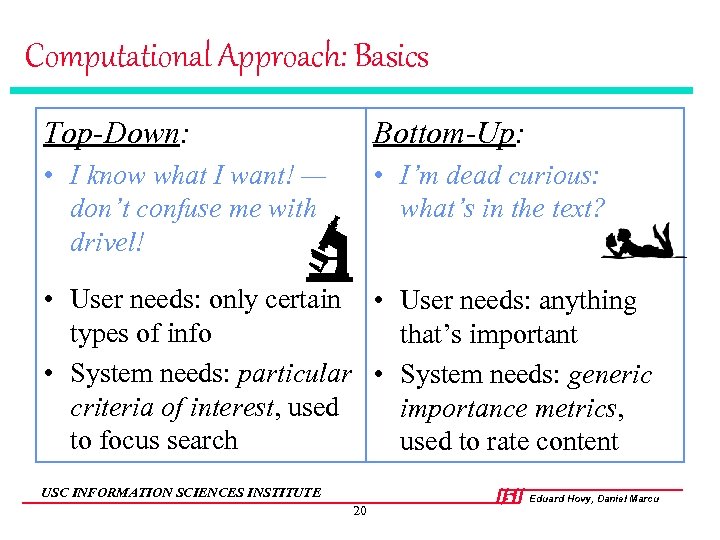 Computational Approach: Basics Top-Down: Bottom-Up: • I know what I want! — don’t confuse me with drivel! • I’m dead curious: what’s in the text? • User needs: only certain • User needs: anything types of info that’s important • System needs: particular • System needs: generic criteria of interest, used importance metrics, to focus search used to rate content USC INFORMATION SCIENCES INSTITUTE 20 Eduard Hovy, Daniel Marcu
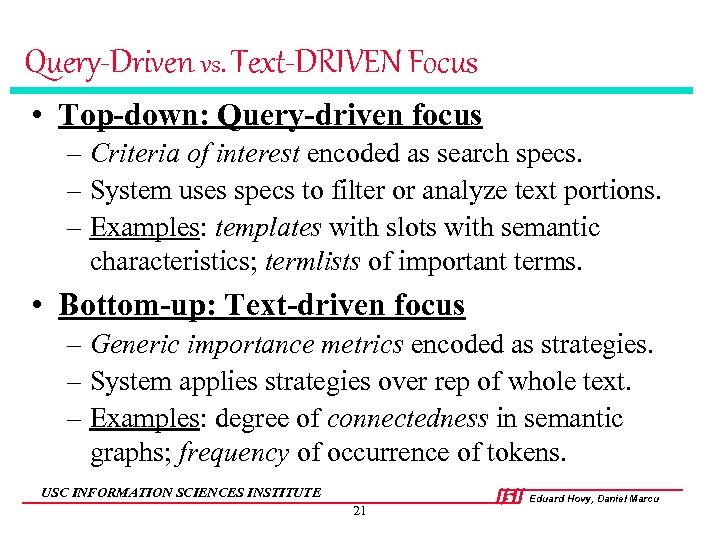 Query-Driven vs. Text-DRIVEN Focus • Top-down: Query-driven focus – Criteria of interest encoded as search specs. – System uses specs to filter or analyze text portions. – Examples: templates with slots with semantic characteristics; termlists of important terms. • Bottom-up: Text-driven focus – Generic importance metrics encoded as strategies. – System applies strategies over rep of whole text. – Examples: degree of connectedness in semantic graphs; frequency of occurrence of tokens. USC INFORMATION SCIENCES INSTITUTE 21 Eduard Hovy, Daniel Marcu
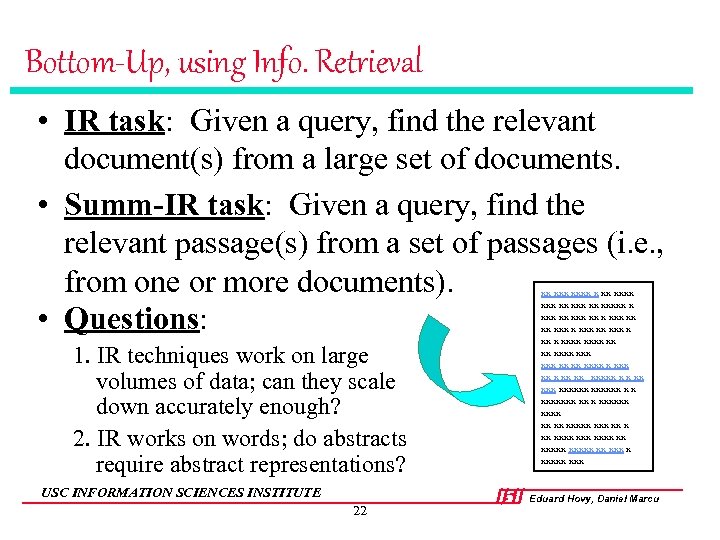 Bottom-Up, using Info. Retrieval • IR task: Given a query, find the relevant document(s) from a large set of documents. • Summ-IR task: Given a query, find the relevant passage(s) from a set of passages (i. e. , from one or more documents). • Questions: 1. IR techniques work on large volumes of data; can they scale down accurately enough? 2. IR works on words; do abstracts require abstract representations? USC INFORMATION SCIENCES INSTITUTE 22 xx xxxx xxx xx xxxxx xx x xx xxx xx x xxxx xx xx xxxx x xx xx xxxxx x x xx xxxxxx x x xxxxxxx xx xx xxx xx xxxx xx xxxxx xxxxx Eduard Hovy, Daniel Marcu
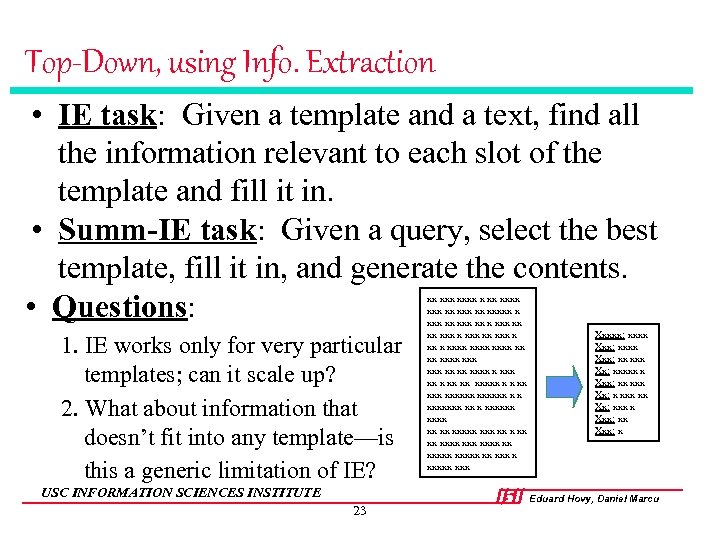 Top-Down, using Info. Extraction • IE task: Given a template and a text, find all the information relevant to each slot of the template and fill it in. • Summ-IE task: Given a query, select the best template, fill it in, and generate the contents. • Questions: 1. IE works only for very particular templates; can it scale up? 2. What about information that doesn’t fit into any template—is this a generic limitation of IE? USC INFORMATION SCIENCES INSTITUTE 23 xx xxxx xxx xx xxxxx xx x xx xxx xx x xxxx xx xx xxxx x xx xx xxxxx x x xx xxxxxx x x xxxxxxx xx xx xxx xxxx xx xxxxx xxxxx Xxxxx: xxxx Xxx: xx xxx Xx: xxxxx x Xxx: xx xxx Xx: xxx x Xxx: x Eduard Hovy, Daniel Marcu
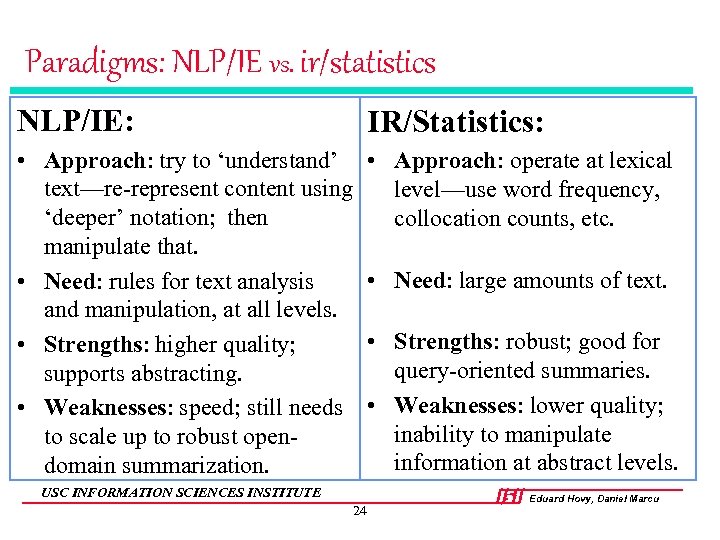 Paradigms: NLP/IE vs. ir/statistics NLP/IE: IR/Statistics: • Approach: try to ‘understand’ text—re-represent content using ‘deeper’ notation; then manipulate that. • Need: rules for text analysis and manipulation, at all levels. • Strengths: higher quality; supports abstracting. • Weaknesses: speed; still needs to scale up to robust opendomain summarization. • Approach: operate at lexical level—use word frequency, collocation counts, etc. USC INFORMATION SCIENCES INSTITUTE 24 • Need: large amounts of text. • Strengths: robust; good for query-oriented summaries. • Weaknesses: lower quality; inability to manipulate information at abstract levels. Eduard Hovy, Daniel Marcu
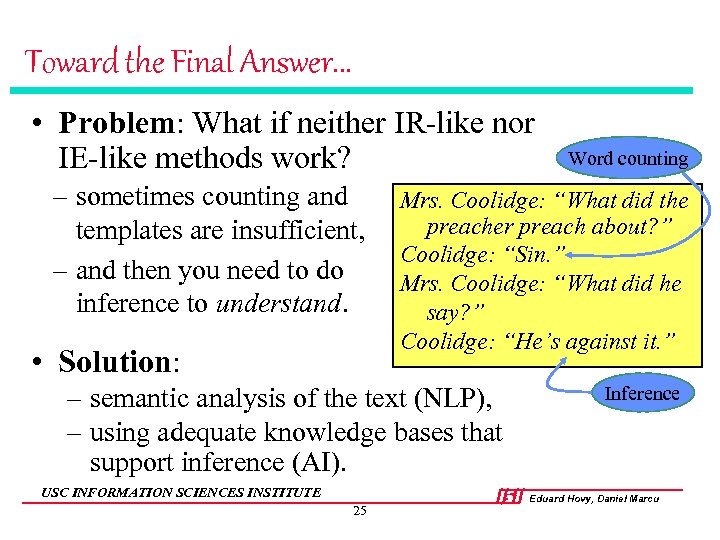 Toward the Final Answer. . . • Problem: What if neither IR-like nor IE-like methods work? – sometimes counting and templates are insufficient, – and then you need to do inference to understand. • Solution: Mrs. Coolidge: “What did the preacher preach about? ” Coolidge: “Sin. ” Mrs. Coolidge: “What did he say? ” Coolidge: “He’s against it. ” – semantic analysis of the text (NLP), – using adequate knowledge bases that support inference (AI). USC INFORMATION SCIENCES INSTITUTE 25 Word counting Inference Eduard Hovy, Daniel Marcu
 The Optimal Solution. . . Combine strengths of both paradigms…. . . use IE/NLP when you have suitable template(s), . . . use IR when you don’t… …but how exactly to do it? USC INFORMATION SCIENCES INSTITUTE 26 Eduard Hovy, Daniel Marcu
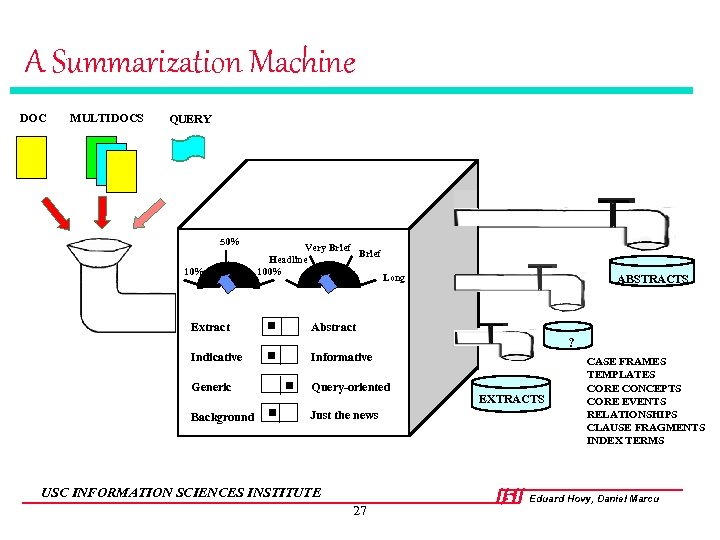 A Summarization Machine DOC MULTIDOCS QUERY 50% 10% Extract Very Brief Headline 100% Long ABSTRACTS Abstract ? Indicative Informative Generic Query-oriented Background Just the news USC INFORMATION SCIENCES INSTITUTE 27 EXTRACTS CASE FRAMES TEMPLATES CORE CONCEPTS CORE EVENTS RELATIONSHIPS CLAUSE FRAGMENTS INDEX TERMS Eduard Hovy, Daniel Marcu
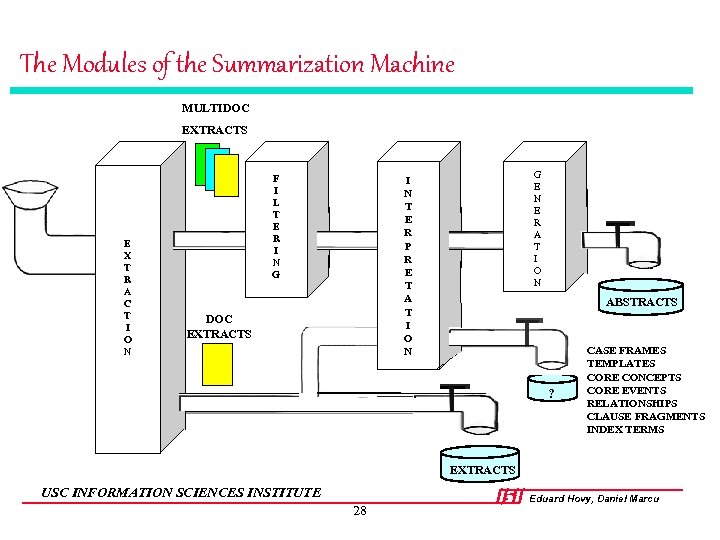 The Modules of the Summarization Machine MULTIDOC EXTRACTS E X T R A C T I O N F I L T E R I N G G E N E R A T I O N I N T E R P R E T A T I O N DOC EXTRACTS ABSTRACTS ? CASE FRAMES TEMPLATES CORE CONCEPTS CORE EVENTS RELATIONSHIPS CLAUSE FRAGMENTS INDEX TERMS EXTRACTS USC INFORMATION SCIENCES INSTITUTE 28 Eduard Hovy, Daniel Marcu
 Table of contents 1. Motivation. 2. Genres and types of summaries. 3. Approaches and paradigms. 4. Summarization methods (& exercise). Topic Extraction. Interpretation. Generation. 5. Evaluating summaries. 6. The future. USC INFORMATION SCIENCES INSTITUTE 29 Eduard Hovy, Daniel Marcu
 Overview of Extraction Methods • Position in the text – lead method; optimal position policy – title/heading method • Cue phrases in sentences • Word frequencies throughout the text • Cohesion: links among words – word co-occurrence – coreference – lexical chains • Discourse structure of the text • Information Extraction: parsing and analysis USC INFORMATION SCIENCES INSTITUTE 30 Eduard Hovy, Daniel Marcu
 Note • The recall and precision figures reported here reflect the ability of various methods to match human performance on the task of identifying the sentences/clauses that are important in texts. • Rely on evaluations using six corpora: (Edmundson, 68; Kupiec et al. , 95; Teufel and Moens, 97; Marcu, 97; Jing et al. , 98; SUMMAC, 98). USC INFORMATION SCIENCES INSTITUTE 31 Eduard Hovy, Daniel Marcu
 POSition-based method (1) • Claim: Important sentences occur at the beginning (and/or end) of texts. • Lead method: just take first sentence(s)! • Experiments: – In 85% of 200 individual paragraphs the topic sentences occurred in initial position and in 7% in final position (Baxendale, 58). – Only 13% of the paragraphs of contemporary writers start with topic sentences (Donlan, 80). USC INFORMATION SCIENCES INSTITUTE 32 Eduard Hovy, Daniel Marcu
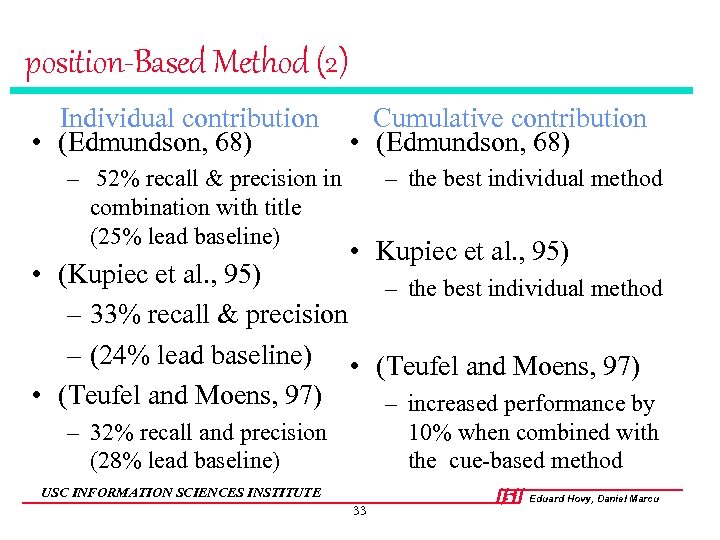 position-Based Method (2) Individual contribution • (Edmundson, 68) – 52% recall & precision in combination with title (25% lead baseline) Cumulative contribution • (Edmundson, 68) – the best individual method • Kupiec et al. , 95) • (Kupiec et al. , 95) – the best individual method – 33% recall & precision – (24% lead baseline) • (Teufel and Moens, 97) – increased performance by – 32% recall and precision (28% lead baseline) 10% when combined with the cue-based method USC INFORMATION SCIENCES INSTITUTE 33 Eduard Hovy, Daniel Marcu
 Optimum Position Policy (OPP) • Claim: Important sentences are located at positions that are genre-dependent; these positions can be determined automatically through training (Lin and Hovy, 97). – Corpus: 13000 newspaper articles (ZIFF corpus). – Step 1: For each article, determine overlap between sentences and the index terms for the article. – Step 2: Determine a partial ordering over the locations where sentences containing important words occur: Optimal Position Policy (OPP) USC INFORMATION SCIENCES INSTITUTE 34 Eduard Hovy, Daniel Marcu
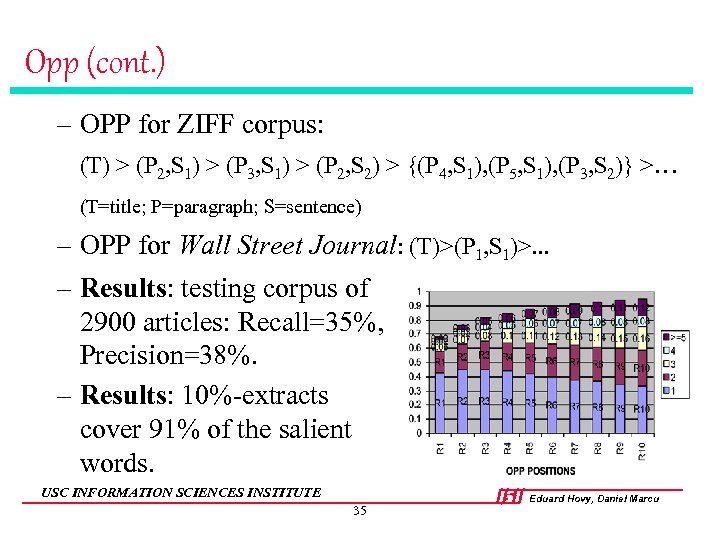 Opp (cont. ) – OPP for ZIFF corpus: (T) > (P 2, S 1) > (P 3, S 1) > (P 2, S 2) > {(P 4, S 1), (P 5, S 1), (P 3, S 2)} >… (T=title; P=paragraph; S=sentence) – OPP for Wall Street Journal: (T)>(P 1, S 1)>. . . – Results: testing corpus of 2900 articles: Recall=35%, Precision=38%. – Results: 10%-extracts cover 91% of the salient words. USC INFORMATION SCIENCES INSTITUTE 35 Eduard Hovy, Daniel Marcu
 Title-Based Method (1) • Claim: Words in titles and headings are positively relevant to summarization. • Shown to be statistically valid at 99% level of significance (Edmundson, 68). • Empirically shown to be useful in summarization systems. USC INFORMATION SCIENCES INSTITUTE 36 Eduard Hovy, Daniel Marcu
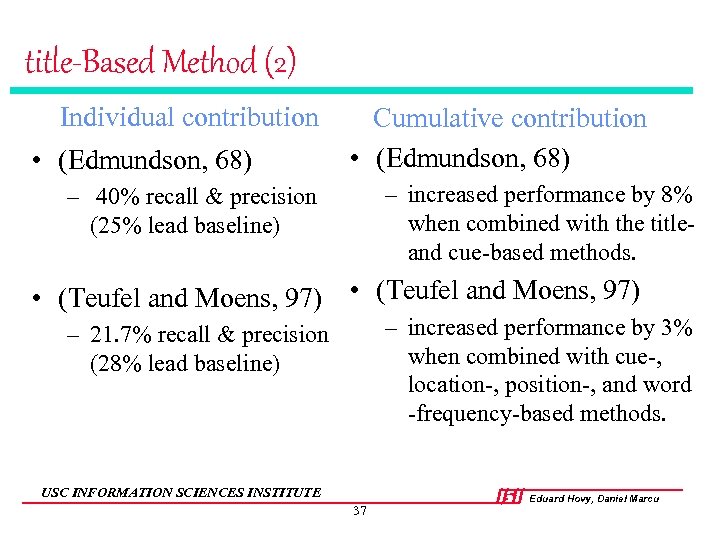 title-Based Method (2) Individual contribution • (Edmundson, 68) Cumulative contribution • (Edmundson, 68) – increased performance by 8% when combined with the titleand cue-based methods. – 40% recall & precision (25% lead baseline) • (Teufel and Moens, 97) – increased performance by 3% when combined with cue-, location-, position-, and word -frequency-based methods. – 21. 7% recall & precision (28% lead baseline) USC INFORMATION SCIENCES INSTITUTE 37 Eduard Hovy, Daniel Marcu
 Cue-Phrase method (1) • Claim 1: Important sentences contain ‘bonus phrases’, such as significantly, In this paper we show, and In conclusion, while non-important sentences contain ‘stigma phrases’ such as hardly and impossible. • Claim 2: These phrases can be detected automatically (Kupiec et al. 95; Teufel and Moens 97). • Method: Add to sentence score if it contains a bonus phrase, penalize if it contains a stigma phrase. USC INFORMATION SCIENCES INSTITUTE 38 Eduard Hovy, Daniel Marcu
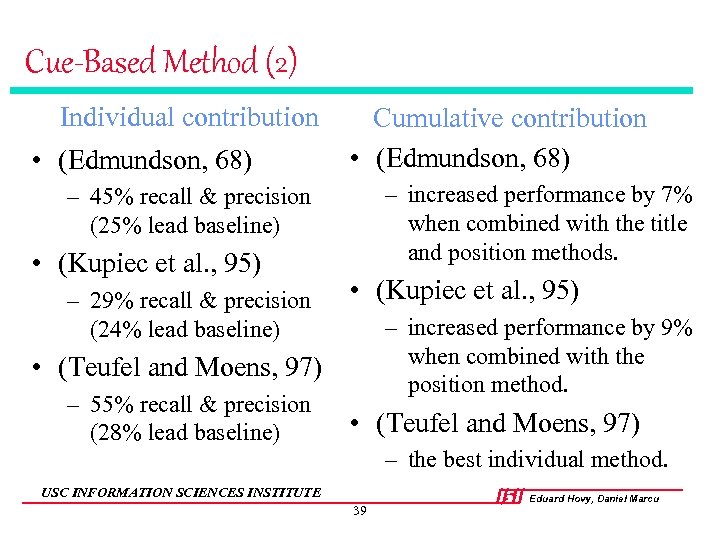 Cue-Based Method (2) Individual contribution • (Edmundson, 68) Cumulative contribution • (Edmundson, 68) – increased performance by 7% when combined with the title and position methods. – 45% recall & precision (25% lead baseline) • (Kupiec et al. , 95) – 29% recall & precision (24% lead baseline) • (Kupiec et al. , 95) – increased performance by 9% when combined with the position method. • (Teufel and Moens, 97) – 55% recall & precision (28% lead baseline) • (Teufel and Moens, 97) – the best individual method. USC INFORMATION SCIENCES INSTITUTE 39 Eduard Hovy, Daniel Marcu
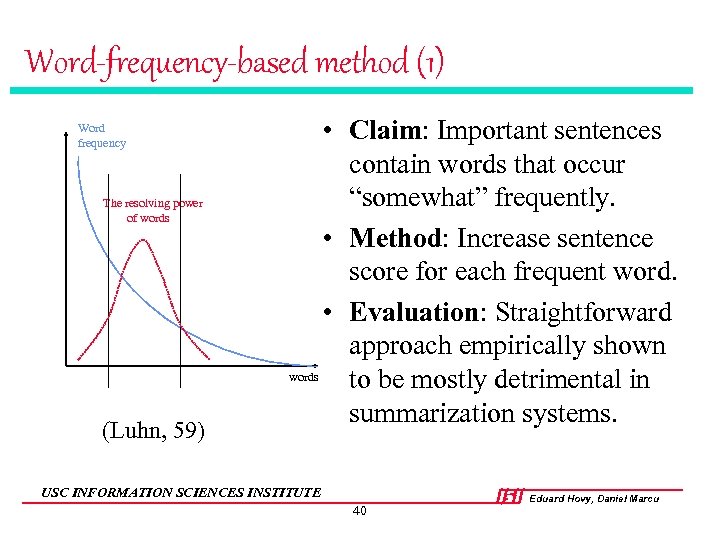 Word-frequency-based method (1) Word frequency The resolving power of words (Luhn, 59) • Claim: Important sentences contain words that occur “somewhat” frequently. • Method: Increase sentence score for each frequent word. • Evaluation: Straightforward approach empirically shown words to be mostly detrimental in summarization systems. USC INFORMATION SCIENCES INSTITUTE 40 Eduard Hovy, Daniel Marcu
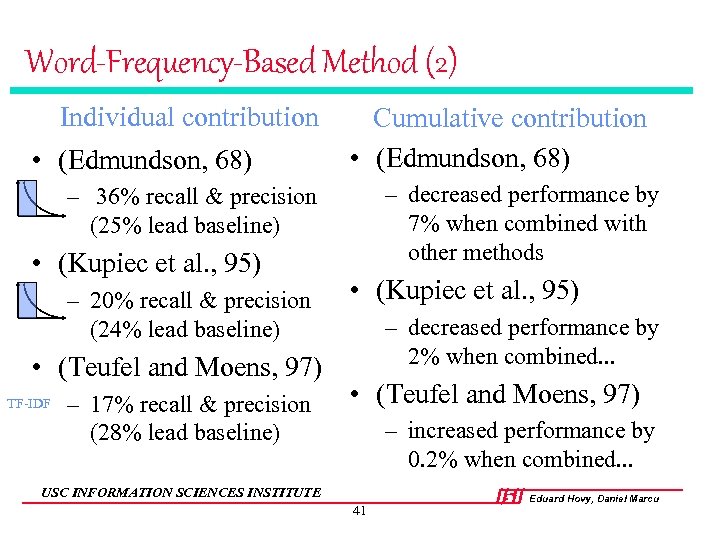 Word-Frequency-Based Method (2) Individual contribution • (Edmundson, 68) Cumulative contribution • (Edmundson, 68) – decreased performance by 7% when combined with other methods – 36% recall & precision (25% lead baseline) • (Kupiec et al. , 95) – 20% recall & precision (24% lead baseline) • (Teufel and Moens, 97) TF-IDF – 17% recall & precision (28% lead baseline) • (Kupiec et al. , 95) – decreased performance by 2% when combined. . . • (Teufel and Moens, 97) – increased performance by 0. 2% when combined. . . USC INFORMATION SCIENCES INSTITUTE 41 Eduard Hovy, Daniel Marcu
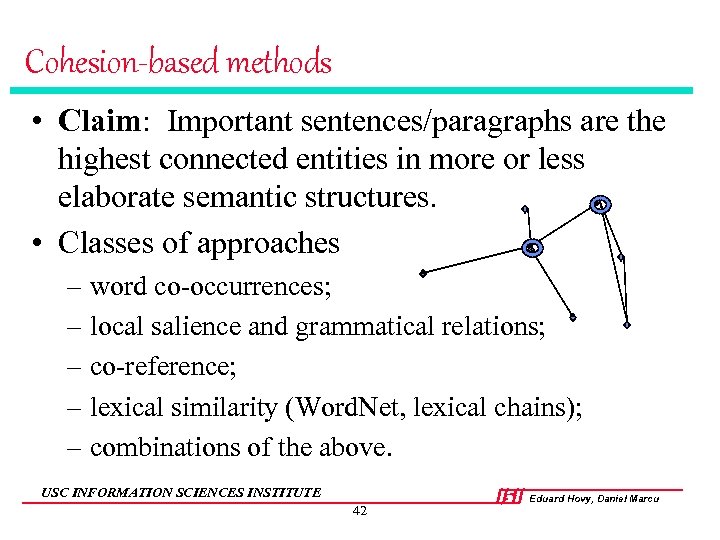 Cohesion-based methods • Claim: Important sentences/paragraphs are the highest connected entities in more or less elaborate semantic structures. • Classes of approaches – word co-occurrences; – local salience and grammatical relations; – co-reference; – lexical similarity (Word. Net, lexical chains); – combinations of the above. USC INFORMATION SCIENCES INSTITUTE 42 Eduard Hovy, Daniel Marcu
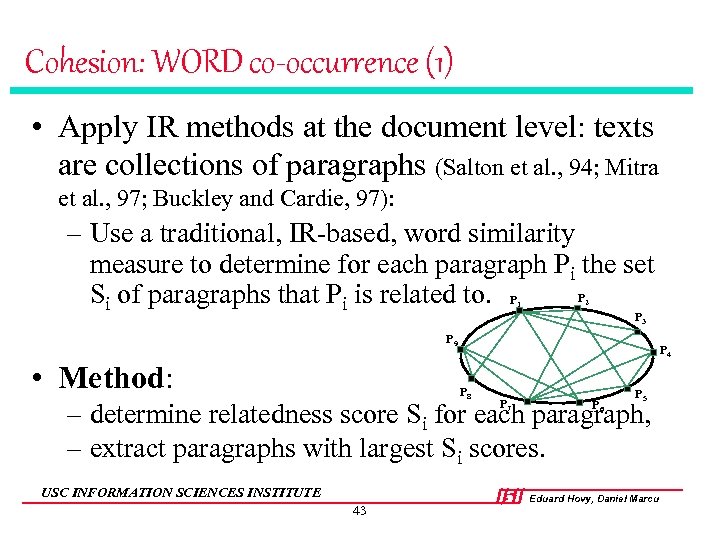 Cohesion: WORD co-occurrence (1) • Apply IR methods at the document level: texts are collections of paragraphs (Salton et al. , 94; Mitra et al. , 97; Buckley and Cardie, 97): – Use a traditional, IR-based, word similarity measure to determine for each paragraph Pi the set P Si of paragraphs that Pi is related to. P 1 2 P 3 P 9 • Method: P 4 P 8 P 7 P 5 – determine relatedness score Si for each paragraph, – extract paragraphs with largest Si scores. USC INFORMATION SCIENCES INSTITUTE 43 P 6 Eduard Hovy, Daniel Marcu
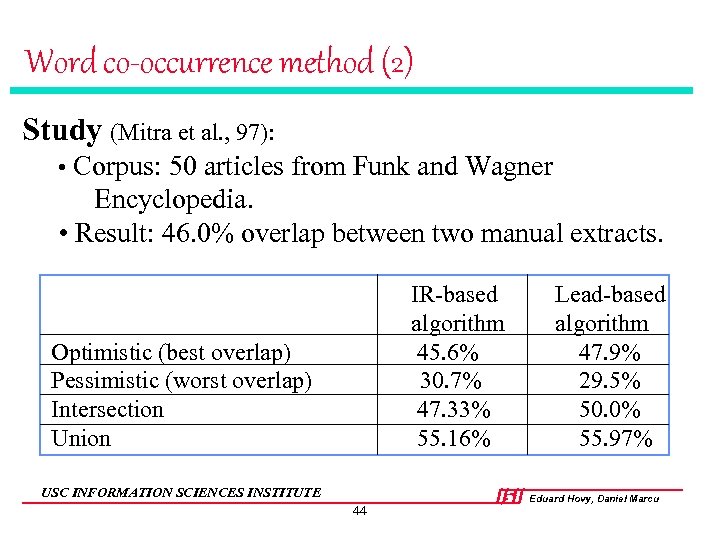 Word co-occurrence method (2) Study (Mitra et al. , 97): • Corpus: 50 articles from Funk and Wagner Encyclopedia. • Result: 46. 0% overlap between two manual extracts. IR-based algorithm 45. 6% 30. 7% 47. 33% 55. 16% Optimistic (best overlap) Pessimistic (worst overlap) Intersection Union USC INFORMATION SCIENCES INSTITUTE 44 Lead-based algorithm 47. 9% 29. 5% 50. 0% 55. 97% Eduard Hovy, Daniel Marcu
 Word co-occurrence method (3) In the context of query-based summarization • Cornell’s Smart-based approach – expand original query – compare expanded query against paragraphs – select top three paragraphs (max 25% of original) that are most similar to the original query (SUMMAC, 98): 71. 9% F-score for relevance judgment • CGI/CMU approach – maximize query-relevance while minimizing redundancy with previous information. (SUMMAC, 98): 73. 4% F-score for relevance judgment USC INFORMATION SCIENCES INSTITUTE 45 Eduard Hovy, Daniel Marcu
 Cohesion: Local salience Method • Assumes that important phrasal expressions are given by a combination of grammatical, syntactic, and contextual parameters (Boguraev and Kennedy, 97): CNTX: 50 SUBJ: 80 EXST: 70 ACC: 50 HEAD: 80 ARG: 50 iff the expression is in the current discourse segment iff the expression is a subject iff the expression is an existential construction iff the expression is a direct object iff the expression is not contained in another phrase iff the expression is not contained in an adjunct • No evaluation of the method. USC INFORMATION SCIENCES INSTITUTE 46 Eduard Hovy, Daniel Marcu
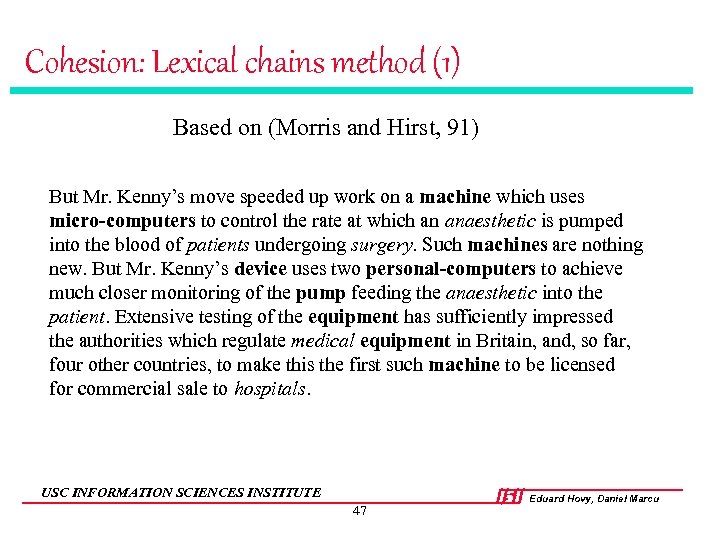 Cohesion: Lexical chains method (1) Based on (Morris and Hirst, 91) But Mr. Kenny’s move speeded up work on a machine which uses micro-computers to control the rate at which an anaesthetic is pumped into the blood of patients undergoing surgery. Such machines are nothing new. But Mr. Kenny’s device uses two personal-computers to achieve much closer monitoring of the pump feeding the anaesthetic into the patient. Extensive testing of the equipment has sufficiently impressed the authorities which regulate medical equipment in Britain, and, so far, four other countries, to make this the first such machine to be licensed for commercial sale to hospitals. USC INFORMATION SCIENCES INSTITUTE 47 Eduard Hovy, Daniel Marcu
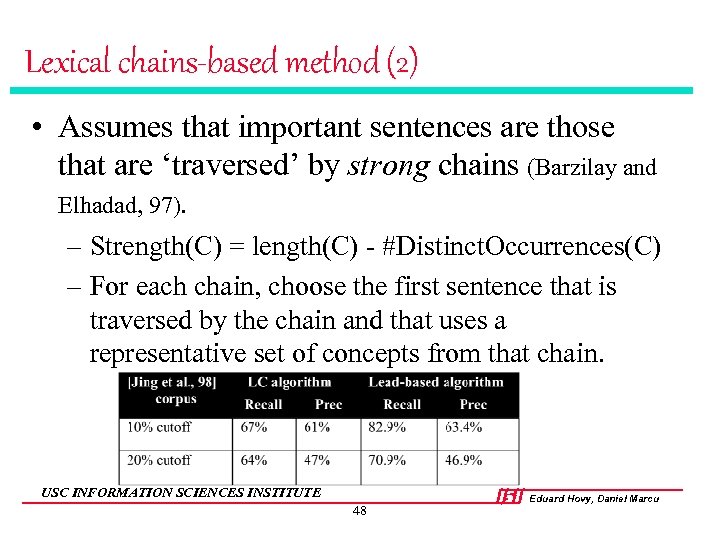 Lexical chains-based method (2) • Assumes that important sentences are those that are ‘traversed’ by strong chains (Barzilay and Elhadad, 97). – Strength(C) = length(C) - #Distinct. Occurrences(C) – For each chain, choose the first sentence that is traversed by the chain and that uses a representative set of concepts from that chain. USC INFORMATION SCIENCES INSTITUTE 48 Eduard Hovy, Daniel Marcu
 Cohesion: Coreference method • Build co-reference chains (noun/event identity, part-whole relations) between – query and document - In the context of query-based summarization – title and document – sentences within document • Important sentences are those traversed by a large number of chains: – a preference is imposed on chains (query > title > doc) • Evaluation: 67% F-score for relevance (SUMMAC, 98). (Baldwin and Morton, 98) USC INFORMATION SCIENCES INSTITUTE 49 Eduard Hovy, Daniel Marcu
 Cohesion: Connectedness method (1) (Mani and Bloedorn, 97) • Map texts into graphs: – The nodes of the graph are the words of the text. – Arcs represent adjacency, grammatical, coreference, and lexical similarity-based relations. • Associate importance scores to words (and sentences) by applying the tf. idf metric. • Assume that important words/sentences are those with the highest scores. USC INFORMATION SCIENCES INSTITUTE 50 Eduard Hovy, Daniel Marcu
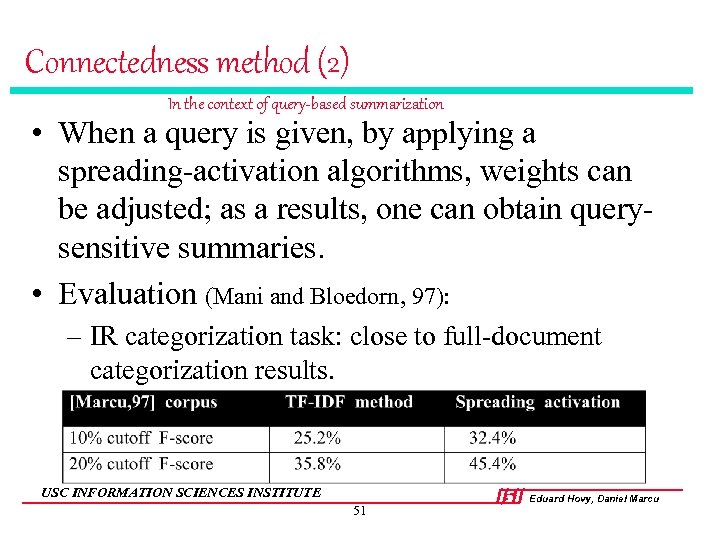 Connectedness method (2) In the context of query-based summarization • When a query is given, by applying a spreading-activation algorithms, weights can be adjusted; as a results, one can obtain querysensitive summaries. • Evaluation (Mani and Bloedorn, 97): – IR categorization task: close to full-document categorization results. USC INFORMATION SCIENCES INSTITUTE 51 Eduard Hovy, Daniel Marcu
 Discourse-based method • Claim: The multi-sentence coherence structure of a text can be constructed, and the ‘centrality’ of the textual units in this structure reflects their importance. • Tree-like representation of texts in the style of Rhetorical Structure Theory (Mann and Thompson, 88). • Use the discourse representation in order to determine the most important textual units. Attempts: – (Ono et al. , 94) for Japanese. – (Marcu, 97) for English. USC INFORMATION SCIENCES INSTITUTE 52 Eduard Hovy, Daniel Marcu
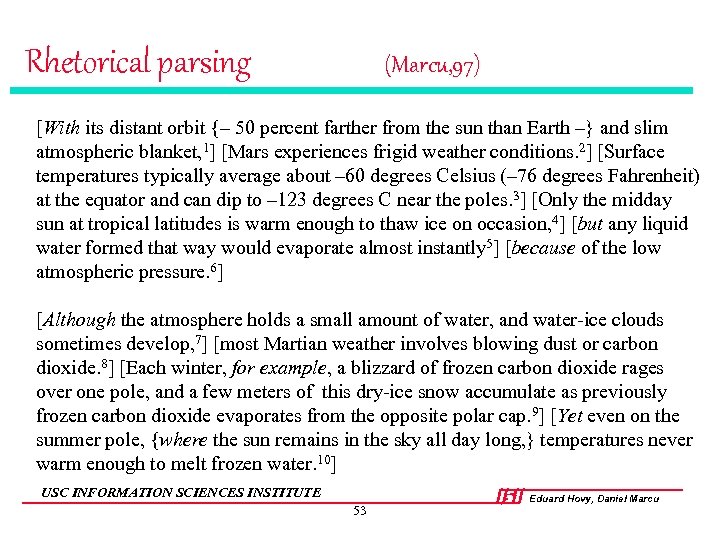 Rhetorical parsing (Marcu, 97) [With its distant orbit {– 50 percent farther from the sun than Earth –} and slim atmospheric blanket, 1] [Mars experiences frigid weather conditions. 2] [Surface temperatures typically average about – 60 degrees Celsius (– 76 degrees Fahrenheit) at the equator and can dip to – 123 degrees C near the poles. 3] [Only the midday sun at tropical latitudes is warm enough to thaw ice on occasion, 4] [but any liquid water formed that way would evaporate almost instantly 5] [because of the low atmospheric pressure. 6] [Although the atmosphere holds a small amount of water, and water-ice clouds sometimes develop, 7] [most Martian weather involves blowing dust or carbon dioxide. 8] [Each winter, for example, a blizzard of frozen carbon dioxide rages over one pole, and a few meters of this dry-ice snow accumulate as previously frozen carbon dioxide evaporates from the opposite polar cap. 9] [Yet even on the summer pole, {where the sun remains in the sky all day long, } temperatures never warm enough to melt frozen water. 10] USC INFORMATION SCIENCES INSTITUTE 53 Eduard Hovy, Daniel Marcu
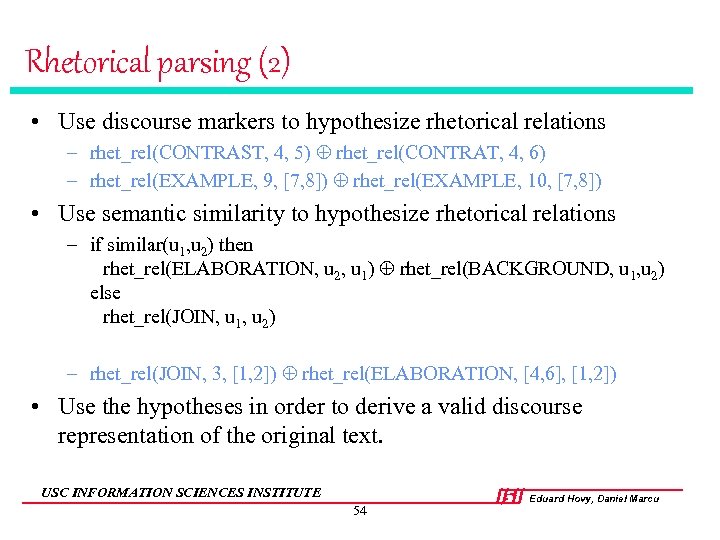 Rhetorical parsing (2) • Use discourse markers to hypothesize rhetorical relations – rhet_rel(CONTRAST, 4, 5) rhet_rel(CONTRAT, 4, 6) – rhet_rel(EXAMPLE, 9, [7, 8]) rhet_rel(EXAMPLE, 10, [7, 8]) • Use semantic similarity to hypothesize rhetorical relations – if similar(u 1, u 2) then rhet_rel(ELABORATION, u 2, u 1) rhet_rel(BACKGROUND, u 1, u 2) else rhet_rel(JOIN, u 1, u 2) – rhet_rel(JOIN, 3, [1, 2]) rhet_rel(ELABORATION, [4, 6], [1, 2]) • Use the hypotheses in order to derive a valid discourse representation of the original text. USC INFORMATION SCIENCES INSTITUTE 54 Eduard Hovy, Daniel Marcu
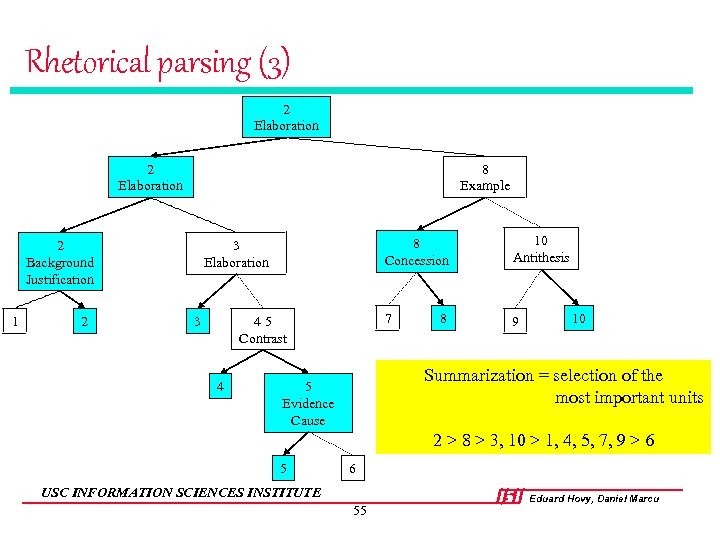 Rhetorical parsing (3) 2 Elaboration 8 Example 2 Background Justification 1 2 8 Concession 45 Contrast 3 4 10 Antithesis 7 3 Elaboration 9 8 10 Summarization = selection of the most important units 5 Evidence Cause 2 > 8 > 3, 10 > 1, 4, 5, 7, 9 > 6 5 6 USC INFORMATION SCIENCES INSTITUTE 55 Eduard Hovy, Daniel Marcu
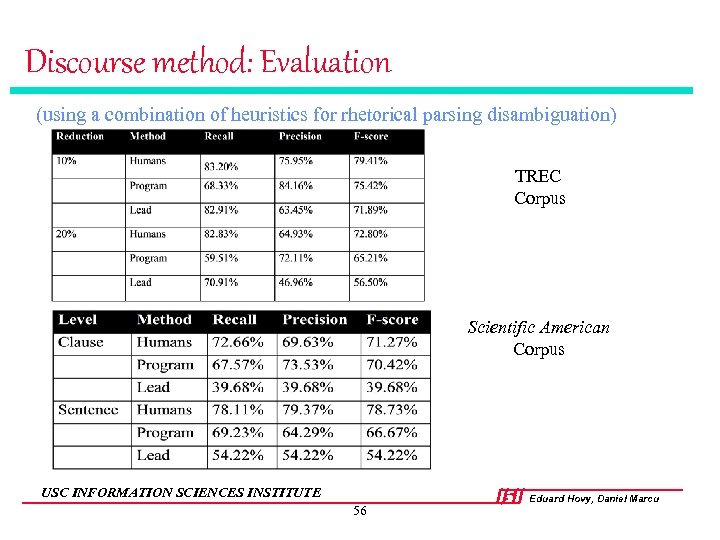 Discourse method: Evaluation (using a combination of heuristics for rhetorical parsing disambiguation) TREC Corpus Scientific American Corpus USC INFORMATION SCIENCES INSTITUTE 56 Eduard Hovy, Daniel Marcu
 Information extraction Method (1) • Idea: content selection using templates – Predefine a template, whose slots specify what is of interest. – Use a canonical IE system to extract from a (set of) document(s) the relevant information; fill the template. – Generate the content of the template as the summary. • Previous IE work: – FRUMP (De. Jong, 78): ‘sketchy scripts’ of terrorism, natural disasters, political visits. . . – (Mauldin, 91): templates for conceptual IR. – (Rau and Jacobs, 91): templates for business. – (Mc. Keown and Radev, 95): templates for news. USC INFORMATION SCIENCES INSTITUTE 57 Eduard Hovy, Daniel Marcu
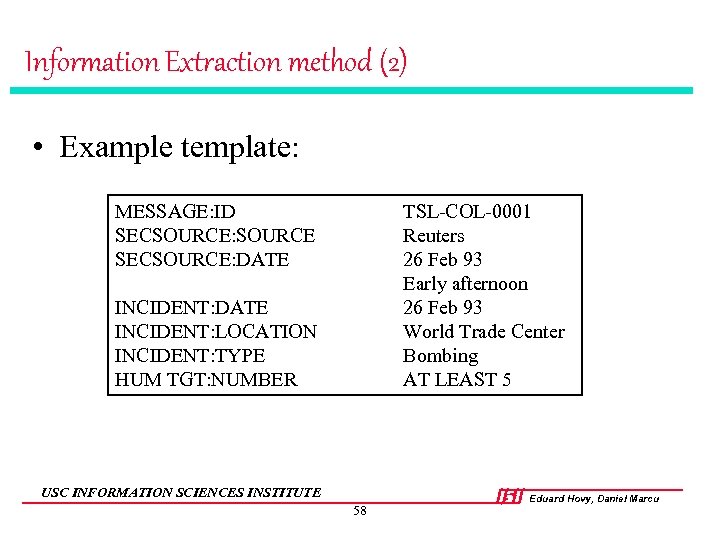 Information Extraction method (2) • Example template: MESSAGE: ID SECSOURCE: SOURCE SECSOURCE: DATE TSL-COL-0001 Reuters 26 Feb 93 Early afternoon 26 Feb 93 World Trade Center Bombing AT LEAST 5 INCIDENT: DATE INCIDENT: LOCATION INCIDENT: TYPE HUM TGT: NUMBER USC INFORMATION SCIENCES INSTITUTE 58 Eduard Hovy, Daniel Marcu
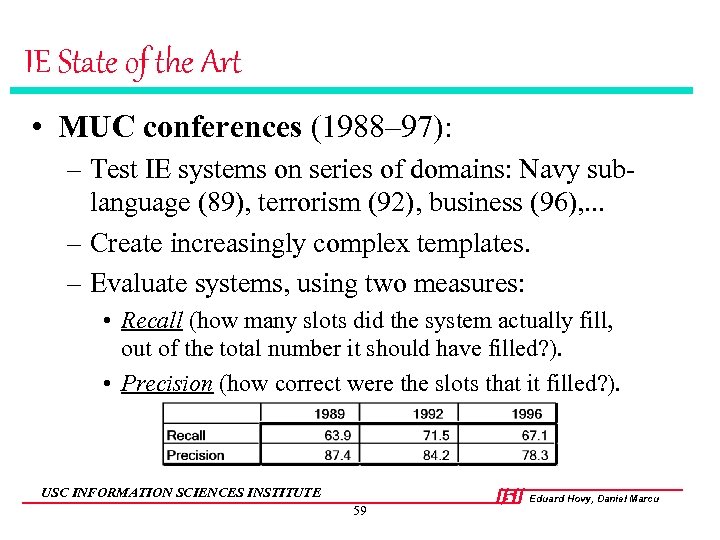 IE State of the Art • MUC conferences (1988– 97): – Test IE systems on series of domains: Navy sublanguage (89), terrorism (92), business (96), . . . – Create increasingly complex templates. – Evaluate systems, using two measures: • Recall (how many slots did the system actually fill, out of the total number it should have filled? ). • Precision (how correct were the slots that it filled? ). USC INFORMATION SCIENCES INSTITUTE 59 Eduard Hovy, Daniel Marcu
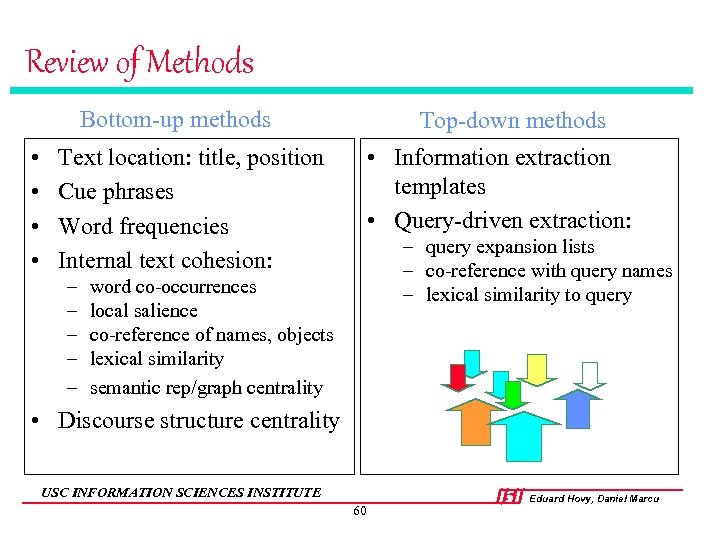 Review of Methods Bottom-up methods • • Top-down methods • Information extraction templates • Query-driven extraction: Text location: title, position Cue phrases Word frequencies Internal text cohesion: – – – query expansion lists – co-reference with query names – lexical similarity to query word co-occurrences local salience co-reference of names, objects lexical similarity semantic rep/graph centrality • Discourse structure centrality USC INFORMATION SCIENCES INSTITUTE 60 Eduard Hovy, Daniel Marcu
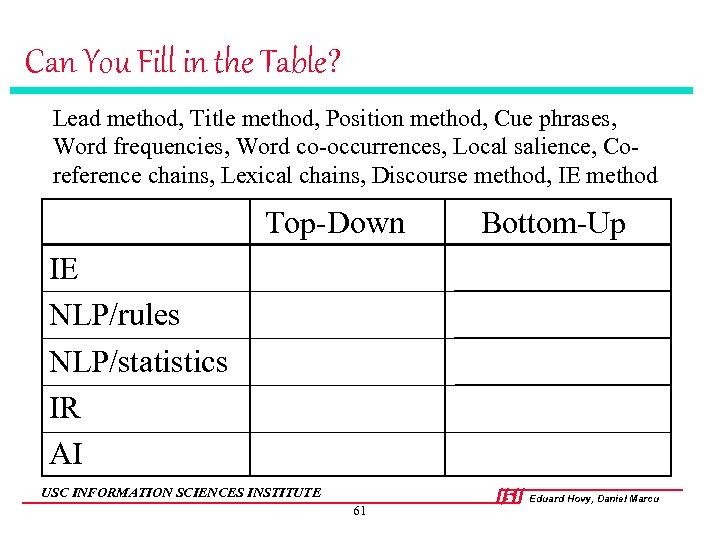 Can You Fill in the Table? Lead method, Title method, Position method, Cue phrases, Word frequencies, Word co-occurrences, Local salience, Coreference chains, Lexical chains, Discourse method, IE method Top-Down Bottom-Up IE NLP/rules NLP/statistics IR AI USC INFORMATION SCIENCES INSTITUTE 61 Eduard Hovy, Daniel Marcu
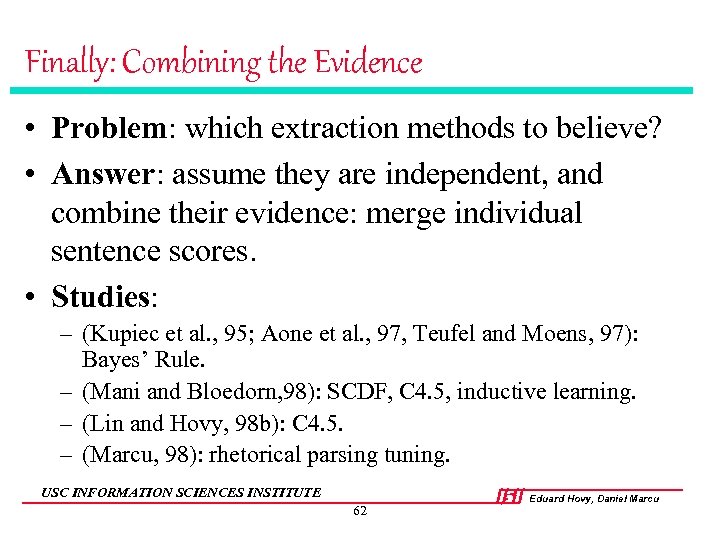 Finally: Combining the Evidence • Problem: which extraction methods to believe? • Answer: assume they are independent, and combine their evidence: merge individual sentence scores. • Studies: – (Kupiec et al. , 95; Aone et al. , 97, Teufel and Moens, 97): Bayes’ Rule. – (Mani and Bloedorn, 98): SCDF, C 4. 5, inductive learning. – (Lin and Hovy, 98 b): C 4. 5. – (Marcu, 98): rhetorical parsing tuning. USC INFORMATION SCIENCES INSTITUTE 62 Eduard Hovy, Daniel Marcu
 And Now, an Example. . . USC INFORMATION SCIENCES INSTITUTE 63 Eduard Hovy, Daniel Marcu
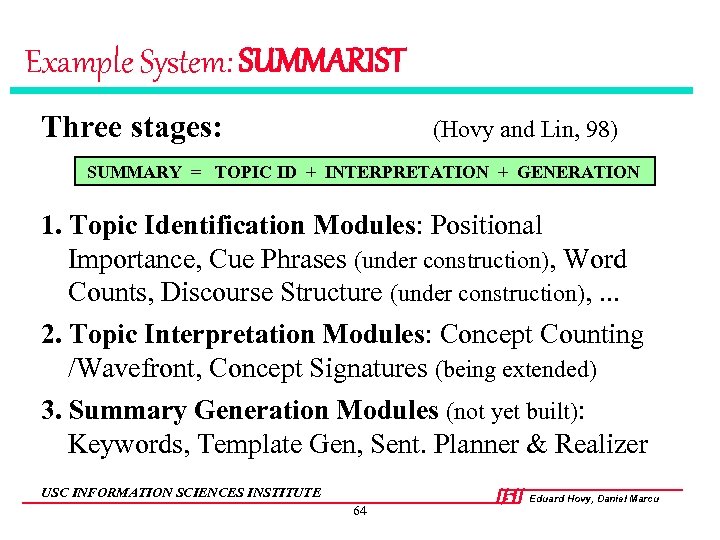 Example System: SUMMARIST Three stages: (Hovy and Lin, 98) SUMMARY = TOPIC ID + INTERPRETATION + GENERATION 1. Topic Identification Modules: Positional Importance, Cue Phrases (under construction), Word Counts, Discourse Structure (under construction), . . . 2. Topic Interpretation Modules: Concept Counting /Wavefront, Concept Signatures (being extended) 3. Summary Generation Modules (not yet built): Keywords, Template Gen, Sent. Planner & Realizer USC INFORMATION SCIENCES INSTITUTE 64 Eduard Hovy, Daniel Marcu
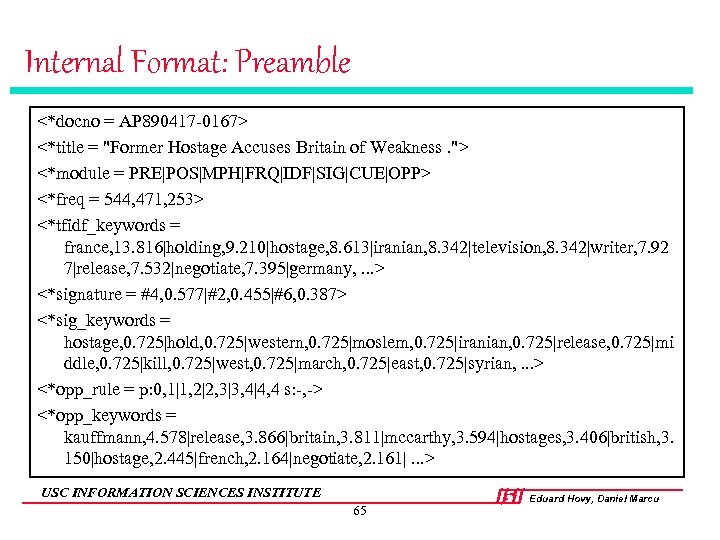 Internal Format: Preamble <*docno = AP 890417 -0167> <*title = "Former Hostage Accuses Britain of Weakness. "> <*module = PRE|POS|MPH|FRQ|IDF|SIG|CUE|OPP> <*freq = 544, 471, 253> <*tfidf_keywords = france, 13. 816|holding, 9. 210|hostage, 8. 613|iranian, 8. 342|television, 8. 342|writer, 7. 92 7|release, 7. 532|negotiate, 7. 395|germany, . . . > <*signature = #4, 0. 577|#2, 0. 455|#6, 0. 387> <*sig_keywords = hostage, 0. 725|hold, 0. 725|western, 0. 725|moslem, 0. 725|iranian, 0. 725|release, 0. 725|mi ddle, 0. 725|kill, 0. 725|west, 0. 725|march, 0. 725|east, 0. 725|syrian, . . . > <*opp_rule = p: 0, 1|1, 2|2, 3|3, 4|4, 4 s: -, -> <*opp_keywords = kauffmann, 4. 578|release, 3. 866|britain, 3. 811|mccarthy, 3. 594|hostages, 3. 406|british, 3. 150|hostage, 2. 445|french, 2. 164|negotiate, 2. 161|. . . > USC INFORMATION SCIENCES INSTITUTE 65 Eduard Hovy, Daniel Marcu
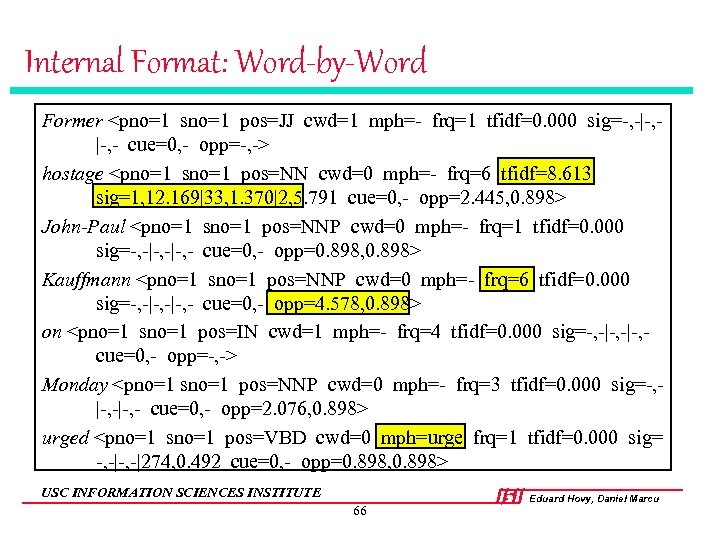 Internal Format: Word-by-Word Former
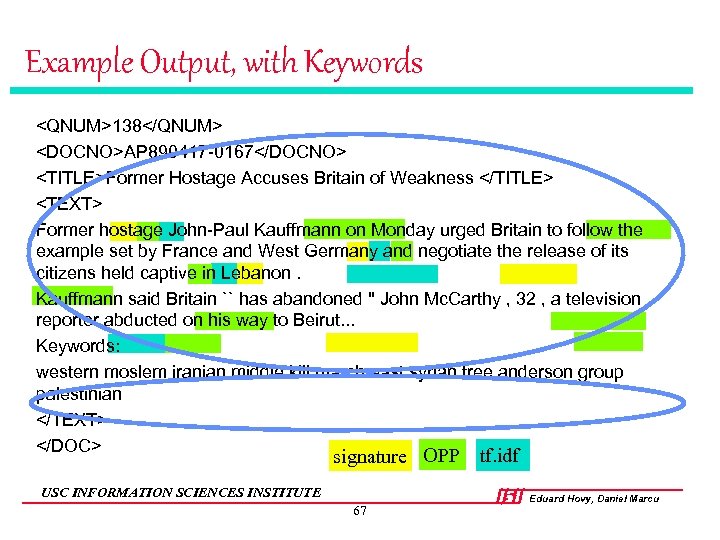 Example Output, with Keywords
 Summarization exercise • Write a one-sentence summary for each of the following texts. USC INFORMATION SCIENCES INSTITUTE 68 Eduard Hovy, Daniel Marcu
 Flu stopper A new compound is set for human testing (Times) Running nose. Raging fever. Aching joints. Splitting headache. Are there any poor souls suffering from the flu this winter who haven’t longed for a pill to make it all go away? Relief may be in sight. Researchers at Gilead Sciences, a pharmaceutical company in Foster City, California, reported last week in the Journal of the American Chemical Society that they have discovered a compound that can stop the influenza virus from spreading in animals. Tests on humans are set for later this year. The new compound takes a novel approach to the familiar flu virus. It targets an enzyme, called neuraminidase, that the virus needs in order to scatter copies of itself throughout the body. This enzyme acts like a pair of molecular scissors that slices through the protective mucous linings of the nose and throat. After the virus infects the cells of the respiratory system and begins replicating, neuraminidase cuts the newly formed copies free to invade other cells. By blocking this enzyme, the new compound, dubbed GS 4104, prevents the infection from spreading. USC INFORMATION SCIENCES INSTITUTE 69 Eduard Hovy, Daniel Marcu
 Plant matters How do you regulate an herb? (Scientific American) If Harlan Page Hubbard were alive, he might be the president of a dietary supplements company. In the late 19 th century Hubbard sold Lydia E. Pinkham’s Vegetable Compound for kidney and sexual problems. The renowned huckster is remembered each year by national consumer and health organizations who confer a “Hubbard” – a statuette clutching a fresh lemon – for the “most misleading, unfair and irresponsible advertising of the past 12 months. ” Appropriately enough, one of this year’s winners was a product that Hubbard might have peddled alongside his Lydia Pinkham elixir. Ginkay, an extract of the herb gingko, received its lemon for advertising and labelling claims that someone ingesting the product will have a better memory. Whereas some studies have shown that gingko improves mental functioning in people with dementia, none has proved that it serves as brain tonic for healthy. USC INFORMATION SCIENCES INSTITUTE 70 Eduard Hovy, Daniel Marcu
 Table of contents 1. Motivation. 2. Genres and types of summaries. 3. Approaches and paradigms. 4. Summarization methods (& exercise). Topic Extraction. Interpretation. Generation. 5. Evaluating summaries. 6. The future. USC INFORMATION SCIENCES INSTITUTE 71 Eduard Hovy, Daniel Marcu
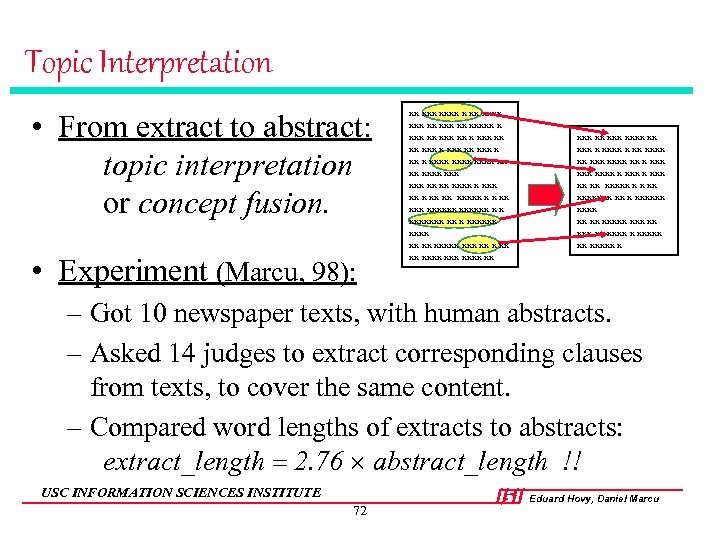 Topic Interpretation • From extract to abstract: topic interpretation or concept fusion. • Experiment (Marcu, 98): xx xxxx xxx xx xxxxx xx x xx xxx xx x xxxx xx xx xxxx x xx xx xxxxx x x xx xxxxxx x x xxxxxxx xx xx xxx xxxx xx xxx xxxx xxxx xxx xxxx xxx xxxx xx xx xxxxx x x xx xxxxxxx xx xx xxx xx xxxxx x – Got 10 newspaper texts, with human abstracts. – Asked 14 judges to extract corresponding clauses from texts, to cover the same content. – Compared word lengths of extracts to abstracts: extract_length 2. 76 abstract_length !! USC INFORMATION SCIENCES INSTITUTE 72 Eduard Hovy, Daniel Marcu
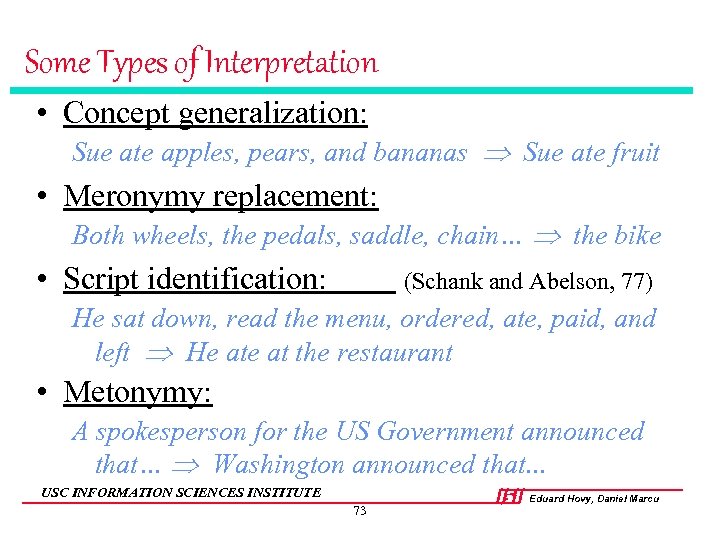 Some Types of Interpretation • Concept generalization: Sue ate apples, pears, and bananas Sue ate fruit • Meronymy replacement: Both wheels, the pedals, saddle, chain… the bike • Script identification: (Schank and Abelson, 77) He sat down, read the menu, ordered, ate, paid, and left He at the restaurant • Metonymy: A spokesperson for the US Government announced that… Washington announced that. . . USC INFORMATION SCIENCES INSTITUTE 73 Eduard Hovy, Daniel Marcu
 General Aspects of Interpretation • Interpretation occurs at the conceptual level. . . …words alone are polysemous (bat animal and sports instrument) and combine for meaning (alleged murderer). • For interpretation, you need world knowledge. . . …the fusion inferences are not in the text! • Little work so far: (Lin, 95; Mc. Keown and Radev, 95; Reimer and Hahn, 97; Hovy and Lin, 98). USC INFORMATION SCIENCES INSTITUTE 74 Eduard Hovy, Daniel Marcu
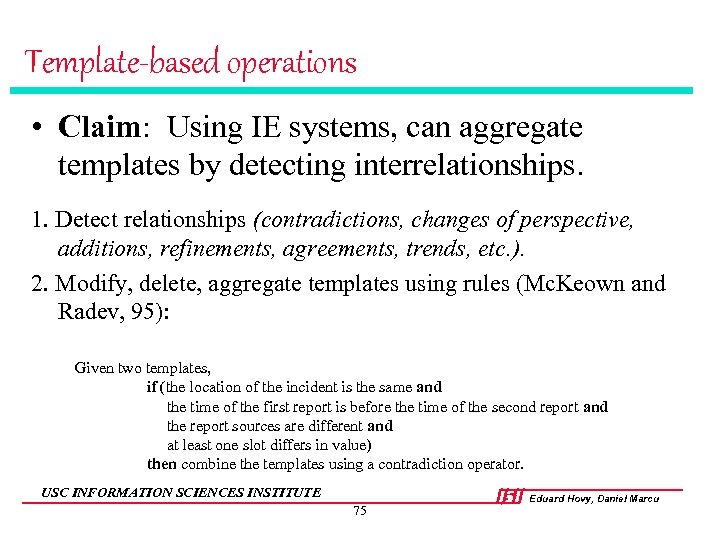 Template-based operations • Claim: Using IE systems, can aggregate templates by detecting interrelationships. 1. Detect relationships (contradictions, changes of perspective, additions, refinements, agreements, trends, etc. ). 2. Modify, delete, aggregate templates using rules (Mc. Keown and Radev, 95): Given two templates, if (the location of the incident is the same and the time of the first report is before the time of the second report and the report sources are different and at least one slot differs in value) then combine the templates using a contradiction operator. USC INFORMATION SCIENCES INSTITUTE 75 Eduard Hovy, Daniel Marcu
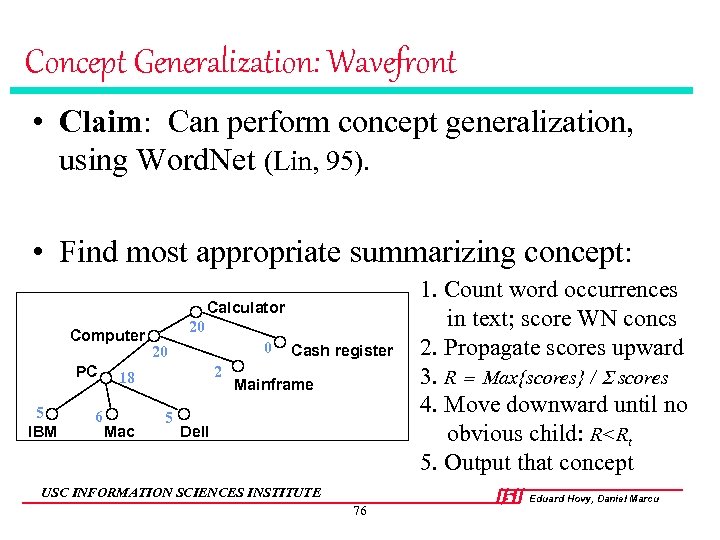 Concept Generalization: Wavefront • Claim: Can perform concept generalization, using Word. Net (Lin, 95). • Find most appropriate summarizing concept: Calculator Computer PC 5 IBM 6 20 0 20 2 18 Mac 5 Cash register Mainframe Dell USC INFORMATION SCIENCES INSTITUTE 76 1. Count word occurrences in text; score WN concs 2. Propagate scores upward 3. R Max{scores} / scores 4. Move downward until no obvious child: R
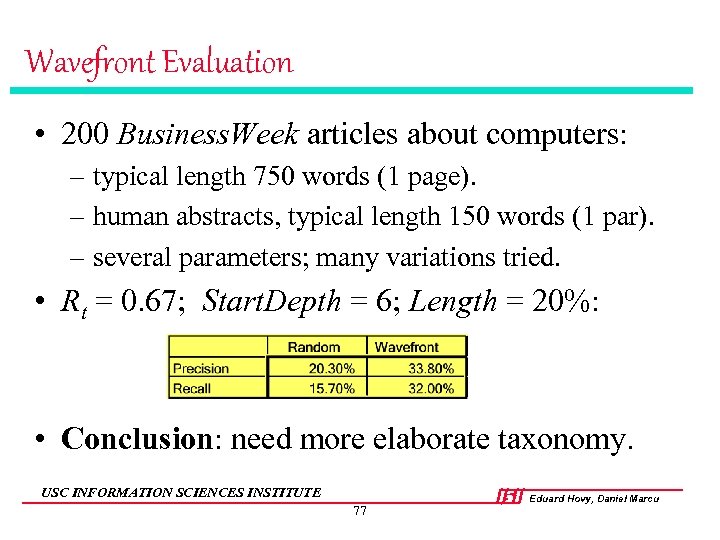 Wavefront Evaluation • 200 Business. Week articles about computers: – typical length 750 words (1 page). – human abstracts, typical length 150 words (1 par). – several parameters; many variations tried. • Rt = 0. 67; Start. Depth = 6; Length = 20%: • Conclusion: need more elaborate taxonomy. USC INFORMATION SCIENCES INSTITUTE 77 Eduard Hovy, Daniel Marcu
 Inferences in terminological Logic • ‘Condensation’ operators (Reimer and Hahn, 97). 1. Parse text, incrementally build a terminological rep. 2. Apply condensation operators to determine the salient concepts, relationships, and properties for each paragraph (employ frequency counting and other heuristics on concepts and relations, not on words). 3. Build a hierarchy of topic descriptions out of salient constructs. Conclusion: No evaluation. USC INFORMATION SCIENCES INSTITUTE 78 Eduard Hovy, Daniel Marcu
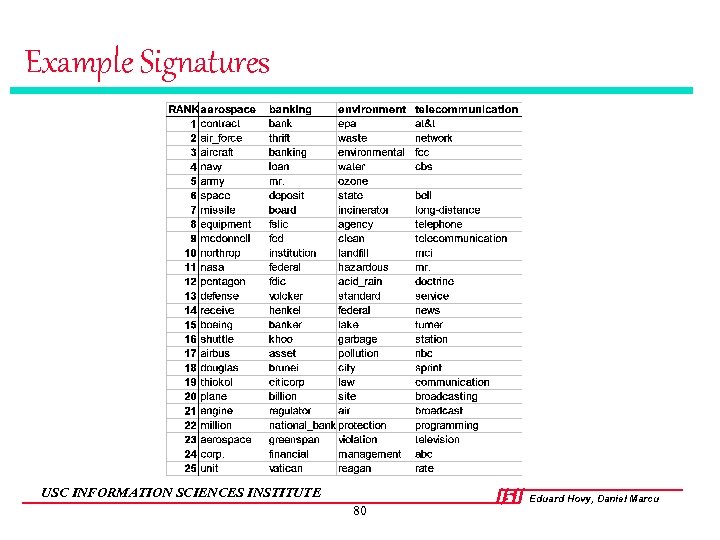
 Topic Signatures (1) • Claim: Can approximate script identification at lexical level, using automatically acquired ‘word families’ (Hovy and Lin, 98). • Idea: Create topic signatures: each concept is defined by frequency distribution of its related words (concepts): signature = {head (c 1, f 1) (c 2, f 2). . . } restaurant waiter + menu + food + eat. . . • (inverse of query expansion in IR. ) USC INFORMATION SCIENCES INSTITUTE 79 Eduard Hovy, Daniel Marcu
 Example Signatures USC INFORMATION SCIENCES INSTITUTE 80 Eduard Hovy, Daniel Marcu
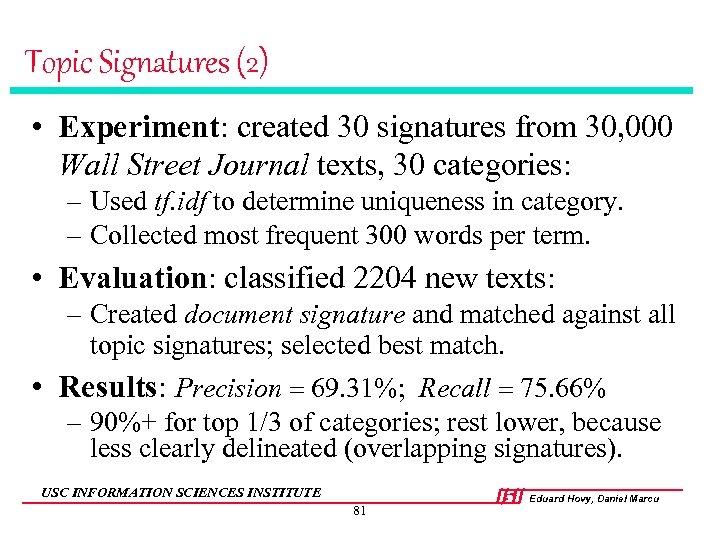 Topic Signatures (2) • Experiment: created 30 signatures from 30, 000 Wall Street Journal texts, 30 categories: – Used tf. idf to determine uniqueness in category. – Collected most frequent 300 words per term. • Evaluation: classified 2204 new texts: – Created document signature and matched against all topic signatures; selected best match. • Results: Precision 69. 31%; Recall 75. 66% – 90%+ for top 1/3 of categories; rest lower, because less clearly delineated (overlapping signatures). USC INFORMATION SCIENCES INSTITUTE 81 Eduard Hovy, Daniel Marcu
 Table of contents 1. Motivation. 2. Genres and types of summaries. 3. Approaches and paradigms. 4. Summarization methods (& exercise). Topic Extraction. Interpretation. Generation. 5. Evaluating summaries. 6. The future. USC INFORMATION SCIENCES INSTITUTE 82 Eduard Hovy, Daniel Marcu
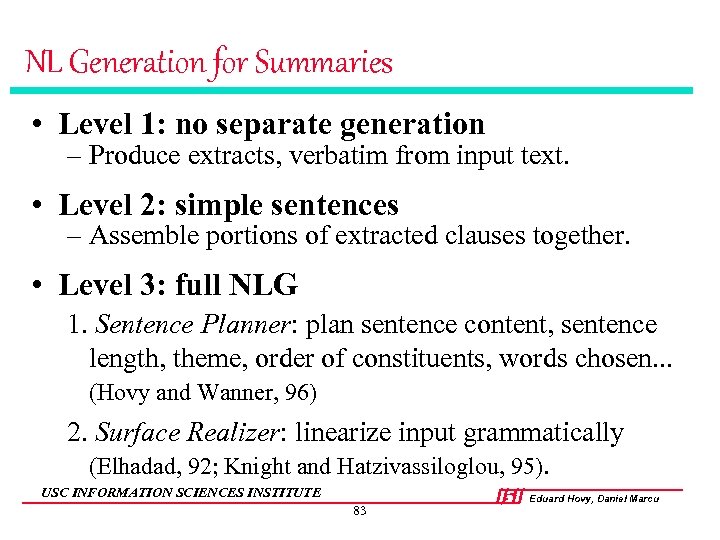 NL Generation for Summaries • Level 1: no separate generation – Produce extracts, verbatim from input text. • Level 2: simple sentences – Assemble portions of extracted clauses together. • Level 3: full NLG 1. Sentence Planner: plan sentence content, sentence length, theme, order of constituents, words chosen. . . (Hovy and Wanner, 96) 2. Surface Realizer: linearize input grammatically (Elhadad, 92; Knight and Hatzivassiloglou, 95). USC INFORMATION SCIENCES INSTITUTE 83 Eduard Hovy, Daniel Marcu
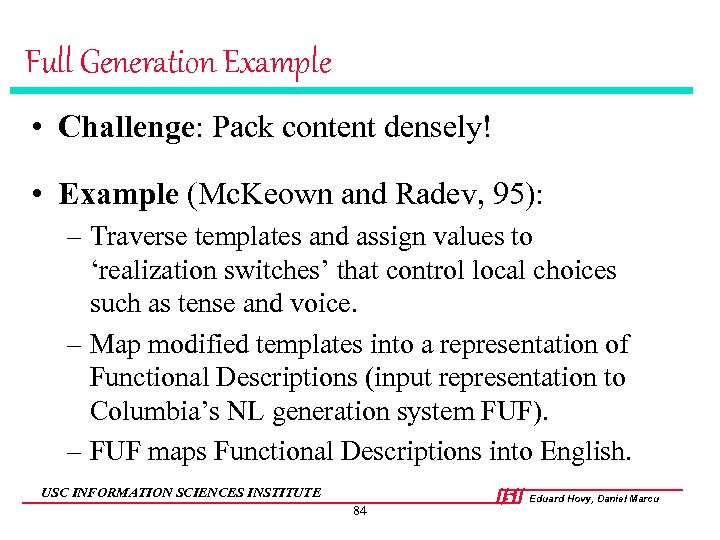 Full Generation Example • Challenge: Pack content densely! • Example (Mc. Keown and Radev, 95): – Traverse templates and assign values to ‘realization switches’ that control local choices such as tense and voice. – Map modified templates into a representation of Functional Descriptions (input representation to Columbia’s NL generation system FUF). – FUF maps Functional Descriptions into English. USC INFORMATION SCIENCES INSTITUTE 84 Eduard Hovy, Daniel Marcu
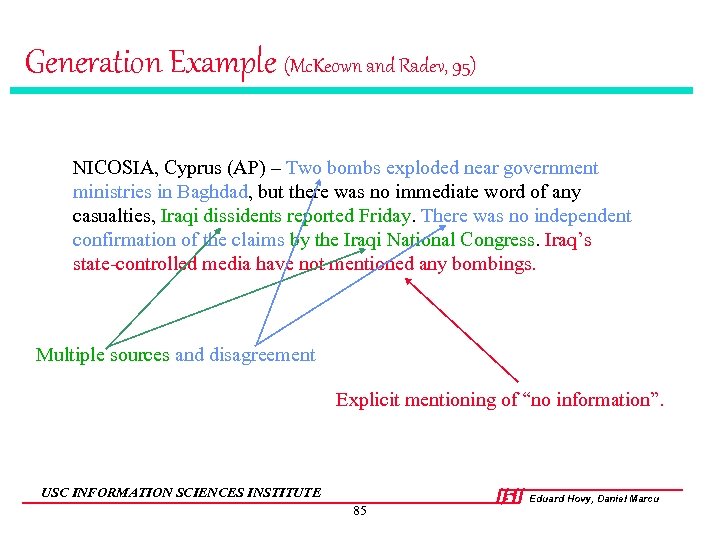 Generation Example (Mc. Keown and Radev, 95) NICOSIA, Cyprus (AP) – Two bombs exploded near government ministries in Baghdad, but there was no immediate word of any casualties, Iraqi dissidents reported Friday. There was no independent confirmation of the claims by the Iraqi National Congress. Iraq’s state-controlled media have not mentioned any bombings. Multiple sources and disagreement Explicit mentioning of “no information”. USC INFORMATION SCIENCES INSTITUTE 85 Eduard Hovy, Daniel Marcu
 Table of contents 1. Motivation. 2. Genres and types of summaries. 3. Approaches and paradigms. 4. Summarization methods (& exercise). 5. Evaluating summaries. 6. The future. USC INFORMATION SCIENCES INSTITUTE 86 Eduard Hovy, Daniel Marcu
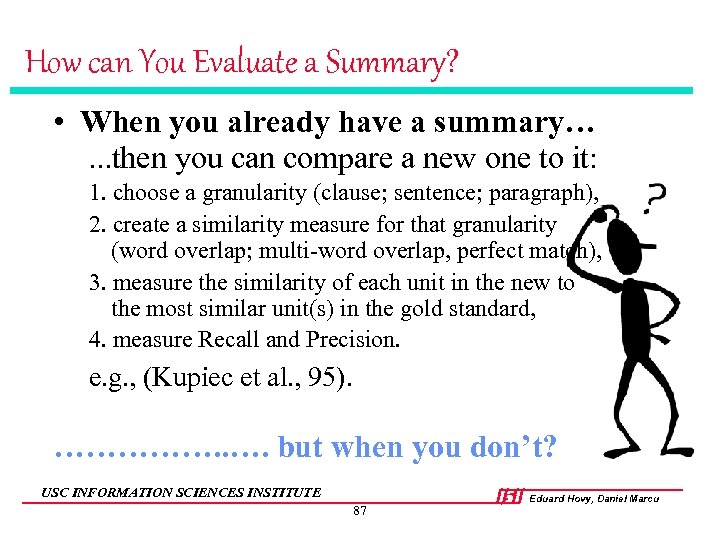 How can You Evaluate a Summary? • When you already have a summary…. . . then you can compare a new one to it: 1. choose a granularity (clause; sentence; paragraph), 2. create a similarity measure for that granularity (word overlap; multi-word overlap, perfect match), 3. measure the similarity of each unit in the new to the most similar unit(s) in the gold standard, 4. measure Recall and Precision. e. g. , (Kupiec et al. , 95). ……………. . …. but when you don’t? USC INFORMATION SCIENCES INSTITUTE 87 Eduard Hovy, Daniel Marcu
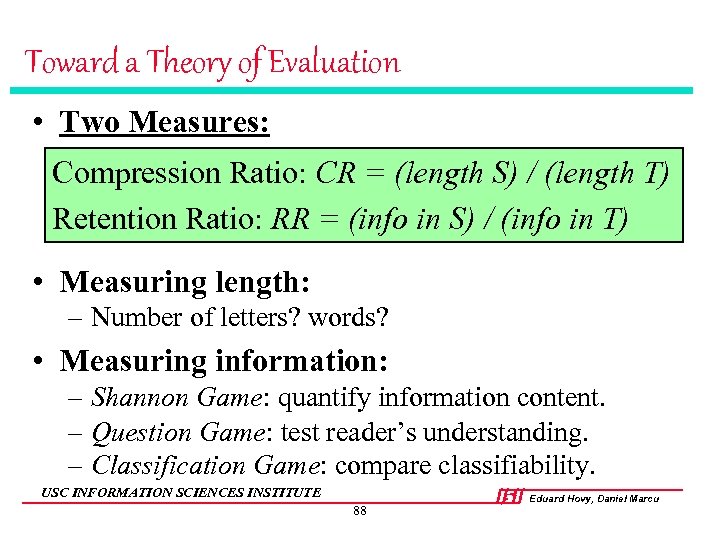 Toward a Theory of Evaluation • Two Measures: Compression Ratio: CR = (length S) / (length T) Retention Ratio: RR = (info in S) / (info in T) • Measuring length: – Number of letters? words? • Measuring information: – Shannon Game: quantify information content. – Question Game: test reader’s understanding. – Classification Game: compare classifiability. USC INFORMATION SCIENCES INSTITUTE 88 Eduard Hovy, Daniel Marcu
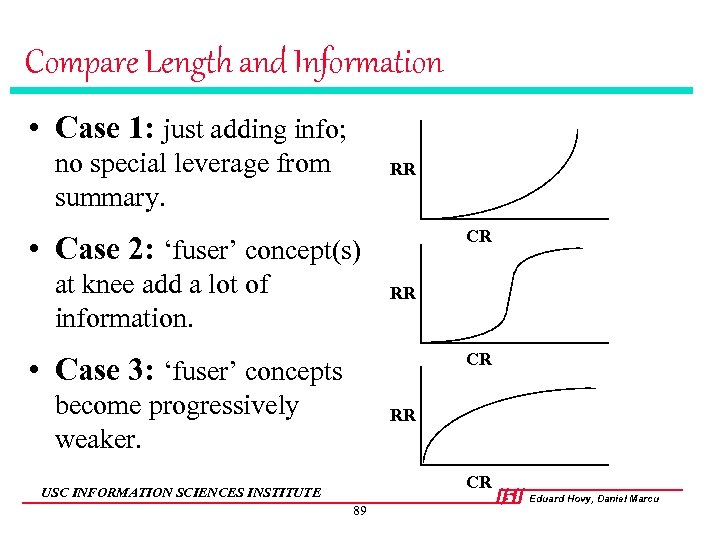 Compare Length and Information • Case 1: just adding info; no special leverage from summary. RR CR • Case 2: ‘fuser’ concept(s) at knee add a lot of information. RR CR • Case 3: ‘fuser’ concepts become progressively weaker. RR CR USC INFORMATION SCIENCES INSTITUTE 89 Eduard Hovy, Daniel Marcu
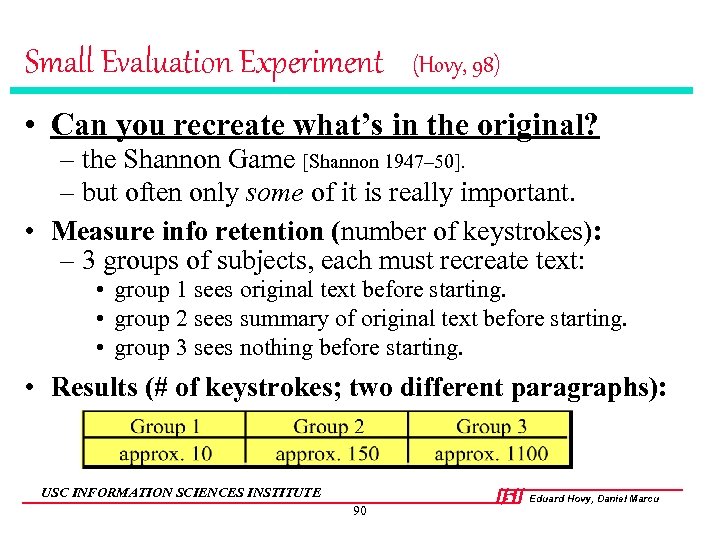 Small Evaluation Experiment (Hovy, 98) • Can you recreate what’s in the original? – the Shannon Game [Shannon 1947– 50]. – but often only some of it is really important. • Measure info retention (number of keystrokes): – 3 groups of subjects, each must recreate text: • group 1 sees original text before starting. • group 2 sees summary of original text before starting. • group 3 sees nothing before starting. • Results (# of keystrokes; two different paragraphs): USC INFORMATION SCIENCES INSTITUTE 90 Eduard Hovy, Daniel Marcu
 Q&A Evaluation • Can you focus on the important stuff? The Q&A Game—can be tailored to your interests! • Measure core info. capture by Q&A game: – Some people (questioners) see text, must create questions about most important content. – Other people (answerers) see: 1. nothing—but must try to answer questions (baseline), 2. then: summary, must answer same questions, 3. then: full text, must answer same questions again. – Information retention: % answers correct. USC INFORMATION SCIENCES INSTITUTE 91 Eduard Hovy, Daniel Marcu
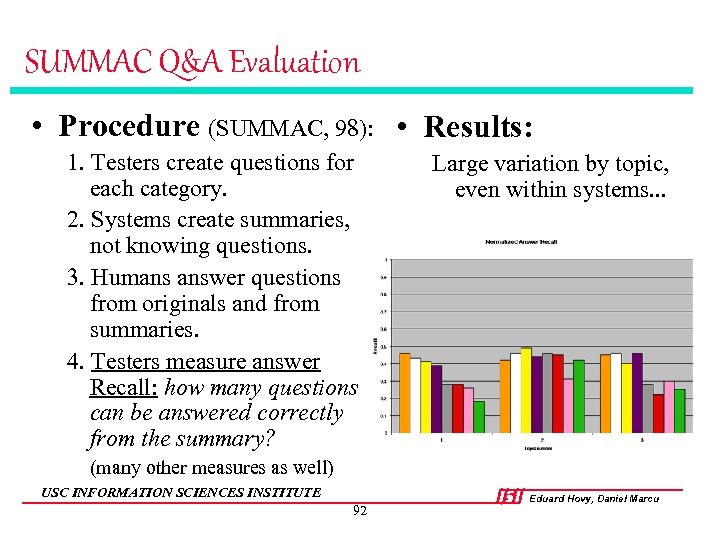 SUMMAC Q&A Evaluation • Procedure (SUMMAC, 98): • Results: 1. Testers create questions for each category. 2. Systems create summaries, not knowing questions. 3. Humans answer questions from originals and from summaries. 4. Testers measure answer Recall: how many questions can be answered correctly from the summary? Large variation by topic, even within systems. . . (many other measures as well) USC INFORMATION SCIENCES INSTITUTE 92 Eduard Hovy, Daniel Marcu
 Task Evaluation: Text Classification • Can you perform some task faster? – example: the Classification Game. – measures: time and effectiveness. • TIPSTER/SUMMAC evaluation: – February, 1998 (SUMMAC, 98). – Two tests: 1. Categorization 2. Ad Hoc (query-sensitive) – 2 summaries per system: fixed-length (10%), best. – 16 systems (universities, companies; 3 intern’l). USC INFORMATION SCIENCES INSTITUTE 93 Eduard Hovy, Daniel Marcu
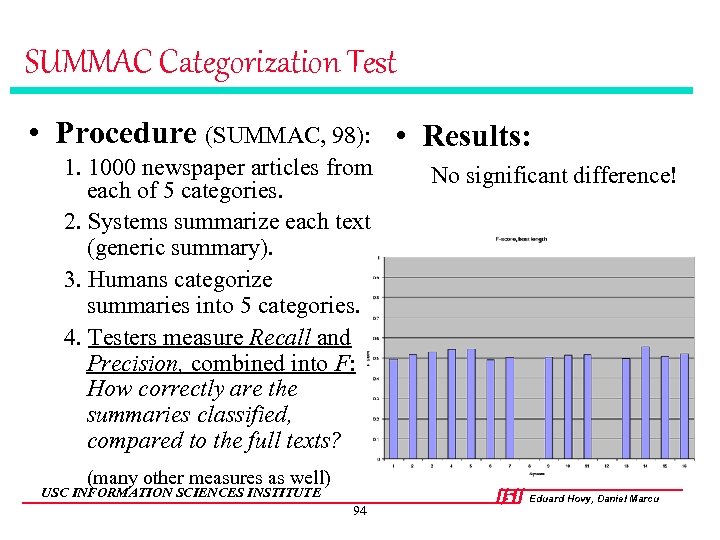 SUMMAC Categorization Test • Procedure (SUMMAC, 98): • Results: 1. 1000 newspaper articles from each of 5 categories. 2. Systems summarize each text (generic summary). 3. Humans categorize summaries into 5 categories. 4. Testers measure Recall and Precision, combined into F: How correctly are the summaries classified, compared to the full texts? No significant difference! (many other measures as well) USC INFORMATION SCIENCES INSTITUTE 94 Eduard Hovy, Daniel Marcu
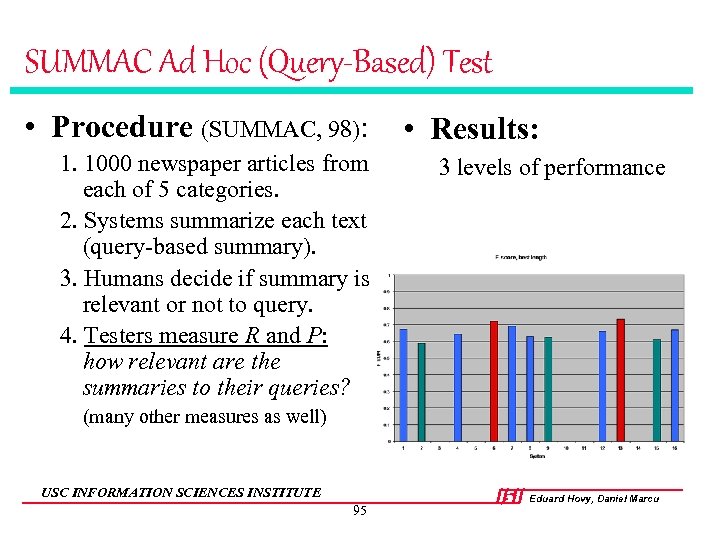 SUMMAC Ad Hoc (Query-Based) Test • Procedure (SUMMAC, 98): 1. 1000 newspaper articles from each of 5 categories. 2. Systems summarize each text (query-based summary). 3. Humans decide if summary is relevant or not to query. 4. Testers measure R and P: how relevant are the summaries to their queries? • Results: 3 levels of performance (many other measures as well) USC INFORMATION SCIENCES INSTITUTE 95 Eduard Hovy, Daniel Marcu
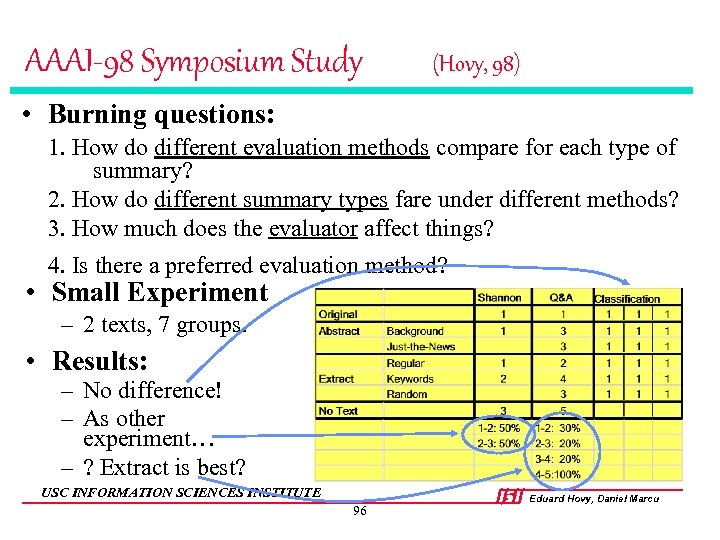 AAAI-98 Symposium Study (Hovy, 98) • Burning questions: 1. How do different evaluation methods compare for each type of summary? 2. How do different summary types fare under different methods? 3. How much does the evaluator affect things? 4. Is there a preferred evaluation method? • Small Experiment – 2 texts, 7 groups. • Results: – No difference! – As other experiment… – ? Extract is best? USC INFORMATION SCIENCES INSTITUTE 96 Eduard Hovy, Daniel Marcu
 Table of contents 1. Motivation. 2. Genres and types of summaries. 3. Approaches and paradigms. 4. Summarization methods (& exercise). 5. Evaluating summaries. 6. The future. USC INFORMATION SCIENCES INSTITUTE 97 Eduard Hovy, Daniel Marcu
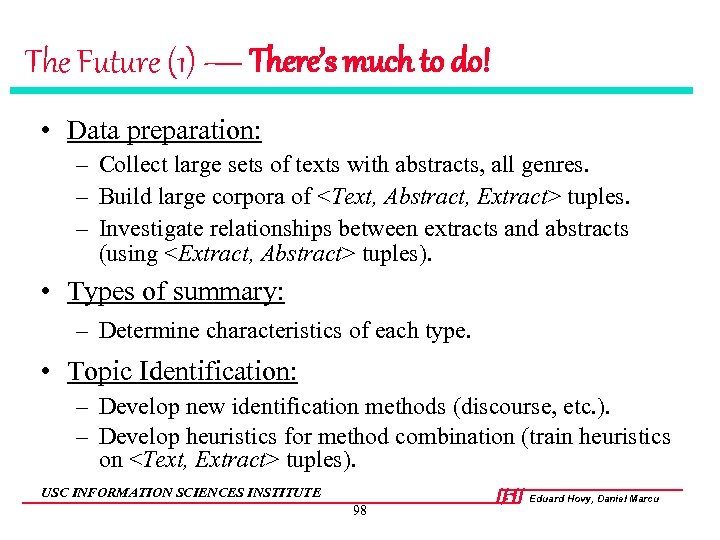 The Future (1) — There’s much to do! • Data preparation: – Collect large sets of texts with abstracts, all genres. – Build large corpora of
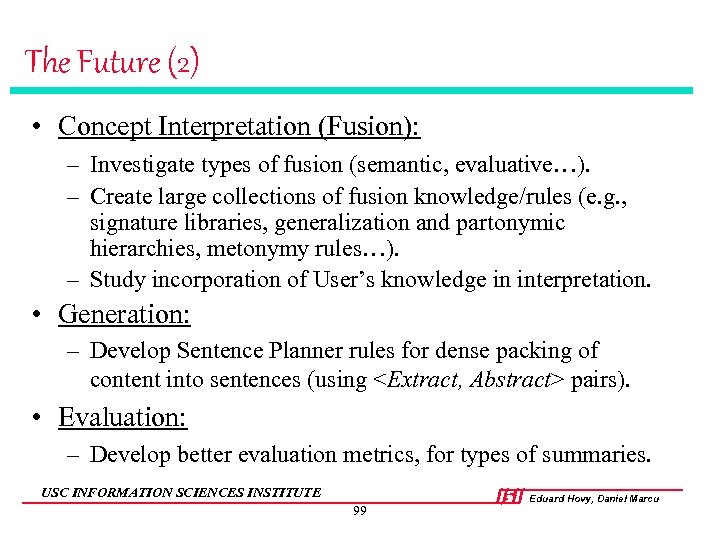 The Future (2) • Concept Interpretation (Fusion): – Investigate types of fusion (semantic, evaluative…). – Create large collections of fusion knowledge/rules (e. g. , signature libraries, generalization and partonymic hierarchies, metonymy rules…). – Study incorporation of User’s knowledge in interpretation. • Generation: – Develop Sentence Planner rules for dense packing of content into sentences (using
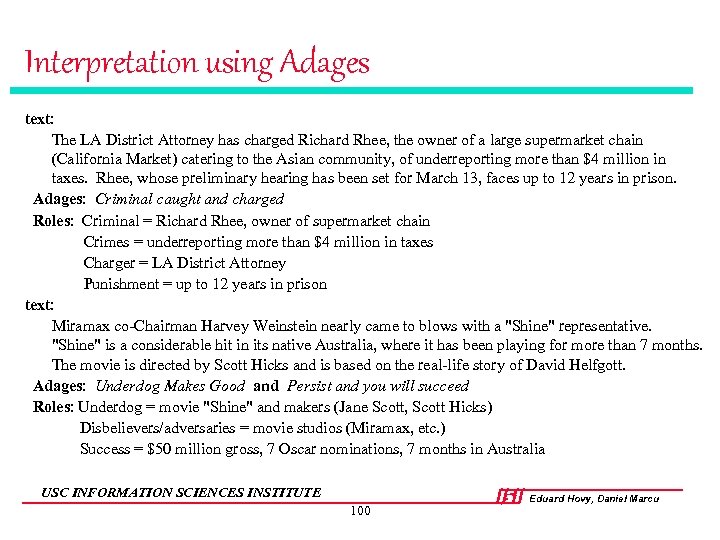 Interpretation using Adages text: The LA District Attorney has charged Richard Rhee, the owner of a large supermarket chain (California Market) catering to the Asian community, of underreporting more than $4 million in taxes. Rhee, whose preliminary hearing has been set for March 13, faces up to 12 years in prison. Adages: Criminal caught and charged Roles: Criminal = Richard Rhee, owner of supermarket chain Crimes = underreporting more than $4 million in taxes Charger = LA District Attorney Punishment = up to 12 years in prison text: Miramax co-Chairman Harvey Weinstein nearly came to blows with a "Shine" representative. "Shine" is a considerable hit in its native Australia, where it has been playing for more than 7 months. The movie is directed by Scott Hicks and is based on the real-life story of David Helfgott. Adages: Underdog Makes Good and Persist and you will succeed Roles: Underdog = movie "Shine" and makers (Jane Scott, Scott Hicks) Disbelievers/adversaries = movie studios (Miramax, etc. ) Success = $50 million gross, 7 Oscar nominations, 7 months in Australia USC INFORMATION SCIENCES INSTITUTE 100 Eduard Hovy, Daniel Marcu
 Goodbye! USC INFORMATION SCIENCES INSTITUTE 101 Eduard Hovy, Daniel Marcu
 Appendix USC INFORMATION SCIENCES INSTITUTE 102 Eduard Hovy, Daniel Marcu
 CORPORA IN SUMMARIZATION STUDIES (1) • Edmundson (68) – Training corpus: 200 physical science, life science, information science, and humanities contractor reports. – Testing corpus: 200 chemistry contractor reports having lengths between 100 to 3900 words. • Kupiec et al. (95) – 188 scientific/technical documents having an average of 86 sentences each. USC INFORMATION SCIENCES INSTITUTE 103 Eduard Hovy, Daniel Marcu
 Corpora IN summarization studies(2) • Teufel and Moens (97) – 202 computational linguistics papers from the E-PRINT archive. • Marcu (97) – 5 texts from Scientific American having lengths from 161 to 725 words • Jing et al. (98) – 40 newspaper articles from the TREC collection. USC INFORMATION SCIENCES INSTITUTE 104 Eduard Hovy, Daniel Marcu
 CORPORA IN SUMMARIZATION STUDIES(3) • For each text in each of the five corpora – Human annotators determined the collection of salient sentences/clauses (Edmundson, Jing et al. , Marcu). – One human annotator used author-generated abstracts in order to manually select the sentences that were important in each text (Teufel & Moens). – Important sentences were considered to be those that matched closely the sentences of abstracts generated by professional summarizers (Kupiec). USC INFORMATION SCIENCES INSTITUTE 105 Eduard Hovy, Daniel Marcu
 Corpora in summarization studies(4) • TIPSTER (98) – judgments with respect to • a query-oriented summary being relevant to the original query; • a generic summary being adequate for categorization; • a query-oriented summary being adequate to answer a set of questions that pertain to the original query. USC INFORMATION SCIENCES INSTITUTE 106 Eduard Hovy, Daniel Marcu
 References (1) Aone, C. , M. E. Okurowski, J. Gorlinsky, B. Larsen. 1997. A Scalable Summarization System using Robust NLP. Proceedings of the Workshop on Intelligent Scalable Text Summarization, 66– 73. ACL/EACL Conference, Madrid, Spain. Baldwin, B. and T. Morton. 1998. Coreference-Based Summarization. In T. Firmin Hand B. Sundheim (eds). TIPSTERSUMMAC Summarization Evaluation. Proceedings of the TIPSTER Text Phase III Workshop. Washington. Barzilay, R. and M. Elhadad. 1997. Using Lexical Chains for Text Summarization. In Proceedings of the Workshop on Intelligent Scalable Text Summarization at the ACL/EACL Conference, 10– 17. Madrid, Spain. Baxendale, P. B. 1958. Machine-Made Index for Technical Literature—An Experiment. IBM Journal (October) 354– 361. Boguraev B. and C. Kennedy, 1997. Salience-based Content Characterization of Text Documents. In Proceedings of the Workshop on Intelligent Scalable Text Summarization at the ACL/EACL Conference, 2– 9. Madrid, Spain. Buckley, C. and C. Cardie. 1997. SMART Summarization System. In T. Firmin Hand B. Sundheim (eds). TIPSTERSUMMAC Summarization Evaluation. Proceedings of the TIPSTER Text Phase III Workshop. Washington. De. Jong, G. 1978. Fast Skimming of News Stories: The FRUMP System. Ph. D. diss. Yale University. Donlan, D. 1980. Locating Main Ideas in History Textbooks. Journal of Reading, 24, 135– 140. Edmundson, H. P. 1968. New Methods in Automatic Extraction. Journal of the ACM 16(2), 264– 285. Elhadad, M. 1992. Using Argumentation to Control Lexical Choice: A Functional Unification-Based Approach. Ph. D. diss, Columbia University. Endres-Niggemeyer, B. 1998. Summarizing Information. New York: Springer-Verlag. Hovy, E. H. and L. Wanner. 1996. Managing Sentence Planning Requirements. In Proceedings of the Workshop on Gaps and Bridges in NL Planning and Generation, 53– 58. ECAI Conference. Budapest, Hungary. Hovy, E. H. and Lin, C-Y. 1998. Automated Text Summarization in SUMMARIST. In M. Maybury and I. Mani (eds), Intelligent Scalable Summarization Text Summarization. Forthcoming. Hovy, E. H. 1998. Experiments in Evaluating Summarization. In prep. USC INFORMATION SCIENCES INSTITUTE 107 Eduard Hovy, Daniel Marcu
 References (2) Jing, H. , R. Barzilay, K. Mc. Keown, and M. Elhadad. 1998. Summarization Evaluation Methods: Experiments and Analysis. In Working Notes of the AAAI’ 98 Spring Symposium on Intelligent Text Summarization, 60– 68. Stanford, CA. Kintsch, W. and T. A. van Dijk. 1978. Toward a Model of Text Comprehension and Production. Psychological Review, 85, 363– 394. Knight, K. and V. Hatzivassiloglou. 1995. Two-Level Many-Paths Generation. In Proceedings of the Thirty-third Conference of the Association of Computational Linguistics (ACL-95), 252– 260. Boston, MA. Kupiec, J. Pedersen, and F. Chen. 1995. A Trainable Document Summarizer. In Proceedings of the Eighteenth Annual International ACM Conference on Research and Development in Information Retrieval (SIGIR), 68– 73. Seattle, WA. Lehnert, W. G. 1983. Narrative complexity based on summarization algorithms. In Proceedings of the Eighth International Joint Conference of Artificial Intelligence (IJCAI -83), 713– 716. Karlsruhe, Germany. Lin, C-Y. 1995. Topic Identification by Concept Generalization. In Proceedings of the Thirty-third Conference of the Association of Computational Linguistics (ACL-95), 308– 310. Boston, MA. Lin, C-Y. 1997. Robust Automated Topic Identification. Ph. D. diss. , University of Southern California. Lin, C-Y. and E. H. Hovy. 1997. Identifying Topics by Position. In Proceedings of the Applied Natural Language Processing Conference (ANLP-97), 283– 290. Washington. Luhn, H. P. 1959. The Automatic Creation of Literature Abstracts. IBM Journal of Research and Development, 159– 165. Mani, I. , E. Bloedorn, and B. Gates. 1998. Using Cohesion and Coherence Models for Text Summarization. In Working Notes of the AAAI’ 98 Spring Symposium on Intelligent Text Summarization, 69– 76. Stanford, CA. Mani I. And E. Bloedorn. 1998. Machine Learning of Generic and User-Focused Summarization. Proceedings of the National Conference on Artificial Intelligence, (AAAI). Madison, WI. Mann, W. C. and S. A. Thompson. 1988. Rhetorical Structure Theory: Toward a Functional Theory of Text Organization. Text 8(3), 243– 281. Also available as USC/Information Sciences Institute Research Report RR-87 -190. Marcu, D. 1997. The Rhetorical Parsing, Summarization, and Generation of Natural Language Texts. Ph. D. diss. University of Toronto. USC INFORMATION SCIENCES INSTITUTE 108 Eduard Hovy, Daniel Marcu
 References (3) Marcu, D. 1998. Improving Summarization Through Rhetorical Parsing Tuning. Proceedings of the Workshop on Very Large Corpora. Montreal, Canada. Marcu, D. 1998. The Automatic Construction of Large-Scale Corpora for Summarization Research. In prep. Mauldin, M. L. 1991. Conceptual Information Retrieval—A Case Study in Adaptive Partial Parsing. Boston, MA: Kluwer Academic Publishers. Mc. Keown, K. R. and D. R. Radev. 1995. Generating Summaries of Multiple News Articles. In Proceedings of the Eighteenth Annual International ACM Conference on Research and Development in Information Retrieval (SIGIR), 74– 82. Seattle, WA. Mitra M. , A. Singhal, and C. Buckley. 1997. Automatic Text Summarization by Paragraph Extraction. In Proceedings of the Workshop on Intelligent Scalable Summarization at the ACL/EACL Conference, 39– 46. Madrid, Spain. Morris J. and G. Hirst. 1991. Lexical Cohesion Computed by Thesaural Relations as an Indicator of the Structure of Text. Computational Linguistics 17(1), 21– 48. MUC conference series. 1989– 1997. Sundheim, B. (ed. ) Proceedings of the Message Understanding Conferences, I–VI. Morgan Kaufman. Ono K. , K. Sumita, and S. Miike. Abstract Generation Based on Rhetorical Structure Extraction. In Proceedings of the International Conference on Computational Linguistics (Coling), 344– 348. Japan. Paice, C. D. 1990. Constructing Literature Abstracts by Computer: Techniques and Prospects. Information Processing and Management 26(1): 171– 186. Rau, L. S. and P. S. Jacobs. 1991. Creating Segmented Databases from Free Text for Text Retrieval. In Proceedings of the Fourteenth Annual International ACM Conference on Research and Development in Information Retrieval (SIGIR), 337– 346. New York, NY. Reimer U. and U. Hahn. 1997. A Formal Model of Text Summarization Based on Condensation Operators of a Terminological Logic. In Proceedings of the Workshop on Intelligent Scalable Summarization at the ACL/EACL Conference, 97– 104. Madrid, Spain. USC INFORMATION SCIENCES INSTITUTE 109 Eduard Hovy, Daniel Marcu
 References (4) Salton, G. , J. Allen, C. Buckley, and A. Singhal. 1994. Automatic Analysis, Theme Generation, and Summarization of Machine. Readable Texts. Science 264: 1421– 1426. Schank, R. C. and R. P. Abelson. 1977. Scripts, Plans, Goals, and Understanding. Hillsdale, NJ: Lawrence Erlbaum Associates. Spark Jones, K. 1997. Invited keynote address, Workshop on Intelligent Scalable Text Summarization. ACL/EACL Conference. Madrid, Spain. SUMMAC, 1998. Firmin Hand, T. and B. Sundheim (eds). TIPSTER-SUMMAC Summarization Evaluation. Proceedings of the TIPSTER Text Phase III Workshop. Washington. Teufel, S. and M. Moens. 1997. Sentence Extraction as a Classification Task. In Proceedings of the Workshop on Intelligent Scalable Summarization. ACL/EACL Conference, 58– 65. Madrid, Spain. Online bibliographies: • http: //www. cs. columbia. edu/~radev/summarization/ • http: //www. cs. columbia. edu/~jing/summarization. html • http: //www. dcs. shef. ac. uk/~gael/alphalist. html USC INFORMATION SCIENCES INSTITUTE 110 Eduard Hovy, Daniel Marcu