


 Скачать презентацию Automated Solution of Realistic Near-Optimal Aircraft Trajectories Using
51a8545b71a7bb6584ca9dc02e083a9d.ppt
- Количество слайдов: 17
 Automated Solution of Realistic Near-Optimal Aircraft Trajectories Using Computational Optimal Control and Inverse Simulation Janne Karelahti and Kai Virtanen Helsinki University of Technology, Espoo, Finland John Öström VTT Technical Research Center, Espoo, Finland S ystems Analysis Laboratory Helsinki University of Technology
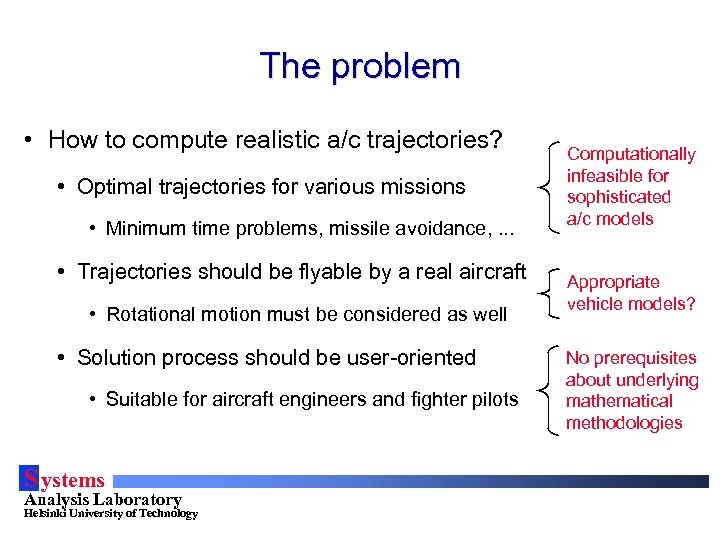 The problem • How to compute realistic a/c trajectories? • Optimal trajectories for various missions • Minimum time problems, missile avoidance, . . . • Trajectories should be flyable by a real aircraft • Rotational motion must be considered as well • Solution process should be user-oriented • Suitable for aircraft engineers and fighter pilots S ystems Analysis Laboratory Helsinki University of Technology Computationally infeasible for sophisticated a/c models Appropriate vehicle models? No prerequisites about underlying mathematical methodologies
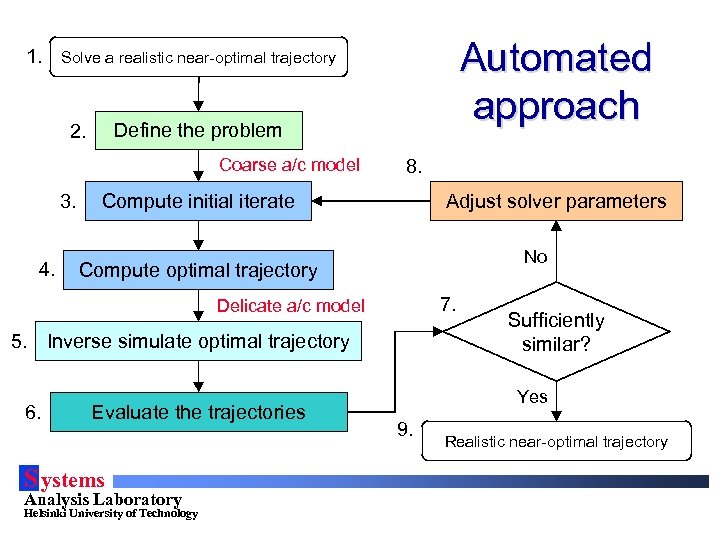 1. Define the problem 2. Coarse a/c model 3. 4. Automated approach Solve a realistic near-optimal trajectory 8. Compute initial iterate Adjust solver parameters No Compute optimal trajectory 7. Delicate a/c model 5. Inverse simulate optimal trajectory 6. Evaluate the trajectories S ystems Analysis Laboratory Helsinki University of Technology Sufficiently similar? Yes 9. Realistic near-optimal trajectory
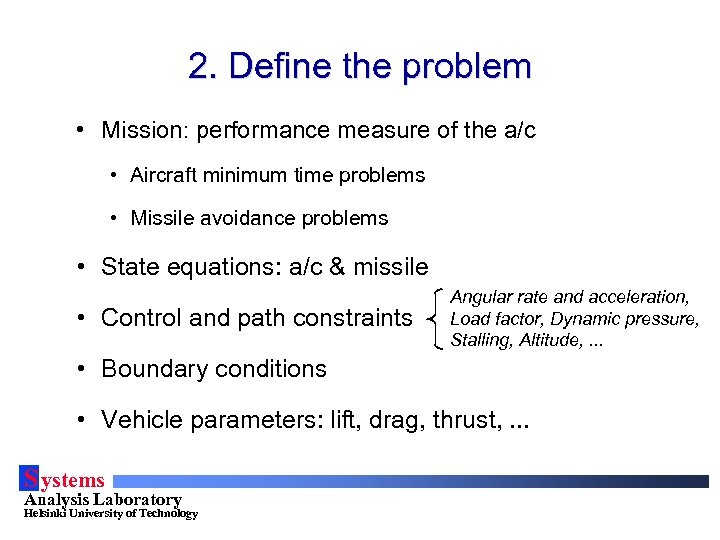 2. Define the problem • Mission: performance measure of the a/c • Aircraft minimum time problems • Missile avoidance problems • State equations: a/c & missile • Control and path constraints Angular rate and acceleration, Load factor, Dynamic pressure, Stalling, Altitude, . . . • Boundary conditions • Vehicle parameters: lift, drag, thrust, . . . S ystems Analysis Laboratory Helsinki University of Technology
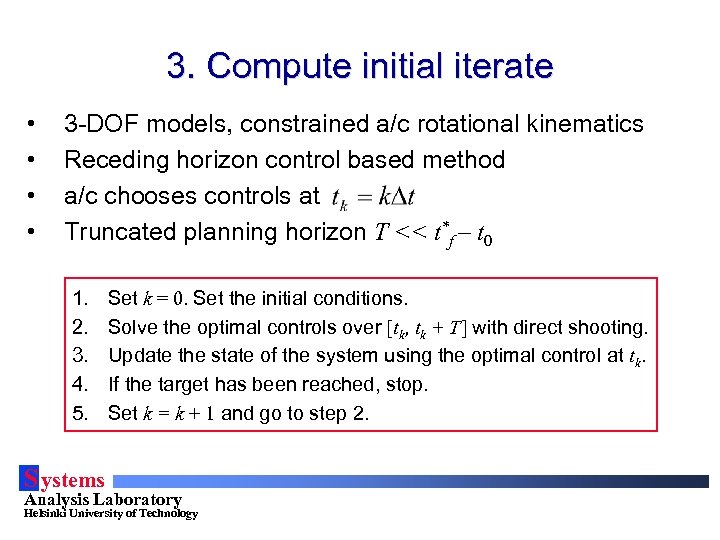 3. Compute initial iterate • • 3 -DOF models, constrained a/c rotational kinematics Receding horizon control based method a/c chooses controls at Truncated planning horizon T << t*f – t 0 1. 2. 3. 4. 5. Set k = 0. Set the initial conditions. Solve the optimal controls over [tk, tk + T] with direct shooting. Update the state of the system using the optimal control at tk. If the target has been reached, stop. Set k = k + 1 and go to step 2. S ystems Analysis Laboratory Helsinki University of Technology
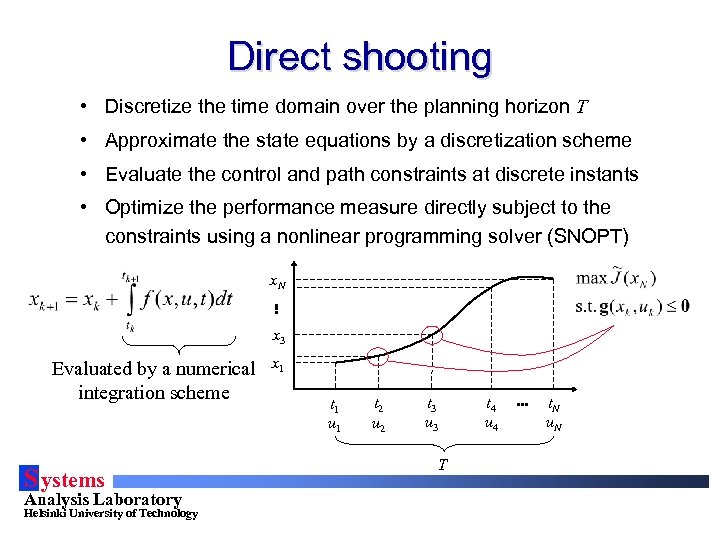 Direct shooting • Discretize the time domain over the planning horizon T • Approximate the state equations by a discretization scheme • Evaluate the control and path constraints at discrete instants • Optimize the performance measure directly subject to the constraints using a nonlinear programming solver (SNOPT) . . . x. N x 3 Evaluated by a numerical integration scheme S ystems Analysis Laboratory Helsinki University of Technology x 1 t 1 u 1 t 2 u 2 t 3 u 3 t 4 u 4 T . . . t. N u. N
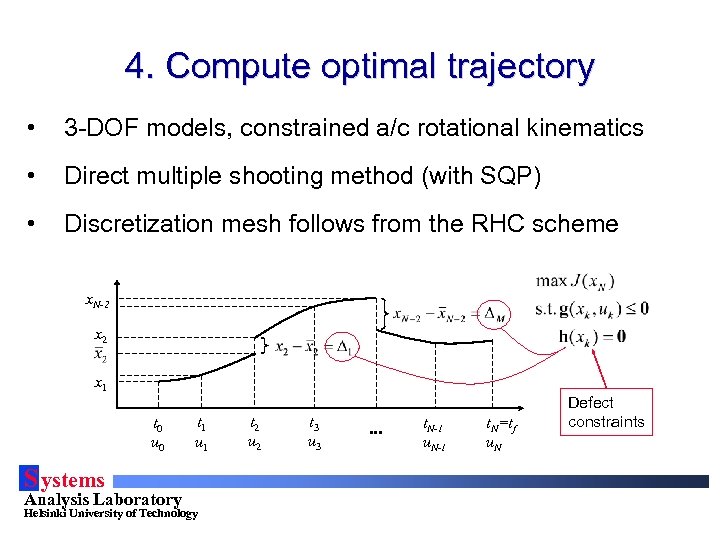 4. Compute optimal trajectory • 3 -DOF models, constrained a/c rotational kinematics • Direct multiple shooting method (with SQP) • Discretization mesh follows from the RHC scheme x. N-2 x 1 t 0 u 0 t 1 u 1 S ystems Analysis Laboratory Helsinki University of Technology t 2 u 2 t 3 u 3 . . . t. N-1 u. N-1 t. N=tf u. N Defect constraints
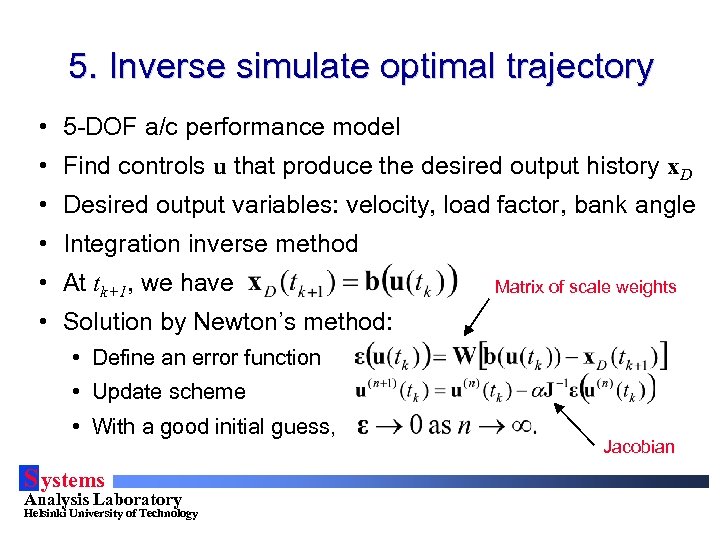 5. Inverse simulate optimal trajectory • 5 -DOF a/c performance model • Find controls u that produce the desired output history x. D • Desired output variables: velocity, load factor, bank angle • Integration inverse method • At tk+1, we have Matrix of scale weights • Solution by Newton’s method: • Define an error function • Update scheme • With a good initial guess, S ystems Analysis Laboratory Helsinki University of Technology Jacobian
 6. Evaluation of trajectories • Compare optimal and inverse simulated trajectories • Visual analysis, average and maximum abs. errors • Special attention to velocity, load factor, and bank angle • If the trajectories are not sufficiently similar, then • Adjust parameters affecting the solutions and recompute • In the optimization, these parameters include • Angular acceleration bounds, RHC step size, horizon length • In the inverse simulation, these parameters include • Velocity, load factor, and bank angle scale weights S ystems Analysis Laboratory Helsinki University of Technology
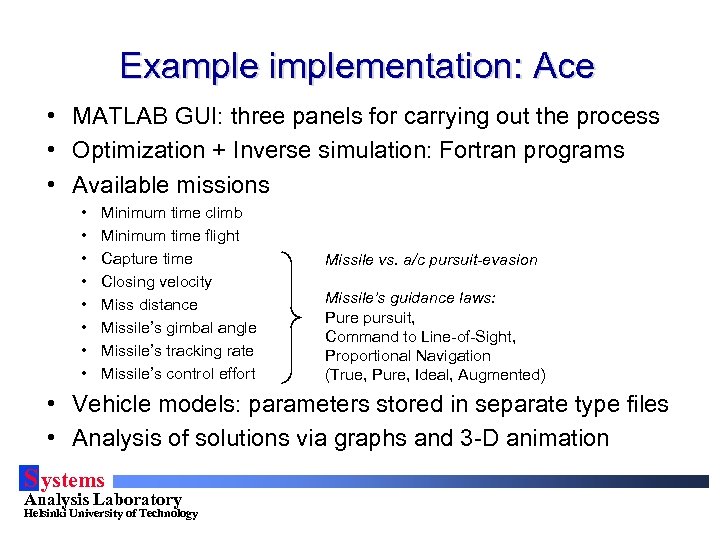 Example implementation: Ace • MATLAB GUI: three panels for carrying out the process • Optimization + Inverse simulation: Fortran programs • Available missions • • Minimum time climb Minimum time flight Capture time Closing velocity Miss distance Missile’s gimbal angle Missile’s tracking rate Missile’s control effort Missile vs. a/c pursuit-evasion Missile’s guidance laws: Pure pursuit, Command to Line-of-Sight, Proportional Navigation (True, Pure, Ideal, Augmented) • Vehicle models: parameters stored in separate type files • Analysis of solutions via graphs and 3 -D animation S ystems Analysis Laboratory Helsinki University of Technology
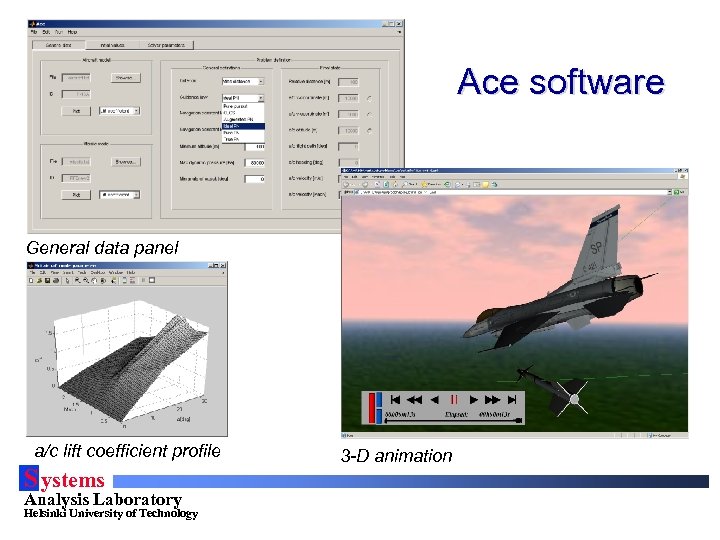 Ace software General data panel a/c lift coefficient profile S ystems Analysis Laboratory Helsinki University of Technology 3 -D animation
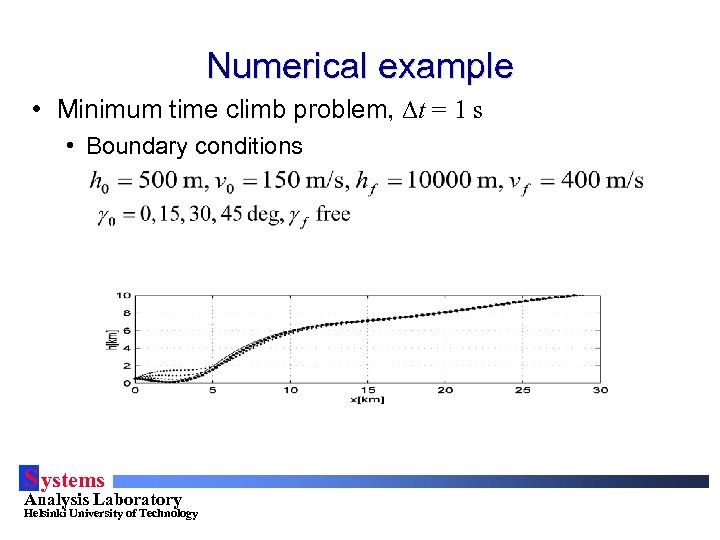 Numerical example • Minimum time climb problem, Dt = 1 s • Boundary conditions S ystems Analysis Laboratory Helsinki University of Technology
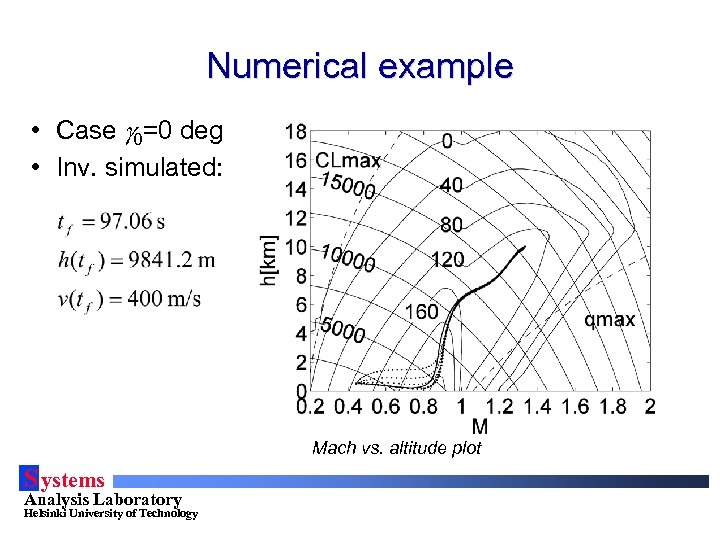 Numerical example • Case g 0=0 deg • Inv. simulated: Mach vs. altitude plot S ystems Analysis Laboratory Helsinki University of Technology
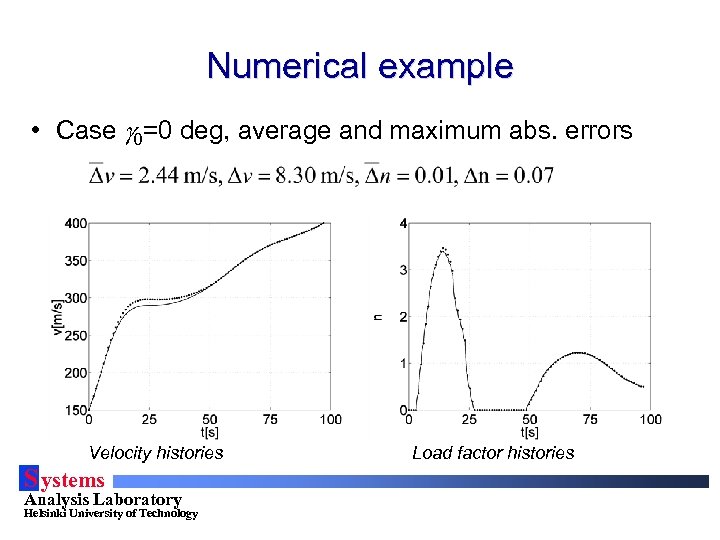 Numerical example • Case g 0=0 deg, average and maximum abs. errors Velocity histories S ystems Analysis Laboratory Helsinki University of Technology Load factor histories
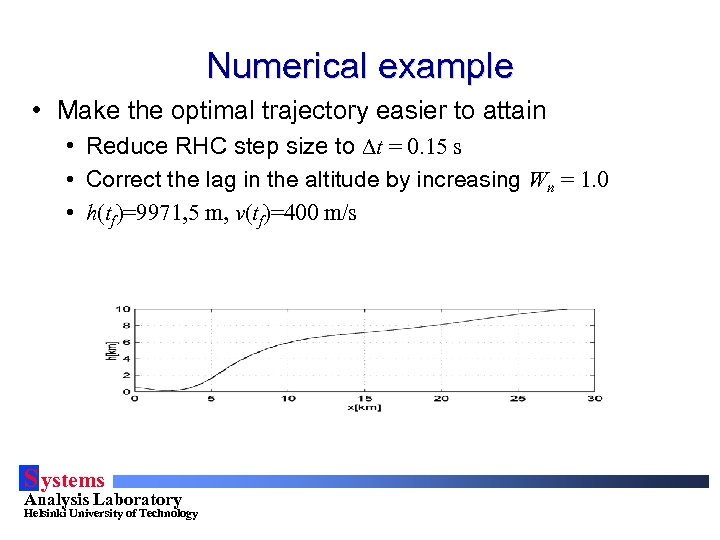 Numerical example • Make the optimal trajectory easier to attain • Reduce RHC step size to Dt = 0. 15 s • Correct the lag in the altitude by increasing Wn = 1. 0 • h(tf)=9971, 5 m, v(tf)=400 m/s S ystems Analysis Laboratory Helsinki University of Technology
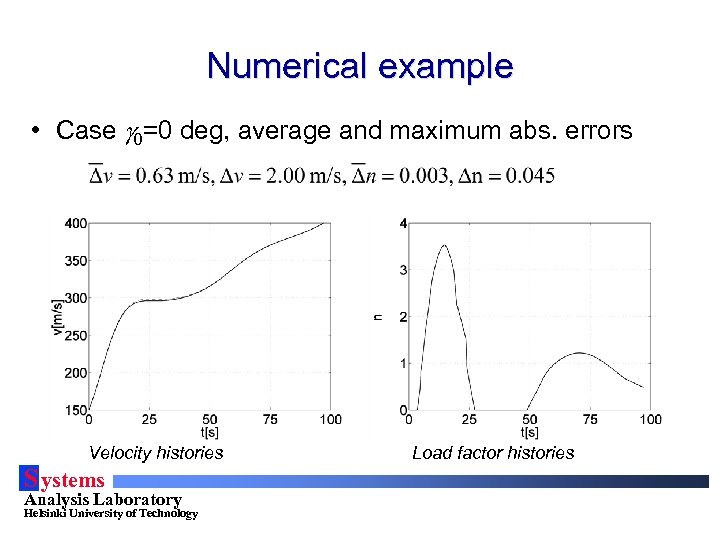 Numerical example • Case g 0=0 deg, average and maximum abs. errors Velocity histories S ystems Analysis Laboratory Helsinki University of Technology Load factor histories
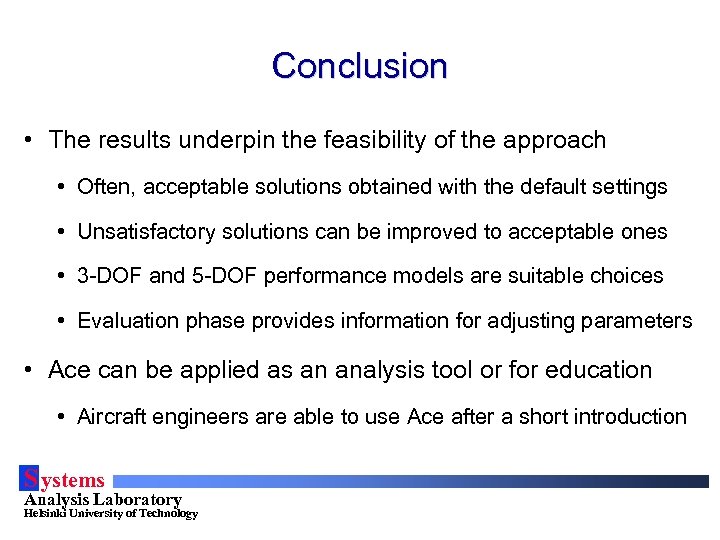 Conclusion • The results underpin the feasibility of the approach • Often, acceptable solutions obtained with the default settings • Unsatisfactory solutions can be improved to acceptable ones • 3 -DOF and 5 -DOF performance models are suitable choices • Evaluation phase provides information for adjusting parameters • Ace can be applied as an analysis tool or for education • Aircraft engineers are able to use Ace after a short introduction S ystems Analysis Laboratory Helsinki University of Technology