


 Скачать презентацию AUTOMATED SECURE ALARM PROTOCOL ASAP TO THE PSAP
000bc880a29319ee2b4218a3a89ad470.ppt
- Количество слайдов: 29
 AUTOMATED SECURE ALARM PROTOCOL (ASAP TO THE PSAP) PROJECT UPDATES Turn on the volume and Press –F 5 - to Begin the Slide Show. Slides Will Advance Automatically Based on Pre-Set Timers or Mouse Click May be Used to Advance Slides
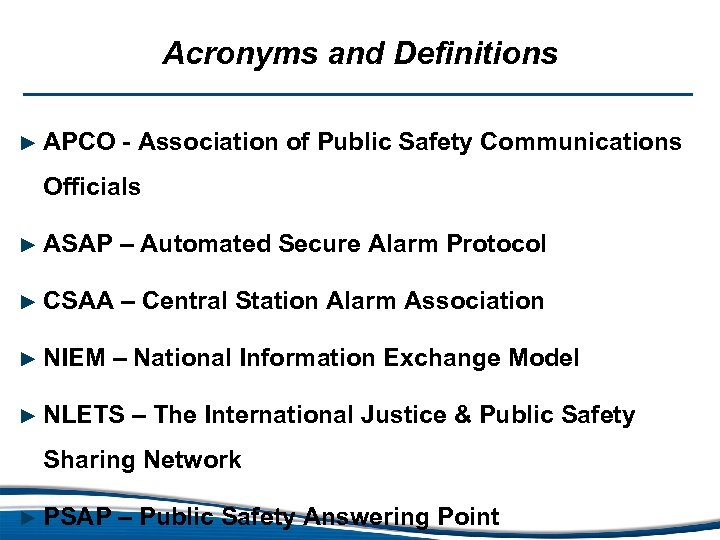 Acronyms and Definitions ► APCO - Association of Public Safety Communications Officials ► ASAP – Automated Secure Alarm Protocol ► CSAA – Central Station Alarm Association ► NIEM – National Information Exchange Model ► NLETS – The International Justice & Public Safety Sharing Network ► PSAP – Public Safety Answering Point
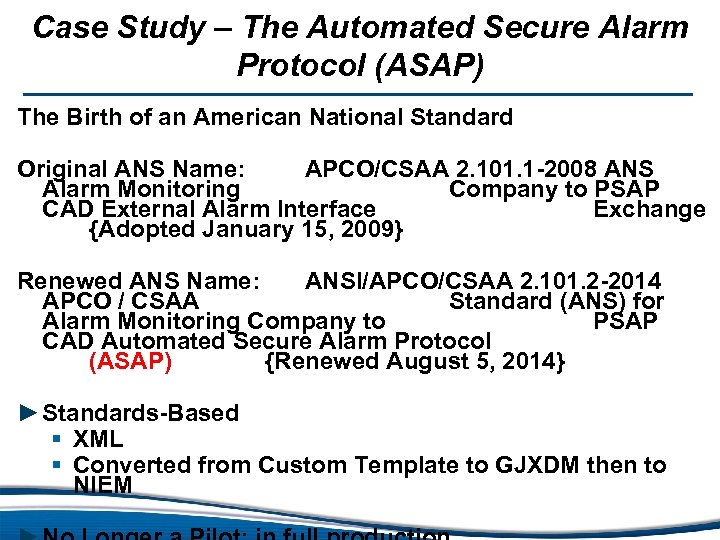 Case Study – The Automated Secure Alarm Protocol (ASAP) The Birth of an American National Standard Original ANS Name: APCO/CSAA 2. 101. 1 -2008 ANS Alarm Monitoring Company to PSAP CAD External Alarm Interface Exchange {Adopted January 15, 2009} Renewed ANS Name: ANSI/APCO/CSAA 2. 101. 2 -2014 APCO / CSAA Standard (ANS) for Alarm Monitoring Company to PSAP CAD Automated Secure Alarm Protocol (ASAP) {Renewed August 5, 2014} ► Standards-Based § XML § Converted from Custom Template to GJXDM then to NIEM
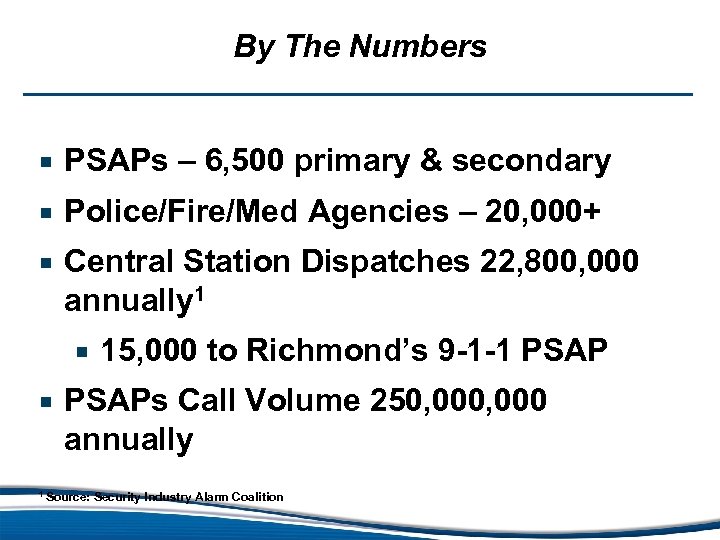 By The Numbers ¡ PSAPs – 6, 500 primary & secondary ¡ Police/Fire/Med Agencies – 20, 000+ ¡ Central Station Dispatches 22, 800, 000 annually 1 ¡ ¡ 15, 000 to Richmond’s 9 -1 -1 PSAPs Call Volume 250, 000 annually 1 Source: Security Industry Alarm Coalition
 Automated Secure Alarm Protocol - Purpose To provide a standard data exchange for electronically transmitting information between an Alarm Monitoring Company and a Public Safety Answering Point (PSAP). Generic Explanation: The exchange replaces the telephone calls between the Alarm Monitoring Company operator and the 911 PSAP call-taker.
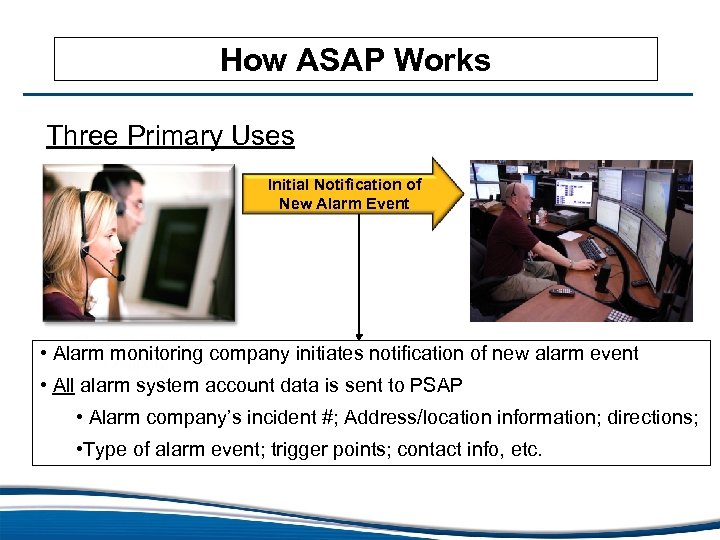 How ASAP Works Three Primary Uses Initial Notification of New Alarm Event • Alarm monitoring company initiates notification of new alarm event • All alarm system account data is sent to PSAP • Alarm company’s incident #; Address/location information; directions; • Type of alarm event; trigger points; contact info, etc.
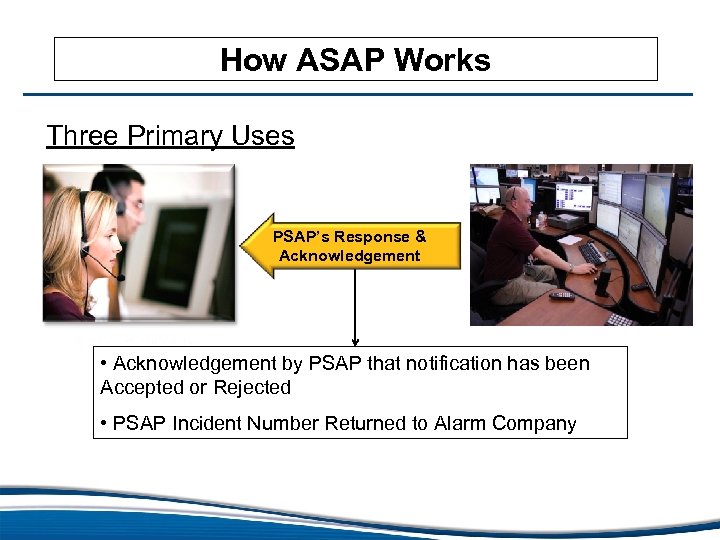 How ASAP Works Three Primary Uses PSAP’s Response & Acknowledgement • Acknowledgement by PSAP that notification has been Accepted or Rejected • PSAP Incident Number Returned to Alarm Company
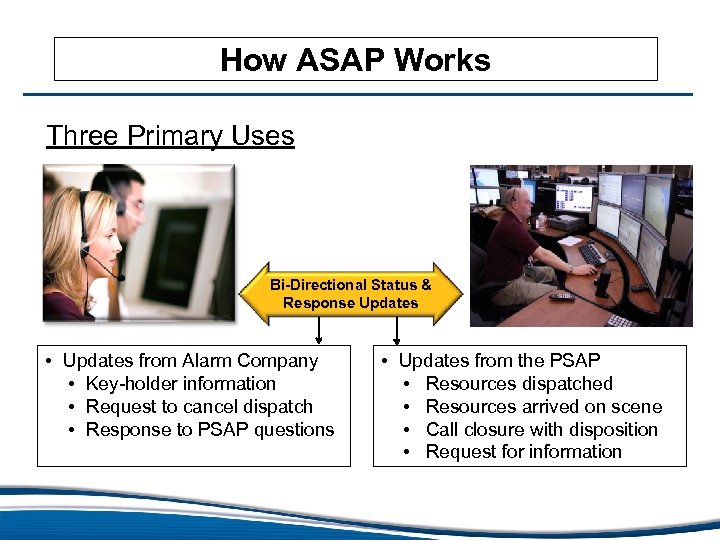 How ASAP Works Three Primary Uses Bi-Directional Status & Response Updates • Updates from Alarm Company • Key-holder information • Request to cancel dispatch • Response to PSAP questions • Updates from the PSAP • Resources dispatched • Resources arrived on scene • Call closure with disposition • Request for information
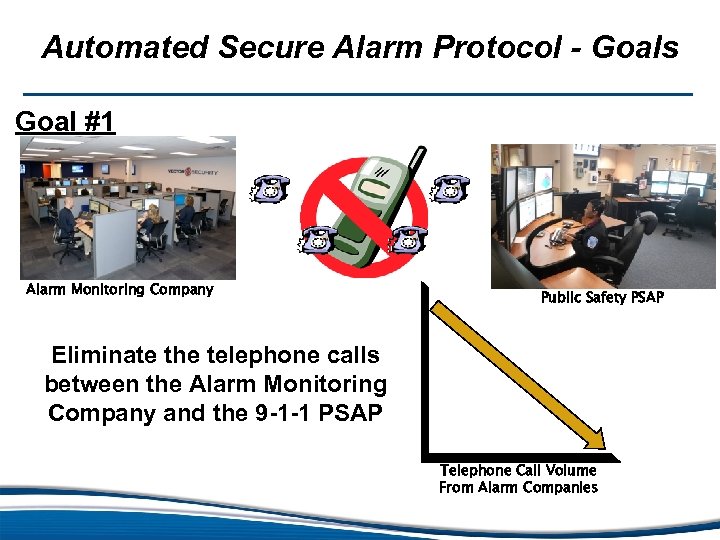 Automated Secure Alarm Protocol - Goals Goal #1 Alarm Monitoring Company Public Safety PSAP Eliminate the telephone calls between the Alarm Monitoring Company and the 9 -1 -1 PSAP Telephone Call Volume From Alarm Companies
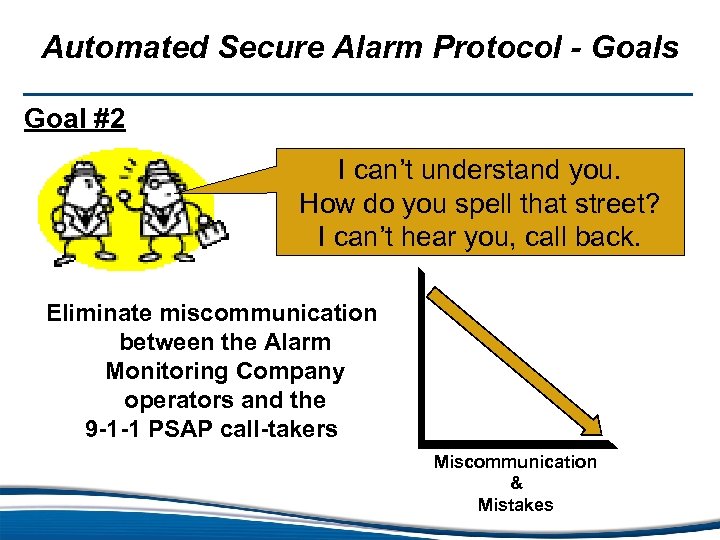 Automated Secure Alarm Protocol - Goals Goal #2 I can’t understand you. How do you spell that street? I can’t hear you, call back. Eliminate miscommunication between the Alarm Monitoring Company operators and the 9 -1 -1 PSAP call-takers Miscommunication & Mistakes
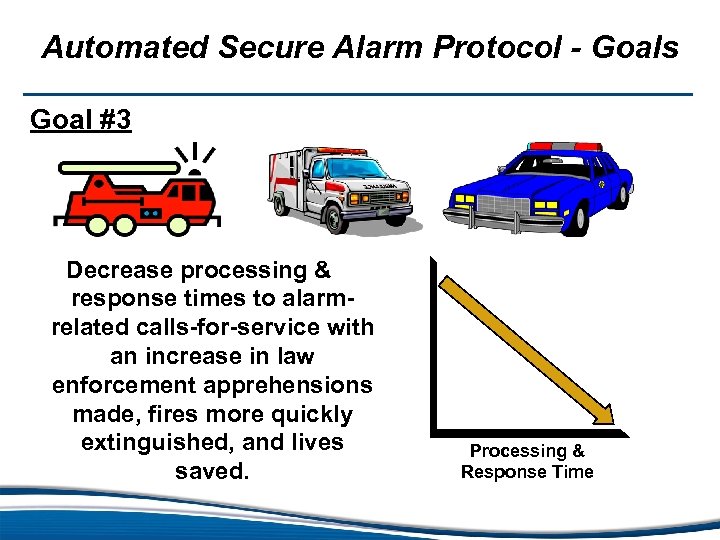 Automated Secure Alarm Protocol - Goals Goal #3 Decrease processing & response times to alarmrelated calls-for-service with an increase in law enforcement apprehensions made, fires more quickly extinguished, and lives saved. Processing & Response Time
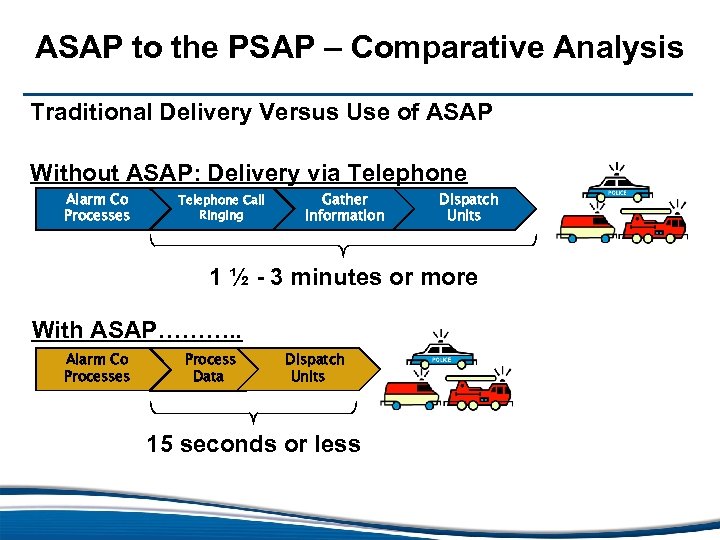 ASAP to the PSAP – Comparative Analysis Traditional Delivery Versus Use of ASAP Without ASAP: Delivery via Telephone Alarm Co Processes Telephone Call Ringing Gather Information Dispatch Units 1 ½ - 3 minutes or more With ASAP………. . Alarm Co Processes No Phone Process No Gathering Information Call Data Dispatch Units 15 seconds or less
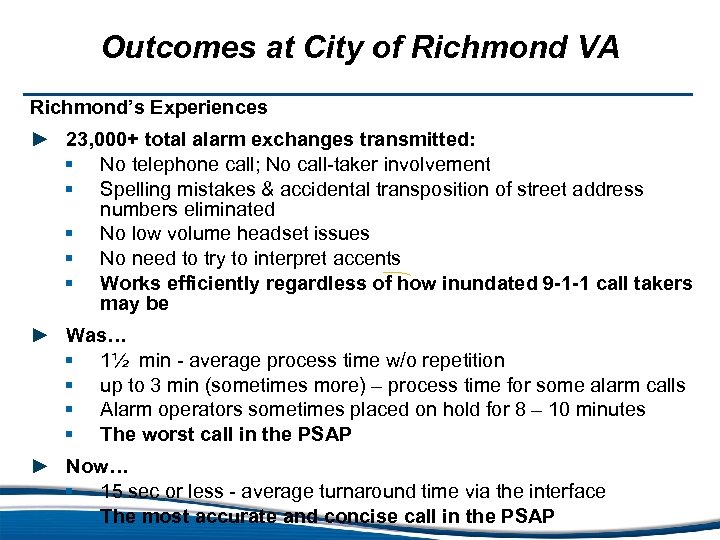 Outcomes at City of Richmond VA Richmond’s Experiences ► 23, 000+ total alarm exchanges transmitted: § No telephone call; No call-taker involvement § Spelling mistakes & accidental transposition of street address numbers eliminated § No low volume headset issues § No need to try to interpret accents § Works efficiently regardless of how inundated 9 -1 -1 call takers may be ► Was… § 1½ min - average process time w/o repetition § up to 3 min (sometimes more) – process time for some alarm calls § Alarm operators sometimes placed on hold for 8 – 10 minutes § The worst call in the PSAP ► Now… § 15 sec or less - average turnaround time via the interface § The most accurate and concise call in the PSAP
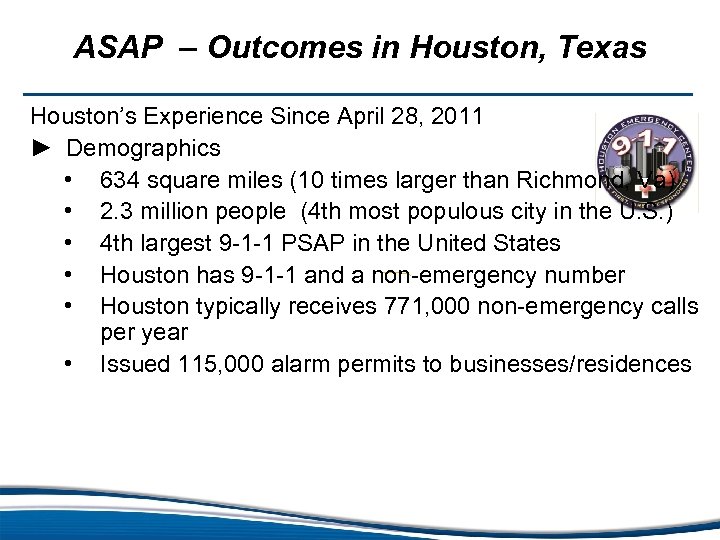 ASAP – Outcomes in Houston, Texas Houston’s Experience Since April 28, 2011 ► Demographics • 634 square miles (10 times larger than Richmond, Va) • 2. 3 million people (4 th most populous city in the U. S. ) • 4 th largest 9 -1 -1 PSAP in the United States • Houston has 9 -1 -1 and a non-emergency number • Houston typically receives 771, 000 non-emergency calls per year • Issued 115, 000 alarm permits to businesses/residences
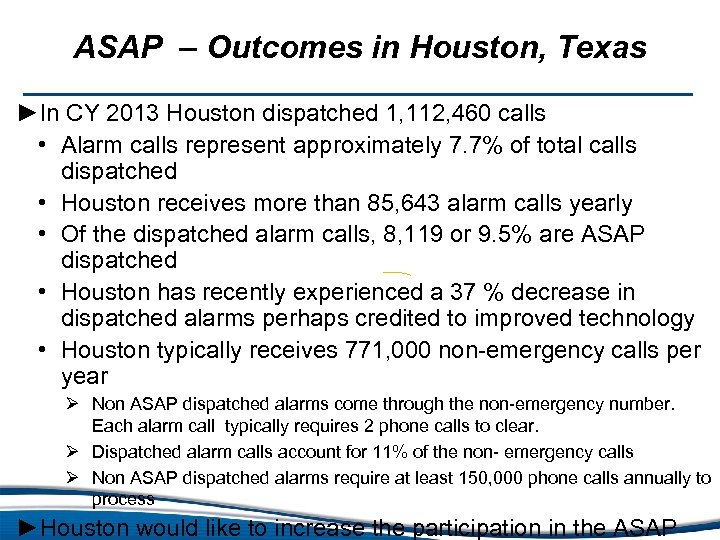 ASAP – Outcomes in Houston, Texas ►In CY 2013 Houston dispatched 1, 112, 460 calls • Alarm calls represent approximately 7. 7% of total calls dispatched • Houston receives more than 85, 643 alarm calls yearly • Of the dispatched alarm calls, 8, 119 or 9. 5% are ASAP dispatched • Houston has recently experienced a 37 % decrease in dispatched alarms perhaps credited to improved technology • Houston typically receives 771, 000 non-emergency calls per year Ø Non ASAP dispatched alarms come through the non-emergency number. Each alarm call typically requires 2 phone calls to clear. Ø Dispatched alarm calls account for 11% of the non- emergency calls Ø Non ASAP dispatched alarms require at least 150, 000 phone calls annually to process ►Houston would like to increase the participation in the ASAP
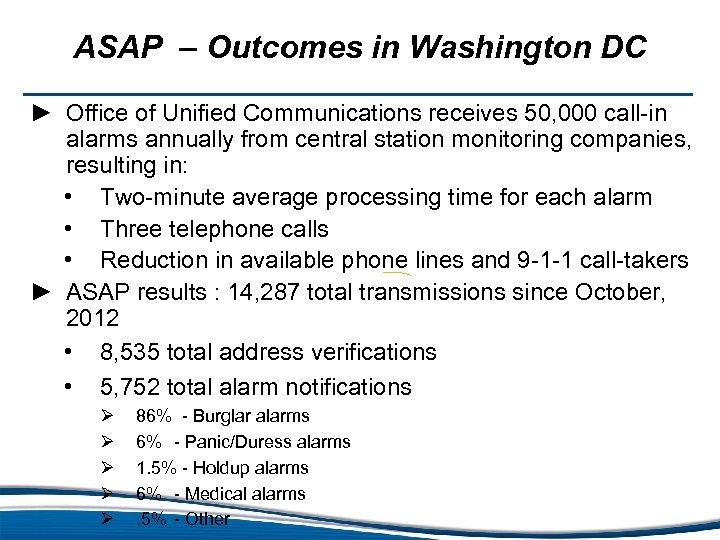 ASAP – Outcomes in Washington DC ► Office of Unified Communications receives 50, 000 call-in alarms annually from central station monitoring companies, resulting in: • Two-minute average processing time for each alarm • Three telephone calls • Reduction in available phone lines and 9 -1 -1 call-takers ► ASAP results : 14, 287 total transmissions since October, 2012 • 8, 535 total address verifications • 5, 752 total alarm notifications Ø Ø Ø 86% - Burglar alarms 6% - Panic/Duress alarms 1. 5% - Holdup alarms 6% - Medical alarms. 5% - Other
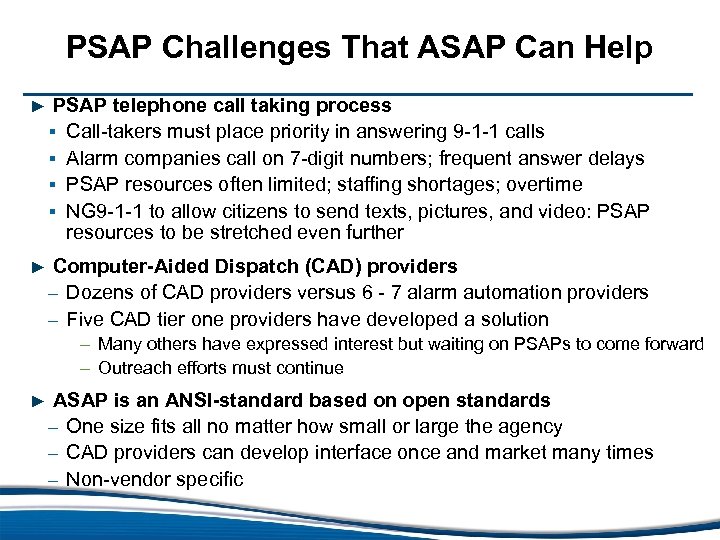 PSAP Challenges That ASAP Can Help ► PSAP telephone call taking process § Call-takers must place priority in answering 9 -1 -1 calls § Alarm companies call on 7 -digit numbers; frequent answer delays § PSAP resources often limited; staffing shortages; overtime § NG 9 -1 -1 to allow citizens to send texts, pictures, and video: PSAP resources to be stretched even further ► Computer-Aided Dispatch (CAD) providers – Dozens of CAD providers versus 6 - 7 alarm automation providers – Five CAD tier one providers have developed a solution – Many others have expressed interest but waiting on PSAPs to come forward – Outreach efforts must continue ► ASAP is an ANSI-standard based on open standards – One size fits all no matter how small or large the agency – CAD providers can develop interface once and market many times – Non-vendor specific
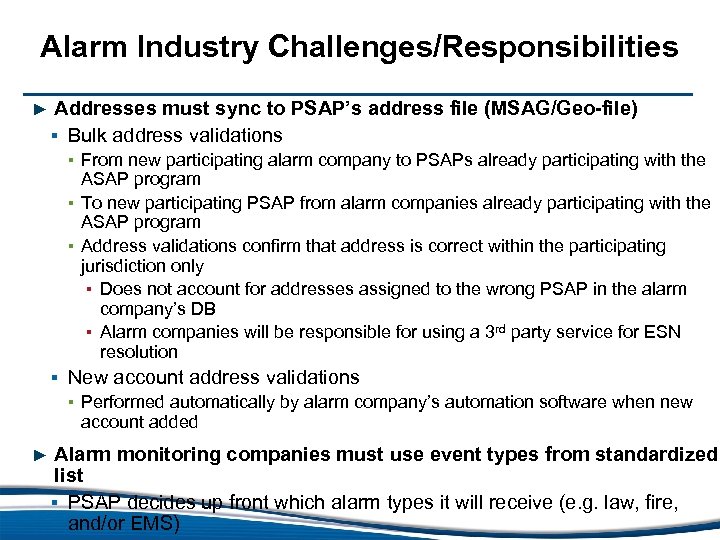 Alarm Industry Challenges/Responsibilities ► Addresses must sync to PSAP’s address file (MSAG/Geo-file) § Bulk address validations ▪ From new participating alarm company to PSAPs already participating with the ASAP program ▪ To new participating PSAP from alarm companies already participating with the ASAP program ▪ Address validations confirm that address is correct within the participating jurisdiction only ▪ Does not account for addresses assigned to the wrong PSAP in the alarm company’s DB ▪ Alarm companies will be responsible for using a 3 rd party service for ESN resolution § New account address validations ▪ Performed automatically by alarm company’s automation software when new account added ► Alarm monitoring companies must use event types from standardized list § PSAP decides up front which alarm types it will receive (e. g. law, fire, and/or EMS)
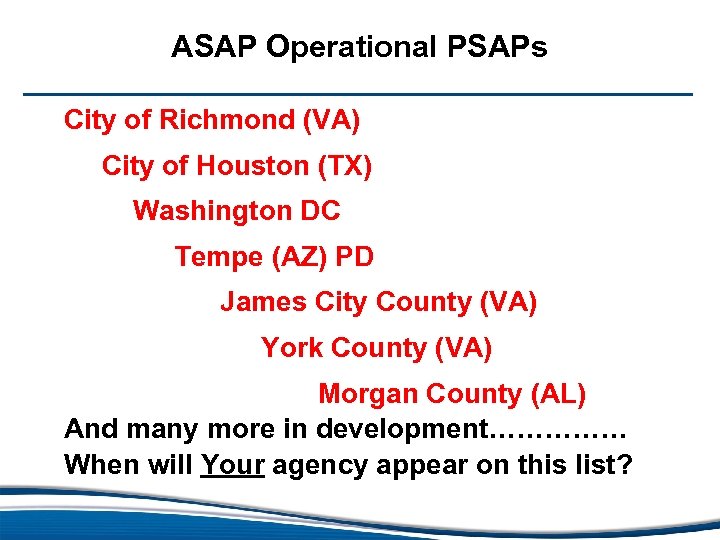 ASAP Operational PSAPs City of Richmond (VA) City of Houston (TX) Washington DC Tempe (AZ) PD James City County (VA) York County (VA) Morgan County (AL) And many more in development…………… When will Your agency appear on this list?
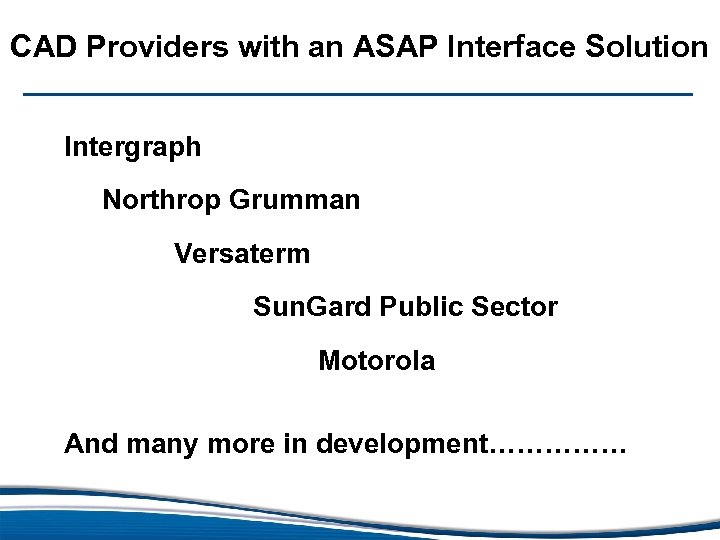 CAD Providers with an ASAP Interface Solution Intergraph Northrop Grumman Versaterm Sun. Gard Public Sector Motorola And many more in development……………
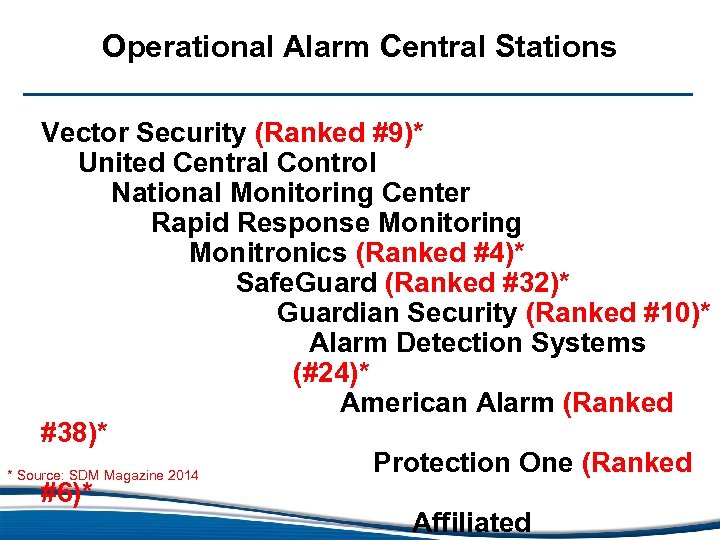 Operational Alarm Central Stations Vector Security (Ranked #9)* United Central Control National Monitoring Center Rapid Response Monitoring Monitronics (Ranked #4)* Safe. Guard (Ranked #32)* Guardian Security (Ranked #10)* Alarm Detection Systems (#24)* American Alarm (Ranked #38)* Protection One (Ranked * Source: SDM Magazine 2014 #6)* Affiliated
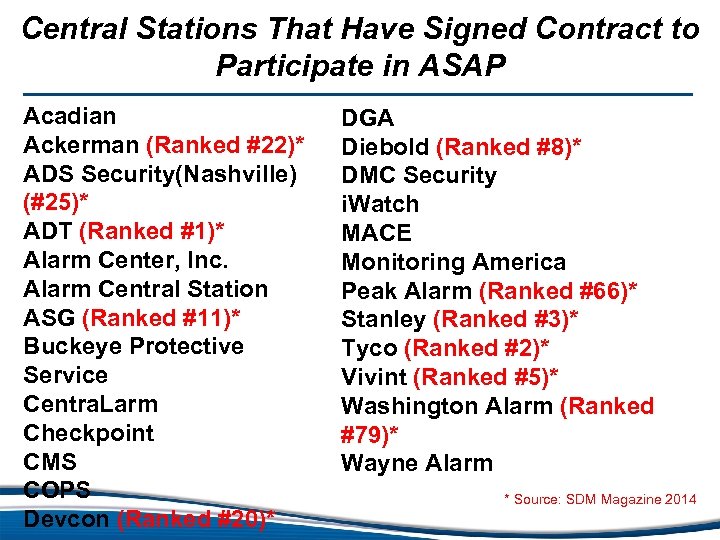 Central Stations That Have Signed Contract to Participate in ASAP Acadian Ackerman (Ranked #22)* ADS Security(Nashville) (#25)* ADT (Ranked #1)* Alarm Center, Inc. Alarm Central Station ASG (Ranked #11)* Buckeye Protective Service Centra. Larm Checkpoint CMS COPS Devcon (Ranked #20)* DGA Diebold (Ranked #8)* DMC Security i. Watch MACE Monitoring America Peak Alarm (Ranked #66)* Stanley (Ranked #3)* Tyco (Ranked #2)* Vivint (Ranked #5)* Washington Alarm (Ranked #79)* Wayne Alarm * Source: SDM Magazine 2014
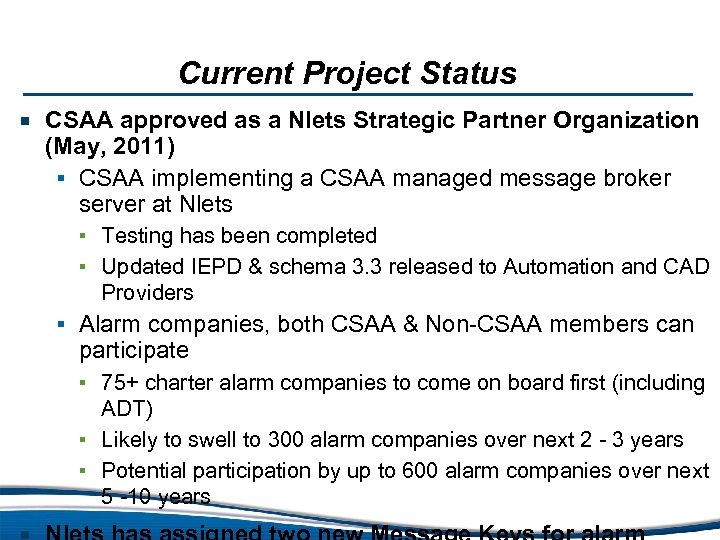 Current Project Status ¡ CSAA approved as a Nlets Strategic Partner Organization (May, 2011) § CSAA implementing a CSAA managed message broker server at Nlets ▪ Testing has been completed ▪ Updated IEPD & schema 3. 3 released to Automation and CAD Providers § Alarm companies, both CSAA & Non-CSAA members can participate ▪ 75+ charter alarm companies to come on board first (including ADT) ▪ Likely to swell to 300 alarm companies over next 2 - 3 years ▪ Potential participation by up to 600 alarm companies over next 5 -10 years
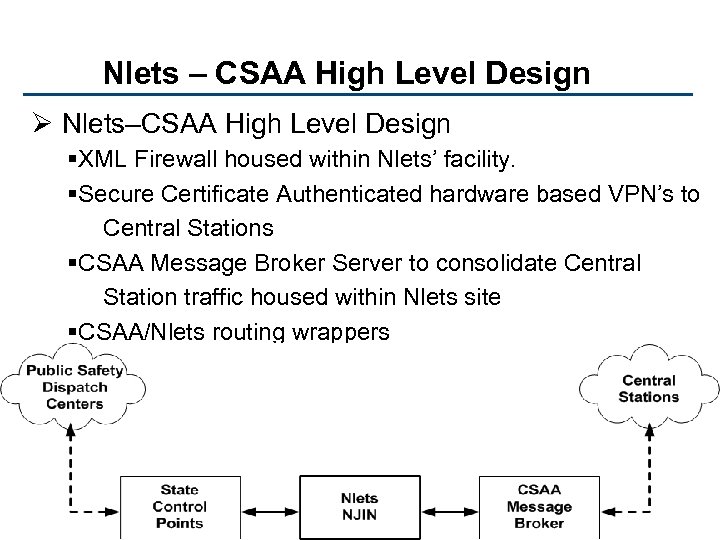 Nlets – CSAA High Level Design Ø Nlets–CSAA High Level Design §XML Firewall housed within Nlets’ facility. §Secure Certificate Authenticated hardware based VPN’s to Central Stations §CSAA Message Broker Server to consolidate Central Station traffic housed within Nlets site §CSAA/Nlets routing wrappers
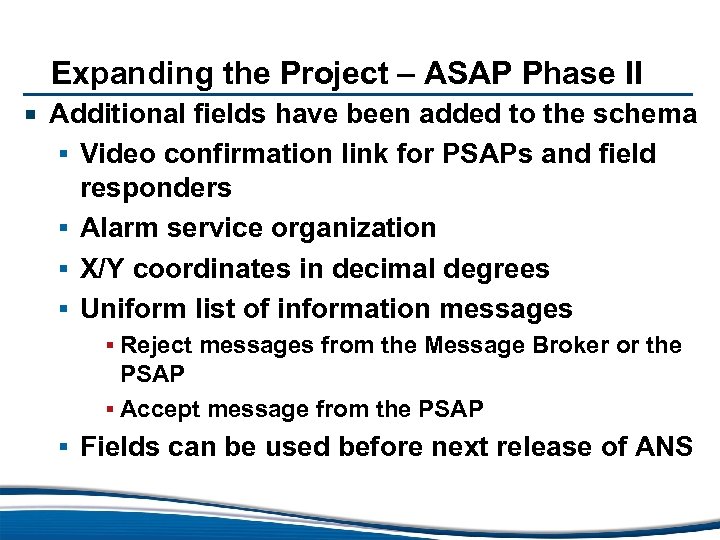 Expanding the Project – ASAP Phase II ¡ Additional fields have been added to the schema § Video confirmation link for PSAPs and field responders § Alarm service organization § X/Y coordinates in decimal degrees § Uniform list of information messages ▪ Reject messages from the Message Broker or the PSAP ▪ Accept message from the PSAP § Fields can be used before next release of ANS
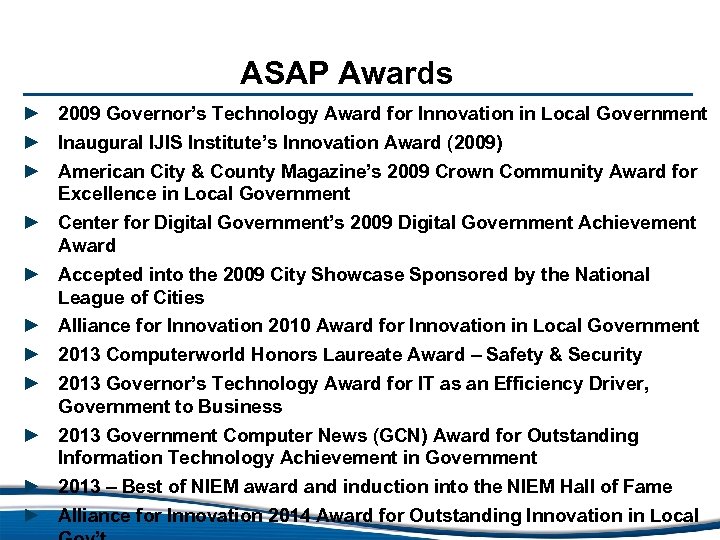 ASAP Awards ► 2009 Governor’s Technology Award for Innovation in Local Government ► Inaugural IJIS Institute’s Innovation Award (2009) ► American City & County Magazine’s 2009 Crown Community Award for Excellence in Local Government ► Center for Digital Government’s 2009 Digital Government Achievement Award ► Accepted into the 2009 City Showcase Sponsored by the National League of Cities ► Alliance for Innovation 2010 Award for Innovation in Local Government ► 2013 Computerworld Honors Laureate Award – Safety & Security ► 2013 Governor’s Technology Award for IT as an Efficiency Driver, Government to Business ► 2013 Government Computer News (GCN) Award for Outstanding Information Technology Achievement in Government ► 2013 – Best of NIEM award and induction into the NIEM Hall of Fame ► Alliance for Innovation 2014 Award for Outstanding Innovation in Local
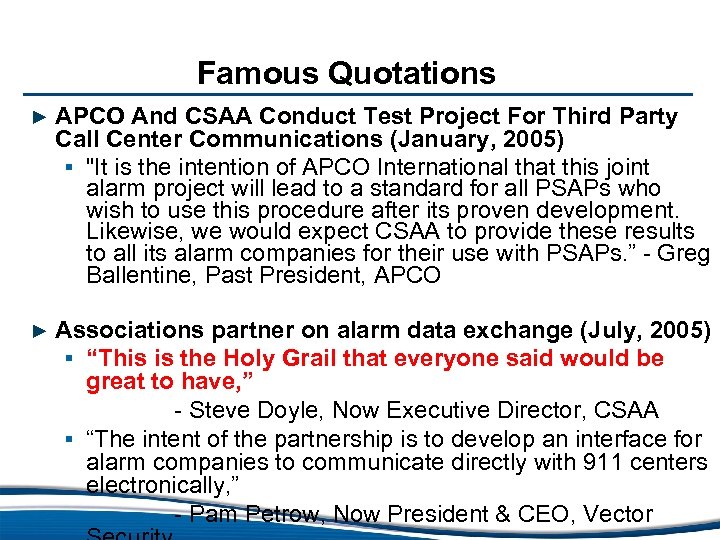 Famous Quotations ► APCO And CSAA Conduct Test Project For Third Party Call Center Communications (January, 2005) § "It is the intention of APCO International that this joint alarm project will lead to a standard for all PSAPs who wish to use this procedure after its proven development. Likewise, we would expect CSAA to provide these results to all its alarm companies for their use with PSAPs. ” - Greg Ballentine, Past President, APCO ► Associations partner on alarm data exchange (July, 2005) § “This is the Holy Grail that everyone said would be great to have, ” - Steve Doyle, Now Executive Director, CSAA § “The intent of the partnership is to develop an interface for alarm companies to communicate directly with 911 centers electronically, ” - Pam Petrow, Now President & CEO, Vector
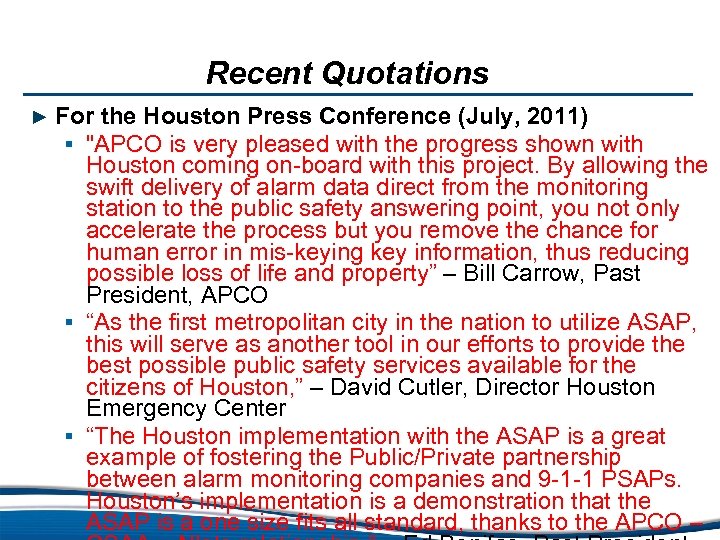 Recent Quotations ► For the Houston Press Conference (July, 2011) § "APCO is very pleased with the progress shown with Houston coming on-board with this project. By allowing the swift delivery of alarm data direct from the monitoring station to the public safety answering point, you not only accelerate the process but you remove the chance for human error in mis-keying key information, thus reducing possible loss of life and property” – Bill Carrow, Past President, APCO § “As the first metropolitan city in the nation to utilize ASAP, this will serve as another tool in our efforts to provide the best possible public safety services available for the citizens of Houston, ” – David Cutler, Director Houston Emergency Center § “The Houston implementation with the ASAP is a great example of fostering the Public/Private partnership between alarm monitoring companies and 9 -1 -1 PSAPs. Houston’s implementation is a demonstration that the ASAP is a one size fits all standard, thanks to the APCO –
 For More Information: • APCO: www. apco 911. org email: asap@apcointl. org • External Alarm Interface Exchange ANSI, Fact Sheet, FAQs, IEPD • http: //www. apco 911. org/resources/asap. html • IEPD available at www. niem. gov (Tools > Work with IEPDs > Search for IEPD (Keyword “Alarm”) • Central Station Alarm Association: www. csaaintl. org Email: psap@csaa-asap. org • Nlets: www. nlets. org • CSAA Video: csaaintl. org/asap