 Скачать презентацию Automated Machinery Maintenance Bill Powell Tony Burnett
1fdc04be0bb456fccddaea5aea0ade71.ppt
- Количество слайдов: 49



Automated Machinery Maintenance Bill Powell Tony Burnett
Agenda l Industry Trends & Challenges l Machinery Health Strategy l l Automating Decision Support Key Points
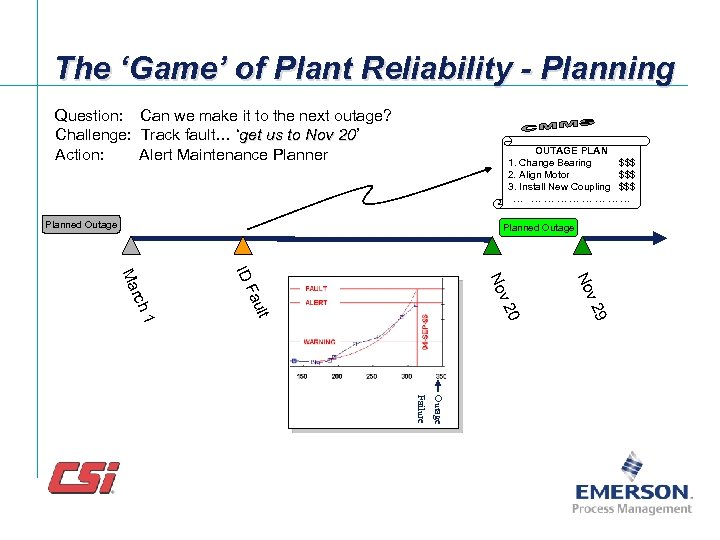
The ‘Game’ of Plant Reliability - Planning Question: Can we make it to the next outage? Challenge: Track fault… ‘get us to Nov 20’ 20 Action: Alert Maintenance Planner OUTAGE PLAN 1. Change Bearing $$$ 2. Align Motor $$$ 3. Install New Coupling $$$ … ………… Planned Outage 9 v 2 No 0 1 lt v 2 Fau No ID rch Ma Outage Failure
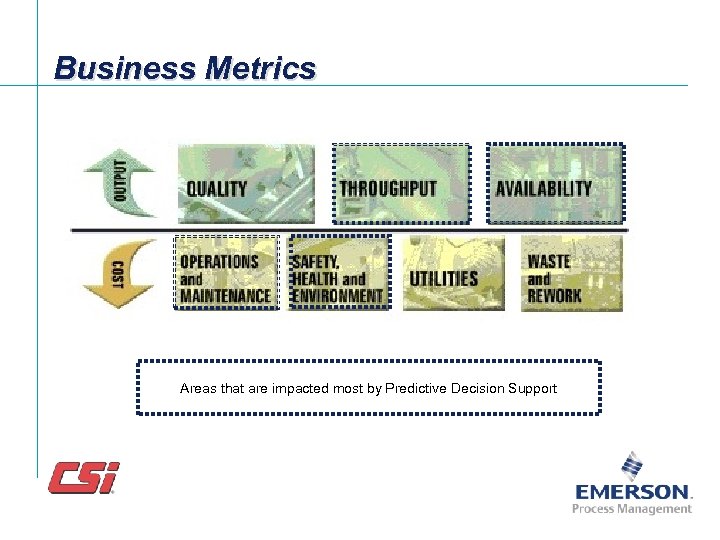
Business Metrics Areas that are impacted most by Predictive Decision Support
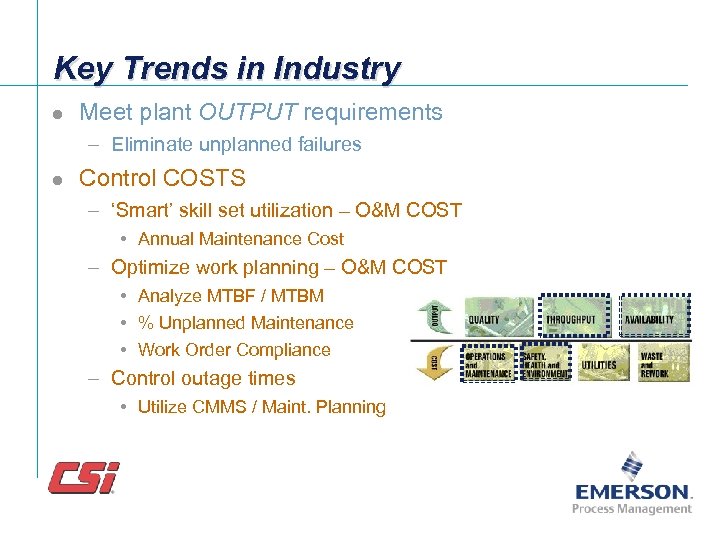
Key Trends in Industry l Meet plant OUTPUT requirements – Eliminate unplanned failures l Control COSTS – ‘Smart’ skill set utilization – O&M COST • Annual Maintenance Cost – Optimize work planning – O&M COST • Analyze MTBF / MTBM • % Unplanned Maintenance • Work Order Compliance – Control outage times • Utilize CMMS / Maint. Planning
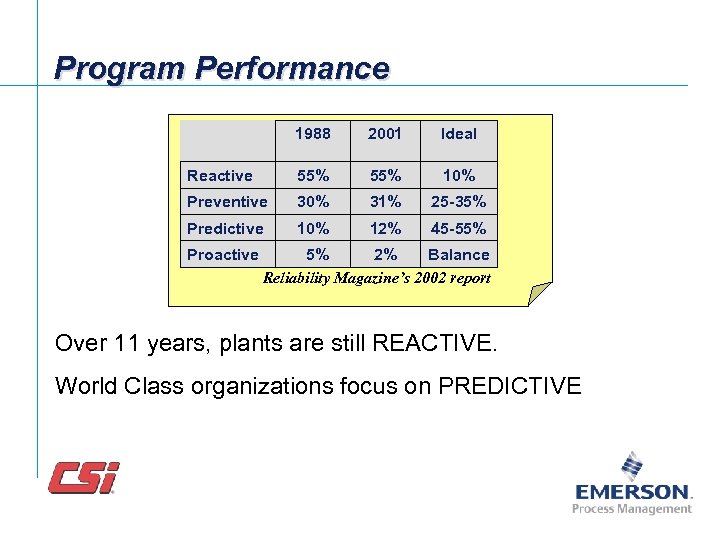
Program Performance 1988 2001 Ideal Reactive 55% 10% Preventive 30% 31% 25 -35% Predictive 10% 12% 45 -55% Proactive 5% 2% Balance Reliability Magazine’s 2002 report Over 11 years, plants are still REACTIVE. World Class organizations focus on PREDICTIVE
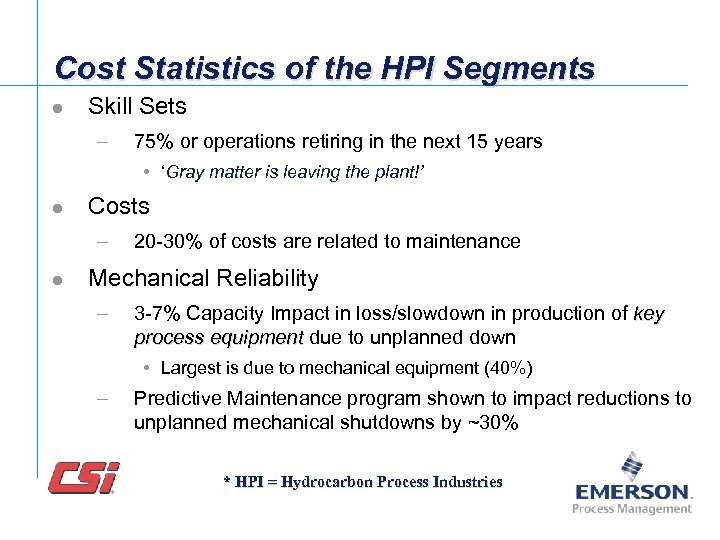
Cost Statistics of the HPI Segments l Skill Sets – 75% or operations retiring in the next 15 years • ‘Gray matter is leaving the plant!’ l Costs – l 20 -30% of costs are related to maintenance Mechanical Reliability – 3 -7% Capacity Impact in loss/slowdown in production of key process equipment due to unplanned down • Largest is due to mechanical equipment (40%) – Predictive Maintenance program shown to impact reductions to unplanned mechanical shutdowns by ~30% * HPI = Hydrocarbon Process Industries
Operational Challenges of Today l ‘Our target is ZERO unplanned downtime!’ – Maximize Equipment Availability & Reliability • Plan all maintenance - HOW? l ‘We are trying to be competitive today with a plant that is typically more than 40 years old - and so are our competitors. ’ – l Extend Machinery Life & Rebuilds ‘We are running our equipment beyond its design capacity to handle the variety of materials that we must process’ – Running equipment beyond rated capacity • Increased Throughput, but without RISK?
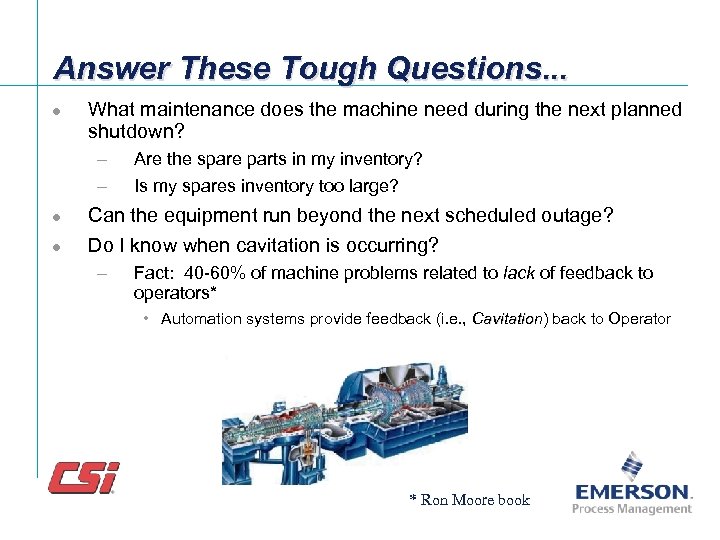
Answer These Tough Questions. . . l What maintenance does the machine need during the next planned shutdown? – – l l Are the spare parts in my inventory? Is my spares inventory too large? Can the equipment run beyond the next scheduled outage? Do I know when cavitation is occurring? – Fact: 40 -60% of machine problems related to lack of feedback to operators* • Automation systems provide feedback (i. e. , Cavitation) back to Operator Cavitation * Ron Moore book
Answer These Tough Questions. . . l Do you know the # of failures ranked by equipment type? type – Rotating Equipment can be segmented into… • Pumps / Fans / Compressors • Pumps can be segmented into… – Centrifugal / Recip / Rotary / special effect l What are your most problematic machines? – Are they the bottlenecks in your production facility? • These machines = downtime cost for entire plant. – Automated monitoring strategy would be ideal for these cases
Answer These Tough Questions. . . l What are your Key Performance Indicators (KPI)? – – – # failures, MTBF/MTBM Cost of Repairs, Avg. Repair Cost, Maintenance costs by Equipment Group Quantified Lost Production Opportunity (LPO) Ex. : Exxon. Mobil reduced maintenance costs 20% corporatewide by considering these categorical cost concepts
Answer These Tough Questions. . . l Have you identified your most critical equipment? – One facility has identified that… • ~ 6 machines can bring them to 0 output • ~ 30 machines can reduce output to 40 -60% • Point: Some output is better than no output! MOST CRITICAL ESSENTIAL – If production is $1 M / day, then 50% output loss = $500 K / day » Likely comes from O&M Budget – Ex. : TN Eastman has 27, 000 pieces of equipment • 3% (or ~750) need online-predictive & protection (AMI 1) • 26% (~7000) need online and walk-around (AMI 2 or 3) • What percentage would your operations group tell you? * AMI = Asset Management Index (1 -5, 1 is most critical)
Conclusions… l The market is forcing major industrial facilities to adopt new methods for the sake of profitability – Equipment is getting old…Running beyond design speeds… l Planning is everything – But we don’t have unlimited man-power – industry is challenged! l Trained skill sets are starting to retiring – How do you capture this knowledge? l Do I have MTBF statistics? – CMMS is becoming important tool for O&M strategies l Identify the machines that reduce greatest percentage of output reduction – These are most critical! Automation is easily justifiable.
Agenda l Industry Trends & Challenges l Machinery Health Strategy l l Automating Decision Support Key Points
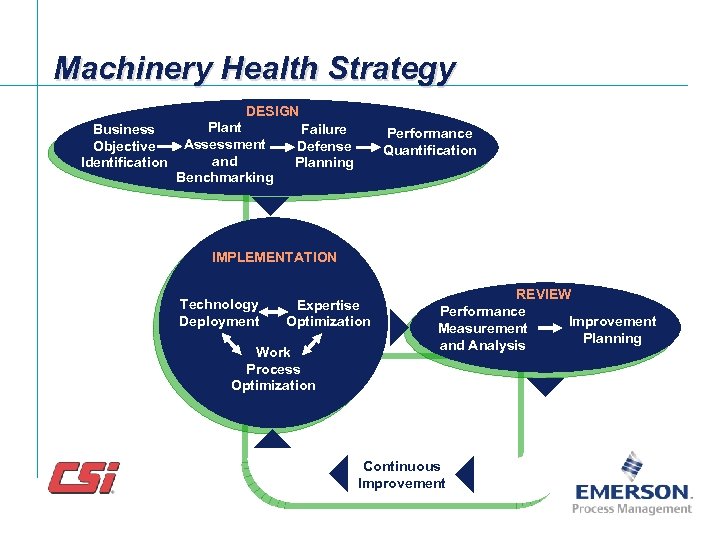
Machinery Health Strategy DESIGN Business Objective Identification Plant Assessment and Benchmarking Failure Defense Planning Performance Quantification IMPLEMENTATION Technology Deployment Expertise Optimization Work Process Optimization REVIEW Performance Improvement Measurement Planning and Analysis Continuous Improvement
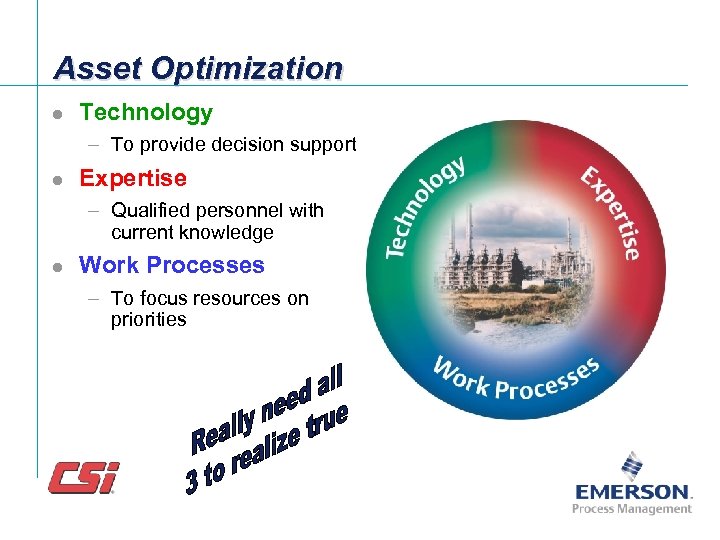
Asset Optimization l Technology – To provide decision support l Expertise – Qualified personnel with current knowledge l Work Processes – To focus resources on priorities
Agenda l Industry Trends & Challenges l Machinery Health Strategy l l Automating Decision Support Key Points
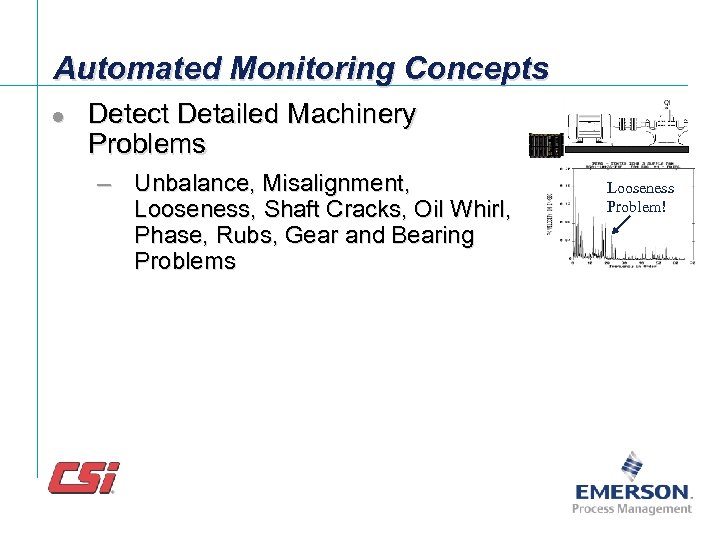
Automated Monitoring Concepts l Detect Detailed Machinery Problems – Unbalance, Misalignment, Looseness, Shaft Cracks, Oil Whirl, Phase, Rubs, Gear and Bearing Problems Looseness Problem!
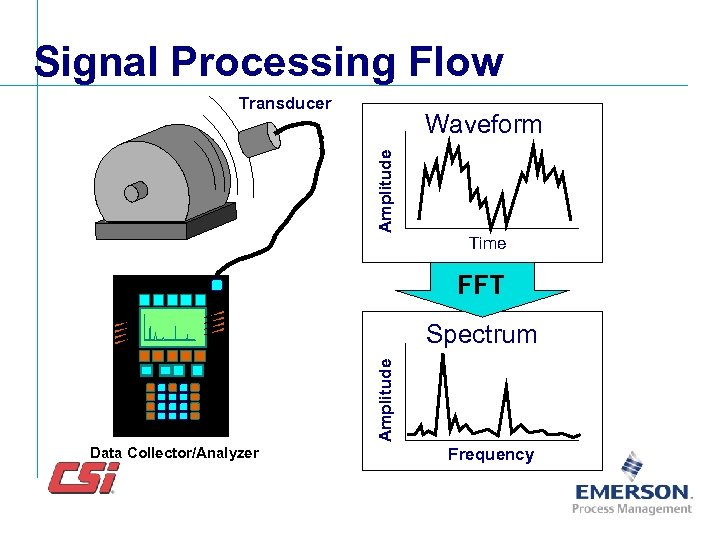
Signal Processing Flow Transducer Amplitude Waveform Time FFT Amplitude Spectrum Data Collector/Analyzer Frequency
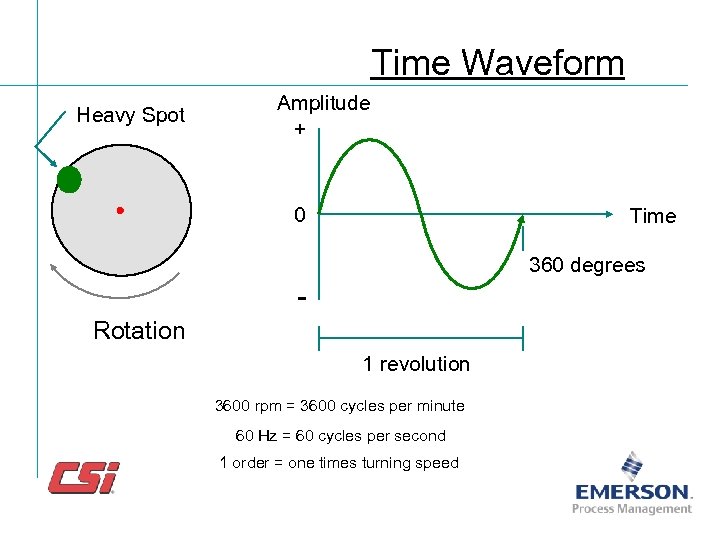
Time Waveform Heavy Spot Amplitude + 0 Time 360 degrees Rotation 1 revolution 3600 rpm = 3600 cycles per minute 60 Hz = 60 cycles per second 1 order = one times turning speed
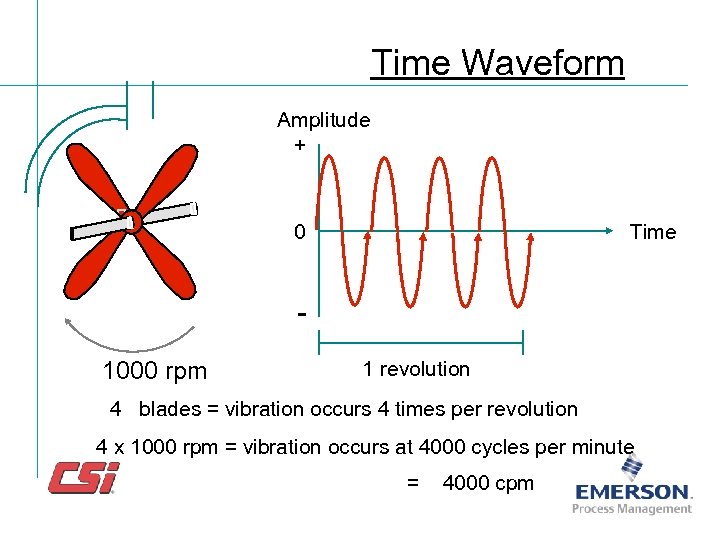
Time Waveform Amplitude + 0 Time 1000 rpm 1 revolution 4 blades = vibration occurs 4 times per revolution 4 x 1000 rpm = vibration occurs at 4000 cycles per minute = 4000 cpm
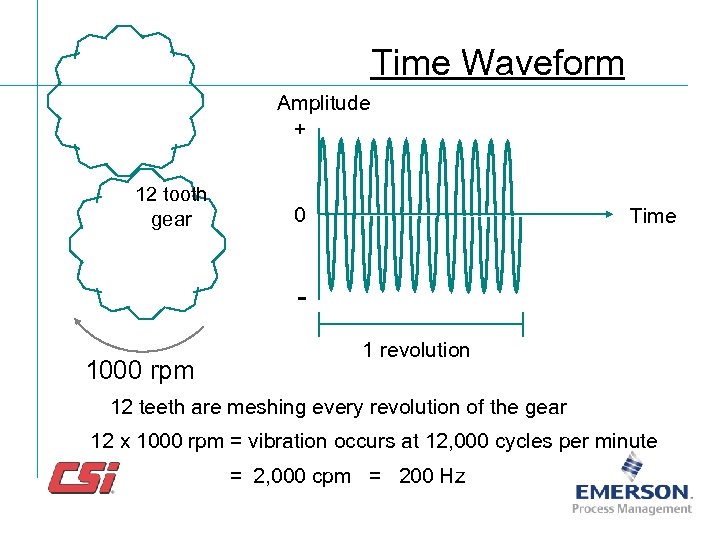
Time Waveform Amplitude + 12 tooth gear 0 Time 1000 rpm 1 revolution 12 teeth are meshing every revolution of the gear 12 x 1000 rpm = vibration occurs at 12, 000 cycles per minute = 2, 000 cpm = 200 Hz
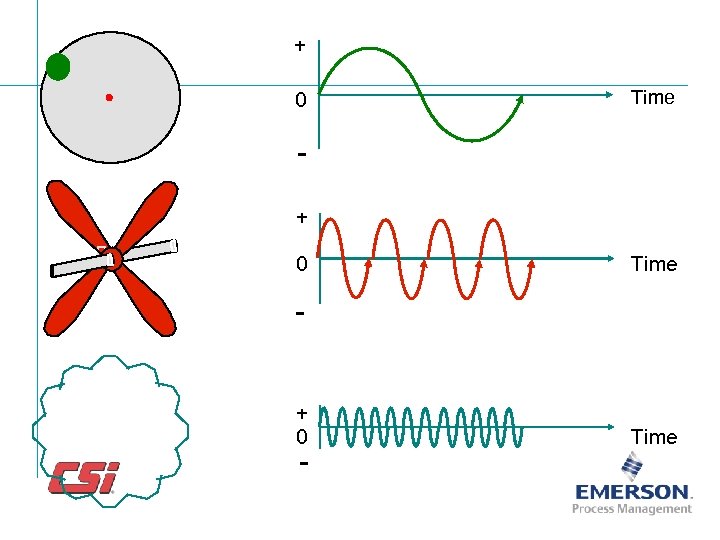
+ 0 Time + 0 - Time
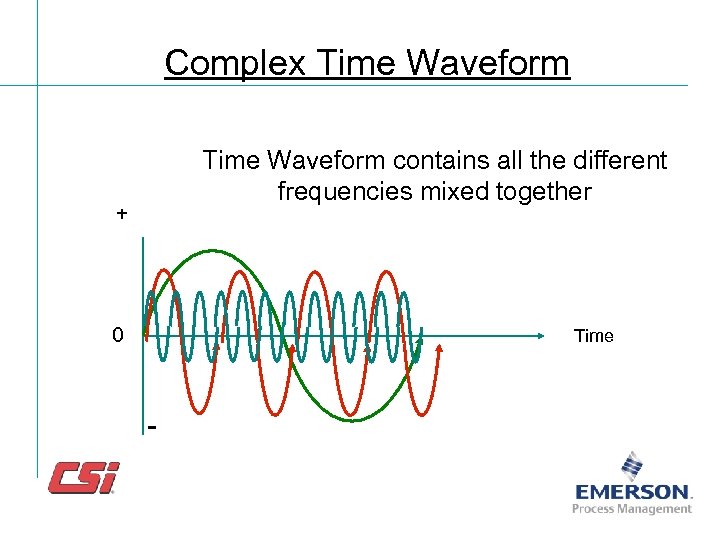
Complex Time Waveform contains all the different frequencies mixed together + 0 Time -
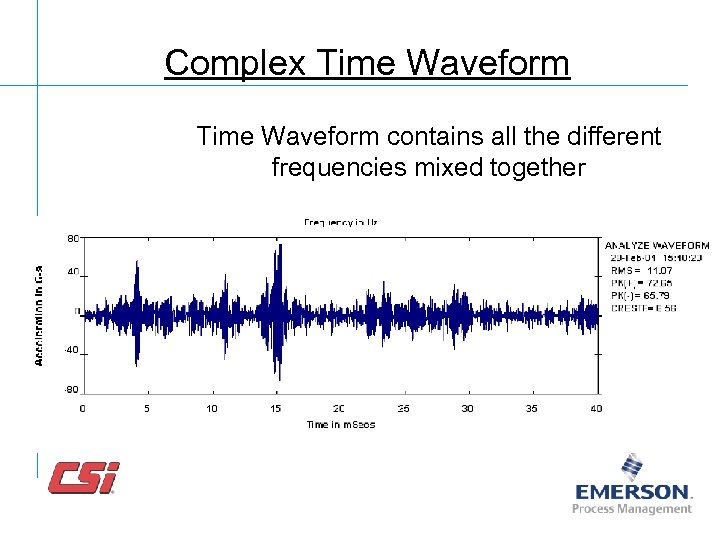
Complex Time Waveform contains all the different frequencies mixed together
We are now entering the Frequency Domain • FFT - Fast Fourier Transform • Separates individual frequencies • Detects how much vibration at each frequency
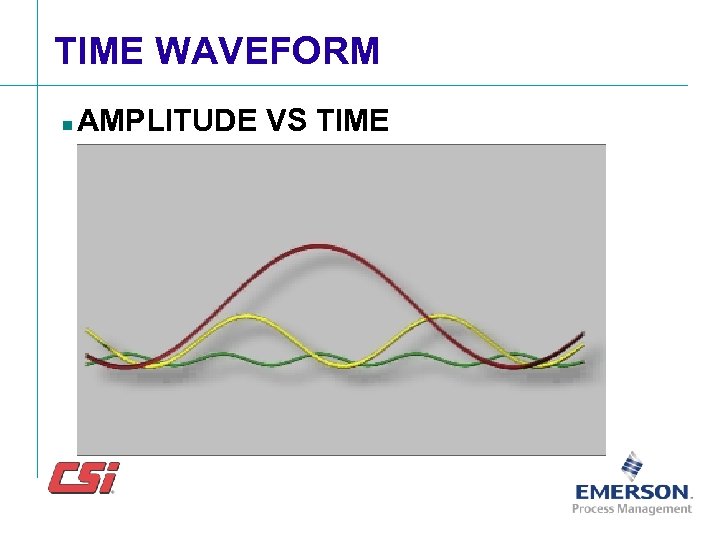
TIME WAVEFORM n AMPLITUDE VS TIME
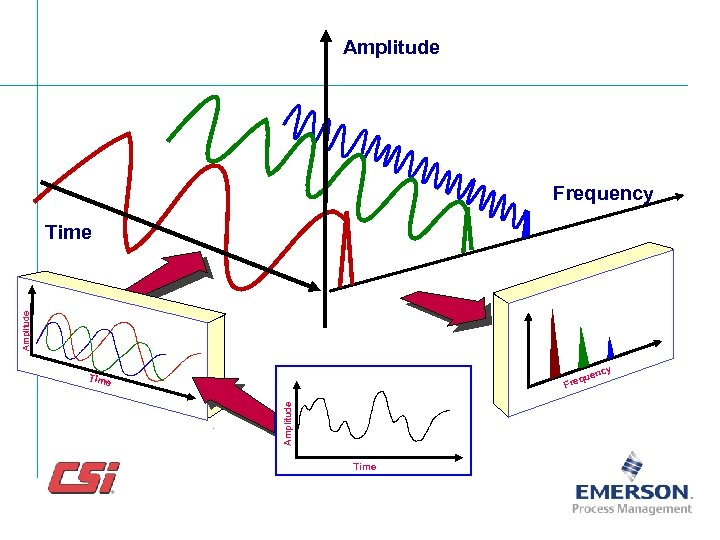
Amplitude Frequency Amplitude Time Amplitude q Fre Time uen cy
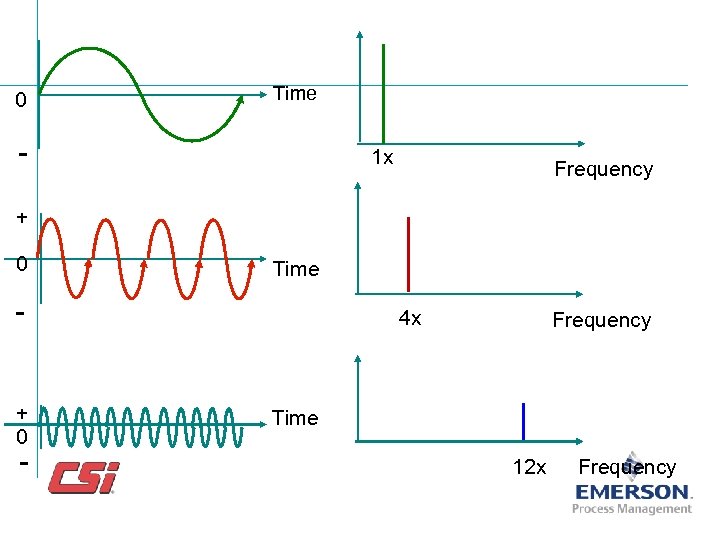
0 Time - 1 x Frequency + 0 Time + 0 - 4 x Frequency Time 12 x Frequency
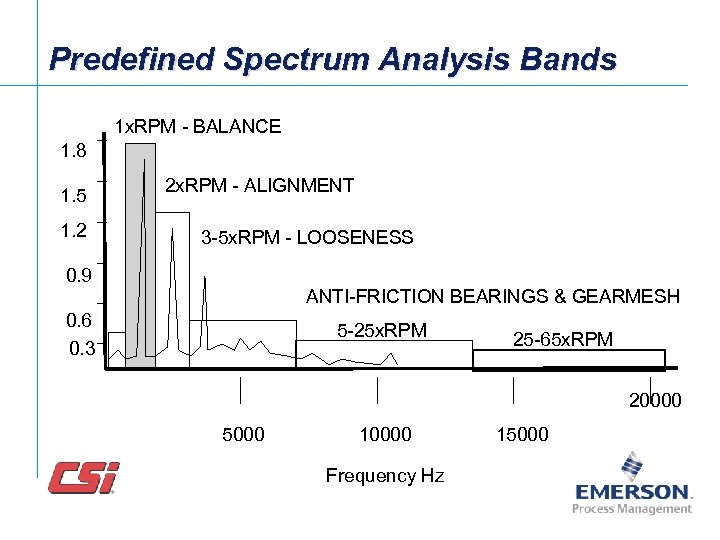
Predefined Spectrum Analysis Bands 1 x. RPM - BALANCE 1. 8 1. 5 1. 2 2 x. RPM - ALIGNMENT 3 -5 x. RPM - LOOSENESS 0. 9 ANTI-FRICTION BEARINGS & GEARMESH 0. 6 0. 3 5 -25 x. RPM 25 -65 x. RPM 20000 5000 10000 Frequency Hz 15000
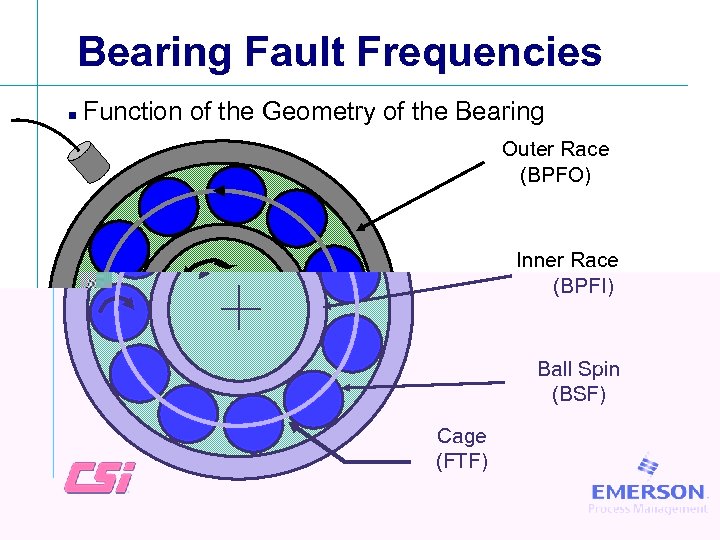
Bearing Fault Frequencies n Function of the Geometry of the Bearing Outer Race (BPFO) Inner Race (BPFI) Ball Spin (BSF) Cage (FTF)
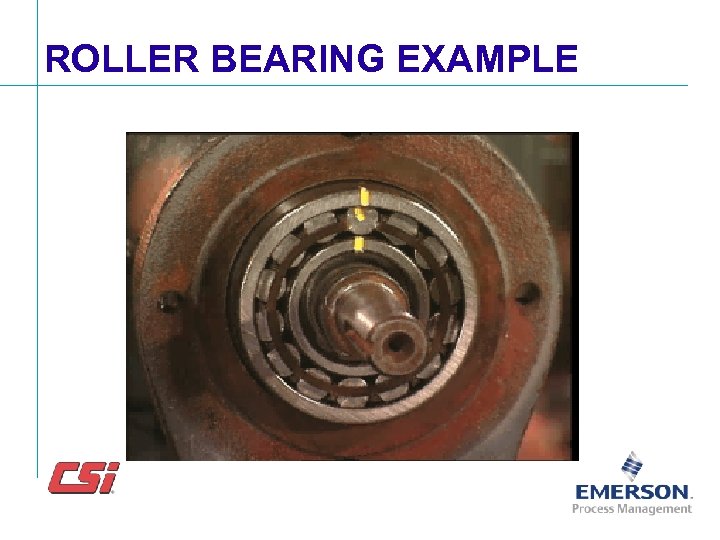
ROLLER BEARING EXAMPLE
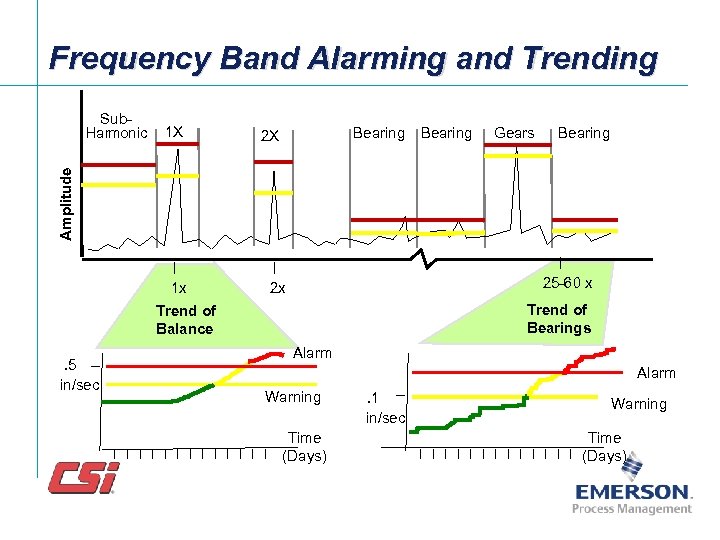
Frequency Band Alarming and Trending 1 X Bearing 2 X Bearing Gears Bearing Amplitude Sub. Harmonic 1 x 25 -60 x 2 x Trend of Bearings Trend of Balance. 5 in/sec Alarm Warning Time (Days) . 1 in/sec Warning Time (Days)
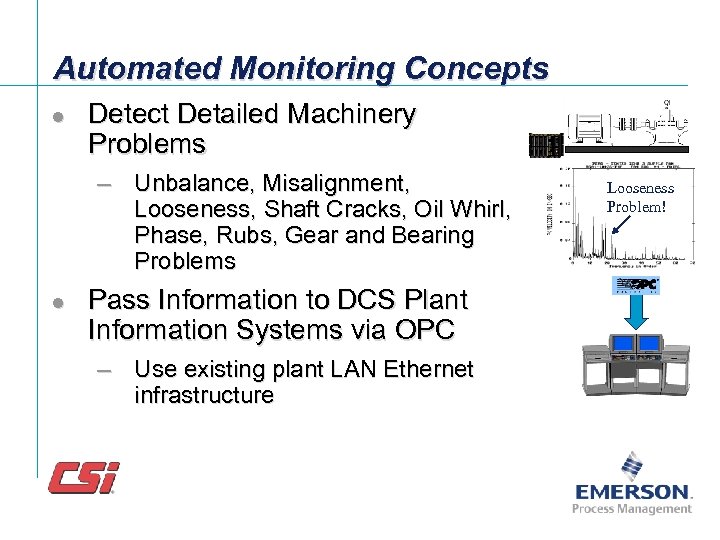
Automated Monitoring Concepts l Detect Detailed Machinery Problems – Unbalance, Misalignment, Looseness, Shaft Cracks, Oil Whirl, Phase, Rubs, Gear and Bearing Problems l Pass Information to DCS Plant Information Systems via OPC – Use existing plant LAN Ethernet infrastructure Looseness Problem!
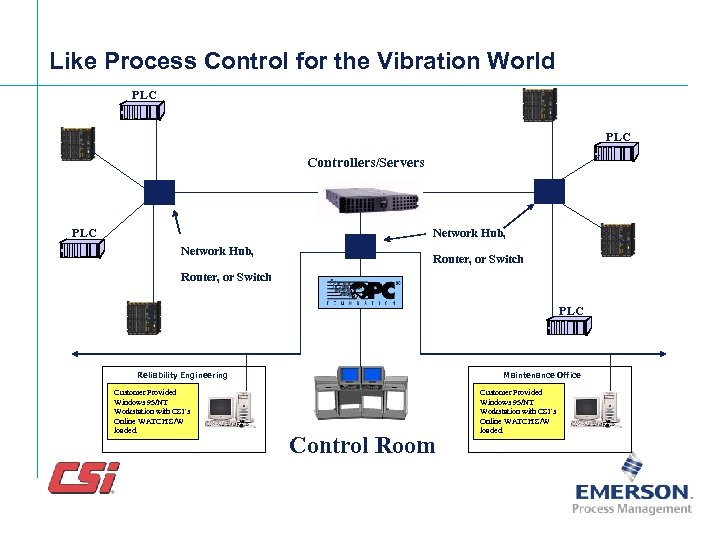
Like Process Control for the Vibration World PLC Controllers/Servers PLC Network Hub, Router, or Switch PLC Reliability Engineering Customer Provided Windows 95/NT = Workstation with CSI’s Online WATCH S/W loaded. Maintenance Office Control Room Customer Provided Windows 95/NT = Workstation with CSI’s Online WATCH S/W loaded.
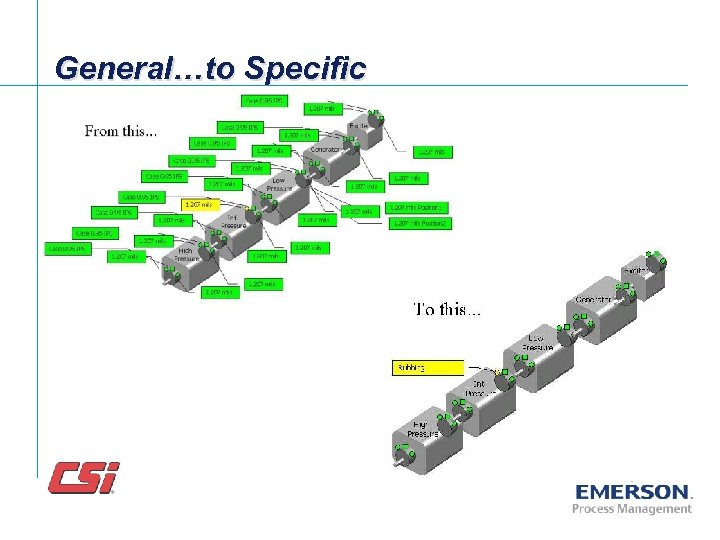
General…to Specific
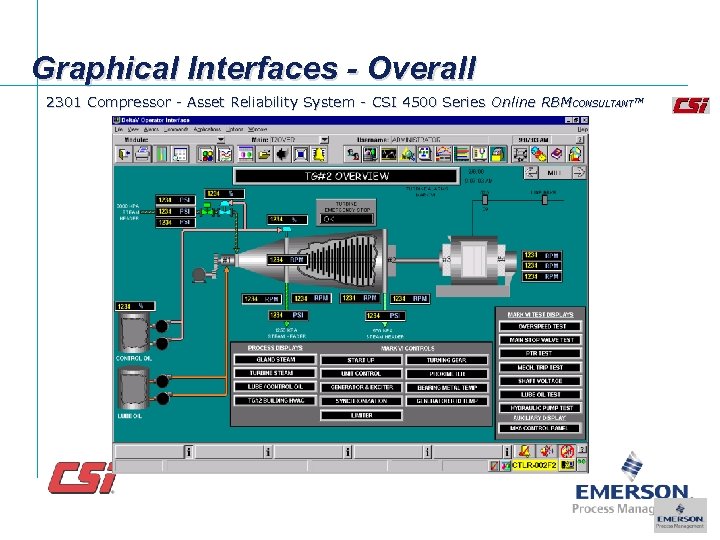
Graphical Interfaces - Overall 2301 Compressor - Asset Reliability System - CSI 4500 Series Online RBMCONSULTANTTM
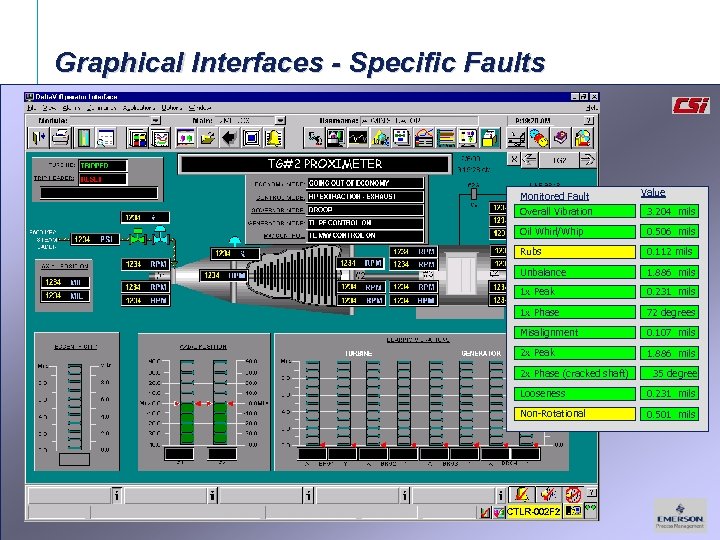
Graphical Interfaces - Specific Faults Monitored Fault Value Overall Vibration 3. 204 mils Oil Whirl/Whip 0. 506 mils Rubs 0. 112 mils Unbalance 1. 886 mils 1 x Peak 0. 231 mils 1 x Phase 72 degrees Misalignment 0. 107 mils 2 x Peak 1. 886 mils 2 x Phase (cracked shaft) 35 degree Looseness 0. 231 mils Non-Rotational 0. 501 mils
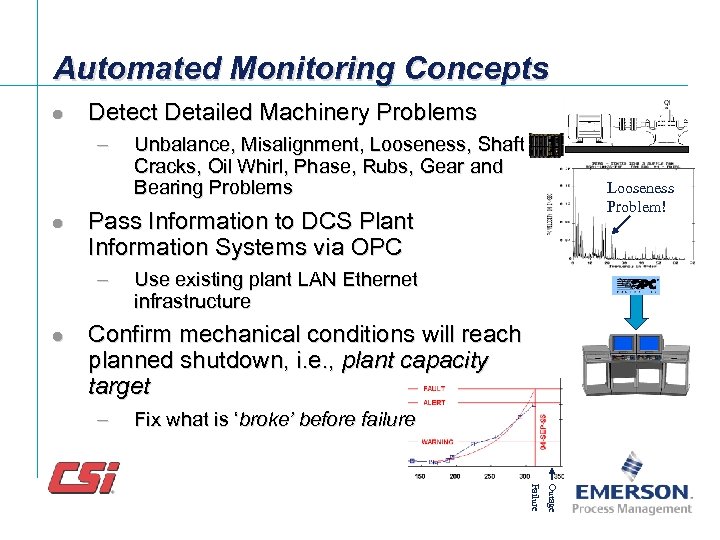
Automated Monitoring Concepts l Detect Detailed Machinery Problems – l Looseness Problem! Pass Information to DCS Plant Information Systems via OPC – l Unbalance, Misalignment, Looseness, Shaft Cracks, Oil Whirl, Phase, Rubs, Gear and Bearing Problems Use existing plant LAN Ethernet infrastructure Confirm mechanical conditions will reach planned shutdown, i. e. , plant capacity target – Fix what is ‘broke’ before failure Outage Failure
Automation Technology – Best Practices l Data-to-Information – Assess condition/faults of machine in field • Report results – not just data l Accuracy of automated analysis – Combine analysis with machine operating condition • Addresses false alarming l Report-upon-exception – Keep skilled analysts focused on problems • Addresses the ‘data generator’ issue
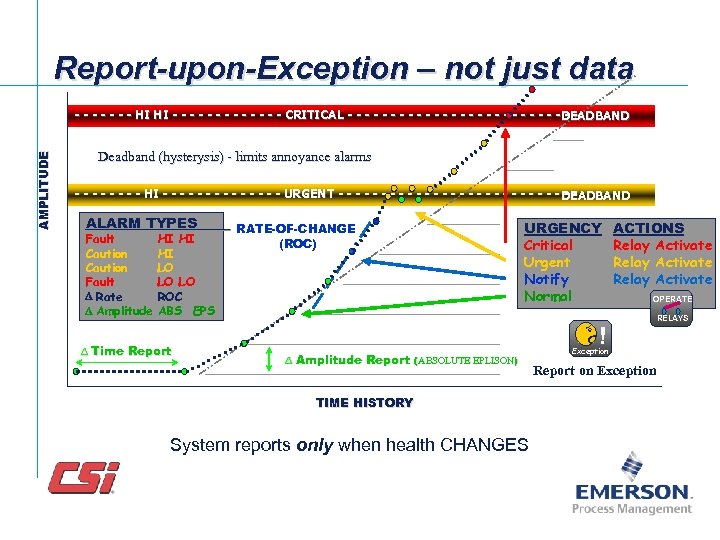
Report-upon-Exception – not just data AMPLITUDE - - - - HI HI - - - - CRITICAL - - - - - - - DEADBAND -- Deadband (hysterysis) - limits annoyance alarms - - - - HI - - - - URGENT - - - - - - - DEADBAND -- ALARM TYPES Fault Caution Fault D Rate D Amplitude HI HI HI LO LO LO ROC ABS EPS D Time Report RATE-OF-CHANGE (ROC) URGENCY Critical Urgent Notify Normal ACTIONS Relay Activate OPERATE RELAYS ! D Amplitude Report (ABSOLUTE EPLISON) TIME HISTORY System reports only when health CHANGES Exception Report on Exception
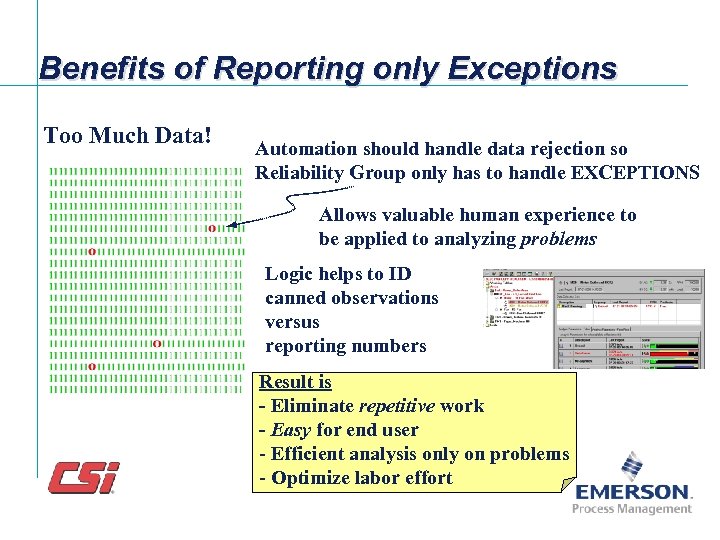
Benefits of Reporting only Exceptions Too Much Data! Automation should handle data rejection so Reliability Group only has to handle EXCEPTIONS Allows valuable human experience to be applied to analyzing problems Logic helps to ID canned observations versus reporting numbers Result is - Eliminate repetitive work - Easy for end user - Efficient analysis only on problems - Optimize labor effort
Agenda l Industry Trends & Challenges l Machinery Health Strategy l l Automating Decision Support Key Points
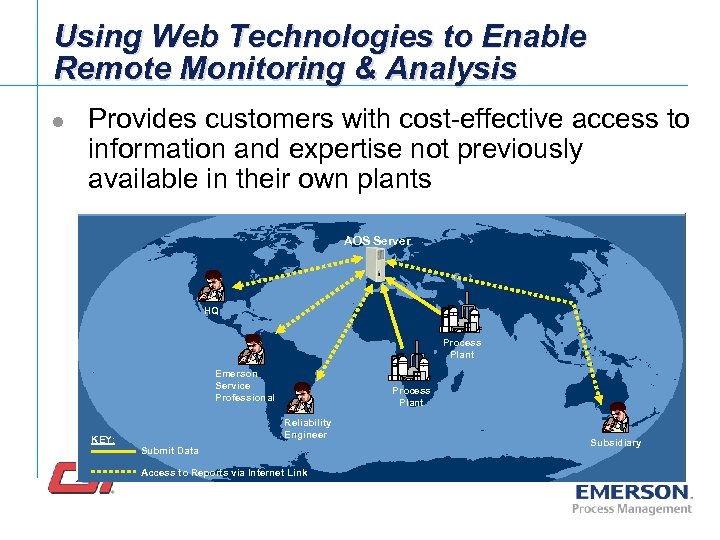
Using Web Technologies to Enable Remote Monitoring & Analysis l Provides customers with cost-effective access to information and expertise not previously available in their own plants AOS Server HQ Process Plant Emerson Service Professional Process Plant Reliability Engineer KEY: Submit Data Access to Reports via Internet Link Subsidiary
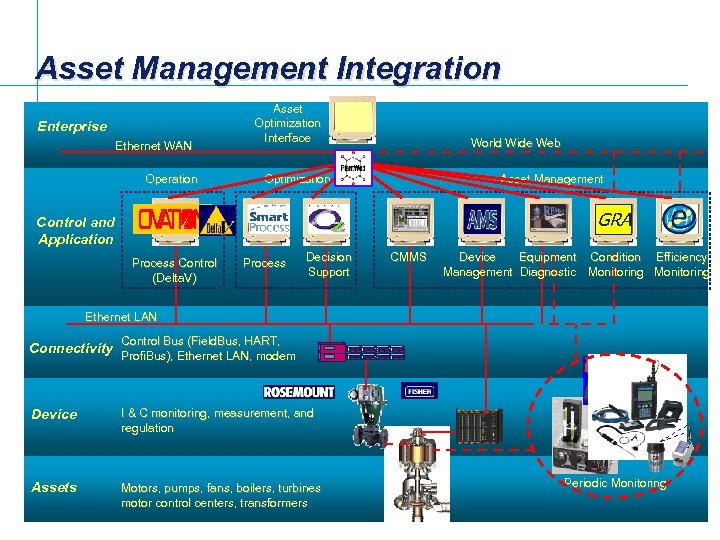
Asset Management Integration Enterprise Ethernet WAN Operation Asset Optimization Interface World Wide Web Optimization Asset Management GRA Control and Application Process Control (Delta. V) Process Decision Support CMMS Device Equipment Condition Efficiency Management Diagnostic Monitoring Ethernet LAN Control Bus (Field. Bus, HART, Connectivity Profi. Bus), Ethernet LAN, modem Device I & C monitoring, measurement, and regulation Assets Motors, pumps, fans, boilers, turbines motor control centers, transformers Periodic Monitoring
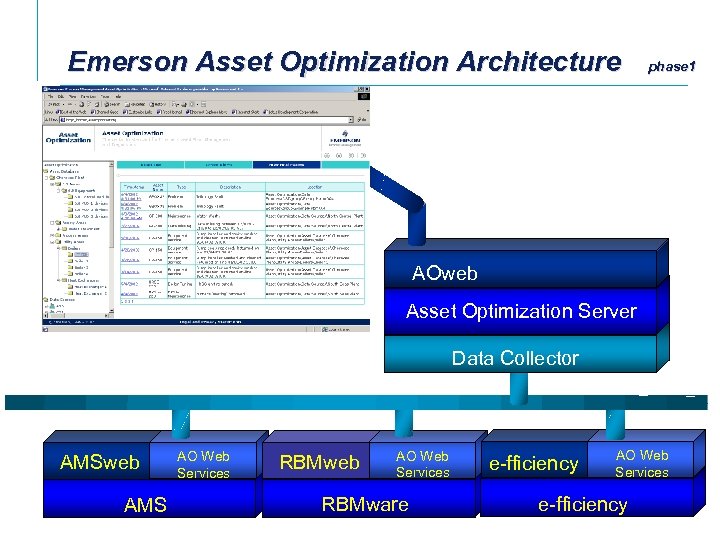
Emerson Asset Optimization Architecture phase 1 AOweb Asset Optimization Server Data Collector AMSweb AMS AO Web Services RBMweb AO Web Services RBMware e-fficiency AO Web Services e-fficiency
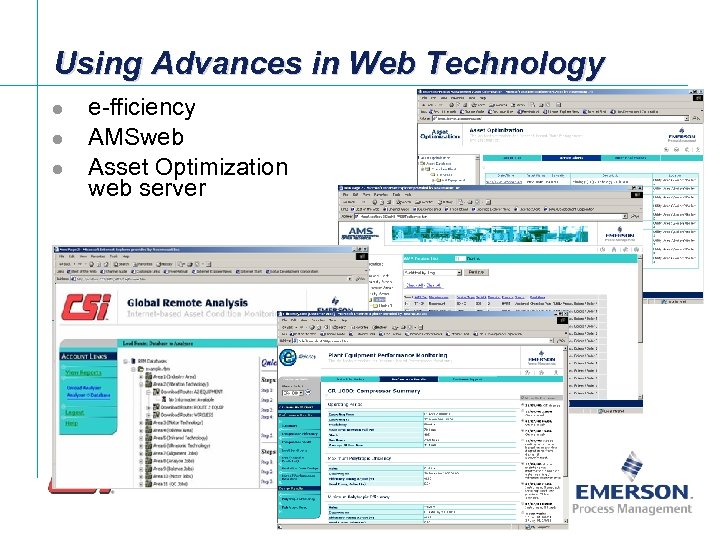
Using Advances in Web Technology l l l e-fficiency AMSweb Asset Optimization web server
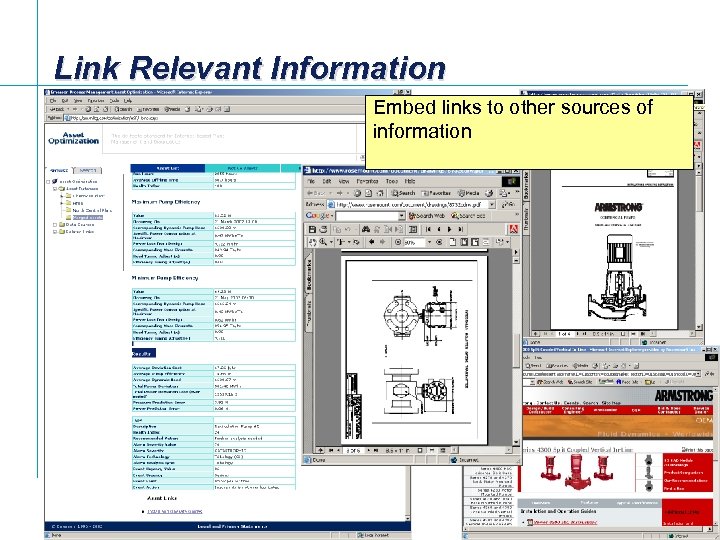
Link Relevant Information Embed links to other sources of information
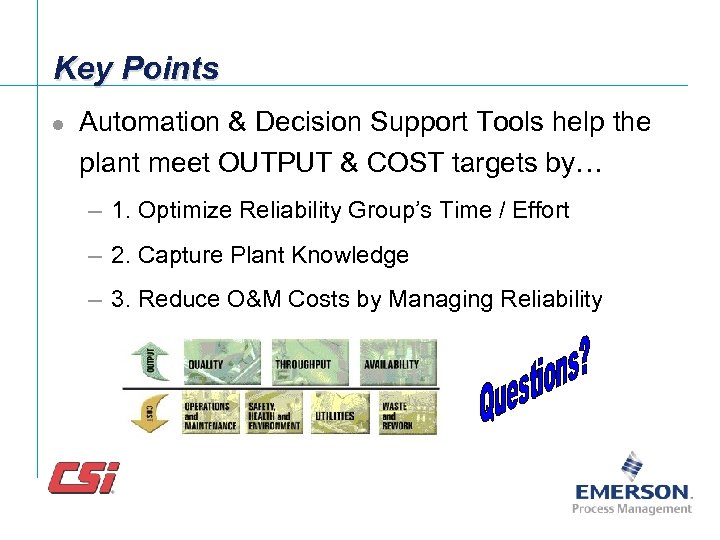
Key Points l Automation & Decision Support Tools help the plant meet OUTPUT & COST targets by… – 1. Optimize Reliability Group’s Time / Effort – 2. Capture Plant Knowledge – 3. Reduce O&M Costs by Managing Reliability
Скачать презентацию Automated Machinery Maintenance Bill Powell Tony Burnett
1fdc04be0bb456fccddaea5aea0ade71.ppt