


 Скачать презентацию Automated landform classification using DEMs Automated classification of
87fe7d2b23bd74fc71405aef07b026f2.ppt
- Количество слайдов: 44
 Automated landform classification using DEMs Automated classification of geomorphic/ hydrologic spatial entities to support predictive ecosystem mapping (PEM) R. A. (Bob) Mac. Millan Land. Mapper Environmental Solutions
 Outline n Introduction and background n Automated landform classification from DEMs n Capturing and applying expert knowledge n Significance with respect to PEM n Closing thoughts Land. Mapper Environmental Solutions © 2001 BC PEM Workshop, April 25 -27, 2001
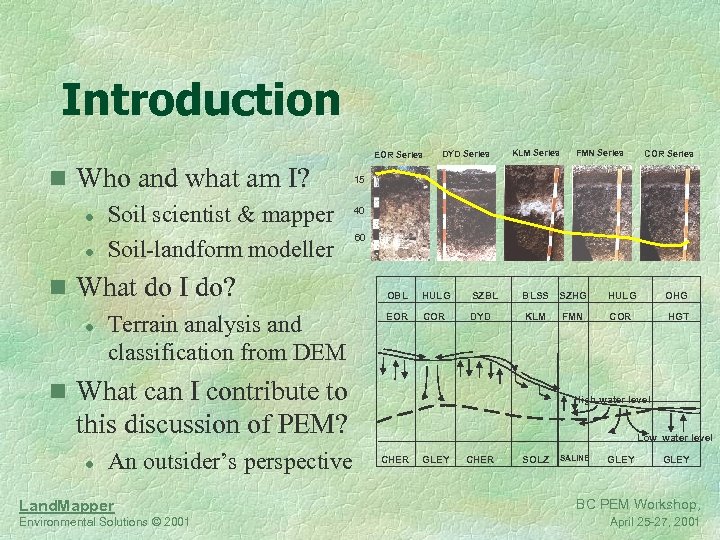 Introduction EOR Series n Who and what am I? l Soil scientist & mapper l Soil-landform modeller n What do I do? l Terrain analysis and classification from DEM DYD Series KLM Series FMN Series 15 40 60 OBL HULG SZBL BLSS SZHG HULG OHG EOR COR DYD KLM FMN COR HGT n What can I contribute to High water level this discussion of PEM? l An outsider’s perspective Land. Mapper Environmental Solutions © 2001 COR Series Low water level CHER GLEY CHER SOLZ SALINE GLEY BC PEM Workshop, April 25 -27, 2001
 Our Fundamental Assumption n J. S. Rowe (1996) l All fundamental variations in landscape ecosystems can initially (in primary succession) be attributed to variations in landforms as they modify climate Land. Mapper Environmental Solutions © 2001 BC PEM Workshop, April 25 -27, 2001
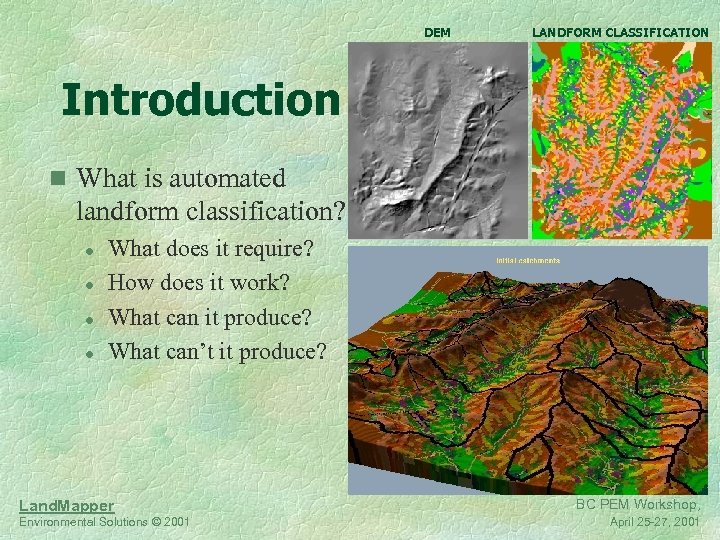 DEM LANDFORM CLASSIFICATION Introduction n What is automated landform classification? l l What does it require? How does it work? What can it produce? What can’t it produce? Land. Mapper Environmental Solutions © 2001 BC PEM Workshop, April 25 -27, 2001
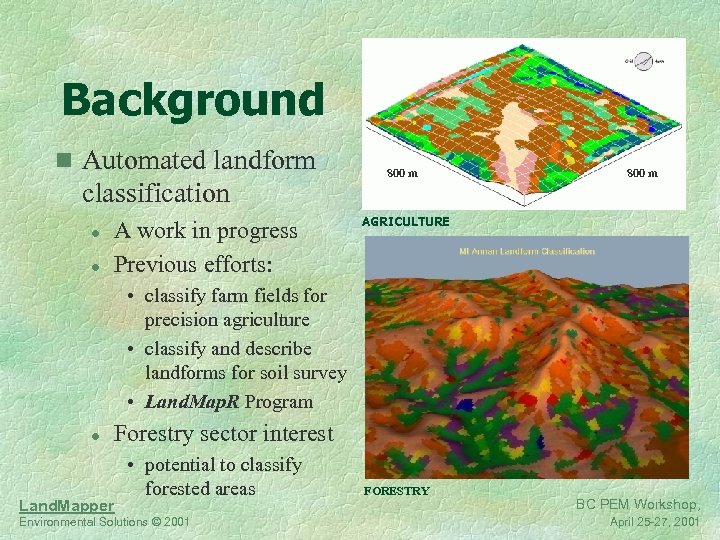 Background n Automated landform classification l l A work in progress Previous efforts: 800 m AGRICULTURE • classify farm fields for precision agriculture • classify and describe landforms for soil survey • Land. Map. R Program l Forestry sector interest Land. Mapper • potential to classify forested areas Environmental Solutions © 2001 FORESTRY BC PEM Workshop, April 25 -27, 2001
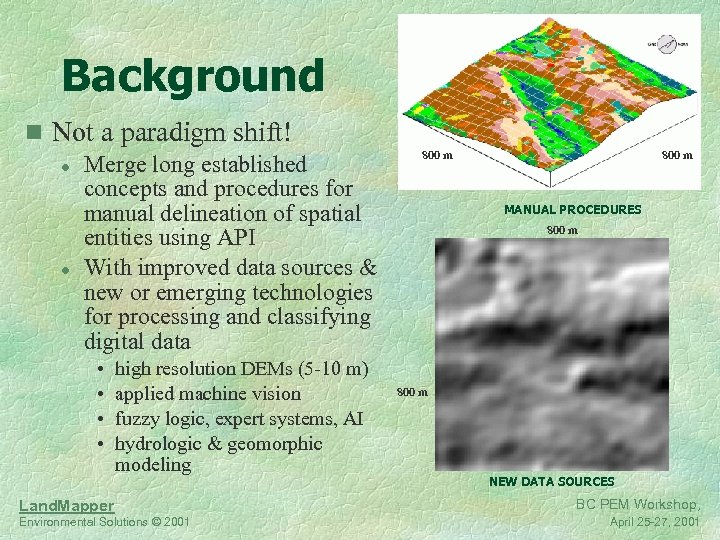 Background n Not a paradigm shift! l Merge long established concepts and procedures for manual delineation of spatial entities using API l With improved data sources & new or emerging technologies for processing and classifying digital data • • high resolution DEMs (5 -10 m) applied machine vision fuzzy logic, expert systems, AI hydrologic & geomorphic modeling Land. Mapper Environmental Solutions © 2001 800 m MANUAL PROCEDURES 800 m NEW DATA SOURCES BC PEM Workshop, April 25 -27, 2001
 Situation analysis n Increasing challenges: n Expectations for Natural Resource Inventories: l Demands for sustainability l Digital from start to finish l Expanding obligations for monitoring & certification l Provide framework for multi -scale, nested modeling of l More accurate forecasting processes n Significant changes: – Ecosystem l A new generation of classification – landscape and mapping systems – watershed l New systems must be: l Have known accuracy • more dynamic, adaptive • cheaper, faster, higher resolution • able to model processes Land. Mapper Environmental Solutions © 2001 l Support management re • policy, regulations, planning, operations BC PEM Workshop, April 25 -27, 2001
 Objective l l Devise and implement new procedures & an operational toolkit for automatically defining… A multi-level hierarchy of nested hydrologically and geomorphologically oriented spatial entities • which act as a basic structural framework for different kinds of natural resource inventories and their interpretations — soil maps, terrestrial ecosystem, wildlife habitat, forest productivity • based on physical features that are: – – distinct & readily identifiable landform entities logical entities capable of supporting management & planning able to support definition of linkages & interactions able to support nesting & aggregation within a hierarchy Land. Mapper Environmental Solutions © 2001 BC PEM Workshop, April 25 -27, 2001
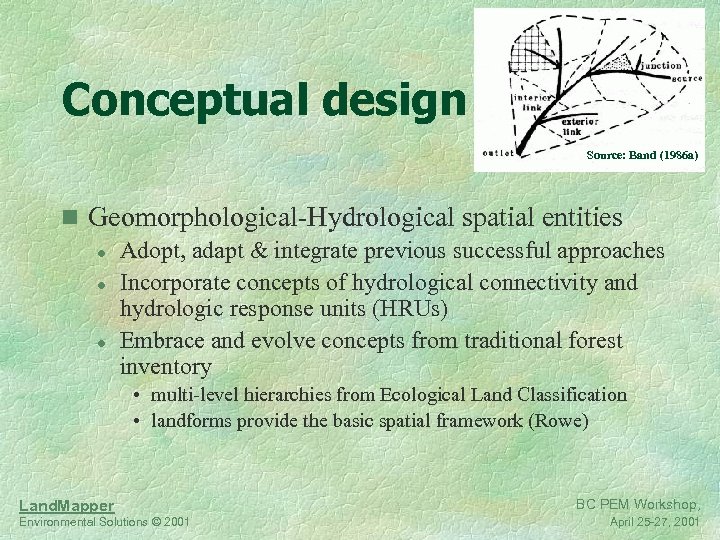 Conceptual design Source: Band (1986 a) n Geomorphological-Hydrological spatial entities l Adopt, adapt & integrate previous successful approaches l Incorporate concepts of hydrological connectivity and hydrologic response units (HRUs) l Embrace and evolve concepts from traditional forest inventory • multi-level hierarchies from Ecological Land Classification • landforms provide the basic spatial framework (Rowe) Land. Mapper Environmental Solutions © 2001 BC PEM Workshop, April 25 -27, 2001
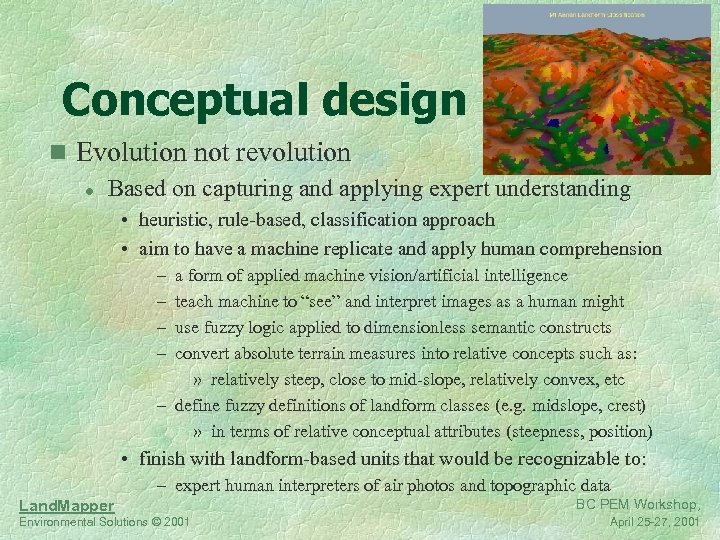 Conceptual design n Evolution not revolution l Based on capturing and applying expert understanding • heuristic, rule-based, classification approach • aim to have a machine replicate and apply human comprehension – – a form of applied machine vision/artificial intelligence teach machine to “see” and interpret images as a human might use fuzzy logic applied to dimensionless semantic constructs convert absolute terrain measures into relative concepts such as: » relatively steep, close to mid-slope, relatively convex, etc – define fuzzy definitions of landform classes (e. g. midslope, crest) » in terms of relative conceptual attributes (steepness, position) • finish with landform-based units that would be recognizable to: – expert human interpreters of air photos and topographic data Land. Mapper Environmental Solutions © 2001 BC PEM Workshop, April 25 -27, 2001
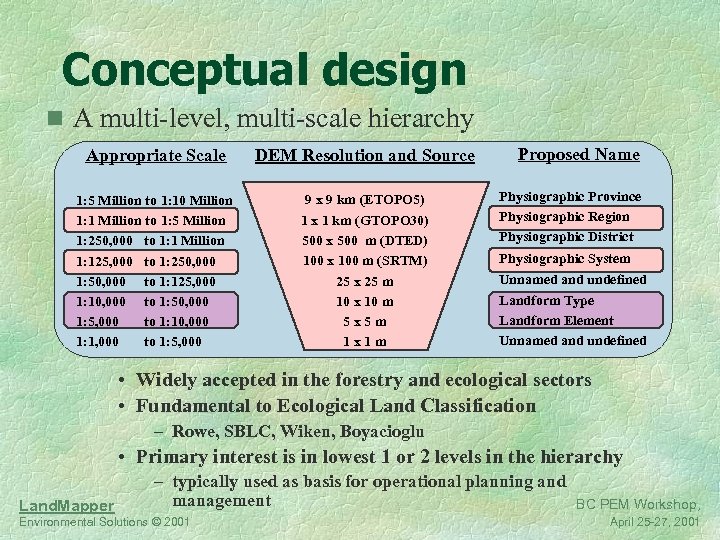 Conceptual design n A multi-level, multi-scale hierarchy Appropriate Scale DEM Resolution and Source 1: 5 Million to 1: 10 Million 1: 1 Million to 1: 5 Million 1: 250, 000 to 1: 1 Million 1: 125, 000 to 1: 250, 000 1: 50, 000 to 1: 125, 000 1: 10, 000 to 1: 50, 000 1: 5, 000 to 1: 10, 000 1: 1, 000 to 1: 5, 000 9 x 9 km (ETOPO 5) 1 x 1 km (GTOPO 30) 500 x 500 m (DTED) 100 x 100 m (SRTM) 25 x 25 m 10 x 10 m 5 x 5 m 1 x 1 m Proposed Name Physiographic Province Physiographic Region Physiographic District Physiographic System Unnamed and undefined Landform Type Landform Element Unnamed and undefined • Widely accepted in the forestry and ecological sectors • Fundamental to Ecological Land Classification – Rowe, SBLC, Wiken, Boyacioglu • Primary interest is in lowest 1 or 2 levels in the hierarchy Land. Mapper – typically used as basis for operational planning and management Environmental Solutions © 2001 BC PEM Workshop, April 25 -27, 2001
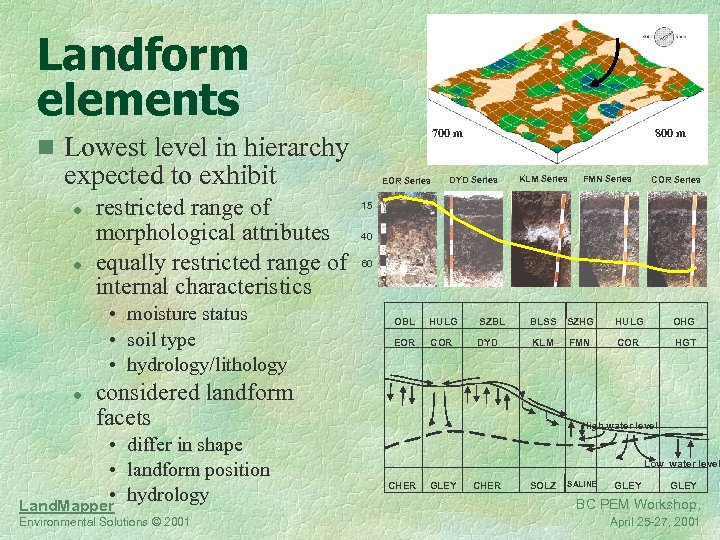 Landform elements 700 m n Lowest level in hierarchy expected to exhibit l l restricted range of morphological attributes equally restricted range of internal characteristics • moisture status • soil type • hydrology/lithology l EOR Series 800 m DYD Series KLM Series Environmental Solutions © 2001 COR Series 15 40 60 OBL HULG SZBL BLSS SZHG HULG OHG EOR COR DYD KLM FMN COR HGT considered landform facets • differ in shape • landform position • hydrology Land. Mapper FMN Series High water level Low water level CHER GLEY CHER SOLZ SALINE GLEY BC PEM Workshop, April 25 -27, 2001
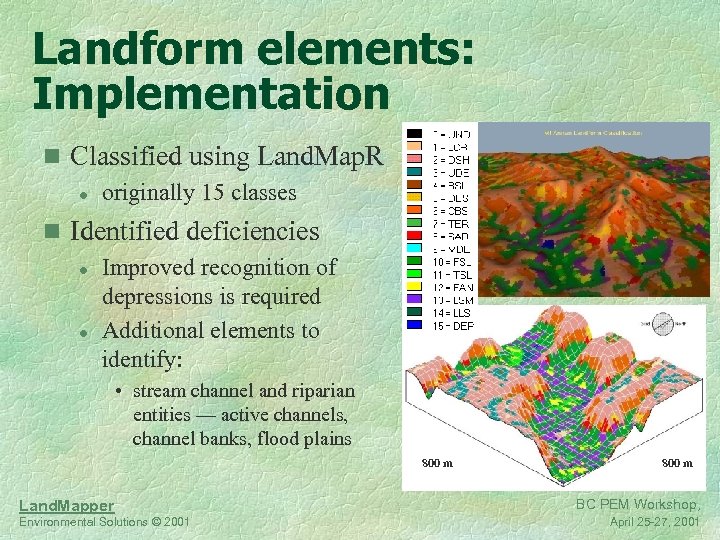 Landform elements: Implementation n Classified using Land. Map. R l originally 15 classes n Identified deficiencies l Improved recognition of depressions is required l Additional elements to identify: • stream channel and riparian entities — active channels, channel banks, flood plains 800 m Land. Mapper Environmental Solutions © 2001 800 m BC PEM Workshop, April 25 -27, 2001
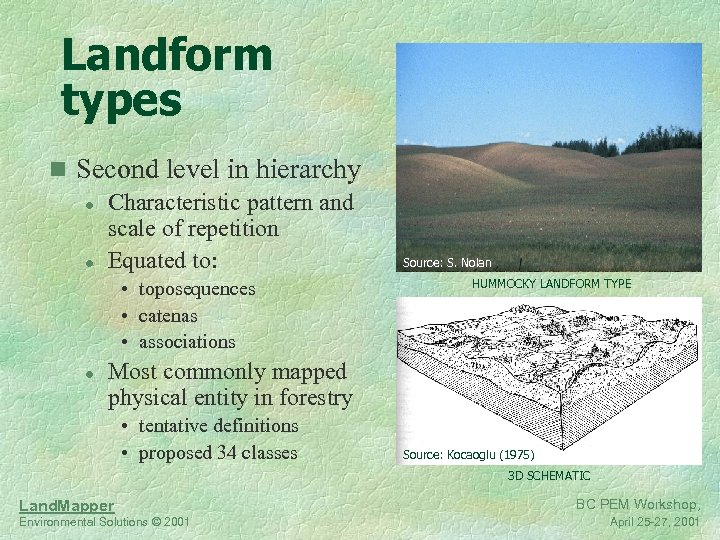 Landform types n Second level in hierarchy l Characteristic pattern and scale of repetition l Equated to: • toposequences • catenas • associations l Source: S. Nolan HUMMOCKY LANDFORM TYPE Most commonly mapped physical entity in forestry • tentative definitions • proposed 34 classes Source: Kocaoglu (1975) 3 D SCHEMATIC Land. Mapper Environmental Solutions © 2001 BC PEM Workshop, April 25 -27, 2001
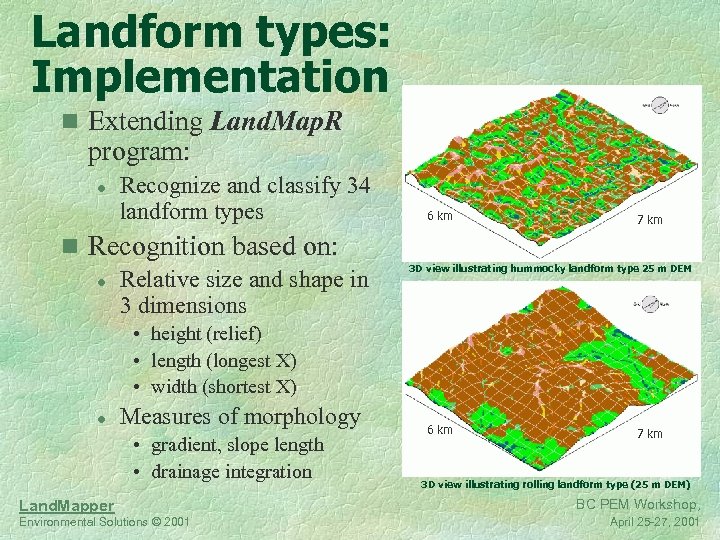 Landform types: Implementation n Extending Land. Map. R program: l Recognize and classify 34 landform types n Recognition based on: l Relative size and shape in 3 dimensions 6 km 7 km 3 D view illustrating hummocky landform type 25 m DEM • height (relief) • length (longest X) • width (shortest X) l Measures of morphology • gradient, slope length • drainage integration Land. Mapper Environmental Solutions © 2001 6 km 7 km 3 D view illustrating rolling landform type (25 m DEM) BC PEM Workshop, April 25 -27, 2001
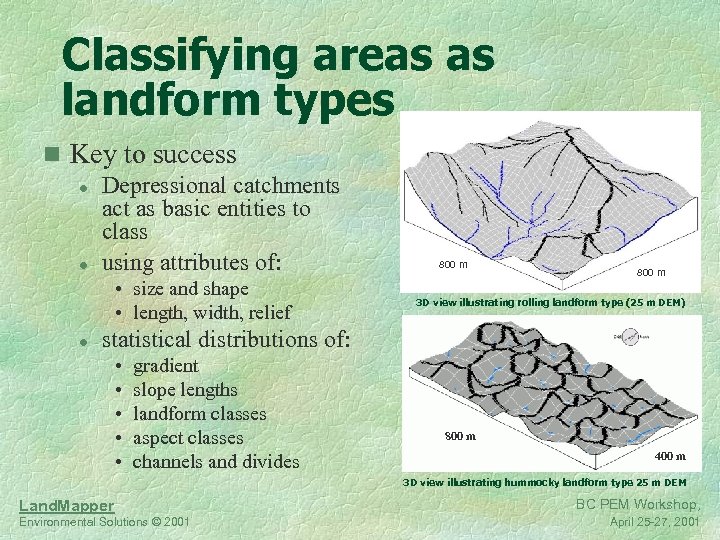 Classifying areas as landform types n Key to success l Depressional catchments act as basic entities to class l using attributes of: • size and shape • length, width, relief l 800 m 3 D view illustrating rolling landform type (25 m DEM) statistical distributions of: • • • gradient slope lengths landform classes aspect classes channels and divides 800 m 400 m 3 D view illustrating hummocky landform type 25 m DEM Land. Mapper Environmental Solutions © 2001 BC PEM Workshop, April 25 -27, 2001
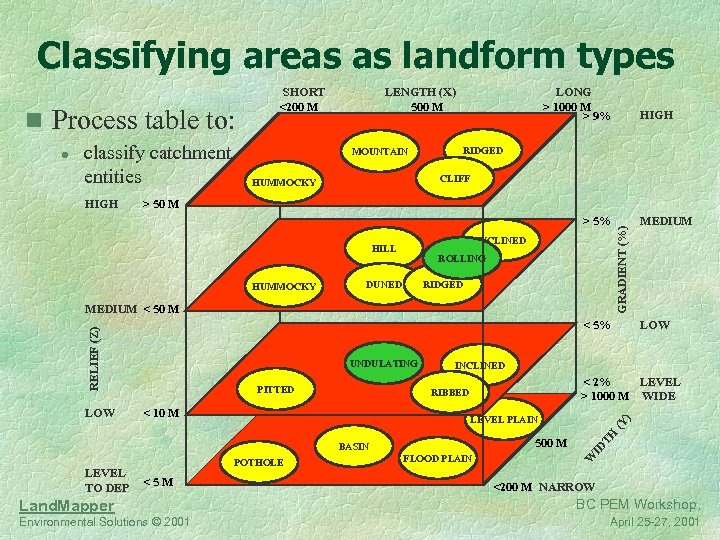 Classifying areas as landform types n Process table to: classify catchment entities HIGH LENGTH (X) 500 M LONG > 1000 M > 9% RIDGED MOUNTAIN CLIFF HUMMOCKY > 50 M > 5% INCLINED HILL HUMMOCKY ROLLING DUNED RIDGED MEDIUM < 50 M < 5% UNDULATING PITTED < 2% LEVEL > 1000 M WIDE LEVEL TO DEP <5 M Land. Mapper Environmental Solutions © 2001 FLOOD PLAIN (Y TH ID 500 M BASIN ) LEVEL PLAIN POTHOLE LOW INCLINED RIBBED < 10 M MEDIUM W RELIEF (Z) LOW HIGH GRADIENT (%) l SHORT <200 M NARROW BC PEM Workshop, April 25 -27, 2001
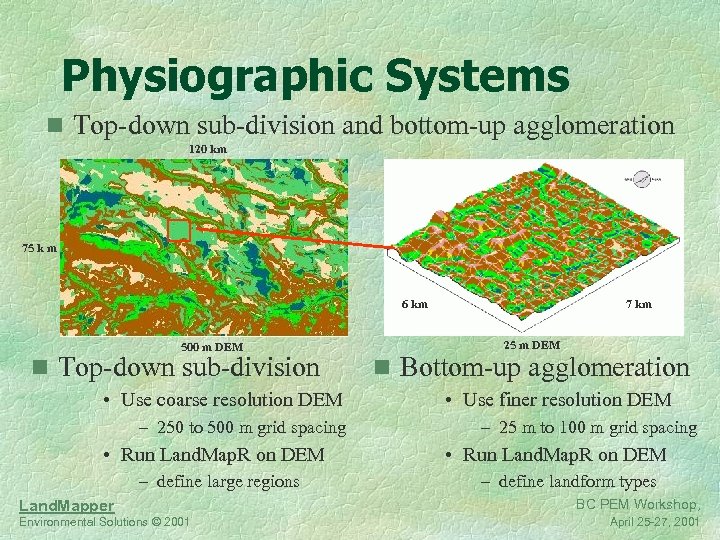 Physiographic Systems n Top-down sub-division and bottom-up agglomeration 120 km 75 k m 6 km 500 m DEM n Top-down sub-division • Use coarse resolution DEM – 250 to 500 m grid spacing • Run Land. Map. R on DEM – define large regions Land. Mapper Environmental Solutions © 2001 7 km 25 m DEM n Bottom-up agglomeration • Use finer resolution DEM – 25 m to 100 m grid spacing • Run Land. Map. R on DEM – define landform types BC PEM Workshop, April 25 -27, 2001
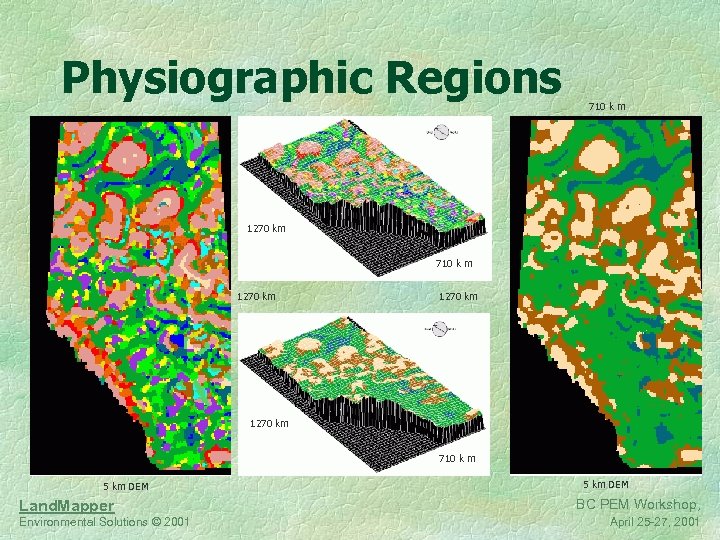 Physiographic Regions 710 k m 1270 km 710 k m 5 km DEM Land. Mapper Environmental Solutions © 2001 5 km DEM BC PEM Workshop, April 25 -27, 2001
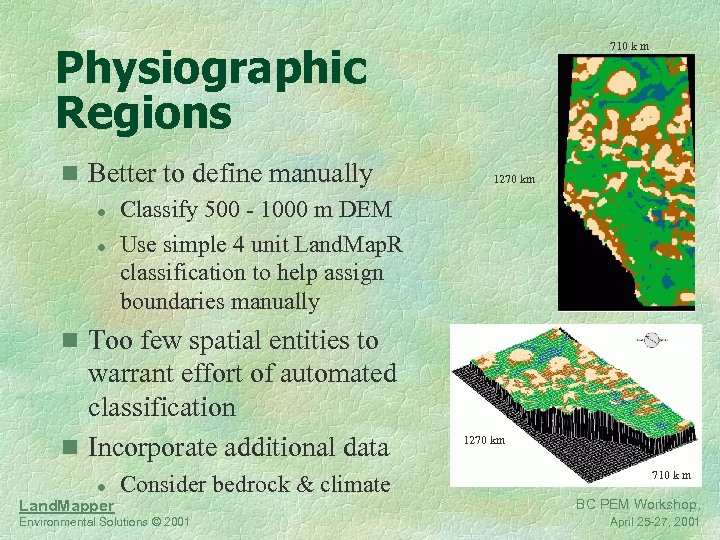 Physiographic Regions n Better to define manually l Classify 500 - 1000 m DEM l Use simple 4 unit Land. Map. R classification to help assign boundaries manually 710 k m 1270 km n Too few spatial entities to warrant effort of automated classification n Incorporate additional data l Land. Mapper Consider bedrock & climate Environmental Solutions © 2001 1270 km 710 k m BC PEM Workshop, April 25 -27, 2001
 Some useful technical details n Role of hydrological topology l l Define cells to cell flow paths n Intelligent pit removal Define channels, divides, l Establish sequence of hillslopes, patches n Significance of depressions l l n Pit characteristics l Location, extent, depth l Overspill locations Real landscape features Need to quantify Land. Mapper Environmental Solutions © 2001 • Overspill and connection l Compute and record • Full depressional topology • How, when and where pits fill, overspill & connect BC PEM Workshop, April 25 -27, 2001
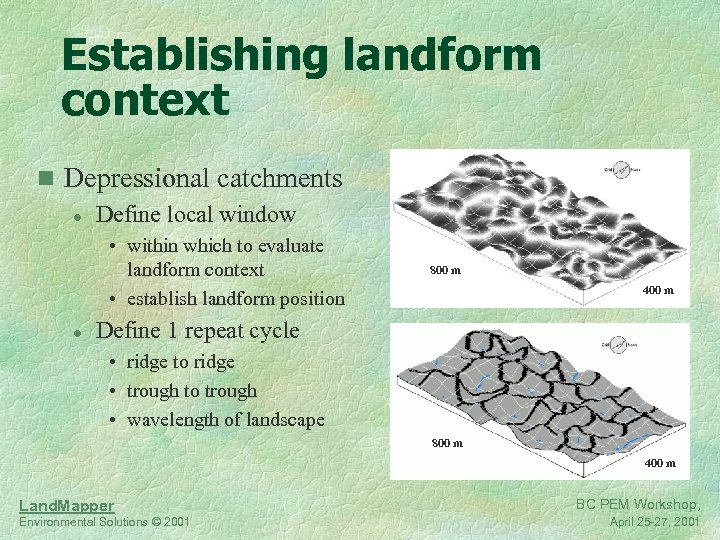 Establishing landform context n Depressional catchments l Define local window • within which to evaluate landform context • establish landform position l 800 m 400 m Define 1 repeat cycle • ridge to ridge • trough to trough • wavelength of landscape 800 m 400 m Land. Mapper Environmental Solutions © 2001 BC PEM Workshop, April 25 -27, 2001
 Hydrological response units (HRUs) n Establish interactions & flows n Importance of HRUs in establishing connectivity: l Feature that is lacking in solely l From cell to cell geomorphic classifications l From upper to mid to lower l Essential for modeling slope entities within subecological and hydrological catchments processes — flows of energy, l From sub-catchment hillslope entities to channel matter, water; in response to segments gravitational gradients l From channel segment to l Important framework for channel segment nesting and agglomeration, l From catchment to rolling spatial entities up catchment Land. Mapper Environmental Solutions © 2001 BC PEM Workshop, April 25 -27, 2001
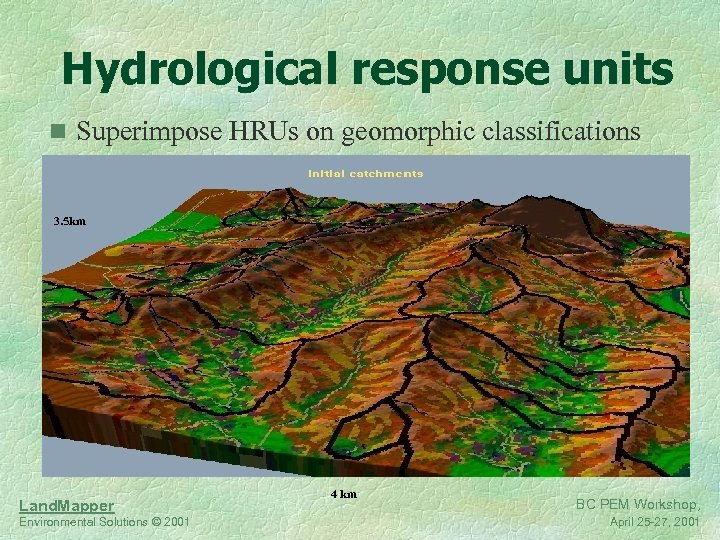 Hydrological response units n Superimpose HRUs on geomorphic classifications 3. 5 km Land. Mapper Environmental Solutions © 2001 4 km BC PEM Workshop, April 25 -27, 2001
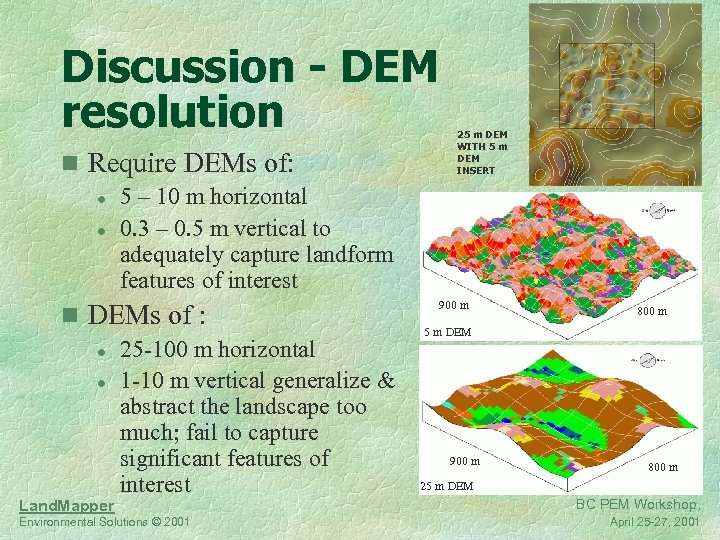 Discussion - DEM resolution n Require DEMs of: l 5 – 10 m horizontal l 0. 3 – 0. 5 m vertical to adequately capture landform features of interest n DEMs of : l 25 -100 m horizontal l 1 -10 m vertical generalize & abstract the landscape too much; fail to capture significant features of interest Land. Mapper Environmental Solutions © 2001 25 m DEM WITH 5 m DEM INSERT 900 m 800 m 5 m DEM 900 m 800 m 25 m DEM BC PEM Workshop, April 25 -27, 2001
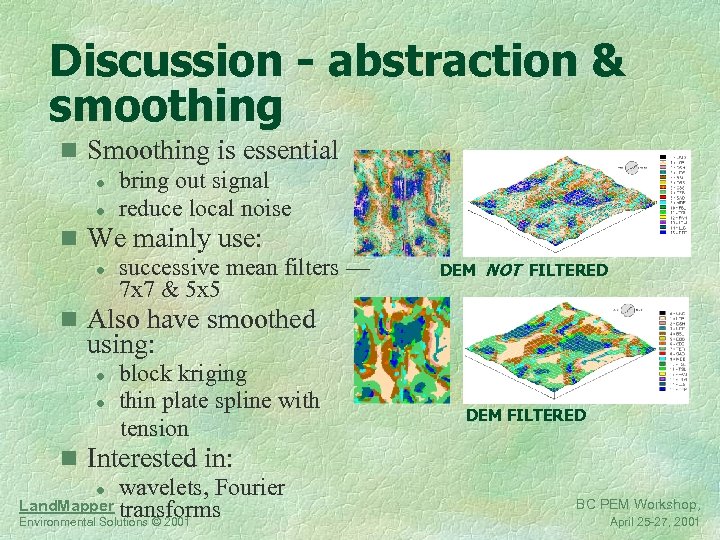 Discussion - abstraction & smoothing n Smoothing is essential l bring out signal l reduce local noise n We mainly use: l successive mean filters — 7 x 7 & 5 x 5 n Also have smoothed DEM NOT FILTERED using: l l block kriging thin plate spline with tension n Interested in: l wavelets, Fourier Land. Mapper transforms Environmental Solutions © 2001 DEM FILTERED BC PEM Workshop, April 25 -27, 2001
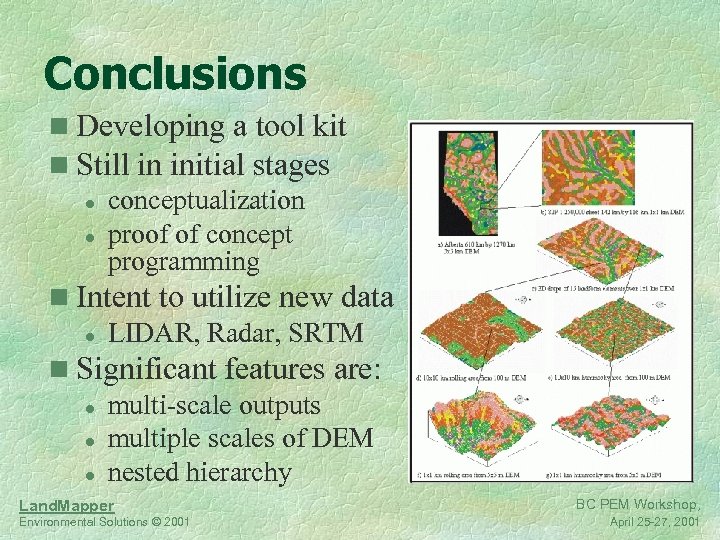 Conclusions n Developing a tool kit n Still in initial stages l conceptualization l proof of concept programming n Intent to utilize new data l LIDAR, Radar, SRTM n Significant features are: l multi-scale outputs l multiple scales of DEM l nested hierarchy Land. Mapper Environmental Solutions © 2001 BC PEM Workshop, April 25 -27, 2001
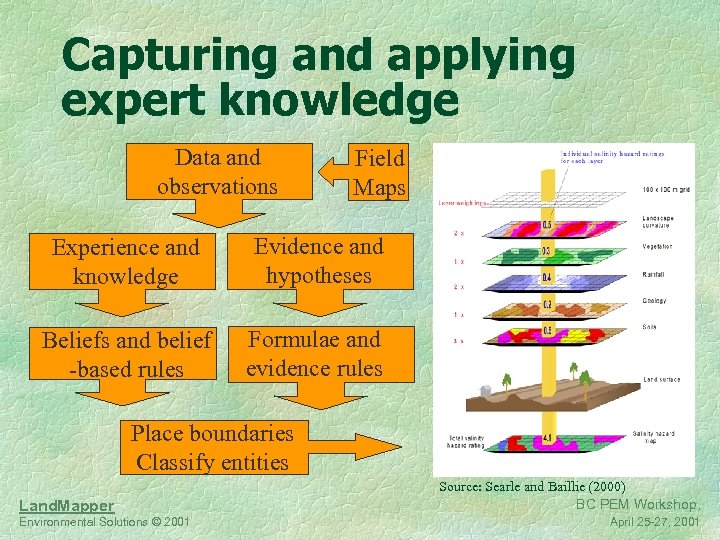 Capturing and applying expert knowledge Data and observations Field Maps Experience and knowledge Evidence and hypotheses Beliefs and belief -based rules Formulae and evidence rules Place boundaries Classify entities Land. Mapper Environmental Solutions © 2001 Source: Searle and Baillie (2000) BC PEM Workshop, April 25 -27, 2001
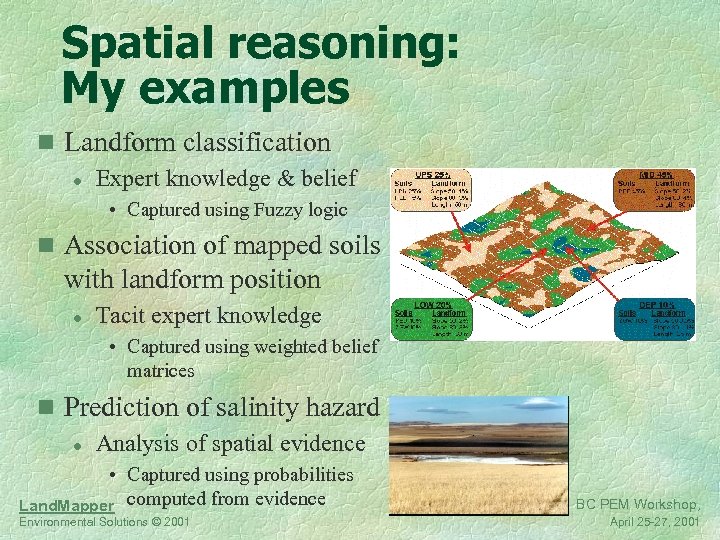 Spatial reasoning: My examples n Landform classification l Expert knowledge & belief • Captured using Fuzzy logic n Association of mapped soils with landform position l Tacit expert knowledge • Captured using weighted belief matrices n Prediction of salinity hazard l Analysis of spatial evidence • Captured using probabilities Land. Mapper computed from evidence Environmental Solutions © 2001 BC PEM Workshop, April 25 -27, 2001
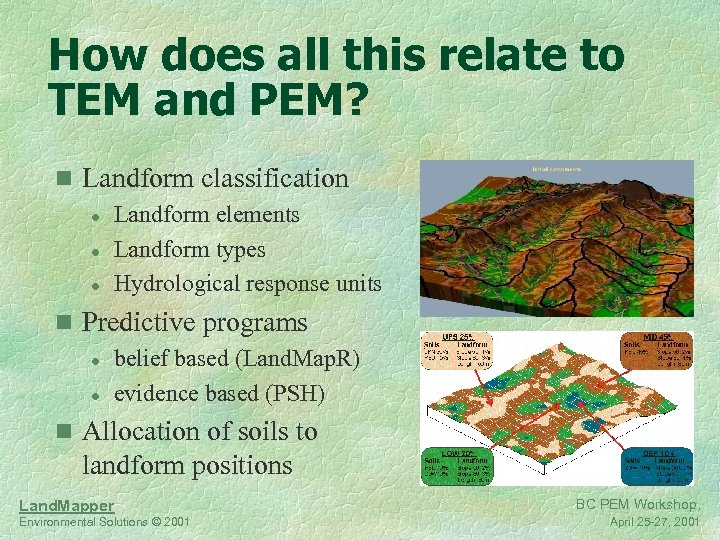 How does all this relate to TEM and PEM? n Landform classification l Landform elements l Landform types l Hydrological response units n Predictive programs l belief based (Land. Map. R) l evidence based (PSH) n Allocation of soils to landform positions Land. Mapper Environmental Solutions © 2001 BC PEM Workshop, April 25 -27, 2001
 Relevance of landform elements to PEM n TEM and PEM utilize l Terrain, Topography, Landscape, Soils n Automated landform classification could: l n Rowe (1996) suggested: l Combining terrain and topographic components into a single coverage • With coincident boundaries • Comprehensive descriptions of texture, drainage, depth, mineralogy, slope attributes Land. Mapper Environmental Solutions © 2001 Define combined terraintopographic units with: • A single set of boundaries • Comprehensive descriptions of attributes l Capture a consistent set of automated rules for: • Delineating boundaries • Describing areas BC PEM Workshop, April 25 -27, 2001
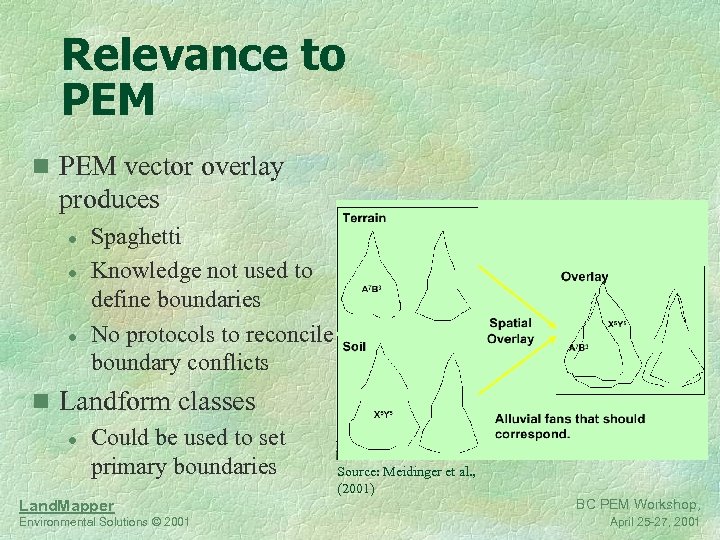 Relevance to PEM n PEM vector overlay produces l l l Spaghetti Knowledge not used to define boundaries No protocols to reconcile boundary conflicts n Landform classes l Could be used to set primary boundaries Land. Mapper Environmental Solutions © 2001 Source: Meidinger et al. , (2001) BC PEM Workshop, April 25 -27, 2001
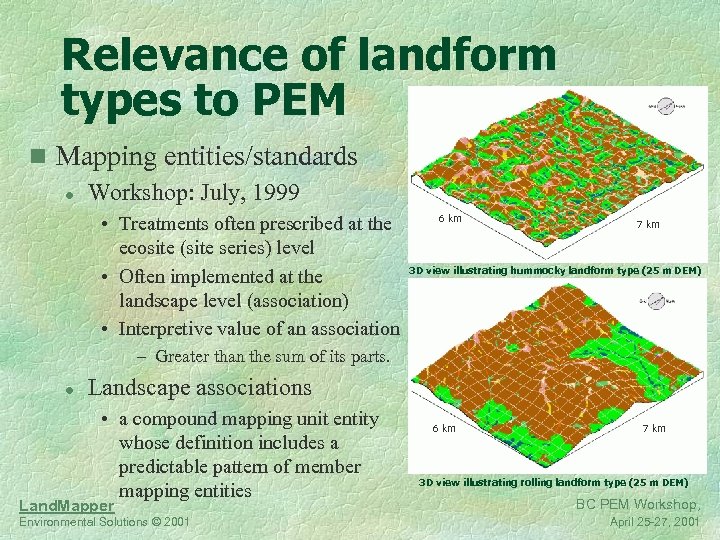 Relevance of landform types to PEM n Mapping entities/standards l Workshop: July, 1999 • Treatments often prescribed at the ecosite (site series) level • Often implemented at the landscape level (association) • Interpretive value of an association 6 km 7 km 3 D view illustrating hummocky landform type (25 m DEM) – Greater than the sum of its parts. l Landscape associations • a compound mapping unit entity whose definition includes a predictable pattern of member mapping entities Land. Mapper Environmental Solutions © 2001 6 km 7 km 3 D view illustrating rolling landform type (25 m DEM) BC PEM Workshop, April 25 -27, 2001
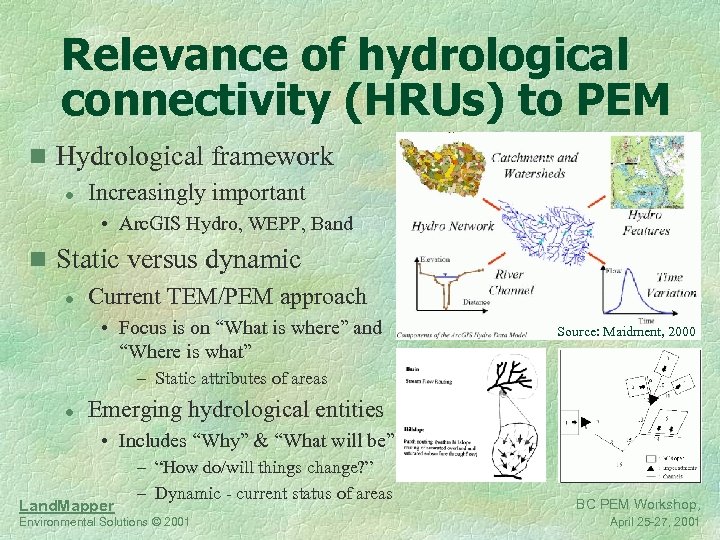 Relevance of hydrological connectivity (HRUs) to PEM n Hydrological framework l Increasingly important • Arc. GIS Hydro, WEPP, Band n Static versus dynamic l Current TEM/PEM approach • Focus is on “What is where” and “Where is what” Source: Maidment, 2000 – Static attributes of areas l Emerging hydrological entities • Includes “Why” & “What will be” Land. Mapper – “How do/will things change? ” – Dynamic - current status of areas Environmental Solutions © 2001 BC PEM Workshop, April 25 -27, 2001
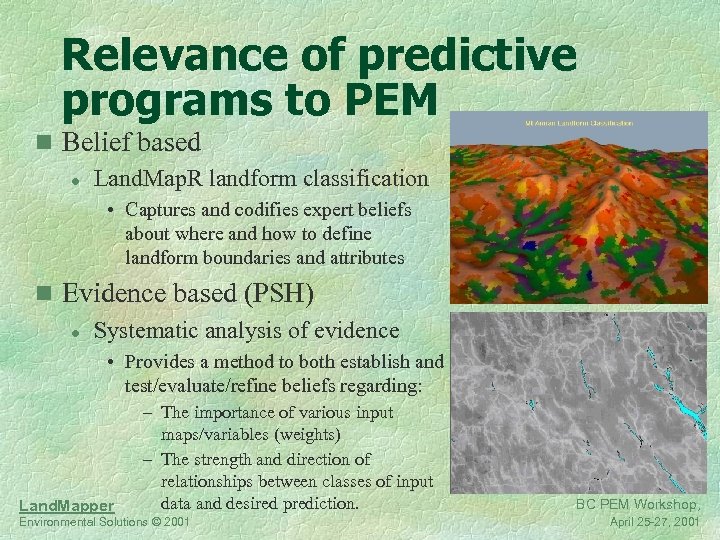 Relevance of predictive programs to PEM n Belief based l Land. Map. R landform classification • Captures and codifies expert beliefs about where and how to define landform boundaries and attributes n Evidence based (PSH) l Systematic analysis of evidence • Provides a method to both establish and test/evaluate/refine beliefs regarding: Land. Mapper – The importance of various input maps/variables (weights) – The strength and direction of relationships between classes of input data and desired prediction. Environmental Solutions © 2001 BC PEM Workshop, April 25 -27, 2001
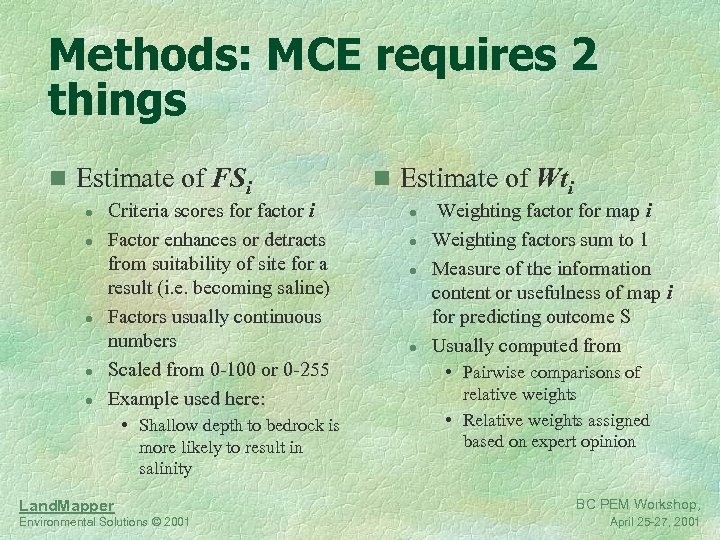 Methods: MCE requires 2 things n Estimate of FSi l l l Criteria scores for factor i Factor enhances or detracts from suitability of site for a result (i. e. becoming saline) Factors usually continuous numbers Scaled from 0 -100 or 0 -255 Example used here: • Shallow depth to bedrock is more likely to result in salinity Land. Mapper Environmental Solutions © 2001 n Estimate of Wti l l Weighting factor for map i Weighting factors sum to 1 Measure of the information content or usefulness of map i for predicting outcome S Usually computed from • Pairwise comparisons of relative weights • Relative weights assigned based on expert opinion BC PEM Workshop, April 25 -27, 2001
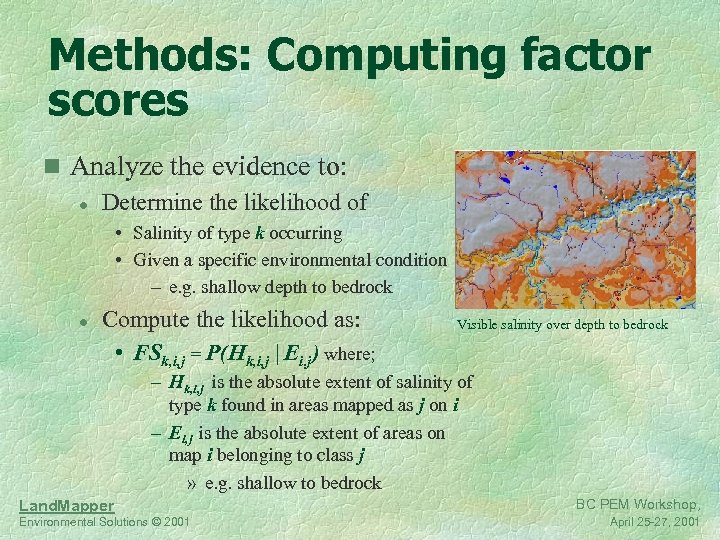 Methods: Computing factor scores n Analyze the evidence to: l Determine the likelihood of • Salinity of type k occurring • Given a specific environmental condition – e. g. shallow depth to bedrock l Compute the likelihood as: • FSk, i, j = P(Hk, i, j | Ei. j) where; Visible salinity over depth to bedrock – Hk, i, j is the absolute extent of salinity of type k found in areas mapped as j on i – Ei, j is the absolute extent of areas on map i belonging to class j » e. g. shallow to bedrock Land. Mapper Environmental Solutions © 2001 BC PEM Workshop, April 25 -27, 2001
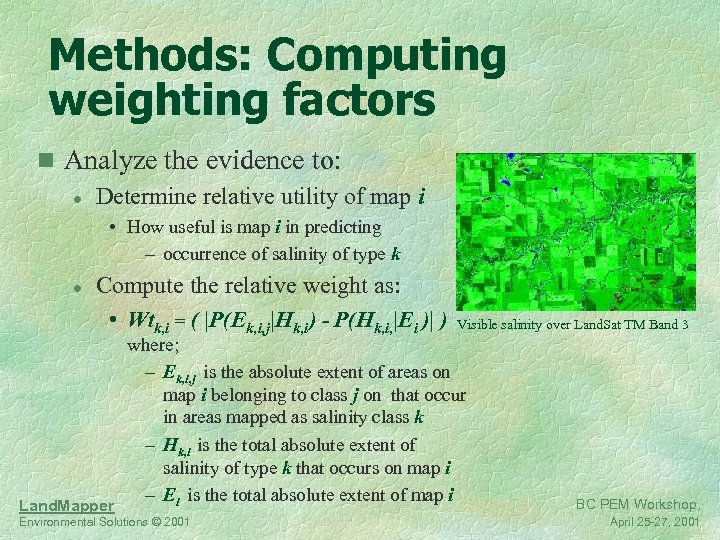 Methods: Computing weighting factors n Analyze the evidence to: l Determine relative utility of map i • How useful is map i in predicting – occurrence of salinity of type k l Compute the relative weight as: • Wtk, i = ( |P(Ek, i, j|Hk, i) - P(Hk, i, |Ei )| ) Land. Mapper Visible salinity over Land. Sat TM Band 3 where; – Ek, i, j is the absolute extent of areas on map i belonging to class j on that occur in areas mapped as salinity class k – Hk, i is the total absolute extent of salinity of type k that occurs on map i – Ei is the total absolute extent of map i Environmental Solutions © 2001 BC PEM Workshop, April 25 -27, 2001
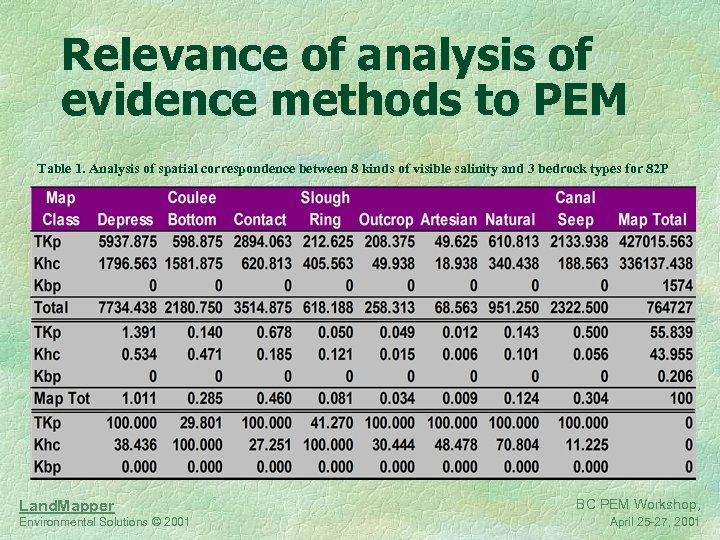 Relevance of analysis of evidence methods to PEM Table 1. Analysis of spatial correspondence between 8 kinds of visible salinity and 3 bedrock types for 82 P Land. Mapper Environmental Solutions © 2001 BC PEM Workshop, April 25 -27, 2001
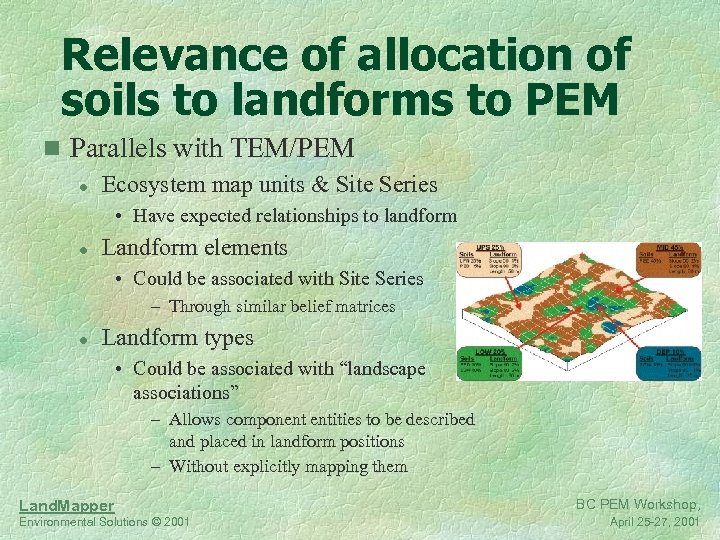 Relevance of allocation of soils to landforms to PEM n Parallels with TEM/PEM l Ecosystem map units & Site Series • Have expected relationships to landform l Landform elements • Could be associated with Site Series – Through similar belief matrices l Landform types • Could be associated with “landscape associations” – Allows component entities to be described and placed in landform positions – Without explicitly mapping them Land. Mapper Environmental Solutions © 2001 BC PEM Workshop, April 25 -27, 2001
 Relevance of predictive programs to PEM n Similarity & convergence n Multi-purpose Predictive Calculator (MPC or UPC) l Predicted output (class) l Both possible & desirable l Usually a function (F) of expert belief or quantitative l Many different processing evidence about: options & possible outputs • Importance of input variable in predicting output class (Weight) • Strength and direction of relationship between input variable value and each output class to be predicted Land. Mapper Environmental Solutions © 2001 • Many different options for implementing calculations – Weighted means, Fuzzy JMF, Boolean, Bayesian, Cross products • Many possible combinations of inputs & outputs BC PEM Workshop, April 25 -27, 2001
 Some closing thoughts n J. S. Rowe (1996) l Thus, landforms, with their vegetation, modify and shape their coincident climates over all scales l All fundamental variations in landscape ecosystems can initially (in primary succession) be attributed to variations in landforms as they modify climate l Boundaries between potential ecosystems can be mapped to coincide with changes in those landform characteristics known to regulate the reception and retention of energy and water Land. Mapper Environmental Solutions © 2001 BC PEM Workshop, April 25 -27, 2001
 Thank you! Land. Mapper Environmental Solutions © 2001 BC PEM Workshop, April 25 -27, 2001