


 Скачать презентацию Automated Intruder Tracking using Particle Filtering and a
66bbf37af58e3e48a96f674abf53823a.ppt
- Количество слайдов: 47
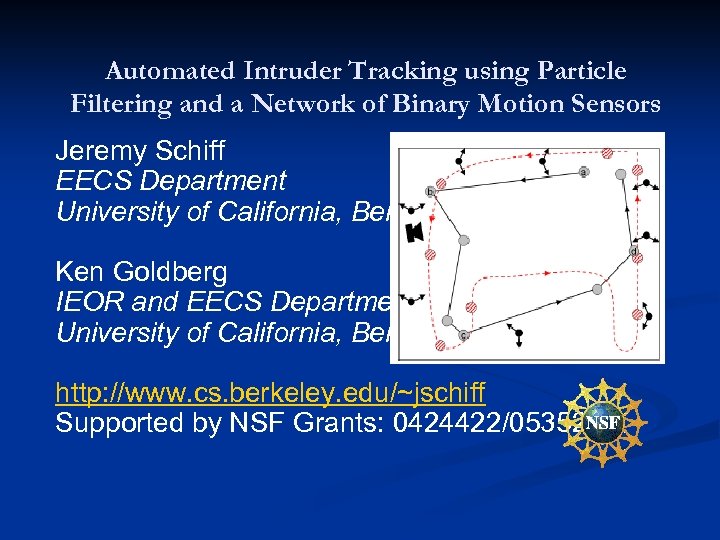 Automated Intruder Tracking using Particle Filtering and a Network of Binary Motion Sensors Jeremy Schiff EECS Department University of California, Berkeley Ken Goldberg IEOR and EECS Departments University of California, Berkeley http: //www. cs. berkeley. edu/~jschiff Supported by NSF Grants: 0424422/0535218
 Outline n n n Introduction Related Work Problem Formulation n Results n n n Setup and Assumptions Particle Filtering Simulation Experimental Conclusion/Future Work
 Motivation n New class of technologies due to 9/11 n n Automated Security Wireless Sensor Networks n n Robotic Webcams n n n X 10 PIR sensors - $25 Pan, Tilt, Zoom 500 Mpixels/Steradian Increased computer processing speeds n Enables Realtime Applications
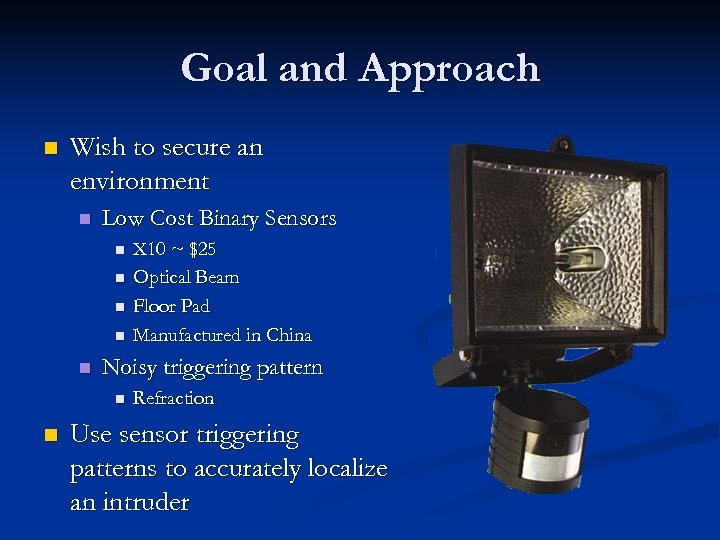 Goal and Approach n Wish to secure an environment n Low Cost Binary Sensors n n n Noisy triggering pattern n n X 10 ~ $25 Optical Beam Floor Pad Manufactured in China Refraction Use sensor triggering patterns to accurately localize an intruder
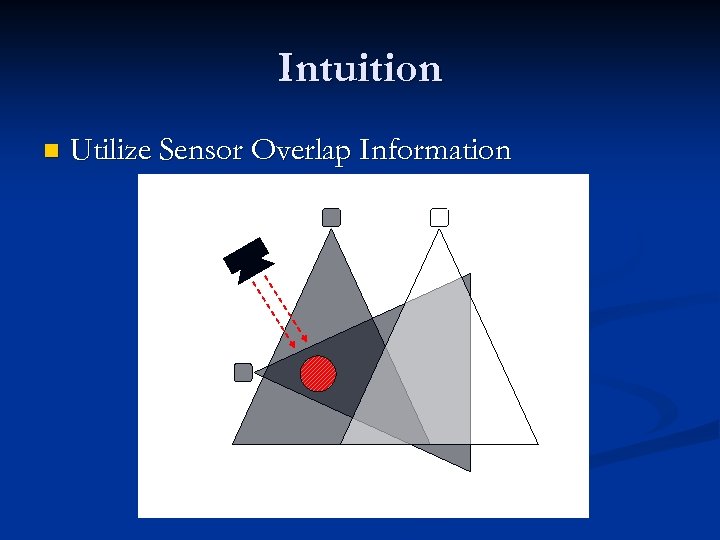 Intuition n Utilize Sensor Overlap Information
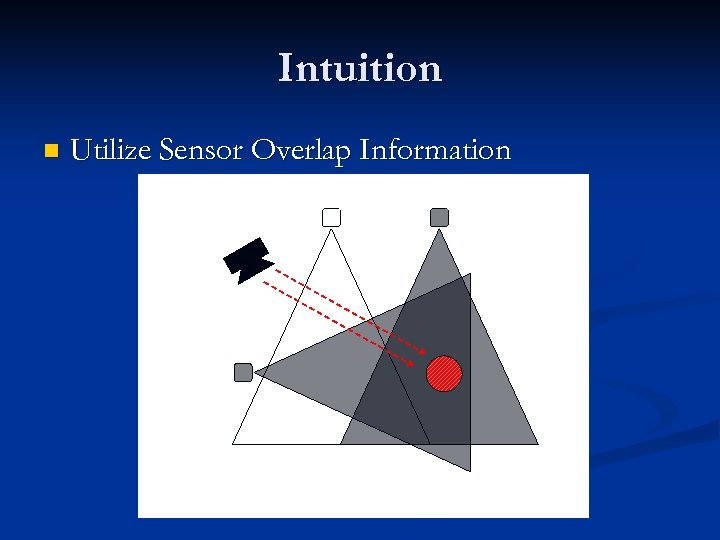 Intuition n Utilize Sensor Overlap Information
 Outline n n n Introduction Related Work Problem Formulation n Experiments n n n Setup and Assumptions Particle Filtering Simulation Real-world Conclusion/Future Work
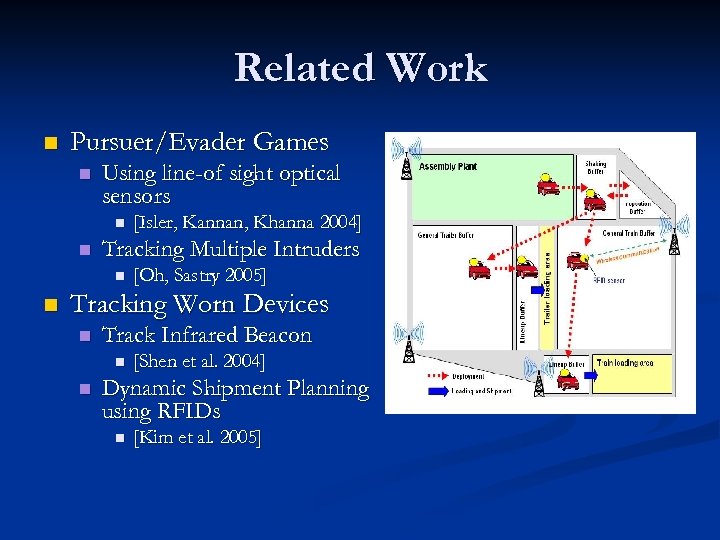 Related Work n Pursuer/Evader Games n Using line-of sight optical sensors n n Tracking Multiple Intruders n n [Isler, Kannan, Khanna 2004] [Oh, Sastry 2005] Tracking Worn Devices n Track Infrared Beacon n n [Shen et al. 2004] Dynamic Shipment Planning using RFIDs n [Kim et al. 2005]
![Related Work II n Video Tracking Systems n n [Micilotta and Bowden 2004] Multiple](https://present5.com/presentation/66bbf37af58e3e48a96f674abf53823a/image-9.jpg "Related Work II n Video Tracking Systems n n [Micilotta and Bowden 2004] Multiple") Related Work II n Video Tracking Systems n n [Micilotta and Bowden 2004] Multiple Classes of Sensors n Multiple exclusive modes n n Fuse data of multiple sensor types n n [Cochran, Sinno, Clausen 1999] [Jeffery et al. 2005] Virtual Devices Automated Camera Control n [Song et al. 2005] Physical Devices
Related Work II n Video Tracking Systems n n [Micilotta and Bowden 2004] Multiple Classes of Sensors n Multiple exclusive modes n n Fuse data of multiple sensor types n n [Cochran, Sinno, Clausen 1999] [Jeffery et al. 2005] Virtual Devices Automated Camera Control n [Song et al. 2005] Physical Devices
![Related Work III n Probabilistic Tracking Approaches n Kalman Filtering n [Kalman 1960] n](https://present5.com/presentation/66bbf37af58e3e48a96f674abf53823a/image-10.jpg "Related Work III n Probabilistic Tracking Approaches n Kalman Filtering n [Kalman 1960] n") Related Work III n Probabilistic Tracking Approaches n Kalman Filtering n [Kalman 1960] n Extended Kalman Filtering n [Lefebvre, Bruyninckx, De Schutter 2004] n Particle Filtering n Book: [Thrun, Burgard, Fox 2005] n [Arulampalam et al. 2002]
Related Work III n Probabilistic Tracking Approaches n Kalman Filtering n [Kalman 1960] n Extended Kalman Filtering n [Lefebvre, Bruyninckx, De Schutter 2004] n Particle Filtering n Book: [Thrun, Burgard, Fox 2005] n [Arulampalam et al. 2002]
![Related Work IV n Multiple humans controlling a camera [Song and Goldberg 2003] n](https://present5.com/presentation/66bbf37af58e3e48a96f674abf53823a/image-11.jpg "Related Work IV n Multiple humans controlling a camera [Song and Goldberg 2003] n") Related Work IV n Multiple humans controlling a camera [Song and Goldberg 2003] n [Song, Goldberg and Pashkevich 2003] n n Panorama Generation n n [Song et al. 2005] Art Gallery Problem [Shermer 1990] n [Urrutia 2000] n
Related Work IV n Multiple humans controlling a camera [Song and Goldberg 2003] n [Song, Goldberg and Pashkevich 2003] n n Panorama Generation n n [Song et al. 2005] Art Gallery Problem [Shermer 1990] n [Urrutia 2000] n
 Outline n n n Introduction Related Work Problem Formulation n Experiments n n n Setup and Assumptions Particle Filtering Simulation Real-world Conclusion/Future Work
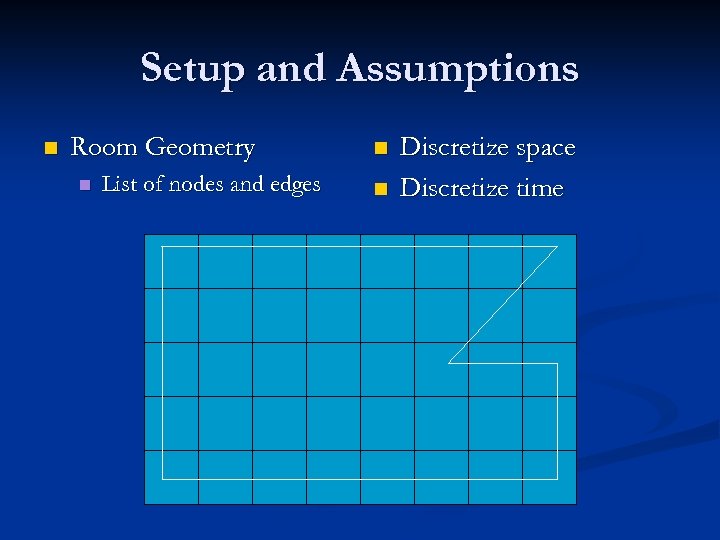 Setup and Assumptions n Room Geometry n List of nodes and edges n n Discretize space Discretize time
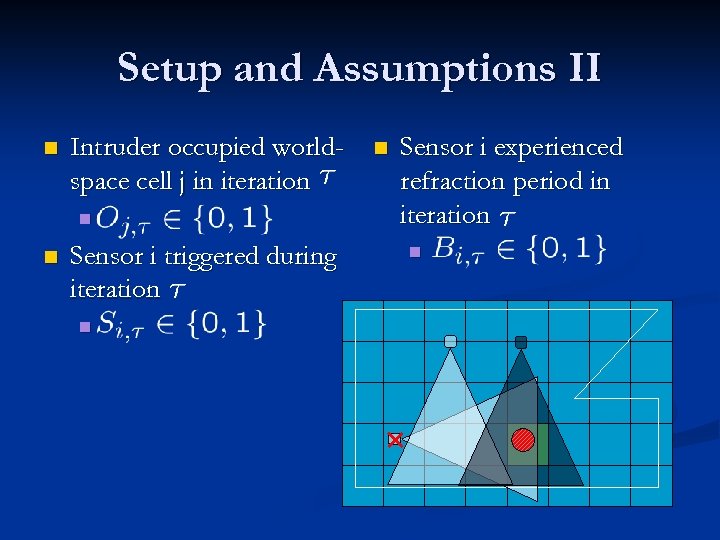 Setup and Assumptions II n Intruder occupied worldspace cell j in iteration n n Sensor i triggered during iteration n n Sensor i experienced refraction period in iteration n
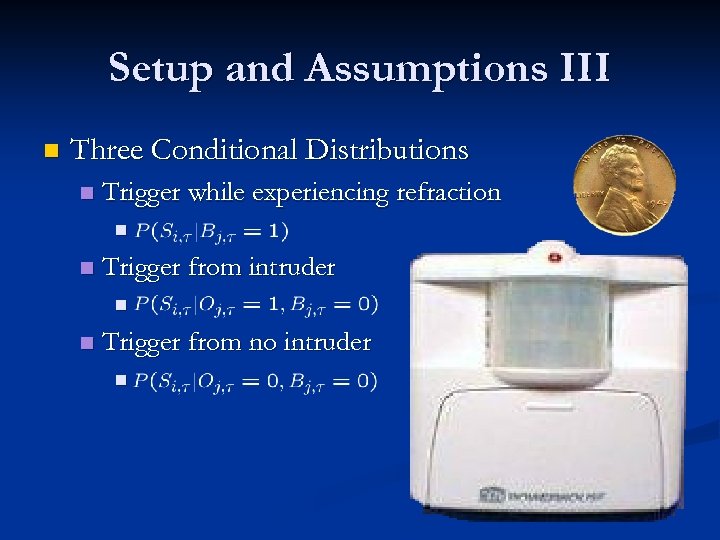 Setup and Assumptions III n Three Conditional Distributions n Trigger while experiencing refraction n n Trigger from intruder n n Trigger from no intruder n
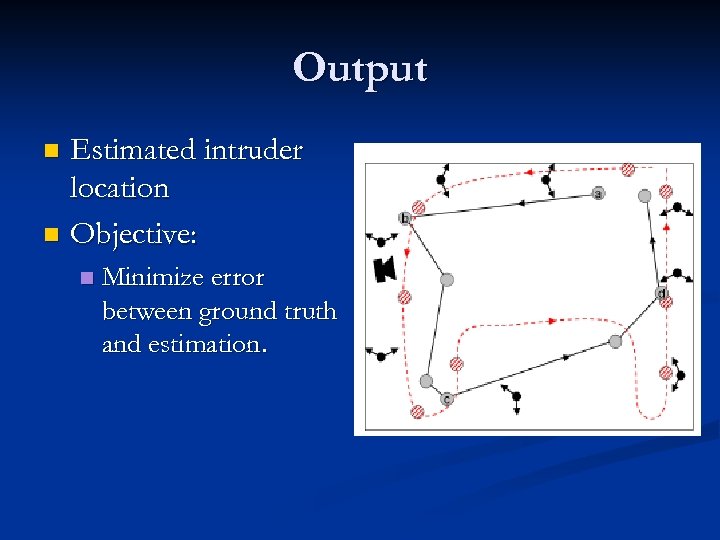 Output Estimated intruder location n Objective: n n Minimize error between ground truth and estimation.
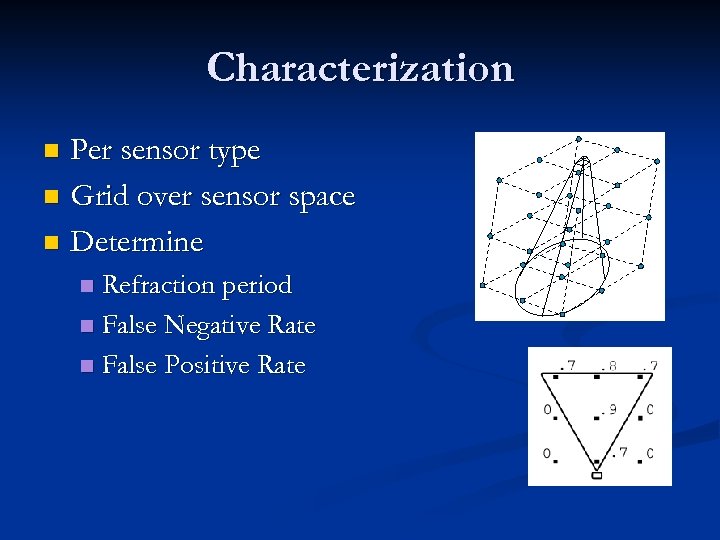 Characterization Per sensor type n Grid over sensor space n Determine n Refraction period n False Negative Rate n False Positive Rate n
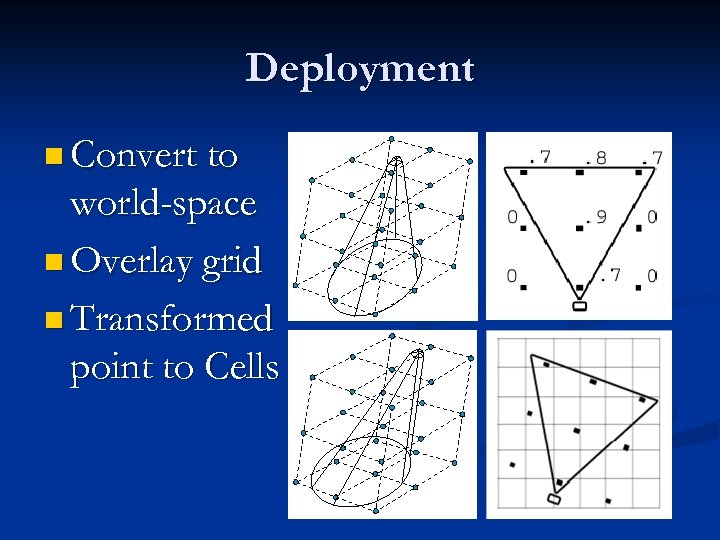 Deployment n Convert to world-space n Overlay grid n Transformed point to Cells
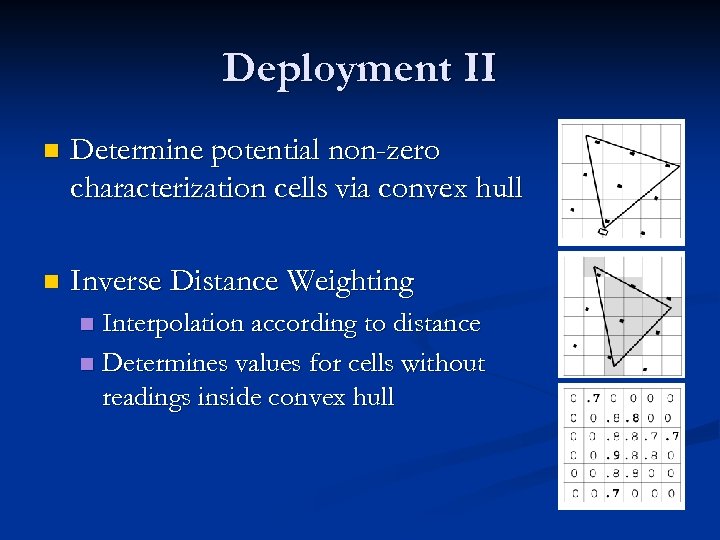 Deployment II n Determine potential non-zero characterization cells via convex hull n Inverse Distance Weighting Interpolation according to distance n Determines values for cells without readings inside convex hull n
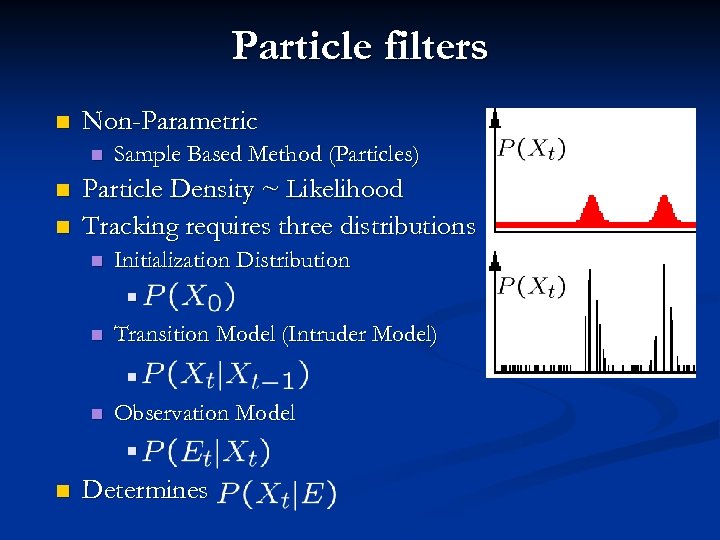 Particle filters n Non-Parametric n n n Sample Based Method (Particles) Particle Density ~ Likelihood Tracking requires three distributions n Initialization Distribution n n Transition Model (Intruder Model) n n Observation Model n n Determines
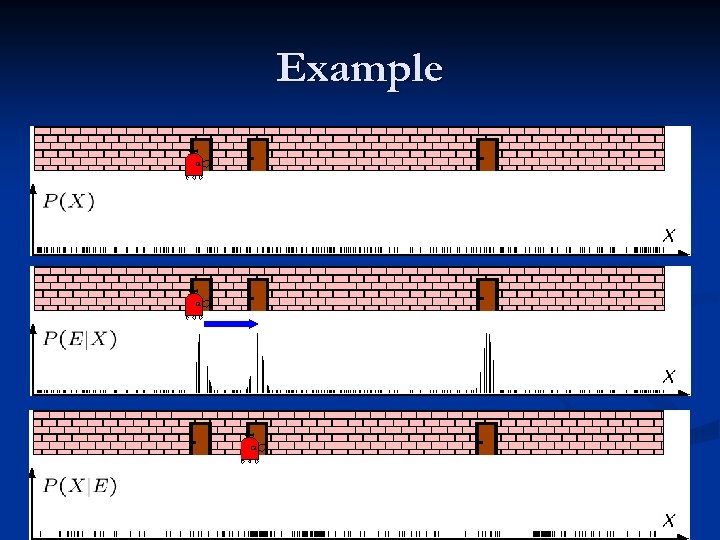 Example
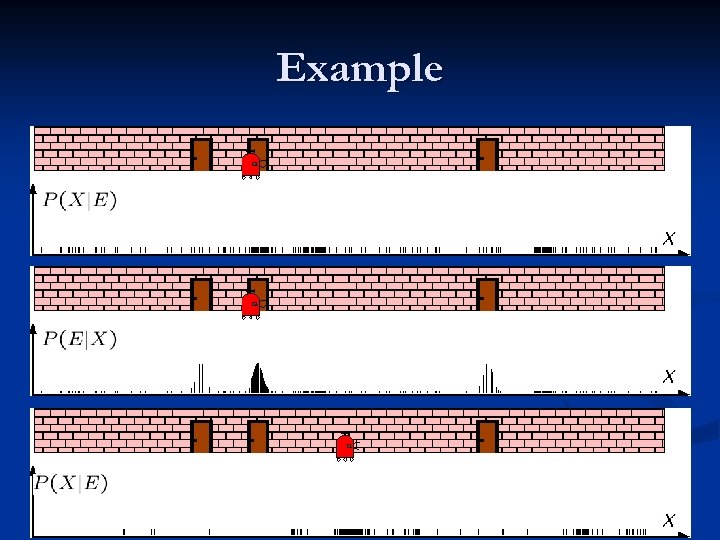 Example
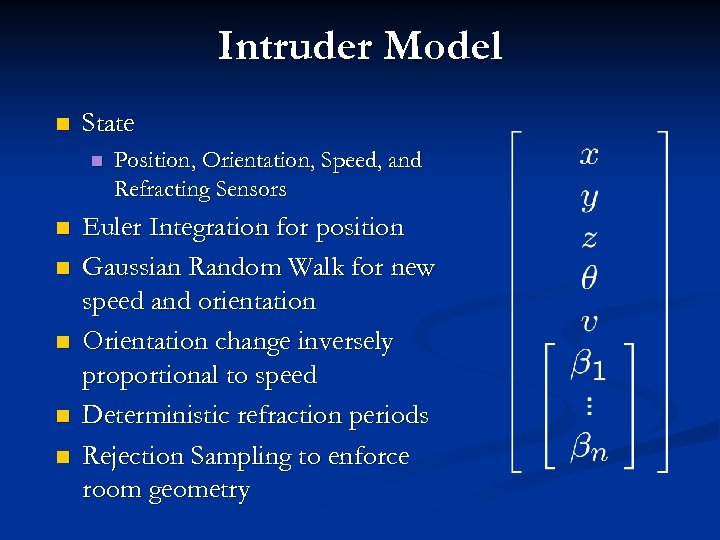 Intruder Model n State n n n Position, Orientation, Speed, and Refracting Sensors Euler Integration for position Gaussian Random Walk for new speed and orientation Orientation change inversely proportional to speed Deterministic refraction periods Rejection Sampling to enforce room geometry
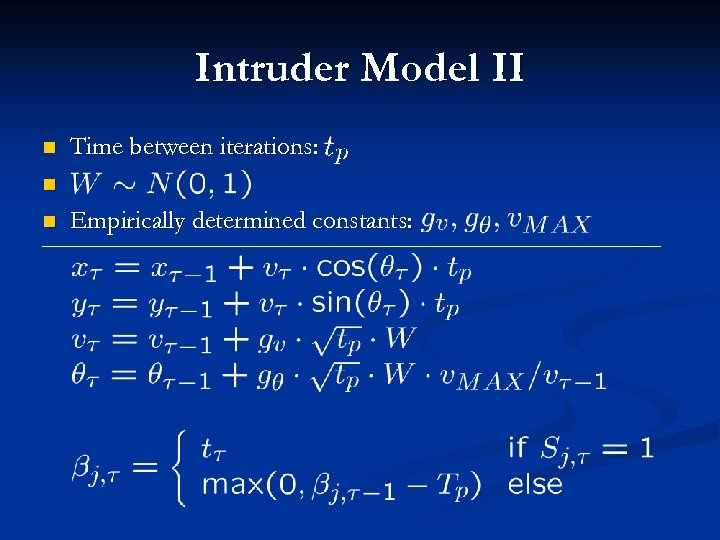 Intruder Model II n Time between iterations: n n Empirically determined constants:
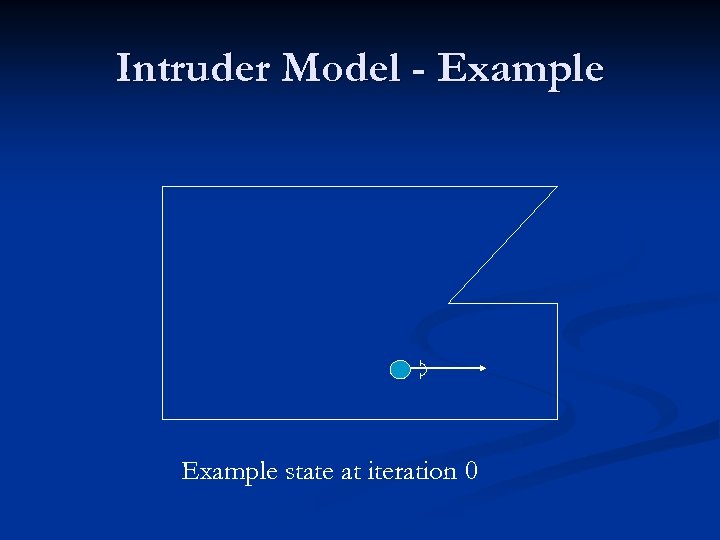 Intruder Model - Example state at iteration 0
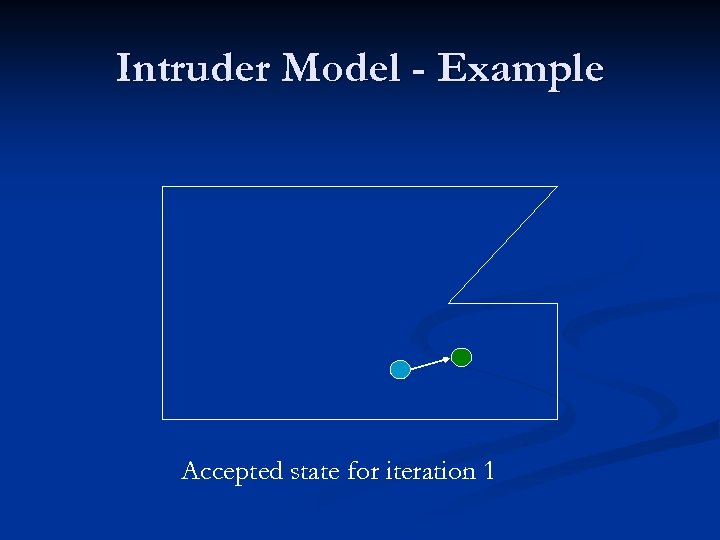 Intruder Model - Example Accepted state for iteration 1
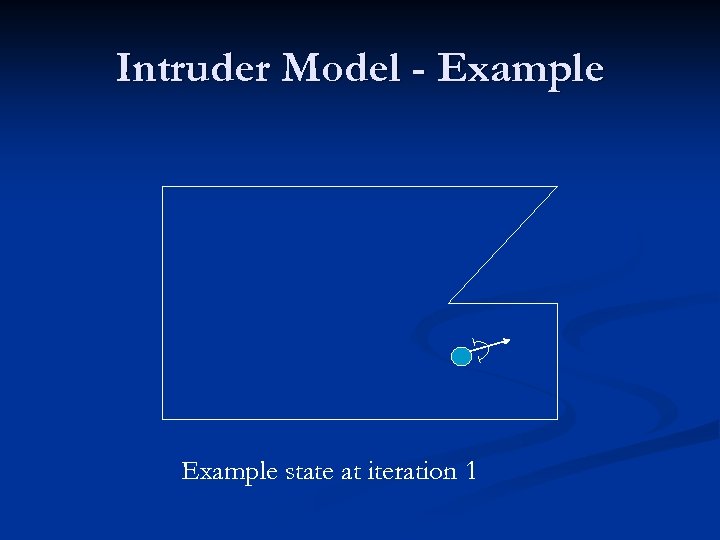 Intruder Model - Example state at iteration 1
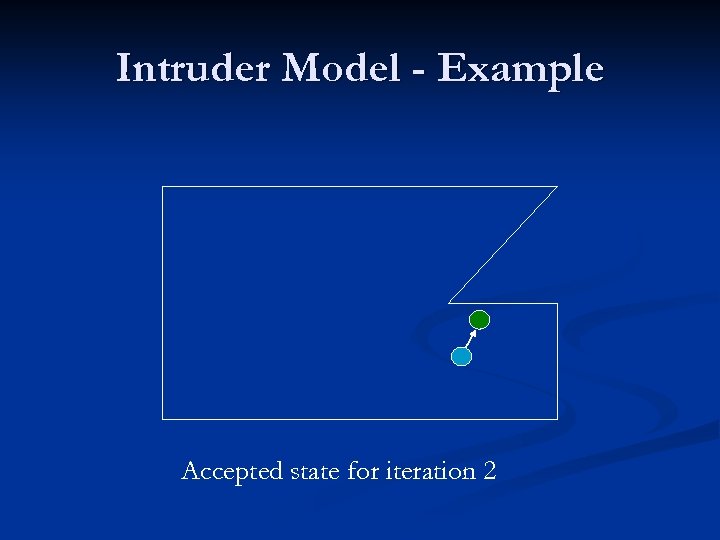 Intruder Model - Example Accepted state for iteration 2
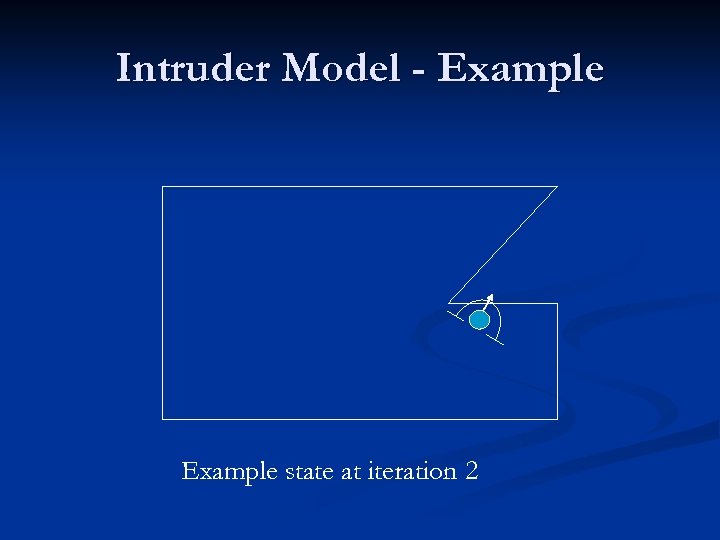 Intruder Model - Example state at iteration 2
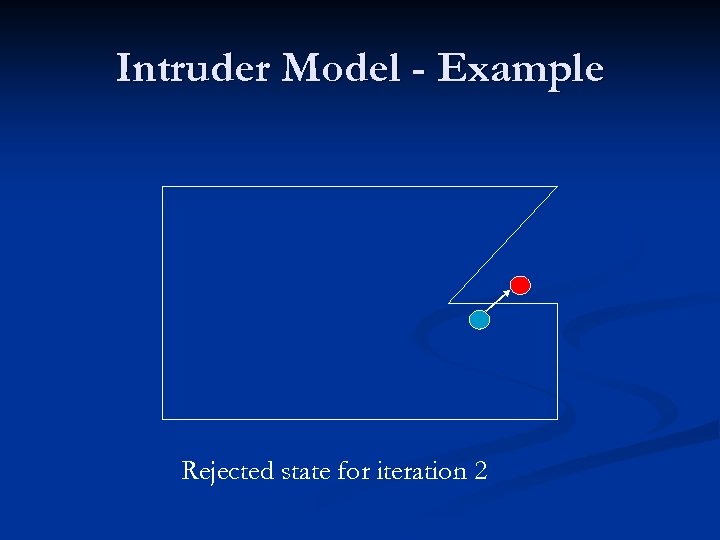 Intruder Model - Example Rejected state for iteration 2
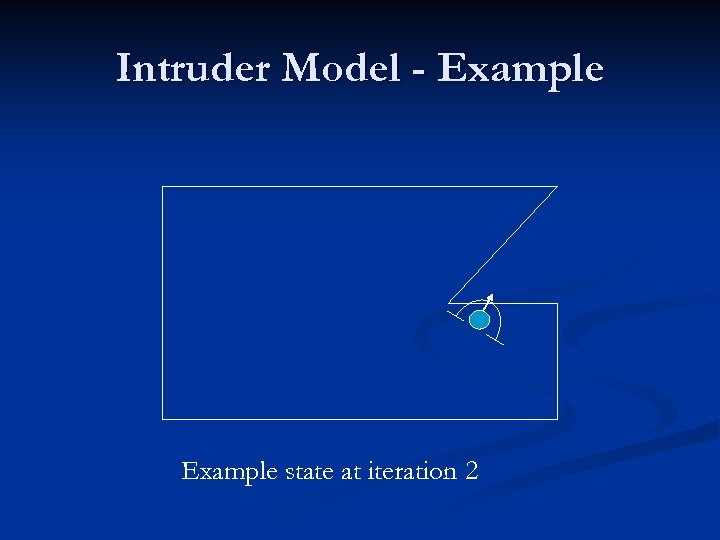 Intruder Model - Example state at iteration 2
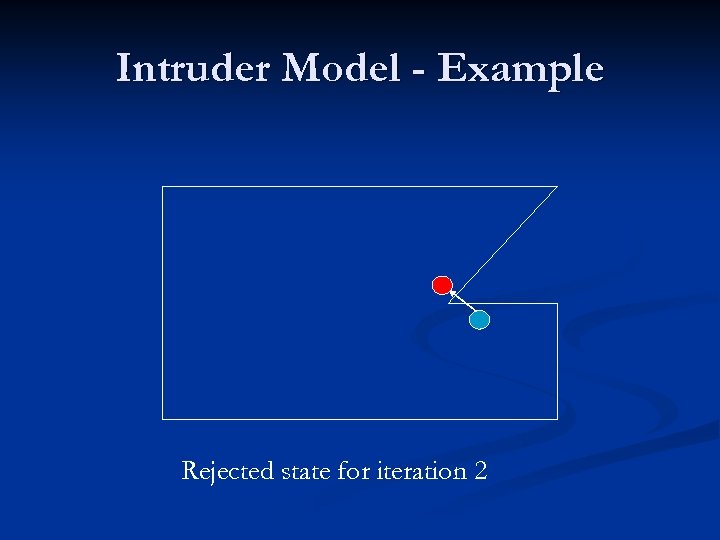 Intruder Model - Example Rejected state for iteration 2
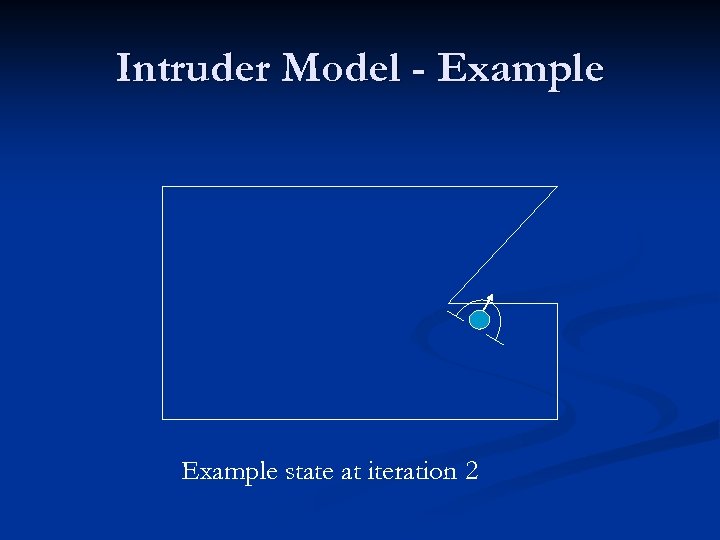 Intruder Model - Example state at iteration 2
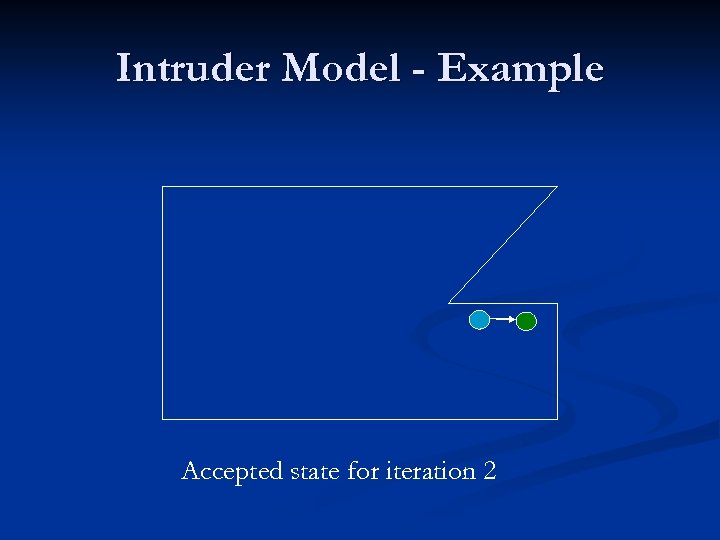 Intruder Model - Example Accepted state for iteration 2
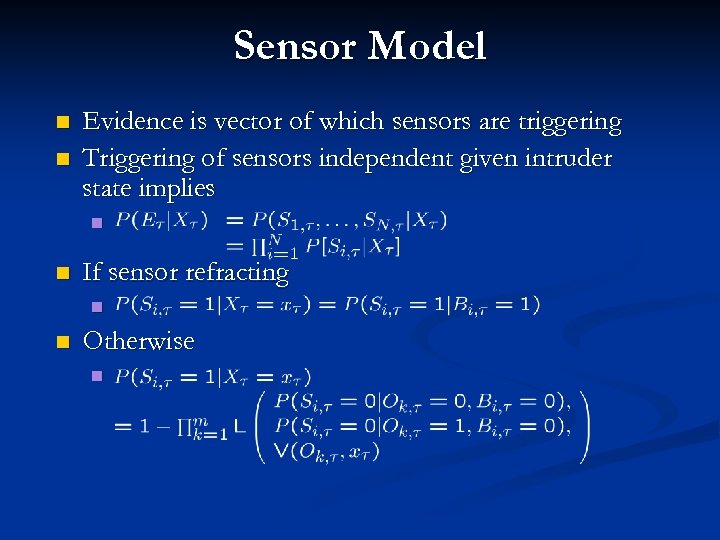 Sensor Model n n Evidence is vector of which sensors are triggering Triggering of sensors independent given intruder state implies n n If sensor refracting n n Otherwise n
 Outline n n n Introduction Related Work Problem Formulation n Experiments n n n Setup and Assumptions Particle Filtering Simulation Real-world Conclusion/Future Work
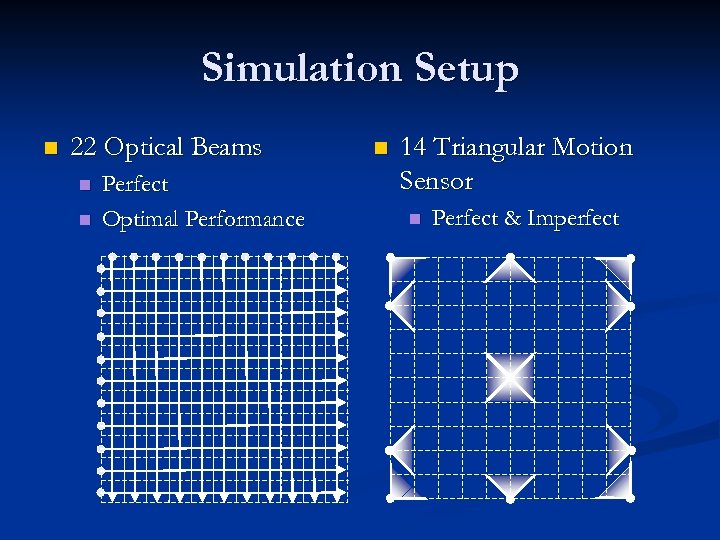 Simulation Setup n 22 Optical Beams n n Perfect Optimal Performance n 14 Triangular Motion Sensor n Perfect & Imperfect
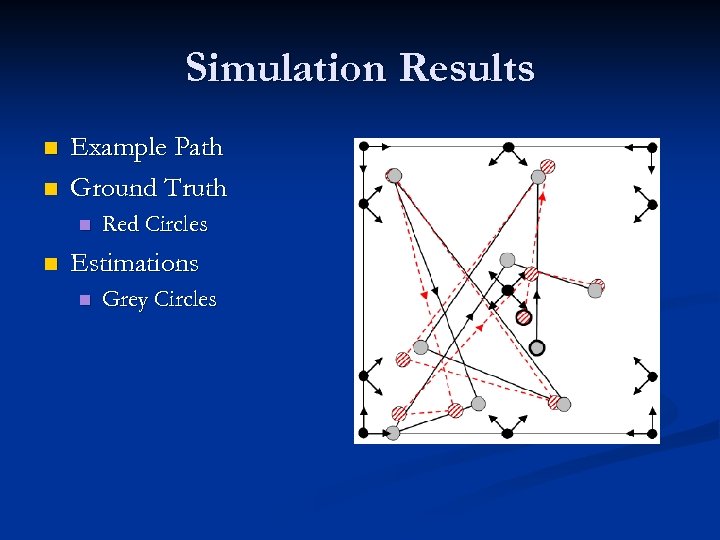 Simulation Results n n Example Path Ground Truth n n Red Circles Estimations n Grey Circles
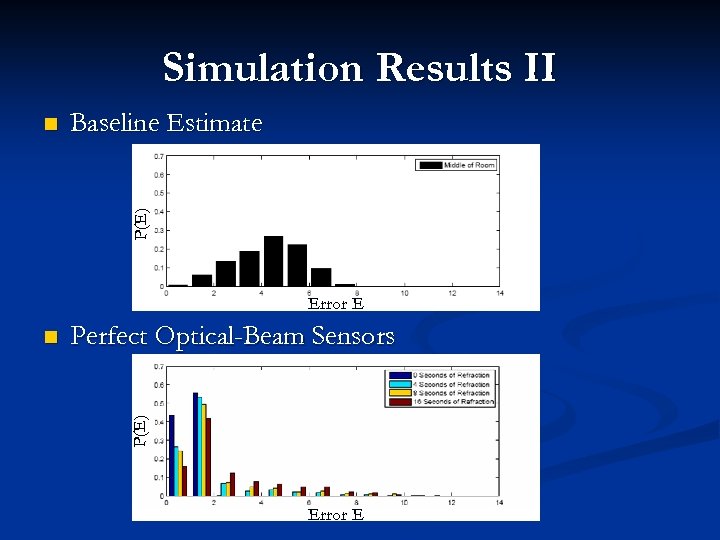 Simulation Results II Baseline Estimate P(E) n Error E Perfect Optical-Beam Sensors P(E) n Error E
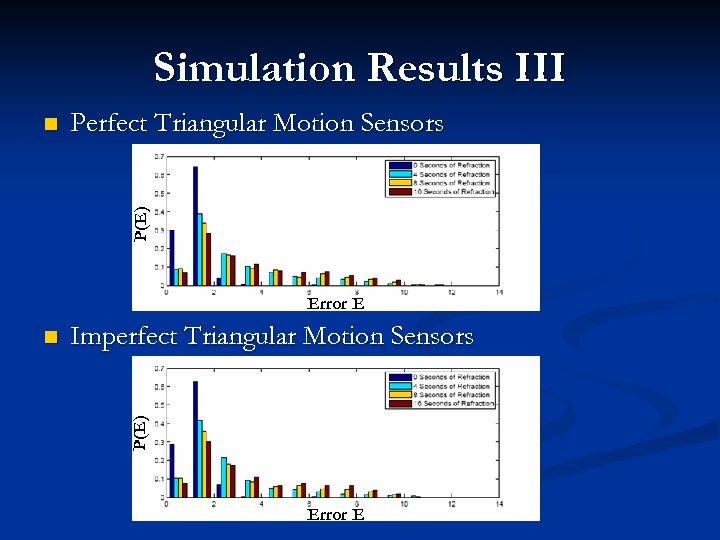 Simulation Results III Perfect Triangular Motion Sensors P(E) n Error E Imperfect Triangular Motion Sensors P(E) n Error E
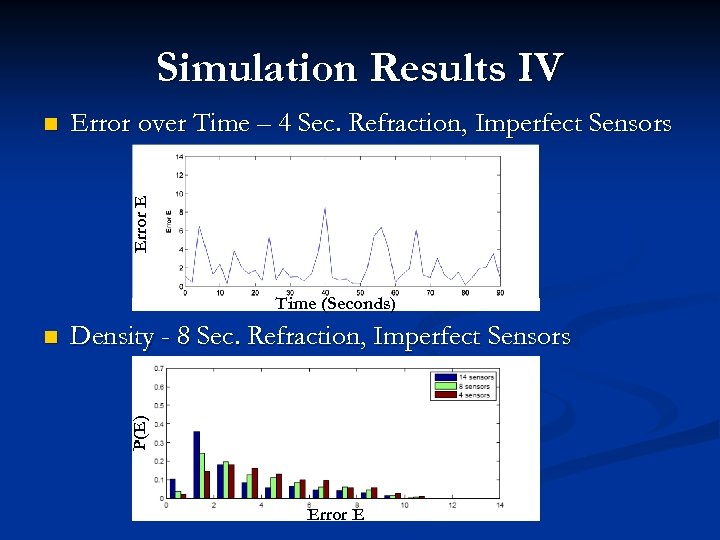 Simulation Results IV Error over Time – 4 Sec. Refraction, Imperfect Sensors Error E n Time (Seconds) Density - 8 Sec. Refraction, Imperfect Sensors P(E) n Error E
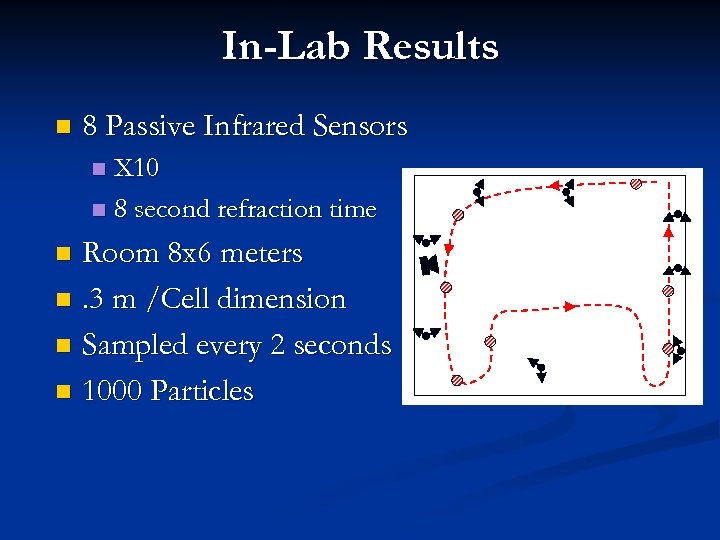 In-Lab Results n 8 Passive Infrared Sensors X 10 n 8 second refraction time n Room 8 x 6 meters n. 3 m /Cell dimension n Sampled every 2 seconds n 1000 Particles n
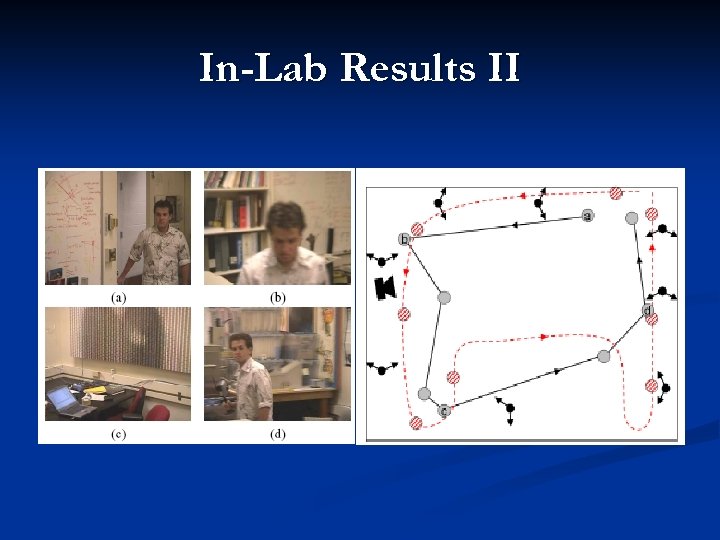 In-Lab Results II
 Outline n n n Introduction Related Work Problem Formulation n Results n n n Setup and Assumptions Particle Filtering Simulation Experimental Conclusion/Future Work
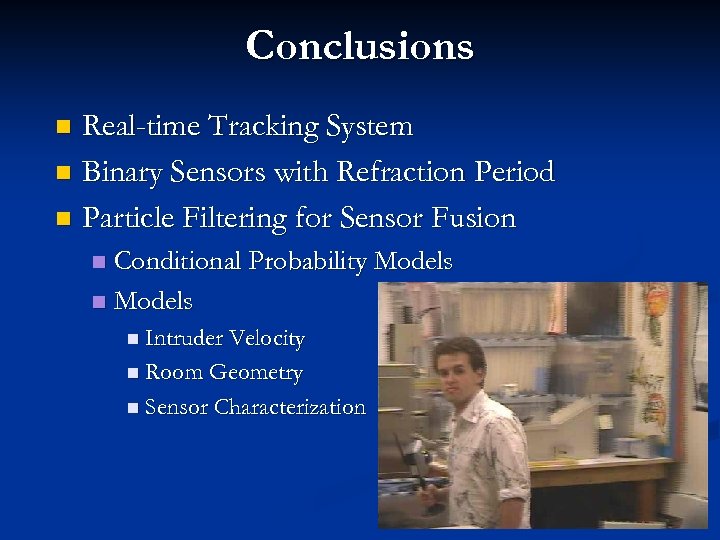 Conclusions Real-time Tracking System n Binary Sensors with Refraction Period n Particle Filtering for Sensor Fusion n Conditional Probability Models n n Intruder Velocity n Room Geometry n Sensor Characterization
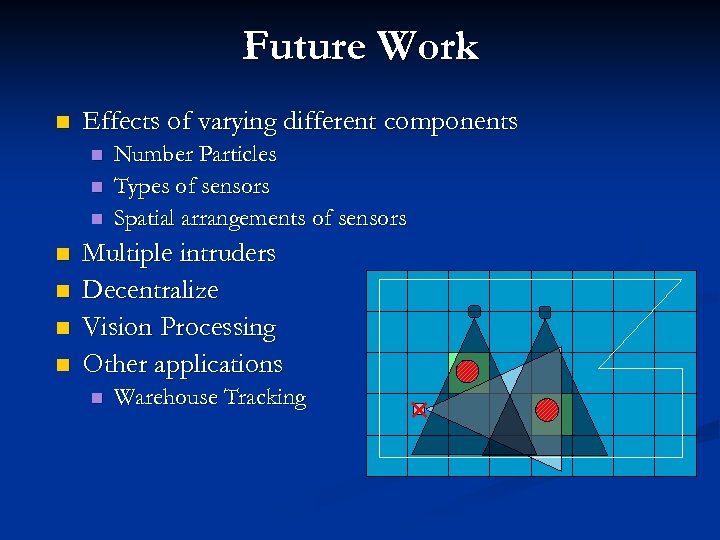 Future Work n Effects of varying different components n n n n Number Particles Types of sensors Spatial arrangements of sensors Multiple intruders Decentralize Vision Processing Other applications n Warehouse Tracking
 Thank You Jeremy Schiff: jschiff@cs. berkeley. edu n Ken Goldberg: goldberg@ieor. berkeley. edu n URL: www. cs. berkeley. edu/~jschiff n