


 Скачать презентацию Automated Infection Control Surveillance Technologies Overview and Perspectives
acb6c8494cb99b2542f45822615ed00f.ppt
- Количество слайдов: 15
 Automated Infection Control Surveillance Technologies: Overview and Perspectives Presenter: Lisa Payne Simon, MPH Massachusetts Coalition for the Prevention of Medical Errors September 11, 2008 1
 Outline of today’s presentation • Problem statement • Automated infection control surveillance technology – Overview (Technology Review from Sg 2) – Purchase decision: Factors to consider (APIC tools) • Illustration: the CA Healthcare-Associated Infection Prevention Initiative (CHAIPI) • Voices from the field: – Debbie Mulligan, RN, MSN, CIC – Infection Prevention Manager, Mission Hospital Regional Medical Center, Mission Viejo, CA – Julie Jefferson, RN, MPH, CIC – Director, Epidemiology & Infection Control, Rhode Island Hospital, Providence, RI – Patricia Burns RN, CIC – Infection Control Coordinator, Saint Elizabeth Medical Center, Edgewood, KY 2
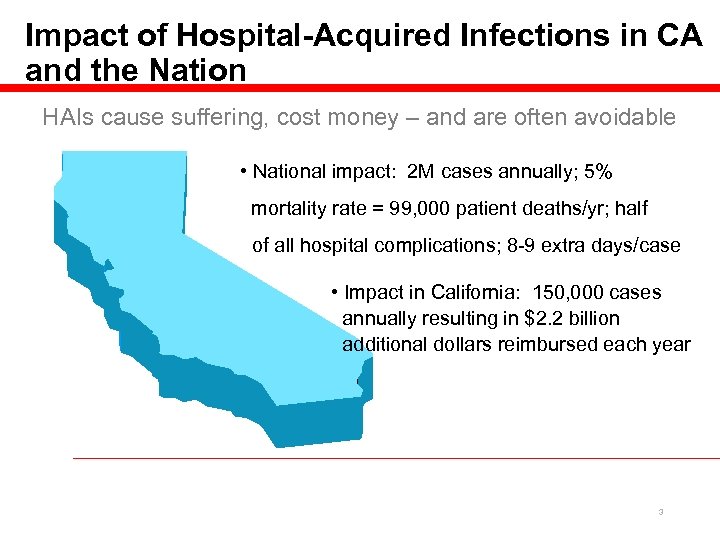 Impact of Hospital-Acquired Infections in CA and the Nation HAIs cause suffering, cost money – and are often avoidable • National impact: 2 M cases annually; 5% mortality rate = 99, 000 patient deaths/yr; half of all hospital complications; 8 -9 extra days/case • Impact in California: 150, 000 cases annually resulting in $2. 2 billion additional dollars reimbursed each year 3
 Technology Overview • Key facts - Electronic surveillance: – Uses hospital data to detect outbreaks in infections. Data are analyzed internally or by vendors; returned in retrospective reports or real-time alerts – Replaces manual chart review – Enables ICPs to focus on prevention – Alerts caregivers to potential infections and guides treatment selection • • Environmental drivers (regulatory, reimbursement) Clinical impact – Reduces mortality (5% attributable mortality rate reduction) – Improves HAI identification and measurement accuracy; improves proactive intervention – Reduces length or stay by 8 -10 days per case on average 4
 Technology Overview (cont. ) • Financial impact – Reduces cost of care (fewer infections, reduced LOS) – estimated $3 -$5 return for every $1 invested in surveillance technology – Effective Oct. 2008, CMS will eliminate higher payments for HAIs • Operational impact – Reduces ICP time reviewing charts; expands productivity and time for prevention activities – Expands depth and scope of reporting; improves QI – Supports collaboration across staff using defined goals, reporting • Information resource: Technology Review from Sg 2 5
 Vendor Landscape - Market leaders • Continuum of products: Software for on-site monitoring vs. data mining/reporting/consulting services • Software: AICE Millenium, Epi. Quest • Data Mining Services: – Cardinal Health/Med. Mined – Premier (Safety Surveillor) – Theradoc – The Advisory Board Company/Vecna 6
 Purchase Decision: APIC Tools offer Guidance • Association for Professionals in Infection Control and Epidemiology (APIC) is a resource for unbiased decision-making tools and support • Visit www. apic. org/Surv. Tech. Resources – Extensive literature references – Starter Questions – Product Comparison Tool – Glossary of informatics terms – Web community (user group) 7
 Purchasing an electronic surveillance solution – Factors to consider • What is the goal of adopting electronic surveillance for your hospital? • What solution is a clinical and operational fit for your organization and supports the goal? • What solution will the hospital IT department support and quickly implement? • What is the total cost of ownership for the solution? – Start-up expenses (capital budget-one time) – Ongoing expenses (operational budget-monthly) – Long-term support expenses (i. e. ; HIS/Lab system changes and modifications) 8
 Purchasing an electronic surveillance solution – Factors to consider • Does the solution have a track record of results and positive return on investment? • Does the electronic surveillance solution enhance other internal quality improvement projects? • Can the electronic surveillance company provide multiple hospital references at different levels (i. e. ; ICP, Director of Quality/Nursing, IT and executive)? 9
 Guidelines for assessing technologies for your hospital: Does the technology… • Eliminate non-value added work so you can spend more time on the tasks that really make a difference • Quantify improved patient outcomes and financial return on investment (ROI) • Give you a hospital-wide, objective view of your infections • Get up and running quickly • Provide a solid support team behind the technology • Engage executive leadership team in the process 10
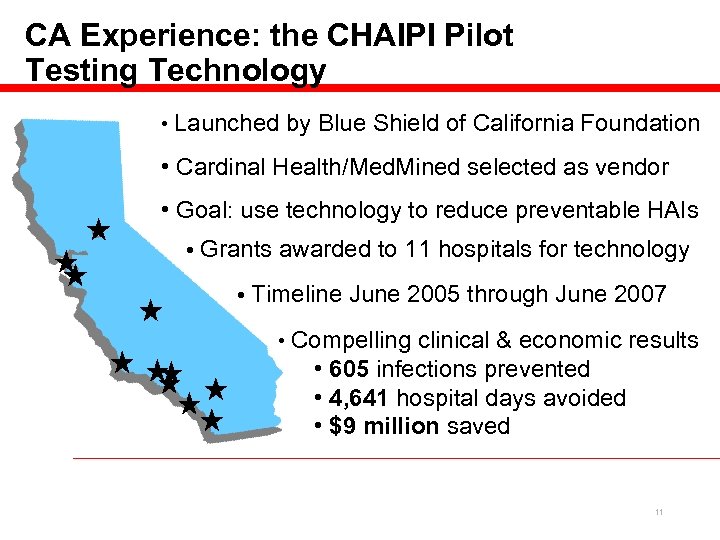 CA Experience: the CHAIPI Pilot Testing Technology • Launched by Blue Shield of California Foundation • Cardinal Health/Med. Mined selected as vendor • Goal: use technology to reduce preventable HAIs • Grants awarded to 11 hospitals for technology • Timeline June 2005 through June 2007 • Compelling clinical & economic results • 605 infections prevented • 4, 641 hospital days avoided • $9 million saved 11
 CHAIPI Expansion 2008 - 2009 • 55 hospitals and growing • Collaborative grants - Best practices + peer learning • Technology grants - Med. Mined surveillance - Preferred pricing - one vendor • Independent evaluation - Program outcomes - Infection Preventionist role • Inclusion of “for profit” hospitals • Multiple innovative partners 12
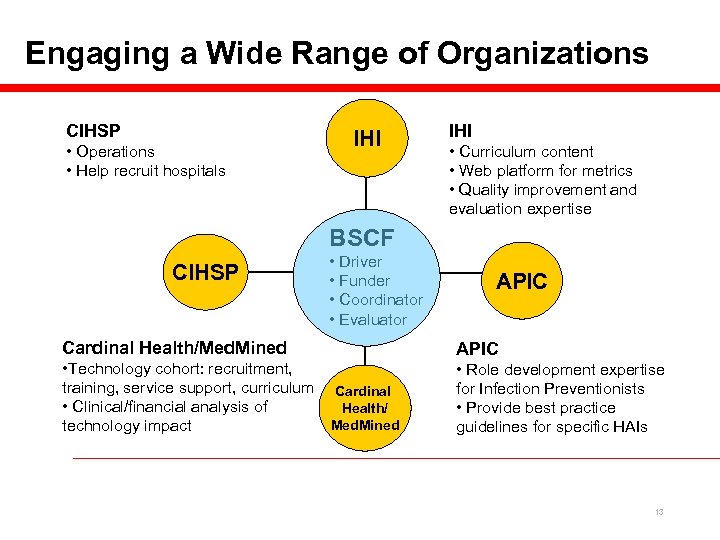 Engaging a Wide Range of Organizations CIHSP • Operations • Help recruit hospitals IHI • Curriculum content • Web platform for metrics • Quality improvement and evaluation expertise BSCF CIHSP • Driver • Funder • Coordinator • Evaluator Cardinal Health/Med. Mined • Technology cohort: recruitment, training, service support, curriculum Cardinal • Clinical/financial analysis of Health/ Med. Mined technology impact APIC • Role development expertise for Infection Preventionists • Provide best practice guidelines for specific HAIs 13
 Defining CHAIPI Program Success • Catalyze HAI reduction efforts statewide • Serve as a national model for testing technology to improve quality and lower costs • Save lives and money • Contribute new knowledge to the field 14
 Voices from the Field Cardinal Health/Med. Mined user – Debbie Mulligan, RN, MSN, CIC – Infection Prevention Manager, Mission Hospital Regional Medical Center, Mission Viejo, CA Premier (Safety Surveillor) user – Patricia Burns RN, CIC – Infection Control Coordinator, Saint Elizabeth Medical Center, Edgewood, KY Theradoc user – Julie A. Jefferson, RN, MPH, CIC – Director, Epidemiology & Infection Control, Rhode Island Hospital, Providence, RI 15