


 Скачать презентацию Automated Deduction Techniques for Knowledge Representation Applications Peter
26a1977db8fb4662c2770234ca0340b7.ppt
- Количество слайдов: 20
 Automated Deduction Techniques for Knowledge Representation Applications Peter Baumgartner Max-Planck-Institute for Informatics Automated Deduction Techniques for Knowledge Representation Applications
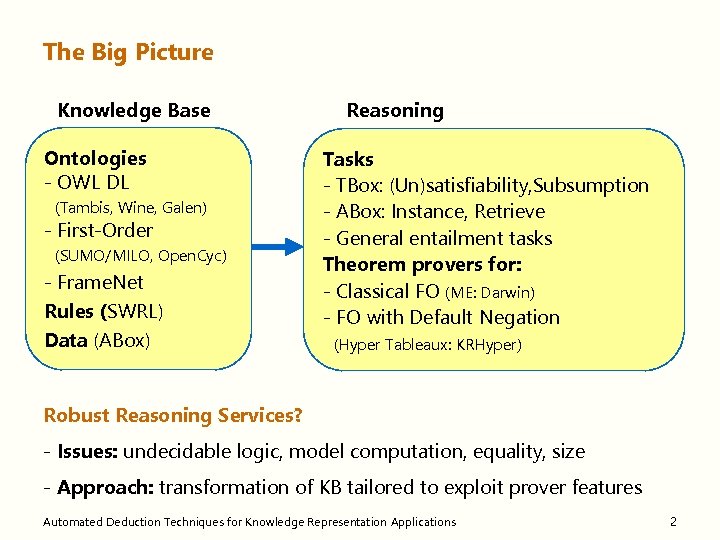 The Big Picture Knowledge Base Ontologies - OWL DL (Tambis, Wine, Galen) - First-Order (SUMO/MILO, Open. Cyc) - Frame. Net Rules (SWRL) Data (ABox) Reasoning Tasks - TBox: (Un)satisfiability, Subsumption - ABox: Instance, Retrieve - General entailment tasks Theorem provers for: - Classical FO (ME: Darwin) - FO with Default Negation (Hyper Tableaux: KRHyper) Robust Reasoning Services? - Issues: undecidable logic, model computation, equality, size - Approach: transformation of KB tailored to exploit prover features Automated Deduction Techniques for Knowledge Representation Applications 2
 Contents • Transforming the knowledge base for reasoning – Transformation of OWL to clause logic: about equality – Treating equality – Blocking • Theorem proving – KRHyper model generation prover – Experimental evaluation • Rules: an application for reasoning on Frame. Net Automated Deduction Techniques for Knowledge Representation Applications 3
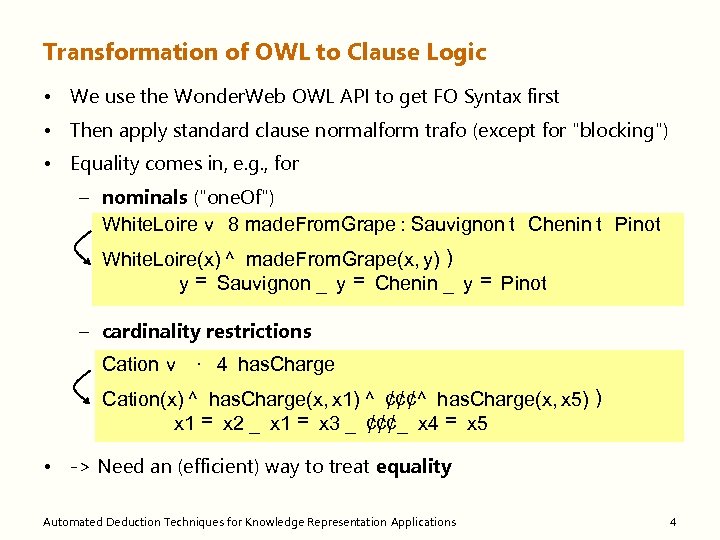 Transformation of OWL to Clause Logic • We use the Wonder. Web OWL API to get FO Syntax first • Then apply standard clause normalform trafo (except for "blocking") • Equality comes in, e. g. , for – nominals ("one. Of") White. Loire v 8 made. From. Grape : Sauvignon t Chenin t Pinot White. Loire(x) ^ made. From. Grape(x, y) ) y = Sauvignon _ y = Chenin _ y = Pinot – cardinality restrictions Cation v · 4 has. Charge Cation(x) ^ has. Charge(x, x 1) ^ ¢¢¢^ has. Charge(x, x 5) ) x 1 = x 2 _ x 1 = x 3 _ ¢¢¢_ x 4 = x 5 • -> Need an (efficient) way to treat equality Automated Deduction Techniques for Knowledge Representation Applications 4
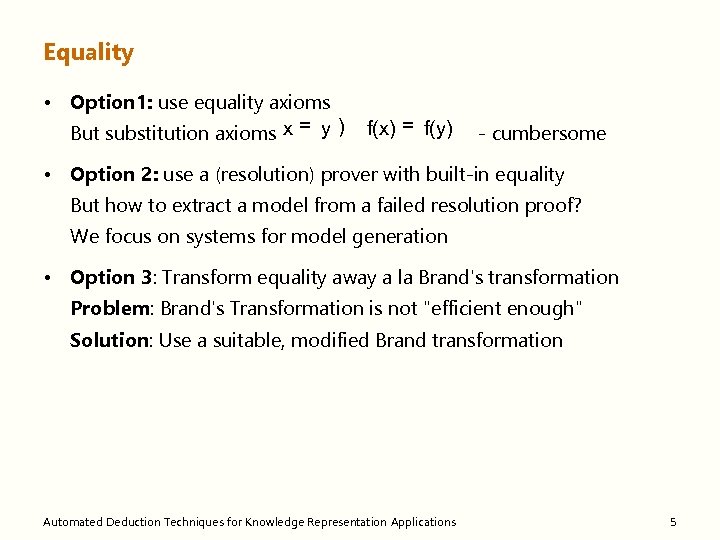 Equality • Option 1: use equality axioms But substitution axioms x = y ) f(x) = f(y) - cumbersome • Option 2: use a (resolution) prover with built-in equality But how to extract a model from a failed resolution proof? We focus on systems for model generation • Option 3: Transform equality away a la Brand's transformation Problem: Brand's Transformation is not "efficient enough" Solution: Use a suitable, modified Brand transformation Automated Deduction Techniques for Knowledge Representation Applications 5
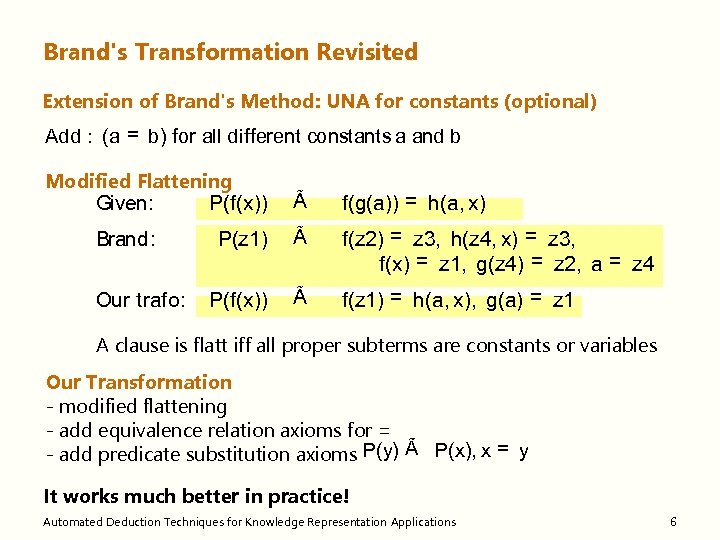 Brand's Transformation Revisited Extension of Brand's Method: UNA for constants (optional) Add : (a = b) for all different constants a and b Modified Flattening Given: P(f(x)) Ã f(g(a)) = h(a, x) Brand: P(z 1) Ã f(z 2) = z 3, h(z 4, x) = z 3, f(x) = z 1, g(z 4) = z 2, a = z 4 P(f(x)) Ã f(z 1) = h(a, x), g(a) = z 1 Our trafo: A clause is flatt iff all proper subterms are constants or variables Our Transformation - modified flattening - add equivalence relation axioms for = - add predicate substitution axioms P(y) Ã P(x), x = y It works much better in practice! Automated Deduction Techniques for Knowledge Representation Applications 6
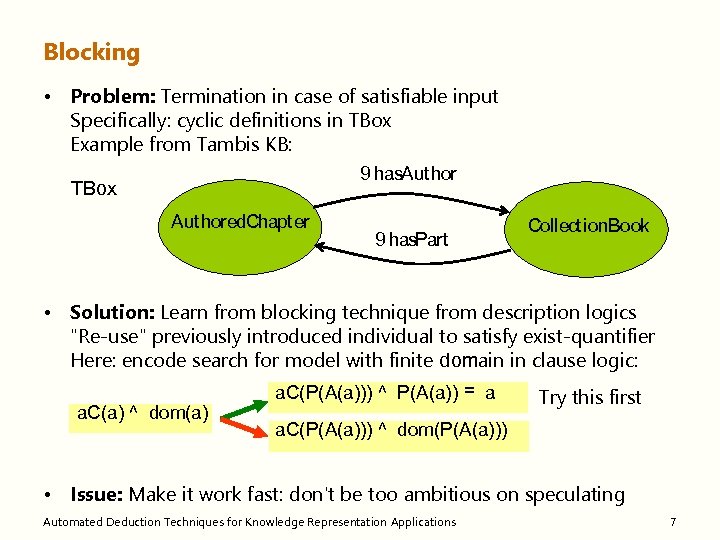 Blocking • Problem: Termination in case of satisfiable input Specifically: cyclic definitions in TBox Example from Tambis KB: 9 has. Author TBox Authored. Chapter 9 has. Part Collection. Book • Solution: Learn from blocking technique from description logics "Re-use" previously introduced individual to satisfy exist-quantifier Here: encode search for model with finite domain in clause logic: a. C(a) ^ dom(a) a. C(P(A(a))) ^ P(A(a)) = a Try this first a. C(P(A(a))) ^ dom(P(A(a))) • Issue: Make it work fast: don't be too ambitious on speculating Automated Deduction Techniques for Knowledge Representation Applications 7
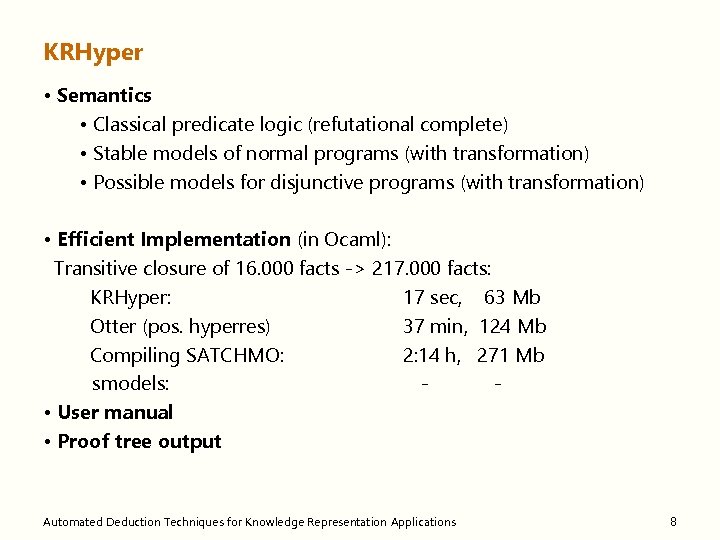 KRHyper • Semantics • Classical predicate logic (refutational complete) • Stable models of normal programs (with transformation) • Possible models for disjunctive programs (with transformation) • Efficient Implementation (in Ocaml): Transitive closure of 16. 000 facts -> 217. 000 facts: KRHyper: 17 sec, 63 Mb Otter (pos. hyperres) 37 min, 124 Mb Compiling SATCHMO: 2: 14 h, 271 Mb smodels: • User manual • Proof tree output Automated Deduction Techniques for Knowledge Representation Applications 8
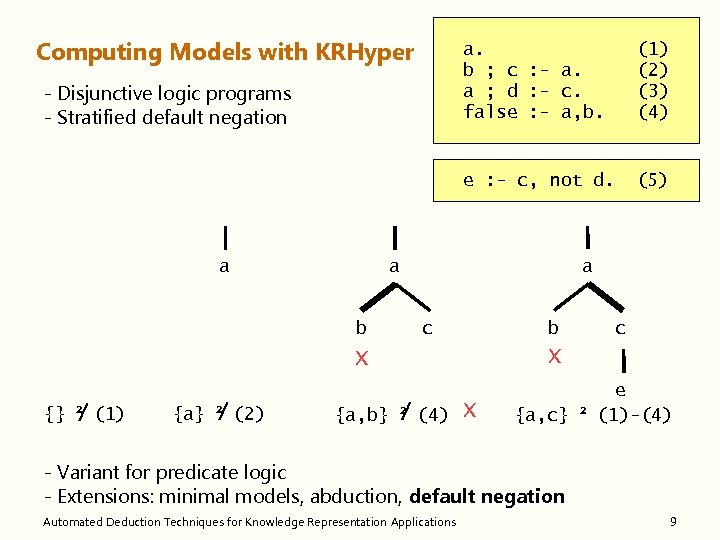 Computing Models with KRHyper a. b ; c : - a. a ; d : - c. false : - a, b. e : - c, not d. - Disjunctive logic programs - Stratified default negation a (1) (2) (3) (4) (5) a a b b c X X {} ² (1) {a} ² (2) {a, b} ² (4) c X e {a, c} ² (1)-(4) - Variant for predicate logic - Extensions: minimal models, abduction, default negation Automated Deduction Techniques for Knowledge Representation Applications 9
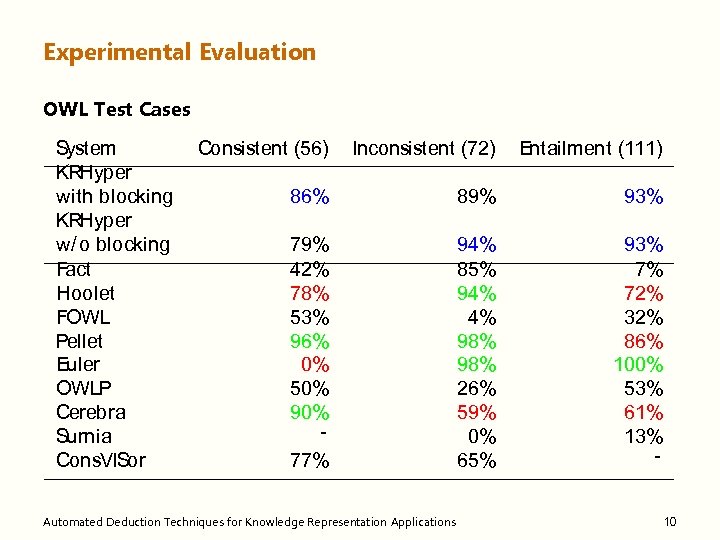 Experimental Evaluation OWL Test Cases System KRHyper with blocking KRHyper w/ o blocking Fact Hoolet FOWL Pellet Euler OWLP Cerebra Surnia Cons. VISor Consistent (56) Inconsistent (72) Entailment (111) 86% 89% 93% 79% 42% 78% 53% 96% 0% 50% 90% 77% 94% 85% 94% 4% 98% 26% 59% 0% 65% 93% 7% 72% 32% 86% 100% 53% 61% 13% - Automated Deduction Techniques for Knowledge Representation Applications 10
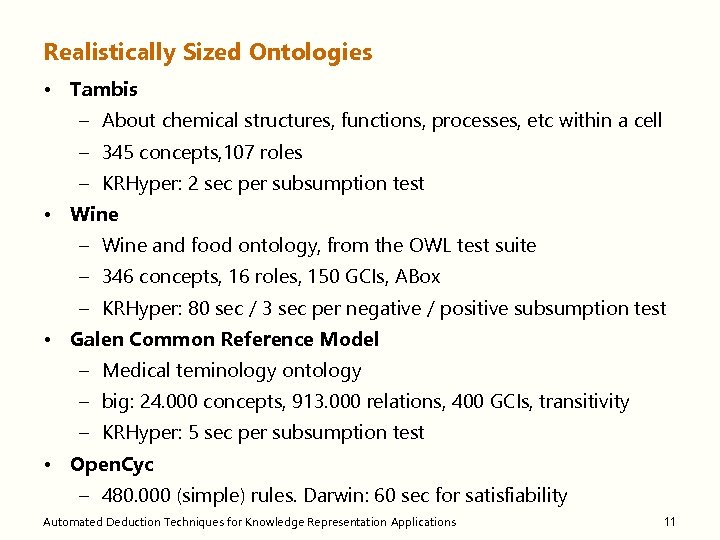 Realistically Sized Ontologies • Tambis – About chemical structures, functions, processes, etc within a cell – 345 concepts, 107 roles – KRHyper: 2 sec per subsumption test • Wine – Wine and food ontology, from the OWL test suite – 346 concepts, 16 roles, 150 GCIs, ABox – KRHyper: 80 sec / 3 sec per negative / positive subsumption test • Galen Common Reference Model – Medical teminology ontology – big: 24. 000 concepts, 913. 000 relations, 400 GCIs, transitivity – KRHyper: 5 sec per subsumption test • Open. Cyc – 480. 000 (simple) rules. Darwin: 60 sec for satisfiability Automated Deduction Techniques for Knowledge Representation Applications 11
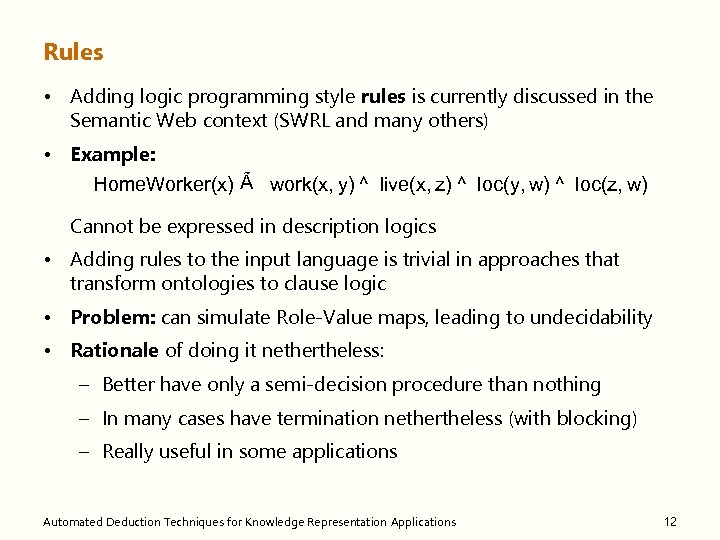 Rules • Adding logic programming style rules is currently discussed in the Semantic Web context (SWRL and many others) • Example: Home. Worker(x) Ã work(x, y) ^ live(x, z) ^ loc(y, w) ^ loc(z, w) Cannot be expressed in description logics • Adding rules to the input language is trivial in approaches that transform ontologies to clause logic • Problem: can simulate Role-Value maps, leading to undecidability • Rationale of doing it nethertheless: – Better have only a semi-decision procedure than nothing – In many cases have termination nethertheless (with blocking) – Really useful in some applications Automated Deduction Techniques for Knowledge Representation Applications 12
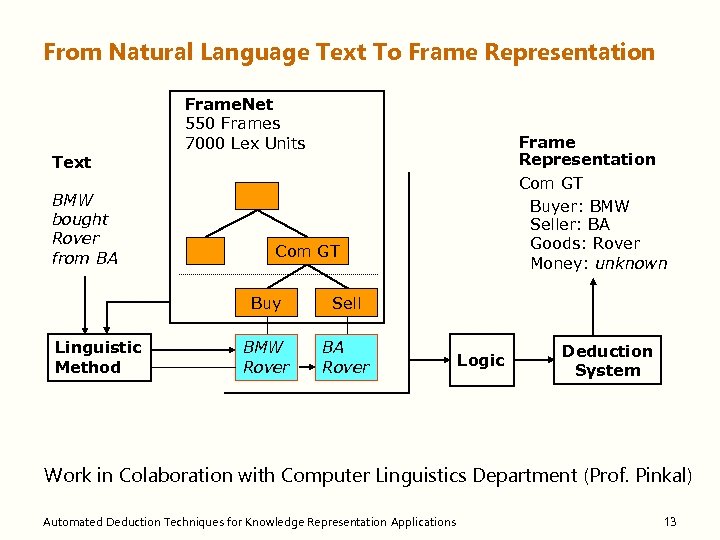 From Natural Language Text To Frame Representation Text BMW bought Rover from BA Frame. Net 550 Frames 7000 Lex Units Frame Representation Com GT Buy Linguistic Method Com GT Buyer: BMW Seller: BA Goods: Rover Money: unknown Sell BMW Rover BA Rover Logic Deduction System Work in Colaboration with Computer Linguistics Department (Prof. Pinkal) Automated Deduction Techniques for Knowledge Representation Applications 13
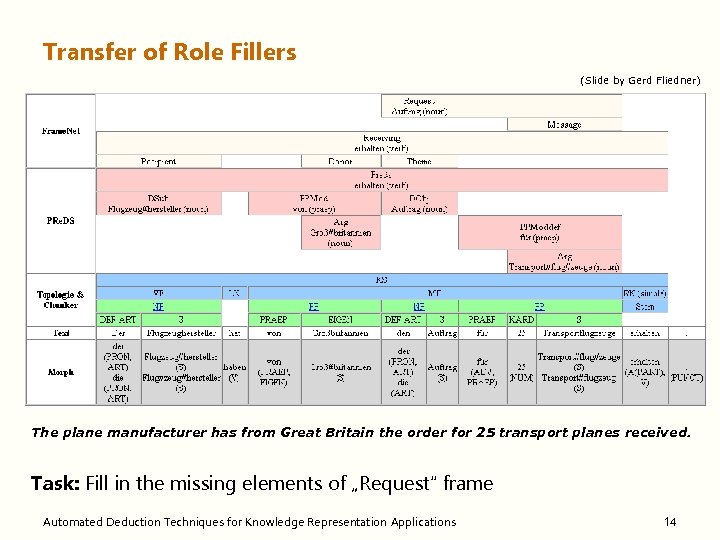 Transfer of Role Fillers (Slide by Gerd Fliedner) The plane manufacturer has from Great Britain the order for 25 transport planes received. Task: Fill in the missing elements of „Request“ frame Automated Deduction Techniques for Knowledge Representation Applications 14
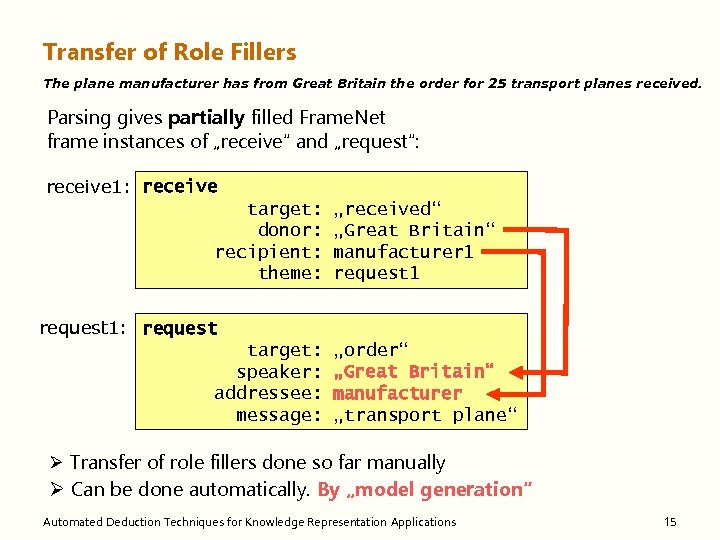 Transfer of Role Fillers The plane manufacturer has from Great Britain the order for 25 transport planes received. Parsing gives partially filled Frame. Net frame instances of „receive“ and „request“: receive 1: receive target: donor: recipient: theme: „received“ „Great Britain“ manufacturer 1 request 1: request target: speaker: addressee: message: „order“ „Great Britain“ manufacturer „transport plane“ Ø Transfer of role fillers done so far manually Ø Can be done automatically. By „model generation“ Automated Deduction Techniques for Knowledge Representation Applications 15
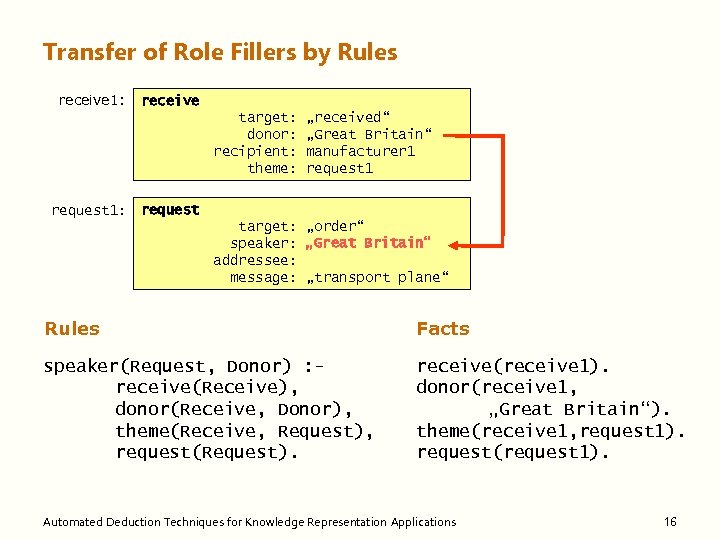 Transfer of Role Fillers by Rules receive 1: receive target: donor: recipient: theme: request 1: „received“ „Great Britain“ manufacturer 1 request target: „order“ speaker: „Great Britain“ addressee: message: „transport plane“ Rules Facts speaker(Request, Donor) : receive(Receive), donor(Receive, Donor), theme(Receive, Request), request(Request). receive(receive 1). donor(receive 1, „Great Britain“). theme(receive 1, request 1). request(request 1). Automated Deduction Techniques for Knowledge Representation Applications 16
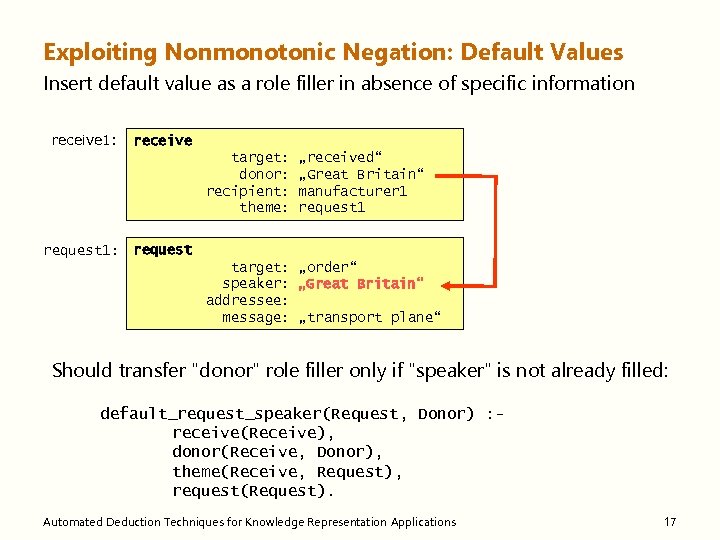 Exploiting Nonmonotonic Negation: Default Values Insert default value as a role filler in absence of specific information receive 1: receive target: donor: recipient: theme: request 1: „received“ „Great Britain“ manufacturer 1 request target: „order“ speaker: „Great Britain“ addressee: message: „transport plane“ Should transfer "donor" role filler only if "speaker" is not already filled: default_request_speaker(Request, Donor) : receive(Receive), donor(Receive, Donor), theme(Receive, Request), request(Request). Automated Deduction Techniques for Knowledge Representation Applications 17
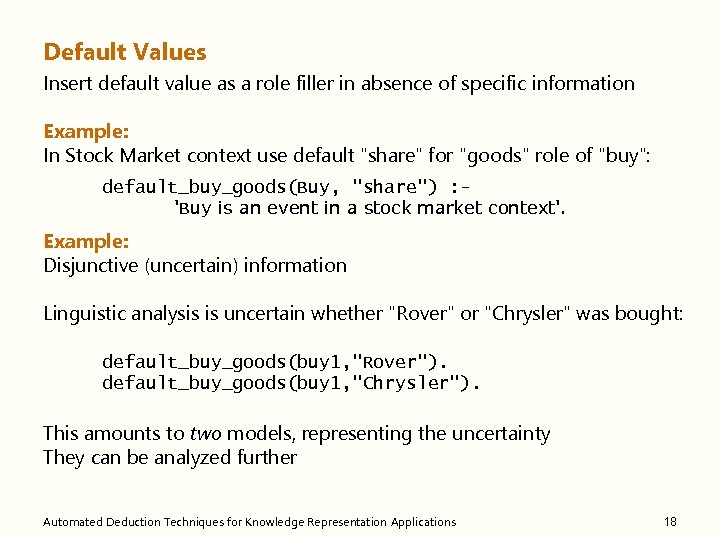 Default Values Insert default value as a role filler in absence of specific information Example: In Stock Market context use default "share" for "goods" role of "buy": default_buy_goods(Buy, "share") : 'Buy is an event in a stock market context'. Example: Disjunctive (uncertain) information Linguistic analysis is uncertain whether "Rover" or "Chrysler" was bought: default_buy_goods(buy 1, "Rover"). default_buy_goods(buy 1, "Chrysler"). This amounts to two models, representing the uncertainty They can be analyzed further Automated Deduction Techniques for Knowledge Representation Applications 18
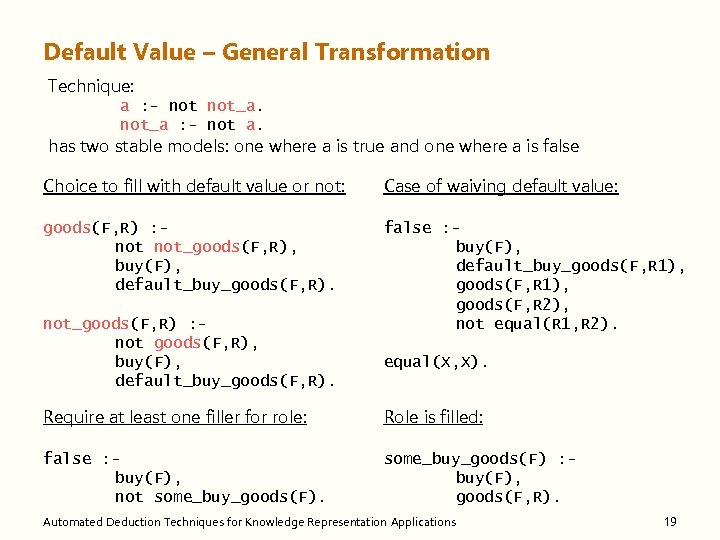 Default Value – General Transformation Technique: a : - not_a : - not a. has two stable models: one where a is true and one where a is false Choice to fill with default value or not: Case of waiving default value: goods(F, R) : not_goods(F, R), buy(F), default_buy_goods(F, R). false : buy(F), default_buy_goods(F, R 1), goods(F, R 2), not equal(R 1, R 2). not_goods(F, R) : not goods(F, R), buy(F), default_buy_goods(F, R). equal(X, X). Require at least one filler for role: Role is filled: false : buy(F), not some_buy_goods(F) : buy(F), goods(F, R). Automated Deduction Techniques for Knowledge Representation Applications 19
 Conclusions • Objective: "robust" reasoning support beyond description logics • Method – FO theorem prover, specifically model generation paradigm – Tailor translation to capitalize on prover features – Exploit nonmonotonic features (for KB with FO semantics!) • Practice – Experimental evaluation on OWL test suite "promising" – Need more experiments with e. g. Open. Cyc and Frame. Net Automated Deduction Techniques for Knowledge Representation Applications 20