


 Скачать презентацию Automated data collection in accommodation statistics a European
2ee53c96f42c7304638ae533900fda00.ppt
- Количество слайдов: 10
 "Automated data collection in accommodation statistics: a European overview" elena. rosa. perez@ine. es Rome, 3 rd December 2012
 • Introduction • ESSnet project “Automated data collection and reporting in accommodation statistics ” • Advantages and disadvantages • Next steps • Conclusions
 Introduction • Regulation 692/2011, economical situation: more information, key indicators. But… • Code of practice, regulations: reduce the respondent burden. • Information available in the management software of accommodation establishments… • Automated data collection: different formats (XML, XBRL), different uses (accommodation statistics, structural business statistics, social surveys).
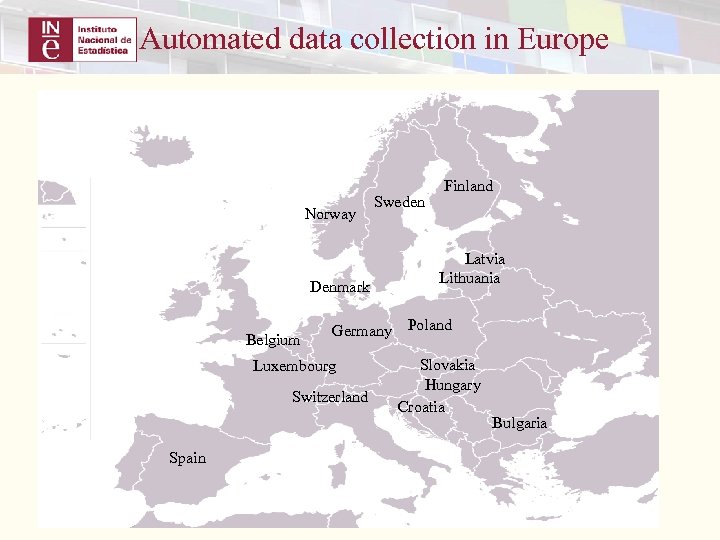 Automated data collection in Europe Sweden Norway Denmark Sweden Finland Latvia Lithuania Poland Germany Poland Slovakia Luxembourg Hungary Switzerland Croatia Bulgaria Belgium Spain
 ESSnet project I • In 2011 ESSnet project “Automated data collection and reporting in accommodation statistics” was launched. • Spain (coordinator), Bulgaria, Belgium, Finland, Latvia, Lithuania, Poland Slovakia. • Aim: develop a common European XML file => conclusion: each country has developed a XML/XBRL file for accommodation statistics.
 ESSnet project II Work Package 2: To research on the management software packages Work Package 3: To analyse the automated data collection systems already working Work Package 4: Definition of a common XML schema for occupancy surveys Work Package 5: Application to receive XML files Work Package 6: Evaluation of NSI’s information systems Work Package 7: Feed-back reports to establishments Work Package 8: Dissemination
 Advantages For establishments: • A big reduction of the response burden; • The feed-back reports containing customized information. For Statistical Organizations: • An increase of the quality of the data (no typing error, no missing data, validation before including the data into the NSI database); • A reduction in the costs (no need to type the data, no need for editing or imputation); • An improvement of timeliness and punctuality.
 Disadvantages For establishments: • Costs in money and/or time to buy/develop the application; • Establishments can be afraid to technical problems or confidentiality. For Statistical Organizations: • Costs to implement the new collection system, although once the system is implemented can be used for other surveys and the use of open-sources software can help.
 Next steps Countries that have already developed the automated data collection system: • To analyze the possibility to broaden the system to other surveys; • To increase the number of establishments; • To create synergies with other countries (international chains). Countries that have not developed the automated data collection system: • To take advantage of the work done by the countries using this data collection system.
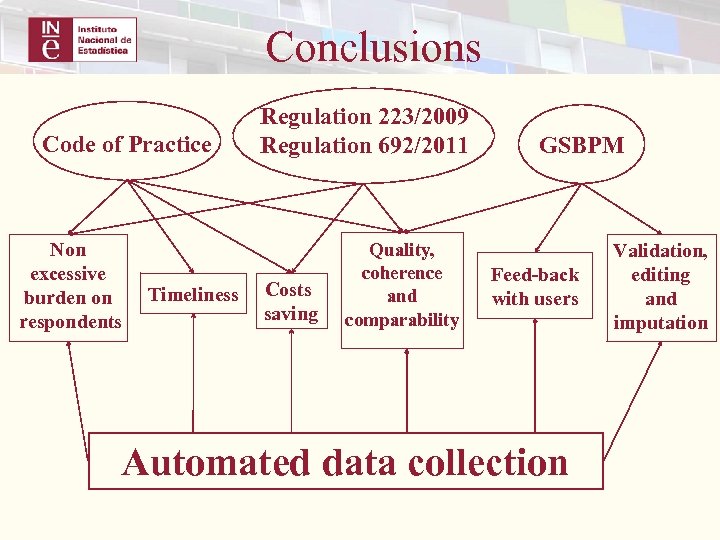 Conclusions Regulation 223/2009 Code of Practice Non excessive burden on respondents Timeliness Regulation 692/2011 Costs saving Quality, coherence and comparability GSBPM Feed-back with users Automated data collection Validation, editing and imputation