 Скачать презентацию Automated Collaboration on the Semantic Web Michael Stollberg
fa1613dbb2e77d6b2e16bd7b2cfff4a9.ppt
- Количество слайдов: 33



Automated Collaboration on the Semantic Web Michael Stollberg DERI – Digital Enterprise Research Institute University of Innsbruck, Austria Doctoral Symposium at the 5 th International Conference on Web Engineering (ICWE 2005) Sydney, Australia, July 24 th 15 -03 -2004 Rubén Lara ruben. lara@uibk. ac. at
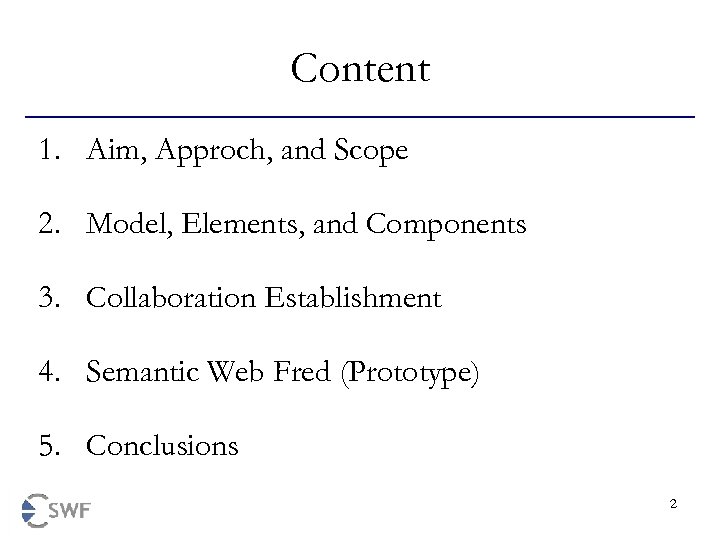
Content 1. Aim, Approch, and Scope 2. Model, Elements, and Components 3. Collaboration Establishment 4. Semantic Web Fred (Prototype) 5. Conclusions 2
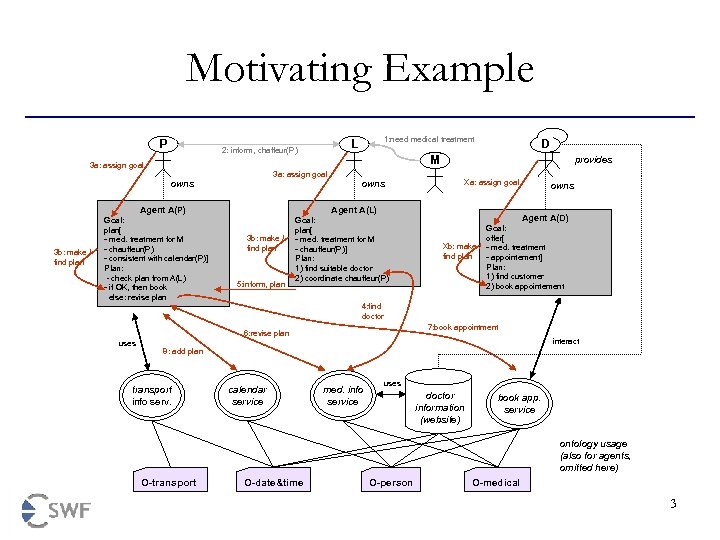
Motivating Example P 3 a: assign goal Agent A(P) 3 b: make / find plan Goal: plan[ - med. treatment for M - chauffeur(P) - consistent with calendar(P)] Plan: - check plan from A(L) - if OK, then book else: revise plan D M 3 a: assign goal owns 1: need medical treatment L 2: inform, chaffeur(P) owns provides Xa: assign goal Agent A(L) 3 b: make / find plan 5: inform, plan Goal: plan[ - med. treatment for M - chauffeur(P)] Plan: 1) find suitable doctor 2) coordinate chauffeur(P) owns Agent A(D) Goal: offer[ Xb: make / - med. treatment find plan - appointement] Plan: 1) find customer 2) book appointement 4: find doctor 7: book appointment 6: revise plan uses interact 8: add plan transport info serv. calendar service med. info service uses doctor information (website) book app. service ontology usage (also for agents, omitted here) O-transport O-date&time O-person O-medical 3
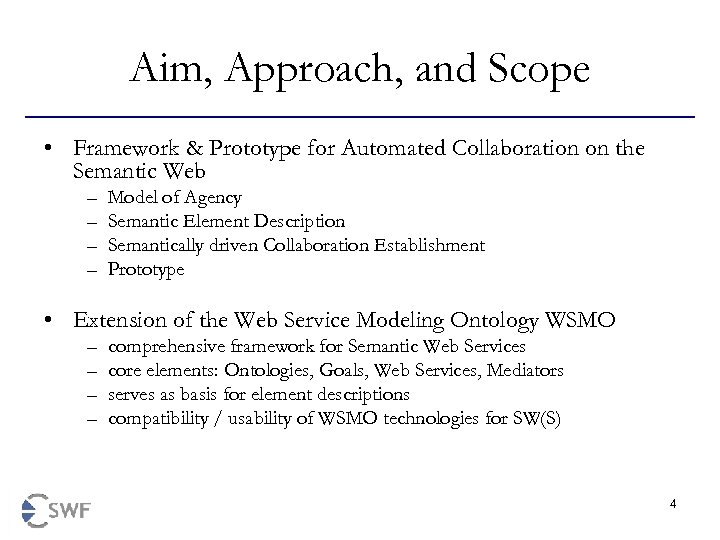
Aim, Approach, and Scope • Framework & Prototype for Automated Collaboration on the Semantic Web – – Model of Agency Semantic Element Description Semantically driven Collaboration Establishment Prototype • Extension of the Web Service Modeling Ontology WSMO – – comprehensive framework for Semantic Web Services core elements: Ontologies, Goals, Web Services, Mediators serves as basis for element descriptions compatibility / usability of WSMO technologies for SW(S) 4
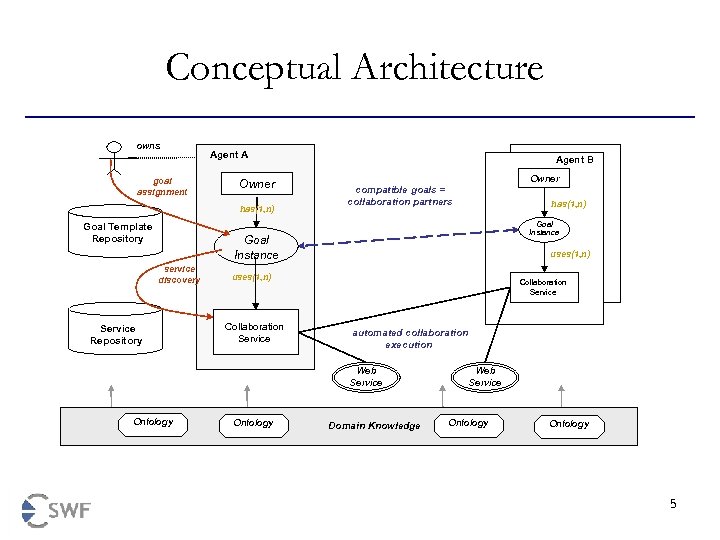
Conceptual Architecture owns goal assignment Agent A Owner has(1, n) Goal Template Repository Agent B Owner compatible goals = collaboration partners has(1, n) Goal Instance service discovery Service Repository uses(1, n) Collaboration Service automated collaboration execution Web Service Ontology Domain Knowledge Web Service Ontology 5
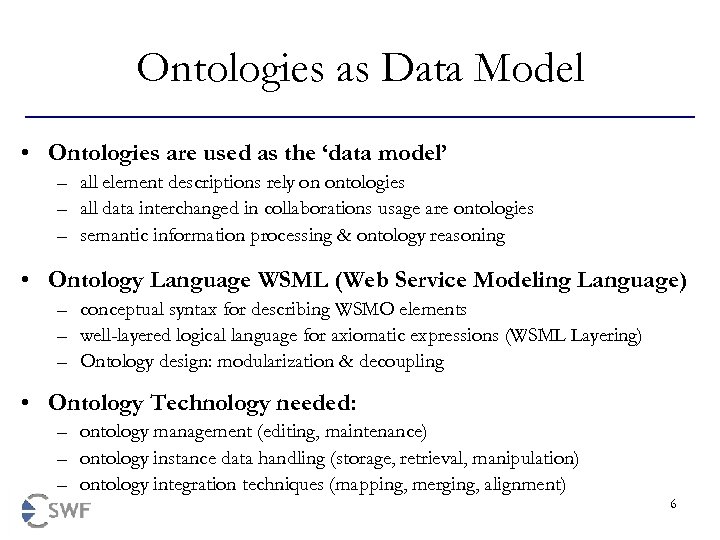
Ontologies as Data Model • Ontologies are used as the ‘data model’ – all element descriptions rely on ontologies – all data interchanged in collaborations usage are ontologies – semantic information processing & ontology reasoning • Ontology Language WSML (Web Service Modeling Language) – conceptual syntax for describing WSMO elements – well-layered logical language for axiomatic expressions (WSML Layering) – Ontology design: modularization & decoupling • Ontology Technology needed: – ontology management (editing, maintenance) – ontology instance data handling (storage, retrieval, manipulation) – ontology integration techniques (mapping, merging, alignment) 6
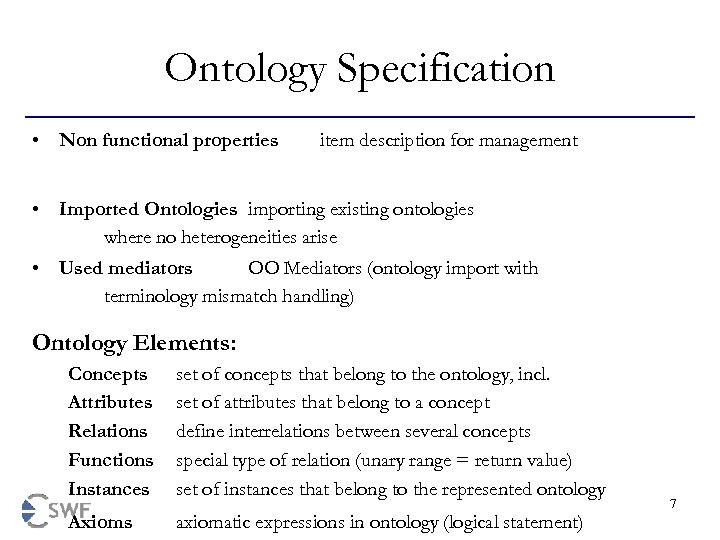
Ontology Specification • Non functional properties item description for management • Imported Ontologies importing existing ontologies where no heterogeneities arise • Used mediators OO Mediators (ontology import with terminology mismatch handling) Ontology Elements: Concepts Attributes Relations Functions Instances set of concepts that belong to the ontology, incl. set of attributes that belong to a concept define interrelations between several concepts special type of relation (unary range = return value) set of instances that belong to the represented ontology Axioms axiomatic expressions in ontology (logical statement) 7
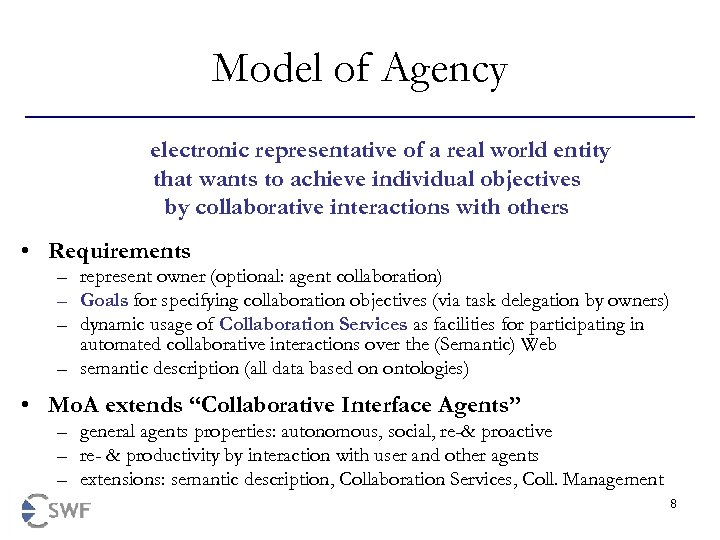
Model of Agency electronic representative of a real world entity that wants to achieve individual objectives by collaborative interactions with others • Requirements – represent owner (optional: agent collaboration) – Goals for specifying collaboration objectives (via task delegation by owners) – dynamic usage of Collaboration Services as facilities for participating in automated collaborative interactions over the (Semantic) Web – semantic description (all data based on ontologies) • Mo. A extends “Collaborative Interface Agents” – general agents properties: autonomous, social, re-& proactive – re- & productivity by interaction with user and other agents – extensions: semantic description, Collaboration Services, Coll. Management 8
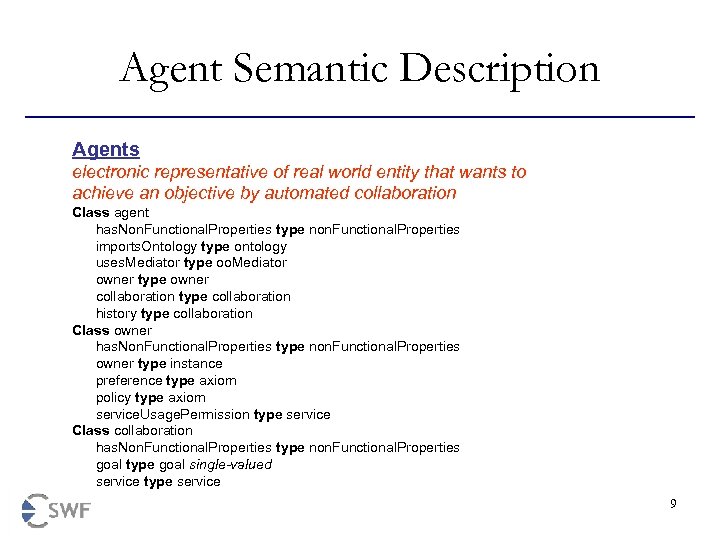
Agent Semantic Description Agents electronic representative of real world entity that wants to achieve an objective by automated collaboration Class agent has. Non. Functional. Properties type non. Functional. Properties imports. Ontology type ontology uses. Mediator type oo. Mediator owner type owner collaboration type collaboration history type collaboration Class owner has. Non. Functional. Properties type non. Functional. Properties owner type instance preference type axiom policy type axiom service. Usage. Permission type service Class collaboration has. Non. Functional. Properties type non. Functional. Properties goal type goal single-valued service type service 9
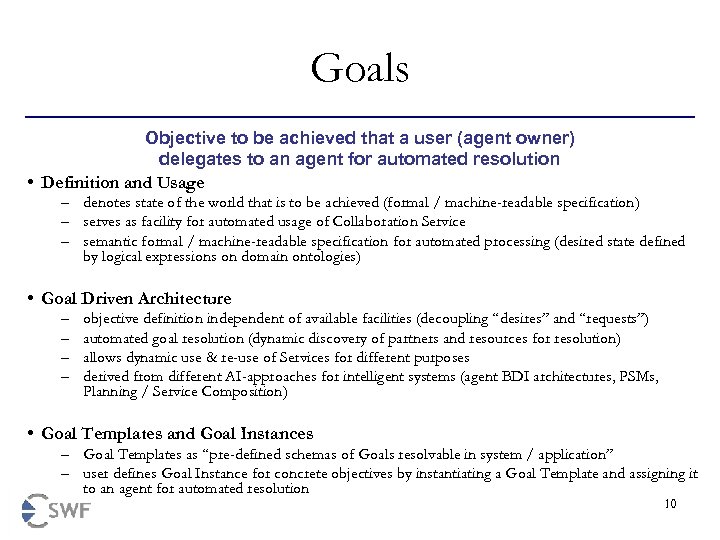
Goals Objective to be achieved that a user (agent owner) delegates to an agent for automated resolution • Definition and Usage – denotes state of the world that is to be achieved (formal / machine-readable specification) – serves as facility for automated usage of Collaboration Service – semantic formal / machine-readable specification for automated processing (desired state defined by logical expressions on domain ontologies) • Goal Driven Architecture – – objective definition independent of available facilities (decoupling “desires” and “requests”) automated goal resolution (dynamic discovery of partners and resources for resolution) allows dynamic use & re-use of Services for different purposes derived from different AI-approaches for intelligent systems (agent BDI architectures, PSMs, Planning / Service Composition) • Goal Templates and Goal Instances – Goal Templates as “pre-defined schemas of Goals resolvable in system / application” – user defines Goal Instance for concrete objectives by instantiating a Goal Template and assigning it to an agent for automated resolution 10
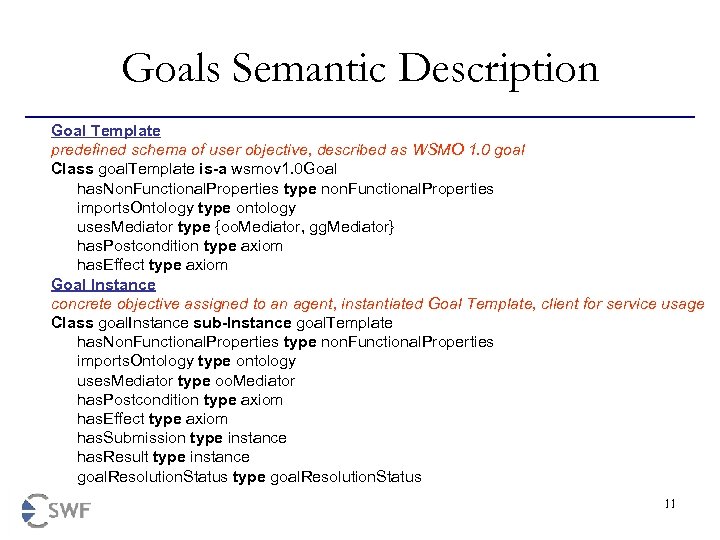
Goals Semantic Description Goal Template predefined schema of user objective, described as WSMO 1. 0 goal Class goal. Template is-a wsmov 1. 0 Goal has. Non. Functional. Properties type non. Functional. Properties imports. Ontology type ontology uses. Mediator type {oo. Mediator, gg. Mediator} has. Postcondition type axiom has. Effect type axiom Goal Instance concrete objective assigned to an agent, instantiated Goal Template, client for service usage Class goal. Instance sub-Instance goal. Template has. Non. Functional. Properties type non. Functional. Properties imports. Ontology type ontology uses. Mediator type oo. Mediator has. Postcondition type axiom has. Effect type axiom has. Submission type instance has. Result type instance goal. Resolution. Status type goal. Resolution. Status 11
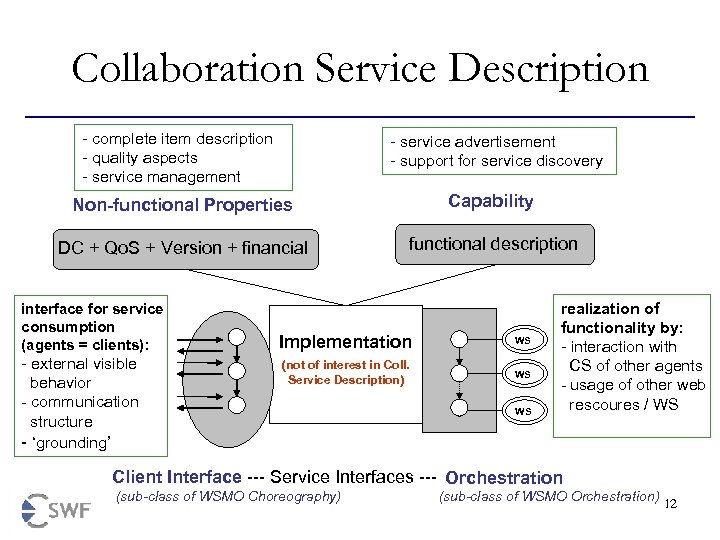
Collaboration Service Description - complete item description - quality aspects - service management - service advertisement - support for service discovery Non-functional Properties Capability DC + Qo. S + Version + financial functional description interface for service consumption (agents = clients): - external visible behavior - communication structure - ‘grounding’ Implementation WS (not of interest in Coll. Service Description) WS WS realization of functionality by: - interaction with CS of other agents - usage of other web rescoures / WS Client Interface --- Service Interfaces --- Orchestration (sub-class of WSMO Choreography) (sub-class of WSMO Orchestration) 12
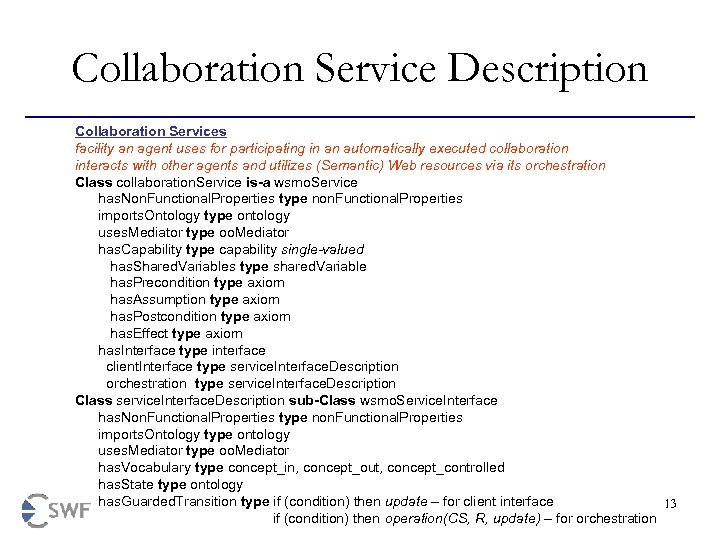
Collaboration Service Description Collaboration Services facility an agent uses for participating in an automatically executed collaboration interacts with other agents and utilizes (Semantic) Web resources via its orchestration Class collaboration. Service is-a wsmo. Service has. Non. Functional. Properties type non. Functional. Properties imports. Ontology type ontology uses. Mediator type oo. Mediator has. Capability type capability single-valued has. Shared. Variables type shared. Variable has. Precondition type axiom has. Assumption type axiom has. Postcondition type axiom has. Effect type axiom has. Interface type interface client. Interface type service. Interface. Description orchestration type service. Interface. Description Class service. Interface. Description sub-Class wsmo. Service. Interface has. Non. Functional. Properties type non. Functional. Properties imports. Ontology type ontology uses. Mediator type oo. Mediator has. Vocabulary type concept_in, concept_out, concept_controlled has. State type ontology has. Guarded. Transition type if (condition) then update – for client interface 13 if (condition) then operation(CS, R, update) – for orchestration
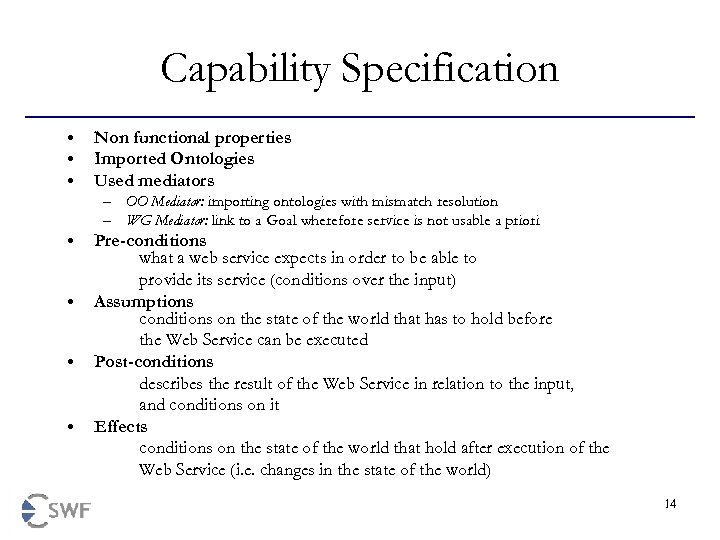
Capability Specification • • • Non functional properties Imported Ontologies Used mediators – OO Mediator: importing ontologies with mismatch resolution – WG Mediator: link to a Goal wherefore service is not usable a priori • • Pre-conditions what a web service expects in order to be able to provide its service (conditions over the input) Assumptions conditions on the state of the world that has to hold before the Web Service can be executed Post-conditions describes the result of the Web Service in relation to the input, and conditions on it Effects conditions on the state of the world that hold after execution of the Web Service (i. e. changes in the state of the world) 14
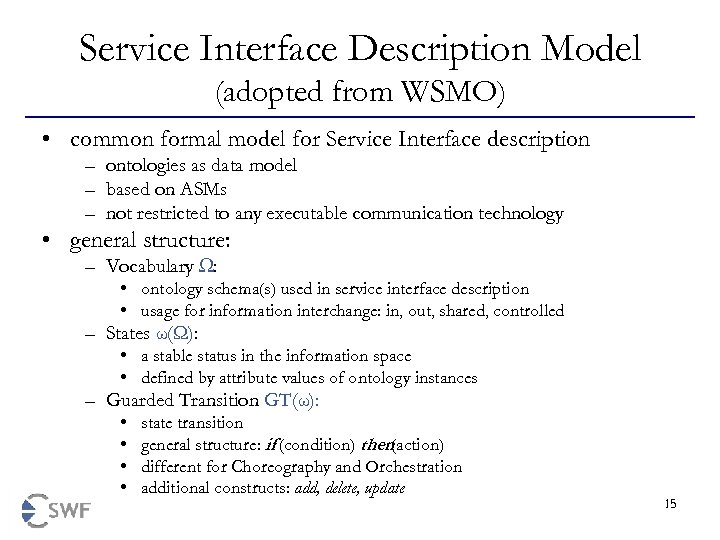
Service Interface Description Model (adopted from WSMO) • common formal model for Service Interface description – ontologies as data model – based on ASMs – not restricted to any executable communication technology • general structure: – Vocabulary Ω: • ontology schema(s) used in service interface description • usage for information interchange: in, out, shared, controlled – States ω(Ω): • a stable status in the information space • defined by attribute values of ontology instances – Guarded Transition GT(ω): • • state transition general structure: if (condition) then(action) different for Choreography and Orchestration additional constructs: add, delete, update 15
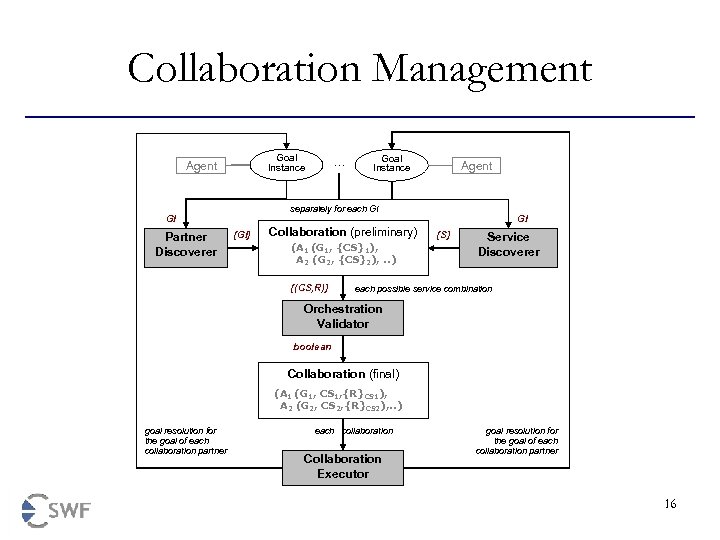
Collaboration Management Goal Instance Agent separately for each GI GI Partner Discoverer … {GI} Collaboration (preliminary) (A 1 (G 1, {CS}1), A 2 (G 2, {CS}2), . . ) {(CS, R)} GI {S} Service Discoverer each possible service combination Orchestration Validator boolean Collaboration (final) (A 1 (G 1, CS 1, {R}CS 1), A 2 (G 2, CS 2, {R}CS 2), . . ) goal resolution for the goal of each collaboration partner each collaboration Collaboration Executor goal resolution for the goal of each collaboration partner 16
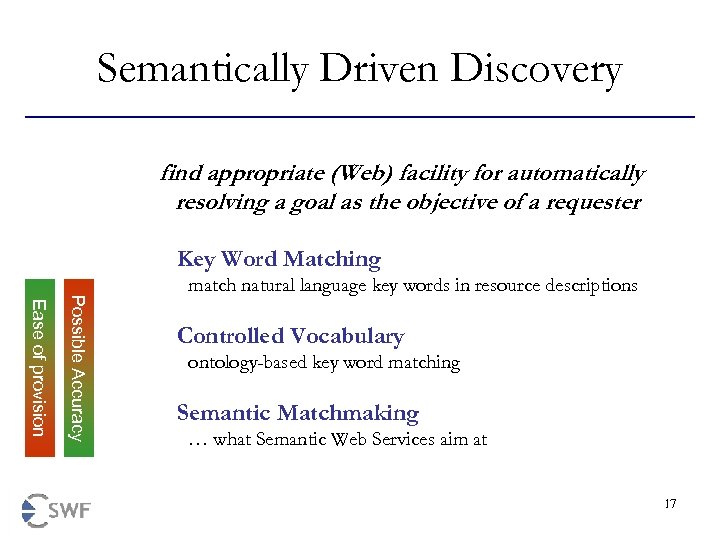
Semantically Driven Discovery find appropriate (Web) facility for automatically resolving a goal as the objective of a requester Key Word Matching Ease of provision Possible Accuracy match natural language key words in resource descriptions Controlled Vocabulary ontology-based key word matching Semantic Matchmaking … what Semantic Web Services aim at 17
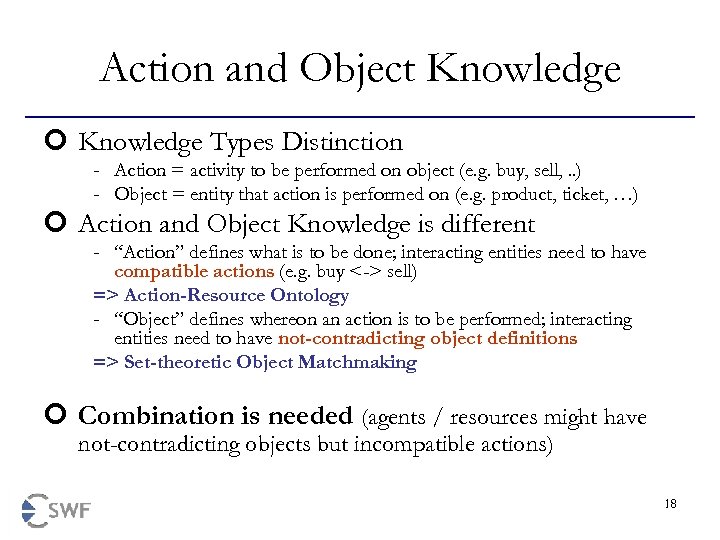
Action and Object Knowledge ¢ Knowledge Types Distinction - Action = activity to be performed on object (e. g. buy, sell, . . ) - Object = entity that action is performed on (e. g. product, ticket, …) ¢ Action and Object Knowledge is different - “Action” defines what is to be done; interacting entities need to have compatible actions (e. g. buy <-> sell) => Action-Resource Ontology - “Object” defines whereon an action is to be performed; interacting entities need to have not-contradicting object definitions => Set-theoretic Object Matchmaking ¢ Combination is needed (agents / resources might have not-contradicting objects but incompatible actions) 18
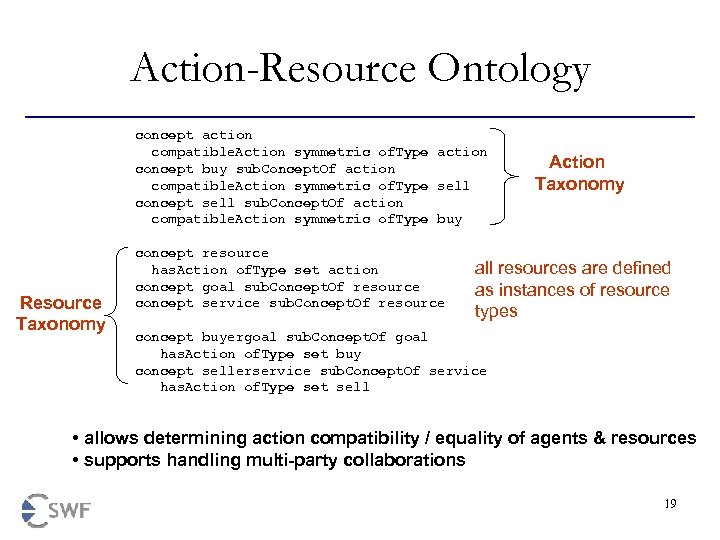
Action-Resource Ontology concept action compatible. Action symmetric of. Type action concept buy sub. Concept. Of action compatible. Action symmetric of. Type sell concept sell sub. Concept. Of action compatible. Action symmetric of. Type buy Resource Taxonomy concept resource has. Action of. Type set action concept goal sub. Concept. Of resource concept service sub. Concept. Of resource Action Taxonomy all resources are defined as instances of resource types concept buyergoal sub. Concept. Of goal has. Action of. Type set buy concept sellerservice sub. Concept. Of service has. Action of. Type set sell • allows determining action compatibility / equality of agents & resources • supports handling multi-party collaborations 19
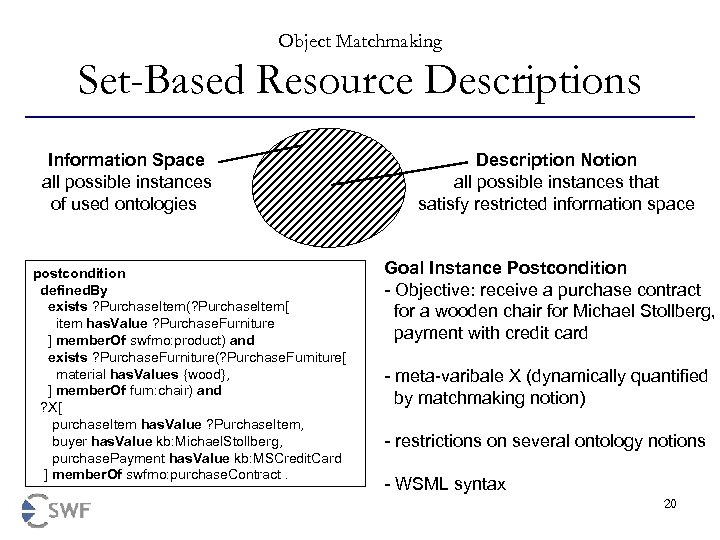
Object Matchmaking Set-Based Resource Descriptions Information Space all possible instances of used ontologies postcondition defined. By exists ? Purchase. Item(? Purchase. Item[ item has. Value ? Purchase. Furniture ] member. Of swfmo: product) and exists ? Purchase. Furniture(? Purchase. Furniture[ material has. Values {wood}, ] member. Of furn: chair) and ? X[ purchase. Item has. Value ? Purchase. Item, buyer has. Value kb: Michael. Stollberg, purchase. Payment has. Value kb: MSCredit. Card ] member. Of swfmo: purchase. Contract. Description Notion all possible instances that satisfy restricted information space Goal Instance Postcondition - Objective: receive a purchase contract for a wooden chair for Michael Stollberg, payment with credit card - meta-varibale X (dynamically quantified by matchmaking notion) - restrictions on several ontology notions - WSML syntax 20
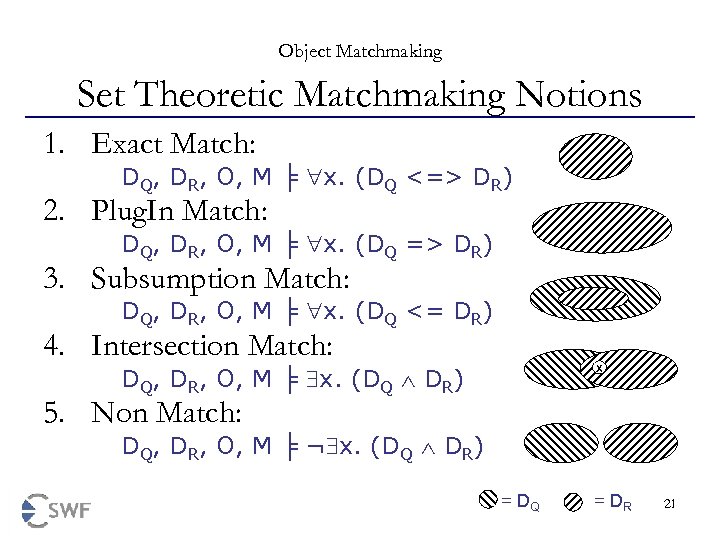
Object Matchmaking Set Theoretic Matchmaking Notions 1. Exact Match: DQ, DR, O, M ╞ x. (DQ <=> DR) 2. Plug. In Match: DQ, DR, O, M ╞ x. (DQ => DR) 3. Subsumption Match: DQ, DR, O, M ╞ x. (DQ <= DR) 4. Intersection Match: DQ, DR, O, M ╞ x. (DQ DR) X 5. Non Match: DQ, DR, O, M ╞ ¬ x. (DQ DR) = DQ = DR 21
Realization in VAMPIRE Structure of a Proof Obligation for discovery 1. Needed Knowledge Resources - 2. Resource Description notion to be matched - 3. include Ontology Theory and Universe Knowledge Base optionally Request Resource & Result Resource Only those notions that are to be matched Object Matchmaking notion - Include as specified in the Discovery Request => easy to generate dynamically 22
Collaboration Establishment Components • • • run independently, invoked by agents realize semantic discovery techniques Design Principles: 1. 2. 3. 4. Common Discoverer Architecture Modularized Functionality Layered Architecture (stepwise narrow search space) Reduction of expensive operations (efficiency) 23
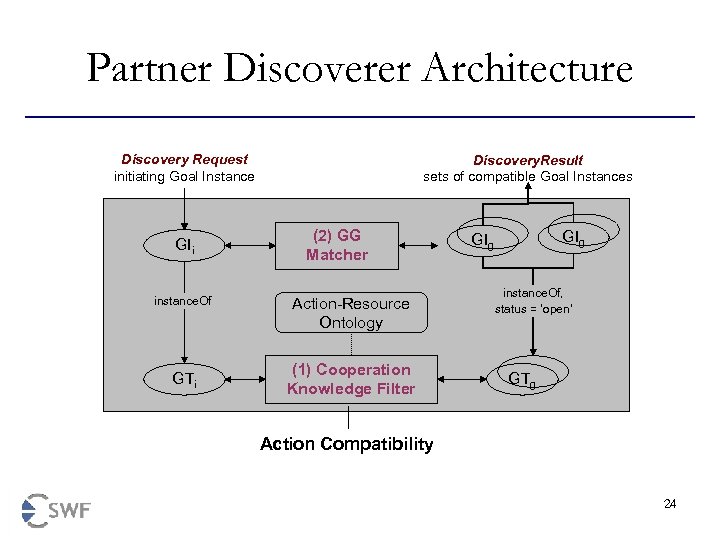
Partner Discoverer Architecture Discovery Request initiating Goal Instance GIi instance. Of GTi Discovery. Result sets of compatible Goal Instances (2) GG Matcher Action-Resource Ontology (1) Cooperation Knowledge Filter GIg instance. Of, status = ‘open’ GTg Action Compatibility 24
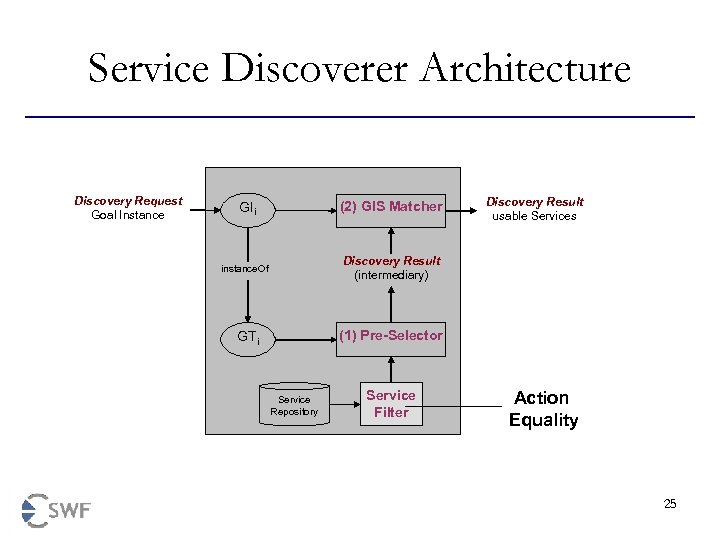
Service Discoverer Architecture Discovery Request Goal Instance (2) GIS Matcher GIi Discovery Result usable Services Discovery Result (intermediary) instance. Of (1) Pre-Selector GTi Service Repository Service Filter Action Equality 25
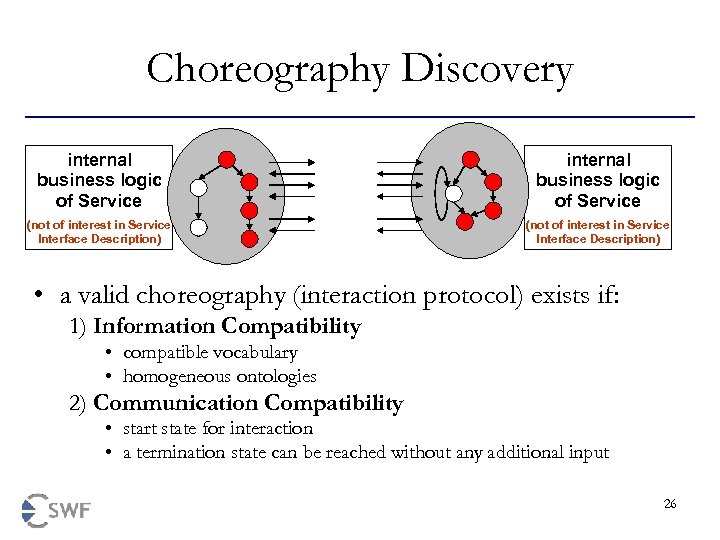
Choreography Discovery internal business logic of Service (not of interest in Service Interface Description) • a valid choreography (interaction protocol) exists if: 1) Information Compatibility • compatible vocabulary • homogeneous ontologies 2) Communication Compatibility • start state for interaction • a termination state can be reached without any additional input 26
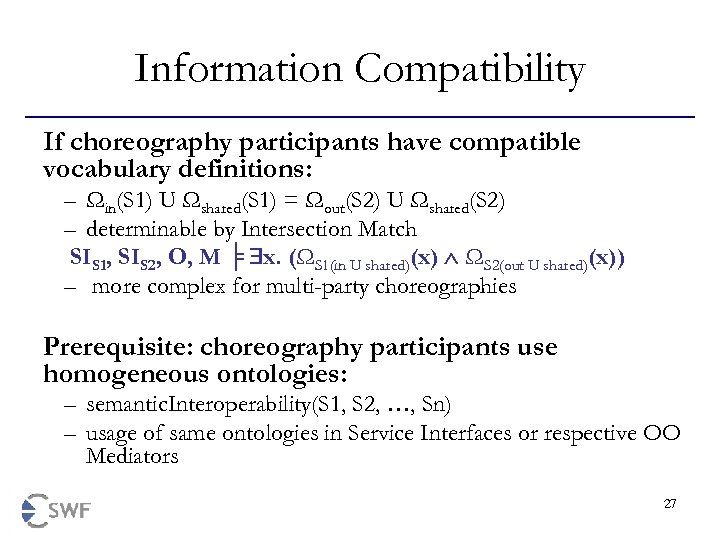
Information Compatibility If choreography participants have compatible vocabulary definitions: – Ωin(S 1) U Ωshared(S 1) = Ωout(S 2) U Ωshared(S 2) – determinable by Intersection Match SIS 1, SIS 2, O, M ╞ x. (ΩS 1(in U shared)(x) ΩS 2(out U shared)(x)) – more complex for multi-party choreographies Prerequisite: choreography participants use homogeneous ontologies: – semantic. Interoperability(S 1, S 2, …, Sn) – usage of same ontologies in Service Interfaces or respective OO Mediators 27
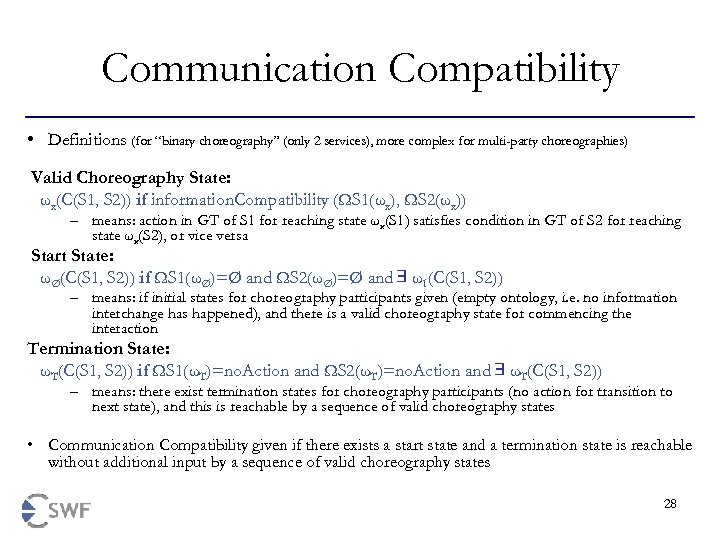
Communication Compatibility • Definitions (for “binary choreography” (only 2 services), more complex for multi-party choreographies) Valid Choreography State: ωx(C(S 1, S 2)) if information. Compatibility (ΩS 1(ωx), ΩS 2(ωx)) – means: action in GT of S 1 for reaching state ωx(S 1) satisfies condition in GT of S 2 for reaching state ωx(S 2), or vice versa Start State: ωØ(C(S 1, S 2)) if ΩS 1(ωØ)=Ø and ΩS 2(ωØ)=Ø and ω1(C(S 1, S 2)) – means: if initial states for choreography participants given (empty ontology, i. e. no information interchange has happened), and there is a valid choreography state for commencing the interaction Termination State: ωT(C(S 1, S 2)) if ΩS 1(ωT)=no. Action and ΩS 2(ωT)=no. Action and ωT(C(S 1, S 2)) – means: there exist termination states for choreography participants (no action for transition to next state), and this is reachable by a sequence of valid choreography states • Communication Compatibility given if there exists a start state and a termination state is reachable without additional input by a sequence of valid choreography states 28
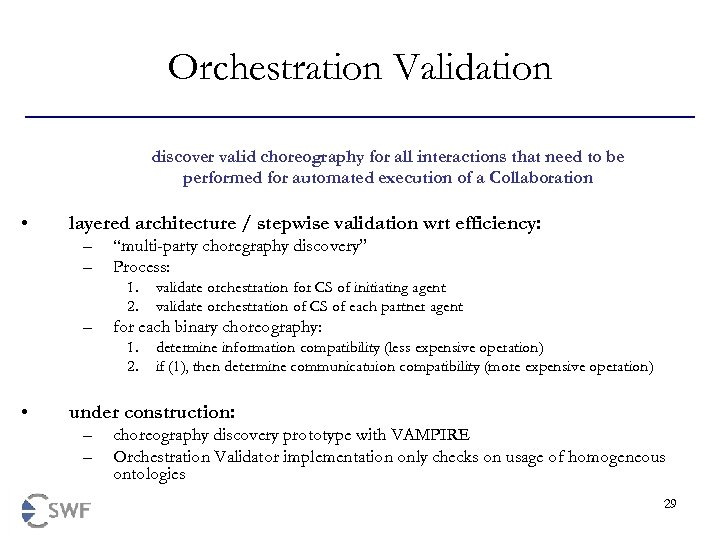
Orchestration Validation discover valid choreography for all interactions that need to be performed for automated execution of a Collaboration • layered architecture / stepwise validation wrt efficiency: – – “multi-party choregraphy discovery” Process: 1. 2. – for each binary choreography: 1. 2. • validate orchestration for CS of initiating agent validate orchestration of CS of each partner agent determine information compatibility (less expensive operation) if (1), then determine communicatuion compatibility (more expensive operation) under construction: – – choreography discovery prototype with VAMPIRE Orchestration Validator implementation only checks on usage of homogeneous ontologies 29
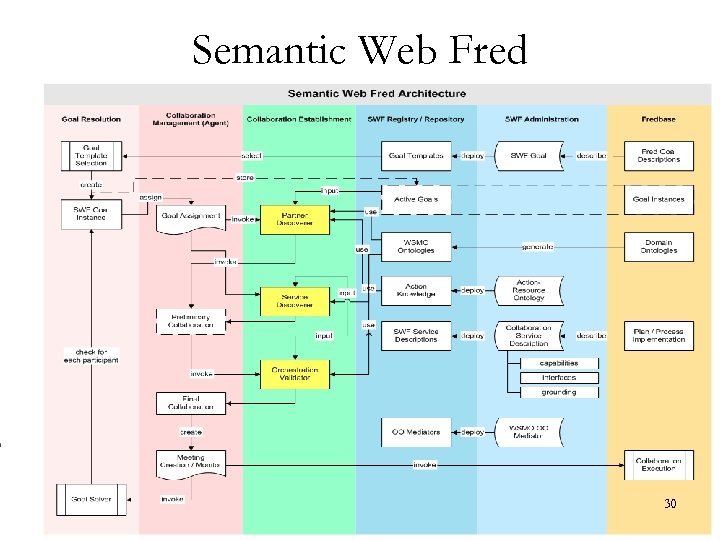
Semantic Web Fred 30
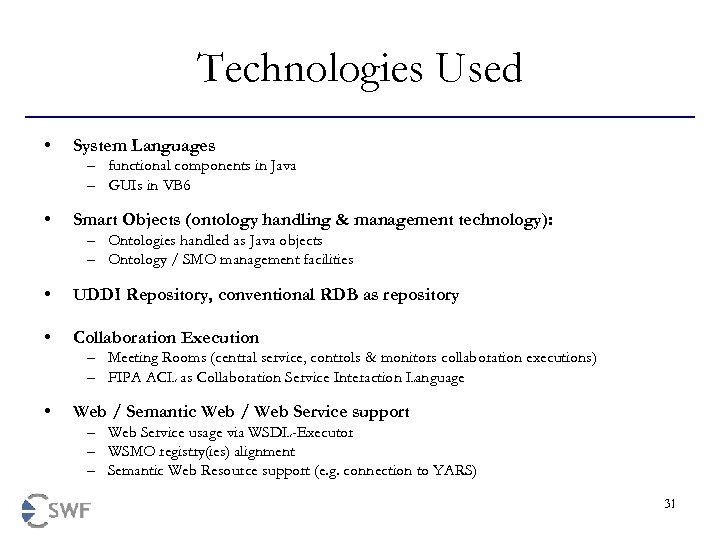
Technologies Used • System Languages – functional components in Java – GUIs in VB 6 • Smart Objects (ontology handling & management technology): – Ontologies handled as Java objects – Ontology / SMO management facilities • UDDI Repository, conventional RDB as repository • Collaboration Execution – Meeting Rooms (central service, controls & monitors collaboration executions) – FIPA ACL as Collaboration Service Interaction Language • Web / Semantic Web / Web Service support – Web Service usage via WSDL-Executor – WSMO registry(ies) alignment – Semantic Web Resource support (e. g. connection to YARS) 31
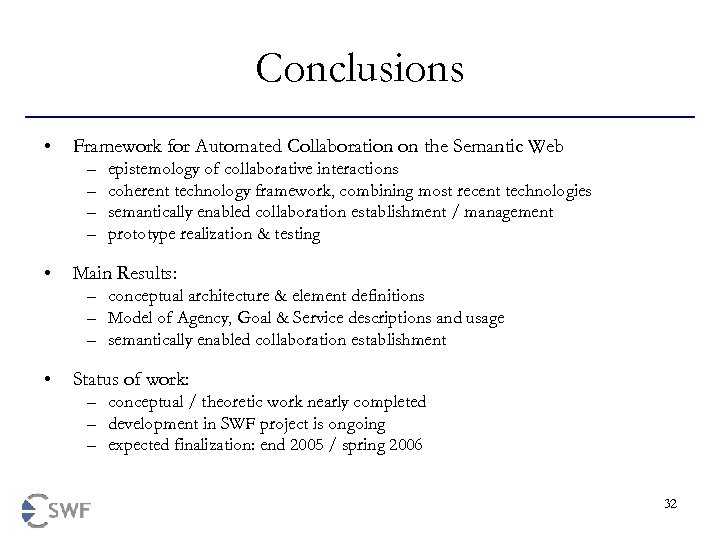
Conclusions • Framework for Automated Collaboration on the Semantic Web – – • epistemology of collaborative interactions coherent technology framework, combining most recent technologies semantically enabled collaboration establishment / management prototype realization & testing Main Results: – conceptual architecture & element definitions – Model of Agency, Goal & Service descriptions and usage – semantically enabled collaboration establishment • Status of work: – conceptual / theoretic work nearly completed – development in SWF project is ongoing – expected finalization: end 2005 / spring 2006 32
Relation to Web Engineering • WE aspects mostly in collaboration execution – – – Þ • Collaboration / Web Service invocation automated information interchange over Web decentralized / autonomous computation currently grounded to conventional Web (Service) technology (NOT what we want) insights in “Semantic Web Engineering”: 1. – – – “inference engines far away from industrial applicability” only limited / partial Reasoning Support tremendous deficiencies in stability, computation time, scalability Reasoning Requirements still unclear (light-weight object matchmaking vs. complex FOL reasoning) 2. – – – “hide logics from users and system developers” semantic descriptions by Knowledge Engineers exhaustive tool support required for users and system developers abandon logical expressivity if it hampers automation 33
Скачать презентацию Automated Collaboration on the Semantic Web Michael Stollberg
fa1613dbb2e77d6b2e16bd7b2cfff4a9.ppt