 Скачать презентацию Automated chronology building in speleothems Claire Smith 1
0f61f4f8e848ad5d6ffec8a04ab68383.ppt
- Количество слайдов: 1



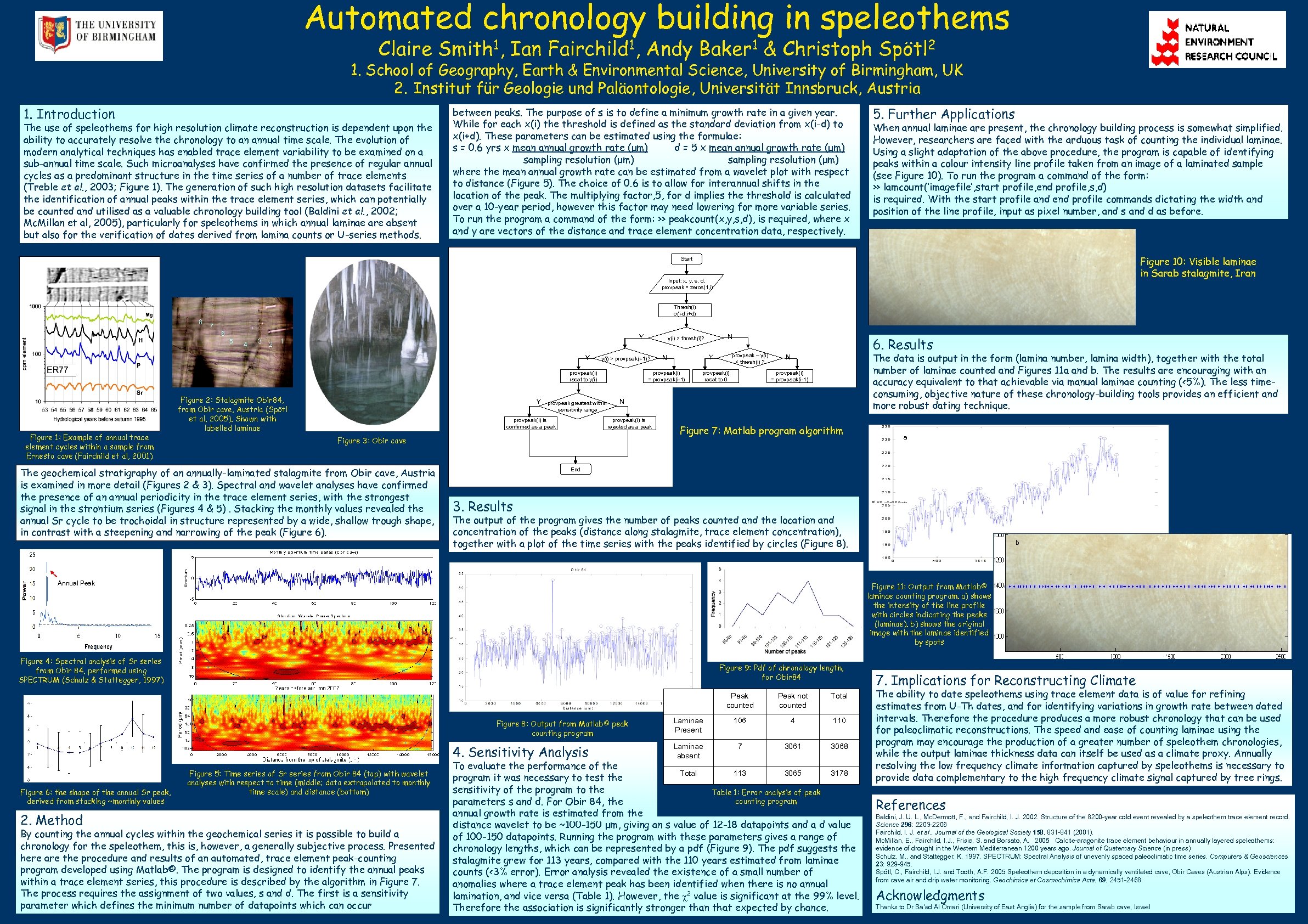
Automated chronology building in speleothems Claire Smith 1, Ian Fairchild 1, Andy Baker 1 & Christoph Spötl 2 1. School of Geography, Earth & Environmental Science, University of Birmingham, UK 2. Institut für Geologie und Paläontologie, Universität Innsbruck, Austria 1. Introduction The use of speleothems for high resolution climate reconstruction is dependent upon the ability to accurately resolve the chronology to an annual time scale. The evolution of modern analytical techniques has enabled trace element variability to be examined on a sub-annual time scale. Such microanalyses have confirmed the presence of regular annual cycles as a predominant structure in the time series of a number of trace elements (Treble et al. , 2003; Figure 1). The generation of such high resolution datasets facilitate the identification of annual peaks within the trace element series, which can potentially be counted and utilised as a valuable chronology building tool (Baldini et al. , 2002; Mc. Millan et al, 2005), particularly for speleothems in which annual laminae are absent but also for the verification of dates derived from lamina counts or U-series methods. between peaks. The purpose of s is to define a minimum growth rate in a given year. While for each x(i) the threshold is defined as the standard deviation from x(i-d) to x(i+d). These parameters can be estimated using the formulae: s = 0. 6 yrs x mean annual growth rate (μm) d = 5 x mean annual growth rate (μm) sampling resolution (μm) where the mean annual growth rate can be estimated from a wavelet plot with respect to distance (Figure 5). The choice of 0. 6 is to allow for interannual shifts in the location of the peak. The multiplying factor, 5, for d implies the threshold is calculated over a 10 -year period, however this factor may need lowering for more variable series. To run the program a command of the form: >> peakcount(x, y, s, d), is required, where x and y are vectors of the distance and trace element concentration data, respectively. 5. Further Applications When annual laminae are present, the chronology building process is somewhat simplified. However, researchers are faced with the arduous task of counting the individual laminae. Using a slight adaptation of the above procedure, the program is capable of identifying peaks within a colour intensity line profile taken from an image of a laminated sample (see Figure 10). To run the program a command of the form: >> lamcount(‘imagefile’, start profile, end profile, s, d) is required. With the start profile and end profile commands dictating the width and position of the line profile, input as pixel number, and s and d as before. Figure 10: Visible laminae in Sarab stalagmite, Iran Start Input: x, y, s, d, provpeak = zeros(1, i) Thresh(i) σ(i-d: i+d) 8 7 6 5 4 3 2 Y 1 Y y(i) > provpeak(i-1)? provpeak(i) reset to y(i) Figure 1: Example of annual trace element cycles within a sample from Ernesto cave (Fairchild et al, 2001) Figure 2: Stalagmite Obir 84, from Obir cave, Austria (Spötl et al, 2005). Shown with labelled laminae Y provpeak greatest within sensitivity range provpeak(i) is confirmed as a peak provpeak – y(i) < thresh(i) ? Y N provpeak(i) = provpeak(i-1) provpeak(i) reset to 0 6. Results The data is output in the form (lamina number, lamina width), together with the total number of laminae counted and Figures 11 a and b. The results are encouraging with an accuracy equivalent to that achievable via manual laminae counting (<5%). The less timeconsuming, objective nature of these chronology-building tools provides an efficient and more robust dating technique. N provpeak(i) = provpeak(i-1) N provpeak(i) is rejected as a peak Figure 3: Obir cave The geochemical stratigraphy of an annually-laminated stalagmite from Obir cave, Austria is examined in more detail (Figures 2 & 3). Spectral and wavelet analyses have confirmed the presence of an annual periodicity in the trace element series, with the strongest signal in the strontium series (Figures 4 & 5). Stacking the monthly values revealed the annual Sr cycle to be trochoidal in structure represented by a wide, shallow trough shape, in contrast with a steepening and narrowing of the peak (Figure 6). N y(i) > thresh(i)? Figure 7: Matlab program algorithm End 3. Results The output of the program gives the number of peaks counted and the location and concentration of the peaks (distance along stalagmite, trace element concentration), together with a plot of the time series with the peaks identified by circles (Figure 8). Annual Peak Figure 9: Pdf of chronology length, for Obir 84 Peak counted Figure 8: Output from Matlab© peak counting program 4. Sensitivity Analysis 2. Method b b Figure 11: Output from Matlab© laminae counting program. a) shows the intensity of the line profile with circles indicating the peaks (laminae). b) shows the original image with the laminae identified by spots Figure 4: Spectral analysis of Sr series from Obir 84, performed using SPECTRUM (Schulz & Stattegger, 1997) Figure 6: the shape of the annual Sr peak, derived from stacking ~monthly values a Figure 5: Time series of Sr series from Obir 84 (top) with wavelet analyses with respect to time (middle; data extrapolated to monthly time scale) and distance (bottom) By counting the annual cycles within the geochemical series it is possible to build a chronology for the speleothem, this is, however, a generally subjective process. Presented here are the procedure and results of an automated, trace element peak-counting program developed using Matlab©. The program is designed to identify the annual peaks within a trace element series, this procedure is described by the algorithm in Figure 7. The process requires the assignment of two values, s and d. The first is a sensitivity parameter which defines the minimum number of datapoints which can occur Peak not counted Total Laminae Present 106 4 110 Laminae absent 7 3061 3068 To evaluate the performance of the Total 113 3065 3178 program it was necessary to test the sensitivity of the program to the Table 1: Error analysis of peak counting program parameters s and d. For Obir 84, the annual growth rate is estimated from the distance wavelet to be ~100 -150 μm, giving an s value of 12 -18 datapoints and a d value of 100 -150 datapoints. Running the program with these parameters gives a range of chronology lengths, which can be represented by a pdf (Figure 9). The pdf suggests the stalagmite grew for 113 years, compared with the 110 years estimated from laminae counts (<3% error). Error analysis revealed the existence of a small number of anomalies where a trace element peak has been identified when there is no annual lamination, and vice versa (Table 1). However, the χ2 value is significant at the 99% level. Therefore the association is significantly stronger than that expected by chance. 7. Implications for Reconstructing Climate The ability to date speleothems using trace element data is of value for refining estimates from U-Th dates, and for identifying variations in growth rate between dated intervals. Therefore the procedure produces a more robust chronology that can be used for paleoclimatic reconstructions. The speed and ease of counting laminae using the program may encourage the production of a greater number of speleothem chronologies, while the output laminae thickness data can itself be used as a climate proxy. Annually resolving the low frequency climate information captured by speleothems is necessary to provide data complementary to the high frequency climate signal captured by tree rings. References Baldini, J. U. L. , Mc. Dermott, F. , and Fairchild, I. J. 2002. Structure of the 8200 -year cold event revealed by a speleothem trace element record. Science 296: 2203 -2206 Fairchild, I. J. et al. , Journal of the Geological Society 158, 831 -841 (2001). Mc. Millan, E. , Fairchild, I. J. , Frisia, S. and Borsato, A. 2005 Calcite-aragonite trace element behaviour in annually layered speleothems: evidence of drought in the Western Mediterranean 1200 years ago. Journal of Quaternary Science (in press) Schulz, M. , and Stattegger, K. 1997. SPECTRUM: Spectral Analysis of unevenly spaced paleoclimatic time series. Computers & Geosciences 23: 929 -945. Spötl, C. , Fairchild, I. J. and Tooth, A. F. 2005 Speleothem deposition in a dynamically ventilated cave, Obir Caves (Austrian Alps). Evidence from cave air and drip water monitoring. Geochimica et Cosmochimica Acta, 69, 2451 -2468. Acknowledgments Thanks to Dr Sa’ad Al Omari (University of East Anglia) for the sample from Sarab cave, Israel
Скачать презентацию Automated chronology building in speleothems Claire Smith 1
0f61f4f8e848ad5d6ffec8a04ab68383.ppt