 Скачать презентацию Automated Changes of Problem Representation Eugene Fink LTI
b6022e26036f0bc6af808b193df1909c.ppt
- Количество слайдов: 28



Automated Changes of Problem Representation Eugene Fink LTI Retreat 2007
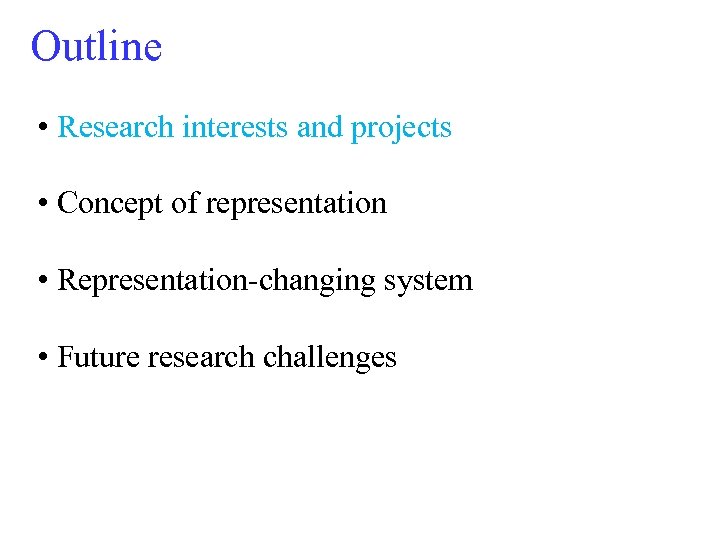
Outline • Research interests and projects • Concept of representation • Representation-changing system • Future research challenges
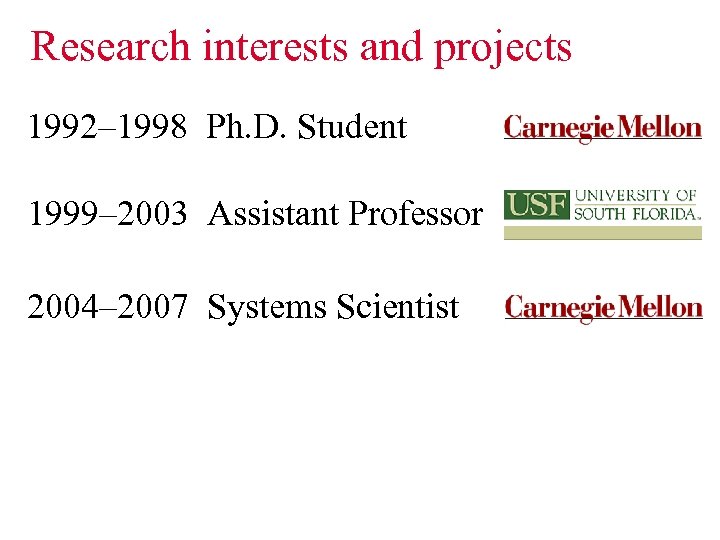
Research interests and projects 1992– 1998 Ph. D. Student 1999– 2003 Assistant Professor 2004– 2007 Systems Scientist
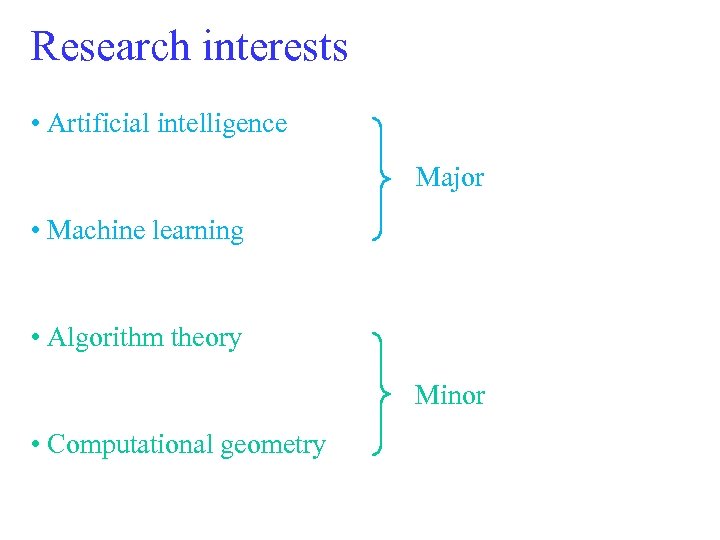
Research interests • Artificial intelligence Major • Machine learning • Algorithm theory Minor • Computational geometry
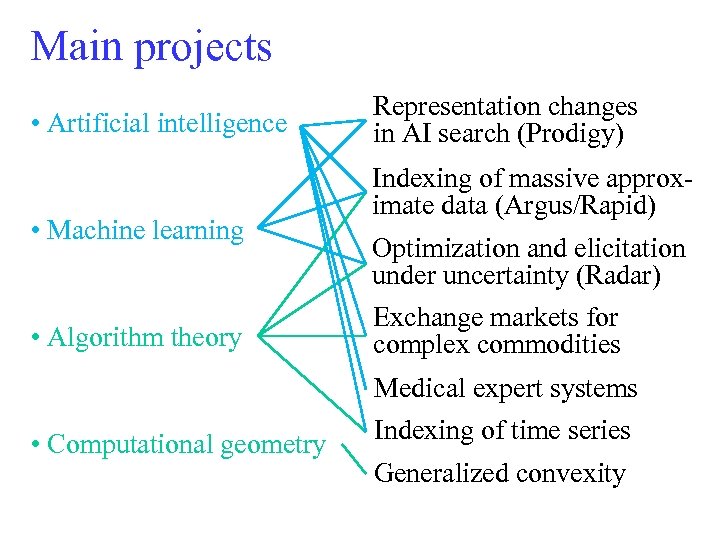
Main projects • Artificial intelligence • Machine learning • Algorithm theory Representation changes in AI search (Prodigy) Indexing of massive approximate data (Argus/Rapid) Optimization and elicitation under uncertainty (Radar) Exchange markets for complex commodities Medical expert systems • Computational geometry Indexing of time series Generalized convexity
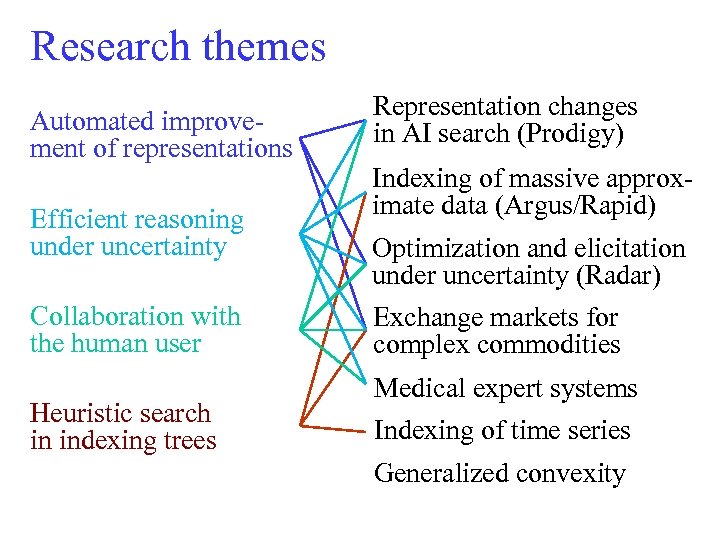
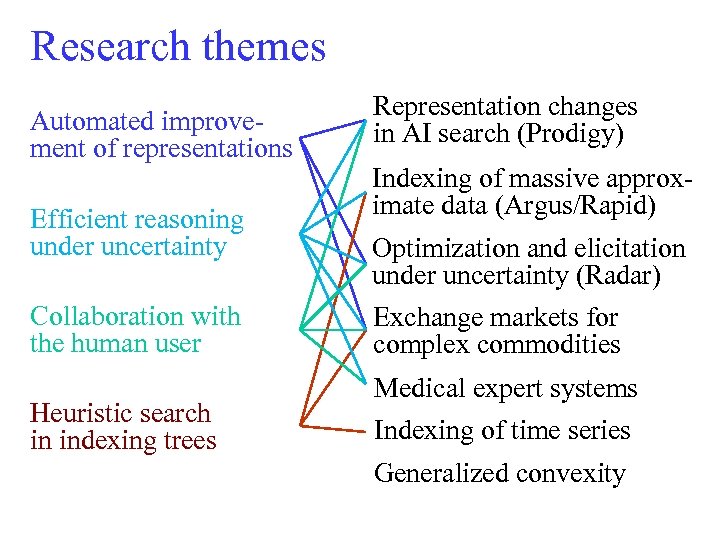
Research themes Automated improvement of representations Efficient reasoning under uncertainty Collaboration with the human user Heuristic search in indexing trees Representation changes in AI search (Prodigy) Indexing of massive approximate data (Argus/Rapid) Optimization and elicitation under uncertainty (Radar) Exchange markets for complex commodities Medical expert systems Indexing of time series Generalized convexity
Research themes Automated improvement of representations Efficient reasoning under uncertainty Collaboration with the human user Heuristic search in indexing trees Representation changes in AI search (Prodigy) Indexing of massive approximate data (Argus/Rapid) Optimization and elicitation under uncertainty (Radar) Exchange markets for complex commodities Medical expert systems Indexing of time series Generalized convexity
Outline • Research interests and projects • Concept of representation • Representation-changing system • Future research challenges
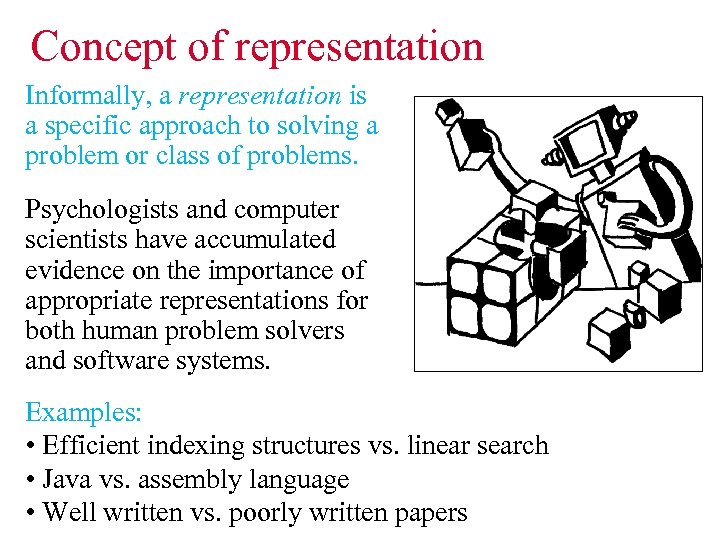
Concept of representation Informally, a representation is a specific approach to solving a problem or class of problems. Psychologists and computer scientists have accumulated evidence on the importance of appropriate representations for both human problem solvers and software systems. Examples: • Efficient indexing structures vs. linear search • Java vs. assembly language • Well written vs. poorly written papers
Motivation When humans works on a complex problem, they may need to search for the right approach to the problem. The related AI challenge is to automated the search for the right approach. Aha!
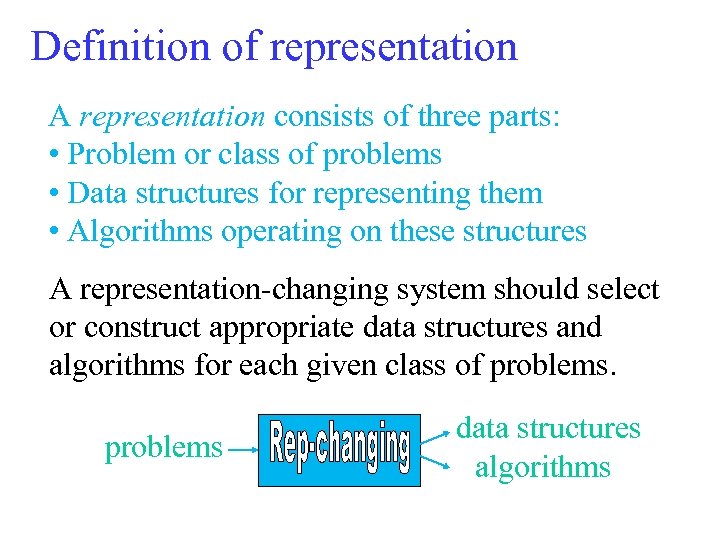
Definition of representation A representation consists of three parts: • Problem or class of problems • Data structures for representing them • Algorithms operating on these structures A representation-changing system should select or construct appropriate data structures and algorithms for each given class of problems data structures algorithms
Outline • Research interests and projects • Concept of representation • Representation-changing system • Future research challenges
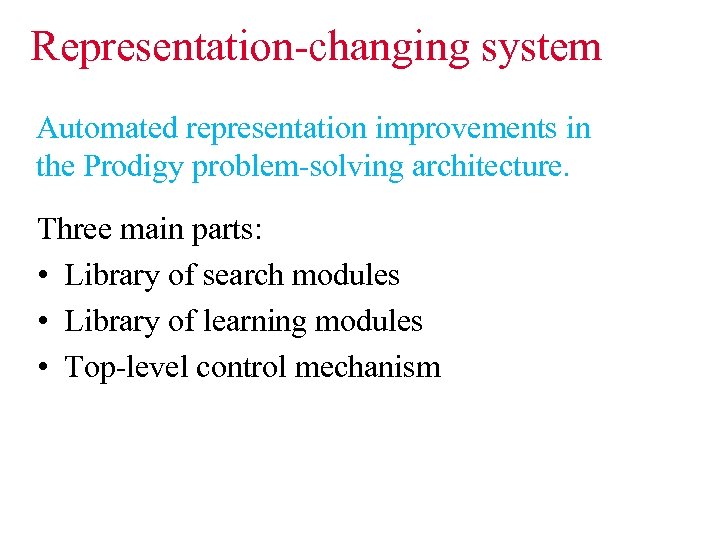
Representation-changing system Automated representation improvements in the Prodigy problem-solving architecture. Three main parts: • Library of search modules • Library of learning modules • Top-level control mechanism

Architecture
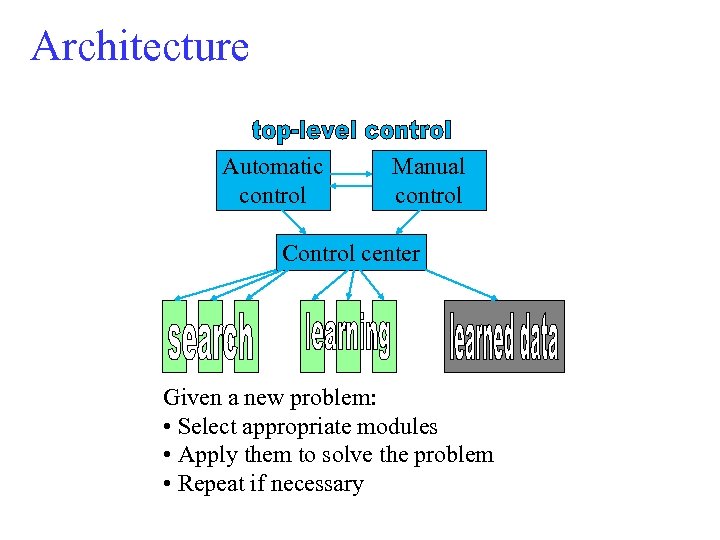
Architecture Automatic control Manual control Control center Given a new problem: • Select appropriate modules • Apply them to solve the problem • Repeat if necessary
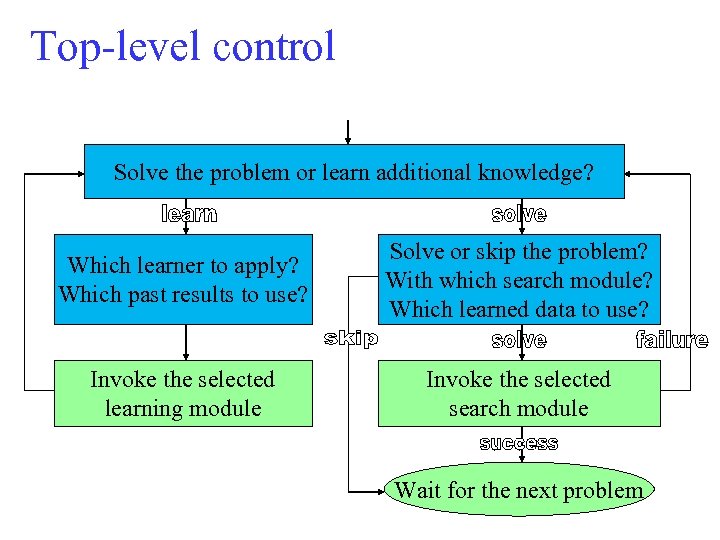
Top-level control Solve the problem or learn additional knowledge? Which learner to apply? Which past results to use? Solve or skip the problem? With which search module? Which learned data to use? Invoke the selected learning module Invoke the selected search module Wait for the next problem
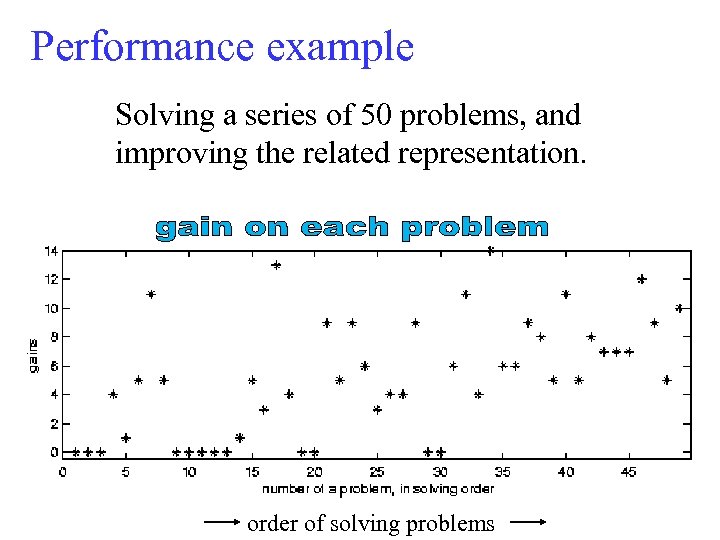
Performance example Solving a series of 50 problems, and improving the related representation. order of solving problems
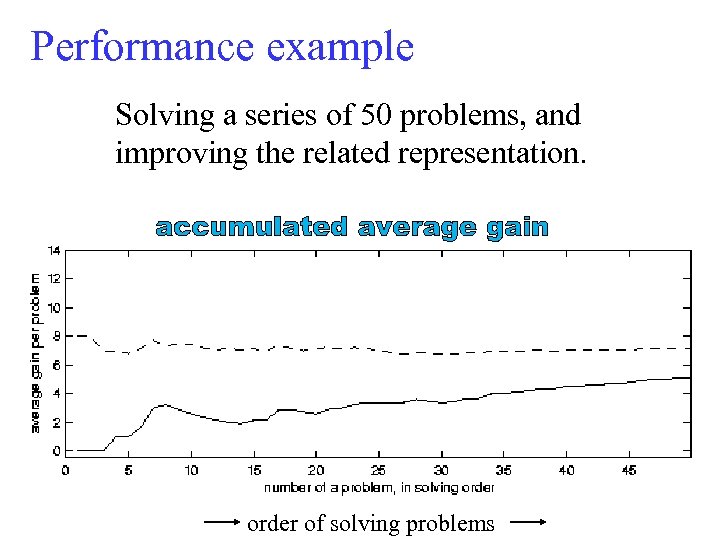
Performance example Solving a series of 50 problems, and improving the related representation. order of solving problems
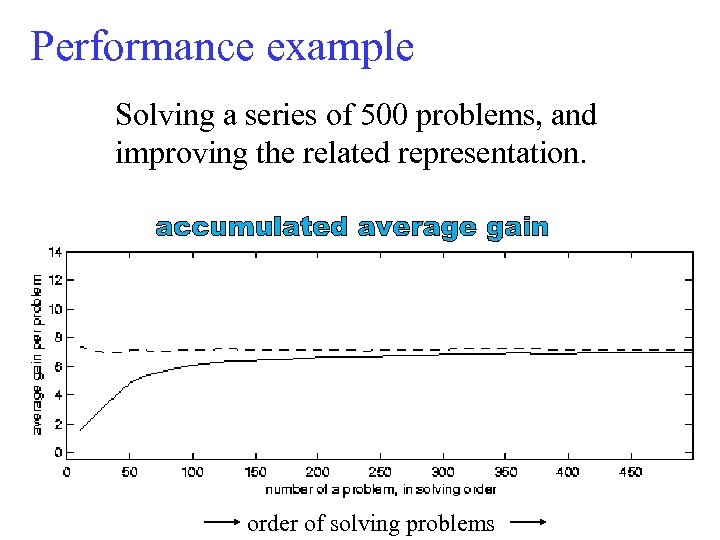
Performance example Solving a series of 500 problems, and improving the related representation. order of solving problems
Related publications • Eugene Fink. Changes of problem representation. Springer-Verlag, 2003. • Eugene Fink. Automatic evaluation and selection of problem solving methods. JETAI journal, 16(2), 2004. • Eugene Fink. Evaluation of representations. IEEE SMC conference, under review.
Applications • Exchange markets for complex commodities: Automated selection of indexing structures, depending on the type and number of orders • Elicitation under uncertainty (Radar): Automated selection among elicitation algorithms and related heuristics
Outline • Research interests and projects • Concept of representation • Representation-changing system • Future research challenges
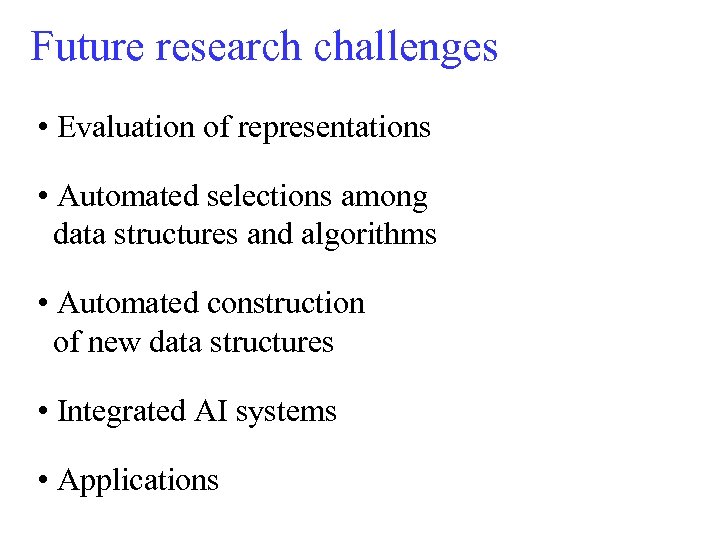
Future research challenges • Evaluation of representations • Automated selections among data structures and algorithms • Automated construction of new data structures • Integrated AI systems • Applications
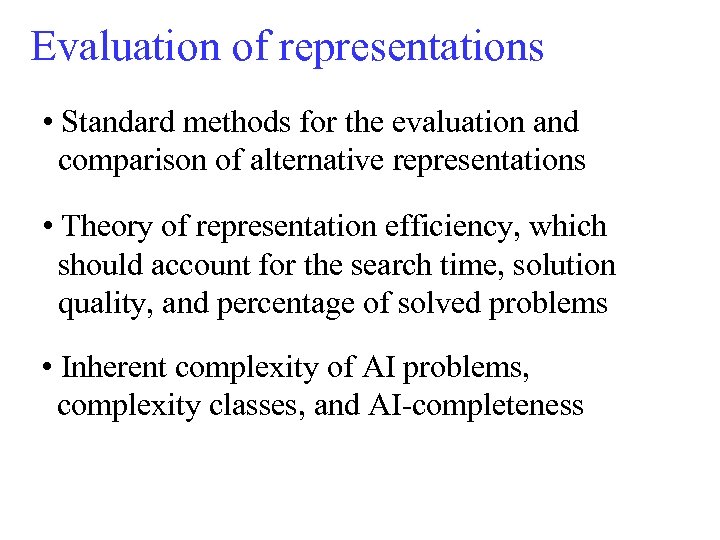
Evaluation of representations • Standard methods for the evaluation and comparison of alternative representations • Theory of representation efficiency, which should account for the search time, solution quality, and percentage of solved problems • Inherent complexity of AI problems, complexity classes, and AI-completeness
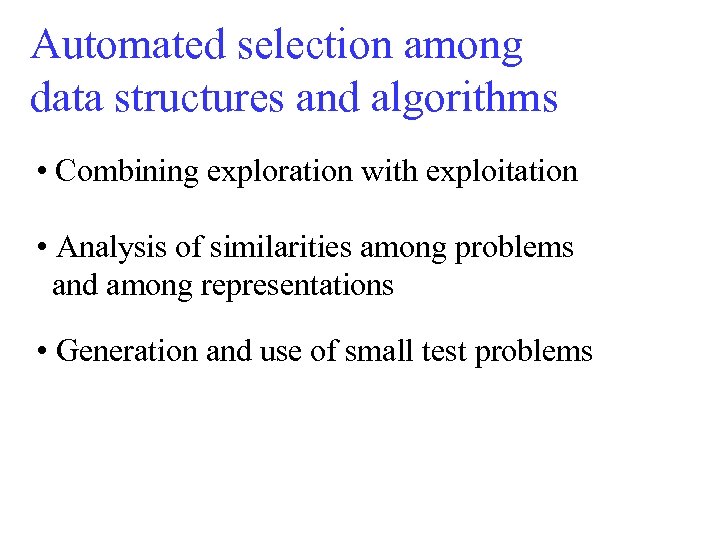
Automated selection among data structures and algorithms • Combining exploration with exploitation • Analysis of similarities among problems and among representations • Generation and use of small test problems
Automated construction of new data structures • Automated selection among alternative data structures • Self-adjusting data structures • Automated construction of complex structures from basic blocks
Integrated AI systems • General architecture for integrating search and learning algorithms • Large library of standard AI algorithms and tools for their synergetic use The grand challenge is to develop an architecture that integrates thousands of AI engines and problem domains, in the same way as an operating system integrates file-processing programs.
Applications The automated improvement of representations should be applicable to most areas of computer science.
Скачать презентацию Automated Changes of Problem Representation Eugene Fink LTI
b6022e26036f0bc6af808b193df1909c.ppt