


 Скачать презентацию Automated Celestial Systems for Attitude Position Determination
3f31adf3e87caba42edc801a117a8758.ppt
- Количество слайдов: 18
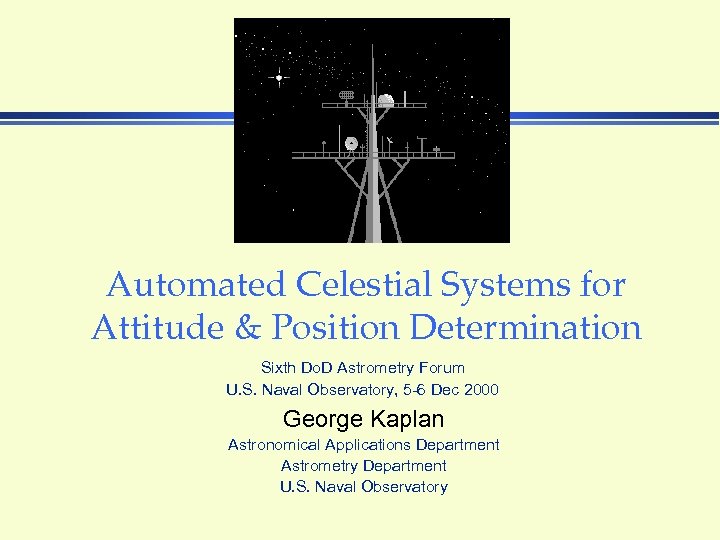 Automated Celestial Systems for Attitude & Position Determination Sixth Do. D Astrometry Forum U. S. Naval Observatory, 5 -6 Dec 2000 George Kaplan Astronomical Applications Department Astrometry Department U. S. Naval Observatory
 Isn’t GPS Enough? l Much work now ongoing in Do. D to mitigate effects of GPS denial (primarily by jamming) l GPS enhancements (AJ, etc. ) Complimentary technology Independent technology (alternatives) Navy policy requires each vehicle to have two independent means of navigation recently reiterated in policy letter
 What About INS as a GPS Alternative? l l Inertial navigation systems (INS) are now common on aircraft and ships, both military and commercial A form of precise, automated dead reckoning Accuracy (position drift) varies widely Must be periodically aligned with an external reference system: GPS LORAN Celestial
 Advantages of Celestial Nav l Absolute – self-calibrating l World-wide l Passive, self-contained l Nav aids (stars) need no maintenance l Widespread use and experience
 Automating the Celestial Observations Compared to manual methods, automated systems can provide l Better accuracy l Higher data rate l Determination of platform attitude l Direct input into INS
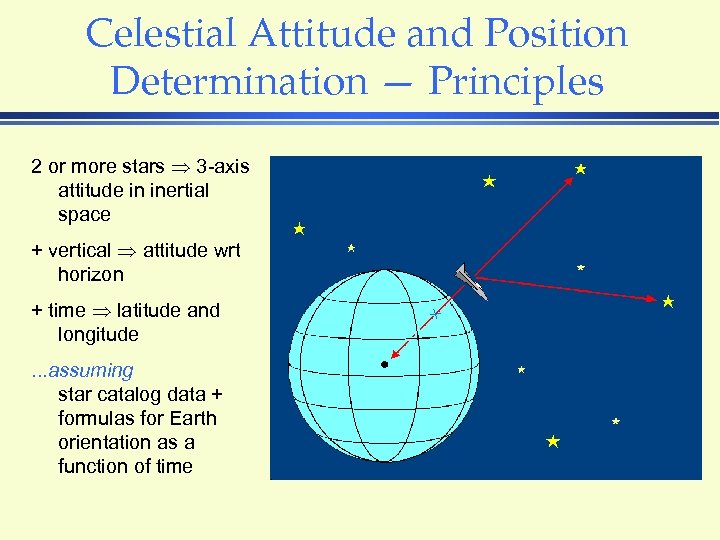 Celestial Attitude and Position Determination — Principles 2 or more stars 3 -axis attitude in inertial space + vertical attitude wrt horizon + time latitude and longitude. . . assuming star catalog data + formulas for Earth orientation as a function of time
 Automated Star Trackers Used in l Missile guidance Snark, Polaris, Poseidon, Trident, MX l Satellite attitude determination XTE, SWAS, STEX, DS-1, WIRE, etc. l Aircraft navigation SR-71, RC-135, B-2 l l Space Shuttle guidance Planetary exploration spacecraft
 Star Tracker Technology l Old Technology l Gimbaled Single-star observations Photomultiplier tube or similar detectors Programmed observations based on EP & attitude New Technology Strapdown Multiple-star observations CCD detectors Automatic star pattern recognition
 Star Tracker Technology (cont. ) New vs. old technologies l l l ~1/3 weight, size, and power 3 MTBF Higher data rates …but, newest technologies mostly confined to space applications so far
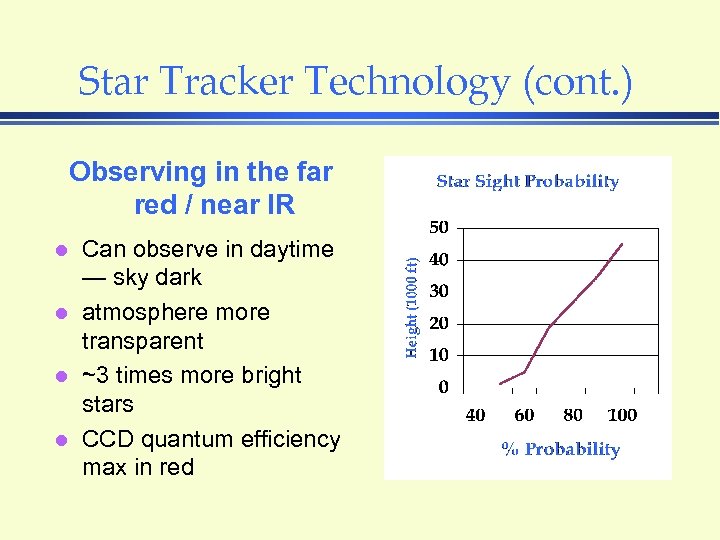 Star Tracker Technology (cont. ) Observing in the far red / near IR l l Can observe in daytime — sky dark atmosphere more transparent ~3 times more bright stars CCD quantum efficiency max in red
 Star Tracker Examples Example 1: B 2 l Legacy system from Snark, SR-71 l 150 -lb unit in left wing, 10 -inch window l View up to 45º off vertical: out of 52 star catalog, 4 -6 stars visible at any given time l Cassegrain telescope on gimbaled platform 2 -inch aperture, 40 arcsec FOV, PMT detector l l Programmed sequence of observations, several per minute Azimuth and elevation data back to INS
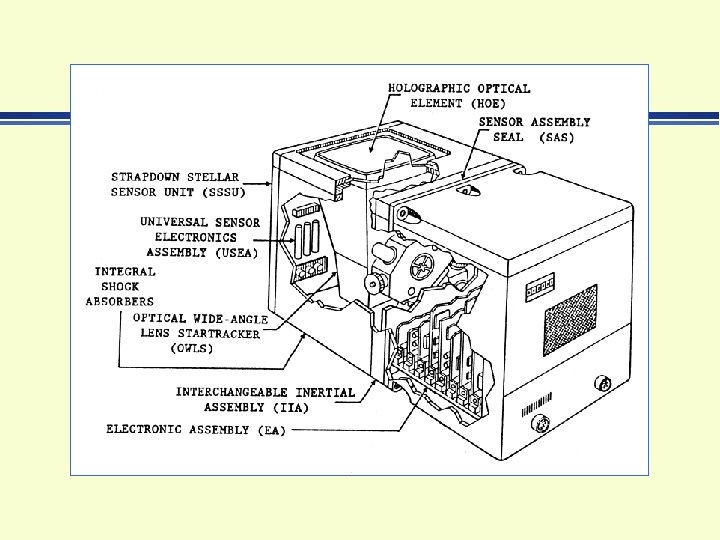
 Star Tracker Examples (cont. ) Example 2: Northrop OWLS l l l Strapdown system (non-gimbaled) CCD detector, R band ( 0. 6 -0. 8 m) Three simultaneous 3° fields of view holographic lens l l l Stars to magnitude 5 in daylight at sea level 1 arcsecond (5 rad) precision 2 -axis attitude data back to INS
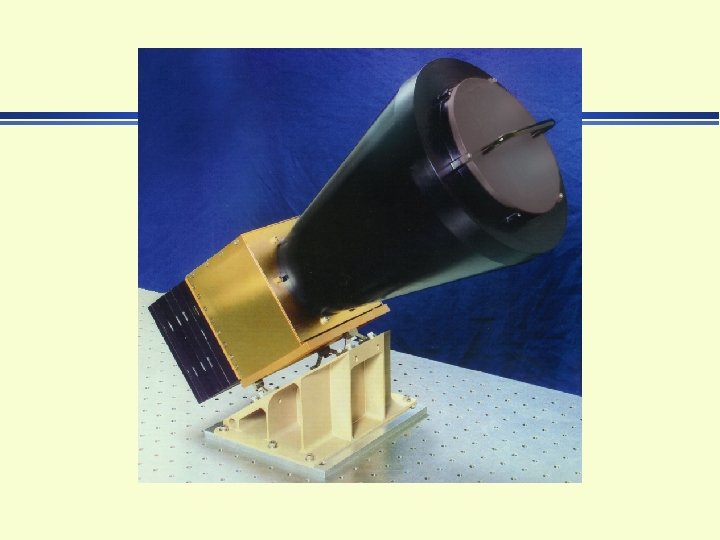
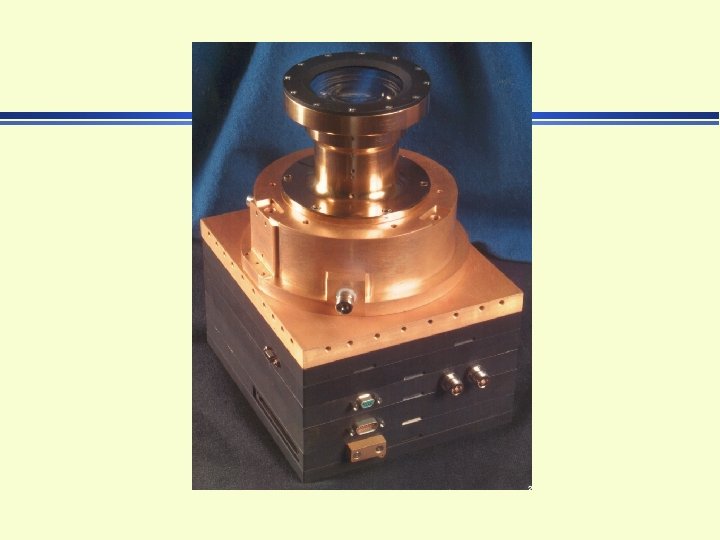
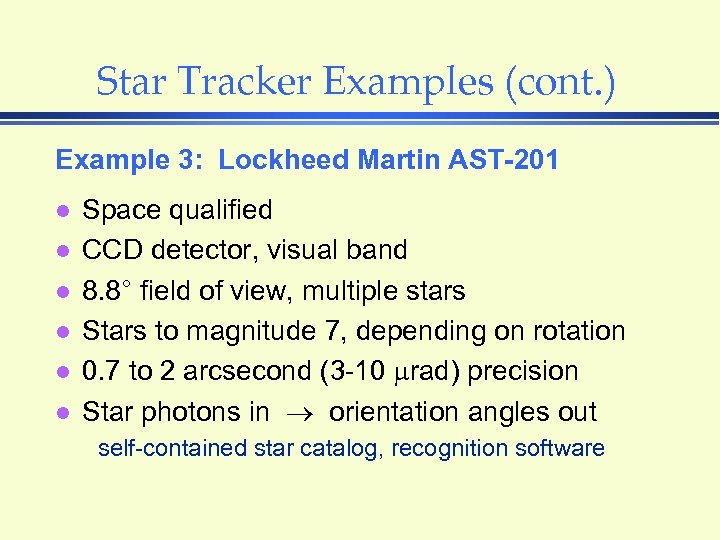 Star Tracker Examples (cont. ) Example 3: Lockheed Martin AST-201 l l l Space qualified CCD detector, visual band 8. 8° field of view, multiple stars Stars to magnitude 7, depending on rotation 0. 7 to 2 arcsecond (3 -10 rad) precision Star photons in orientation angles out self-contained star catalog, recognition software
 Determination of the Vertical l An easy problem from stationary locations l can use precision tiltmeters A hard problem from moving vehicles! Motion-related accelerations not separable from gravitational acceleration Generally, must use INS vertical (from NAVSSI? ) Other possibilities: – horizon sensor – atmospheric refraction – observe artificial satellites against star background
 Conclusions l Existing Do. D astro-inertial systems demonstrate feasibility of accurate autonomous navigation without GPS l New technology star trackers show promise of wider application possibilities for surface/air navigation at lower cost l Still TBD: detailed price and performance expectations for new systems