 Скачать презентацию Autism Awareness 2011 by Linda Donnelly True
b7e1d6413bc7f8cc2d61be86efaae8d7.ppt
- Количество слайдов: 25



Autism Awareness 2011 by Linda Donnelly
True or False? There is only one type of autism and most people diagnosed with it exhibit the same types of behavior False Autism is an umbrella diagnosis for 5 specific types of the disorder; these are known as Autism Spectrum Disorders (ASDs)
The 5 Categories of ASDs Asperger syndrome (high-functioning autism) Kanner’s syndrome (classic autism) Pervasive Developmental Disorder—Not Otherwise Specified (PDD-NOS) Childhood Disintegrative Disorder Rhett’s disease (Female only) Internet Special Education Resources
What is Autism? Autism is a neurological condition that affects the brain's normal development of social and communication skills From the Greek root autos meaning “self, ” autism literally means “alone. ” All individuals on the autism spectrum suffer from anxiety issues There is no blood test, no scan, and no image that can detect autism. Diagnosis relies on behavioral observations
Autism Spectrum Disorders (ASDs) Symptoms of ASDs usually appear during the first three years of life ASDs persist into adulthood and remain a lifelong challenge for individuals with the diagnosis There is no known cause for autism, although there are many theories, including environmental factors, genetic predisposition, and even diet There is no “cure” for ASDs
True or False? One in four (25%) of people diagnosed with autism will also suffer from a seizure disorder True About one in four autistic individuals begin to have seizures during puberty. The exact reason for the onset of seizures is not known, but it is likely that the seizure activity may be due to hormonal changes in the body. www. togetherforautism. org
Facts about ASDs Across the decade of 1993 -2003, statistics revealed a 657% increase in the nationwide diagnosis of autism (Department of Education) Autism now affects 1 in 110 children (Autism Speaks) Only 1 in 10 autistics are “savants” (extraordinary skills); In reality, mental retardation occurs in 75 -80% of persons with autism (New England Center for Children)
The Cost of Autism costs the nation over $35 billion per year and is expected to increase during the next decade (Autism Speaks) In 2011, autism is now more common than childhood cancer, diabetes, and AIDS combined (CDC) but receives the least amount of federal funding Most private insurance doesn’t cover the cost of treatments related to an autism diagnosis
True or False? More children from Caucasian, middle-class families with college-educated parents (one or both) are diagnosed with autism than any other population False Autism is an equal opportunity disability (other than gender); there is no correlation between race, ethnicity, socio-economic status, religion, nationality, etc. www. autismspeaks. org
Who is Affected? Boys are four times more likely than girls to have autism Siblings of those with an ASD are at greater risk for being on the spectrum Approximately 67 million people worldwide are affected by autism www. autismspeaks. org
True or False? Many people with high-functioning autism have normal to high intelligence True Individuals with high-functioning autism typically have a normal or even high I. Q. , often have a large, impressive vocabulary, and are usually mainstreamed in regular classrooms. Some even graduate from college
Asperger’s syndrome Individuals with high-functioning autism are often diagnosed with Asperger’s syndrome Those with Asperger’s syndrome may excel in fields such as computer programming and science Individuals with Asperger’s syndrome are able to take care of themselves and usually able to live alone as adults; some marry and have children.
True or False? People with autism prefer to be left alone most of the time and don’t really care if they have friends False Most individuals with autism, especially those high-functioning autism, desire friendships and want to “fit in” with their peers, but their social awkwardness, rigidness, and emotional immaturity make those goals very difficult to achieve
High-functioning autism Obsessive Behaviors Areas of interest may be quite narrow, such as an obsession with one topic or area Individuals with high functioning autism will present many facts about their subject of interest, but there will seem to be no point or conclusion. They often do not recognize that the other person has lost interest in the topic. Are not flexible about routines or rituals; seem very rigid and have difficulty with sudden change
High-functioning autism Isolation/Social Problems interpreting body language, facial expressions, or social cues Often respond inappropriately in social settings May be emotionally immature Difficulty making eye contact May appear cold or rude at times May be singled out by others as "weird" or "strange. "
High-functioning autism Communication Problems May have difficulty engaging in natural conversational exchanges May speak in a monotone Difficulty interpreting humor and figurative language; sarcasm and exaggeration is especially difficult to process; difficulty understanding jokes Do not recognize the need to change the volume of their voice in different settings
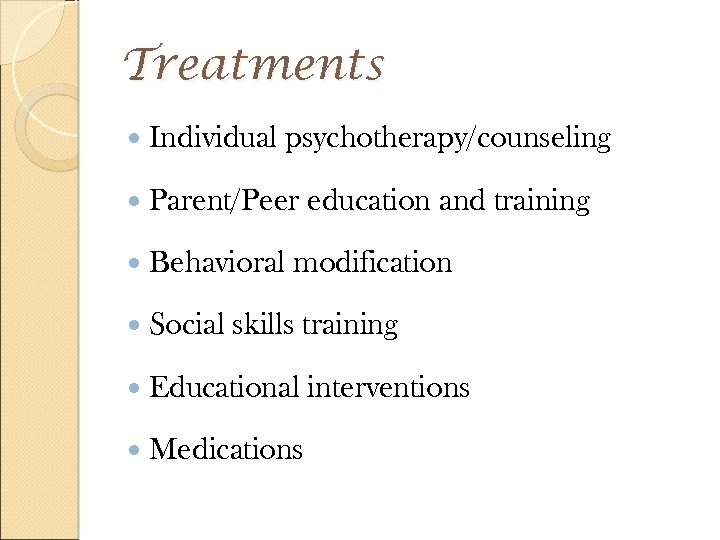
Treatments Individual psychotherapy/counseling Parent/Peer Behavioral Social education and training modification skills training Educational Medications interventions
True or False? Albert Einstein probably had high-functioning autism True Given what is known about autism now, Einstein’s quirky behavior and social deficits would qualify for an autism diagnosis if he were alive today
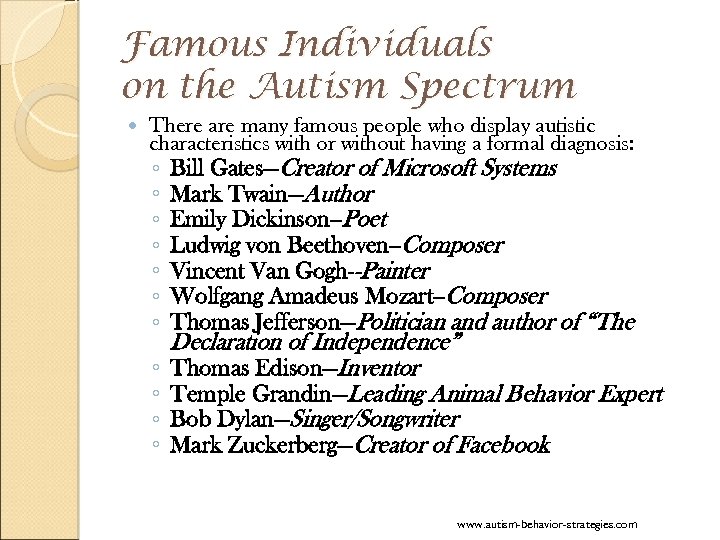
Famous Individuals on the Autism Spectrum There are many famous people who display autistic characteristics with or without having a formal diagnosis: ◦ ◦ ◦ Bill Gates—Creator of Microsoft Systems Mark Twain—Author Emily Dickinson--Poet Ludwig von Beethoven--Composer Vincent Van Gogh--Painter Wolfgang Amadeus Mozart--Composer Thomas Jefferson—Politician and author of “The Declaration of Independence” Thomas Edison—Inventor Temple Grandin—Leading Animal Behavior Expert Bob Dylan—Singer/Songwriter Mark Zuckerberg—Creator of Facebook www. autism-behavior-strategies. com
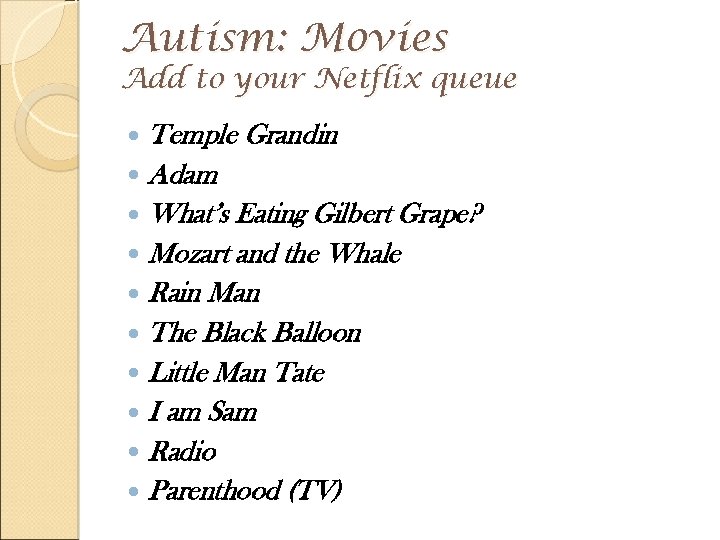
Autism: Movies Add to your Netflix queue Temple Grandin Adam What’s Eating Gilbert Grape? Mozart and the Whale Rain Man The Black Balloon Little Man Tate I am Sam Radio Parenthood (TV)
Autism in Literature The Curious Incident of the Dog in the Nighttime by Mark Haddock House Rules by Jodi Picoult Look Me in the Eye: My Life with Asperger's by John Elder Robinson All Cats have Asperger syndrome by Kathy Hoopmann
True or False? In the 1950 s, mothers were blamed if their child was diagnosed with autism True In the 1950 s, a mother’s failure to bond with her child was blamed for the condition, regardless if she had other normal children. These mothers were labeled “refrigerator mothers” because they were considered to be emotionally cold
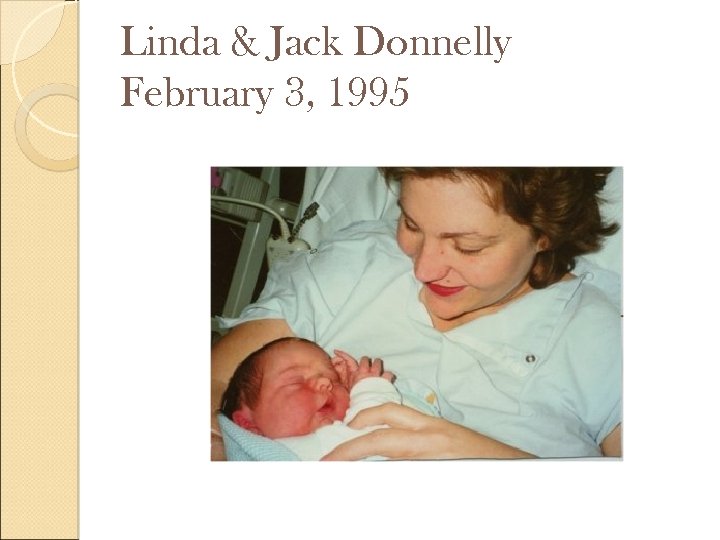
Linda & Jack Donnelly February 3, 1995
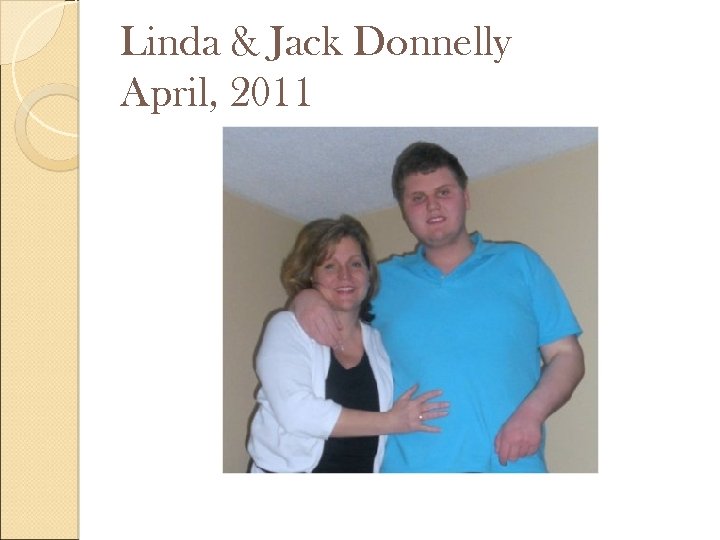
Linda & Jack Donnelly April, 2011
Works Cited www. autismsocietyofamerica. org www. autismspeaks. org www. cdc. org www. departmentofeducation. gov www. newenglandcenterforchildren. com www. togetherforautism. org
Скачать презентацию Autism Awareness 2011 by Linda Donnelly True
b7e1d6413bc7f8cc2d61be86efaae8d7.ppt