


 Скачать презентацию Authors don t always tell every detail or give
2b0f5afd45de4040f826efc30f90380c.ppt
- Количество слайдов: 22
 Authors don’t always tell every detail or give every bit of information in nonfiction or in fiction stories.
 Readers make inferences to supply information that authors leave out.
 When you make an inference, you add what you already know to what an author has told you.
 Examples
 What the author said + what I know inference The weather had been scorchin g for weeks. Summer is the hottest time of the year. = my It is summer.
 What the author said + what I know inference Al took out a pitcher of cold lemonade. You keep things cold in a refridgerator. = my Al took the lemonade out of the refridgerator.
 What the author said + what I know inference He got a glass out of the cupboard. People get out glasses when they want to drink somethin g. = my Al wanted to drink a glass of lemonade.
 Let’s Play Detective! Sometimes you will hear or read the term “drawing inferences” as part of a reading test or assignment. That means you have to figure something out from clues. The story you read will only give you clues, and you will have to play detective. It can be fun. Click to the next slide and we’ll start to play detective.
 Using Clues 1. You smell smoke. 2. You see smoke coming out of a house. 3. You hear the siren on a fire truck. The three clues above suggest that the house is on fire, and someone has already called the fire department.
 Some Useful Tips and Tricks 1. Read the question before reading the story. 2. Read the story twice. 3. Find key words in the question, and scan the story for the words.
 Finding Clues In A Story. Tommy and Sarah just got off the school bus. Sarah said, “I smell smoke. ” Tommy pointed and yelled, “Sarah, look at the smoke coming out of that house!” In a moment they both heard what sounded like a fire engine siren. The passage suggests that – A. The house is on fire, and someone called to report it. B. The house is on fire, and no one called to report it. C. Someone was burning leaves in the back yard. D. This was a fire drill.
 Drawing Conclusions Pretend you are at Wal Mart. As you are walking down the candy aisle, you notice a little boy crying and pulling on his mom’s skirt as she pushes her cart towards the front of the store. The closer she gets towards the front of the store, the louder the little boy screams. Lots of things could be wrong with the little boy, BUT we can probably conclude that— What do you conclude? Click on the speaker below to hear what I think. Of course, I could be wrong.
 Finding Clues In A Story. Maria was on the flag squad that performed at half time during football games. It was the first game that her grandparents and uncle Luigi attended. Maria waved her flag while looking for her family in the large crowd. Just as she spotted her grandmother, her greatest fear came true. She lost her grip on the flag, and it started to fall. Even though she caught it quickly, Maria’s face became red. She felt as if she had made a horrible mistake and everyone were staring at her. The passage suggests that Maria almost dropped her flag partly because she -A was thinking about the football game B wasn’t strong enough C was looking for her family D was frightened by a loud noise
 Finding Clues In A Story. Maria was on the flag squad that performed at half time during football games. It was the first game that her grandparents and uncle Luigi attended. Maria waved her flag while looking for her family in the large crowd. Just as she spotted her grandmother, her greatest fear came true. She lost her grip on the flag, and it started to fall. Even though she caught it quickly, Maria’s face became red. She felt as if she had made a horrible mistake and everyone were staring at her. The passage suggests that Maria almost dropped her flag partly because she -A was thinking about the football game B wasn’t strong enough C was looking for her family D was frightened by a loud noise
 A Quick Review When people talk, they don’t always say exactly what they mean. The listener must figure out what the speaker really means. Inference in reading is when you need to use the clues written in a story to draw a conclusion. In other words, you need to be a “word detective. ” You will not always be right when you draw a conclusion from a story, but the more you try, the more skilled you will become. Being a good reader and word detective is a good thing!
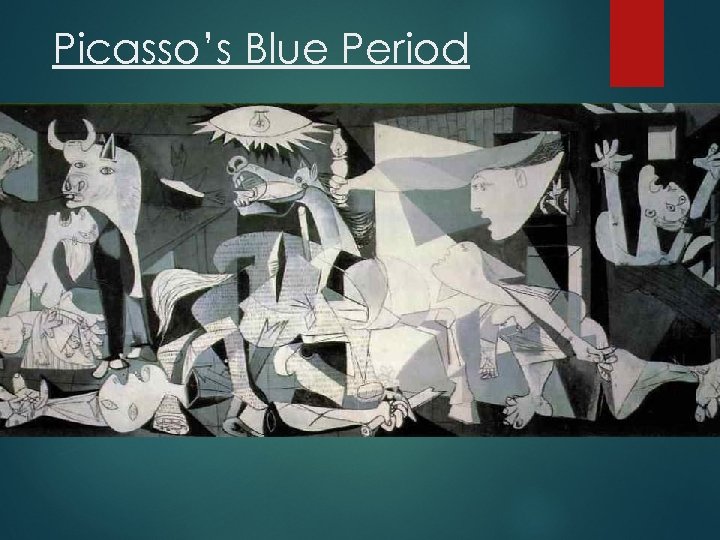
 Now, Let’s make an inference using visuals: • Write a short response (no less than a paragraph) making an inference about the photos on the next two slides. Be specific and use evidence from the illustration. Name of Photo -Description of photo -Inference about photo (What does it represent? )
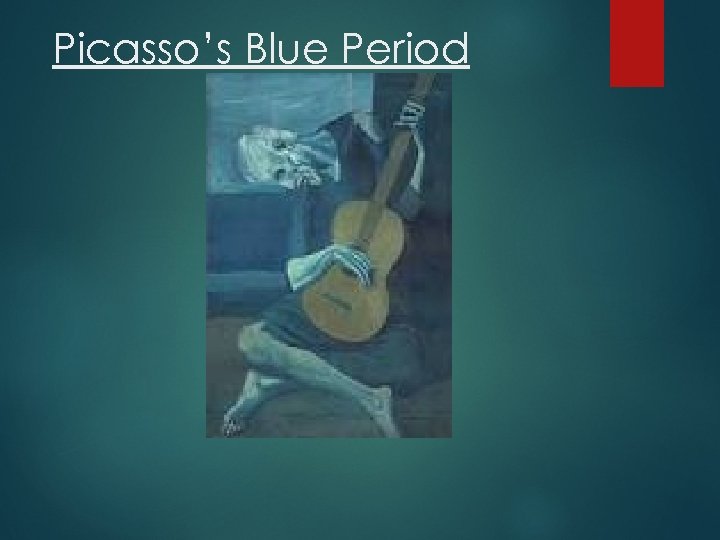 Picasso’s Blue Period
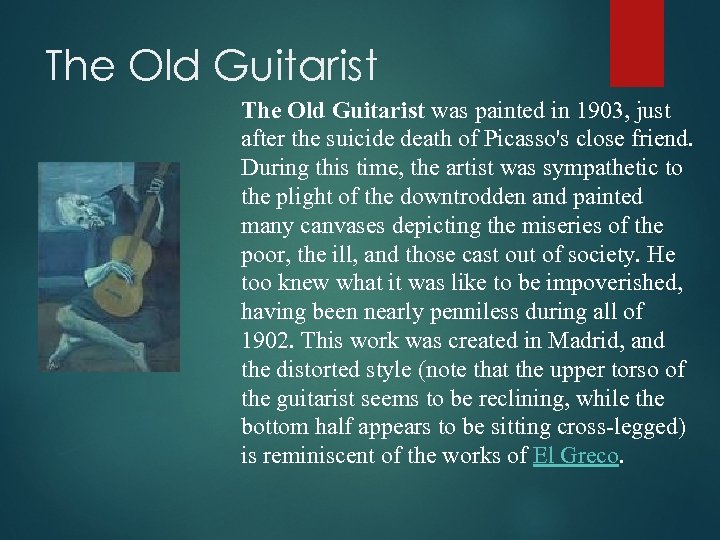 The Old Guitarist was painted in 1903, just after the suicide death of Picasso's close friend. During this time, the artist was sympathetic to the plight of the downtrodden and painted many canvases depicting the miseries of the poor, the ill, and those cast out of society. He too knew what it was like to be impoverished, having been nearly penniless during all of 1902. This work was created in Madrid, and the distorted style (note that the upper torso of the guitarist seems to be reclining, while the bottom half appears to be sitting cross-legged) is reminiscent of the works of El Greco.
 Picasso’s Blue Period
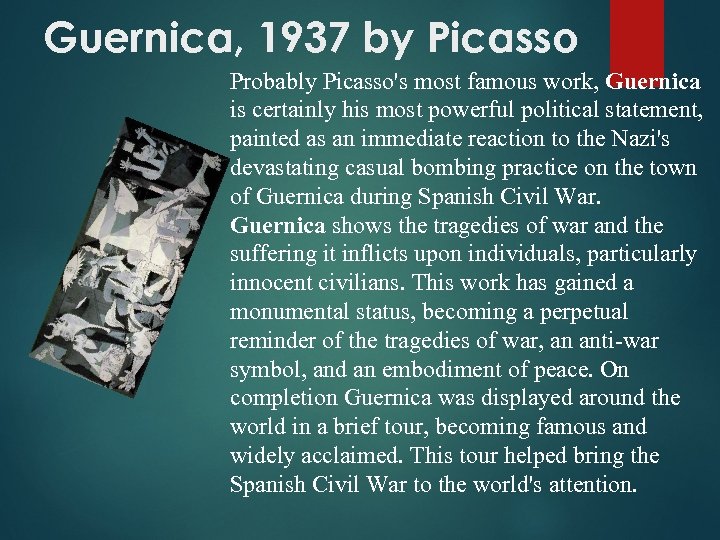 Guernica, 1937 by Picasso Probably Picasso's most famous work, Guernica is certainly his most powerful political statement, painted as an immediate reaction to the Nazi's devastating casual bombing practice on the town of Guernica during Spanish Civil War. Guernica shows the tragedies of war and the suffering it inflicts upon individuals, particularly innocent civilians. This work has gained a monumental status, becoming a perpetual reminder of the tragedies of war, an anti-war symbol, and an embodiment of peace. On completion Guernica was displayed around the world in a brief tour, becoming famous and widely acclaimed. This tour helped bring the Spanish Civil War to the world's attention.
 Sources www. aisd. net/AISD/Link. Click. aspx? fileticket. . . tabid= 13399&mid. . . https: //www. rcs. k 12. va. us/pfes/. . . /making%20 inferenc es. ppt www. pablopicasso. org/old-guitarist. jsp