 Скачать презентацию Author Notes Delete this slide before presenting
c2a5dbc41953a1b6daa7e2f840c454f0.ppt
- Количество слайдов: 87



Author Notes • Delete this slide before presenting. • We provide these slides as a general framework. You are free to adapt them as necessary. • We ask that you please cite the authors and book when using any of these slides (whether adapted or intact).
Effective and Efficient Collaborative Problem-Solving Teams (Chapter 5) Your Name Here Institutional Affiliation Here
Who Am I? • Insert funny cartoon here
Acknowledgments • Cates, Blum, & Swerdlik (2011). Authors of Effective RTI Training and Practices: Helping School and District Teams Improve Academic Performance and Social Behavior and this Power. Point presentation • Insert other people to be recognized here
Today’s Agenda • Insert agenda items here • Insert amount of time for items here
Today’s Objectives • Provide the purpose and rationale for problem solving • Identify the common characteristics of problem solving in RTI schools • Define collaboration, including its underlying assumptions and importance to effective problem solving • Identify the different types of school-based problemsolving teams and how they can be organized within an RTI framework at the building level
Today’s Objectives • Identify, discuss the critical components, and provide examples (at all three tiers) of the five stages of problem-solving: problem identification, problem analysis, plan development, plan implementation, and plan evaluation • Identify the characteristics of effective team members • Discuss the various roles and responsibilities of team members
Today’s Objectives • Discuss various strategies to promote effective group communication and participation • Discuss the importance of and how to monitor the implementation of problem solving in your school
Introduction • Briefly describe the current status of your school’s implementation of problem solving and teaming • What are your biggest concerns?
Quick Review of RTI • Comprehensive system of student support for academic performance and behavior • Has a prevention focus • Matches instructional needs with scientifically based interventions/instruction for all students • Emphasizes data-based decision making across a multi-tiered framework
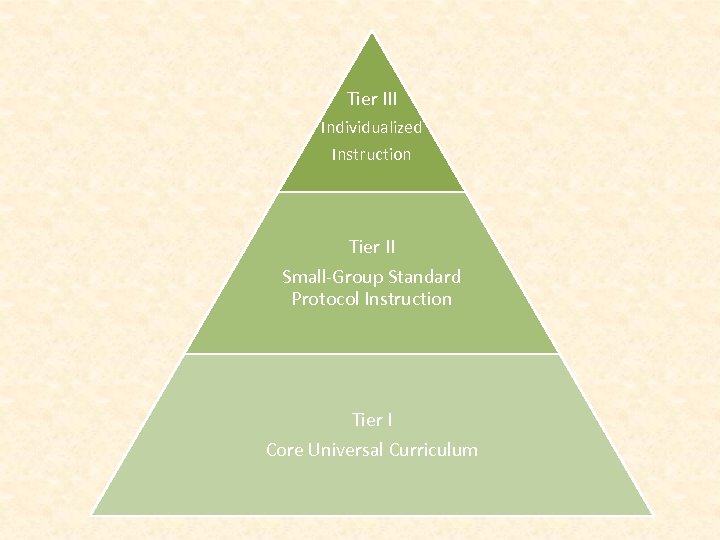
Tier III Individualized Instruction Tier II Small-Group Standard Protocol Instruction Tier I Core Universal Curriculum
Differentiating Problem-Solving Teams from Other Types of Pre. Referral Teams
Differentiating Problem-Solving Teams from Other Types of Pre-Referral Teams • Pre-referral teams focus on determining whether a full and individual multidisciplinary evaluation is necessary to determine eligibility • Interventions come out of pre-referral teams but are often ineffective due to limited data or lack of consistent implementation • Problem-solving teams within an RTI framework use a more systematic problem analysis approach and base their decisions on data
Differentiating Problem-Solving Teams from Other Types of Pre-Referral Teams • Problem solving not new to schools – Pre-referral teams are used to screen special education referrals; hence, they are referred to as “pre-referral” – Interventions often come out of these pre-referral meetings but often are not effectively developed due to limited data or being implemented without integrity to the process • Problem-solving teams use behavioral consultation methods and focus on techniques of behavioral analysis • Problem-solving teams employ collaborative problem -solving concepts and strategies
Characteristics of Problem Solving Within an RTI Framework
Characteristics of Problem Solving Within an RTI Framework Must occur at all three tiers Collaborative Adheres to a five-stage process Adopts a common format related to logistics such as meeting times, locations, roles and responsibilities of members • Teams evaluate their own effectiveness and barriers to efficiency and effectiveness • •
Collaborative Problem-Solving Concepts and Strategies
Collaborative Problem-Solving Concepts and Strategies • Systematically define/conceptualize a problem brought to the team • Analyze environmental, curricular, instructional, and individual student factors that impact the problem • Develop and implement interventions to address the identified problem • Monitor the integrity of the intervention (i. e. , is the intervention being implemented as designed? ) • Use progress-monitoring strategies to evaluate the effectiveness of the interventions • Remain consistent with the science-based principles of RTI
What Is Collaboration and Why Is It Important? • Refers to two or more coequal partners working together in a supportive and mutually beneficial relationship • Voluntary relationship • Shared decision making • Work toward a common goal
Underlying Assumptions About Collaboration • The combination of talents, energies, and efforts of a team working together will yield better results • Each team member brings unique and varied experiences, perspectives, and expertise • Each team member has something to contribute
How Many Teams Should a School Have and How Should They Be Organized? • Depends on number of staff and students in a building • One team might serve all RTI functions • Multiple teams are more typical • All teams should have common goal to find solutions to student, classroom, or building-level problems • Do not focus solely on decision making for individual students
Tier I Teams
Tier I Teams • Often referred to as Building Leadership, School Improvement, or Data-Analysis Team • Focus on problems/decision making at the building level
Membership of Tier I Teams • Should reflect all stakeholders in the building • Administrator must be a member of and actively participate in the Tier I team • Respected general education teachers from various grade levels • School psychologist and/or social worker with skills related to data collection and interpretation and knowledge of problemsolving/RTI process • Content specialists in reading and/or math • Parent representative (team will not be discussing individual student data, so confidentiality is not an issue)
Responsibilities of Tier I Teams • Handle resource allocation such as scheduling personnel, core curricular issues across grade levels and subject areas, studying building climate, writing schoolwide behavior plans • Analyze academic/behavioral schoolwide data • Determine the effectiveness of Tier I universal instruction and Tier I targeted interventions delivered through differentiated instruction • Might also discuss particular grade-level needs • Might review systematic data on overall implementation of RTI in the building
Tier II Teams
Tier II Teams • Often referred to as grade-level or cluster teams • Can be organized around individual grade levels or paths (combination of grade levels) • In high school, can be organized around subject areas such as math, science, and English
Membership of Tier II Teams • All teachers at each grade level • Perhaps the principal (but if he/she is not a member, administrative support is critical) • School psychologist or social worker familiar with data collection and analysis procedures • Content specialist in reading and/or math
Responsibilities of Tier II Teams • Assist in review of universal screening data to determine targeted Tier I interventions delivered through differentiated instruction and identify students in need of additional support; decide what type of Tier II support • Focus on application of the core curriculum to individual grade levels to determine gaps in expected outcomes • Collaborate with the Tier I team as needed, such as when choosing standard Tier II interventions
Tier III Teams
Tier III Teams • Referred to as Student Support, Student Services, or Building-Level Problem-Solving Team • Focus on more intensive, systematic problem solving for individual students related to behavior and/or academic performance
Membership of Tier III Teams • 4 to 8 individuals with expertise in data analysis, accommodations, modifications, and interventions for a wide variety of problems • Classroom teacher • Some teams have a designated individual who organizes and facilitates problem solving in a building • Principal may or may not be a member, but administrative support is critical • A balance of members representing special and general education and special service personnel • Parents • Members with particular expertise (as needed on a case-bycase basis)
Responsibilities of Tier III Teams • Conduct ongoing analysis and interpretation of individual student progress monitoring data • Coordinate individualized interventions • Play an important role in special education eligibility process (the interventions designed and implemented by the team are a key source of data for eligibility decisions)
Five Steps of Problem Solving
Five Steps of Problem Solving 1. 2. 3. 4. 5. Problem Identification Problem Analysis Plan Development Plan Implementation Plan Evaluation
Step 1: Problem Identification
Step 1: Problem Identification • Answer question: “What is the discrepancy between what is expected and what is occurring? ”
Five Steps in Problem Identification 1. Operationally define the problem: Define the problem in observable and measurable terms 2. Collect baseline data: Assess the current level of the problem (frequency, intensity, duration) 3. Prioritize the problem(s): List and prioritize all problems based on academic and social expectations continued
Five Steps in Problem Identification 4. State the discrepancy between what is expected (based on typical peer performance) and what is occurring 5. Identify a replacement behavior that teams want the student to engage in and define behavior in concrete observable terms. Do not just focus on problems—identify target replacement behaviors that represent improvements or increases in competencies the team wants student(s) to increase (Note: Eliminating or reducing problem behaviors does not ensure that desired behaviors will occur—it means that the desired behaviors must be addressed explicitly )
Define Target Skills and Determine What Tier to Focus On • Define a replacement behavior or target skill • Collect and analyze data related to replacement behavior • Determine the discrepancy between current rate of the replacement behavior and expected rate (through typical peer performance) • Socially define the level of expected behavior • Conduct a gap analysis
Step 2: Problem Analysis
Step 2: Problem Analysis • Major question addressed: “Why is the problem occurring? ” • Review existing records, including universal screening and diagnostic data; interview key personnel involved with the student; observe in relevant environments; conduct additional testing, if necessary • This process uses the RIOT matrix …
RIOT Matrix 1. Review 2. Interview 3. Observe 4. Test
Hypothesis: Skill Deficit or Performance Deficit?
Hypothesis Generated During Problem Analysis • Two broad categories—is problem a skill deficit (can’t do) or performance deficit (won’t do)? • Performance deficits require increasing reinforcement or decreasing punishment • Skill deficits require more systematic instructional interventions

Step 3: Plan Development
Step 3: Plan Development • Questions include: “What is the goal? ” and “How will progress be monitored? ” • Write the goal for the intervention • Define the logistics of how the intervention will be implemented • Determine how progress will be monitored
Logistics to Define During Plan Development • What strategies and procedures will be used? • When, where, and how often the intervention will occur? • Who will implement the intervention? • When will the intervention begin and when will it be evaluated?
Step 4: Plan Implementation
Step 4: Plan Implementation • Main question team addresses: “How will plan implementation integrity be ensured? ” • Team must support the intervention implementers • Interventions are observed and integrity checklists completed • Adjustments are made to the plan as necessary • Case manager should be assigned and meet with intervention implementer within two days of intervention initiation
Step 5: Plan Evaluation
Step 5: Plan Evaluation • Main questions to be answered: – What effect did the plan have on the problem? – Is progress being made toward the stated goal? – Is the gap/discrepancy with peers being reduced? • In Tier III, the plan evaluation phase often addresses the question, “Can the plan be maintained in general education, or is there a need for referral to special education? ”
Characteristics of Effective Teams
Characteristics of Effective Teams • Contribute to climate of mutual respect, trust, and support • Commitment to being open and genuine in their communication and to goals of collaborative teaming • Believe in creative problem-solving process • Commitment to problem resolution • Refrain from “admiring the problem” (spending an excessive amount of time talking about how bad a situation is) • Willing to put in extra time and effort • Aware of and willing to assume various team roles • Always prepared with data
Characteristics of Effective Teams: The Experience Factor • Recent graduates may be more informed about problemsolving process for developing interventions … • … But more-experienced team members often possess expert knowledge helpful in data collection and intervention development • Teams should include both less- and more-experienced staff • Avoid team members who subscribe to “test and place model” of service delivery unless they are willing to learn the process of data-based decision making and understand that problem solving is focused on developing effective interventions to address identified problem areas
Team Member Roles and Responsibilities for Effective Teaming
Team Member Responsibilities • Actively participate in problem solving, collecting data, and implementing interventions • Be knowledgeable about and trained in the problem-solving process and committed its success • It is not necessary for all team members know students personally
Tier III Team Members • • Teacher requesting assistance Principal/administrator Specialist in area of concern Parent of student
Teacher Requesting Assistance • At Tier III problem-solving meetings, the teacher requesting assistance should attend all meetings and help collect necessary data • Frequently involved in implementation of the intervention • Responsible for communicating with parents/guardians, including inviting them to the meetings (unless done by the case manager) • Needs to be aware of the problem-solving process and should not have another role during the meeting
Principal/Administrator • Ensures that problem-solving process is implemented effectively • Provides resources necessary to support the process, such as time and place to meet • Monitors staff climate • Communicates importance of problem solving to all staff and parents/guardians • Communicates to teaching staff that engaging in problem solving is a sign of competence not weakness • Emphasizes that interventions need to be implemented with integrity
Parent/Guardian • Integral part of the team—knows child the best • Can be helpful in terms of problem identification, analysis, and plan implementation • Effective home and school collaboration promotes student learning and success
Specialists as Needed • Depending on nature of the student problem behaviors (academic or social-emotional/behavioral) being addressed by the team, can include one or more of the following: – School psychologist – Social worker – Speech and language therapist, occupational and/or physical therapist – Special education teacher – Reading or math specialist
Rotating Participation Roles • Some roles are unique to the specific problem-solving tier • Some roles may be assigned permanently to team members; others are intended to rotate
Participation Roles • • Facilitator Timekeeper Jargon buster Justifier Process specialist Parent advocate Note taker Case (data) manager
Facilitator Ensures the integrity of the problem-solving process Supports effective communication Keeps the team on track Ensures all problem-solving steps are completed Promotes effective group communication and participation • Characteristics of effective facilitator include: knowledgeable of the problem-solving process, has group-process skills, assertive, and a strong leader • Not everyone will be effective in this role • • •
Timekeeper • Keeps team on track by making the time and time limits public • Important role because time is a frequently cited problem area and there a number of challenges related to time • Must be assertive • Meeting time can be reduced if tasks are accomplished prior to the meeting • Actual meeting should only take 20 -30 minutes
Jargon Buster • Use of jargon interferes with effective problem solving • Responsible for listening for and drawing the attention of the team to unfamiliar terms (team member using the term is asked to define/explain it) • Important to be sensitive to parent/guardian’s ability to understand various terms
Justifier • Requests team members to provide a rationale for a particular conclusion • Particularly important during problem analysis and plan development • Includes providing a rationale for using various assessment methods and drawing inferences/conclusions from the data
Process Specialist • Assigned by teams that are particularly interested in promoting effective collaborative problem solving • Has responsibility to comment on how team worked together and engaged in effective problem solving • Example areas to comment on include degree of participation by members of various disciplines, degree to which team members were heard and respected
Parent Advocate • Not a typically assigned role, but is potentially valuable • Assigned to a school staff member • Ensures that parent/guardian involvement occurs • Monitors parent/guardian’s reaction as to what is occurring during the meeting • Ensures that parent/guardian’s rights are upheld
Note Taker • Documents the meeting on designated forms • Summarizes the team discussion when necessary • Notifies team if a problem-solving stage has been omitted • Characteristics of effective note takers include being detail oriented, staying on task, and knowledgeable in the five stages of problem solving • Notes should be made available using technology • Forms should be used facilitate or guide note taking
Case (Data) Manager • • Role used in Tier III problem-solving meeting Consults with teachers and parents Must be competent in problem analysis and collaboration Ensures all required data are collected and summarized at the meeting Ensures intervention is implemented as intended Role should be rotated among several team members based on skills and interest Appoint prior to the first team meeting Must be organized and have strong interpersonal/ communication skills
Special Problem-Solving Meeting Considerations
Special Problem-Solving Meeting Considerations • • Getting started Managing conflict Staying on task Ensuring active participation of all team members
Getting Started • Meeting starts and ends on time • Members know purpose of the meeting • Remind participants of the amount of time allocated to problem solving for each case presented
Managing Conflict • Facilitator helps team come to a consensus • Consensus mean the decision is not necessarily everyone’s first choice but all “can live with the decision”
Staying on Task • Facilitator helps team stay on task • Everyone should know the problem-solving stage being addressed; information is summarized, and an effort is made to reach consensus • Facilitators use active listening skills (clarify, reflect feelings, encourage participation, summarize) • Facilitators encourage brief and concise comments
Staying on Task • Facilitators encourage members to share only the most important information at meetings • Facilitators often use flipcharts or posters showing stages of problem solving and principles of effective communication
What Does Research Tell us About Effective Problem Solving/Teaming?
Team Member Participation • Importance of balanced participation among members • School psychologists and special educators likely to provide a disproportionally larger input, which can impact satisfaction with team decisions and “buy-in” to implement plan • Important for facilitator to redistribute power by ensuring that all team members have knowledge of roles and expectations • Facilitator can structure communication so members contribute in an organized fashion • Teachers and parents are encourage to contribute first, followed by school psychologists and special educators
Meeting Logistics • Teams meet at a consistent time and place that is comfortable for teamwork and has adequate space • Team should have easy access to confidential student files • Routines should be established to use time efficiently • Never use meeting time to accomplish what can be done at another time • Team problem-solving time is reserved for the purpose of collaborative problem solving continued
Meeting Logistics • Most teams meet weekly, but frequency depends on tier level of team, size of school, and number of referrals • Tier III teams should take no more than 20 -30 minutes per case • Tier III teams should meet no more than 1 -2 weeks after a request for assistance has been received continued
Meeting Logistics • Member of Tier III problem-solving team should meet with intervention implementer within first 2 days and then follow up weekly for next several weeks • Tier I teams should meet at least three times per year after universal screening data have been collected, or more often, depending on building-level issues that need to be addressed • Tier II teams should meet monthly or bi-monthly
Review of Important Points • Problem-solving teams are different from prereferral teams • Problem solving must occur at all three tiers • Problem-solving teams are collaborative and engage in systematic defining and conceptualizing of the problem • Number of teams in a particular building depends on number of staff and students • Multiple teams are more typical than just one team • Team membership and responsibilities differ depending on tier
Review of Important Points • Tier I team focuses on buildingwide issues such as the universal curriculum and school climate • Tier II team focuses on individual grade levels, and on choosing targeted interventions and who should receive them • Tier III teams focus on more-intensive, individualized problem solving • Five steps of problem solving: problem identification, problem analysis, plan development, plan implementation, and plan evaluation
Review of Important Points • Characteristics of effective team members include commitment to problem resolution, commitment to being open and genuine in communication, and being creative problem solvers • Tier III team members include teacher requesting assistance, principal/administrator, specialist in area of concern, and parent/guardian • Roles that rotate include facilitator, timekeeper, jargon buster, justifier, process specialist, parent advocate, note taker, and case (data) manager

Questions
Скачать презентацию Author Notes Delete this slide before presenting
c2a5dbc41953a1b6daa7e2f840c454f0.ppt