 Скачать презентацию Author — Christina Babayeva the student of the
Водные ресурсы Ставропольского края.ppt
- Количество слайдов: 30



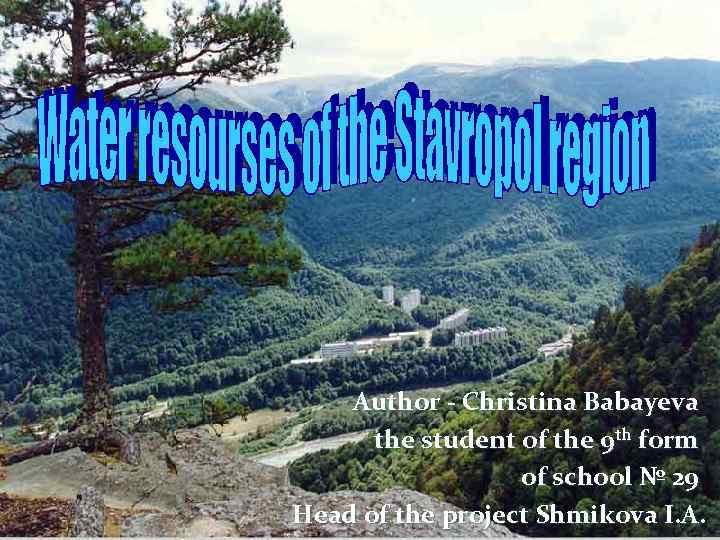
Author - Christina Babayeva the student of the 9 th form of school № 29 Head of the project Shmikova I. A.
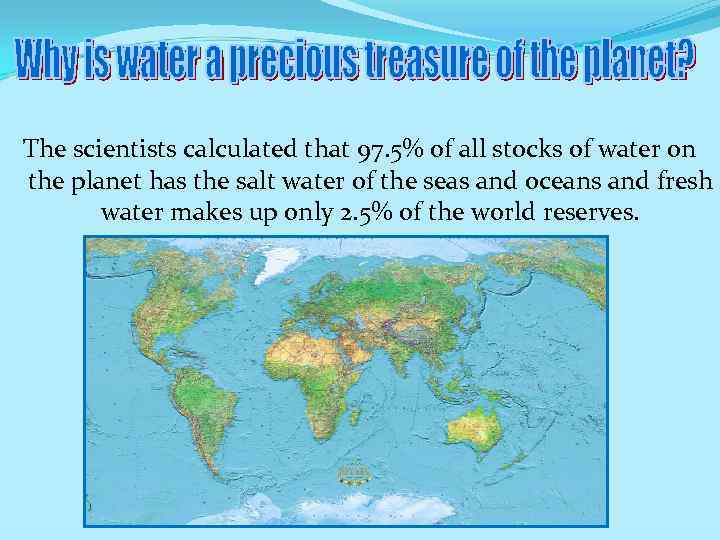
The scientists calculated that 97. 5% of all stocks of water on the planet has the salt water of the seas and oceans and fresh water makes up only 2. 5% of the world reserves.
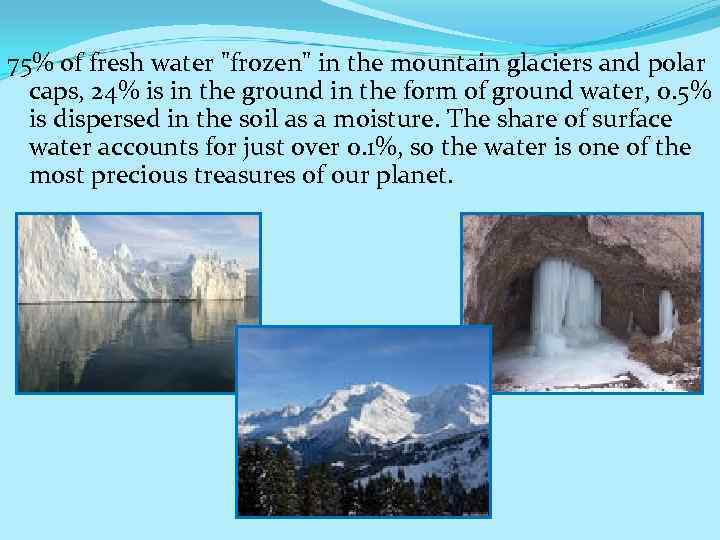
75% of fresh water "frozen" in the mountain glaciers and polar caps, 24% is in the ground in the form of ground water, 0. 5% is dispersed in the soil as a moisture. The share of surface water accounts for just over 0. 1%, so the water is one of the most precious treasures of our planet.
In the adult human body to share water accounts for more than 65%, of which 70% is contained in the cells, and 30% outside the cells. The main physiological function of water is filler, solvent, temperature control and support. As a filler it supports a form of authority and giving their normal functioning.

As a universal solvent dissolves the nutrients involved in the chemical processes in digestion, flushes waste products, is a physical-chemical environment, through which the reaction takes place in metabolism.
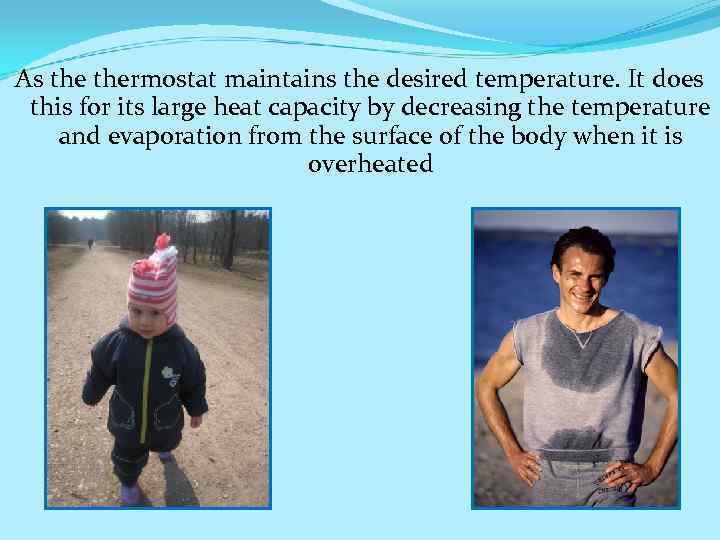
As thermostat maintains the desired temperature. It does this for its large heat capacity by decreasing the temperature and evaporation from the surface of the body when it is overheated
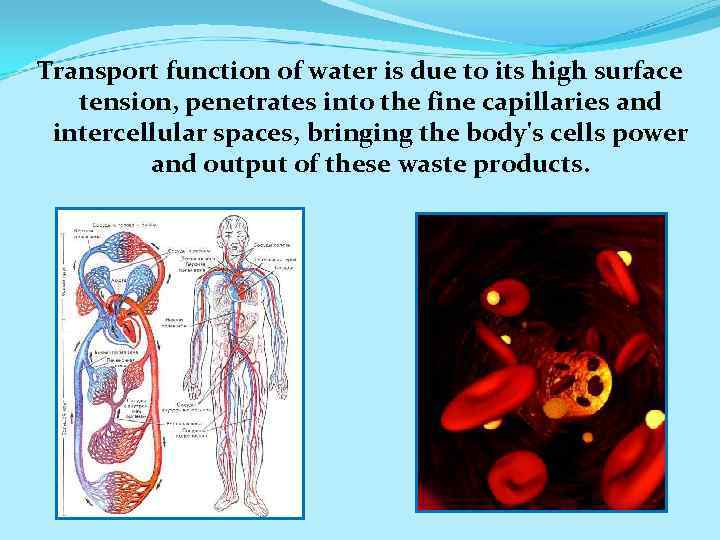
Transport function of water is due to its high surface tension, penetrates into the fine capillaries and intercellular spaces, bringing the body's cells power and output of these waste products.
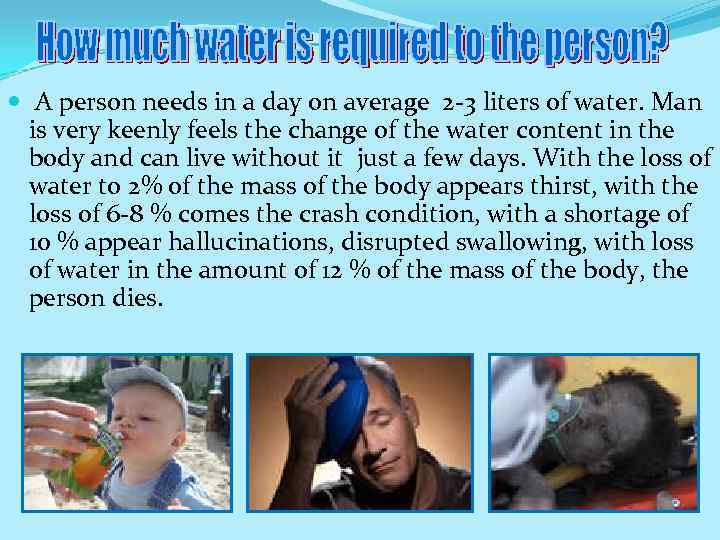
A person needs in a day on average 2 -3 liters of water. Man is very keenly feels the change of the water content in the body and can live without it just a few days. With the loss of water to 2% of the mass of the body appears thirst, with the loss of 6 -8 % comes the crash condition, with a shortage of 10 % appear hallucinations, disrupted swallowing, with loss of water in the amount of 12 % of the mass of the body, the person dies.
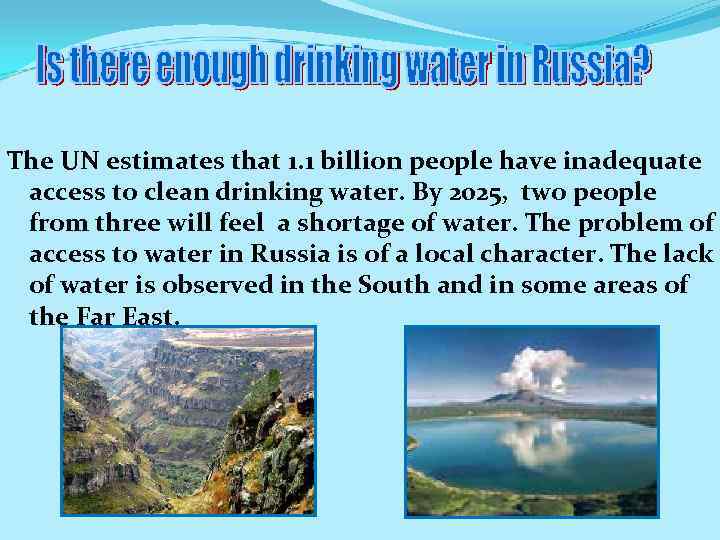
The UN estimates that 1. 1 billion people have inadequate access to clean drinking water. By 2025, two people from three will feel a shortage of water. The problem of access to water in Russia is of a local character. The lack of water is observed in the South and in some areas of the Far East.
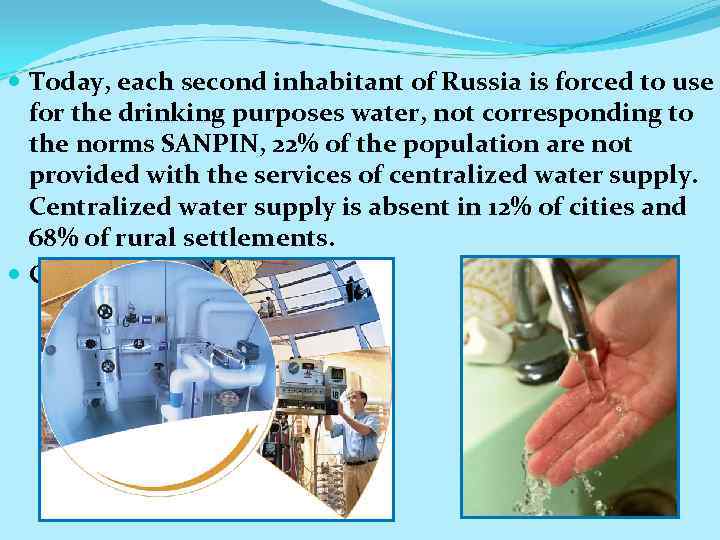
Today, each second inhabitant of Russia is forced to use for the drinking purposes water, not corresponding to the norms SANPIN, 22% of the population are not provided with the services of centralized water supply. Centralized water supply is absent in 12% of cities and 68% of rural settlements. Страница 1
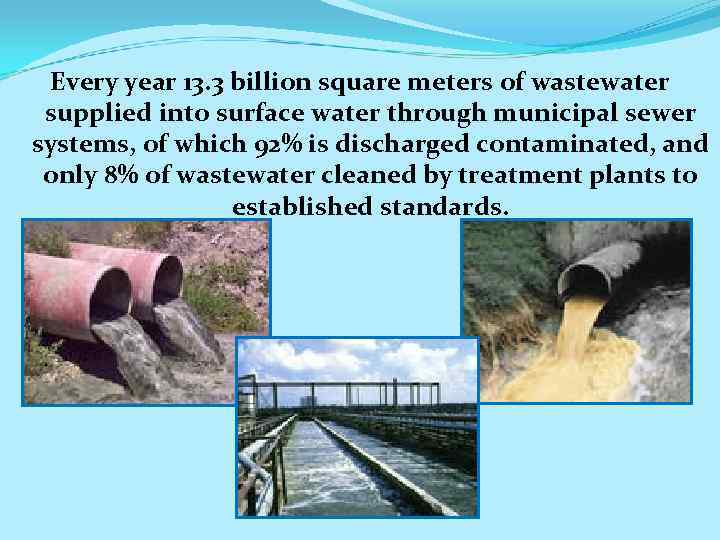
Every year 13. 3 billion square meters оf wastewater supplied into surface water through municipal sewer systems, of which 92% is discharged contaminated, and only 8% of wastewater cleaned by treatment plants to established standards.
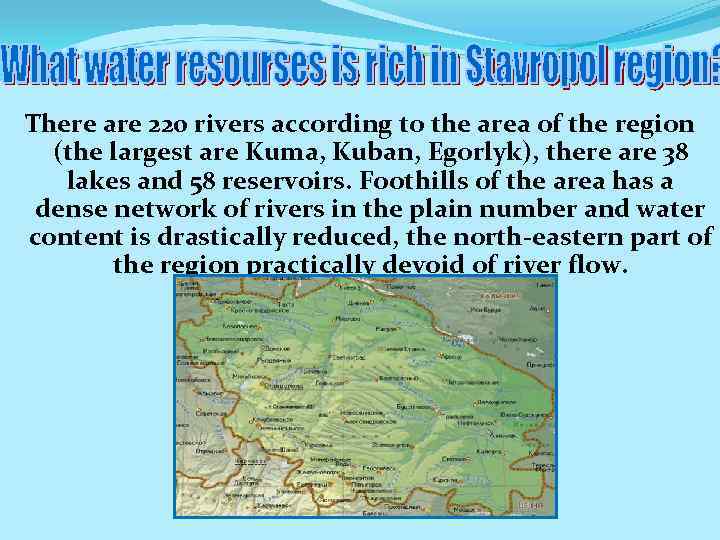
There are 220 rivers according to the area of the region (the largest are Kuma, Kuban, Egorlyk), there are 38 lakes and 58 reservoirs. Foothills of the area has a dense network of rivers in the plain number and water content is drastically reduced, the north-eastern part of the region practically devoid of river flow.
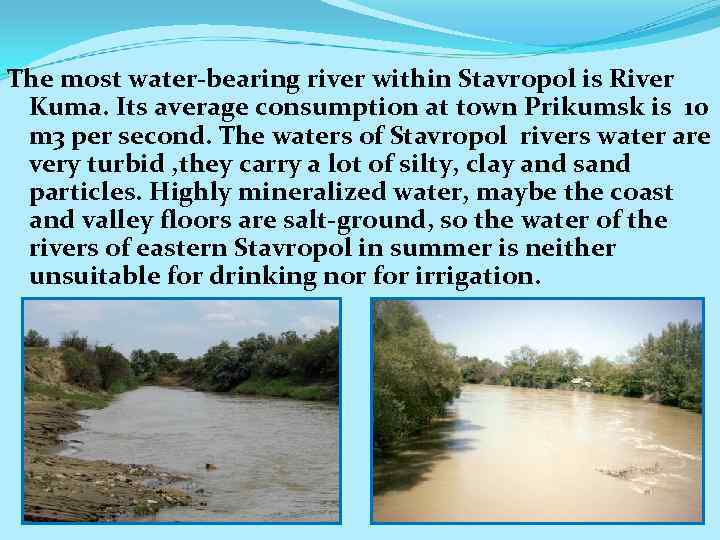
The most water-bearing river within Stavropol is River Kuma. Its average consumption at town Prikumsk is 10 m 3 per second. The waters of Stavropol rivers water are very turbid , they carry a lot of silty, clay and sand particles. Highly mineralized water, maybe the coast and valley floors are salt-ground, so the water of the rivers of eastern Stavropol in summer is neither unsuitable for drinking nor for irrigation.
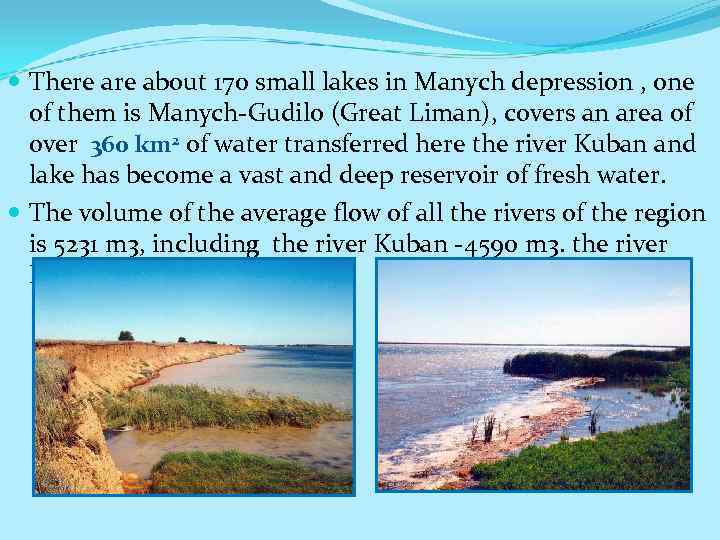
There about 170 small lakes in Manych depression , one of them is Manych-Gudilo (Great Liman), covers an area of over 360 km 2 of water transferred here the river Kuban and lake has become a vast and deep reservoir of fresh water. The volume of the average flow of all the rivers of the region is 5231 m 3, including the river Kuban -4590 m 3. the river Kuma -300 million m 3.
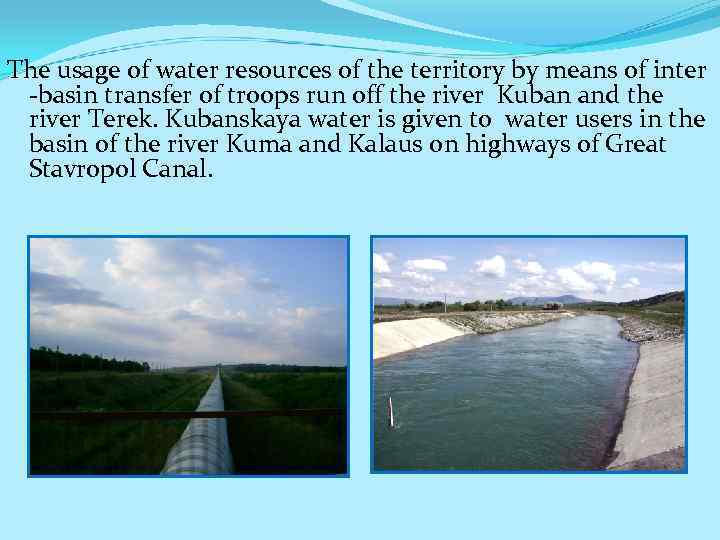
The usage of water resources of the territory by means of inter -basin transfer of troops run off the river Kuban and the river Terek. Kubanskaya water is given to water users in the basin of the river Kuma and Kalaus on highways of Great Stavropol Canal.
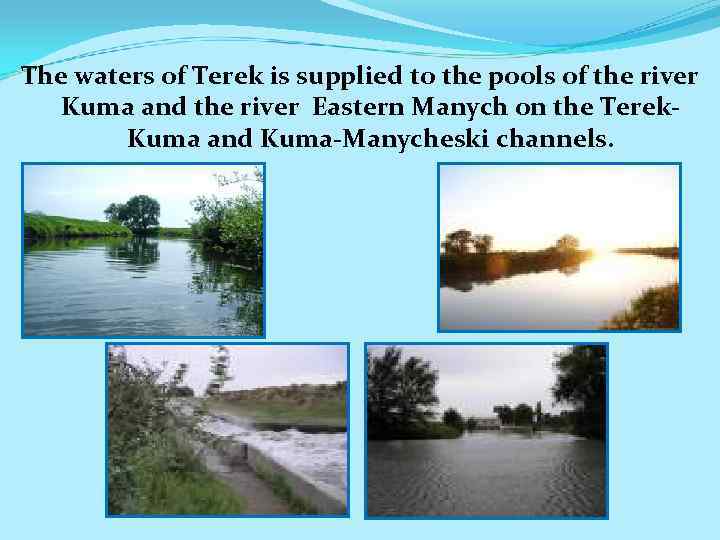
The waters of Terek is supplied to the pools of the river Kuma and the river Eastern Manych on the Terek. Kuma and Kuma-Manycheski channels.
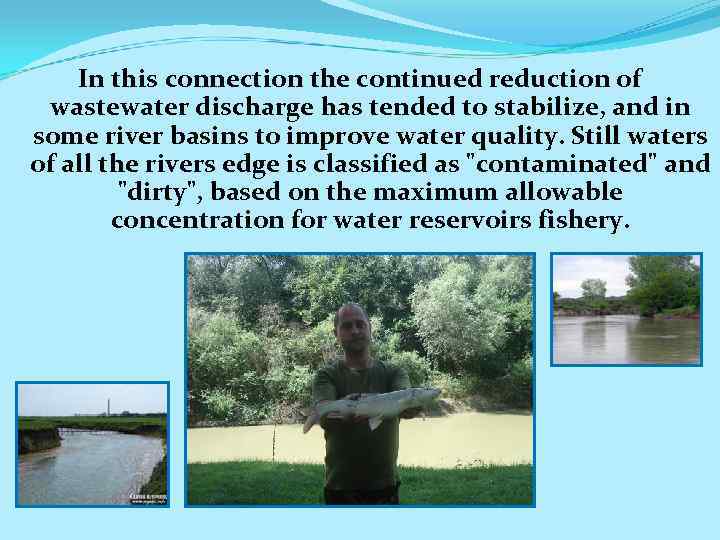
In this connection the continued reduction of wastewater discharge has tended to stabilize, and in some river basins to improve water quality. Still waters of all the rivers edge is classified as "contaminated" and "dirty", based on the maximum allowable concentration for water reservoirs fishery.
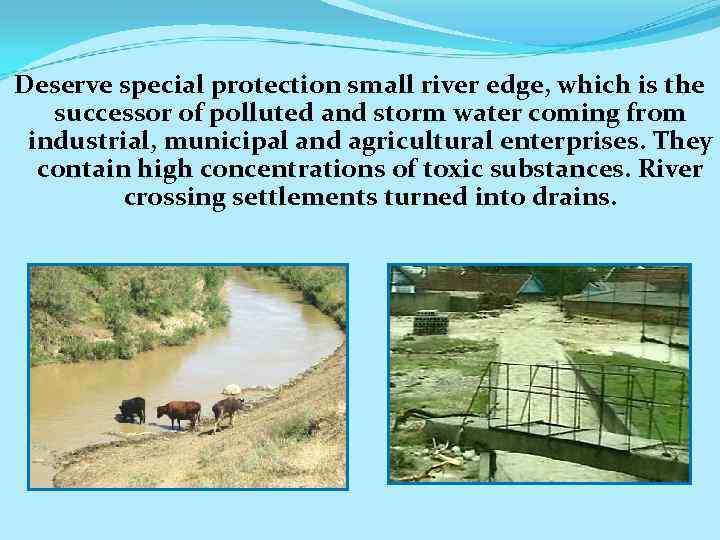
Deserve special protection small river edge, which is the successor of polluted and storm water coming from industrial, municipal and agricultural enterprises. They contain high concentrations of toxic substances. River crossing settlements turned into drains.
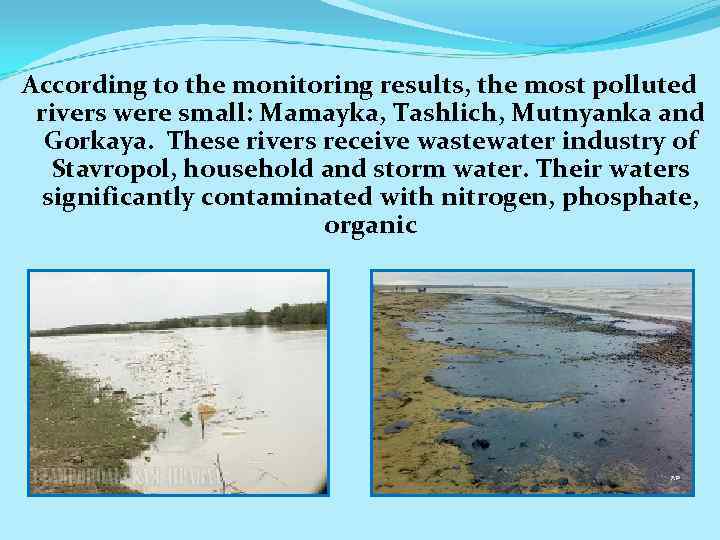
According to the monitoring results, the most polluted rivers were small: Mamayka, Tashlich, Mutnyanka and Gorkaya. These rivers receive wastewater industry of Stavropol, household and storm water. Their waters significantly contaminated with nitrogen, phosphate, organic
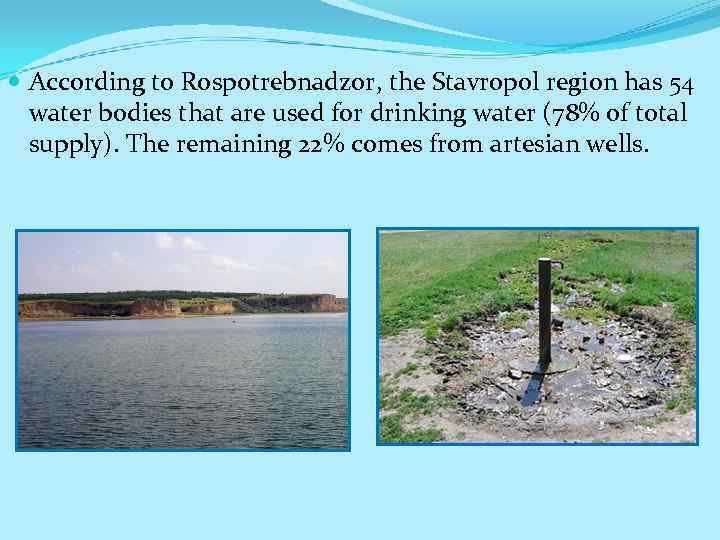
According to Rospotrebnadzor, the Stavropol region has 54 water bodies that are used for drinking water (78% of total supply). The remaining 22% comes from artesian wells.
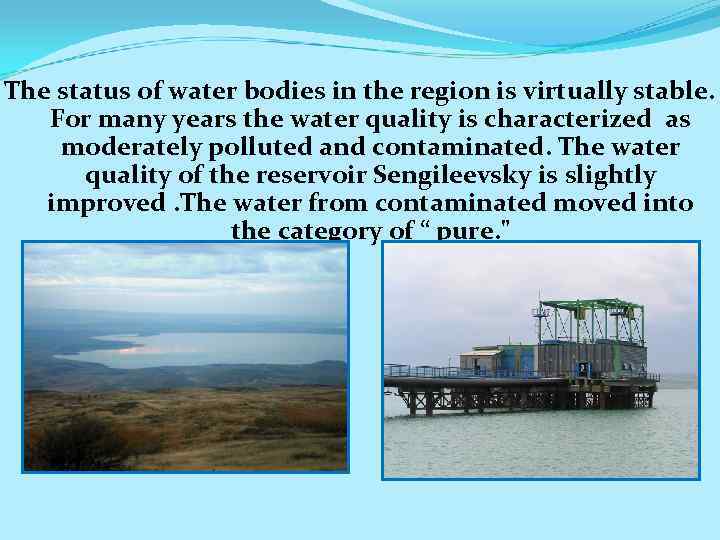
The status of water bodies in the region is virtually stable. For many years the water quality is characterized as moderately polluted and contaminated. The water quality of the reservoir Sengileevsky is slightly improved. The water from contaminated moved into the category of “ pure. "
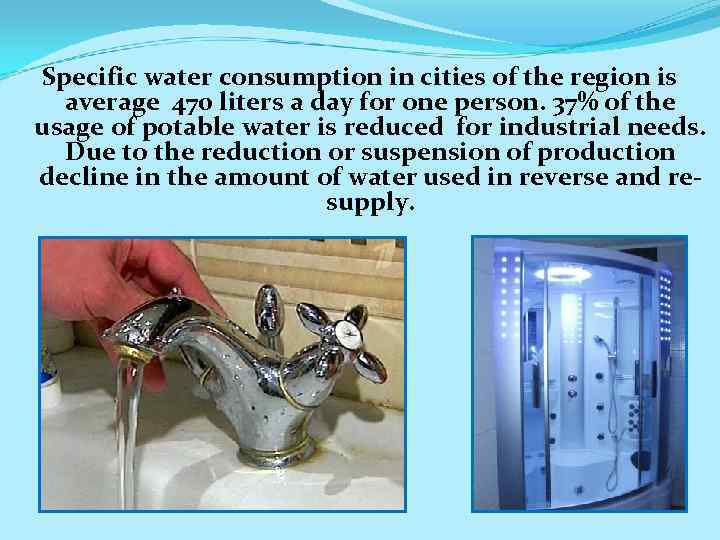
Specific water consumption in cities of the region is average 470 liters a day for one person. 37% of the usage of potable water is reduced for industrial needs. Due to the reduction or suspension of production decline in the amount of water used in reverse and resupply.
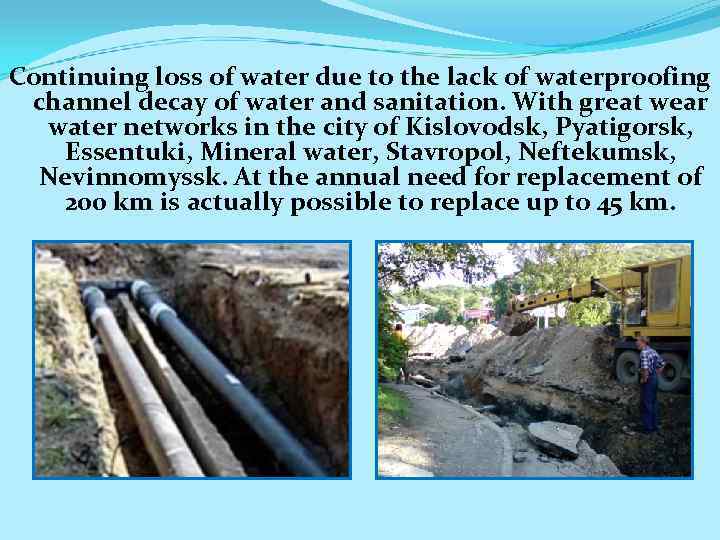
Continuing loss of water due to the lack of waterproofing channel decay of water and sanitation. With great wear water networks in the city of Kislovodsk, Pyatigorsk, Essentuki, Mineral water, Stavropol, Neftekumsk, Nevinnomyssk. At the annual need for replacement of 200 km is actually possible to replace up to 45 km.
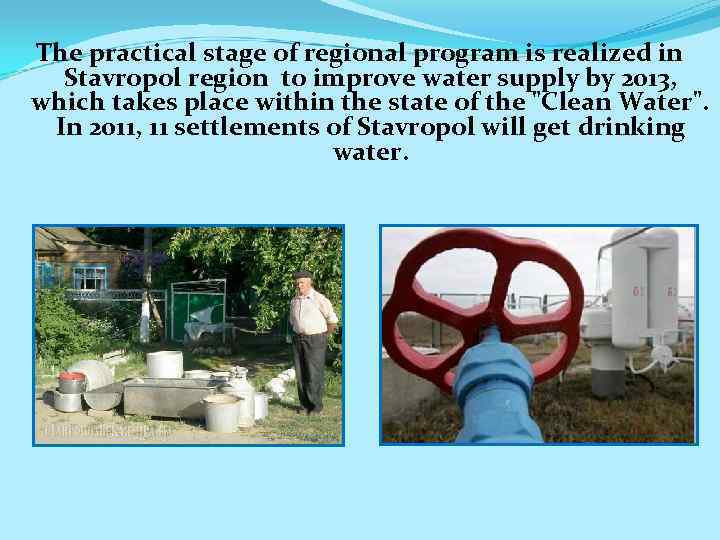
The practical stage of regional program is realized in Stavropol region to improve water supply by 2013, which takes place within the state of the "Clean Water". In 2011, 11 settlements of Stavropol will get drinking water.
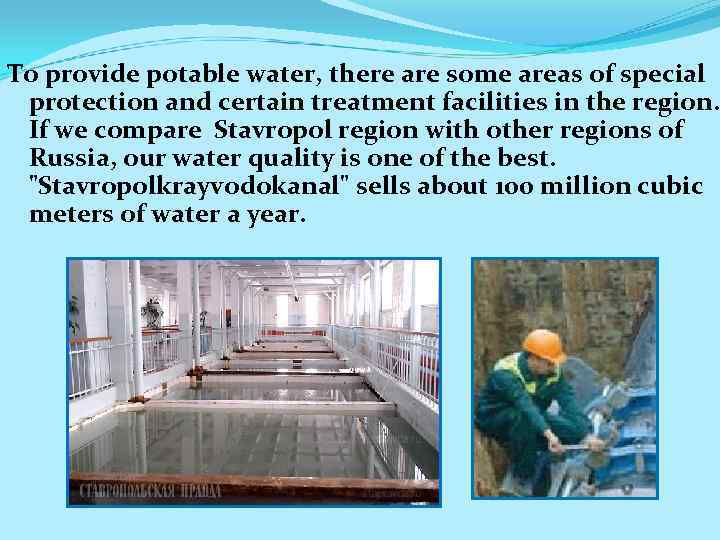
To provide potable water, there are some areas of special protection and certain treatment facilities in the region. If we compare Stavropol region with other regions of Russia, our water quality is one of the best. "Stavropolkrayvodokanal" sells about 100 million cubic meters of water a year.
There was a research of drinking water supplied by a central water system in 2010 -2013 in MBOU SOSH № 29
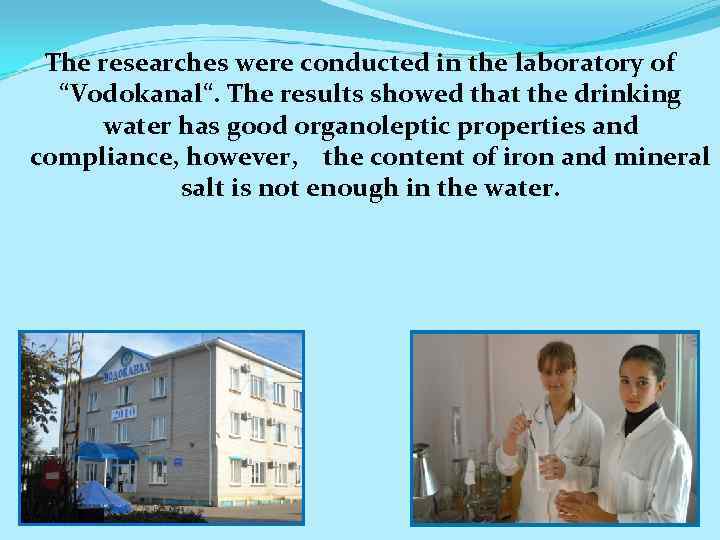
The researches were conducted in the laboratory of “Vodokanal“. The results showed that the drinking water has good organoleptic properties and compliance, however, the content of iron and mineral salt is not enough in the water.
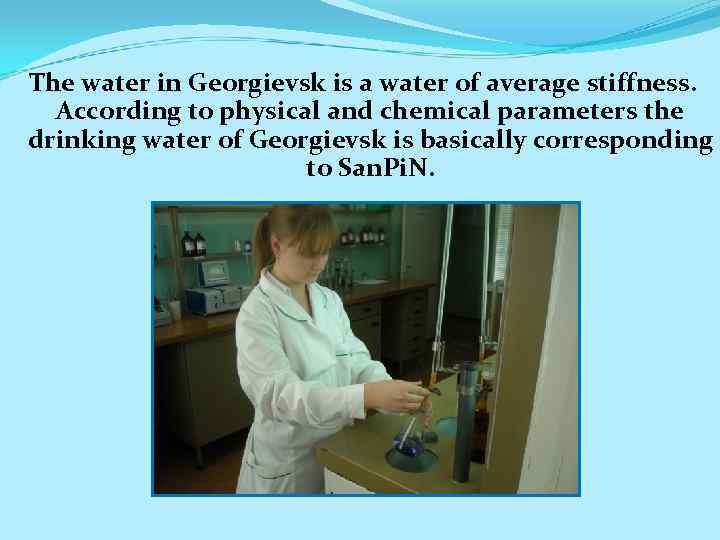
The water in Georgievsk is a water of average stiffness. According to physical and chemical parameters the drinking water of Georgievsk is basically corresponding to San. Pi. N.
Every year on March 22 many countries in the world celebrate World Water Day, which was established February 22, 1993 by the General Assembly. This day is meant to draw attention to the state of water bodies and the problems associated with their restoration and protection, think about the role of water in the life of every person on earth.
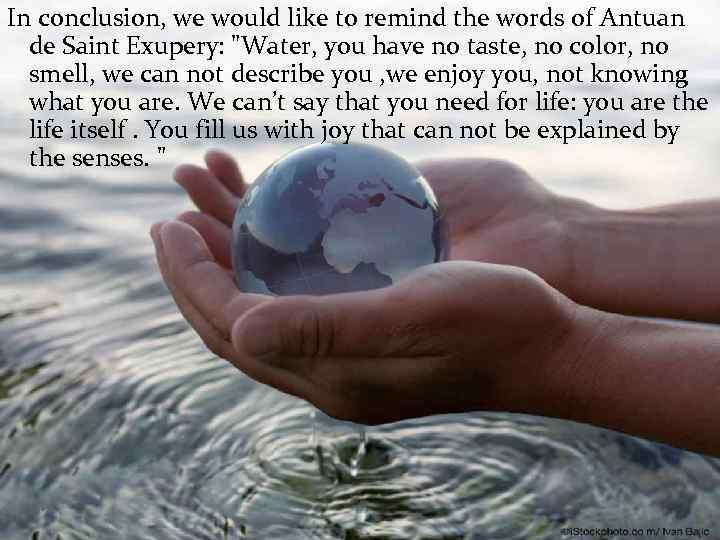
In conclusion, we would like to remind the words of Antuan de Saint Exupery: "Water, you have no taste, no color, no smell, we can not describe you , we enjoy you, not knowing what you are. We can’t say that you need for life: you are the life itself. You fill us with joy that can not be explained by the senses. "
Скачать презентацию Author — Christina Babayeva the student of the
Водные ресурсы Ставропольского края.ppt