


 Скачать презентацию Authentication Protocols used to convince parties of
740374affc86b567a0b3af7bc1191e73.ppt
- Количество слайдов: 14
 Authentication Protocols • used to convince parties of each others identity and to exchange session keys • may be one-way or mutual • key issues are – confidentiality – to protect session keys – timeliness – to prevent replay attacks
 Replay Attacks • where a valid signed message is copied and later resent – – simple replay repetition that can be logged repetition that cannot be detected backward replay without modification • countermeasures include – use of sequence numbers (generally impractical) – timestamps (needs synchronized clocks) – challenge/response (using unique nonce)
 Using Symmetric Encryption • as discussed previously can use a twolevel hierarchy of keys • usually with a trusted Key Distribution Center (KDC) – each party shares own master key with KDC – KDC generates session keys used for connections between parties – master keys used to distribute these to them
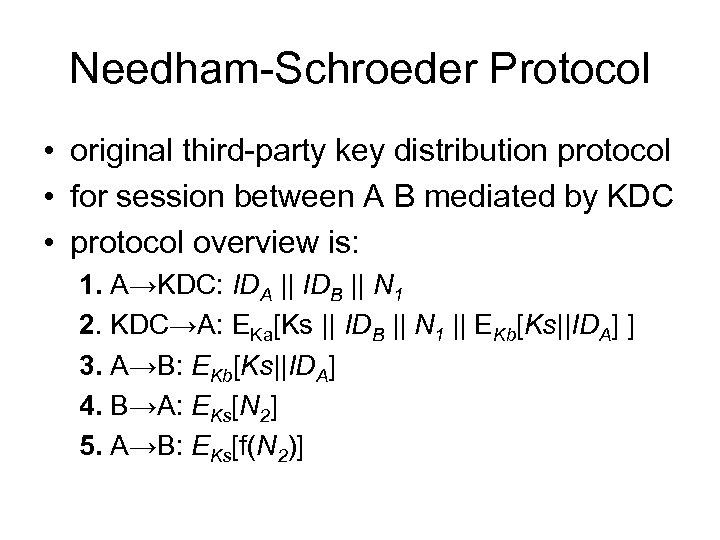 Needham-Schroeder Protocol • original third-party key distribution protocol • for session between A B mediated by KDC • protocol overview is: 1. A→KDC: IDA || IDB || N 1 2. KDC→A: EKa[Ks || IDB || N 1 || EKb[Ks||IDA] ] 3. A→B: EKb[Ks||IDA] 4. B→A: EKs[N 2] 5. A→B: EKs[f(N 2)]
 Needham-Schroeder Protocol • used to securely distribute a new session key for communications between A & B • but is vulnerable to a replay attack if an old session key has been compromised – then message 3 can be resent convincing B that is communicating with A • modifications to address this require: – timestamps (Denning 81) – using an extra nonce (Neuman 93)
 Using Public-Key Encryption • have a range of approaches based on the use of public-key encryption • need to ensure have correct public keys for other parties • using a central Authentication Server (AS) • various protocols exist using timestamps or nonces
 Denning AS Protocol • Denning 81 presented the following: 1. A→AS: IDA || IDB 2. AS→A: EKRas[IDA||KUa||T] || EKRas[IDB||KUb||T] 3. A→B: EKRas[IDA||KUa||T] || EKRas[IDB||KUb||T] || EKUb[EKRas[Ks||T]] • note session key is chosen by A, hence AS need not be trusted to protect it • timestamps prevent replay but require synchronized clocks
 One-Way Authentication • required when sender & receiver are not in communications at same time (eg. email) • have header in clear so can be delivered by email system • may want contents of body protected & sender authenticated
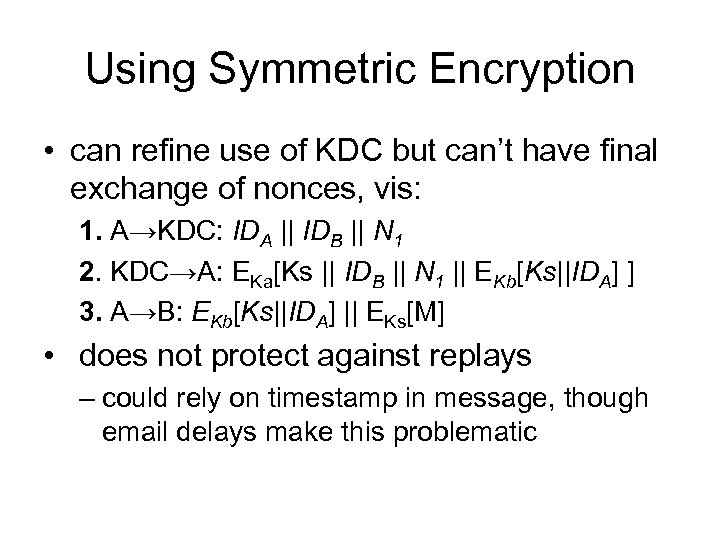 Using Symmetric Encryption • can refine use of KDC but can’t have final exchange of nonces, vis: 1. A→KDC: IDA || IDB || N 1 2. KDC→A: EKa[Ks || IDB || N 1 || EKb[Ks||IDA] ] 3. A→B: EKb[Ks||IDA] || EKs[M] • does not protect against replays – could rely on timestamp in message, though email delays make this problematic
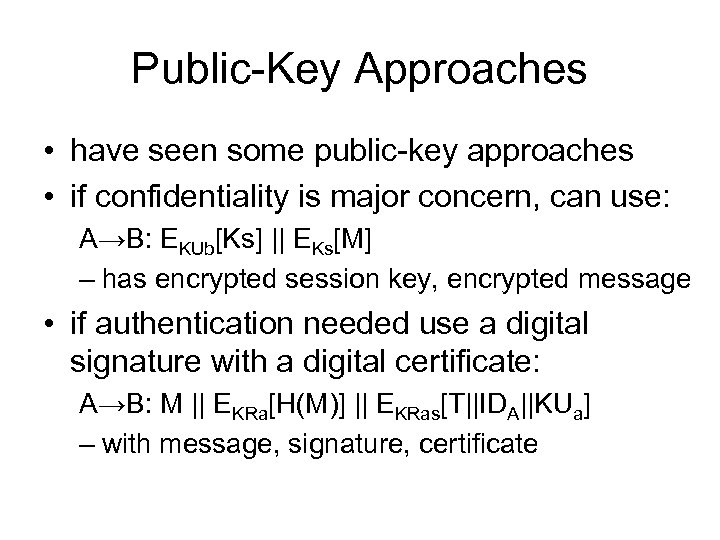 Public-Key Approaches • have seen some public-key approaches • if confidentiality is major concern, can use: A→B: EKUb[Ks] || EKs[M] – has encrypted session key, encrypted message • if authentication needed use a digital signature with a digital certificate: A→B: M || EKRa[H(M)] || EKRas[T||IDA||KUa] – with message, signature, certificate
 Digital Signature Standard (DSS) • • • US Govt approved signature scheme FIPS 186 uses the SHA hash algorithm designed by NIST & NSA in early 90's DSS is the standard, DSA is the algorithm a variant on El. Gamal and Schnorr schemes creates a 320 bit signature, but with 512 -1024 bit security • security depends on difficulty of computing discrete logarithms
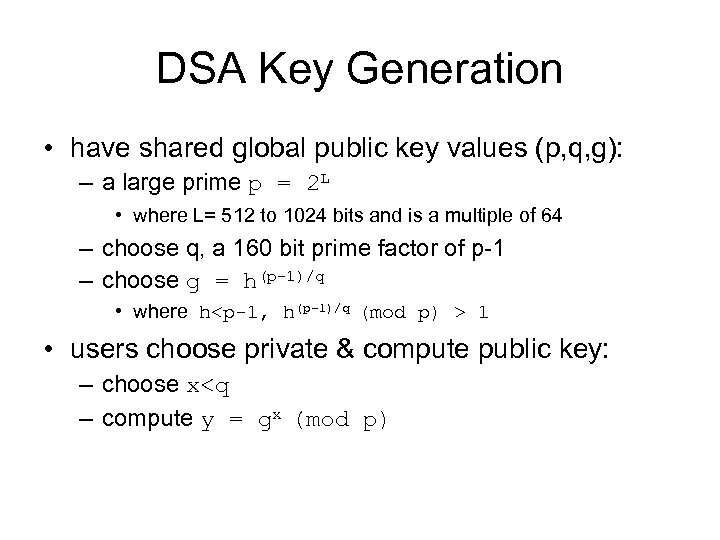 DSA Key Generation • have shared global public key values (p, q, g): – a large prime p = 2 L • where L= 512 to 1024 bits and is a multiple of 64 – choose q, a 160 bit prime factor of p-1 – choose g = h(p-1)/q • where h
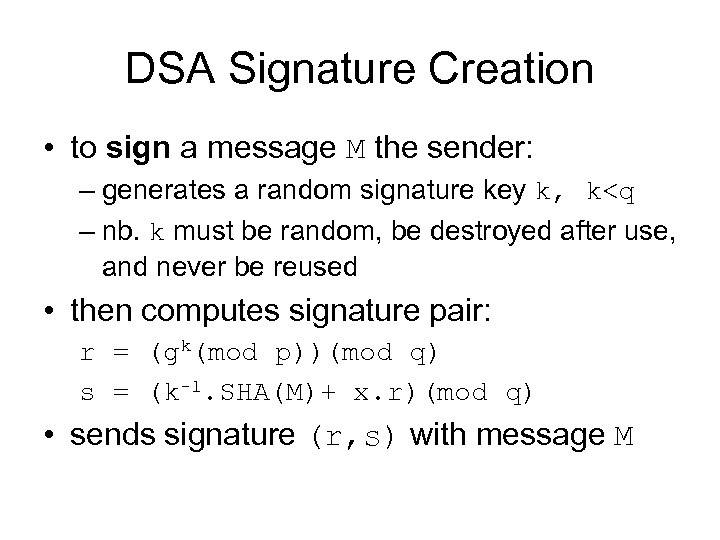 DSA Signature Creation • to sign a message M the sender: – generates a random signature key k, k
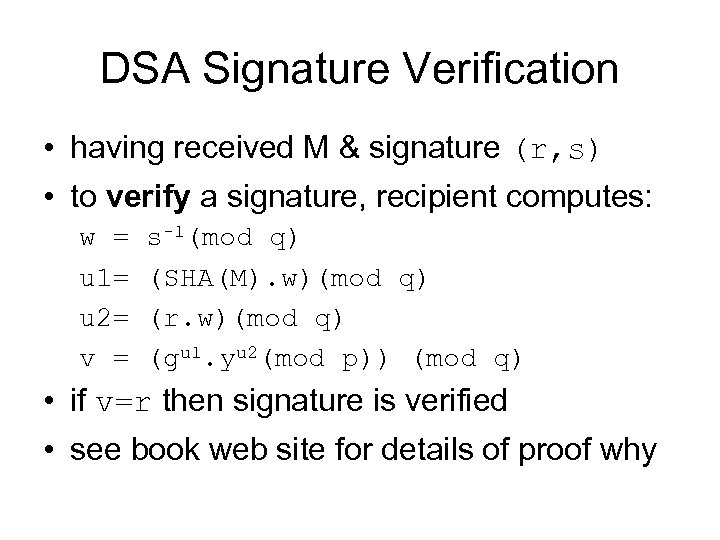 DSA Signature Verification • having received M & signature (r, s) • to verify a signature, recipient computes: w = u 1= u 2= v = s-1(mod q) (SHA(M). w)(mod q) (r. w)(mod q) (gu 1. yu 2(mod p)) (mod q) • if v=r then signature is verified • see book web site for details of proof why