


 Скачать презентацию Authentication and Authorization in g Lite Rafael Marco
1a06448b0513ef2cc72d47ba8573d4ee.ppt
- Количество слайдов: 22
 Authentication and Authorization in g. Lite Rafael Marco IFCA-Universidad de Cantabria
 Overview • Problems • Glossary • Encryption – Symmetric algorithms – Asymmetric algorithms: Public Key Infrastructure • Certificates – Digital Signatures – X. 509 certificates • Grid Security – Proxy certificates – Command line interfaces • Virtual Organization – Concept of VO and authorization Authentication and Authorization in g. Lite 2
 Glossary • • Principal – An entity: a user, a program, or a machine Credentials – Some data providing a proof of identity Authentication – Verify the identity of a principal Authorization – Map an entity to some set of privileges Confidentiality – Encrypt the message so that only the recipient can understand it Integrity – Ensure that the message has not been altered in the transmission Non-repudiation – Impossibility of denying the authenticity of a digital signature • The “Grid Security Infrastructure(GSI)” is the basis of (most) production grids Authentication and Authorization in g. Lite 3
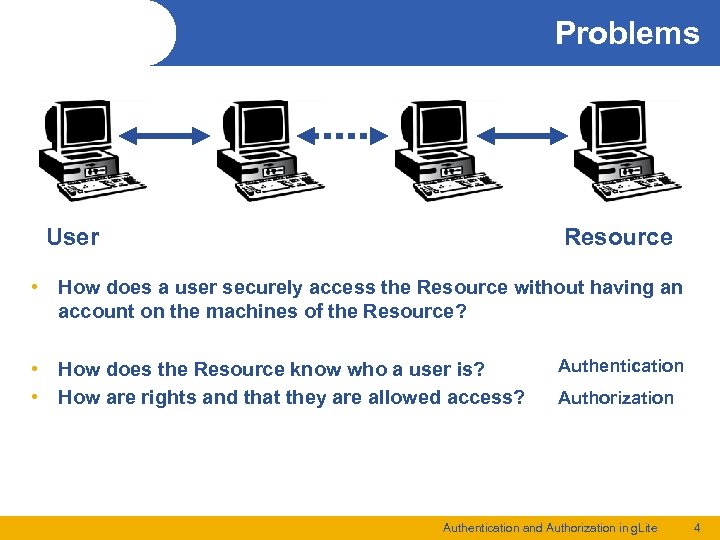 Problems User Resource • How does a user securely access the Resource without having an account on the machines of the Resource? • How does the Resource know who a user is? • How are rights and that they are allowed access? Authentication Authorization Authentication and Authorization in g. Lite 4
 Problems • Security!!! – Launch attacks to other sites § Large distributed farms of machines, perfect for launching a Distributed Denial of Service attack. – Illegal or inappropriate data distribution and access sensitive information § Massive distributed storage capacity ideal for example, for swapping movies. § Growing number of users have data that must be private – biomedical imaging for example – Damage caused by viruses, worms etc. § Highly connected infrastructure means worms could spread faster than on the internet in general. Authentication and Authorization in g. Lite 5
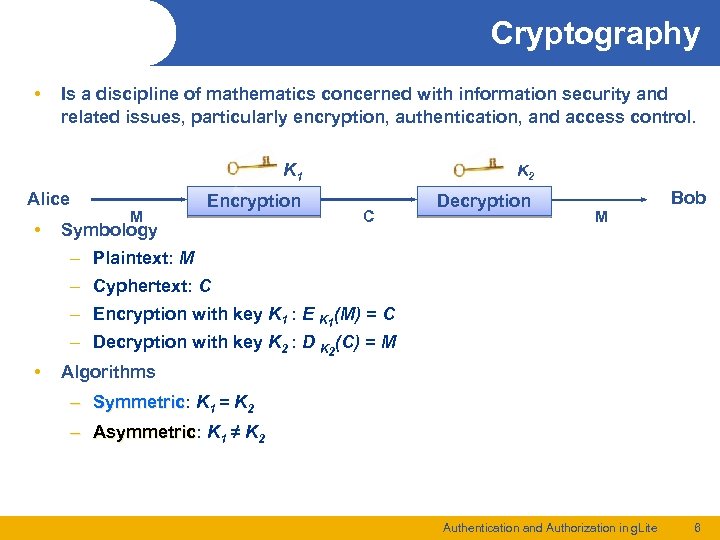 Cryptography • Is a discipline of mathematics concerned with information security and related issues, particularly encryption, authentication, and access control. K 1 Alice • M K 2 Encryption Decryption Symbology C M Bob – Plaintext: M – Cyphertext: C – Encryption with key K 1 : E K 1(M) = C – Decryption with key K 2 : D K 2(C) = M • Algorithms – Symmetric: K 1 = K 2 Symmetric – Asymmetric: K 1 ≠ K 2 Asymmetric Authentication and Authorization in g. Lite 6
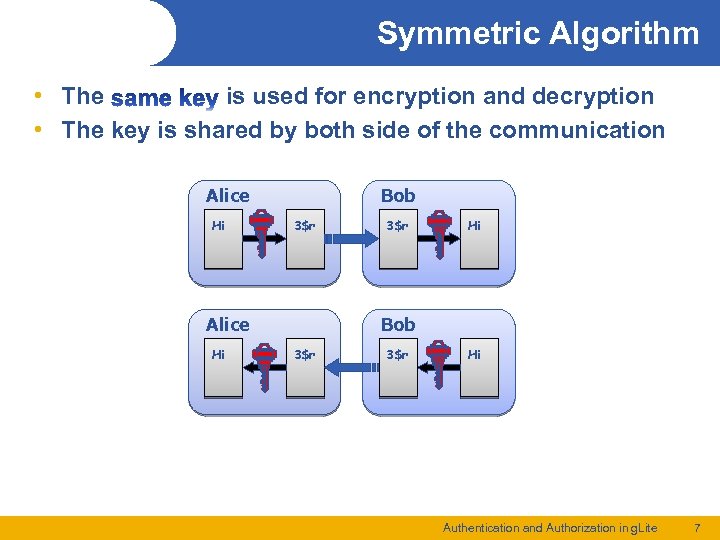 Symmetric Algorithm • The is used for encryption and decryption • The key is shared by both side of the communication Alice Hi Bob 3$r Alice Hi 3$r Hi Bob 3$r Hi Authentication and Authorization in g. Lite 7
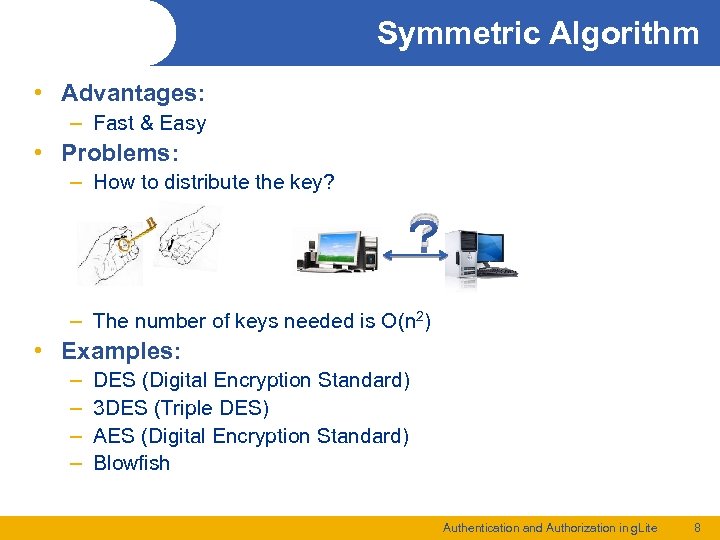 Symmetric Algorithm • Advantages: – Fast & Easy • Problems: – How to distribute the key? ? – The number of keys needed is O(n 2) • Examples: – – DES (Digital Encryption Standard) 3 DES (Triple DES) AES (Digital Encryption Standard) Blowfish Authentication and Authorization in g. Lite 8
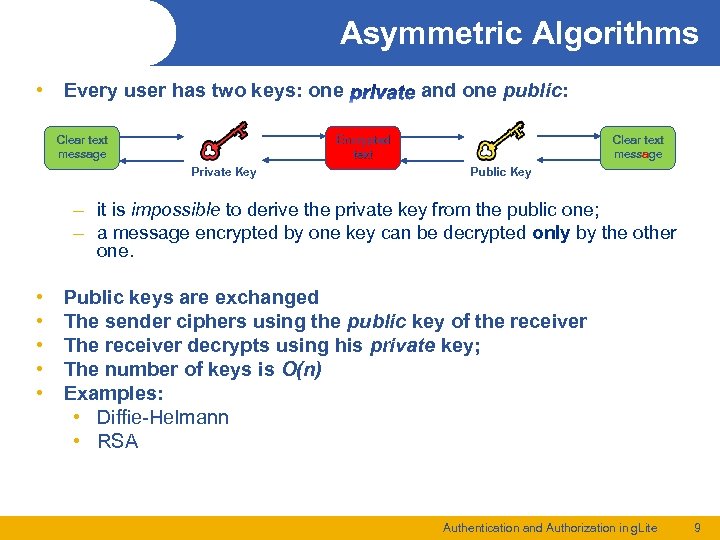 Asymmetric Algorithms • Every user has two keys: one Clear text message and one public: Clear text message messa Encrypted text Private Key Public Key – it is impossible to derive the private key from the public one; – a message encrypted by one key can be decrypted only by the other one. • • • Public keys are exchanged The sender ciphers using the public key of the receiver The receiver decrypts using his private key; The number of keys is O(n) Examples: • Diffie-Helmann • RSA Authentication and Authorization in g. Lite 9
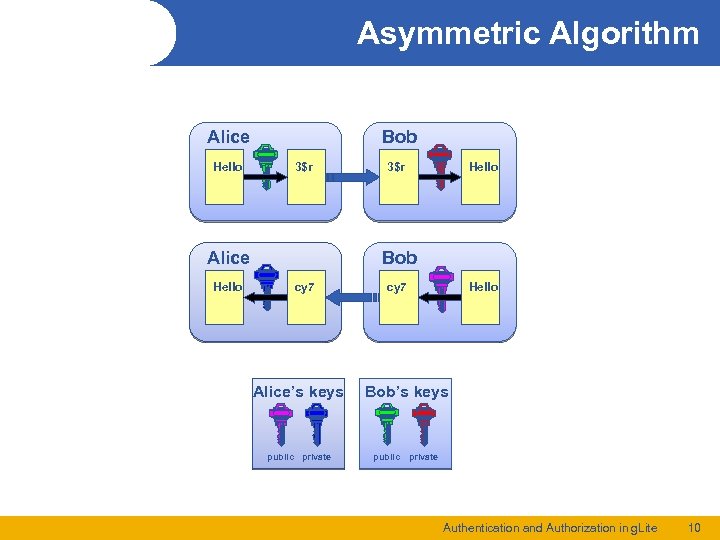 Asymmetric Algorithm Alice Hello Bob 3$r Alice Hello 3$r Hello Bob cy 7 Alice’s keys public private cy 7 Hello Bob’s keys public private Authentication and Authorization in g. Lite 10
 Hash Function • Converts any size of input into a fixed (smaller) size of output – Given h(x), it is difficult to compute x. – Given x, it is difficult to find x’ such that h(x) = h(x’). • Usage – Verifying file integrity – Digitally Signature • Examples – MD 5 – SHA-1 Authentication and Authorization in g. Lite 11
 Digital Signature • Digital signatures – A hash derived from the message and encrypted with the signer’s private key – Signature is checked by decrypting with the signer’s public key • Alice calculates the hash A of the message • Alice encrypts the hash using his private key: the encrypted hash is the. • Alice sends the signed message to Bob. • Bob calculates the hash B of the message • Decrypts signature, to get hash A , using Alice’s public key. • If hashes equal: – message wasn’t modified; – hash A is from Alice’s private key Authentication and Authorization in g. Lite 12
 Certification Authorities • How can Bob be sure that Alice’s public key is really Alice’s public key and not someone else’s? – A third party certifies correspondence between the public key and Alice’s identity. – Both Bob and Alice trust this third party The “third party” is called a Certification Authority (CA). Authentication and Authorization in g. Lite 13
 Certification Authorities • User’s identity has to be certified by one of the national Certification Authorities (CAs) • Resources are also certified by CAs • CAs are mutually recognized http: //www. gridpma. org/ • CAs each establish a number of people “registration authorities” RAs Authentication and Authorization in g. Lite 14
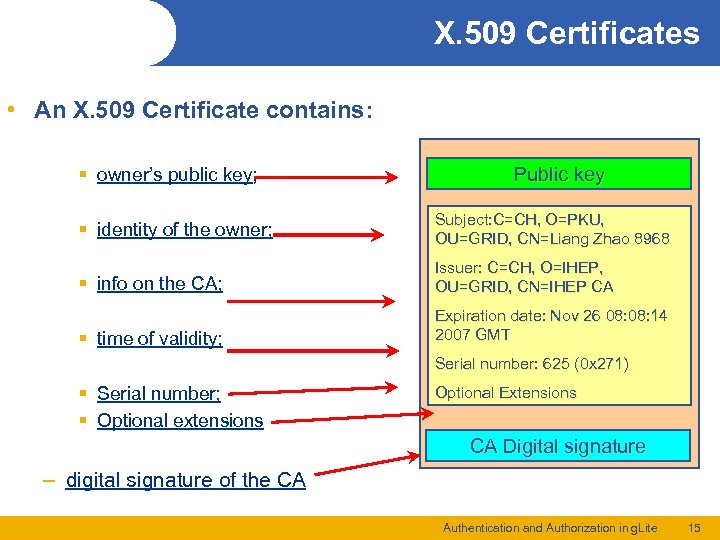 X. 509 Certificates • An X. 509 Certificate contains: § owner’s public key; Public key § identity of the owner; Subject: C=CH, O=PKU, OU=GRID, CN=Liang Zhao 8968 § info on the CA; Issuer: C=CH, O=IHEP, OU=GRID, CN=IHEP CA § time of validity; Expiration date: Nov 26 08: 14 2007 GMT Serial number: 625 (0 x 271) § Serial number; § Optional extensions Optional Extensions CA Digital signature – digital signature of the CA Authentication and Authorization in g. Lite 15
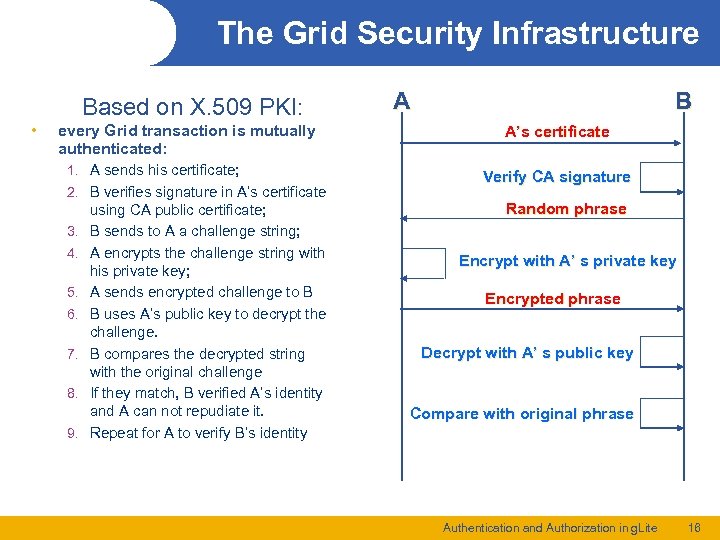 The Grid Security Infrastructure Based on X. 509 PKI: • every Grid transaction is mutually authenticated: 1. A sends his certificate; 2. B verifies signature in A’s certificate 3. 4. 5. 6. 7. 8. 9. using CA public certificate; B sends to A a challenge string; A encrypts the challenge string with his private key; A sends encrypted challenge to B B uses A’s public key to decrypt the challenge. B compares the decrypted string with the original challenge If they match, B verified A’s identity and A can not repudiate it. Repeat for A to verify B’s identity B A A’s certificate Verify CA signature Random phrase Encrypt with A’ s private key Encrypted phrase Decrypt with A’ s public key Compare with original phrase Authentication and Authorization in g. Lite 16
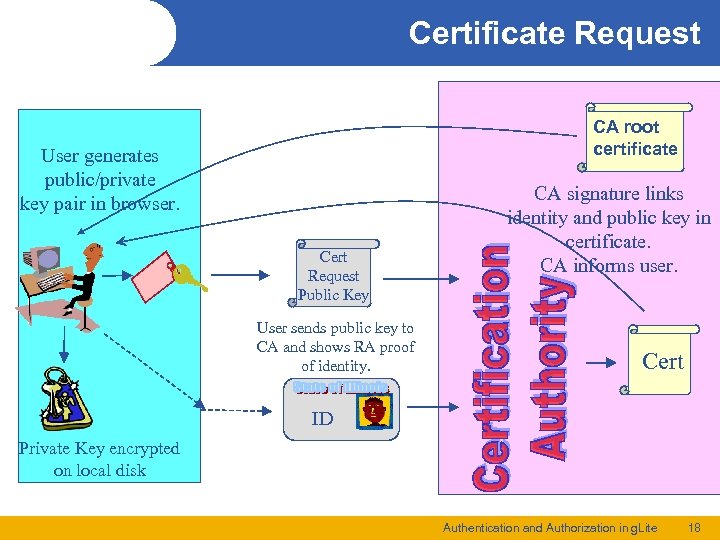 Certificate Request CA root certificate User generates public/private key pair in browser. Cert Request Public Key User sends public key to CA and shows RA proof of identity. CA signature links identity and public key in certificate. CA informs user. Cert ID Private Key encrypted on local disk Authentication and Authorization in g. Lite 18
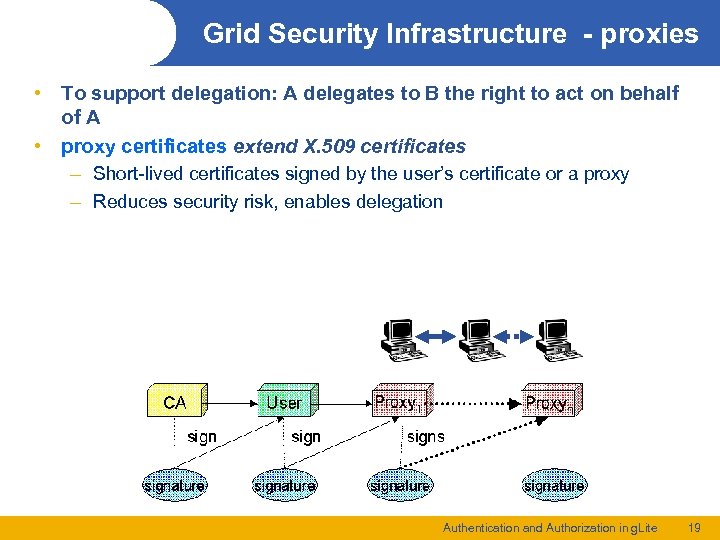 Grid Security Infrastructure - proxies • To support delegation: A delegates to B the right to act on behalf of A • proxy certificates extend X. 509 certificates – Short-lived certificates signed by the user’s certificate or a proxy – Reduces security risk, enables delegation Authentication and Authorization in g. Lite 19
 User Responsibilities • Keep your private key secure – on USB drive only • Do not loan your certificate to anyone. • Report to your local/regional contact if your certificate has been compromised. • Do not launch a delegation service for longer than your current task needs. If your certificate or delegated service is used by someone other than you, it cannot be proven that it was not you. Authentication and Authorization in g. Lite 20
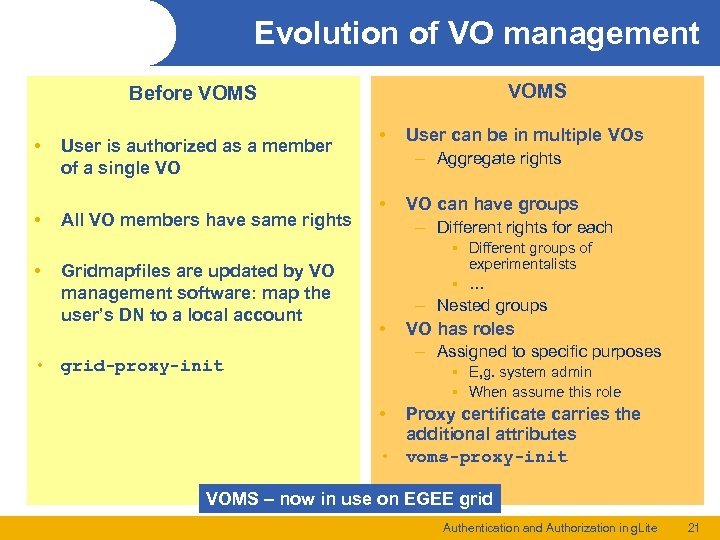 Evolution of VO management VOMS Before VOMS • • • User is authorized as a member of a single VO All VO members have same rights Gridmapfiles are updated by VO management software: map the user’s DN to a local account • User can be in multiple VOs – Aggregate rights • VO can have groups – Different rights for each § Different groups of experimentalists § … • • grid-proxy-init – Nested groups VO has roles – Assigned to specific purposes § E, g. system admin § When assume this role • Proxy certificate carries the additional attributes • voms-proxy-init VOMS – now in use on EGEE grid Authentication and Authorization in g. Lite 21
 Summary of AA - 1 • Authentication based on X. 509 PKI infrastructure – Trust between Certificate Authorities (CA) and sites, CAs and users is established (offline) – CAs issue (long lived) certificates identifying sites and individuals (much like a passport) § Commonly used in web browsers to authenticate to sites – In order to reduce vulnerability, on the Grid user identification is done by using (short lived) proxies of their certificates • Proxies can – Be delegated to a service such that it can act on the user’s behalf – Include additional attributes (like VO information via the VO Membership Service VOMS) – Be stored in an external proxy store (My. Proxy) – Be renewed (in case they are about to expire) Authentication and Authorization in g. Lite 22
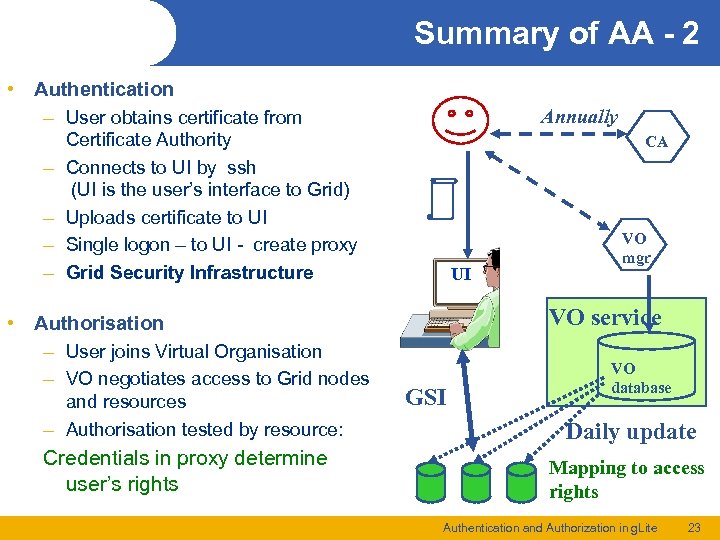 Summary of AA - 2 • Authentication – User obtains certificate from – – Annually Certificate Authority Connects to UI by ssh (UI is the user’s interface to Grid) Uploads certificate to UI Single logon – to UI - create proxy Grid Security Infrastructure • Authorisation – User joins Virtual Organisation – VO negotiates access to Grid nodes and resources – Authorisation tested by resource: Credentials in proxy determine user’s rights CA UI VO mgr VO service GSI VO database Daily update Mapping to access rights Authentication and Authorization in g. Lite 23