


 Скачать презентацию Australiathe Land Down Under Area 7 7
история австралии.pptx
- Количество слайдов: 17
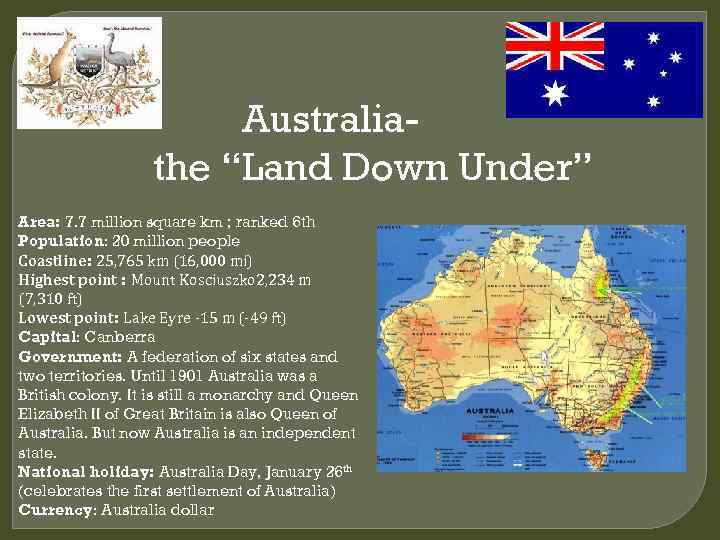 Australiathe “Land Down Under” Area: 7. 7 million square km ; ranked 6 th Population: 20 million people Coastline: 25, 765 km (16, 000 mi) Highest point : Mount Kosciuszko 2, 234 m (7, 310 ft) Lowest point: Lake Eyre -15 m (-49 ft) Capital: Canberra Government: A federation of six states and two territories. Until 1901 Australia was a British colony. It is still a monarchy and Queen Elizabeth II of Great Britain is also Queen of Australia. But now Australia is an independent state. National holiday: Australia Day, January 26 th (celebrates the first settlement of Australia) Currency: Australia dollar
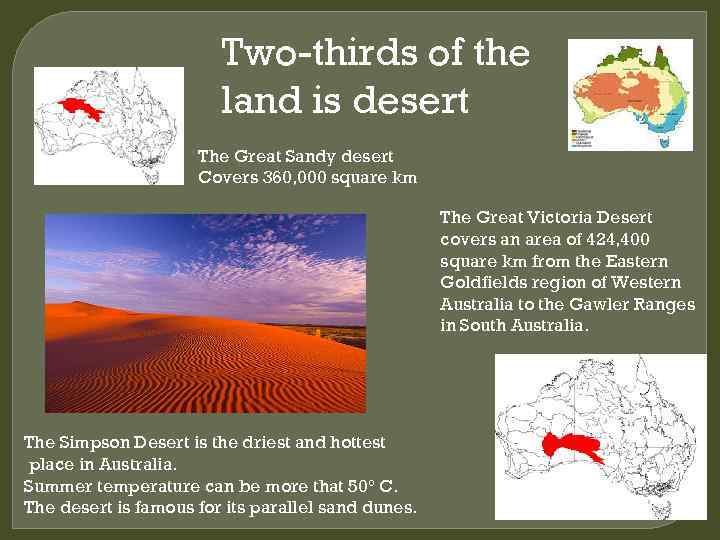 Two-thirds of the land is desert The Great Sandy desert Covers 360, 000 square km The Great Victoria Desert covers an area of 424, 400 square km from the Eastern Goldfields region of Western Australia to the Gawler Ranges in South Australia. The Simpson Desert is the driest and hottest place in Australia. Summer temperature can be more that 50 o C. The desert is famous for its parallel sand dunes.
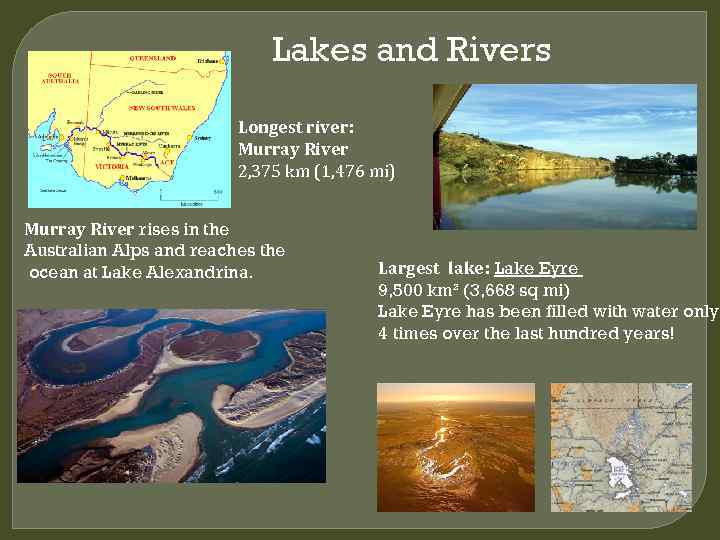 Lakes and Rivers Longest river: Murray River 2, 375 km (1, 476 mi) Murray River rises in the Australian Alps and reaches the ocean at Lake Alexandrina. Largest lake: Lake Eyre 9, 500 km² (3, 668 sq mi) Lake Eyre has been filled with water only 4 times over the last hundred years!
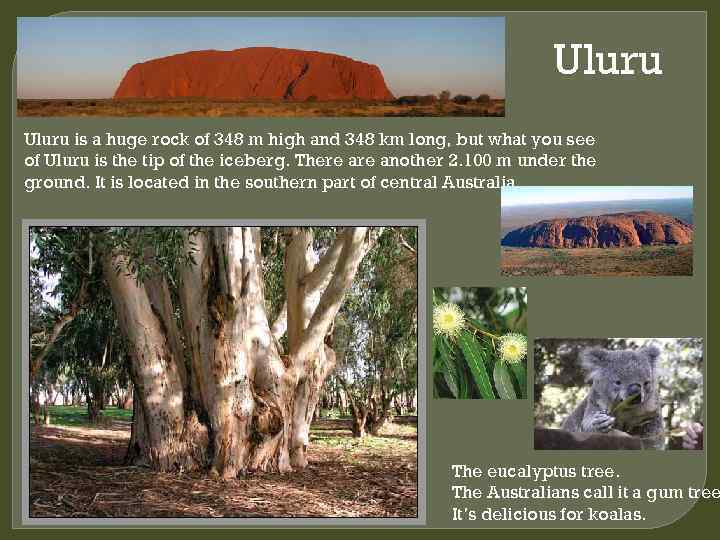 Uluru is a huge rock of 348 m high and 348 km long, but what you see of Uluru is the tip of the iceberg. There another 2. 100 m under the ground. It is located in the southern part of central Australia. The eucalyptus tree. The Australians call it a gum tree It’s delicious for koalas.
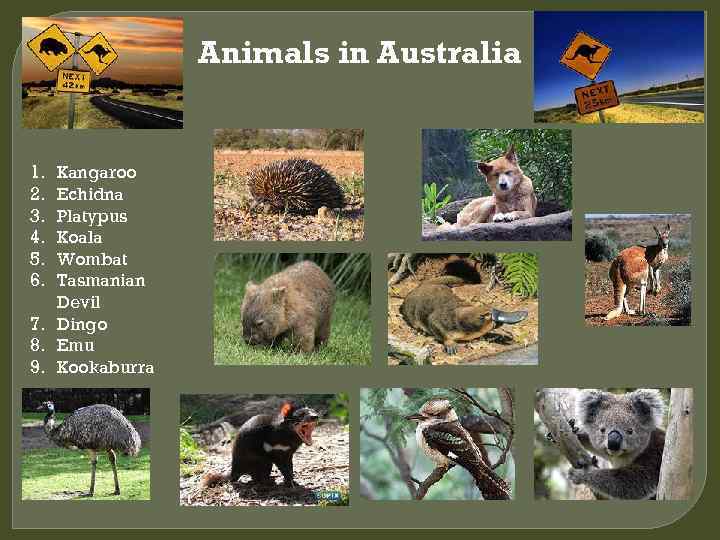 Animals in Australia 1. 2. 3. 4. 5. 6. Kangaroo Echidna Platypus Koala Wombat Tasmanian Devil 7. Dingo 8. Emu 9. Kookaburra
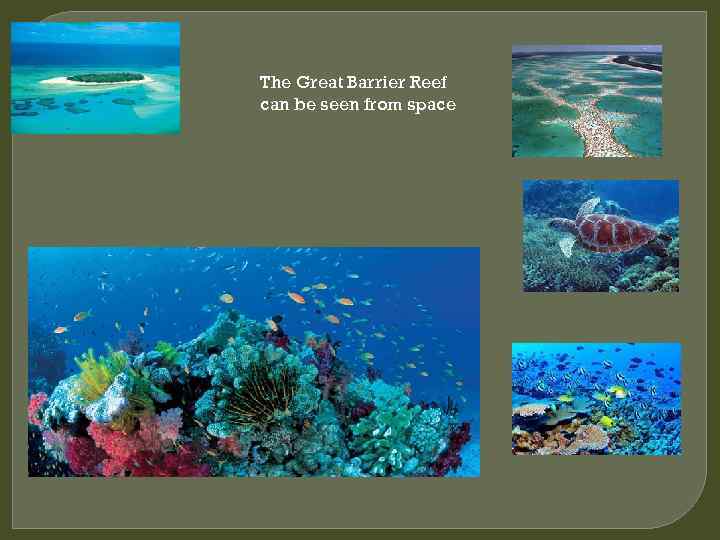 The Great Barrier Reef can be seen from space
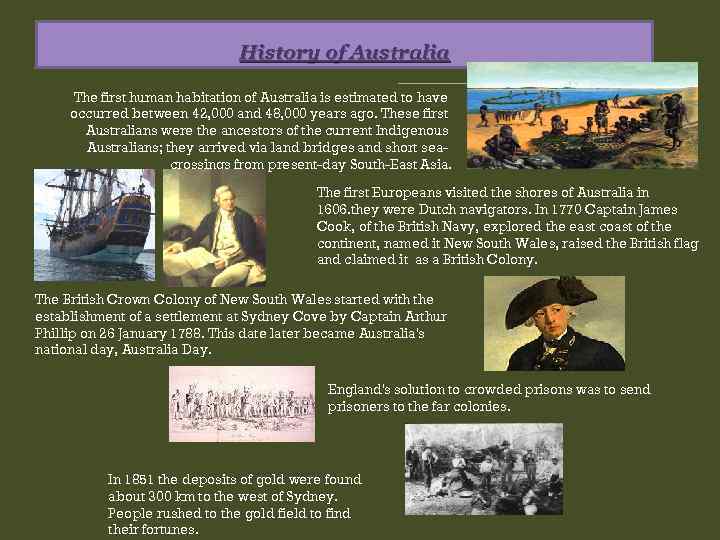 History of Australia The first human habitation of Australia is estimated to have occurred between 42, 000 and 48, 000 years ago. These first Australians were the ancestors of the current Indigenous Australians; they arrived via land bridges and short seacrossings from present-day South-East Asia. The first Europeans visited the shores of Australia in 1606. they were Dutch navigators. In 1770 Captain James Cook, of the British Navy, explored the east coast of the continent, named it New South Wales, raised the British flag and claimed it as a British Colony. The British Crown Colony of New South Wales started with the establishment of a settlement at Sydney Cove by Captain Arthur Phillip on 26 January 1788. This date later became Australia's national day, Australia Day. England's solution to crowded prisons was to send prisoners to the far colonies. In 1851 the deposits of gold were found about 300 km to the west of Sydney. People rushed to the gold field to find their fortunes.
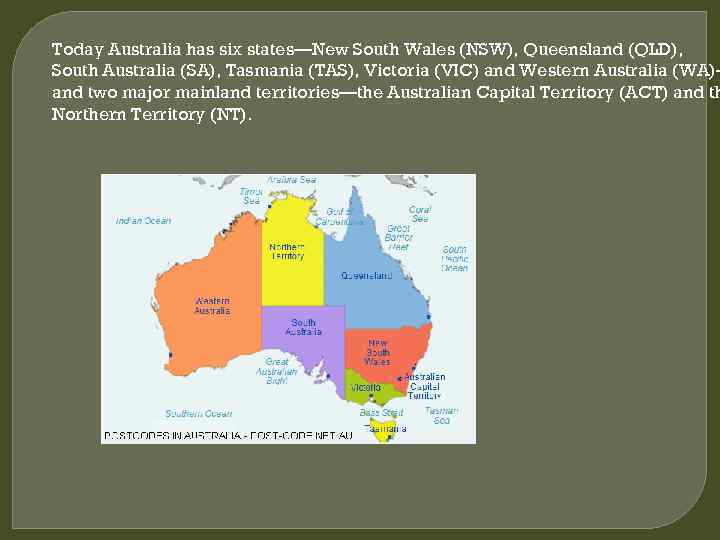 Today Australia has six states—New South Wales (NSW), Queensland (QLD), South Australia (SA), Tasmania (TAS), Victoria (VIC) and Western Australia (WA)— and two major mainland territories—the Australian Capital Territory (ACT) and th Northern Territory (NT).
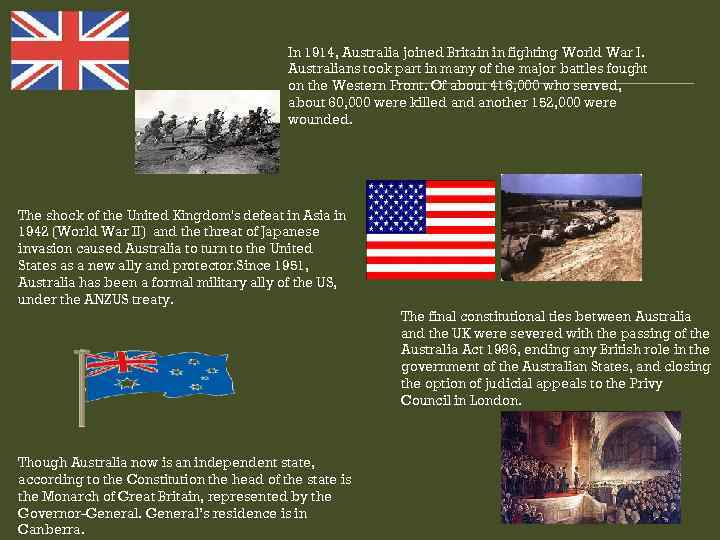 In 1914, Australia joined Britain in fighting World War I. Australians took part in many of the major battles fought on the Western Front. Of about 416, 000 who served, about 60, 000 were killed another 152, 000 were wounded. The shock of the United Kingdom's defeat in Asia in 1942 (World War II) and the threat of Japanese invasion caused Australia to turn to the United States as a new ally and protector. Since 1951, Australia has been a formal military ally of the US, under the ANZUS treaty. The final constitutional ties between Australia and the UK were severed with the passing of the Australia Act 1986, ending any British role in the government of the Australian States, and closing the option of judicial appeals to the Privy Council in London. Though Australia now is an independent state, according to the Constitution the head of the state is the Monarch of Great Britain, represented by the Governor-General’s residence is in Canberra.
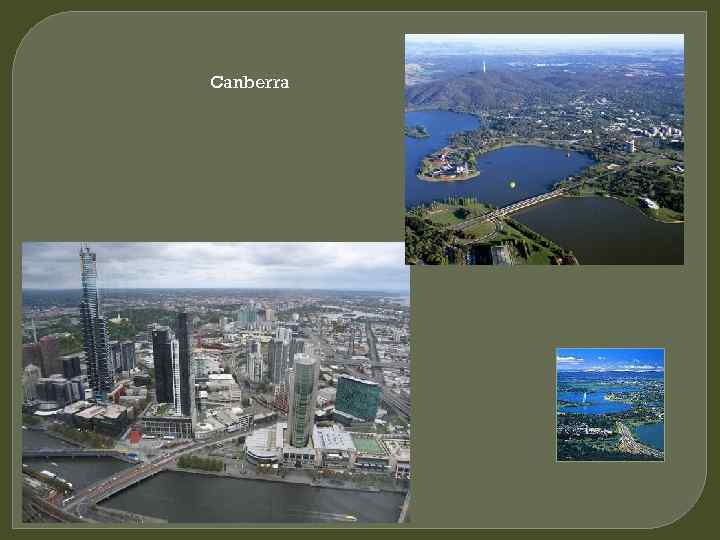 Canberra
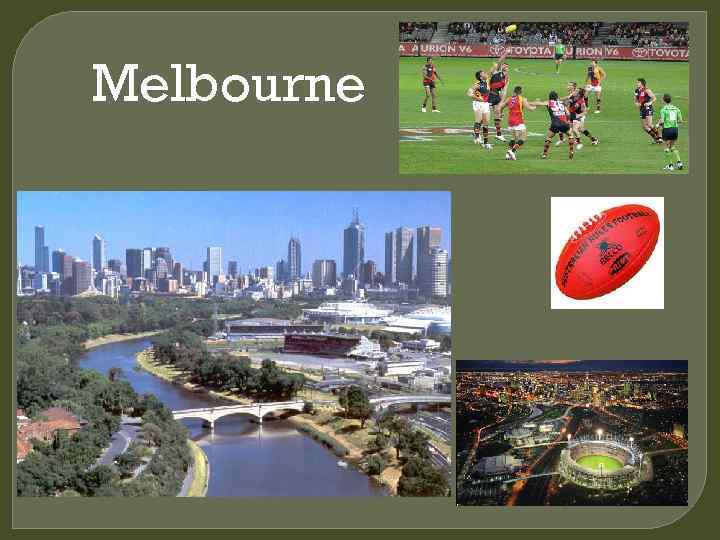 Melbourne
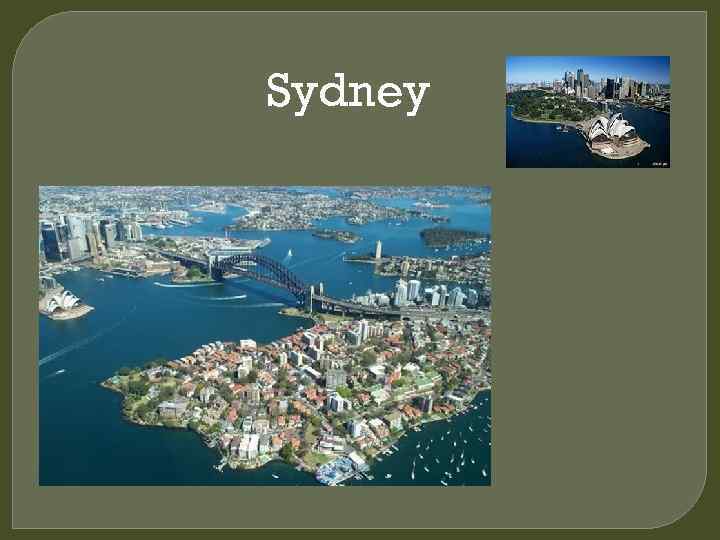 Sydney
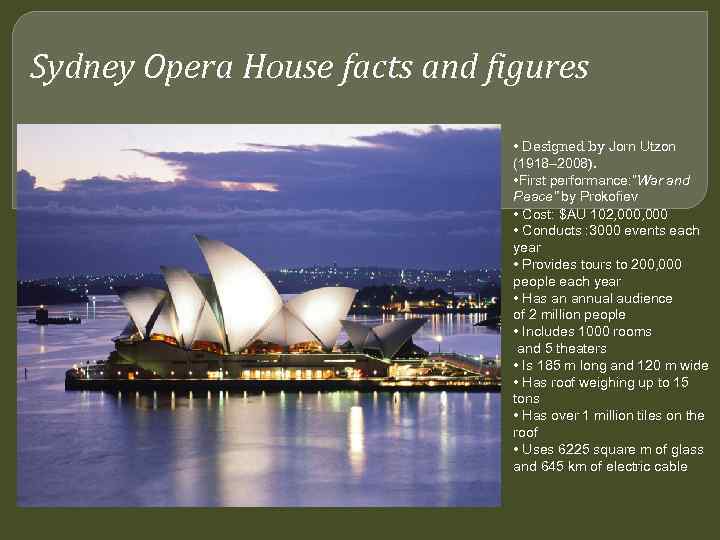 Sydney Opera House facts and figures • Designed by Jorn Utzon (1918– 2008). • First performance: ”War and Peace” by Prokofiev • Cost: $AU 102, 000 • Conducts : 3000 events each year • Provides tours to 200, 000 people each year • Has an annual audience of 2 million people • Includes 1000 rooms and 5 theaters • Is 185 m long and 120 m wide • Has roof weighing up to 15 tons • Has over 1 million tiles on the roof • Uses 6225 square m of glass and 645 km of electric cable
 Australian people speak English but their English is a bit different. Can you guess what these words mean? 1. arvo: 2. barbie: 3. chook: 4. Chrissie: 5. crook: 6. cow: 7. cozzie: 8. dead horse: 9. drongo: 10. fair dinkum: 11. grizzle: 12. Hooly-Dooly: 13. journo: 14. kanga or kangaroo: 15. lollies: 16. lolly 17. mate: 18. mozzie: 19. snags: afternoon a barbecue a chicken Christmas not well, ill, as in ‘I’m crook. I think I have the fly. ’ anything that is difficult swimming suit tomato sauce a foolish person really, honestly to complain an expression of surprise journalist shoe sweets money a best friend a mosquito sausages
 Can you translate? 1. 2. 3. 4. Hey, mate! Come along to our barbie this arvo. We’re going to cook the snags. I don’t mean to grizzle, but I was feeling pretty crook during Chrissie. She’ll be apples!
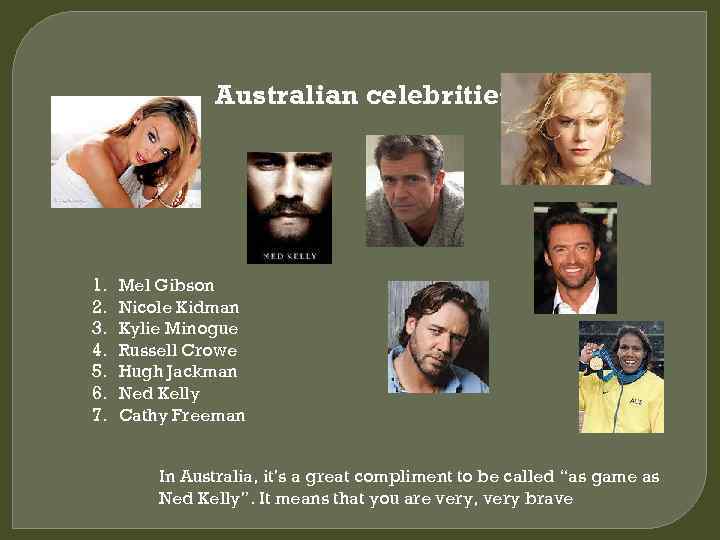 Australian celebrities 1. 2. 3. 4. 5. 6. 7. Mel Gibson Nicole Kidman Kylie Minogue Russell Crowe Hugh Jackman Ned Kelly Cathy Freeman In Australia, it’s a great compliment to be called “as game as Ned Kelly”. It means that you are very, very brave
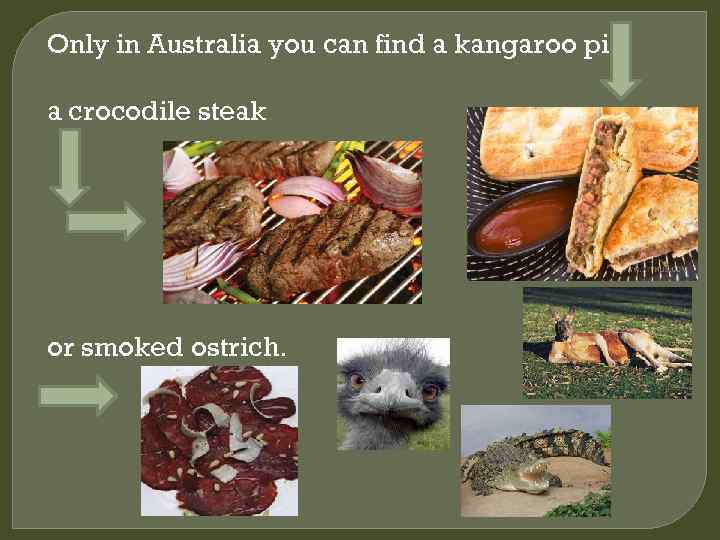 Only in Australia you can find a kangaroo pie, a crocodile steak or smoked ostrich.