


 Скачать презентацию Australian Vocational Education System Example for Myanmar Technical
84b27e0ebe8f5ed8f4edfdb93de28531.ppt
- Количество слайдов: 72
 Australian Vocational Education System Example for Myanmar Technical Education Dr Kyaw Naing (Providing the information rather than presenting the own educational theories & concepts) 1
 TRAINING & SKILLS The development of a country depends on the education system that can provide the appropriate education, skills and competency required for performing the tasks at different levels of occupations. 2
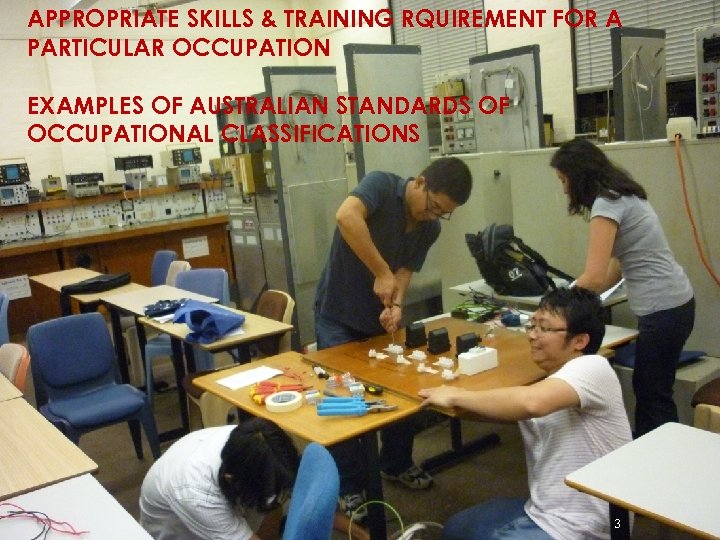 APPROPRIATE SKILLS & TRAINING RQUIREMENT FOR A PARTICULAR OCCUPATION EXAMPLES OF AUSTRALIAN STANDARDS OF OCCUPATIONAL CLASSIFICATIONS 3
 Skills & Qualifications for Australian Occupations SK I L L L E V E L 1 Occupations at Skill Level 1 have a level of skill commensurate with a bachelor degree or higher qualification. At least five years of relevant experience may substitute for the formal qualification. In some instances relevant experience and/or on-the-job training may be required in addition to the formal qualification. 4
 TASKS OF SKILL LEVEL 1 setting the overall direction and objectives of organisations and departments within organisations formulating, administering and reviewing policy and legislation to ensure organisational and departmental objectives are met directing and coordinating the allocation of assets and resources directing, controlling and coordinating the activities of organisations and departments, either personally orthrough senior subordinate staff monitoring and evaluating overall organisational and departmental performance, and adjusting policies, rules and regulations to ensure objectives are met representing the organisation at official occasions, in negotiations, at conventions, seminars, public hearings and forums, and liaising between areas of responsibility 5
 SAMPLES OF SKILLS LEVEL 1 OCCUPATIONS Specialist Managers Farmers and Farm Managers Chief Executives, General Managers and Legislators Legal, Social and Welfare Professionals ICT Professionals Health Professionals Education Professionals Design, Engineering, Science and Transport Professionals Business, Human Resource and Marketing Professionals Arts and Media Professionals 6
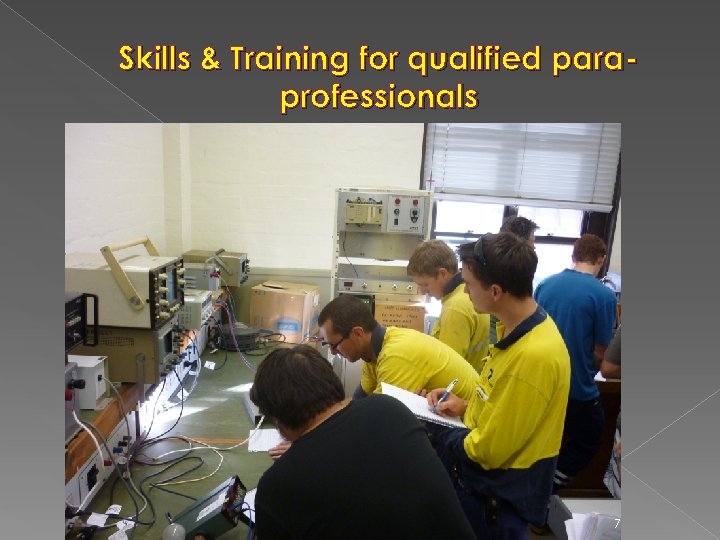 Skills & Training for qualified paraprofessionals 7
 Skills & Qualifications for Australian Occupations SK I L L L E V E L 2 Occupations at Skill Level 2 have a level of skill commensurate with one of the following: Register Diploma or NZ Associate Degree, Advanced Diploma AQF or Diploma. At least three years of relevant experience may substitute for the formal qualifications listed above. In some instances relevant experience and/or on-the-job training may be required in addition to the formal qualification. 8
 TASKS OF SKILLS LEVEL 2 communicating ideas through language, printed and electronic media, and artistic media including the visual and performing arts analysing, planning, developing and implementing programs and solutions to resolve business and economic problems providing services in financial accounting, human resource development, publicity and marketing, and the efficient operation of organisation flying aircraft, and controlling and directing the operation of ships, boats and marine equipment conducting and analysing research to extend the body of knowledge in the field of the sciences and developing techniques to apply this knowledge designing products, buildings and other physical structures, and engineering systems researching and developing curricula, and teaching students in a range of educational settings designing, implementing, testing and maintaining technologies and services that enable information to be accessed, stored, manipulated, processed, and disseminated identifying, treating, and advising on, health, social, and personal issues advising clients on legal matters 9
 SAMPLES OF SKILLS LEVEL 2 OCCUPATIONS Engineering, ICT and Science Technicians Health and Welfare Support Workers Office Managers and Program Administrators 10
 Skills & Qualifications for Australian Occupations SK I L L L E V E L 3 Occupations at Skill Level 3 have a level of skill commensurate with one of the following: Register Level 4 qualification NZ AQF Certificate IV or AQF Certificate III including at least two years of on-the-job training. 11
 TASKS OF SKILLS LEVEL 3 Breadth, depth and complexity of knowledge and competencies would cover a broad range of varied activities or application in a wider variety of contexts most of which are complex and non-routine. Leadership and guidance are involved when organising activities of self and others as well as contributing to technical solutions of a non-routine or contingency nature. Performance of a broad range of skilled applications including the requirement to evaluate and analyse current practices, develop Australian criteria and procedures for performing current practices and provision of some leadership and guidance to others in the application and planning of the skills. Applications involve responsibility for, and limited organisation of, others. 12
 SOME EXAMPLE TASKS OF SKILLS LEVEL 3 carrying out tests and experiments, and providing technical support to Health Professionals, Natural and Physical Science Professionals and Engineering Professionals providing technical support to users of computer hardware and software fabricating, repairing and maintaining metal, wood, glass and textile products repairing and maintaining motor vehicles, aircraft, marine craft and electrical and electronic machines and equipment constructing, repairing, fitting-out and finishing buildings and other structures operating printing and binding equipment preparing and cooking food shearing, caring for, training and grooming animals, and assisting Veterinarians propagating and cultivating plants, and establishing and maintaining turf surfaces for sporting events cutting and styling hair operating chemical, gas, petroleum and power generation equipment providing technical assistance for the production, recording and broadcasting of artistic performances 13
 SAMPLES OF SKILLS LEVEL 3 OCCUPATIONS Technicians and Trades Workers Skilled Animal and Horticultural Workers Food Trades Workers Electrotechnology and Telecommunications Trades Workers Construction Trades Workers Automotive and Engineering Trades Workers 14
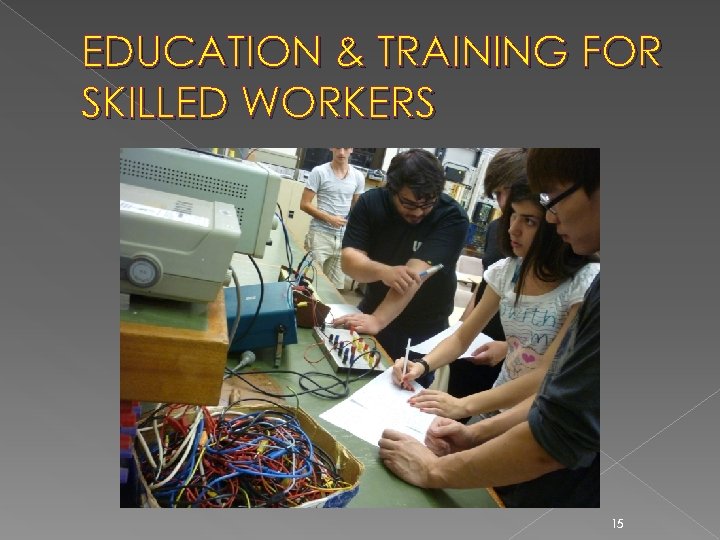 EDUCATION & TRAINING FOR SKILLED WORKERS 15
 Skills & Qualifications for Australian Occupations SK I L L L E V E L 4 Occupations at Skill Level 4 have a level of skill commensurate with one of the following: Register Level 2 or 3 qualification or NZ Certificate II or III. AQF At least one year of relevant experience may substitute for the formal qualifications listed above. In some instances relevant experience may be required in addition to the formal qualification. 16
 TASKS OF SKILLS LEVEL 4 Breadth, depth and complexity of knowledge and competencies would cover selecting, adapting and transferring skills and knowledge to Australian environments and providing technical advice and some leadership in resolution of specified problems. This would be applied across a range of roles in a variety of contexts with some complexity in the extent and choice of options available. Performance of a defined range of skilled operations, usually within a range of broader related activities involving known routines, methods and procedures, where some discretion and judgement is required in the section of equipment, services or contingency measures and within known time constraints. Applications may involve some responsibility for others. Participation in teams including group or team coordination may be involved. 17
 SAMPLES OF SKILLS LEVEL 4 OCCUPATIONS Sports and Personal Service Workers Protective Service Workers Hospitality Workers Carers and Aides Sales Representatives and Agents Other Clerical and Administrative Workers Clerical and Office Support Workers Numerical Clerks Inquiry Clerks and Receptionists 18
 SAMPLES OF SKILLS LEVEL 4 OCCUPATIONS Storepersons Road and Rail Drivers Mobile Plant Operators Machine and Stationary Plant Operators 19
 Skills & Qualifications for Australian Occupations SK I L L L E V E L 5 Occupations at Skill Level 5 have a level of skill commensurate with one of the following: Register Level 1 qualification NZ AQF Certificate I or compulsory secondary education. 20
 SAMPLES OF SKILLS LEVEL 5 OCCUPATIONS Food Preparation Assistants Farm, Forestry and Garden Workers Factory Process Workers Construction and Mining Labourers Cleaners and Laundry Workers Other Labourers 21
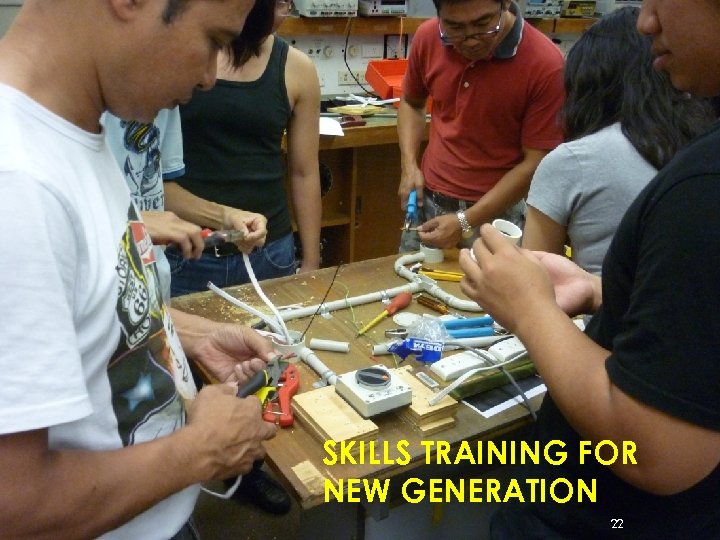 SKILLS TRAINING FOR NEW GENERATION 22
 VOCATIONAL EDUCATION & TRAINING FOR SKILLS LEVEL 2, 3, 4 & 5 NATIONAL APPROACH & GUIDELINES INDUSTRY SKILLS COUNCILS STATES & TERRITORITIES TRAINING AUTHORITIES AUSTRALIAN QUALIFICATIONS FRAMEWORK EDUCATIONAL & TRAINING INSTITUTIONS 23
 www. trainming. gov. au training. gov. au encompasses the national register which contains the authoritative information about Registered Training Organisations (RTOs), recognised training products and the approved scope of each RTO to deliver nationally recognised training as required in national and jurisdictional legislation within Australia. Information on this site is maintained by the Registration and Course Accreditation Bodies (RCABs) and the Industry Skills Councils (ISCs). 24
 LIST OF TRAINING PACKAGES Agri-Food Training Package Live Performance Training Package Library, Information and Cultural Services Training Package Visual Arts, Crafts and Design Training Package Forest and Forest Products Training Package 25
 List of training packages Printing and Graphic Arts Integrated Telecommunications Training Package Sustainability Training Package Manufactured Mineral Products Seafood Industry Training Package Hairdressing Training Package 26
 List of training packages Sugar Milling Training Package Maritime Training Package Electrotechnology Training Package Gas Industry Training Package Pulp Paper Manufacturing Industry Training Package Australian Meat Industry Training Package 27
 List of training packages Plastics, Rubber and Cablemaking Training Package Electricity Supply Industry - Generation Sector Training Package Screen and Media Training Package Music Training Package Laboratory Operations Training Package Retail Services Training Package 28
 List of training packages Sport, Fitness and Recreation Training Package Animal Care and Management Food Processing Water Training Package TAE 10 Training and Education TRANSPORT AND LOGISTICS TRAINING PACKAGE 29
 List of training packages Agriculture, Horticulture and Conservation and Land Management Local Government Training Package Tourism, Hospitality and Events Training Package Community Services Training Package Financial Services Training Package Chemical, Hydrocarbons and Refining Training Package 30
 List of training packages ASSET MAINTENANCE TRAINING PACKAGE Resources and Infrastructure Industry Training Package Transmission, Distribution and Rail Sector Training Package Entertainment Training Package Automotive Industry Retail, Service and Repair Training Package 31
 List of training packages Health Training Package Textiles, Clothing and Footwear Training Package Public Sector Training Package Business Services Training Package Metal and Engineering Training Package Construction, Plumbing and Services Training Package 32
 List of training packages Manufacturing Training Package Furnishing Training Package Public Safety Training Package Property Services Training Package 33
 RIGHT TO EDUCATION SCHOOL AGED YOUTHS EXISTING WORKERS CONTINUING EDUCATION ADULT EDUCATION FOR DISADVANTAGED PEOPLE EQUAL OPPORTUNITY IN EDUCATION REMOVING THE DISCRIMINATIONS IN EDUCATION 34
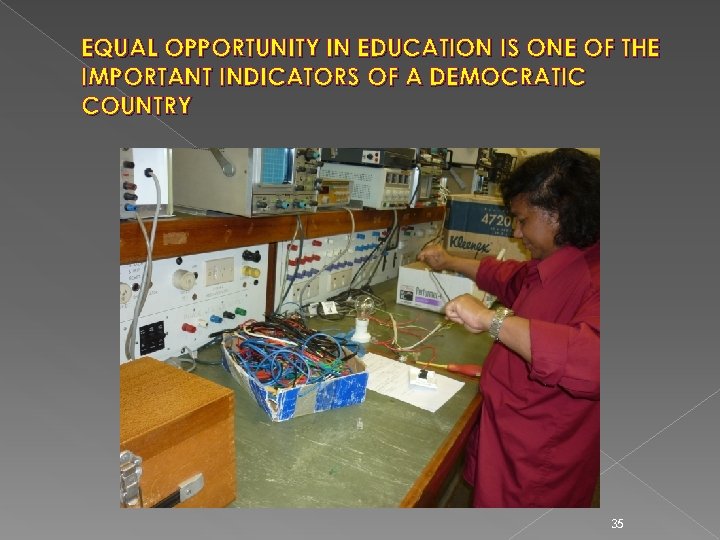 EQUAL OPPORTUNITY IN EDUCATION IS ONE OF THE IMPORTANT INDICATORS OF A DEMOCRATIC COUNTRY 35
 FEATURES OF TRAINING PACKAGES Preliminary Information. Important Note to Users Overview of Training Packages The specific Industry Coverage Regulatory arrangements Statutes, regulations and codes of practice Content of this Training Package Structure and Overview Competency Standard Units – Content and scope Layout of this Training Package AQF qualifications in this Training Package List of Imported Units of Competency Language, Literacy, Numeracy Access, Equity and Cultural Diversity Responsibility for Training Package Maintenance 36
 HOW THE TRAINING PACKAGE FULFILLS THE RIGHT TO EDUCATION Assessment System Overview Benchmarks for Assessment Australian Quality Training Framework Assessment Requirements Pathway 1: New Entrant Competency Development Pathway 2: Recognition of prior learning/current competencies (RPL/RCC) Pathway 3: Recognition of Other Industry/Enterprise Standards. 37 Assessment Principles within the particular Industry
 FEATURES OF TRAINING PACKAGE Assessment Principles Assessment Judgments. Assessment Processes Opportunities for Combined Approaches Assessor Requirements Assessors, Technical Experts and Workplace Supervisors 38
 FEATURES OF TRAINING PACKAGE Team/Panel Assessment Designing Assessment Tools Assessment Methods Conducting Assessment Industry-preferred assessment process Guidelines for Designing Assessment Materials Assessment Material Design Process Maintenance of Assessment Guide 39
 THE TRAINING SYSTEM THAT PROMOTES THE CAREER DEVELOPMENT OF LEARNERS Validity - Reliability - Flexibility - Fairness - Sufficiency - 40
 HOW SHOULD MYANMAR ADULT & VOCATIONAL EDUCATION SYSTEM BE FRAMED? Validity The adult & vocational education system that provides the real knowledge & skills required for practical work performance. Reliability The adult & vocational education system that provides the good quality of knowledge & skills. 41
 HOW SHOULD MYANMAR ADULT & VOCATIONAL EDUCATION SYSTEM BE FRAMED? Flexibility The adult & vocational education system that promotes the working people for career development. Fairness The education system for all citizens. Sufficiency The education system that equips the sufficient knowledge and skills in line with modern and international technology. 42
 Why Australian Training Packages should be studied Vocational education system changes from traditional class room based & academic focus to work performance competency based training. How competency based training can be applied in Myanmar Recognising Prior Learning & Work experience into formal qualification system used in Australian Vocational Education System & how the skills of Myanmar workers can be converted to formal qualifications 43
 Why Australian Training Packages should be studied Syllabus& Curriculum Resources of Australian Vocational Training Packages & explore the components useful to Myanmar Technical & Vocational Education. 44
 UEE 11_R 1. 5 UEE 11 Electrotechnology Training Package 1. 1. 01 Electrotechnology Industry Qualifications Framework 1. 1. 02 Qualification Pathways 1. 1. 03 Qualification Employability Skills Statements 1. 1. 04 Qualification Scope, Work Function and Environment 1. 1. 05 Qualifications and Packaging Rules 1. 1. 06 Skill Sets 1. 2. 01 Competency Standards 1. 2. 02 Contextualisation of Competency Standard Units by RTOs 1. 2. 03 Components of Units of Competency 1. 2. 04 Employability Skills in Units of Competency 1. 2. 05 Competency Standards for the Electrotechnology Industry 1. 2. 06 Competency Standard Units for the Electrotechnology Industry 1. 2. 07 Maintenance of Competency Standards 1. 2. 08 Index of Competency Standard Units 1. 2. 09 Unit Relationships UEE 11 V 1 to UEE 07 V 4 1. 3. 00 Assessment Guidelines 1. 3. 01 Introduction 1. 3. 02 Assessment System Overview 45 1. 3. 03 Pathways
 Qualification Framework This section describes how the qualifications, scope/descriptions, composition and content are structured. Completion and issuance requirements are provided as well as advice on flexibility arrangements, with entry and exit pathways and articulation arrangements. Titles and codes of the list of qualifications to be issued are also included 46
 Competency Standards This section describes how the competency standards were developed (in broad terms), the industry coverage they apply to, as well as the format and construction of the individual Competency Standard Units. The index of Competency Standard Units and their scope/description is included in this part. Matters related to language, literacy and numeracy, access, equity and cultural diversity and regulatory arrangements, for which the Competency Standard Units may apply, is also included. The Definitions/Glossary and Essential Knowledge and Associated Skills sections of the Training Package link directly to the Competency Standard Units and no Unit is to be used in isolation or exported without these interrelated components. 47
 Part 3 – Assessment Guidelines This section outlines how the assessment guidelines inform a Registered Training Organisation (RTO) on the infrastructure requirements they will need to enable them to carry out training delivery assessment activities related to the Training Package. The guidelines include assessment systems, the role of RTOs, assessment pathways, recognition arrangements, assessor qualifications and sources of information. 48
 Volume 2: Competency Standard Units — Content and scope Volume 2 contains the Competency Standard Units in their respective disciplines. Volume 2 also contains the Essential Knowledge and Associated Skills, a Matrix mapping the essential knowledge and associated skills (EKAS) to the Unit and to the Definitions/Glossary section, which provides a description of relevant terms and vocabulary that appear in this Package. Also included are definitions relating to literacy and numeracy skills. Note: The two volumes form an integrated whole and must not be used independently of each other. 49
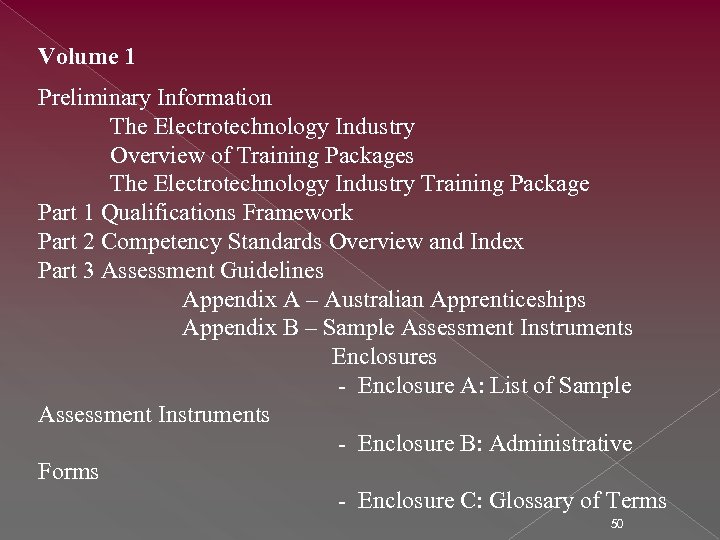 Volume 1 Preliminary Information The Electrotechnology Industry Overview of Training Packages The Electrotechnology Industry Training Package Part 1 Qualifications Framework Part 2 Competency Standards Overview and Index Part 3 Assessment Guidelines Appendix A – Australian Apprenticeships Appendix B – Sample Assessment Instruments Enclosures - Enclosure A: List of Sample Assessment Instruments - Enclosure B: Administrative Forms - Enclosure C: Glossary of Terms 50
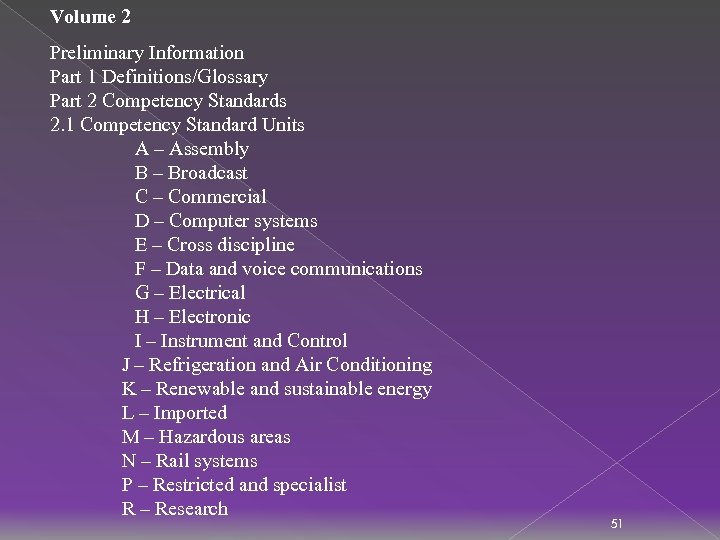 Volume 2 Preliminary Information Part 1 Definitions/Glossary Part 2 Competency Standards 2. 1 Competency Standard Units A – Assembly B – Broadcast C – Commercial D – Computer systems E – Cross discipline F – Data and voice communications G – Electrical H – Electronic I – Instrument and Control J – Refrigeration and Air Conditioning K – Renewable and sustainable energy L – Imported M – Hazardous areas N – Rail systems P – Restricted and specialist R – Research 51
 2. 2 Essential Knowledge and Associated Skills Volume of: Knowledge and Associated Skills — Reference Codes and Reference Names Table of Essential Knowledge and Skills to Unit Matrix 52
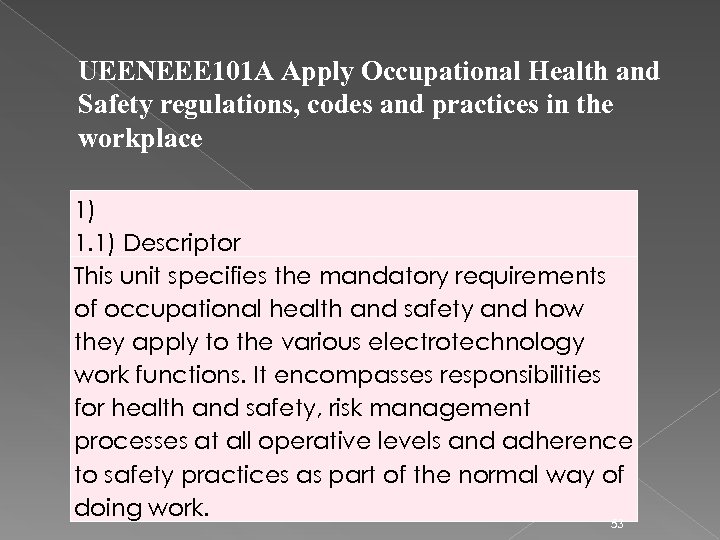 UEENEEE 101 A Apply Occupational Health and Safety regulations, codes and practices in the workplace 1) 1. 1) Descriptor This unit specifies the mandatory requirements of occupational health and safety and how they apply to the various electrotechnology work functions. It encompasses responsibilities for health and safety, risk management processes at all operative levels and adherence to safety practices as part of the normal way of doing work. 53
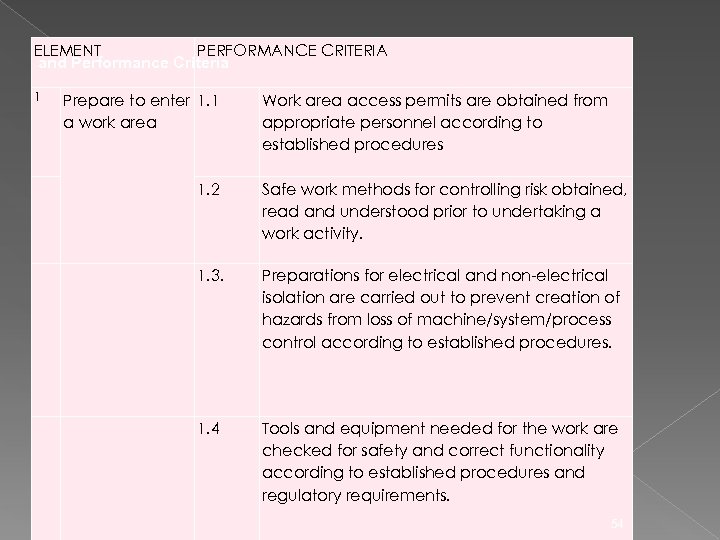 ELEMENT PERFORMANCE CRITERIA and Performance Criteria 1 Prepare to enter 1. 1 a work area Work area access permits are obtained from appropriate personnel according to established procedures 1. 2 Safe work methods for controlling risk obtained, read and understood prior to undertaking a work activity. 1. 3. Preparations for electrical and non-electrical isolation are carried out to prevent creation of hazards from loss of machine/system/process control according to established procedures. 1. 4 Tools and equipment needed for the work are checked for safety and correct functionality according to established procedures and regulatory requirements. 54
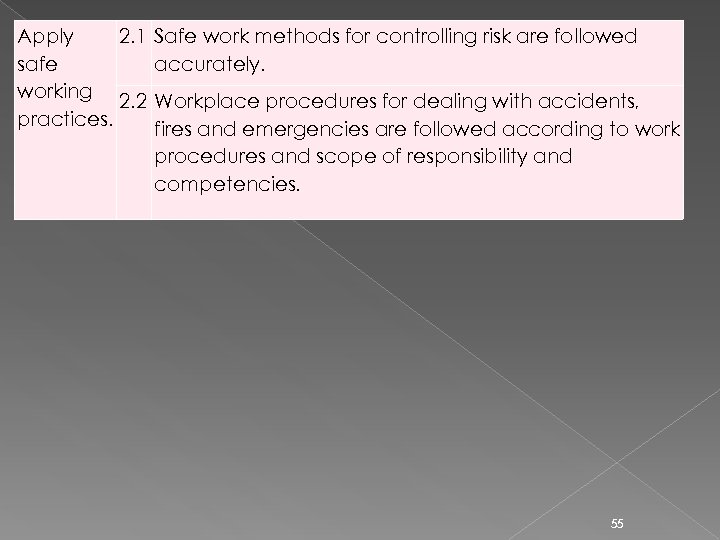 Apply 2. 1 Safe work methods for controlling risk are followed safe accurately. working 2. 2 Workplace procedures for dealing with accidents, practices. fires and emergencies are followed according to work procedures and scope of responsibility and competencies. 55
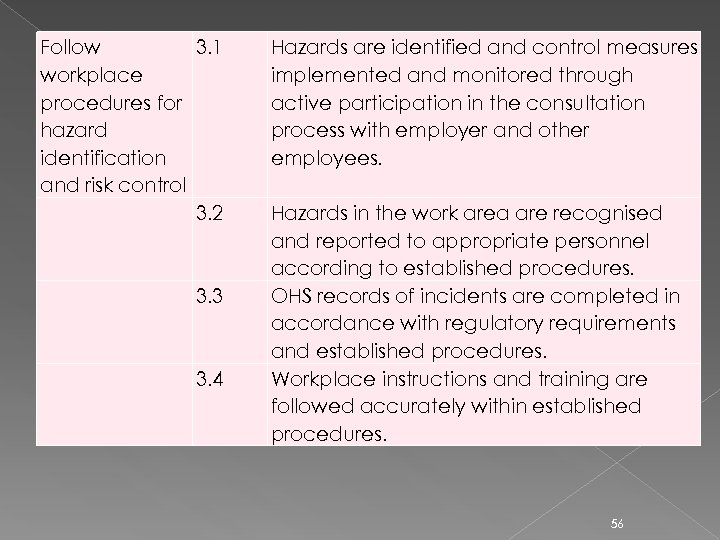 Follow 3. 1 workplace procedures for hazard identification and risk control 3. 2 3. 3 3. 4 Hazards are identified and control measures implemented and monitored through active participation in the consultation process with employer and other employees. Hazards in the work area are recognised and reported to appropriate personnel according to established procedures. OHS records of incidents are completed in accordance with regulatory requirements and established procedures. Workplace instructions and training are followed accurately within established procedures. 56
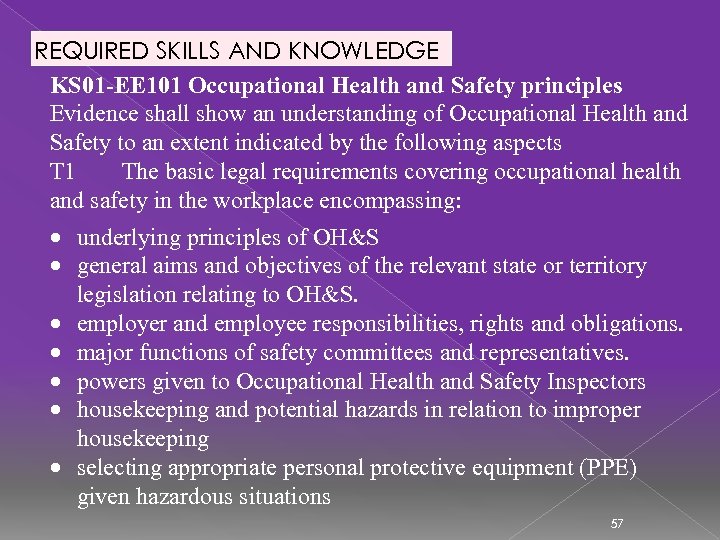 REQUIRED SKILLS AND KNOWLEDGE KS 01 -EE 101 Occupational Health and Safety principles Evidence shall show an understanding of Occupational Health and Safety to an extent indicated by the following aspects T 1 The basic legal requirements covering occupational health and safety in the workplace encompassing: underlying principles of OH&S general aims and objectives of the relevant state or territory legislation relating to OH&S. employer and employee responsibilities, rights and obligations. major functions of safety committees and representatives. powers given to Occupational Health and Safety Inspectors housekeeping and potential hazards in relation to improper housekeeping selecting appropriate personal protective equipment (PPE) given hazardous situations 57
 T 2 The work environment encompassing: typical hazards associated with a range of work environments procedures used to control the risks associated with these hazards principles of risk assessment / management and state the purpose of each. hierarchy of OH&S hazard control measures. required documentation for risk assessment. commonly used workplace safety signs. workplace emergencies that pose a threat to health and safety and suitable procedure for an emergency workplace evacuation. appropriate fire extinguisher for a given type of fire. requirements for the location, mounting and maintenance of portable fire extinguishers. basic process of fighting a fire. Importance of safe premises, buildings and security in an industrial setting and the consequences of non- compliance. 58
 T 3 Manual Handling encompassing: typical manual handling injuries and the effect they can have on lifestyle situations that may cause manual handling injuries correct procedures for lifting and carrying to prevent manual handling injuries T 4 Chemicals in the workplace encompassing: hazardous substances and dangerous goods. classification of chemicals as hazardous substances and/or dangerous goods requirements for labelling of chemicals in the workplace safe storage procedures for chemicals purpose and interpretation of material safety data sheet (MSDS) 59
 T 5 Working at heights encompassing: dangers associated with working on ladders and scaffolds identification of work area as a height risk and use appropriate safety equipment to prevent a fall selecting an appropriate ladder for a given situation and perform a safety check before use precautions that should be taken when ascending and working off a ladder precautions that should be taken when working on and around a scaffold and elevated platforms. T 6 Confined spaces encompassing: hazards associated with working in a confined space identifying workplace situations that could be classified as a confined space control measures for working in a designated confined space 60
 T 7 Physical and psychological hazards encompassing: short and long term effects of excessive noise and techniques to avoid damage to hearing due to excessive noise effects of vibration on the human body and work practices to protect against vibration effects of thermal stress on the human body and work practices to protect against thermal stress effects of ultraviolet (UV) radiation on the human body and work practices to protect against UV radiation. dangers associated with laser operated equipment and tools and suitable protective measures to overcome the danger. occupational overuse syndrome, how it occurs and means to overcome it factors that cause stress in the workplace, symptoms of a person suffering from stress and personal stress management techniques detrimental effects and dangers of drug and alcohol use in the workplace 61
 T 8 Working safely with electricity encompassing: effects of electric shock on the human body common causes of electrical accidents precautions that can minimise the chance of electric shock (earthing, extra low voltage, fuses, circuit breakers and residual current devices – RCDs) protection offered by a residual current device (RCD) need for ensuring the (safe) isolation of an electrical supply appropriate method of removing an electric shock victim from a live electrical situation 62
 T 9 Life support - CPR in the workplace encompassing: First Aid. responsibilities of the First Aider. priorities of first aid management for any accident or injury. procedures required at an accident scene. legal and ethical issues, which may impact on the management of care. 'Duty of Care'. examination of a casualty for injuries. effect of cardio pulmonary arrest on the body. Managing simulated conditions of: airway obstruction; respiratory arrest and cardio pulmonary arrest, single and two-person cardio pulmonary resuscitation (CPR). signs and symptoms of an altered level of consciousness management of simulation of a casualty with an altered level of consciousness. 63 signs and symptoms of shock.
 EVIDENCE GUIDE Methods chosen for a particular assessment will be influenced by various factors. These include the extent of the assessment, the most effective locations for the assessment activities to take place, access to physical resources, additional safety measures that may be required and the critical nature of the competencies being assessed. 64
 A B C D Preparing to enter the workplace including, the use of work permits and clearances and isolation permissions. Understanding and following risk control safe work methods. Applying work procedures and instructions as they apply to risk control measures. Dealing with accidents and emergencies within the scope of responsibility. 65
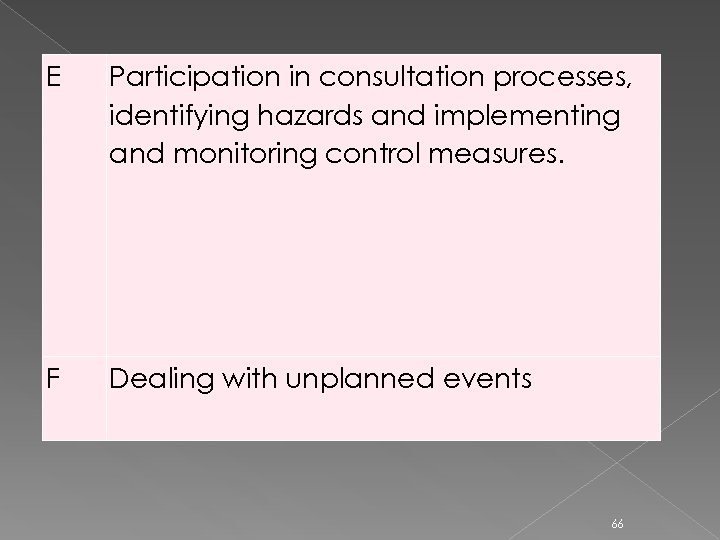 E Participation in consultation processes, identifying hazards and implementing and monitoring control measures. F Dealing with unplanned events 66
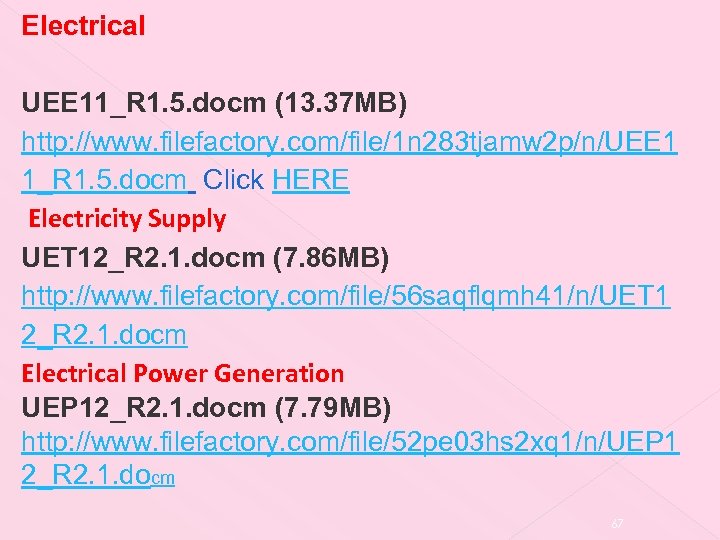 Electrical UEE 11_R 1. 5. docm (13. 37 MB) http: //www. filefactory. com/file/1 n 283 tjamw 2 p/n/UEE 1 1_R 1. 5. docm Click HERE Electricity Supply UET 12_R 2. 1. docm (7. 86 MB) http: //www. filefactory. com/file/56 saqflqmh 41/n/UET 1 2_R 2. 1. docm Electrical Power Generation UEP 12_R 2. 1. docm (7. 79 MB) http: //www. filefactory. com/file/52 pe 03 hs 2 xq 1/n/UEP 1 2_R 2. 1. docm 67
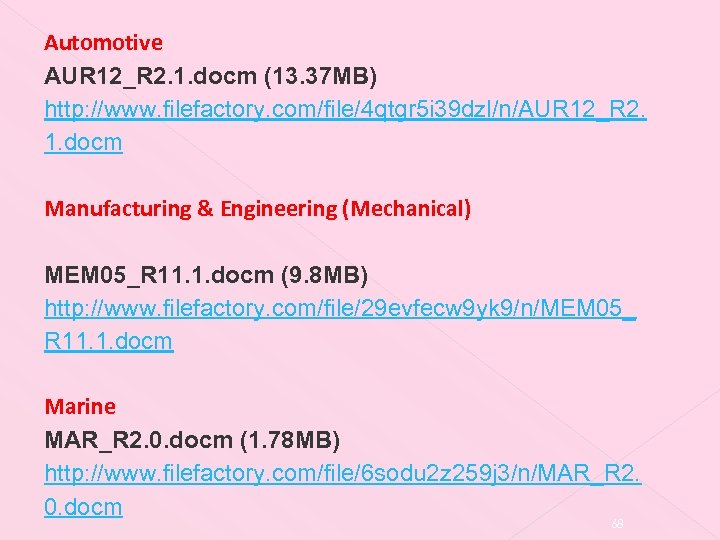 Automotive AUR 12_R 2. 1. docm (13. 37 MB) http: //www. filefactory. com/file/4 qtgr 5 i 39 dzl/n/AUR 12_R 2. 1. docm Manufacturing & Engineering (Mechanical) MEM 05_R 11. 1. docm (9. 8 MB) http: //www. filefactory. com/file/29 evfecw 9 yk 9/n/MEM 05_ R 11. 1. docm Marine MAR_R 2. 0. docm (1. 78 MB) http: //www. filefactory. com/file/6 sodu 2 z 259 j 3/n/MAR_R 2. 0. docm 68
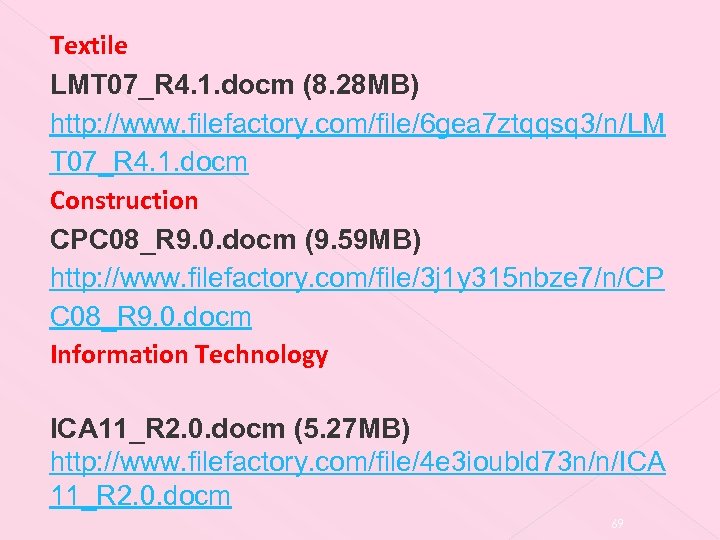 Textile LMT 07_R 4. 1. docm (8. 28 MB) http: //www. filefactory. com/file/6 gea 7 ztqqsq 3/n/LM T 07_R 4. 1. docm Construction CPC 08_R 9. 0. docm (9. 59 MB) http: //www. filefactory. com/file/3 j 1 y 315 nbze 7/n/CP C 08_R 9. 0. docm Information Technology ICA 11_R 2. 0. docm (5. 27 MB) http: //www. filefactory. com/file/4 e 3 ioubld 73 n/n/ICA 11_R 2. 0. docm 69
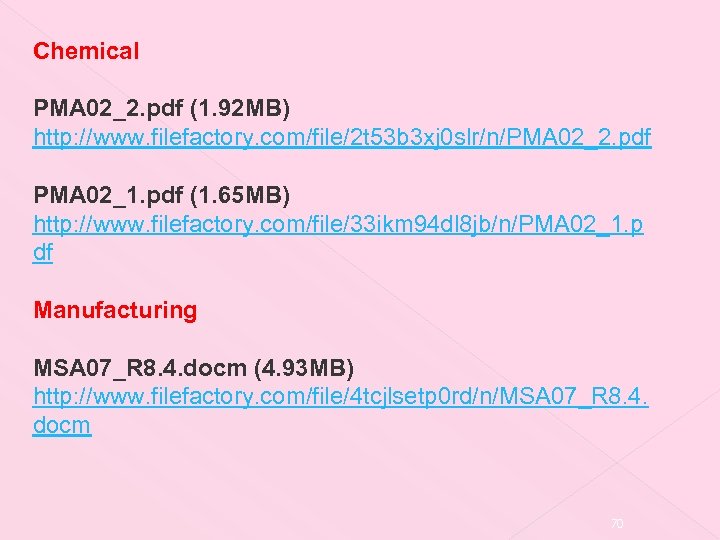 Chemical PMA 02_2. pdf (1. 92 MB) http: //www. filefactory. com/file/2 t 53 b 3 xj 0 slr/n/PMA 02_2. pdf PMA 02_1. pdf (1. 65 MB) http: //www. filefactory. com/file/33 ikm 94 dl 8 jb/n/PMA 02_1. p df Manufacturing MSA 07_R 8. 4. docm (4. 93 MB) http: //www. filefactory. com/file/4 tcjlsetp 0 rd/n/MSA 07_R 8. 4. docm 70
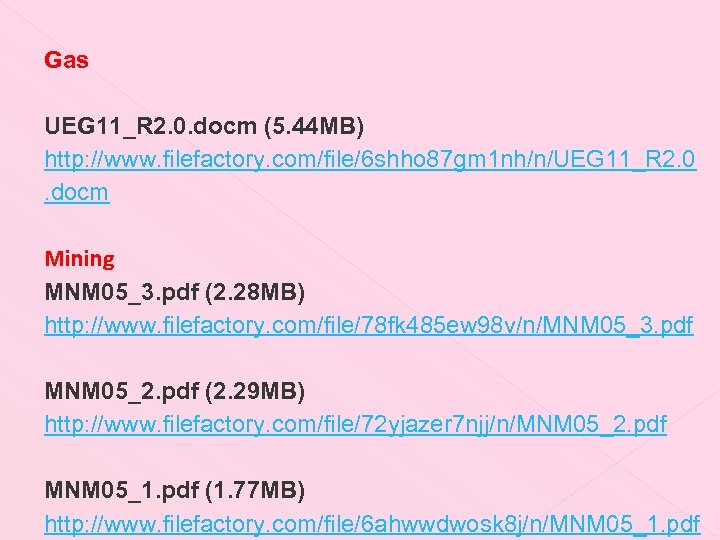 Gas UEG 11_R 2. 0. docm (5. 44 MB) http: //www. filefactory. com/file/6 shho 87 gm 1 nh/n/UEG 11_R 2. 0. docm Mining MNM 05_3. pdf (2. 28 MB) http: //www. filefactory. com/file/78 fk 485 ew 98 v/n/MNM 05_3. pdf MNM 05_2. pdf (2. 29 MB) http: //www. filefactory. com/file/72 yjazer 7 njj/n/MNM 05_2. pdf MNM 05_1. pdf (1. 77 MB) 71 http: //www. filefactory. com/file/6 ahwwdwosk 8 j/n/MNM 05_1. pdf
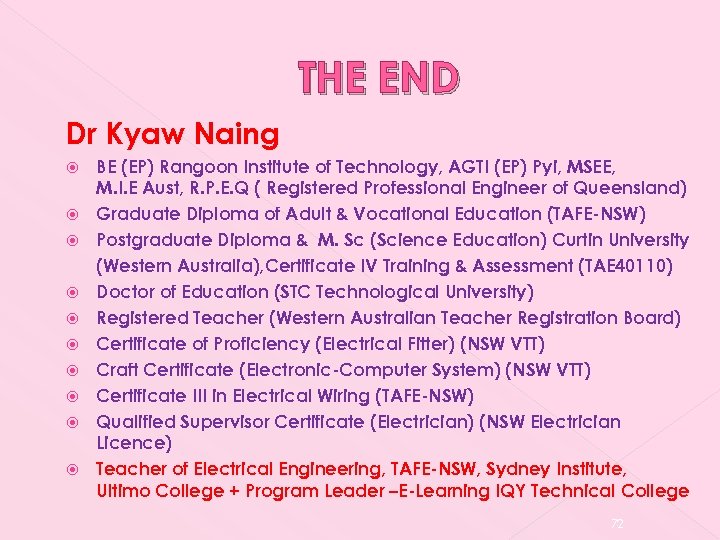 THE END Dr Kyaw Naing BE (EP) Rangoon Institute of Technology, AGTI (EP) Pyi, MSEE, M. I. E Aust, R. P. E. Q ( Registered Professional Engineer of Queensland) Graduate Diploma of Adult & Vocational Education (TAFE-NSW) Postgraduate Diploma & M. Sc (Science Education) Curtin University (Western Australia), Certificate IV Training & Assessment (TAE 40110) Doctor of Education (STC Technological University) Registered Teacher (Western Australian Teacher Registration Board) Certificate of Proficiency (Electrical Fitter) (NSW VTT) Craft Certificate (Electronic-Computer System) (NSW VTT) Certificate III in Electrical Wiring (TAFE-NSW) Qualified Supervisor Certificate (Electrician) (NSW Electrician Licence) Teacher of Electrical Engineering, TAFE-NSW, Sydney Institute, Ultimo College + Program Leader –E-Learning IQY Technical College 72