 Скачать презентацию Australian VLab Centre of Excellence National Himawari-8 Training
8b43fae7b3924a83d930783f756fdd22.ppt
- Количество слайдов: 14



Australian VLab Centre of Excellence National Himawari-8 Training Campaign Introduction to the Severe Convection RGB product (Africa, Spain)
Part 1 a: Instructions • Now that you have downloaded the Power. Point file, please read the Instructions in Parts 1 a (this slide) and familiarise yourself with the Learning Outcomes in slide 1 b (next slide) • Print out the Worksheet in Part 2 a of this file (if applicable) • Examine the Pre-activity Resources in Part 2 b of this file (if applicable). • Download the appropriate accompanying Video Recording (. wmv file). The recording is typically of 3 -13 minute duration. • Commence listening to the Recording. Pause the Recording whenever you want to annotate notes on the Worksheet. • You may wish to examine the slides in Part 3 of this file in Slideshow mode when you stop the Recording. Note that Rapid Scan imagery in the animations embedded in the Power. Point slides is often clearer than in the Recording. • Towards the end of the recording, recommended answers for the exercises are sometimes given.
Part 1 b: Learning Outcomes At the end of this exercise you will: • Have a basic knowledge how the Severe Convection RGB product is constructed from multiple satellite channels and the physics and meteorology underpinning this. • Have a better understanding of the advantages and the limitations of the Severe Storm RGB product in comparison with infrared satellite imagery in the operational monitoring, nowcasting and short term forecasting of thunderstorms. • Have a better appreciation of using the Severe Storm RGB in rapid scan animation when monitoring, nowcasting and short term forecasting of thunderstorms. • Note – corresponding WMO-1083 Capabilities and BOM Enabling Skills are given on the link "Learning Outcomes" on the National Himawari-8 Training Campaign homepage.
Part 2 a: Worksheet for the exercise • The worksheet " The Severe Convection RGB vs the 10. 8 micron infrared channel" is on the next slide. Please print this slides out and use it to make your notes Part 2 b: Pre-activity resources • Please study the four slides of Part 2 b to familiarize yourself with the Severe Convection RGB product.
Part 2 a: The Severe Convection RGB vs the 10. 8 micron infrared channel Question – what additional information does the Severe Convection RGB give you, compared to the 10. 8 micron infrared channel ? Additional comments Your answer:
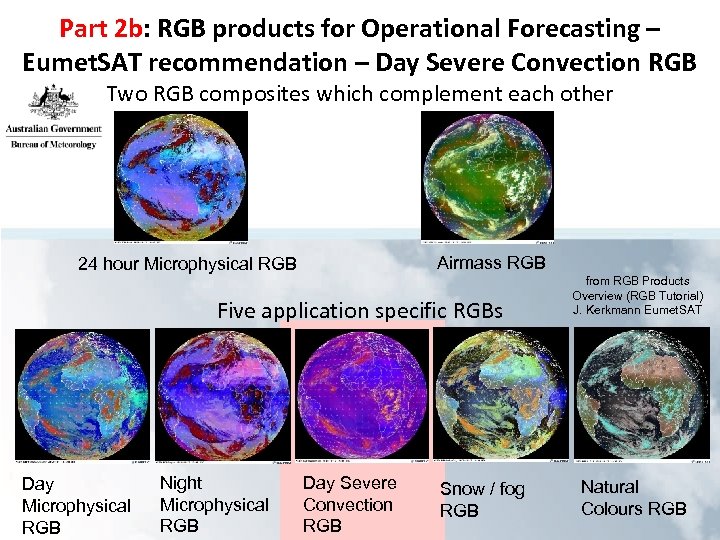
Part 2 b: RGB products for Operational Forecasting – Eumet. SAT recommendation – Day Severe Convection RGB Two RGB composites which complement each other Airmass RGB 24 hour Microphysical RGB Five application specific RGBs Day Microphysical RGB Night Microphysical RGB Day Severe Convection RGB Snow / fog RGB from RGB Products Overview (RGB Tutorial) J. Kerkmann Eumet. SAT Natural Colours RGB
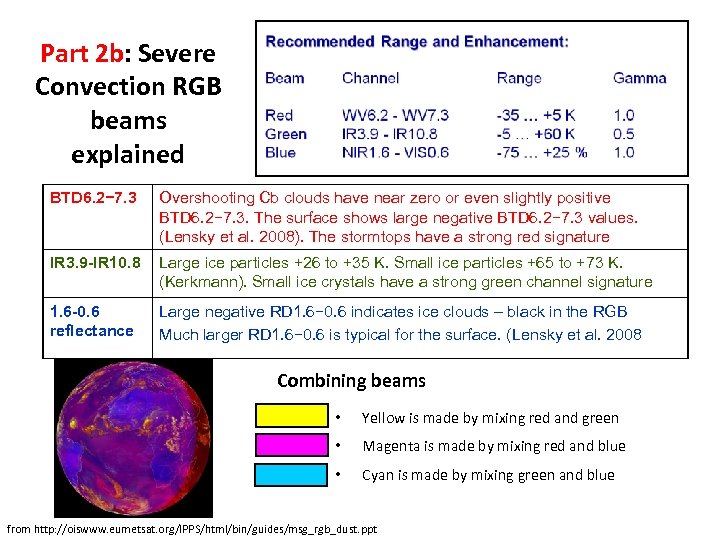
Part 2 b: Severe Convection RGB beams explained BTD 6. 2− 7. 3 Overshooting Cb clouds have near zero or even slightly positive BTD 6. 2− 7. 3. The surface shows large negative BTD 6. 2− 7. 3 values. (Lensky et al. 2008). The stormtops have a strong red signature IR 3. 9 -IR 10. 8 Large ice particles +26 to +35 K. Small ice particles +65 to +73 K. (Kerkmann). Small ice crystals have a strong green channel signature 1. 6 -0. 6 reflectance Large negative RD 1. 6− 0. 6 indicates ice clouds – black in the RGB Much larger RD 1. 6− 0. 6 is typical for the surface. (Lensky et al. 2008 Combining beams • Yellow is made by mixing red and green • Magenta is made by mixing red and blue • Cyan is made by mixing green and blue from http: //oiswww. eumetsat. org/IPPS/html/bin/guides/msg_rgb_dust. ppt
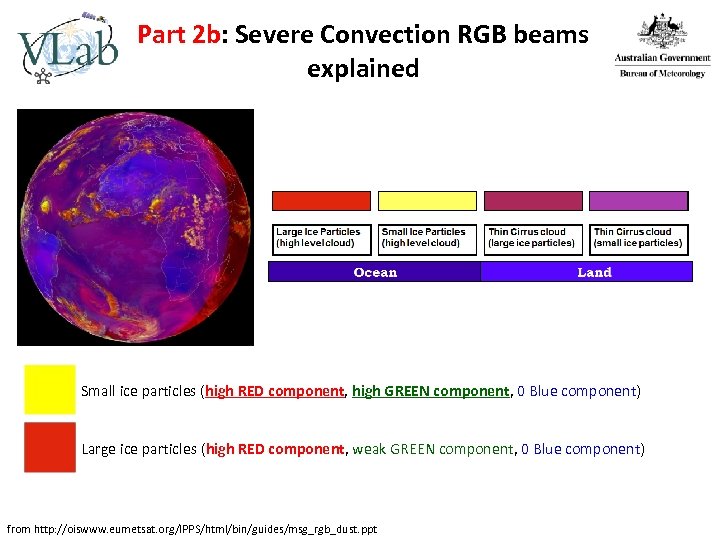
Part 2 b: Severe Convection RGB beams explained Small ice particles (high RED component, high GREEN component, 0 Blue component) Large ice particles (high RED component, weak GREEN component, 0 Blue component) from http: //oiswww. eumetsat. org/IPPS/html/bin/guides/msg_rgb_dust. ppt
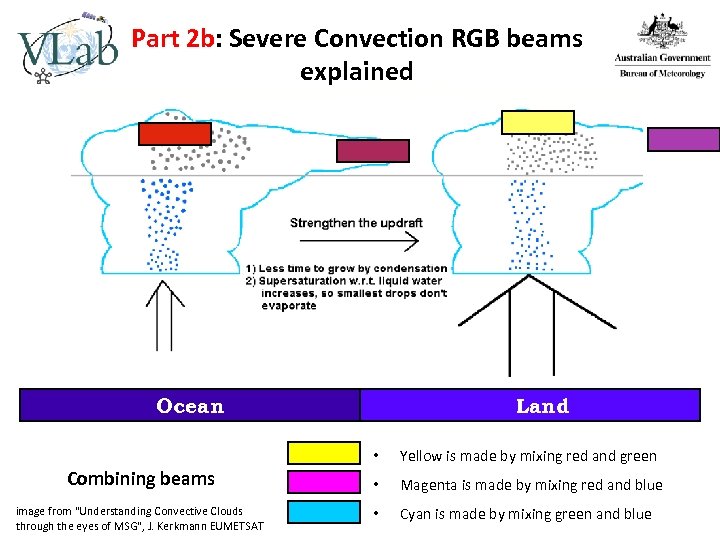
Part 2 b: Severe Convection RGB beams explained Ocean Land • Combining beams image from "Understanding Convective Clouds through the eyes of MSG", J. Kerkmann EUMETSAT Yellow is made by mixing red and green • Magenta is made by mixing red and blue • Cyan is made by mixing green and blue
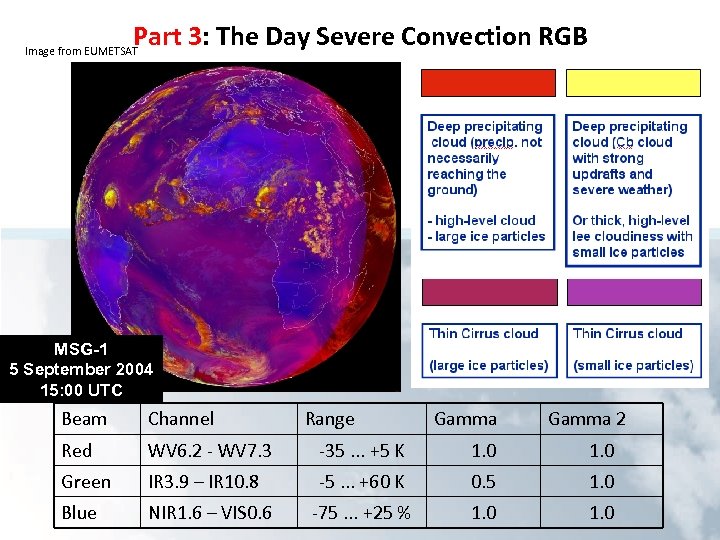
Part 3: The Day Severe Convection RGB Image from EUMETSAT MSG-1 5 September 2004 15: 00 UTC Beam Channel Range Gamma 2 Red WV 6. 2 - WV 7. 3 -35. . . +5 K 1. 0 Green IR 3. 9 – IR 10. 8 -5. . . +60 K 0. 5 1. 0 Blue NIR 1. 6 – VIS 0. 6 -75. . . +25 % 1. 0
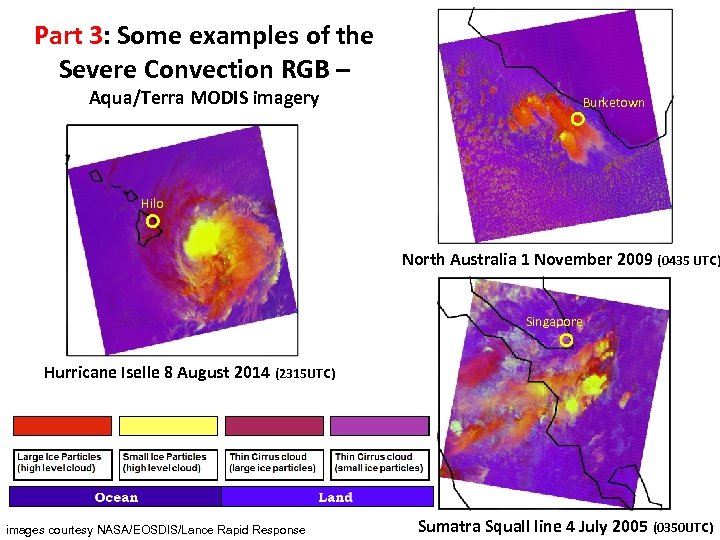
Part 3: Some examples of the Severe Convection RGB – Aqua/Terra MODIS imagery Burketown Hilo North Australia 1 November 2009 (0435 UTC) Singapore Hurricane Iselle 8 August 2014 (2315 UTC) images courtesy NASA/EOSDIS/Lance Rapid Response Singapore Sumatra Squall line 4 July 2005 (0350 UTC)
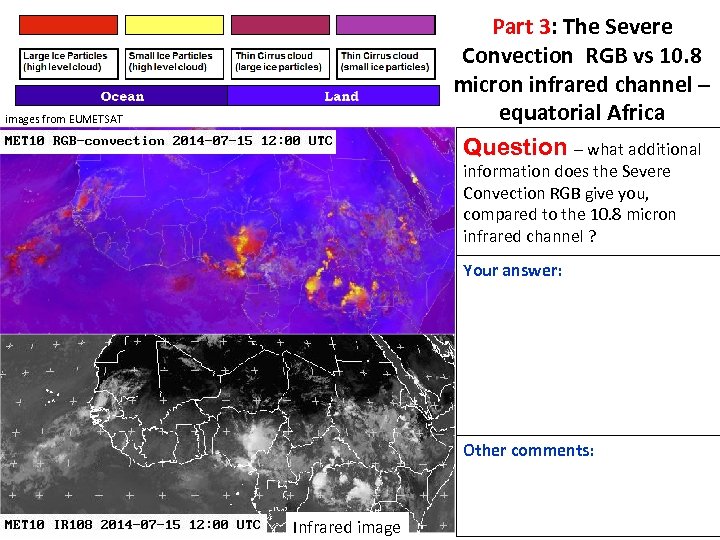
Part 3: The Severe Convection RGB vs 10. 8 micron infrared channel – equatorial Africa Question – what additional images from EUMETSAT information does the Severe Convection RGB give you, compared to the 10. 8 micron infrared channel ? Your answer: Other comments: Infrared images from EUMETSAT
Exercise 5: Severe Storm RGB animation • Visit the EUMETSAT Image Library case study of the Major Thunderstorms over Paris and Berlin' at http: //www. eumetsat. int/website/home/Images/Image. Libr ary/DAT_IL_07_05_25. html • Download the MPG "Animation" of the bottom right hand panel (Met-8, 25 May 2007, 13: 04 UTC) • Please play this animation.
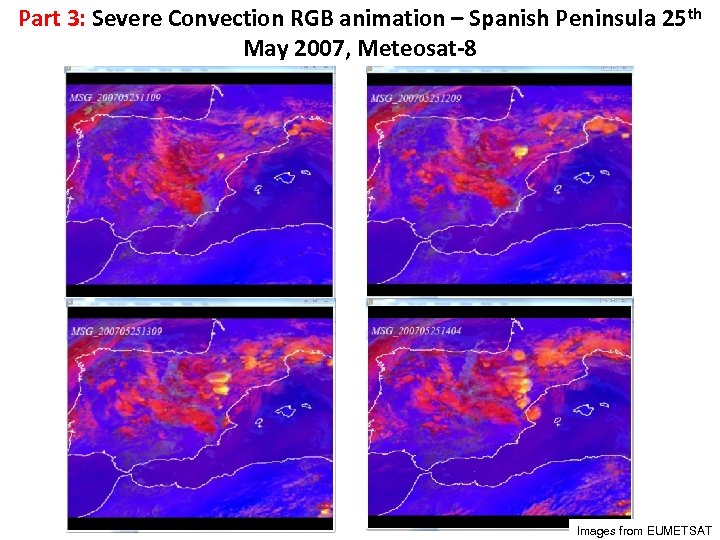
Part 3: Severe Convection RGB animation – Spanish Peninsula 25 th May 2007, Meteosat-8 Images from EUMETSAT
Скачать презентацию Australian VLab Centre of Excellence National Himawari-8 Training
8b43fae7b3924a83d930783f756fdd22.ppt