


 Скачать презентацию Australian Technical Analysts Association My Favorite Indicator The
4a557ed1ece7f80ceb4fd400a2433352.ppt
- Количество слайдов: 19
 Australian Technical Analysts Association My Favorite Indicator The Moving Average By Neil Wrightson 15/03/2018 Newcastle ATAA - Ver. 1 Alternate uses of MA's 1
 Moving Averages and there Alternate uses Overview Ø The moving average is one of the most useful, objective and oldest analytical tools around. Some patterns and indicators can be somewhat subjective, where analysts may disagree on if the pattern is truly forming, or if there is a deviation, this might be an illusion. The moving average is more of a cut-and-dry approach to analyzing stock charts and predicting performance, and it is one of the few that doesn't require a genius intelligence to interpret. . 15/03/2018 Newcastle ATAA - Ver. 1 Alternate uses of MA's 2
 Moving Averages and there Alternate uses Moving average is an indicator that shows the average value of a security's price over a period of time. Ø To find the 50 day Simple Moving Average (SMA) you would add up the closing prices from the past 50 days and divide them by 50. And because prices are constantly changing it means the moving average will move as well. Ø Exponential Moving Average (EMA) - is calculated by applying a percentage of today's closing price to yesterday's moving average value. Use an exponential moving average to place more weight on recent prices. As expected, each new price has a greater impact on the EMA than it has on the SMA. And, each new price changes the moving average only once, not twice. Ø 15/03/2018 Newcastle ATAA - Ver. 1 Alternate uses of MA's 3
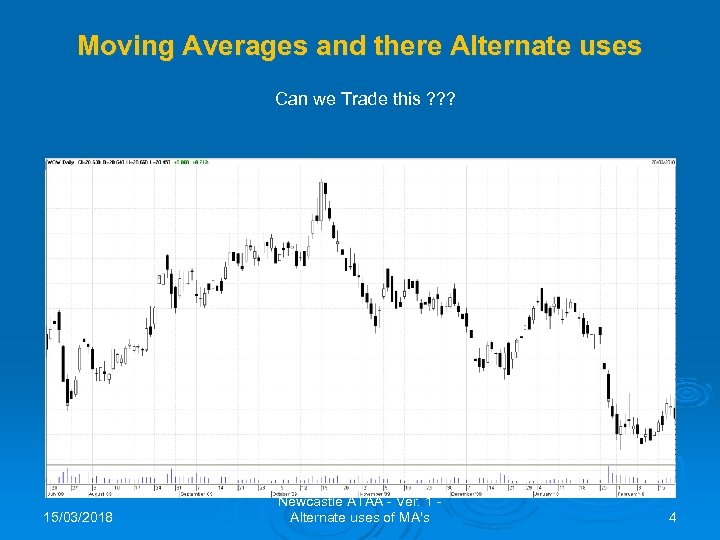 Moving Averages and there Alternate uses Can we Trade this ? ? ? 15/03/2018 Newcastle ATAA - Ver. 1 Alternate uses of MA's 4
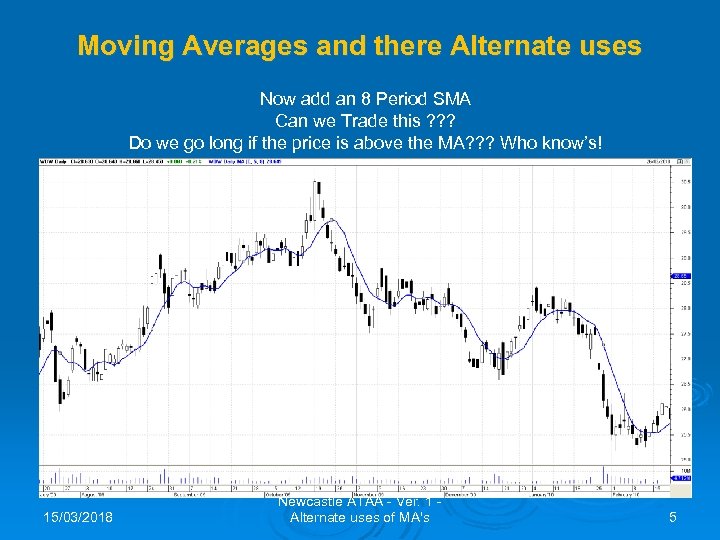 Moving Averages and there Alternate uses Now add an 8 Period SMA Can we Trade this ? ? ? Do we go long if the price is above the MA? ? ? Who know’s! 15/03/2018 Newcastle ATAA - Ver. 1 Alternate uses of MA's 5
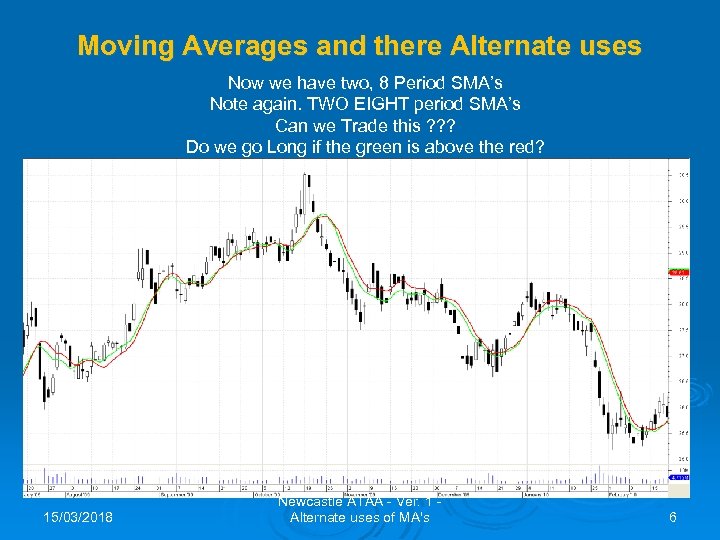 Moving Averages and there Alternate uses Now we have two, 8 Period SMA’s Note again. TWO EIGHT period SMA’s Can we Trade this ? ? ? Do we go Long if the green is above the red? 15/03/2018 Newcastle ATAA - Ver. 1 Alternate uses of MA's 6
 Moving Averages and there Alternate uses Terminology To simplify things, I will now refer to the moving averages in a typical programming language syntax. I. e. – A 8 period simple moving average of the Close would be expressed as MA(Close, 8, Simple) or MA(C, 8, S) 15/03/2018 Newcastle ATAA - Ver. 1 Alternate uses of MA's 7
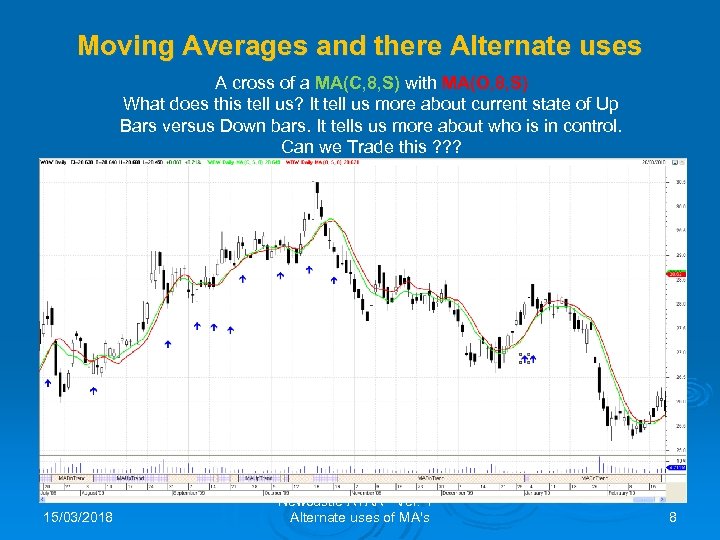 Moving Averages and there Alternate uses A cross of a MA(C, 8, S) with MA(O, 8, S) What does this tell us? It tell us more about current state of Up Bars versus Down bars. It tells us more about who is in control. Can we Trade this ? ? ? 15/03/2018 Newcastle ATAA - Ver. 1 Alternate uses of MA's 8
 Moving Averages and there Alternate uses What else can we do with the humble Moving Average to assist us in our trades? How about some basic Channelling? 15/03/2018 Newcastle ATAA - Ver. 1 Alternate uses of MA's 9
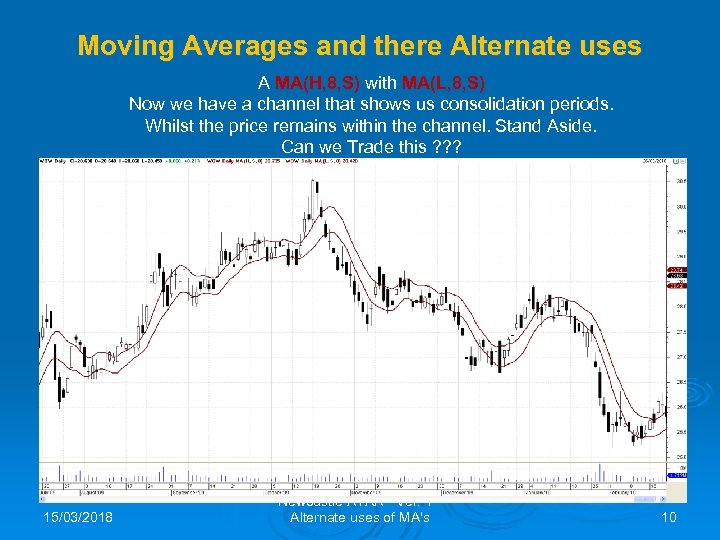 Moving Averages and there Alternate uses A MA(H, 8, S) with MA(L, 8, S) Now we have a channel that shows us consolidation periods. Whilst the price remains within the channel. Stand Aside. Can we Trade this ? ? ? 15/03/2018 Newcastle ATAA - Ver. 1 Alternate uses of MA's 10
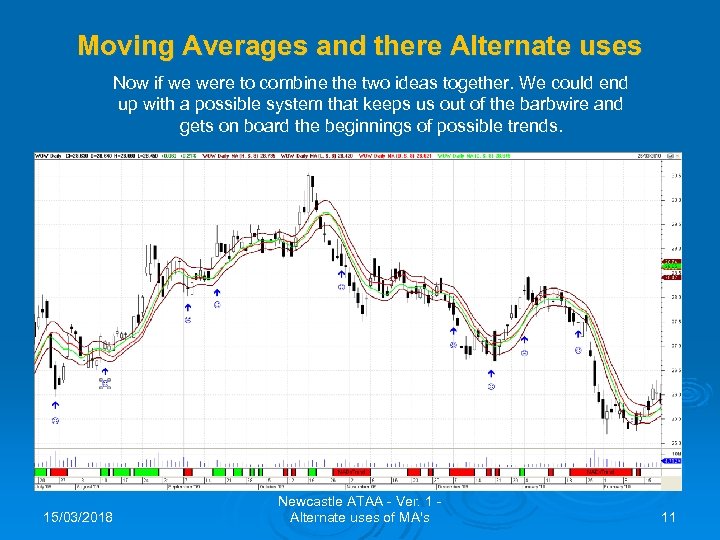 Moving Averages and there Alternate uses Now if we were to combine the two ideas together. We could end up with a possible system that keeps us out of the barbwire and gets on board the beginnings of possible trends. 15/03/2018 Newcastle ATAA - Ver. 1 Alternate uses of MA's 11
 Moving Averages and there Alternate uses System Rules - Long Trades Reverse for Short trades l l An long signal is flagged when there is a close above the MA(H, 8, S) and the MA(C, 8, S) > MA(O, 8, S). A “Buy on Stop” order is then placed above the high of the signal bar. The Initial Stoploss order is placed at the higher value of either – a) Low of the signal bar b) 1 ATR(8) below entry stop. (Money Stop) 15/03/2018 Newcastle ATAA - Ver. 1 Alternate uses of MA's 12
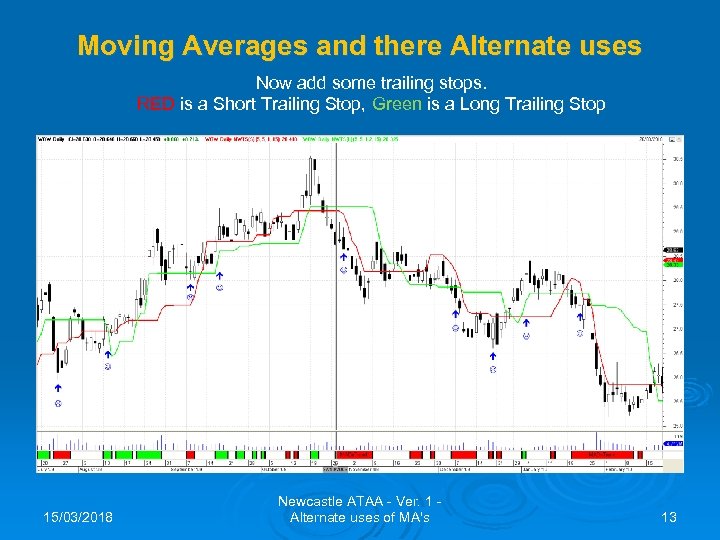 Moving Averages and there Alternate uses Now add some trailing stops. RED is a Short Trailing Stop, Green is a Long Trailing Stop 15/03/2018 Newcastle ATAA - Ver. 1 Alternate uses of MA's 13
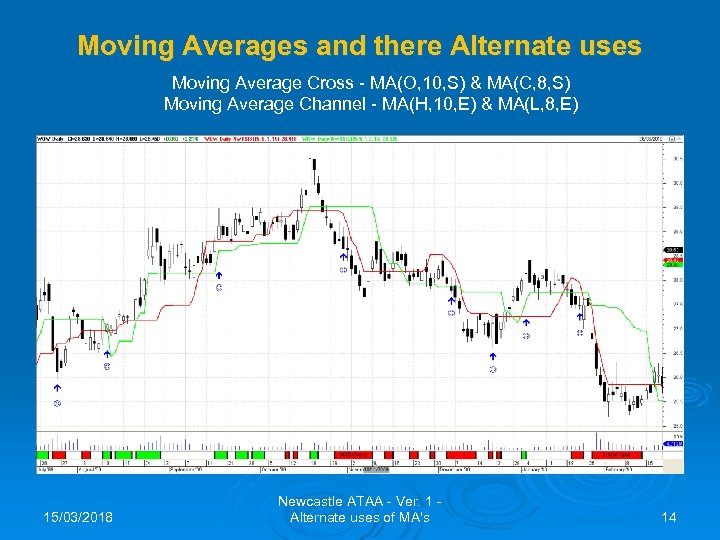 Moving Averages and there Alternate uses Moving Average Cross - MA(O, 10, S) & MA(C, 8, S) Moving Average Channel - MA(H, 10, E) & MA(L, 8, E) 15/03/2018 Newcastle ATAA - Ver. 1 Alternate uses of MA's 14
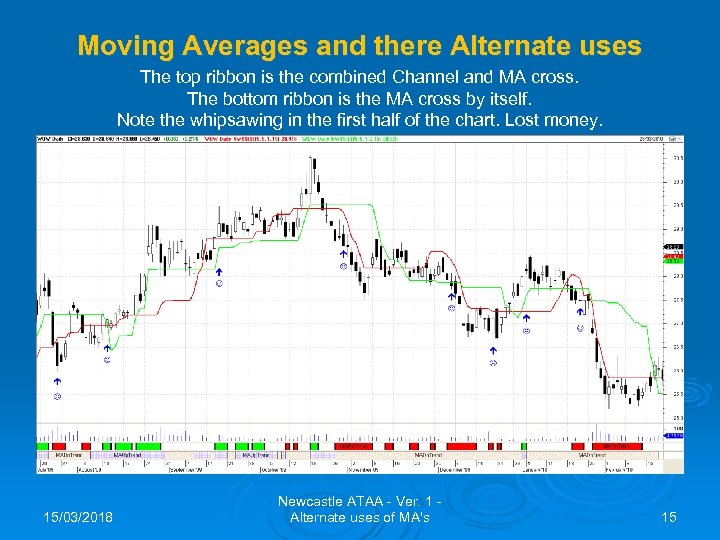 Moving Averages and there Alternate uses The top ribbon is the combined Channel and MA cross. The bottom ribbon is the MA cross by itself. Note the whipsawing in the first half of the chart. Lost money. 15/03/2018 Newcastle ATAA - Ver. 1 Alternate uses of MA's 15
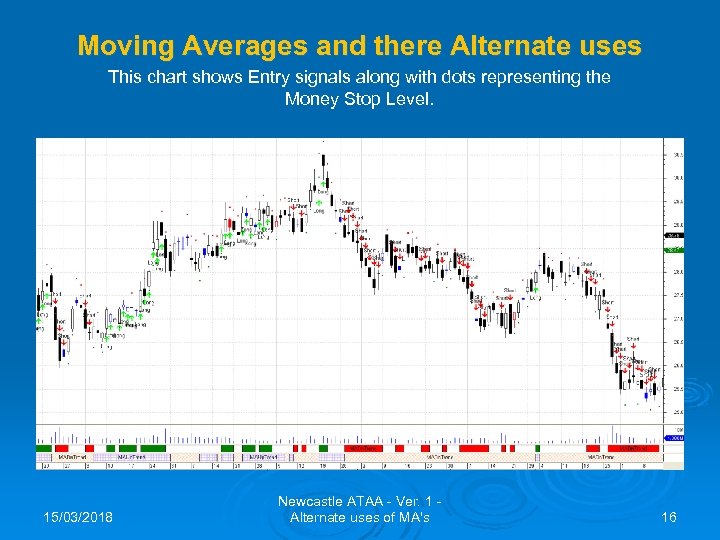 Moving Averages and there Alternate uses This chart shows Entry signals along with dots representing the Money Stop Level. 15/03/2018 Newcastle ATAA - Ver. 1 Alternate uses of MA's 16
 In Conclusion Moving averages can be applied to more than just the Close price. They can be used to give some insight into who’s in control and keep us out of sideways action. The 8 period MA of the Open and Close as well as the MA of the Highs and Lows has been loosely taken from “Jake Bernstein’s” work. However, they have been applied in a completely different context to how he uses them in his work. 15/03/2018 By Neil Wrightson trading@nwe. net. au Newcastle ATAA - Ver. 1 Alternate uses of MA's 17
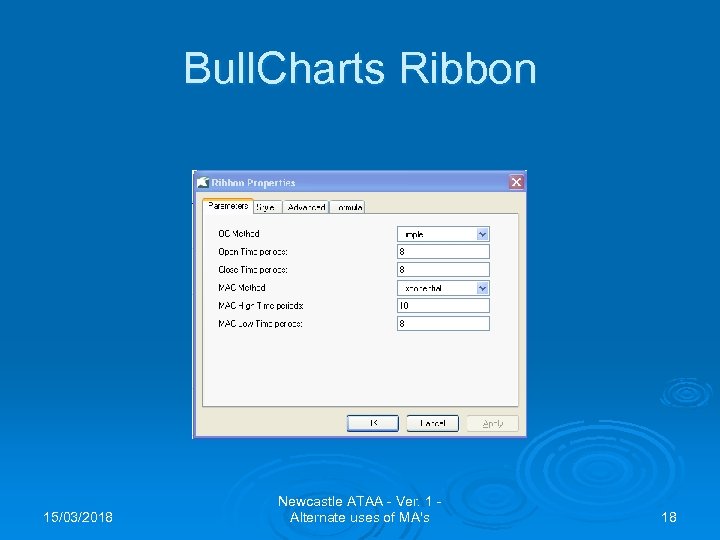 Bull. Charts Ribbon 15/03/2018 Newcastle ATAA - Ver. 1 Alternate uses of MA's 18
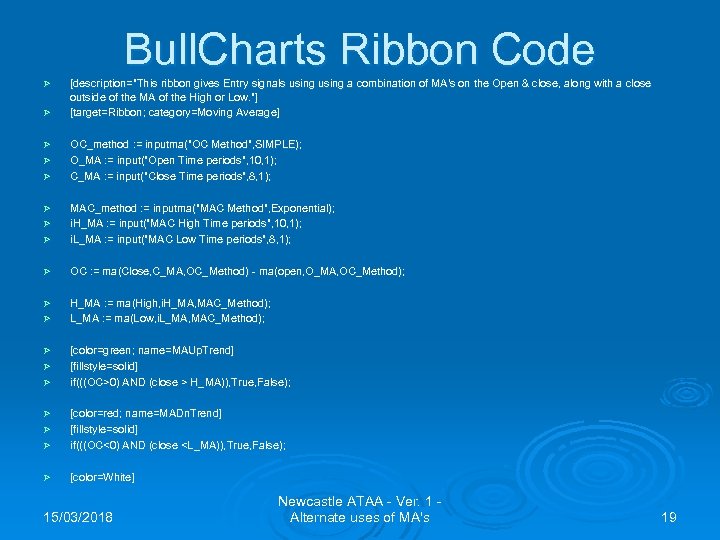 Bull. Charts Ribbon Code Ø Ø Ø [description="This ribbon gives Entry signals using a combination of MA's on the Open & close, along with a close outside of the MA of the High or Low. "] [target=Ribbon; category=Moving Average] OC_method : = inputma("OC Method", SIMPLE); O_MA : = input("Open Time periods", 10, 1); C_MA : = input("Close Time periods", 8, 1); Ø MAC_method : = inputma("MAC Method", Exponential); i. H_MA : = input("MAC High Time periods", 10, 1); i. L_MA : = input("MAC Low Time periods", 8, 1); Ø OC : = ma(Close, C_MA, OC_Method) - ma(open, O_MA, OC_Method); Ø H_MA : = ma(High, i. H_MA, MAC_Method); L_MA : = ma(Low, i. L_MA, MAC_Method); Ø Ø Ø [color=green; name=MAUp. Trend] [fillstyle=solid] if(((OC>0) AND (close > H_MA)), True, False); Ø [color=red; name=MADn. Trend] [fillstyle=solid] if(((OC<0) AND (close